heating Seat Mii 2016 User Guide
[x] Cancel search | Manufacturer: SEAT, Model Year: 2016, Model line: Mii, Model: Seat Mii 2016Pages: 232, PDF Size: 4.9 MB
Page 118 of 232
Operation
●
When tran s
porting heavy objects, use suit-
able ropes or straps.
● Lock the seat backs in vertical position. Practical equipment
Introduction Storage compartments must only be used to
st
or
e light or small objects. WARNING
In the event of sudden braking movements or
turn s, loo
se objects may be thrown around
the vehicle interior. This could cause serious
injuries to passengers and cause the driver to
lose control of the vehicle.
● Do not transport animals or place hard,
heavy or sh
arp objects inside the vehicle in:
open storage compartments, dash panel, rear
shelf, items of clothing or bags.
● While driving, always keep object compart-
ments c
losed. WARNING
Objects falling into the driver's footwell could
prev ent
use of the pedals. This could lead the
driver to lose control of the vehicle, increas-
ing the risk of a serious accident. ●
Mak e s
ure the pedals can be used at all
times, with no objects rolling underneath
them.
● The floor mat should always be secured to
the floor.
● Never p
lace other mats or rugs on top of
the original
mat supplied by the factory.
● Make sure that no objects can fall into the
driver's f
ootwell while the vehicle is in mo-
tion. CAUTION
● Obj
ects on the shelf could chafe against
the wires of the heating element in the heat-
ed rear window and cause damage.
● Do not keep temperature-sensitive objects,
food or medicine
s inside the vehicle. Heat
and cold could damage them or render them
useless.
● Light-transparent objects placed inside the
vehicl
e, such as lenses, magnifying glasses
or transparent suction caps on the windows,
may concentrate the sun's rays and cause
damage to the vehicle. Note
The ventilating slits between the heated rear
windo w and the r
ear shelf must not be cov-
ered so that used air can escape from the ve-
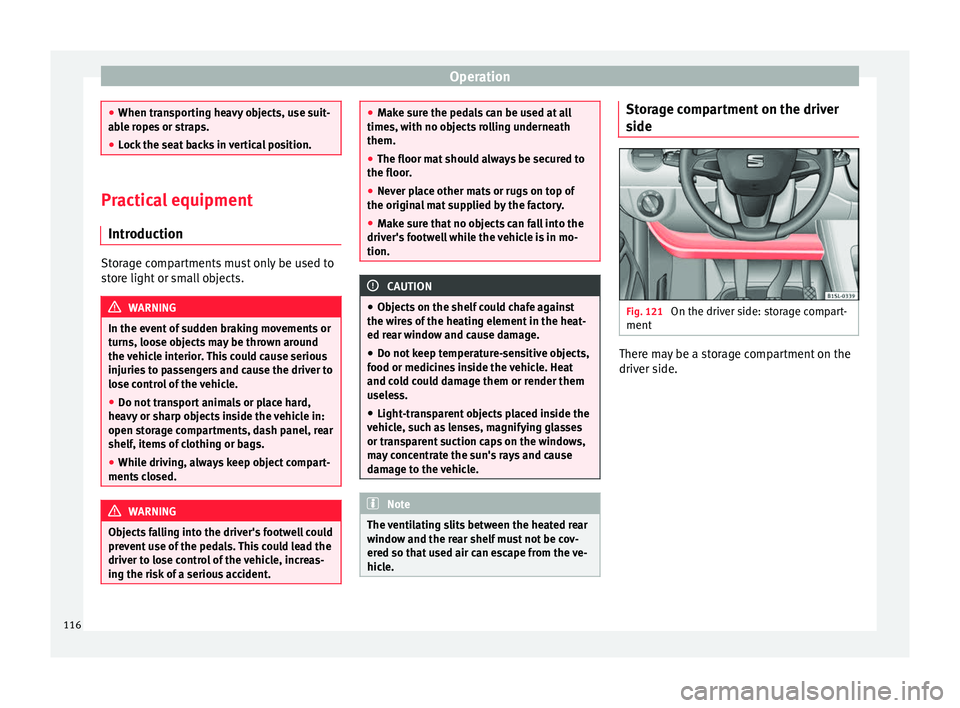
hicle. Storage compartment on the driver
s
ide Fig. 121
On the driver side: storage compart-
ment There may be a storage compartment on the
driv
er s
ide.
116
Page 126 of 232
Operation
and moving to the airbag deployment area in
the event
of
sudden movements or accidents.
● While driving, always keep object compart-
ments c
losed.
● Do not place hard, heavy or sharp objects
inside the
vehicle interior, in open storage
compartments, the rear shelf or on the dash
panel.
● Remove hard, heavy and sharp objects from
clothes
and pockets inside the vehicle and
store securely. WARNING
The transport of heavy object changes vehi-
cl e h
andling and increases braking distance.
Heavy loads that have not been stored or se-
cured correctly could cause loss of control
and result in serious injury.
● Vehicle handling changes when transport-
ing heavy
objects due to a change in the cen-
tre of gravity.
● Distribute the load as uniformly and as low
down on the v
ehicle as possible.
● Store heavy objects in the luggage com-
partment
as far from the rear axle as possi-
ble. CAUTION
Hard objects on the rear shelf could chafe
again s
t the wires of the heating element in
the heated rear window and cause damage. Note
The ventilating slits between the heated rear
windo w and the r
ear shelf must not be cov-
ered so that used air can escape from the ve-
hicle. Folding and lifting up the rear seat
bench b
ac
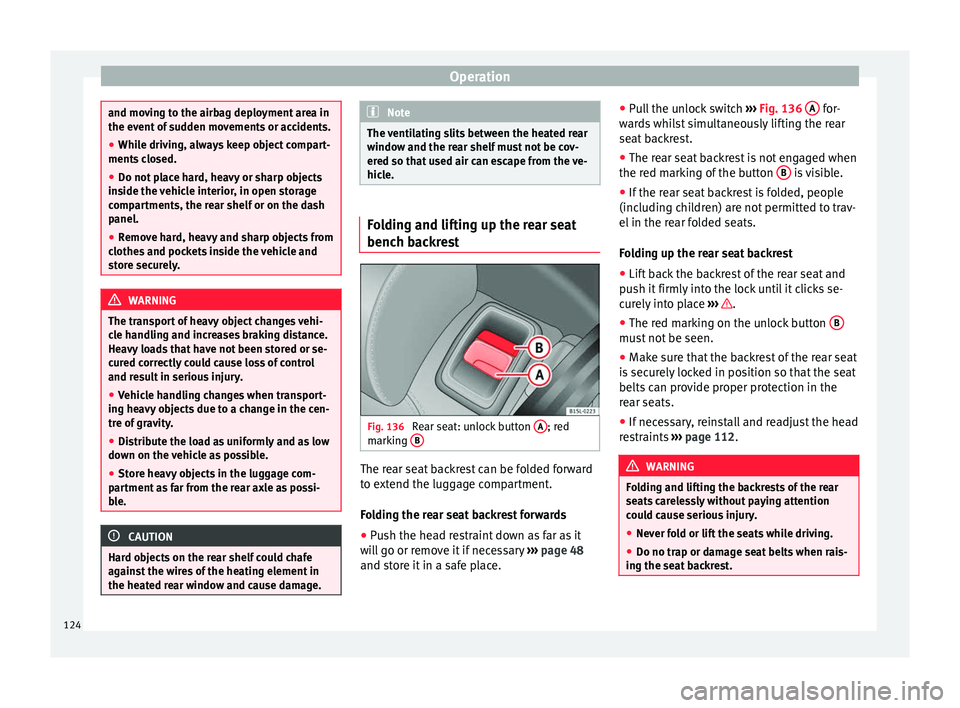
krest Fig. 136
Rear seat: unlock button A ; red
m ark
in
g B The rear seat backrest can be folded forward
t
o e
xt
end the luggage compartment.
Folding the rear seat backrest forwards
● Push the head restraint down as far as it
wil
l go or remove it if necessary ››› page 48
and store it in a safe place. ●
Pul
l the unlock switch ››› Fig. 136 A for-
w ar
d
s whilst simultaneously lifting the rear
seat backrest.
● The rear seat backrest is not engaged when
the red mark
ing of the button B is visible.
● If the rear seat backrest is folded, people
(inc ludin
g c
hildren) are not permitted to trav-
el in the rear folded seats.
Folding up the rear seat backrest
● Lift back the backrest of the rear seat and
push it
firmly into the lock until it clicks se-
curely into place ››› .
● The red marking on the unlock button B must not be seen.
●
Make sure that the backrest of the rear seat
i s
sec
urely locked in position so that the seat
belts can provide proper protection in the
rear seats.
● If necessary, reinstall and readjust the head
res
traints ››› page 112. WARNING
Folding and lifting the backrests of the rear
seat s
carelessly without paying attention
could cause serious injury.
● Never fold or lift the seats while driving.
● Do no trap or damage seat belts when rais-
ing the seat
backrest.124
Page 132 of 232
Operation
Air conditioning
He atin
g,
ventilation and cool-
ing
Introduction Read the additional information carefully
›› ›
page 27
One of the following systems can be installed
in the vehicle:
● Heating and fresh air system
● Manual air conditioning
● Climatronic
The heatin g and fr
esh air system heats and
ventilates the passenger compartment. The
heating and fresh air system cannot cool.
The manual air conditioning and the Clima-
tronic cool and dehumidify the air. Its opti-
mum output is achieved with the windows
and the glass sunroof closed. In case of con-
siderable heat build-up in the passenger
compartment, ventilating this compartment
can accelerate the cooling process.
Display of active functions
The luminous diodes (LED) that light up on
the rotary regulators and on the buttons that
indicate that the corresponding function is
activated. In the case of the Climatronic, the functions
that ar
e activated are shown on the control
panel display. WARNING
When visibility through the windows is poor,
the risk of
accidents or collisions taking place
is increased, which can lead to serious inju-
ries.
● To obtain good visibility, keep the windows
free of ic
e, snow and frost.
● Set the heating, the air conditioner and the
rear w
indow defroster so that the windows do
not mist over.
● Only put the car in gear when there is good
vis
ibility through the windows.
● Do not use the air recirculation for a long
time period. With the c
ooling disconnected
and the air recirculation connected, the win-
dows can quickly mist over and seriously ob-
struct visibility.
● Disconnect the air recirculation whenever it
is not
needed. WARNING
Stale air can quickly bring about fatigue for
the driver and r educ
e his/her capacity to con-
centrate, which could lead to collisions, acci-
dents and serious injuries.
● Never disconnect the blower for an exten-
ded time or never le
ave the air recirculation
disconnected for an extended time, since in the meantime, no outside fresh air shall enter
the pa
s
senger compartment. CAUTION
If the air conditioner does not work, discon-
nect it immedi
ately together with the defrost-
ing/demisting function (in the case of manual
air conditioning) and have the system
checked out by a specialised workshop. In
this way, other damage can be avoided. CAUTION
To avoid damage to the rear window defrost-
er , u nder no c
ircumstances should you stick
any adhesives on the electrical filaments of
the interior side of this defroster. Air recirculation
In air recirculation mode, no fresh air enters
the
v
ehic
le interior.
To connect the air recirculation, move the
regulator towards the right or press the
button .
T o di
s
connect the air recirculation, move the
regulator towards the left or press the but-
ton again
› ›
›
.
130
Page 133 of 232
Air conditioning
WARNING
Stale air can quickly bring about fatigue for
the driver and r educ
e his/her capacity to con-
centrate, which could lead to collisions, acci-
dents and serious injuries.
● Never use the air recirculation for an exten-
ded time, since in the me
antime, no outside
fresh air shall enter the passenger compart-
ment.
● With the cooling disconnected and the air
recir
culation connected, the windows can quickly mist over and seriously obstruct visi-
bi
lity
.
● Disconnect the air recirculation whenever it
is not
needed. CAUTION
Do not smoke when the air recirculation is
c onnect ed in
vehicles with an air conditioner.
Smoke taken in could settle in the cooling
system vaporiser and on the dust and pollen
filter, therefore leading to permanently un-
pleasant odours. Note
● Climatr onic:
When the reverse gear is en-
gaged, the air recirculation is briefly connec-
ted to avoid exhaust gas from entering the
passenger compartment.
● Whenever the outside temperature is very
high, it is
essential to connect the manual air
recirculation mode briefly so that the passen-
ger compartment may cool down more quick-
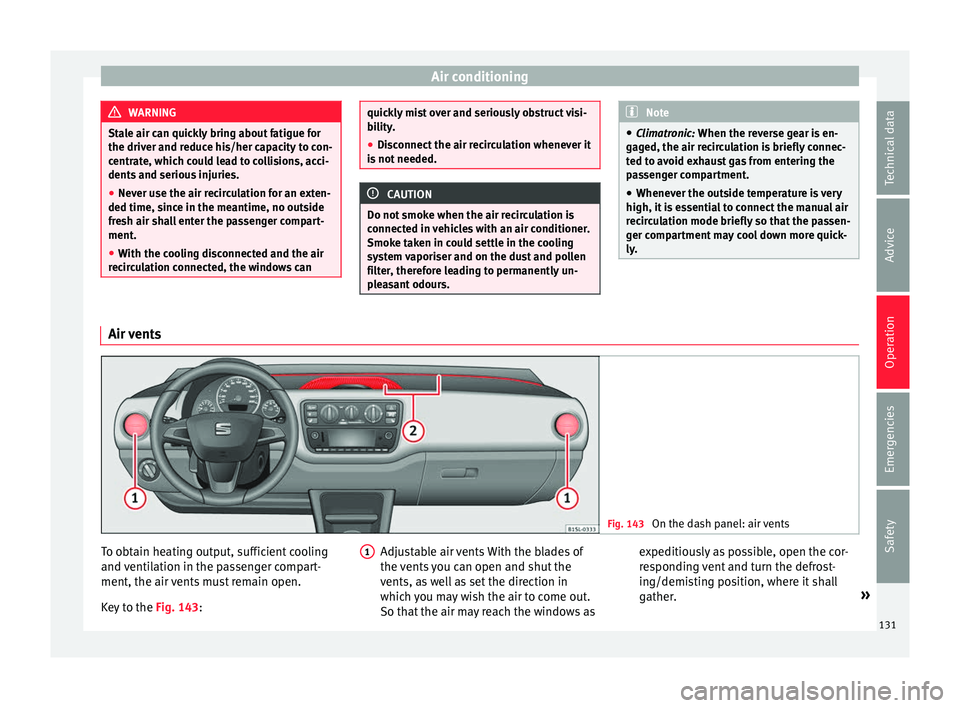
ly. Air vents
Fig. 143
On the dash panel: air vents To obtain heating output, sufficient cooling
and
venti
lation in the passenger compart-
ment, the air vents must remain open.
Key to the Fig. 143: Adjustable air vents With the blades of
the vents
you can open and shut the
vents, as well as set the direction in
which you may wish the air to come out.
So that the air may reach the windows as
1 expeditiously as possible, open the cor-
r
e s
ponding vent and turn the defrost-
ing/demisting position, where it shall
gather. »
131
Technical data
Advice
Operation
Emergencies
Safety
Page 134 of 232
Operation
Non-adjustable air vents
Ther e ar
e no air
vents in the foot well and in
the rear area of the passenger compartment. 2 CAUTION
Never place food, medicines or other temper-
atur e-
sensitive objects close to the air vents.
Food, medicines and other objects sensitive to heat or cold may be damaged or made un-
suit
ab
le for use by the air coming from the
vents. Application tips and instructions for use
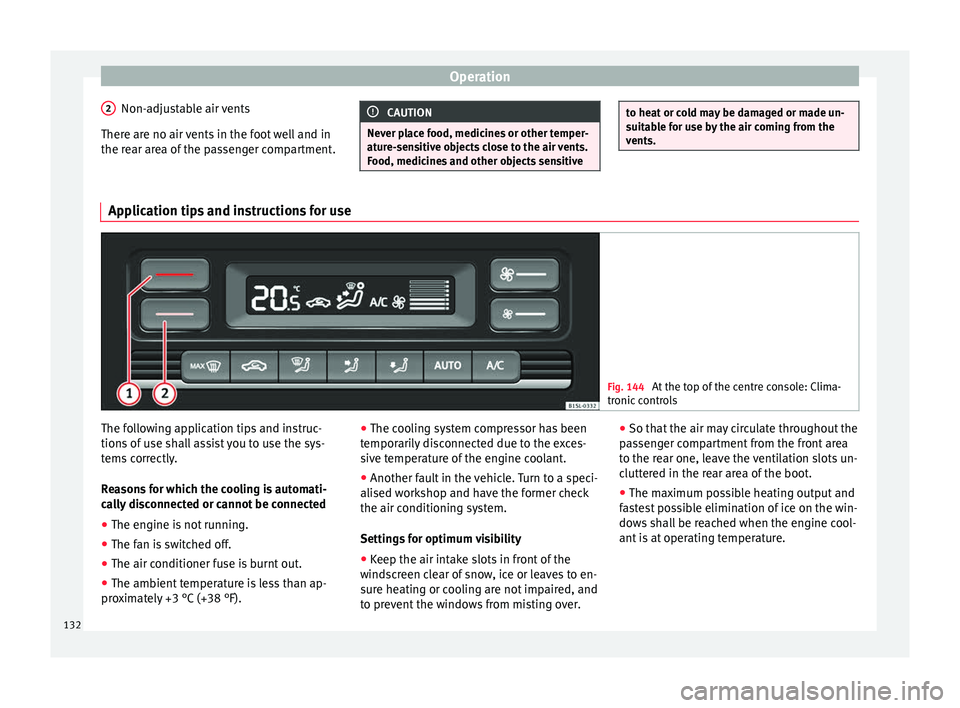
Fig. 144
At the top of the centre console: Clima-
tronic c
ontrols The following application tips and instruc-
tion
s of
use shall assist you to use the sys-
tems correctly.
Reasons for which the cooling is automati-
cally disconnected or cannot be connected
● The engine is not running.
● The fan is switched off.
● The air conditioner fuse is burnt out.
● The ambient temperature is less than ap-
prox
imately +3 °C (+38 °F). ●
The coolin
g system compressor has been
temporarily disconnected due to the exces-
sive temperature of the engine coolant.
● Another fault in the vehicle. Turn to a speci-
alised work
shop and have the former check
the air conditioning system.
Settings for optimum visibility
● Keep the air intake slots in front of the
winds
creen clear of snow, ice or leaves to en-
sure heating or cooling are not impaired, and
to prevent the windows from misting over. ●
So that the air m
ay circulate throughout the
passenger compartment from the front area
to the rear one, leave the ventilation slots un-
cluttered in the rear area of the boot.
● The maximum possible heating output and
fas
test possible elimination of ice on the win-
dows shall be reached when the engine cool-
ant is at operating temperature.
132
Page 135 of 232
Driving
Recommended settings in case of heating
and fr e
sh air sy
stem, and manual air condi-
tioning.
● Disconnect the air recirculation.
● Select speed o from the blo
wer.
● Put the temperature control in the inter-
mediate po
sition.
● Open and direct all of the air outlets on the
dash p
anel .
● Turn the air distribution regulator to the de-
sired po
sition.
● Manual air conditioning: pres
s the button
on the control panel to connect the cool-
in g.
The air i
s dehumidified in the cooling
mode.
Recommended settings in case of Climatron-
ic
● Press the button on the control panel.
● Set the temperature to +22 °C (+72 °F).
● Open the air vents on the dash panel and
dir ect
them.
M
aximum cooling or heating output in case
of Climatronic
While in gear, the maximum cooling and
heating output is set by pressing button 1or
2 several times
›
››
Fig. 144. The tempera-
ture is not regulated. ●
Maximum coo
ling output: set the cooling
below +16 °C (+60 °F). The following appears
on the screen LO.
● Maximum heating output: set the coo
ling
above +29 °C (+84 °F). The following appears
on the screen HI .
Dust and pollen filter
The dirt and pollen filter must be changed
regularly so that the air conditioning output
does not decrease.
If the vehicle is used frequently in areas
where the outside air is very contaminated, it
is possible that you may have to change the
filter prior to the next suggested service.
Water under the vehicle
When the outside humidity and ambient tem-
perature are high, it is possible that conden-
sation water may drip from the cooling evap-
orator and a puddle may from below the vehi-
cle. This is normal and does not indicate a
leak! Driving
St eerin
g
Intr
oduction The power steering* is not hydraulic but elec-
tromec
h
anical. The advantage of this steer-
ing system is that it disposes of hydraulic
tubes, hydraulic oil, the pump, filter and oth-
er components. The electromechanical sys-
tem saves fuel. While a hydraulic system re-
quires oil pressure to be maintained, electro-
mechanical steering only requires energy
when the steering wheel is turned.
With the power steering system, the assisted
steering function automatically adjusts ac-
cording to the vehicle speed, the steering tor-
que and the wheel turning angle. The power
steering only works when the engine is run-
ning. WARNING
If the power steering is not working then the
st eerin
g wheel is much more difficult to turn
and the vehicle more difficult to control.
● The power steering only works when the
engine is
running.
● Never allow the vehicle to move when the
engine is
switched off.
● Never remove the key from the ignition if
the vehic
le is in motion. The steering may » 133
Technical data
Advice
Operation
Emergencies
Safety
Page 142 of 232
Operation
expect the ABS to reduce the braking dis-
t anc
e u
nder any circumstances. This distance
will increase when driving on gravel, recent
snow or on icy or slippery ground.
Brake assist system (BAS)
The brake assist system may reduce the re-
quired braking distance. The brake assist
system boosts the braking force if you press
the brake pedal quickly in an emergency. As
a result, the braking pressure increases rap-
idly, the braking force is multiplied and the
braking distance is reduced. This enables the
ABS to be activated more quickly and effec-
tively.
¡Do not lift your foot off the brake pedal!
When the brake pedal is released or when
the brake force is reduced, braking assist au-
tomatically turns off the brake servo.
Traction control system (ASR) or Traction
Control (TC)*
In the event of wheelspin, the traction control
system ASR or TC reduces the engine torque
to match the amount of grip available. The
ASR or TC makes some situations easier, for
example, when starting, accelerating or go-
ing uphill, even in unfavourable road condi-
tions. Electronic differential lock (EDS)
EDL is
available when driving in straight lines
under normal conditions. When the EDL de-
tects wheelspin, it brakes the spinning wheel
and directs the power to the other one. To
prevent the disc brake of the braked wheel
from overheating, the EDL cuts out automati-
cally if subjected to excessive loads. The EDL
will switch on again automatically when the
brake has cooled down. WARNING
Driving at high speed on icy, slippery or wet
grou nd c
an result in loss of vehicle control
and serious injury to the driver and passen-
gers.
● Adjust your speed and driving style to visi-
bility
, road, traffic and weather conditions.
Even though the brake assist systems, ABS,
BAS, EDL, ASR and ESC* provide more securi-
ty, do not take unnecessary risks while driv-
ing.
● Brake assist systems can not overcome the
law
s of physics. Even with ESC* and other
systems, slippery and wet roads will always
be dangerous.
● Driving to quickly on wet ground can result
in the wheels lo
sing contact with the ground
in an effect known as “aquaplaning”. Without
adherence, it is impossible to brake, steer or
control the vehicle.
● Brake assist systems cannot avoid acci-
dents if
, for example, the driver does not re- spect safety distances or drives to quickly in
difficu
lt
conditions.
● Even though brake assist systems are ex-
tremely eff
ective and help control the vehicle
in difficult situations, remember that the ve-
hicle stability depends on tyre grip.
● When accelerating on a slippery surface,
for ex
ample on ice or snow, press the acceler-
ator carefully. The wheels can still slip even
with brake assist systems resulting in loss of
vehicle control. WARNING
The effectiveness of the ESC* can be consid-
erab ly
reduced if other components and sys-
tems affecting driving dynamics are not main-
tained or are not functioning correctly. This
includes, among others, brakes, tyres and
other systems already mentioned.
● Remember that changing and fitting other
components
to the vehicle can affect opera-
tion of the ABS, BAS, ASR TC, EDL and ESC*.
● Changes to the vehicle suspension or using
unap
proved wheel/tyre combinations can af-
fect operation of the ABS, BAS, ASR, TC, EDL
and ESC* and their effectiveness.
● Likewise, the effectiveness of ESC* de-
pends on the u
se of suitable tyres
››› page 199.140
Page 150 of 232
Operation
Automatic gearbox overheating
The aut om
atic
gearbox can overheat with a
prolonged start up, or when stopping and
starting continuously. This overheating is dis-
played with a warning lamp in the instru-
ment panel. Additionally, an audible warning
can be heard. Stop and let the gearbox cool
››› .
The v
ehic
le moves forward or back despite
having selected a gear range
When the vehicle does not move in the re-
quired direction, the system may not have
the gear range correctly engaged. Press the
brake pedal and engage the gear range
again. If the vehicle still does not move in the
required direction, there is a system malfunc-
tion. Seek specialist assistance and have the
system checked. CAUTION
● When the ge arbo
x is displayed as overheat-
ing for the first time, the vehicle must be
parked safely or must be driven at a speed of
more than 20 km/h (12 mph).
● When the warning lamp lights up and the
audible w
arning is heard, the vehicle must be
parked safely and the engine switched off.
Let the gearbox cool down.
● To prevent damage to the gearbox, driving
must
only be continued when the warning
lamps are no longer lit up. While the gearbox is overheated, starting up and driving, even
at a s
lo
w speed should be avoided. Recommended gear display
In some vehicles, the recommended gear for
reduc
in
g fuel consumption is displayed on
the instrument panel:
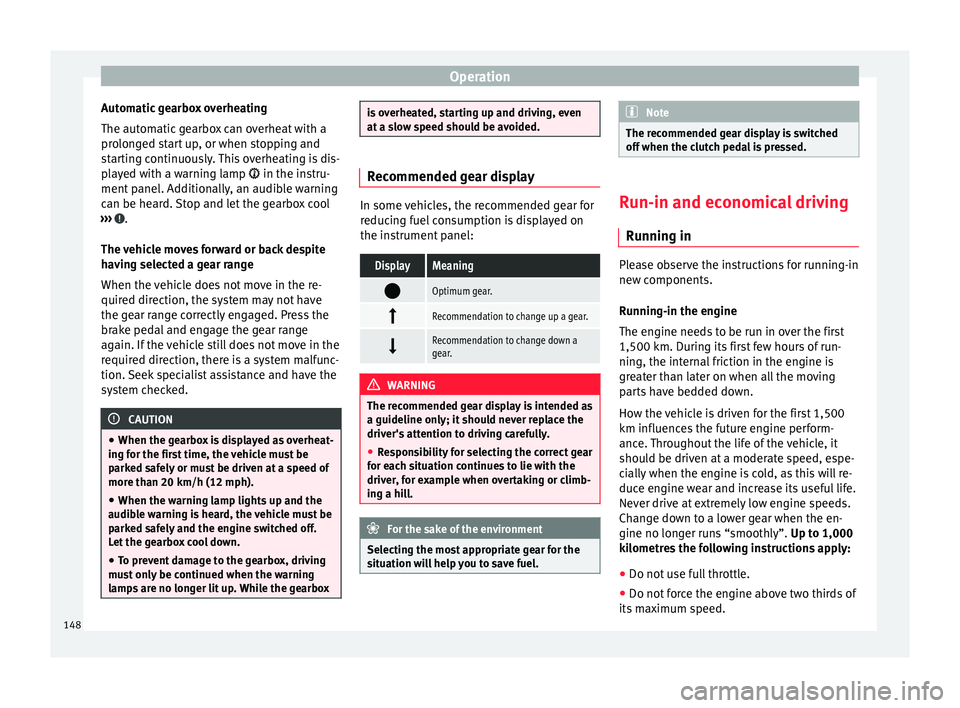
DisplayMeaning
Optimum gear.
Recommendation to change up a gear.
Recommendation to change down a
gear.
WARNING
The recommended gear display is intended as
a guideline only; it shou
ld never replace the
driver's attention to driving carefully.
● Responsibility for selecting the correct gear
for eac
h situation continues to lie with the
driver, for example when overtaking or climb-
ing a hill. For the sake of the environment
Selecting the most appropriate gear for the
sit uation w
ill help you to save fuel. Note
The recommended gear display is switched
off when the c lut
ch pedal is pressed. Run-in and economical driving
Ru nnin
g in Please observe the instructions for running-in
new components.
R u
nning-in the engine
The engine needs to be run in over the first
1,500 km. During its first few hours of run-
ning, the internal friction in the engine is
greater than later on when all the moving
parts have bedded down.
How the vehicle is driven for the first 1,500
km influences the future engine perform-
ance. Throughout the life of the vehicle, it
should be driven at a moderate speed, espe-
cially when the engine is cold, as this will re-
duce engine wear and increase its useful life.
Never drive at extremely low engine speeds.
Change down to a lower gear when the en-
gine no longer runs “smoothly”. Up to 1,000
kilometres the following instructions apply:
● Do not use full throttle.
● Do not force the engine above two thirds of
its m ax
imum speed.
148
Page 152 of 232
Operation
(25 mph) in fourth gear and at 50 km/h
(31 mph) in fif th g
e
ar.
In addition, “skipping” gears when shifting
up helps to save fuel, weather and traffic
conditions permitting.
Do not wait until the last moment before
changing gear. Only use first gear when you
move off and change to second gear quickly.
Avoid the kick-down function in vehicles with
automatic gearbox.
Vehicles with a gear display help to achieve
an economical driving style as the display in-
dicates the best moment to change gear.
Let the vehicle roll
If you take your foot off the accelerator, the
fuel supply is stopped and consumption is
reduced.
Allow the vehicle to roll without accelerating,
for example when approaching a red traffic
light. However, if the vehicle is rolling too
slowly or the distance is too long, the clutch
pedal should be pressed to declutch. The en-
gine will then operate at idle speed.
If the vehicle is going to be at a standstill for
a period of time, switch off the engine; for ex-
ample, while waiting at a level crossing.
Think ahead and “flow” with the traffic
Frequent acceleration and braking considera-
bly increase fuel consumption. If you think ahead as you drive and keep a safe distance
from the v
ehicle in front, it is possible to slow
down by simply lifting your foot off the accel-
erator. This eliminates the need for constant
braking and acceleration.
Calm and steady driving
Constancy is more important than speed: The
more you drive at a constant speed, the lower
the fuel consumption.
When driving on the motorway, it is more effi-
cient to drive at a constant and more moder-
ate speed than to be continuously accelerat-
ing and braking. As a general rule, you will
reach your destination just as quickly when
you drive at a constant speed.
The cruise control function helps you to ach-
ieve a constant style of driving.
Moderate use of additional devices
It is important to travel in comfort, but con-
venience systems should be used ecological-
ly.
Some equipment, when connected, increase
fuel consumption considerably, for example:
● Air conditioning cooling system: If the air
conditioning sy
stem is required to cool to
significantly lower temperatures than the true
outside temperature, it will require a large
amount of energy from the engine. Therefore,
we recommend that the selected temperature for the vehicle is not too different to the out-
side temper
ature. It is a good idea to air the
vehicle before starting your journey and to
drive a short distance with the windows
open. Then you can close the windows and
switch on the air conditioning. Keep windows
closed when travelling at high speeds. Driv-
ing with the windows open increases fuel
consumption.
● Switch off the seat heating when the seats
have w
armed up.
● Switch off the heated rear window when it
is not
moist or covered in ice.
Avoid short journeys
Fuel consumption is much higher when the
engine is cold, immediately after it has been
started. It takes a few kilometres of driving
for the engine to warm up and to normalise
consumption.
The engine and catalytic converter need to
reach their proper working temperature in or-
der to minimise fuel consumption and emis-
sions. The ambient temperature has a deci-
sive influence.
Fig. 150 shows the difference in consump-
tion for the same journey at +20 °C (+68 °F)
and at -10 °C (+14 °F).
Therefore, unnecessary short journeys
should be avoided. Try to combine trips.
150
Page 154 of 232
Operation
It lights up
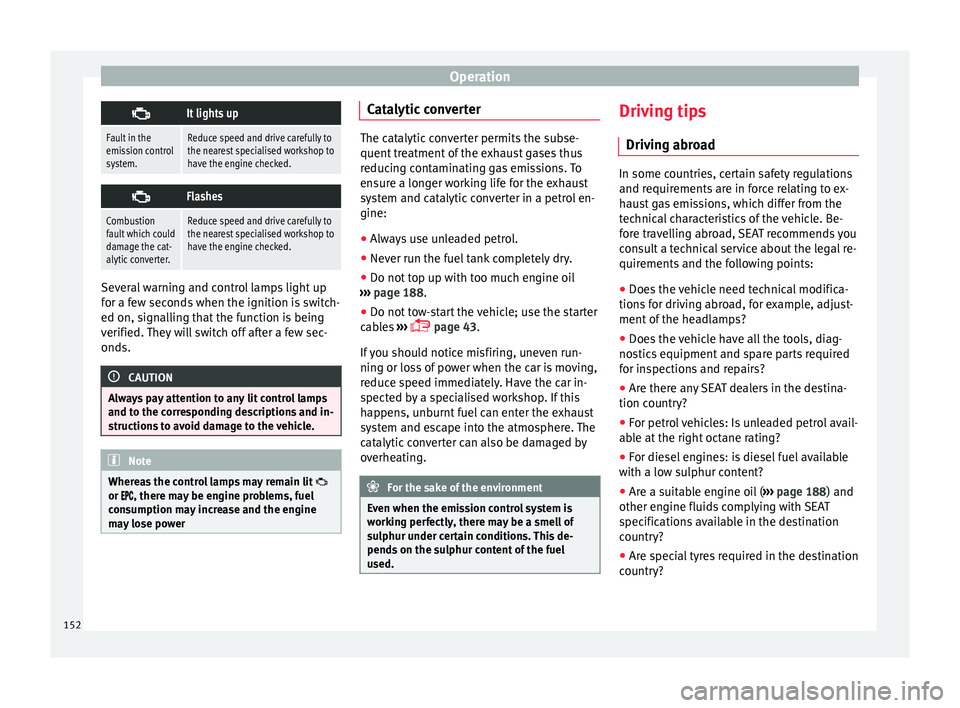
Fault in the
emission control
system.Reduce speed and drive carefully to
the nearest specialised workshop to
have the engine checked.
Flashes
Combustion
fault which could
damage the cat-
alytic converter.Reduce speed and drive carefully to
the nearest specialised workshop to
have the engine checked.
Several warning and control lamps light up
f
or a f
ew sec
onds when the ignition is switch-
ed on, signalling that the function is being
verified. They will switch off after a few sec-
onds. CAUTION
Always pay attention to any lit control lamps
and to the c orr
esponding descriptions and in-
structions to avoid damage to the vehicle. Note
Whereas the control lamps may remain lit
or , ther
e may be engine problems, fuel
consumption may increase and the engine
may lose power Catalytic converter
The catalytic converter permits the subse-
quent tr
e
atment of the exhaust gases thus
reducing contaminating gas emissions. To
ensure a longer working life for the exhaust
system and catalytic converter in a petrol en-
gine:
● Always use unleaded petrol.
● Never run the fuel tank completely dry.
● Do not top up with too much engine oil
›››
page 188.
● Do not tow-start the vehicle; use the starter
cab l
es ›››
page 43.
If you should notice misfiring, uneven run-
ning or loss of power when the car is moving,
reduce speed immediately. Have the car in-
spected by a specialised workshop. If this
happens, unburnt fuel can enter the exhaust
system and escape into the atmosphere. The
catalytic converter can also be damaged by
overheating. For the sake of the environment
Even when the emission control system is
work in
g perfectly, there may be a smell of
sulphur under certain conditions. This de-
pends on the sulphur content of the fuel
used. Driving tips
Driv in
g abr
oad In some countries, certain safety regulations
and requir
ements
are in force relating to ex-
haust gas emissions, which differ from the
technical characteristics of the vehicle. Be-
fore travelling abroad, SEAT recommends you
consult a technical service about the legal re-
quirements and the following points:
● Does the vehicle need technical modifica-
tions f
or driving abroad, for example, adjust-
ment of the headlamps?
● Does the vehicle have all the tools, diag-
nostic
s equipment and spare parts required
for inspections and repairs?
● Are there any SEAT dealers in the destina-
tion countr
y?
● For petrol vehicles: Is unleaded petrol avail-
able at
the right octane rating?
● For diesel engines: is diesel fuel available
with a low s
ulphur content?
● Are a suitable engine oil ( ›››
page 188) and
other engine fluids complying with SEAT
specifications available in the destination
country?
● Are special tyres required in the destination
countr
y?
152