heating Seat Mii 2016 Owner's Guide
[x] Cancel search | Manufacturer: SEAT, Model Year: 2016, Model line: Mii, Model: Seat Mii 2016Pages: 232, PDF Size: 4.9 MB
Page 175 of 232
Care and maintenance
with wax deposits which could smear the
w indo
w
s.
Use window cleaner or a silicone remover to
clean rubber, oil, grease and silicone depos-
its off ››› .
R emo
v
ing wax residue
Automatic car washes and certain car care
products may leave wax deposits on the win-
dows. These deposits can only be removed
with a special product or cleaning cloths. If
wax deposits are left on the windscreen and
the rear window, the blades can scratch the
glass. SEAT recommends you wipe the wax
deposits off the windscreen and the rear win-
dow with a soft cloth each time after you
have washed the vehicle.
A window cleaning detergent which helps to
dissolve the wax may be added to the wind-
screen washer fluid to prevent the wiper
blades from scratching the windscreen.
Please ensure you add the cleaning product
in the correct proportions. Products for re-
moving grease do not eliminate the wax de-
posits ››› .
S pec
i
al cleaning products or window cloths
are available at any technical service. To re-
move wax deposits, SEAT recommends the
following products:
● For the hottest time of the year: the window
cle
aner for summer use G 052 184 A1. Pro- portion 1:100 (1 part detergent, 100 parts
water) in the w
indscreen washer reservoir.
● All year round: the window clean-
er G 052 164 A2; proportion 1:2 in w
ind-
screen washer bottle (1 part concentrate, 2
parts water) in winter, up to -18 ℃ (-0.4°F), or
1:4, during the rest of the year.
● Window cloths G 052 522 A1 for all win-
dows
and exterior mirrors.
Removing snow
Use a small brush to remove snow from the
windows and exterior mirrors.
Removing ice
If possible, use a de-icing spray to remove
ice. If you use an ice scraper, push it in one
direction only without swinging it. If you pull
the scraper backwards, the dirt may scratch
the window. WARNING
Dirty or misted windows reduce visibility in
al l
directions and increase the risk of acci-
dent and serious injury.
● Do not drive unless you have good visibility
through al
l windows!
● Remove ice and snow from the windows
and demist
inside and out. CAUTION
● Never mi x
our cleaning products with other
products not recommended by SEAT in the
windscreen washer reservoir. This could lead
to flocculation and may block the windscreen
washer jets.
● Do not use hot or warm water to remove ice
or snow fr
om the windows and exterior mir-
rors. The glass could crack!
● The heating element for the rear window is
located on the inner s
ide of the window. Do
not stick adhesive labels over the heating el-
ements and never clean the inside of the rear
window with corrosive or acid products or
other similar chemical cleaning products. Caring for and polishing the vehicle
p
aintw
ork Waxing
R
e
gu
lar waxing protects the paintwork. It is
time to apply a good coat of wax when water
no longer forms droplets and rolls off the
clean paintwork.
Even if a wax solution is used regularly in the
automatic car wash, SEAT recommends pro-
tecting the paint with a hard wax coating at
least twice a year. »
173
Technical data
Advice
Operation
Emergencies
Safety
Page 177 of 232
Care and maintenance
De-icing the door lock cylinder To de-ice the lock cylinders, SEAT recommend
the use of
g
enuine SEAT spray with lubricat-
ing and anti-corrosive properties. CAUTION
The use of products containing degreasing
agent s
to de-ice the locks may rust the lock
cylinder. Protection of vehicle undercarriage
The vehicle underbody is coated to protect it
fr
om c
hemic
al and mechanical damage. The
protective coat on the undercarriage may
wear from use while driving. Therefore, SEAT
recommends that the protective coating on
the undercarriage and on the running gear
should be regularly checked, and repaired if
necessary. WARNING
Additional underseal or anti-corrosion prod-
ucts c
ould catch fire due to the high tempera-
tures reached by the exhaust gas system and
other engine components.
● Do not apply additional underseal or anti-
corro
sion products to the exhaust pipes, cat-
alytic converters, heat shields or other parts
of the vehicle which reach high temperatures. Cleaning the engine compartment
The engine compartment of any motor vehi-
cl
e i
s a potentially hazardous area
››› page 186.
The engine compartment should only be
cleaned by qualified personnel. If it is not
correctly cleaned, the anti-corrosion coating
and consequently electrical components may
be damaged. Moreover, water may filter di-
rectly into the vehicle interior through the wa-
ter chamber ››› .
If the en gine c
ompartment is very dirty, al-
ways take the vehicle to a specialised work-
shop for professional cleaning. SEAT recom-
mends taking your car in for technical serv-
ice.
Water box
The water box is in the engine compartment,
between the windscreen and the engine, and
beneath a perforated cover. Air is taken in
through the water box from outside to the ve-
hicle interior via the heating and air condi-
tioner.
Leaves and other loose objects should be
regularly cleaned away from the water box ei-
ther by hand or with a vacuum. WARNING
When working on the engine or in the engine
comp ar
tment, there is a risk of injury, burns,
accident or fire.
● Before starting work, please ensure you are
famili
ar with the required procedure and the
safety precautions ››› page 186.
● SEAT recommends getting a specialised
workshop t
o do these jobs. CAUTION
If water is manually poured into the water box
(e.g. u s
ing a high pressure cleaning appli-
ance), this could cause significant damage to
the vehicle. For the sake of the environment
Only wash the engine compartment in areas
al loc
ated for this purpose, to prevent dirty
water which may be contaminated by oil,
grease or fuel, from entering the drains. In
some places, even washing this compartment
outside planned areas for this purpose is
banned. 175
Technical data
Advice
Operation
Emergencies
Safety
Page 184 of 232
Advice
●
In those c ou
ntries where unleaded petrol is
not available, you may refuel with a fuel with
a low lead content. Natural gas
Natural gas
Natur
al
gas can be compressed or in liquid
form, addition to others.
Liquefied natural gas (LNG) is the result of
heavy cooling of natural gas. Therefore its
volume is considerably reduced compared
with compressed natural gas (CNG). In vehi-
cles with a natural gas engine, liquefied nat-
ural gas cannot be directly refilled, as the gas
would expand excessively in the vehicle gas
tank.
Therefore, vehicles with a natural gas engine
must only be refuelled using compressed
natural gas ››› .
Nat ur
a
l gas quality and consumption
Natural gas is divided into the groups H and
L depending on its quality.
Gas type H has a superior heating power and
inferior nitrogen and carbon dioxide content
than type L. The higher the heating power of
the natural gas, the lower the consumption
will be. However, the heating power and the propor-
tion of nitrog
en and carbon dioxide can fluc-
tuate within the quality groups. Therefore, ve-
hicle consumption can also vary when using
a single type of gas only.
The engine management automatically
adapts to the natural gas used according to
its quality. Therefore, different quality gases
can be mixed in the tank, without the need
for comprehensive draining before applying a
different quality gas.
Natural gas and safety
If you can smell gas or suspect that there is a
leak ››› :
● Stop the vehicle immediately.
● Switch the ignition off.
● Open the doors to appropriately ventilate
the v
ehic
le.
● Extinguish cigarettes immediately.
● Move away from the vehicle or switch off
obj
ects that may cause sparks or a fire.
● If you continue to smell gas, do not contin-
ue driving!
● Seek
specialist assistance. Have the fault
repair
ed. WARNING
Failure to act when you can smell gas in the
vehic l
e or when refuelling can cause serious
injuries.
● Carry out the necessary operations.
● Leave the danger zone.
● If necessary, warn the emergency services. WARNING
The vehicle is not prepared to use liquefied
nat ur
al gas (LNG) and this fuel must not be
added under any circumstances. Liquefied
natural gas can cause the natural gas tank to
explode, resulting in serious injury. Note
Have the natural gas system checked regular-
ly b y
a specialised workshop, according to
the Maintenance Programme. Filling the tank
Intr oduction The fuel tank flap is on the rear right of the
v
ehic
l
e.
182
Page 187 of 232
Checking and refilling levels
CAUTION
● Alw a
ys pay attention to any lit control
lamps and to the corresponding descriptions
and instructions to avoid damage to the vehi-
cle.
● Never run the fuel tank completely dry. An
irregu
lar fuel supply may lead to ignition
faults and unburnt fuel could enter the ex-
haust system. This could damage the catalyt-
ic converter. Note
The arrow next to the fuel pump symbol on
the ins trument
panel ››› Fig. 164 indicates the
side of the vehicle on which the fuel tank flap
is located. Refuelling with petrol
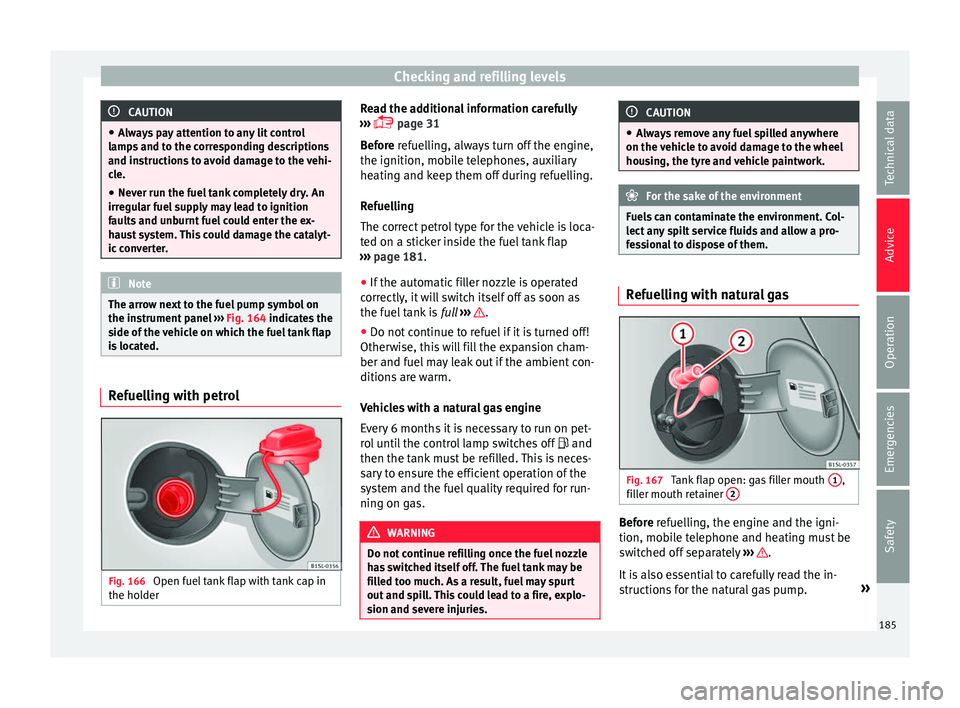
Fig. 166
Open fuel tank flap with tank cap in
the ho l
der Read the additional information carefully
› ›
›
page 31
Before refuelling, always turn off the engine,
the ignition, mobile telephones, auxiliary
heating and keep them off during refuelling.
Refuelling
The correct petrol type for the vehicle is loca-
ted on a sticker inside the fuel tank flap
››› page 181.
● If the automatic filler nozzle is operated
correctly
, it will switch itself off as soon as
the fuel tank is full ››› .
● Do not continue to refuel if it is turned off!
Other w
i
se, this will fill the expansion cham-
ber and fuel may leak out if the ambient con-
ditions are warm.
Vehicles with a natural gas engine
Every 6 months it is necessary to run on pet-
rol until the control lamp switches off and
then the tank must be refilled. This is neces-
sary to ensure the efficient operation of the
system and the fuel quality required for run-
ning on gas. WARNING
Do not continue refilling once the fuel nozzle
ha s
switched itself off. The fuel tank may be
filled too much. As a result, fuel may spurt
out and spill. This could lead to a fire, explo-
sion and severe injuries. CAUTION
● Alw a
ys remove any fuel spilled anywhere
on the vehicle to avoid damage to the wheel
housing, the tyre and vehicle paintwork. For the sake of the environment
Fuels can contaminate the environment. Col-
lect an
y spilt service fluids and allow a pro-
fessional to dispose of them. Refuelling with natural gas
Fig. 167
Tank flap open: gas filler mouth 1 ,
fi l
l
er mouth retainer 2 Before r
efuelling, the engine and the igni-
tion, mo b
ile telephone and heating must be
switched off separately ››› .
It i
s
also essential to carefully read the in-
structions for the natural gas pump. »
185
Technical data
Advice
Operation
Emergencies
Safety
Page 188 of 232
Advice
The vehicle is equipped for refuelling only
w ith C
ompr
essed Natural Gas (CNG) ››› . Re-
f uel
lin
g with another type of natural gas is
not allowed, e.g. Liquefied Natural Gas (LNG)
or hydromethane.
Opening the fuel tank cap
The natural gas filler mouth is behind the fuel
tank cap, next to the petrol filler mouth.
● Unlock the vehicle with the key or with the
central
locking button situated on the driv-
er door ››› page 97.
● Press on the rear area of the flap and open
it.
Ref
uelling
Problem: If the ambient temperature is very
high, the natural gas pump protection
against overheating disconnects this auto-
matically.
● Remove the plug from the gas filler mouth
›››
Fig. 167 1 .
● Connect the pump filling nozzle to the gas
fi l
l
er mouth.
● The fuel tank will be full when the p
ump
compressor automatically cuts the supply.
● If you wish to finish refuelling in advance,
pres
s the button on the pump to stop the
flow. Closing the fuel tank cap
●
Check that the gas filler mouth retainer 2 is not trapped with the filler nozzle. If neces-
s
ar
y
, place it in the filler mouth again.
● Insert the plug in the filler mouth.
● Close the tank flap. Make sure you hear it
click
into place. WARNING
Natural gas is a highly explosive, easily flam-
mab l
e substance. Incorrect handling of the
natural gas can cause accidents serious
burns and other injuries.
● Before refuelling with natural gas, the fill-
ing mouth mus
t be correctly engaged. If you
can smell gas, stop refuelling immediately. WARNING
The vehicle is not prepared to use liquefied
nat ur
al gas (LNG) and this fuel must not be
added under any circumstances. Liquefied
natural gas can cause the natural gas tank to
explode, resulting in serious injury. Note
● The fil lin
g nozzles of natural gas pumps
can differ in the way they are operated. If you
are unacquainted with the pump, it is advisa-
ble that a member of staff of the service sta-
tion performs the refuelling operation. ●
Noise s
heard when refuelling are normal
and do not indicate the presence of a fault in
the system.
● The vehicle natural gas system is prepared
both for ref
uelling with a small compressor
(slow refuel) and a large compressor (fast re-
fuel) in natural gas service stations. Bonnet
Work in
g in the engine compartment Read the additional information carefully
› ›
›
page 10
Before working in the engine compartment,
make sure that the vehicle is parked on hori-
zontal and firm ground.
The engine compartment of the vehicle is a
hazardous area. Never work on the engine or
in the engine compartment if you are not fa-
miliar with the operations to be carried out,
the applicable safety standards and especial-
ly if you do not have the necessary instru-
ments, liquids and tools ››› ! If required,
h av
e an
y work carried out by a specialised
workshop. Negligent work can cause serious
injury. WARNING
If the vehicle moves unexpectedly, this could
cau se seriou
s injury.186
Page 193 of 232
Checking and refilling levels
checked at regular intervals, preferably when
fi l
lin
g the tank and before a journey.
When the engine is working hard, for in-
stance during sustained high-speed motor-
way cruising in summer or when climbing
mountain passes, the oil level should pref-
erably be kept within area ››› Fig. 168 A .
Topping up engine oil Read the additional information carefully
›› ›
page 31.
The engine oil must be changed regularly ac-
cording to the specifications of the Mainte-
nance Programme.
Due to the problems linked with disposing of
used oil and the need for suitable tools and
special knowledge, always visit a specialised
workshop to have the engine oil and filter
changed. SEAT recommends taking your car
in for technical service.
Detailed information on the service intervals
is shown in the Maintenance Programme.
Engine oil additives make new oil darker after
the engine has been running for a short peri-
od. This is normal and does not mean more
frequent oil changes are required. WARNING
Only change the engine oil yourself if you
hav e the s
pecialist knowledge required!
● Before opening the bonnet, read and ob-
serve the w
arnings ››› page 186.
● Wait for the engine to cool down. Hot oil
may
cause burn injuries.
● Wear eye protection to avoid injuries, such
as ac
id burns, caused by splashes of oil.
● When removing the oil drain plug with your
finger
s, keep your arm horizontal to help pre-
vent oil from running down your arm.
● Wash your skin thoroughly if it comes into
contact
with engine oil.
● Engine oil is poisonous! Used oil must be
stor
ed in a safe place out of the reach of chil-
dren. CAUTION
No additives should be used with engine oil.
This c
ould result in engine damage. Any dam-
age caused by the use of such additives
would not be covered by the factory warranty. For the sake of the environment
Before changing the engine oil, find a suita-
bl e loc
ation or service for proper disposal. For the sake of the environment
Always dispose of engine oil with the utmost
re s
pect for the environment. Never dispose of used engine oil in places such as a garden,
wood
s, dr
ains, roads, paths, rivers and drain-
age systems. Engine coolant
Introduction WARNING
Engine coolant is toxic!
● Only keep engine coolant in its original
c ont ainer
, tightly shut and in a safe place.
● Never store engine coolant in empty food
container
s or bottles as other people may ac-
cidentally drink it.
● Always keep engine coolant out of reach of
chil
dren.
● Ensure that the proportion of engine cool-
ant ad
ditive corresponds to the lowest out-
side temperature to which the vehicle will be
exposed.
● If the outside temperature is extremely low,
the engine coo
lant could freeze causing the
vehicle to stop. As this would also cause the
heating to stop working, vehicle occupants
without warm clothing could freeze. For the sake of the environment
Coolants and additives can contaminate the
env ir
onment. If any fluids are spilled, they » 191
Technical data
Advice
Operation
Emergencies
Safety
Page 223 of 232
Index
F F abric
s: c
leaning . . . . . . . . . . . . . . . . . . . . . . . . . 176
Fastening rings . . . . . . . . . . . . . . . . . . . . . . . . . . . 126
Fault parking distance warning system . . . . . . . . . . 154
Fault memory connector . . . . . . . . . . . . . . . . . . . . . . . . . . . . . 168
reading . . . . . . . . . . . . . . . . . . . . . . . . . . . . . . . 168
Filling the tank . . . . . . . . . . . . . . . . . . . . . . 182, 185
Fire extinguisher . . . . . . . . . . . . . . . . . . . . . . . . . . . 70
First-aid kit storage . . . . . . . . . . . . . . . . . . . . . . . . . . . . . . . . 70
Floor mats . . . . . . . . . . . . . . . . . . . . . . . . . . . . . . . . 52
Fluid Level control . . . . . . . . . . . . . . . . . . . . . . . . . 31
Fog light . . . . . . . . . . . . . . . . . . . . . . . . . . . . . . . . . 21
Front airbags . . . . . . . . . . . . . . . . . . . . . . . . . . 14, 62
Front passenger front airbag control lamp . . . . . . . . . . . . . . . . . . . . . . . . . . . . 63
disabling . . . . . . . . . . . . . . . . . . . . . . . . . . . . . . . 15
disconnection . . . . . . . . . . . . . . . . . . . . . . . . . . . 63
Front seat manual adjustment . . . . . . . . . . . . . . . . . . . . . 112
manually adjusting . . . . . . . . . . . . . . . . . . . . . . . 12
Front wiper blades change . . . . . . . . . . . . . . . . . . . . . . . . . . . . . . . . 46
cleaning . . . . . . . . . . . . . . . . . . . . . . . . . . . . . . . 46
Fuel . . . . . . . . . . . . . . . . . . . . . . . . . . . . . . . . 31, 181 natural gas . . . . . . . . . . . . . . . . . . . . . . . . . . . . 182
refuelling . . . . . . . . . . . . . . . . . . . . . . . . . . . . . . 181
savings . . . . . . . . . . . . . . . . . . . . . . . . . . . . . . . 149
Fuel gauge control lamp . . . . . . . . . . . . . . . . . . . . . . . . . . . 184
petrol . . . . . . . . . . . . . . . . . . . . . . . . . . . . . . . . . 184
Fuel tank cap opening and closing . . . . . . . . . . . . . . . . . . . . . 31
Fuel tank flap opening and closing . . . . . . . . . . . . . . . . . . . . . 31 Fuses . . . . . . . . . . . . . . . . . . . . . . . . . . . . . . . . . 34, 78
fuse bo x . . . . . . . . . . . . . . . . . . . . . . . . . . . . . . . . 79
identifying blown fuses . . . . . . . . . . . . . . . . . . . 34
identifying by colours . . . . . . . . . . . . . . . . . . . . . 34
preparation before replacing . . . . . . . . . . . . . . . 34
replacing . . . . . . . . . . . . . . . . . . . . . . . . . . . . . . . 34
G
Gearbox lever . . . . . . . . . . . . . . . . . . . . . . . . . . . . . 26
Gear change . . . . . . . . . . . . . . . . . . . . . . . . . . . . . . 26 automatic gearbox . . . . . . . . . . . . . . . . . . . . . . . 26
changing gears manually . . . . . . . . . . . . . . . . . 145
gear recommendation . . . . . . . . . . . . . . . . . . . 148
manual gear change . . . . . . . . . . . . . . . . . . . . . . 26
putting the vehicle in gear (manual gearbox) 145
Gear engaged . . . . . . . . . . . . . . . . . . . . . . . . . . . . . 26
General instrument panel instrument panel . . . . . . . . . . . . . . . . . . . . . . . . 87
General view control and warning lamps . . . . . . . . . . . . . . . . 24
Generator . . . . . . . . . . . . . . . . . . . . . . . . . . . . . . . 196
Glove compartment . . . . . . . . . . . . . . . . . . 117, 118
H
Handbrake . . . . . . . . . . . . . . . . . . . . . . . . . . . . . . 141
Hazard warning lights . . . . . . . . . . . . . . . . . 21, 106
Head-on collisions and the laws of physics . . . . . 55
Headlight range control . . . . . . . . . . . . . . . . . . . . 107
Headlights driving abroad . . . . . . . . . . . . . . . . . . . . . . . . . 107
Head rest adjustment . . . . . . . . . . . . . . . . . . . . . . . . . . . . 112
Head restraints adjusting . . . . . . . . . . . . . . . . . . . . . . . . . . . . . . 112
rear head restraints . . . . . . . . . . . . . . . . . . . . . . 51
Heating and fresh air controls . . . . . . . . . . . . . . . . . . . . . . . . . . . . . . . . 29 Heating and fresh air system . . . . . . . . . . . . . . . . 130
Heating of
the rear window . . . . . . . . . . . . . . . 28, 30
Hill driving assistant . . . . . . . . . . . . . . . . . . . . . . 160
Hill hold control and warning lamps . . . . . . . . . . . . . . . 161
start-Stop system . . . . . . . . . . . . . . . . . . . . . . . 161
Horn . . . . . . . . . . . . . . . . . . . . . . . . . . . . . . . . . . . . 87
How to jump start . . . . . . . . . . . . . . . . . . . . . . . . . . 43 description . . . . . . . . . . . . . . . . . . . . . . . . . . . . . 44
Hubcaps . . . . . . . . . . . . . . . . . . . . . . . . . . . . . . . . . 37
I
Identifying letters on engine . . . . . . . . . . . . . . . . 210
Ignition . . . . . . . . . . . . . . . . . . . . . . . . . . . . . . . . . . 20 see "Engine and ignition" . . . . . . . . . . . . . . . . 135
Ignition lock . . . . . . . . . . . . . . . . . . . . . . . . . . . . . . 20 removal lock . . . . . . . . . . . . . . . . . . . . . . . . . . . 136
unauthorised vehicle key . . . . . . . . . . . . . . . . . 135
In case of emergency . . . . . . . . . . . . . . . . . . . . . . . 70
Indications on the display . . . . . . . . . . . . . . . . . . . 89 odometer . . . . . . . . . . . . . . . . . . . . . . . . . . . . . . . 89
recommended gear . . . . . . . . . . . . . . . . . . . . . . 90
reminder . . . . . . . . . . . . . . . . . . . . . . . . . . . . . . . 90
seat belt status . . . . . . . . . . . . . . . . . . . . . . . . . . 90
selector lever positions . . . . . . . . . . . . . . . . . . . 90
start-Stop . . . . . . . . . . . . . . . . . . . . . . . . . . . . . . 90
temperature . . . . . . . . . . . . . . . . . . . . . . . . . . . . 89
Instrument panel . . . . . . . . . . . . . . . . . . . . . . . . . . 88 control and warning lamps . . . . . . . . . . . . . . . . 24
display . . . . . . . . . . . . . . . . . . . . . . . . . . . . . . 88, 89
general instrument panel . . . . . . . . . . . . . . . . . . 87
instruments . . . . . . . . . . . . . . . . . . . . . . . . . . . . . 88
menus . . . . . . . . . . . . . . . . . . . . . . . . . . . . . . . . . 23
service intervals . . . . . . . . . . . . . . . . . . . . . . . . . 90
symbols . . . . . . . . . . . . . . . . . . . . . . . . . . . . . . . . 24
Instrument panel lighting . . . . . . . . . . . . . . . . . . 107
Instruments . . . . . . . . . . . . . . . . . . . . . . . . . . . . . . 88
221
Page 226 of 232
Index
Recommended gear . . . . . . . . . . . . . . . . . . . . . . . 148
R ecy
c
led . . . . . . . . . . . . . . . . . . . . . . . . . . . . . . . . 180
Refuelling . . . . . . . . . . . . . . . . . . . . . . . . . . . . . . . 181 control and warning lamps . . . . . . . . . . . . . . . 184
fuel gauge . . . . . . . . . . . . . . . . . . . . . . . . . . . . . 184
mistakes . . . . . . . . . . . . . . . . . . . . . . . . . . . . . . 183
natural gas . . . . . . . . . . . . . . . . . . . . . . . . . . . . 185
opening fuel tank flap . . . . . . . . . . . . . . . . . . . 185
Remote control key unlocking and locking . . . . . . . . . . . . . . . . . . . . 95
Removing ice from the windscreen . . . . . . . . . . . . . . . . . . . 28
Removing ice from the windscreen . . . . . . . . . . . . . . . . . . . . . . 30
Repairs . . . . . . . . . . . . . . . . . . . . . . . . . . . . 165, 180 airbag system . . . . . . . . . . . . . . . . . . . . . . . . . . 166
Repair work . . . . . . . . . . . . . . . . . . . . . . . . . . . . . . 164
Replacement parts . . . . . . . . . . . . . . . . . . . . . . . . . . . . . . . . . 164
Replacement parts . . . . . . . . . . . . . . . . . . . . . . . . 164
Replacing bulbs see "Changing bulbs" . . . . . . . . . . . . . . . . . . . . 79
Reprogramming control units . . . . . . . . . . . . . . . 167
Retaining hooks . . . . . . . . . . . . . . . . . . . . . . . . . . 127
Revolution counter . . . . . . . . . . . . . . . . . . . . . . . . . 88
Rims changing a wheel . . . . . . . . . . . . . . . . . . . . . . . . 36
Roof carrier . . . . . . . . . . . . . . . . . . . . . . . . . . . . . . 127
Roof carrier system . . . . . . . . . . . . . . . . . . . . . . . . 127 fastening the supports . . . . . . . . . . . . . . . . . . . 128
Roof rack . . . . . . . . . . . . . . . . . . . . . . . . . . . . . . . . 127
Rubber seals . . . . . . . . . . . . . . . . . . . . . . . . . . . . . 174
Running in brake pads . . . . . . . . . . . . . . . . . . . . . . . . . . . . 142
new engine . . . . . . . . . . . . . . . . . . . . . . . . . . . . 148
wheels and tyres . . . . . . . . . . . . . . . . . . . . . . . . 202 S
Safe drivin
g safe . . . . . . . . . . . . . . . . . . . . . . . . . . . . . 47
SAFE . . . . . . . . . . . . . . . . . . . . . . . . . . . . . . . 97, 137
safety disabling the front passenger front airbag . . . . 15
Safety . . . . . . . . . . . . . . . . . . . . . . . . . . . . . . . . . . . 47 child safety . . . . . . . . . . . . . . . . . . . . . . . . . . . . . 64
child seats . . . . . . . . . . . . . . . . . . . . . . . . . . . . . . 64
safe driving . . . . . . . . . . . . . . . . . . . . . . . . . . . . . 47
Safety Assist . . . . . . . . . . . . . . . . . . . . . . . . . . . . . 156
Safety equipment . . . . . . . . . . . . . . . . . . . . . . . . . . 48
Safety instructions using child seats . . . . . . . . . . . . . . . . . . . . . 16, 65
using seat belts . . . . . . . . . . . . . . . . . . . . . . . . . 55
Sale of vehicle in other countries / continents . . . . . . . . . . . . 179
Scrapping . . . . . . . . . . . . . . . . . . . . . . . . . . . . . . . 180 airbag system . . . . . . . . . . . . . . . . . . . . . . . . . . 180
vend-of-life vehicles . . . . . . . . . . . . . . . . . . . . . 180
Seat belt adjustment . . . . . . . . . . . . . . . . . . . . . . . . . . 13, 56
Seat belts . . . . . . . . . . . . . . . . . . . . . . . . . . . . . . . . 52 automatic belt retractor . . . . . . . . . . . . . . . . . . . 58
belt tensioner . . . . . . . . . . . . . . . . . . . . . . . . . . . 58
belt tension limiter . . . . . . . . . . . . . . . . . . . . . . . 58
Seatbelts cleaning . . . . . . . . . . . . . . . . . . . . . . . . . . . . . . 178
Seat belts protective function . . . . . . . . . . . . . . . . . . . . . . . 54
purpose . . . . . . . . . . . . . . . . . . . . . . . . . . . . . . . . 52
safety instructions . . . . . . . . . . . . . . . . . . . . . . . 55
twisted belt . . . . . . . . . . . . . . . . . . . . . . . . . . . . . 55
unfastened . . . . . . . . . . . . . . . . . . . . . . . . . . . . . 55
warning lamp . . . . . . . . . . . . . . . . . . . . . . . . . . . 53
Seat belt tensioner . . . . . . . . . . . . . . . . . . . . . . . . . 13
Seat belt tensioners . . . . . . . . . . . . . . . . . . . . . . . . 58 Seat heating . . . . . . . . . . . . . . . . . . . . . . . . . . . . . 113
SEAT inf
ormation system . . . . . . . . . . . . . . . . . . . . 22
Seats . . . . . . . . . . . . . . . . . . . . . . . . . . . . . . . . . . . . 50 heating . . . . . . . . . . . . . . . . . . . . . . . . . . . . . . . 113
incorrect position . . . . . . . . . . . . . . . . . . . . . . . . 50
number of seats . . . . . . . . . . . . . . . . . . . . . . . . . 50
rear backrest . . . . . . . . . . . . . . . . . . . . . . . . . . . 124
Service fluids . . . . . . . . . . . . . . . . . . . . . . . . . . . . 164
Service interval display . . . . . . . . . . . . . . . . . . . . . 90
Side airbags description . . . . . . . . . . . . . . . . . . . . . . . . . . . . . 16
Smell of gas . . . . . . . . . . . . . . . . . . . . . . . . . . . . . 182
Snow chains . . . . . . . . . . . . . . . . . . . . . . . . . 41, 212 temporary spare wheel . . . . . . . . . . . . . . . . . . . 41
Spare fuel canister . . . . . . . . . . . . . . . . . . . . . . . . 183
Spare parts . . . . . . . . . . . . . . . . . . . . . . . . . . . . . . 164
Spare wheel removing . . . . . . . . . . . . . . . . . . . . . . . . . . . . . . 206
Spare wheel or temporary spare wheel advice for driving . . . . . . . . . . . . . . . . . . . . . . . 206
Speed limiter . . . . . . . . . . . . . . . . . . . . . . . . . . . . 155
Speed rating . . . . . . . . . . . . . . . . . . . . . . . . . . . . . 209
Start-Stop system . . . . . . . . . . . . . . . . . . . . . . . . . 161 operation . . . . . . . . . . . . . . . . . . . . . . . . . . . . . . 161
Starting the vehicle . . . . . . . . . . . . . . . . . . . . . . . . 20
Steering . . . . . . . . . . . . . . . . . . . . . . . . . . . . . . . . 133 control and warning lamps . . . . . . . . . . . . . . . 134
electromechanical . . . . . . . . . . . . . . . . . . . . . . 134
power steering . . . . . . . . . . . . . . . . . . . . . . . . . 134
steering column lock . . . . . . . . . . . . . . . . . . . . 134
tendency to pull to one side . . . . . . . . . . . . . . 204
Steering wheel adjustment . . . . . . . . . . . . . . . . . . . . . . . . . . . . . 14
Setting . . . . . . . . . . . . . . . . . . . . . . . . . . . . . . . . . 49
Storage compartment centre console . . . . . . . . . . . . . . . . . . . . . . . . . 118
other storage compartments . . . . . . . . . . . . . . 119
224