phone Seat Mii 2016 User Guide
[x] Cancel search | Manufacturer: SEAT, Model Year: 2016, Model line: Mii, Model: Seat Mii 2016Pages: 232, PDF Size: 4.9 MB
Page 170 of 232
Advice
equipment at the workshop. If the comfort
f u
nction
s are reprogrammed, the information
and Instruction Manual descriptions will not
coincide with the modified functions. There-
fore, SEAT recommends that any modifica-
tions be recorded in the section “Other work-
shop notes” in the Maintenance Programme.
The SEAT Official Service must have a record
of any modification to the programming.
Reading the vehicle fault memory
There is a diagnostics connector in the vehi-
cle interior for reading the vehicle fault mem-
ory. The fault memory documents errors and
deviations from the theoretical values of the
electronic control units.
The diagnostics connector is in the driver
side footwell area, next to the lever for open-
ing the bonnet, below a cover.
The fault memory should only be read and re-
set by a specialised workshop.
Using a mobile telephone in a vehicle
without c
onnection to an exterior aer-
ial Mobile telephones transmit and receive radio
w
av
e
s also called high-frequency energy,
both when in use and when on stand-by. Sci-
entific studies state that radio waves exceed-
ing certain values may be harmful to the hu- man body. International committees and au-
thorities h
ave established limits and direc-
tives in order to ensure electromagnetic radi-
ation from mobile phones remains within cer-
tain limits that do not endanger health. Nev-
ertheless, there is no conclusive scientific
evidence that wireless telephones are totally
safe.
That is why some experts recommend moder-
ate use of the mobile telephone, and the ap-
pliance of measures to reduce radiation on
the human body.
When a mobile phone not connected to an
exterior aerial is used inside the vehicle, the
electromagnetic radiation may be greater
than if the mobile phone were connected to a
built-in aerial or to another exterior aerial.
If the vehicle is fitted with a suitable hands-
free device that allows the employment of
numerous additional mobile telephone func-
tions with compatible Bluetooth technolo-
gy ®
, it will comply with the legislation in
many countries which only permits the use of
mobile phones inside vehicles using a
hands-free device.
Mobile telephones must be placed in a suita-
ble telephone support or stored safely in the
vehicle. If a support is used for the tele-
phone, it must be securely fastened to the
base plate. The mobile will be secure on the
instrument panel and always within reach of
the driver only by following these procedures. Mobile telephone connection with an exter-
nal aeri
al is carried out subject to the hands-
free device, via the telephone support or by
the Bluetooth ®
connections present in the
mobile telephone and the vehicle.
If the mobile phone is connected to an aerial
incorporated into the vehicle or an exterior
aerial connected to the vehicle, it will help re-
duce the electromagnetic radiation transmit-
ted and the risk to human health. It will also
improve the quality of the connection.
If the phone is used inside the vehicle with-
out the hands-free system, it will not be se-
curely fastened and will not be connected to
the exterior aerial of the vehicle telephone.
Nor will the telephone charge if it is not on
the support. In addition, some calls may
break off and the quality of the connection
will be affected.
Mobile telephones should only be used in-
side the vehicle if they are connected to a
hands-free system. SEAT recommends using
an external aerial should you wish to use a
mobile telephone inside the vehicle.
Bluetooth ®
is a registered trademark of Blue-
tooth ®
SIG, Inc. WARNING
If the mobile phone is not securely fastened
in pos ition, it
could be sent flying around the
vehicle in the event of sharp braking, sudden
manoeuvres or accident, causing injury. 168
Page 171 of 232
Care and maintenance
●
Whil e driv
ing, the mobile telephone, other
equipment including telephone accessories
such as telephone supports, notepads and
navigators must be correctly secured, away
from the airbags deployment zones, or stored
in a safe place. WARNING
When using a mobile telephone or two-way
r a dio w
ithout connecting an external aerial,
the maximum permitted levels of electromag-
netic radiation in the vehicle may be excee-
ded, thus putting the driver and the rest of
the vehicle occupants in danger. This is also
the case if the aerial has not been correctly
installed.
● A minimum of 20 centimetres should be
kept betw
een mobile phone aerials and artifi-
cial pacemakers, as mobile telephones may
affect the working of pacemakers.
● Do not keep mobile phones in breast pock-
ets dir
ectly above pacemakers.
● Immediately switch off the mobile tele-
phone if y
ou suspect any interference with
pacemakers or other types of medical equip-
ment. Support points for raising the vehicle
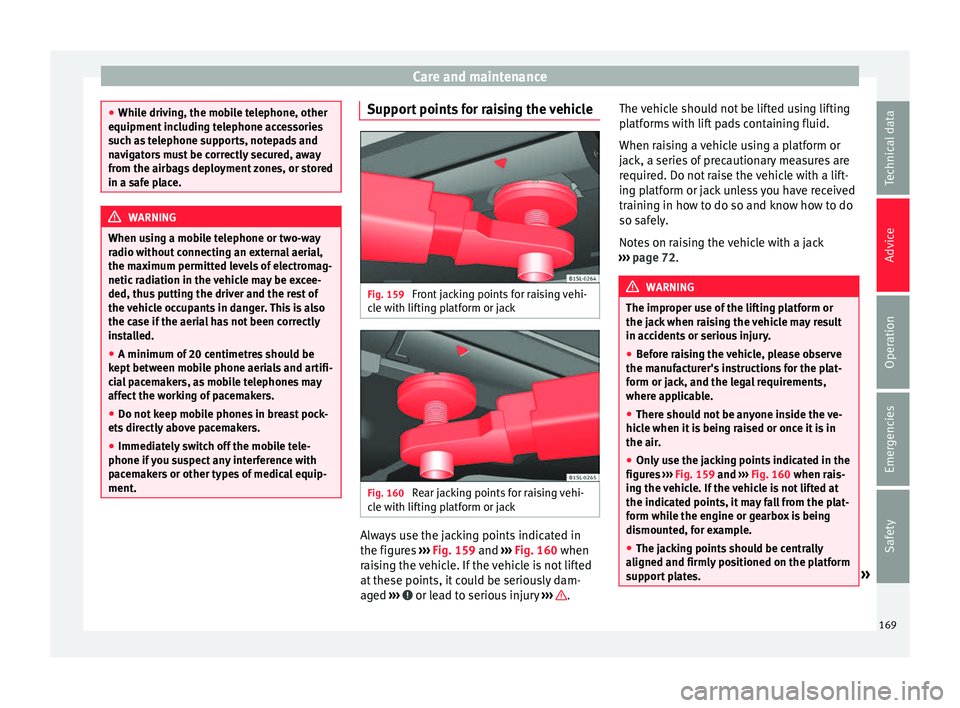
Fig. 159
Front jacking points for raising vehi-
c l
e w
ith lifting platform or jack Fig. 160
Rear jacking points for raising vehi-
c l
e w
ith lifting platform or jack Always use the jacking points indicated in
the figur
e
s
››› Fig. 159 and ››› Fig. 160 when
raising the vehicle. If the vehicle is not lifted
at these points, it could be seriously dam-
aged ››› or lead to serious injury
›
››
.The vehicle should not be lifted using lifting
p
latf
orms with lift pads containing fluid.
When raising a vehicle using a platform or
jack, a series of precautionary measures are
required. Do not raise the vehicle with a lift-
ing platform or jack unless you have received
training in how to do so and know how to do
so safely.
Notes on raising the vehicle with a jack
››› page 72. WARNING
The improper use of the lifting platform or
the jac k
when raising the vehicle may result
in accidents or serious injury.
● Before raising the vehicle, please observe
the manufact
urer's instructions for the plat-
form or jack, and the legal requirements,
where applicable.
● There should not be anyone inside the ve-
hicle when it
is being raised or once it is in
the air.
● Only use the jacking points indicated in the
figures
››› Fig. 159 and ››› Fig. 160 when rais-
ing the vehicle. If the vehicle is not lifted at
the indicated points, it may fall from the plat-
form while the engine or gearbox is being
dismounted, for example.
● The jacking points should be centrally
aligned and firmly
positioned on the platform
support plates. » 169
Technical data
Advice
Operation
Emergencies
Safety
Page 182 of 232
Advice
It may be necessary to fit or remove certain
piec e
s
of equipment or to deactivate certain
functions. Service work may also be affected.
This is particularly true if the vehicle is used
in a different climate for an extended period
of time. CAUTION
● SEA T doe
s not accept liability for any dam-
age to the vehicle due to the use of a lower
quality fuel, an inadequate service or the
non-availability of genuine spare parts.
● SEAT does not accept liability if the vehicle
does not
comply in part or in full with the le-
gal requirements of other countries or conti-
nents. Radio and antenna reception
For factory-fitted radio equipment, the aerial
f
or r
a
dio reception is fitted to the roof of the
vehicle. Note
If electrical equipment such as mobile tele-
phones, i s
used near a roof aerial, you may
observe interference in the reception of AM
stations. Notes on SEAT repairs
WARNING
Repairs or modifications which are not per-
formed c orr
ectly may result in damage or er-
rors in the vehicle operation, affecting the ef-
fectiveness of the driver assist and airbag
systems. This could result in serious acci-
dent.
● Have any repairs or modifications carried
out at a s
pecialised workshop. Conformity certification
The respective manufacturer hereby declares
th
at
the pr
oducts indicated below comply
with basic requirements and the following
provisions and important legislation on the
date of manufacture of the vehicle, among
others FCC Part 15.19, FCC Part 15.21 and
RSS-Gen Issue 1:
Radio frequency equipment
● Electronic gearbox lock.
● Vehicle key
Electrica
l equipment
● 12 volt power socket Collection and scrapping of end-of-life
vehicl
es Collection of end-of-life vehicles
SEA
T i
s already prepared for the moment
when you wish to scrap your vehicle and of-
fers you an environmentally-friendly solution.
An extensive network of used car reception
centres already exists in much of Europe. Af-
ter the vehicle has been delivered, you will
receive a certificate of destruction describing
the environmentally friendly scrapping of the
vehicle in accordance with applicable legisla-
tion.
We will collect the used vehicle free of
charge, provided it complies with all national
legislation.
Please see your technical service for further
information about the collection and scrap-
ping of end-of-life vehicles.
Scrapping
The relevant safety requirements must be ob-
served when the vehicle or components of
the airbag or belt tensioner systems are
scrapped. These requirements are known to
specialised workshops. 180
Page 185 of 232
Checking and refilling levels
WARNING
Refuelling or handling fuel carelessly can
cau se an e
xplosion or fire resulting in serious
burns and injuries.
● Always make sure that you correctly close
the fuel c
ap to avoid evaporation and fuel
spillage.
● Fuels are highly explosive and inflammable
subs
tances that can cause serious burns and
injuries.
● Fuel could leak out or be spilt if the engine
is not
switched off or if the filler fuel nozzle is
not fully inserted into the tank filler neck
when refuelling. This could lead to a fire, ex-
plosion and severe injuries.
● When refuelling, turn off the engine and
turn off the ignition f
or safety reasons.
● Always turn off mobile telephones, radio
appar
atus and other radio wave emitting
equipment before refuelling. Electromagnetic
waves could cause sparks and lead to a fire.
● Never enter the vehicle while refuelling. If it
is ab
solutely necessary to enter, close the
door and touch a metal surface before touch-
ing the filler nozzle again. This will prevent
the generation of static electricity. Sparks
could cause a fire when refuelling.
● Never handle fuel close to flames, sparks or
obj
ects with slow combustion (e.g. ciga-
rettes).
● Avoid static electricity and electro-magnet-
ic ra
diation when refuelling. ●
Ob ser
ve the safety regulations of the serv-
ice station.
● Never spill fuel on the vehicle or in the lug-
gage c
ompartment. WARNING
For safety reasons, SEAT does not recommend
c arr y
ing a spare fuel canister in the vehicle.
Fuel could be spilled and catch fire, above all
in case of an accident and this applies to a
full container as well as empty containers.
This could lead to explosions, fires and inju-
ries.
● Observe the following if you exceptionally
have t
o carry fuel in a canister:
– Never place a fuel container, to fill it, in-
side the vehicle or on the vehicle, for ex-
ample, in the luggage compartment. Fill-
ing in these circumstances could create
an electrostatic charge and spark that
could ignite fuel fumes.
– Always place the canister on the ground
to fill it.
– Insert the fuel nozzle into the neck of the
canister as far as possible.
– If you are using a metal fuel canister, the
nozzle must always touch the canister
while it is being filled to avoid static elec-
tricity.
– Follow the legal requirements for the use,
storage and transport of spare fuel canis-
ters. –
Ins ur
e that the fuel container complies
with manufacturing standards, for exam-
ple, ANSI or ASTM F852-86. CAUTION
● Alw a
ys remove any fuel spilled anywhere
on the vehicle to avoid damage to the wheel
housing, the tyre and vehicle paintwork.
● Refuelling a petrol engine with diesel can
cause seriou
s engine and fuel system dam-
age; the resulting malfunctions are not cov-
ered by the SEAT warranty. If you refuel with
the wrong type of fuel, never start the engine.
This applies to even the smallest amount of
the wrong fuel. Seek specialist assistance.
With the engine running, the composition of
the wrong fuel could significantly damage the
fuel system and the engine itself. For the sake of the environment
Fuels can contaminate the environment. Col-
lect an
y spilt service fluids and allow a pro-
fessional to dispose of them. 183
Technical data
Advice
Operation
Emergencies
Safety
Page 187 of 232
Checking and refilling levels
CAUTION
● Alw a
ys pay attention to any lit control
lamps and to the corresponding descriptions
and instructions to avoid damage to the vehi-
cle.
● Never run the fuel tank completely dry. An
irregu
lar fuel supply may lead to ignition
faults and unburnt fuel could enter the ex-
haust system. This could damage the catalyt-
ic converter. Note
The arrow next to the fuel pump symbol on
the ins trument
panel ››› Fig. 164 indicates the
side of the vehicle on which the fuel tank flap
is located. Refuelling with petrol
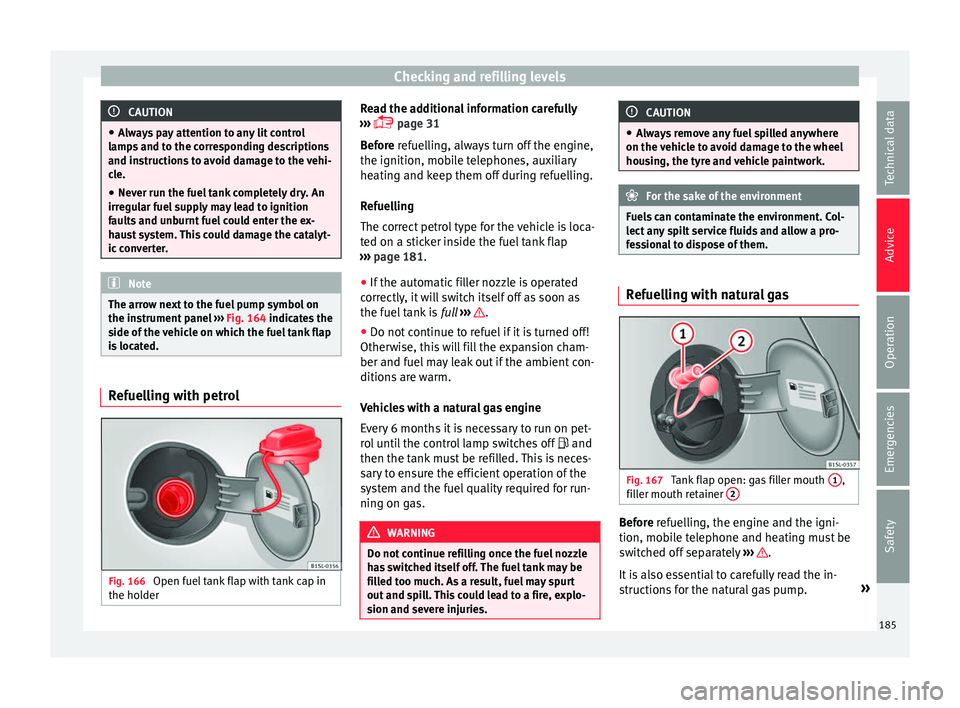
Fig. 166
Open fuel tank flap with tank cap in
the ho l
der Read the additional information carefully
› ›
›
page 31
Before refuelling, always turn off the engine,
the ignition, mobile telephones, auxiliary
heating and keep them off during refuelling.
Refuelling
The correct petrol type for the vehicle is loca-
ted on a sticker inside the fuel tank flap
››› page 181.
● If the automatic filler nozzle is operated
correctly
, it will switch itself off as soon as
the fuel tank is full ››› .
● Do not continue to refuel if it is turned off!
Other w
i
se, this will fill the expansion cham-
ber and fuel may leak out if the ambient con-
ditions are warm.
Vehicles with a natural gas engine
Every 6 months it is necessary to run on pet-
rol until the control lamp switches off and
then the tank must be refilled. This is neces-
sary to ensure the efficient operation of the
system and the fuel quality required for run-
ning on gas. WARNING
Do not continue refilling once the fuel nozzle
ha s
switched itself off. The fuel tank may be
filled too much. As a result, fuel may spurt
out and spill. This could lead to a fire, explo-
sion and severe injuries. CAUTION
● Alw a
ys remove any fuel spilled anywhere
on the vehicle to avoid damage to the wheel
housing, the tyre and vehicle paintwork. For the sake of the environment
Fuels can contaminate the environment. Col-
lect an
y spilt service fluids and allow a pro-
fessional to dispose of them. Refuelling with natural gas
Fig. 167
Tank flap open: gas filler mouth 1 ,
fi l
l
er mouth retainer 2 Before r
efuelling, the engine and the igni-
tion, mo b
ile telephone and heating must be
switched off separately ››› .
It i
s
also essential to carefully read the in-
structions for the natural gas pump. »
185
Technical data
Advice
Operation
Emergencies
Safety
Page 224 of 232
Index
Interior lights . . . . . . . . . . . . . . . . . . . . . . . . . . . . . 22
Int erior r
e
ar vision mirror
anti-dazzle . . . . . . . . . . . . . . . . . . . . . . . . . . . . 111
Interior view left . . . . . . . . . . . . . . . . . . . . . . . . . . . . . . . . . . . . . 7
ISOFIX . . . . . . . . . . . . . . . . . . . . . . . . . . . . . . . . . . . 18
ISOFIX system . . . . . . . . . . . . . . . . . . . . . . . . . . . . . 18
J Jack . . . . . . . . . . . . . . . . . . . . . . . . . . . . . . 36, 70, 72 mounting points . . . . . . . . . . . . . . . . . . . . . . . . . 39
Jump leads . . . . . . . . . . . . . . . . . . . . . . . . . . . . . . . 43
K
Keys control lamp . . . . . . . . . . . . . . . . . . . . . . . . . . . . 93
duplicates . . . . . . . . . . . . . . . . . . . . . . . . . . . . . . 93
mechanical key . . . . . . . . . . . . . . . . . . . . . . . . . . 93
remote control . . . . . . . . . . . . . . . . . . . . . . . . . . 92
replacing the battery . . . . . . . . . . . . . . . . . . . . . 93
spare key . . . . . . . . . . . . . . . . . . . . . . . . . . . . . . . 92
synchronising . . . . . . . . . . . . . . . . . . . . . . . . . . . 94
unlocking and locking . . . . . . . . . . . . . . 8, 95, 97
vehicle key . . . . . . . . . . . . . . . . . . . . . . . . . . . . . 92
Kick-down . . . . . . . . . . . . . . . . . . . . . . . . . . . . . . . 147
L
Labels and plates . . . . . . . . . . . . . . . . . . . . . . . . . 179
Laser sensor . . . . . . . . . . . . . . . . . . . . . . . . . . . . . 158
Leaving Home lights . . . . . . . . . . . . . . . . . . . . . . . . . . . . . . . . . 105
Leaving Home Function . . . . . . . . . . . . . . . . . . . . 105
Lift platform . . . . . . . . . . . . . . . . . . . . . . . . . . . . . 169
Lights . . . . . . . . . . . . . . . . . . . . . . . . . . . . . . 21, 103 audible warnings . . . . . . . . . . . . . . . . . . . . . . . 104
AUTO . . . . . . . . . . . . . . . . . . . . . . . . . . . . . . . . . 104
control and warning lamps . . . . . . . . . . . . . . . 103 control lighting . . . . . . . . . . . . . . . . . . . . . . . . . 107
daytime ru
nning lights . . . . . . . . . . . . . . . . . . . 104
dipped beam headlights . . . . . . . . . . . . . . . . . 103
driving abroad . . . . . . . . . . . . . . . . . . . . . . . . . 107
fog lights . . . . . . . . . . . . . . . . . . . . . . . . . . . . . . . 21
functions . . . . . . . . . . . . . . . . . . . . . . . . . . . . . . 104
hazard warning lights . . . . . . . . . . . . . . . . . . . . 21
headlight range control . . . . . . . . . . . . . . . . . . 107
instrument panel lighting . . . . . . . . . . . . . . . . 107
light controls . . . . . . . . . . . . . . . . . . . . . . . . . . . 103
luggage compartment . . . . . . . . . . . . . . . . . . . 107
main beam . . . . . . . . . . . . . . . . . . . . . . . . . . . . . 21
main beam headlights . . . . . . . . . . . . . . . . . . . 103
main beam lever . . . . . . . . . . . . . . . . . . . . . . . . 105
parking light remains on both sides . . . . . . . . 104
side lights . . . . . . . . . . . . . . . . . . . . . . . . . . . . . 103
switch . . . . . . . . . . . . . . . . . . . . . . . . . . . . . . . . . 21
turn signal lever . . . . . . . . . . . . . . . . . . . . . . . . 105
Load compartment in the luggage compartment see Loading the luggage compartment . . . . . 123
Loading general advice . . . . . . . . . . . . . . . . . . . . . . . . . 114
loaded vehicle . . . . . . . . . . . . . . . . . . . . . . . . . 115
transporting the load . . . . . . . . . . . . . . . . . . . . 115
Loading the luggage compartment . . . . . . . . . . . 123 driving with the rear lid open . . . . . . . . . . . . . . 115
Loading the vehicle class N1 . . . . . . . . . . . . . . . . . . . . . . . . . . . . . . . 126
fastening rings . . . . . . . . . . . . . . . . . . . . . . . . . 126
luggage compartment . . . . . . . . . . . . . . . . . . . . . 9
retaining hooks . . . . . . . . . . . . . . . . . . . . . . . . 127
roof carrier system . . . . . . . . . . . . . . . . . . . . . . 129
Locking and unlocking in the lock cylinder . . . . . . . . . . . . . . . . . . . . . . . . 8
luggage compartment . . . . . . . . . . . . . . . . . . . 100
panoramic sunroof . . . . . . . . . . . . . . . . . . . . . . 102
Luggage . . . . . . . . . . . . . . . . . . . . . . . . . . . . . . . . 123 Luggage compartment . . . . . . . . . . . . . . . 9, 99, 123
clos ing . . . . . . . . . . . . . . . . . . . . . . . . . . . . . . . . 100
cover . . . . . . . . . . . . . . . . . . . . . . . . . . . . . . . . . 125
driving with the rear lid open . . . . . . . . . . . . . . 115
emergency unlocking . . . . . . . . . . . . . . . . . . . . . 10
luggage compartment variable floor . . . . . . . . 126
opening . . . . . . . . . . . . . . . . . . . . . . . . . . . . . . . 100
unlocking . . . . . . . . . . . . . . . . . . . . . . . . . . . . . 100
see also Loading the luggage compartment . 123
Luggage compartment floor . . . . . . . . . . . . . . . . 126
Luggage compartment hatch . . . . . . . . . . . . . . . . 10
Luggage compartment variable floor . . . . . . . . . 126
M Main beam lever . . . . . . . . . . . . . . . . . . . . . . . . . . 105
Main panel turn signal and main beam lever . . . . . . . . . . . 105
Malfunction automatic gearbox . . . . . . . . . . . . . . . . . . . . . . 147
Malfunction in the air conditioning operation . . . . . . . . . . . . . . . . . . . . . . . . . . . . . . 132
Malfunction in the operation catalytic converter . . . . . . . . . . . . . . . . . . . . . . 152
rain and light sensor . . . . . . . . . . . . . . . . . . . . 110
Manual air conditioner . . . . . . . . . . . . . . . . . . . . . 130
Manual air conditioning air distribution . . . . . . . . . . . . . . . . . . . . . . . . . . 29
blower . . . . . . . . . . . . . . . . . . . . . . . . . . . . . . . . . 29
controls . . . . . . . . . . . . . . . . . . . . . . . . . . . . . . . . 29
cooling mode . . . . . . . . . . . . . . . . . . . . . . . . . . . 29
disconnecting . . . . . . . . . . . . . . . . . . . . . . . . . . . 29
setting the temperature . . . . . . . . . . . . . . . . . . . 29
Mirror . . . . . . . . . . . . . . . . . . . . . . . . . . . . . . . . . . 111
Mobile phone . . . . . . . . . . . . . . . . . . . . . . . . . . . . 166
Mobile phones . . . . . . . . . . . . . . . . . . . . . . . . . . . 166
Mobile telephone use without an exterior aerial . . . . . . . . . . . . . 168
222
Page 225 of 232
Index
Model plate . . . . . . . . . . . . . . . . . . . . . . . . . . . . . . 210
N Nat ur
al
gas . . . . . . . . . . . . . . . . . . . . . . . . . . . . . . 182
fuel tank cap . . . . . . . . . . . . . . . . . . . . . . . . . . . 185
refuelling . . . . . . . . . . . . . . . . . . . . . . . . . 182, 185
smell . . . . . . . . . . . . . . . . . . . . . . . . . . . . . . . . . 182
Noises brake assist systems . . . . . . . . . . . . . . . . . . . . 141
engine . . . . . . . . . . . . . . . . . . . . . . . . . . . . . . . . 136
Notes for the user . . . . . . . . . . . . . . . . . . . . . . . . . 179
Number of seats . . . . . . . . . . . . . . . . . . . . . . . . . . . 50
O
Octane rating (petrol) . . . . . . . . . . . . . . . . . . . . . . 181
Odometer partial . . . . . . . . . . . . . . . . . . . . . . . . . . . . . . . . . 88
total . . . . . . . . . . . . . . . . . . . . . . . . . . . . . . . . . . . 88
Oil properties . . . . . . . . . . . . . . . . . . . . . . . . . . . . . 32
Open and close . . . . . . . . . . . . . . . . . . . . . . . . . . . 92 panoramic sunroof . . . . . . . . . . . . . . . . . . . . . . 102
Opening . . . . . . . . . . . . . . . . . . . . . . . . . . . . . . . . . 92 bonnet . . . . . . . . . . . . . . . . . . . . . . . . . . . . . . . . . 10
electric windows . . . . . . . . . . . . . . . . . . . . . . . . . 11
fuel tank flap . . . . . . . . . . . . . . . . . . . . . . . . . . . 185
luggage compartment . . . . . . . . . . . . . . . . . . . 100
panoramic sunroof . . . . . . . . . . . . . . . . . . . . . . . 11
windows . . . . . . . . . . . . . . . . . . . . . . . . . . . . . . 101
Opening and closing . . . . . . . . . . . . . . . . . . . . . . . . 8 bonnet . . . . . . . . . . . . . . . . . . . . . . . . . . . . . . . . . 10
by remote control . . . . . . . . . . . . . . . . . . . . . . . . 95
doors . . . . . . . . . . . . . . . . . . . . . . . . . . . . . . . . . . 98
electric windows . . . . . . . . . . . . . . . . . . . . . . . . . 11
from the inside . . . . . . . . . . . . . . . . . . . . . . . . . . 97
fuel tank flap . . . . . . . . . . . . . . . . . . . . . . . . . . . 185
in the lock cylinder . . . . . . . . . . . . . . . . . . . . . . . . 8
panoramic sunroof . . . . . . . . . . . . . . . . . . . . . . . 11 Panoramic sunroof . . . . . . . . . . . . . . . . . . . . . . 102
rear lid of
the luggage compartment . . . . . . . . . 9
tank flap . . . . . . . . . . . . . . . . . . . . . . . . . . . . . . 185
Opening doors individually . . . . . . . . . . . . . . . . . . 95
Optical parking system (OPS) . . . . . . . . . . . . . . . 155
P Paintwork code . . . . . . . . . . . . . . . . . . . . . . . . . . . . . . . . . . 210
Panoramic sunroof . . . . . . . . . . . . . . . . . . . . 11, 102 anti-trap function . . . . . . . . . . . . . . . . . . . . . . . 102
closing . . . . . . . . . . . . . . . . . . . . . . . . . . . . . . . . 102
opening . . . . . . . . . . . . . . . . . . . . . . . . . . . . . . . 102
Parking . . . . . . . . . . . . . . . . . . . . . . . . . . . . 137, 141 downhill . . . . . . . . . . . . . . . . . . . . . . . . . . . . . . 142
uphill . . . . . . . . . . . . . . . . . . . . . . . . . . . . . . . . . 142
Parking aid . . . . . . . . . . . . . . . . . . . . . . . . . . . . . . 154 optical parking system (OPS) . . . . . . . . . . . . . 155
Parking aid system see Parking aid . . . . . . . . . . . . . . . . . . . . . . . . . 154
Parking distance warning system . . . . . . . . . . . . 153 fault . . . . . . . . . . . . . . . . . . . . . . . . . . . . . . . . . . 154
see also Parking aid . . . . . . . . . . . . . . . . . . . . . 154
Parking light remains . . . . . . . . . . . . . . . . . . . . . . 104
ParkPilot see Parking aid . . . . . . . . . . . . . . . . . . . . . . . . . 154
Passenger door emergency locking . . . . . . . . . . . . 9
Pedals . . . . . . . . . . . . . . . . . . . . . . . . . . . . . . . . 48, 52
Petrol additives . . . . . . . . . . . . . . . . . . . . . . . . . . . . . . 181
fuel gauge . . . . . . . . . . . . . . . . . . . . . . . . . . . . . 184
refuelling . . . . . . . . . . . . . . . . . . . . . . . . . . . . . . 181
Polishing . . . . . . . . . . . . . . . . . . . . . . . . . . . . . . . . 173
Pollen filter . . . . . . . . . . . . . . . . . . . . . . . . . . . . . . 133
Pollution filter . . . . . . . . . . . . . . . . . . . . . . . . . . . . 133
Portable Smartphone base dismantling and assembling . . . . . . . . . . . . . . 122 Positioning the seatbelt
for pre gnant women . . . . . . . . . . . . . . . . . . . . . . 56
Position the seat belt seat belts . . . . . . . . . . . . . . . . . . . . . . . . . . . . . . 13
Power brake system Anti-lock system . . . . . . . . . . . . . . . . . . . . . . . . 139
Power socket 12 volts . . . . . . . . . . . . . . . . . . . . . . . . . . . . . . . 121
Protection of vehicle undercarriage . . . . . . . . . . 175
Puncture action . . . . . . . . . . . . . . . . . . . . . . . . . . . . . . . . . 35
Pushing the vehicle . . . . . . . . . . . . . . . . . . . . . . . 135
R
Radio-operated remote control see Keys . . . . . . . . . . . . . . . . . . . . . . . . . . . . . . . 92
Radio reception antenna . . . . . . . . . . . . . . . . . . . . . . . . . . . . . . . 180
operating faults . . . . . . . . . . . . . . . . . . . . . . . . 180
Rain and light sensor . . . . . . . . . . . . . . . . . . . . . . 109 malfunction in the operation . . . . . . . . . . . . . . 110
Raising the vehicle . . . . . . . . . . . . . . . . . . . . . . . . . 39 lift platform . . . . . . . . . . . . . . . . . . . . . . . . . . . . 169
Rear headrests . . . . . . . . . . . . . . . . . . . . . . . . . . . . . . 51
Rear backrest folding . . . . . . . . . . . . . . . . . . . . . . . . . . . . . . . . 124
lifting up . . . . . . . . . . . . . . . . . . . . . . . . . . . . . . 124
Rear lid . . . . . . . . . . . . . . . . . . . . . . . . . . . . . . . . . . . 9 see also Luggage compartment . . . . . . . . . . . . 99
Rear seat bench . . . . . . . . . . . . . . . . . . . . . . . . . . 124
Rear view mirrors adjusting the exterior mirrors . . . . . . . . . . . . . 111
Rear vision mirror interior anti-dazzle . . . . . . . . . . . . . . . . . . . . . . 111
Rear window defroster . . . . . . . . . . . . . . . . . . . 28, 30
Rear windows . . . . . . . . . . . . . . . . . . . . . . . . . . . . 101
223