weight Seat Mii 2016 User Guide
[x] Cancel search | Manufacturer: SEAT, Model Year: 2016, Model line: Mii, Model: Seat Mii 2016Pages: 232, PDF Size: 4.9 MB
Page 153 of 232
Driving
The vehicle uses more fuel in winter than in
s ummer
, ev
en when other conditions are the
same.
The engine takes a long time to warm up
when it is idling. In addition, mechanical
wear and pollutant emissions are also espe-
cially high during this initial warm-up phase.
It is therefore best to drive off immediately af-
ter starting the engine. Doing this avoids run-
ning the engine at a high speed.
Adjusting type pressures.
Having the correct pressure in your tyres
helps to reduce rolling resistance and, as a
result reduces fuel consumption. Increasing
the tyre pressure slightly (+0.2
bar/+3 psi/+200 kPa) can help to save fuel.
When you buy new tyres, make sure they are
optimised for minimum rolling resistance.
Use low friction engine oil
The use of low viscosity totally synthetic oils,
known as low friction engine oil, helps to re-
duce fuel consumption. These oils reduce the
resistance caused by friction in the engine,
they flow around the engine more quickly
and efficiently, particularly in cold starts. The
effect is particularly noticeable in vehicles
frequently used for short journeys.
Always check the engine oil level and ob-
serve service intervals (engine oil change in-
tervals). When purchasing engine oil, always observe
leg
al requirements and ensure that the oil is
approved by SEAT.
Avoid carrying unnecessary loads
The lighter the vehicle, the more economical
and ecological the driving style. For example,
an additional weight of 100 kg will increase
fuel consumption up to 0.3 l/100 km.
Remove any unnecessary objects or loads
from the vehicle.
Remove optional equipment and unnecessa-
ry accessories
The more aerodynamic the vehicle, the lower
the fuel consumption. Optional equipment
and accessories (such as roof racks or bike
carriers) reduce the aerodynamic benefits of
the vehicle.
Therefore, we recommend you remove all op-
tional and unnecessary equipment and racks,
especially if you intend to drive at high
speeds.
Other factors which increase fuel consump-
tion (examples):
● Fault in engine management.
● Driving on hills. WARNING
Always adapt your speed and the distance to
the v ehic
les ahead in line with visibility,
weather conditions, the condition of the road
and the traffic situation. Engine management and ex-
hau
s
t gas purification system
Introduction WARNING
The components of the exhaust system reach
ver y
high temperatures. This could cause a
fire.
● Always park your vehicle so that no part of
the exhau
st system can come in contact with
flammable materials (such as dried grass).
● Never apply additional underseal or anti-
corro
sion coatings to the exhaust pipes, cata-
lytic converter or the heat shields on the ex-
haust system. Control and warning lamps
It lights up
fault in the pet-
rol engine man-
agement.Take the vehicle to a specialised
workshop as soon as possible and
have the engine checked.
»
151
Technical data
Advice
Operation
Emergencies
Safety
Page 158 of 232
Operation
CAUTION
Failure to heed the warning lamps when they
appe ar m
ay result in faults in the vehicle. Cruise control operation
Read the additional information carefully
›› ›
page 24
The cruise control system (CCS) is able to in-
dividually maintain the set speed when driv-
ing forwards from approx. 20 km/h (15 mph).
The CCS only slows down by reducing the ac-
celerator but not by braking ››› .
T r
av
elling down hills with the CCS
When travelling down hills the CCS cannot
maintain a constant speed. Slow the vehicle
down using the brake pedal and reduce
gears if required.
Automatic off
The cruise control system (CCS) is switched
off automatically or temporarily:
● If the system detects a fault that could af-
fect the w
orking order of the CCS.
● If you increase the stored speed by press-
ing the acc
elerator pedal for a certain time.
● if the brake or clutch pedal is depressed. ●
If the ge
ar is changed with the manual
gearbox.
● If the airbag is triggered. WARNING
Use of the cruise control could cause acci-
dents and sev
ere injuries if it is not possible
to drive at a constant speed maintaining the
safety distance.
● Do not use the cruise control in heavy traf-
fic, if the dis
tance from the vehicle in front is
insufficient, on steep roads, with several
bends or in slippery circumstances (snow,
ice, rain or loose gravel), or on flooded roads.
● Never use the CCS when driving off-road or
on unpav
ed roads.
● Always adapt your speed and the distance
to the v
ehicles ahead in line with visibility,
weather conditions, the condition of the road
and the traffic situation.
● To avoid unexpected operation of the cruise
contro
l system, turn it off every time you fin-
ish using it.
● It is dangerous to use a set speed which is
too high for the pr
evailing road, traffic or
weather conditions.
● When travelling down hills, the CCS cannot
maintain a c
onstant speed. The vehicle tends
to accelerate under its own weight. Select a
lower gear or use the foot brake to slow the
vehicle. Safety Assist* (City Safety As-
s
i
s
t function)
Introduction The City Safety Assist function covers driving
sit
uation
s at a distance of about 10 metres in
front of the vehicle, in a speed range of ap-
proximately 5-30 km/h (3-19 mph).
When the system detects a possible collision
with a vehicle in front, the vehicle prepares
for a possible emergency braking ››› .
If the driv
er doe
s not react to an imminent
collision, the system can automatically brake
the vehicle in order to reduce speed faced
with a possible collision. The system can
help to reduce the consequences of an acci-
dent.
If the City Safety Assist function determines
that the driver has braked insufficiently when
faced with an imminent collision, the system
can increase the brake force in order to re-
duce speed. The system can help to reduce
the consequences of an accident. WARNING
The smart technology in the City Safety As-
si s
t system cannot change the limits imposed
by the laws of physics and by the system it-
self. The increased convenience offered by
the City Safety Assist system should never
prompt you to take risks. The driver always 156
Page 172 of 232
Advice
●
Never s t
art the engine when the vehicle is
raised! The vehicle may fall from the platform
due to the engine vibrations.
● If it is necessary to work underneath the ve-
hicle whi
le it is raised, you should check that
the supporting stands have an adequate load
capacity.
● Never climb onto the lifting platform.
● Always make sure that the weight of the ve-
hicle doe
s not exceed the lifting platform
load capacity. CAUTION
● Never r ai
se the vehicle at the engine oil
sump, the gearbox or the rear or front axles.
● Always use an intermediate rubber support
to prev
ent damage to the vehicle underbody.
Check that the arms of the lifting platform are
able to move with obstruction.
● The arms should not come into contact with
the side runnin
g boards or other parts of the
vehicle. Caring for and cleaning the ve-
hic
le e
xterior
Introduction Regular maintenance and washing help to
m
aint
ain the
value of the vehicle. This may
also be one of the requirements for acknowl- edging warranty claims in the event of body-
work c
orrosion or paint defects.
Products suitable for the care of your vehicle
are available at any technical service. WARNING
Car-care products may be toxic and hazard-
ous. If c
ar care products are not suitable or
are used inappropriately, this could result in
accident, serious injury, burns or intoxica-
tion.
● Car care products must always be stored in
the original
container which should be kept
closed.
● Observe information provided by the manu-
factur
er.
● To prevent confusion, never store car care
products
in empty food cans, bottles or other
containers.
● Keep all care products out of reach of chil-
dren.
● Harmfu
l vapours may be produced when us-
ing car c
are products. Therefore, care prod-
ucts should only be used in well-ventilated
spaces or in the open air.
● Never use fuel, turpentine, engine oil, ace-
tone or any
other volatile liquid to wash,
clean or care for the vehicle. These are toxic
and highly flammable. WARNING
Inappropriate care and cleaning of vehicle
component s
may effect the vehicle safety
equipment, increasing the risk of severe in-
jury.
● Vehicle components should only be
cle
aned and maintained in accordance with
the manufacturer's instructions.
● Only use approved or recommended care
products. CAUTION
Cleaning products which contain solvents will
dam ag
e the material. For the sake of the environment
Only wash the vehicle in areas allocated for
this p
urpose, to prevent dirty water which
may be contaminated by oil, grease or fuel,
from entering the drains. In some places,
even washing it outside the planned areas is
banned. For the sake of the environment
Where possible, always use products which
re s
pect the environment. For the sake of the environment
The remains of car care products should not
be dis po
sed of with ordinary household170
Page 213 of 232
Technical features
Engine and gearbox code, paint number,
int erior equipment
.
Option
al extras, PR numbers.
These data are also provided in the Mainte-
nance Programme.
Specific vehicle weight information The instructions in the official vehicle docu-
ments t
ak
e precedence. All the technical data
provided in this documentation is applicable
to the basic model. The vehicle data label in
the Maintenance Programme or the vehicle
documentation shows which engine is instal-
led in your vehicle.
The figures may be different depending
whether additional equipment is fitted, for
different models and for special vehicles.
Kerb weight values shown in the following ta-
ble apply to a vehicle with driver (75 kg), liq-
uids including a fuel tank 90% full, in addi-
tion to tools and a spare wheel ››› . The
k erb w
eight
indicated increases with optional
equipment and retrofitting of accessories,
while proportionally reducing carrying ca-
pacity.
The load is equivalent to the following
weights:
● Passengers.
● Total equipment.
3 4 ●
Roof
lo
ad, included in the carrier. WARNING
Exceeding the maximum authorised weight
and the loa d on the ax
les could cause dam-
age to the vehicle, accidents and serious in-
juries.
● The real load on the axles should never ex-
ceed the max
imum permitted.
● The load and its distribution in the vehicle
have eff
ects on the vehicle handling and the
braking ability. Always drive at a suitable
speed. CAUTION
Distribute the load as uniformly and as low
down on the v
ehicle as possible. When trans-
porting heavy objects in the luggage com-
partment, these should be placed as far for-
ward as possible or over the rear axle to have
as little influence on handling as possible. Fuel consumption
Approved consumption values are derived
fr
om me
a
surements performed or supervised
by certified EU laboratories, according to the
legislation in force at the time (for more infor-
mation, see the Publications Office of the Eu-
ropean Union on the EUR-Lex website: © Eu-
ropean Union, http://eur-lex.europa.eu/) and
apply to the specified vehicle characteristics. The values relating to fuel consumption and
CO
2 emis
sions can be found in the documen-
tation provided to the purchaser of the vehi-
cle at the time of purchase.
Fuel consumption and CO 2 emissions depend
on the equipment/features of each individual
vehicle, as well as on the driving style, road
conditions, traffic conditions, environmental
conditions, load or number of passengers. Note
In practice, and considering all the factors
mentioned here, c on
sumption values can dif-
fer from those calculated in the current Euro-
pean regulations. Wheels
Ty
r
e pressure, snow chains, wheel
bolts Tyre pressures
The s
tic
k
er with the tyre pressure values can
be found on the inside of the fuel tank flap.
The tyre pressure values are given for cold
tyres ›››
page 203. The slightly raised pres-
sures of warm tyres must not be reduced.
››› »
211
Technical data
Advice
Operation
Emergencies
Safety
Page 215 of 232
Technical features
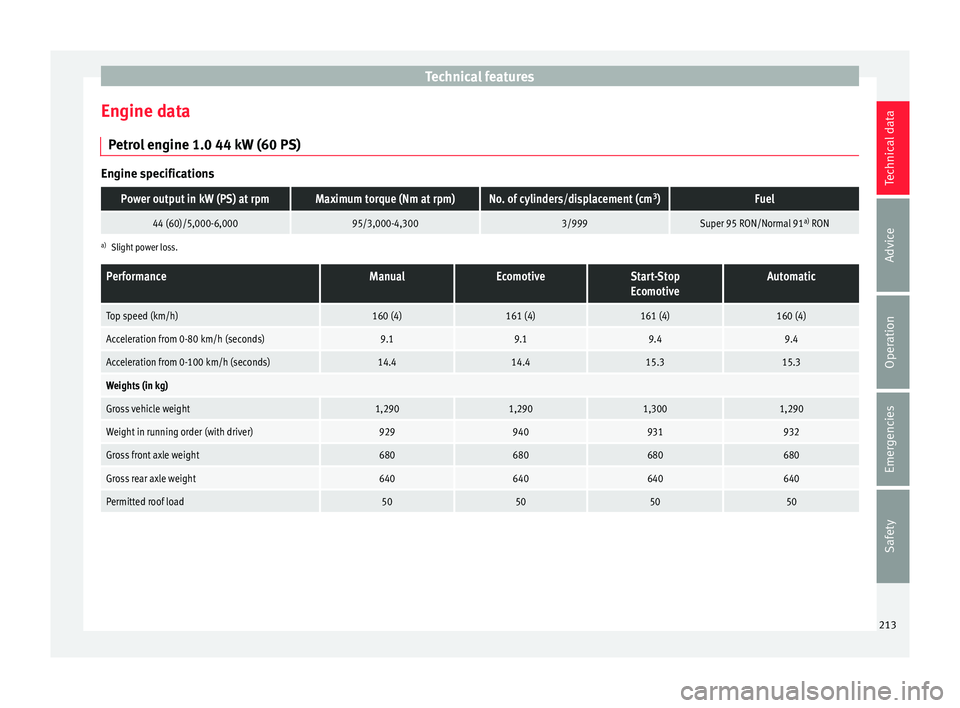
Engine data P etr
o
l engine 1.0 44 kW (60 PS) Engine specifications
Power output in kW (PS) at rpmMaximum torque (Nm at rpm)No. of cylinders/displacement (cm
3
)Fuel
44 (60)/5,000-6,00095/3,000-4,3003/999Super 95 RON/Normal 91 a)
RON
a) Slight power loss.
PerformanceManualEcomotiveStart-Stop
EcomotiveAutomatic
Top speed (km/h)160 (4)161 (4)161 (4)160 (4)
Acceleration from 0-80 km/h (seconds)9.19.19.49.4
Acceleration from 0-100 km/h (seconds)14.414.415.315.3
Weights (in kg)
Gross vehicle weight1,2901,2901,3001,290
Weight in running order (with driver)929940931932
Gross front axle weight680680680680
Gross rear axle weight640640640640
Permitted roof load50505050 213
Technical data
Advice
Operation
Emergencies
Safety
Page 216 of 232
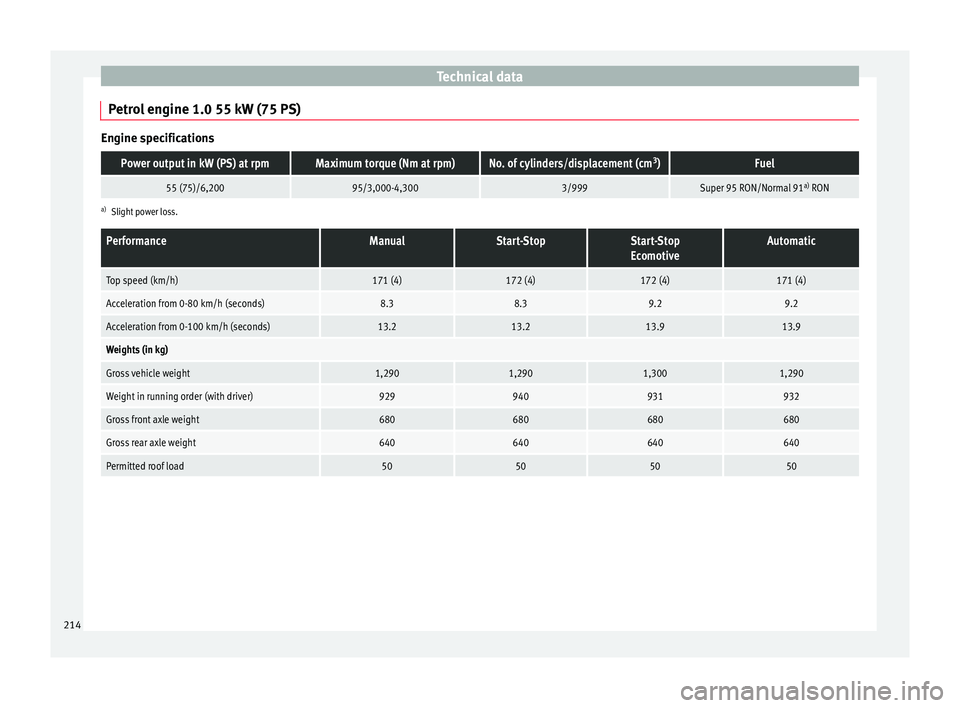
Technical data
Petrol engine 1.0 55 kW (75 PS) Engine specificationsPower output in kW (PS) at rpmMaximum torque (Nm at rpm)No. of cylinders/displacement (cm
3
)Fuel
55 (75)/6,20095/3,000-4,3003/999Super 95 RON/Normal 91 a)
RON
a) Slight power loss.
PerformanceManualStart-StopStart-Stop
EcomotiveAutomatic
Top speed (km/h)171 (4)172 (4)172 (4)171 (4)
Acceleration from 0-80 km/h (seconds)8.38.39.29.2
Acceleration from 0-100 km/h (seconds)13.213.213.913.9
Weights (in kg)
Gross vehicle weight1,2901,2901,3001,290
Weight in running order (with driver)929940931932
Gross front axle weight680680680680
Gross rear axle weight640640640640
Permitted roof load50505050 214
Page 217 of 232
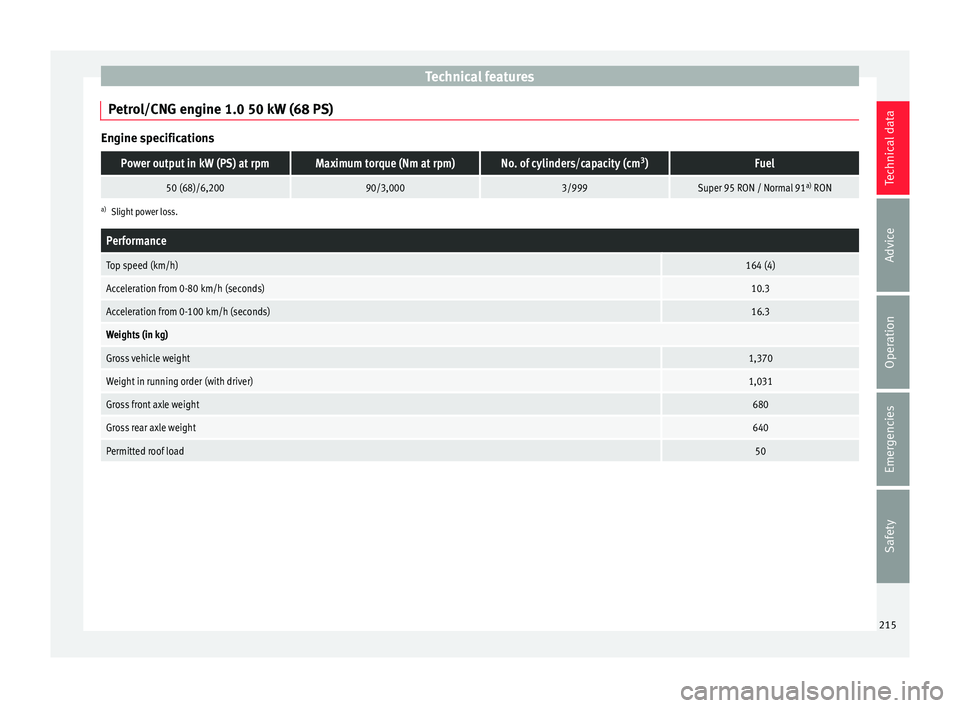
Technical features
Petrol/CNG engine 1.0 50 kW (68 PS) Engine specificationsPower output in kW (PS) at rpmMaximum torque (Nm at rpm)No. of cylinders/capacity (cm
3
)Fuel
50 (68)/6,20090/3,0003/999Super 95 RON / Normal 91 a)
RON
a) Slight power loss.
Performance
Top speed (km/h)164 (4)
Acceleration from 0-80 km/h (seconds)10.3
Acceleration from 0-100 km/h (seconds)16.3
Weights (in kg)
Gross vehicle weight1,370
Weight in running order (with driver)1,031
Gross front axle weight680
Gross rear axle weight640
Permitted roof load50 215
Technical data
Advice
Operation
Emergencies
Safety
Page 218 of 232
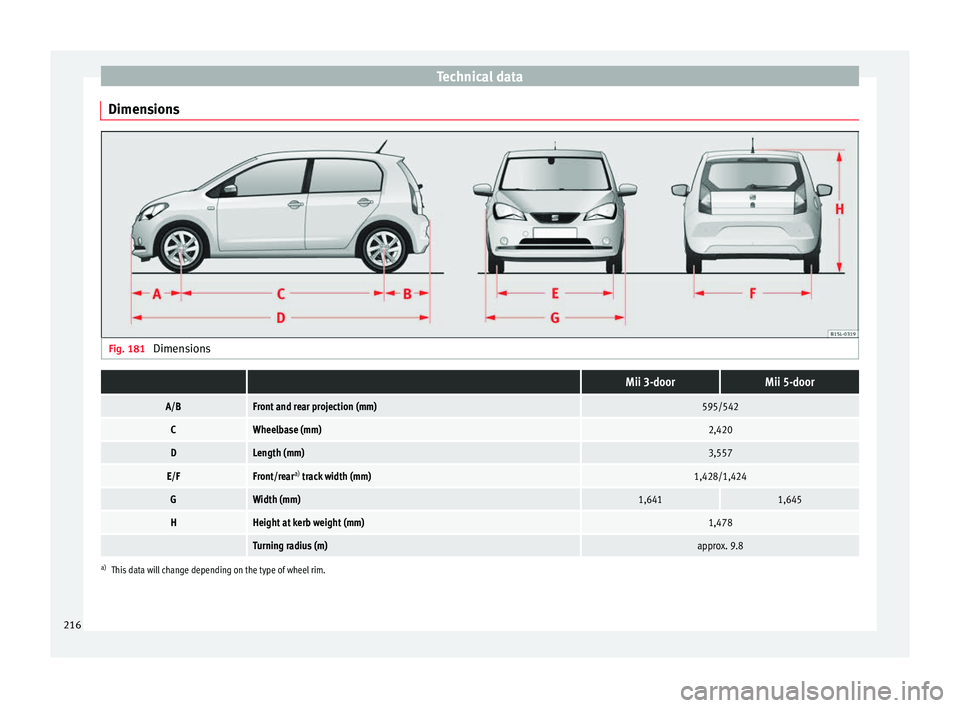
Technical data
Dimensions Fig. 181
Dimensions Mii 3-doorMii 5-door
A/BFront and rear projection (mm)595/542
CWheelbase (mm)2,420
DLength (mm)3,557
E/FFront/rear a)
track width (mm)1,428/1,424
GWidth (mm)1,6411,645
HHeight at kerb weight (mm)1,478
Turning radius (m)approx. 9.8
a) This data will change depending on the type of wheel rim.
216
Page 220 of 232
Index
Boot hatch emer g
ency
locking and unlocking . . . . . . . . . . . 10
Brake assist system . . . . . . . . . . . . . . . . . . . . . . . 139
Brake assist systems . . . . . . . . . . . . . . . . . . . . . . 139
brake fluid . . . . . . . . . . . . . . . . . . . . . . . . . . . . . . . . 33
Brake fluid specification . . . . . . . . . . . . . . . . . . . . . . . . . . . 194
Brakes . . . . . . . . . . . . . . . . . . . . . . . . . . . . . . . . . . 137 brake assist systems . . . . . . . . . . . . . . . . . . . . 139
brake fluid . . . . . . . . . . . . . . . . . . . . . . . . . . . . . 194
brake fluid level . . . . . . . . . . . . . . . . . . . . . . . . 194
brake pads . . . . . . . . . . . . . . . . . . . . . . . . . . . . 142
brake servo . . . . . . . . . . . . . . . . . . . . . . . . . . . . 142
changing the brake fluid . . . . . . . . . . . . . . . . . 194
control and warning lamps . . . . . . . . . . . . . . . 138
running in new brake pads . . . . . . . . . . . . . . . 142
Brake servo . . . . . . . . . . . . . . . . . . . . . . . . . 139, 142
Brake system fault . . . . . . . . . . . . . . . . . . . . . . . . . . . . . . . . . . 142
Brake systems . . . . . . . . . . . . . . . . . . . . . . . . . . . 139
Braking brake assist system . . . . . . . . . . . . . . . . . . . . . 139
Bulb fault see "Changing bulbs" . . . . . . . . . . . . . . . . . . . . 79
C Capacities . . . . . . . . . . . . . . . . . . . . . . . . . . . . . . . . 31 windscreen washer liquid . . . . . . . . . . . . . . . . 195
Capacity natural gas tank . . . . . . . . . . . . . . . . . . . . . . . . 185
Caring for paintwork . . . . . . . . . . . . . . . . . . . . . . . 173
Caring for the vehicle exterior . . . . . . . . . . . . . . . . . . . . . . . . . . . . . . . 171
Catalytic converter . . . . . . . . . . . . . . . . . . . . . . . . 152 control and warning lamps . . . . . . . . . . . . . . . 151
malfunction in the operation . . . . . . . . . . . . . . 152 CCS
see cruise c ontrol . . . . . . . . . . . . . . . . . . . . . . . . 24
Central locking . . . . . . . . . . . . . . . . . . . . . . . . . . . . 94 emergency locking . . . . . . . . . . . . . . . . . . . . . . . . 9
opening doors individually . . . . . . . . . . . . . . . . 95
Central locking system after airbag deployment . . . . . . . . . . . . . . . . . . 95
description . . . . . . . . . . . . . . . . . . . . . . . . . . . . . 95
remote control key . . . . . . . . . . . . . . . . . . . . . . . 95
Changes . . . . . . . . . . . . . . . . . . . . . . . . . . . . . . . . 165
Changing a wheel . . . . . . . . . . . . . . . . . . . . . . 36, 72 subsequent tasks . . . . . . . . . . . . . . . . . . . . . . . . 41
wheel bolts . . . . . . . . . . . . . . . . . . . . . . . . . . . . . 38
Changing bulbs . . . . . . . . . . . . . . . . . . . . . . . . . . . 79 front bumper . . . . . . . . . . . . . . . . . . . . . . . . . . . . 81
headlights . . . . . . . . . . . . . . . . . . . . . . . . . . . . . . 80
number plate light . . . . . . . . . . . . . . . . . . . . . . . 83
rear lights . . . . . . . . . . . . . . . . . . . . . . . . . . . . . . 82
side turn signal . . . . . . . . . . . . . . . . . . . . . . . . . . 84
Changing gear . . . . . . . . . . . . . . . . . . . . . . . . . . . 143 automatic gear change . . . . . . . . . . . . . . . . . . 145
control and warning lamps . . . . . . . . . . . . . . . 144
engaging the gears (automatic gearbox) . . . . 145
tiptronic . . . . . . . . . . . . . . . . . . . . . . . . . . . . . . . 146
Changing the blades . . . . . . . . . . . . . . . . . . . . . . . 75
Changing the wiper blades . . . . . . . . . . . . . . . . . . 45
Charging the battery . . . . . . . . . . . . . . . . . . . . . . . 43
Child safety seat securing with the seat belt . . . . . . . . . . . . . . . . 18
Child seats . . . . . . . . . . . . . . . . . . . . . . . . . . . . 16, 66 disabling the front passenger front airbag . . . . 15
ISOFIX system . . . . . . . . . . . . . . . . . . . . . . . . 18, 69
mounting child seats . . . . . . . . . . . . . . . . . . . . . 17
mounting systems . . . . . . . . . . . . . . . . . . . . . . . 17
on the front passenger seat . . . . . . . . . . . . . . . . 68
on the rear seats . . . . . . . . . . . . . . . . . . . . . . . . . 69 regulations . . . . . . . . . . . . . . . . . . . . . . . . . . . . . 67
safety
instructions . . . . . . . . . . . . . . . . . . . . 16, 65
top Tether system . . . . . . . . . . . . . . . . . . . . . . . . 19
transporting children in the vehicle . . . . . . . . . 67
weight categories . . . . . . . . . . . . . . . . . . . . . . . . 67
Cigarette lighter . . . . . . . . . . . . . . . . . . . . . . . . . . 120
City Safety Assist function . . . . . . . . . . . . . . . . . . 156 control and warning lamps . . . . . . . . . . . . . . . 157
function . . . . . . . . . . . . . . . . . . . . . . . . . . . . . . . 159
sensor . . . . . . . . . . . . . . . . . . . . . . . . . . . . . . . . 158
special driving situations . . . . . . . . . . . . . . . . . 159
Cleaning . . . . . . . . . . . . . . . . . . . . . . . . . . . . . . . . 170 compartments . . . . . . . . . . . . . . . . . . . . . . . . . 177
dash panel . . . . . . . . . . . . . . . . . . . . . . . . . . . . 178
engine compartment . . . . . . . . . . . . . . . . . . . . 175
fabrics . . . . . . . . . . . . . . . . . . . . . . . . . . . . . . . . 176
padding . . . . . . . . . . . . . . . . . . . . . . . . . . . . . . . 177
seatbelts . . . . . . . . . . . . . . . . . . . . . . . . . . . . . . 178
textile covers . . . . . . . . . . . . . . . . . . . . . . . . . . . 177
washing the vehicle . . . . . . . . . . . . . . . . . . . . . 171
washing the vehicle with high pressure clean-ers . . . . . . . . . . . . . . . . . . . . . . . . . . . . . . . . . 172
wheels . . . . . . . . . . . . . . . . . . . . . . . . . . . . . . . . 174
windows . . . . . . . . . . . . . . . . . . . . . . . . . . . . . . 172
Cleaning the vehicle high pressure cleaners . . . . . . . . . . . . . . . . . . . 172
climatronic air recirculation . . . . . . . . . . . . . . . . . . . . . . . . . . 28
Climatronic air distribution . . . . . . . . . . . . . . . . . . . . . . . . . . 28
AUTO (automatic mode) . . . . . . . . . . . . . . . . . . . 27blower . . . . . . . . . . . . . . . . . . . . . . . . . . . . . . . . . 28
controls . . . . . . . . . . . . . . . . . . . . . . . . . . . . . . . . 27
cooling mode . . . . . . . . . . . . . . . . . . . . . . . . . . . 27
disconnecting . . . . . . . . . . . . . . . . . . . . . . . . . . . 27
regulating the temperature . . . . . . . . . . . . . . . . 27
removing ice from the windows . . . . . . . . . . . . . 28
218
Page 227 of 232
Index
Storage compartments . . . . . . . . . . . . . . . . . . . . 116 driv er s
ide
. . . . . . . . . . . . . . . . . . . . . . . . . . . . . 116
Sunglasses storage compartment . . . . . . . . . . . 117
Sun protection . . . . . . . . . . . . . . . . . . . . . . . . . . . 108
Sun visors . . . . . . . . . . . . . . . . . . . . . . . . . . . . . . . 108
Switch hazard warning lights . . . . . . . . . . . . . . . . . . . 106
Switching lights off . . . . . . . . . . . . . . . . . . . . . . . 103
Switching lights on . . . . . . . . . . . . . . . . . . . . . . . 103
Switching the ignition on and off . . . . . . . . . . . . . 20
Symbols see control and warning lamps . . . . . . . . . . . . . 24
T TC see Brake assist systems . . . . . . . . . . . . . . . . . 140
Technical data axle loads . . . . . . . . . . . . . . . . . . . . . . . . . . . . . 211
engine oil specifications . . . . . . . . . . . . . . . . . 189
kerb weight . . . . . . . . . . . . . . . . . . . . . . . . . . . . 211
Roof load . . . . . . . . . . . . . . . . . . . . . . . . . . . . . . 129
total weight . . . . . . . . . . . . . . . . . . . . . . . . . . . . 211
tyre pressures . . . . . . . . . . . . . . . . . . . . . . . . . . 203
weights . . . . . . . . . . . . . . . . . . . . . . . . . . . . . . . 211
windscreen washer liquid amount . . . . . . . . . 195
windshield washer fluid container capacity . . . 31
Technical features . . . . . . . . . . . . . . . . . . . . . . . . 210
Technical modifications . . . . . . . . . . . . . . . . . . . . 165
Technical specifications dimensions . . . . . . . . . . . . . . . . . . . . . . . . . . . . 216
Temperature display liquid coolant temperature . . . . . . . . . . . . . . . . 24
temporary spare wheel snow chains . . . . . . . . . . . . . . . . . . . . . . . . . . . . 41
Tightening torque . . . . . . . . . . . . . . . . . . . . . . . . . 212 wheel bolts . . . . . . . . . . . . . . . . . . . . . . . . . . . . . 38
TIN . . . . . . . . . . . . . . . . . . . . . . . . . . . . . . . . . . . . . 208 Tiptronic . . . . . . . . . . . . . . . . . . . . . . . . . . . . . . . . 146
Top T
ether . . . . . . . . . . . . . . . . . . . . . . . . . . . . . . . . 19
Top Tether system . . . . . . . . . . . . . . . . . . . . . . . . . 19
Tow-starting . . . . . . . . . . . . . . . . . . . . . . . . . . . 43, 75
Towing bracket . . . . . . . . . . . . . . . . . . . . . . . . . . . 163 description . . . . . . . . . . . . . . . . . . . . . . . . . . . . 163
Towing the vehicle . . . . . . . . . . . . . . . . . 42, 75, 135 front towline anchorage . . . . . . . . . . . . . . . . . . . 77
special features . . . . . . . . . . . . . . . . . . . . . . . . . 76
tow bar . . . . . . . . . . . . . . . . . . . . . . . . . . . . . . . . 76
tow rope . . . . . . . . . . . . . . . . . . . . . . . . . . . . . . . 76
Towline anchorages . . . . . . . . . . . . . . . . . . . . . . . . 42
Traction control . . . . . . . . . . . . . . . . . . . . . . . . . . . 140
Traction control system . . . . . . . . . . . . . . . . . . . . 139
Traction Control (TC) . . . . . . . . . . . . . . . . . . . . . . . 140
Traction (tyres) . . . . . . . . . . . . . . . . . . . . . . . . . . . 208
Trailer . . . . . . . . . . . . . . . . . . . . . . . . . . . . . . . . . . 163
Transporting driving with the rear lid open . . . . . . . . . . . . . . 115
load . . . . . . . . . . . . . . . . . . . . . . . . . . . . . . . . . . 115
loaded vehicle . . . . . . . . . . . . . . . . . . . . . . . . . 115
Transporting children . . . . . . . . . . . . . . . . . . . . . . . 64
Transporting items fastening rings . . . . . . . . . . . . . . . . . . . . . . . . . 126
roof carrier . . . . . . . . . . . . . . . . . . . . . . . . . . . . . 127
roof carrier system . . . . . . . . . . . . . . . . . . . . . . 127
Transporting objects roof carrier system . . . . . . . . . . . . . . . . . . . . . . 129
Treadwear . . . . . . . . . . . . . . . . . . . . . . . . . . . . . . . 208
Turn signal convenience function . . . . . . . . . . . . 105
Turn signal lever . . . . . . . . . . . . . . . . . . . . . . 21, 105
Tyre load rating . . . . . . . . . . . . . . . . . . . . . . . . . . . 209
Tyre mobility set . . . . . . . . . . . . . . . . . . . . . . . . . . . 35 components . . . . . . . . . . . . . . . . . . . . . . . . . . . . 74
do not use . . . . . . . . . . . . . . . . . . . . . . . . . . . . . . 73
sealing a tyre . . . . . . . . . . . . . . . . . . . . . . . . . . . 74 Tyre Mobility Set
inflating a ty re . . . . . . . . . . . . . . . . . . . . . . . . . . . 74
Tyre Mobility System see Anti-puncture kit . . . . . . . . . . . . . . . . . . . . . 72
Tyre pressure spare wheel or temporary spare wheel . . . . . . 203
Tyre pressures . . . . . . . . . . . . . . . . . . . . . . . 203, 211
Tyre profile . . . . . . . . . . . . . . . . . . . . . . . . . . . . . . 204
Tyre repair . . . . . . . . . . . . . . . . . . . . . . . . . . . . . . . . 72
Tyre repair kit see Anti-puncture kit . . . . . . . . . . . . . . . . . . . . . 72
Tyres avoiding damage . . . . . . . . . . . . . . . . . . . . . . . 200
changing . . . . . . . . . . . . . . . . . . . . . . . . . . . . . . . 36
code . . . . . . . . . . . . . . . . . . . . . . . . . . . . . . . . . . 207
damage . . . . . . . . . . . . . . . . . . . . . . . . . . . . . . . 204
errors in wheel alignment . . . . . . . . . . . . . . . . 205
foreign bodies in the tyres . . . . . . . . . . . . . . . . 205
handling . . . . . . . . . . . . . . . . . . . . . . . . . . . . . . 200
interchanging tyres . . . . . . . . . . . . . . . . . . . . . 200
new . . . . . . . . . . . . . . . . . . . . . . . . . . . . . . . . . . 202
old . . . . . . . . . . . . . . . . . . . . . . . . . . . . . . . . . . . 201
replacing . . . . . . . . . . . . . . . . . . . . . . . . . . . . . . 202
run-out . . . . . . . . . . . . . . . . . . . . . . . . . . . . . . . . 205
serial number . . . . . . . . . . . . . . . . . . . . . . . . . . 208
snow chains . . . . . . . . . . . . . . . . . . . . . . . . . . . . 41
speed rating . . . . . . . . . . . . . . . . . . . . . . . . . . . 209
storing . . . . . . . . . . . . . . . . . . . . . . . . . . . . . . . . 201
technical details . . . . . . . . . . . . . . . . . . . . . . . . 207
tyre code . . . . . . . . . . . . . . . . . . . . . . . . . . . . . . 207
Tyre identification number (TIN) . . . . . . . . . . . 208
tyre load rating . . . . . . . . . . . . . . . . . . . . . . . . . 209
Tyre pressures . . . . . . . . . . . . . . . . . . . . . . . . . . 203
tyres with directional tread pattern . . . . . . . . . 200
valve caps . . . . . . . . . . . . . . . . . . . . . . . . . . . . . 204
wear . . . . . . . . . . . . . . . . . . . . . . . . . . . . . . . . . . 205
wear indicators . . . . . . . . . . . . . . . . . . . . . . . . . 204
225