oil Seat Mii 2016 Owner's Guide
[x] Cancel search | Manufacturer: SEAT, Model Year: 2016, Model line: Mii, Model: Seat Mii 2016Pages: 232, PDF Size: 4.9 MB
Page 177 of 232
Care and maintenance
De-icing the door lock cylinder To de-ice the lock cylinders, SEAT recommend
the use of
g
enuine SEAT spray with lubricat-
ing and anti-corrosive properties. CAUTION
The use of products containing degreasing
agent s
to de-ice the locks may rust the lock
cylinder. Protection of vehicle undercarriage
The vehicle underbody is coated to protect it
fr
om c
hemic
al and mechanical damage. The
protective coat on the undercarriage may
wear from use while driving. Therefore, SEAT
recommends that the protective coating on
the undercarriage and on the running gear
should be regularly checked, and repaired if
necessary. WARNING
Additional underseal or anti-corrosion prod-
ucts c
ould catch fire due to the high tempera-
tures reached by the exhaust gas system and
other engine components.
● Do not apply additional underseal or anti-
corro
sion products to the exhaust pipes, cat-
alytic converters, heat shields or other parts
of the vehicle which reach high temperatures. Cleaning the engine compartment
The engine compartment of any motor vehi-
cl
e i
s a potentially hazardous area
››› page 186.
The engine compartment should only be
cleaned by qualified personnel. If it is not
correctly cleaned, the anti-corrosion coating
and consequently electrical components may
be damaged. Moreover, water may filter di-
rectly into the vehicle interior through the wa-
ter chamber ››› .
If the en gine c
ompartment is very dirty, al-
ways take the vehicle to a specialised work-
shop for professional cleaning. SEAT recom-
mends taking your car in for technical serv-
ice.
Water box
The water box is in the engine compartment,
between the windscreen and the engine, and
beneath a perforated cover. Air is taken in
through the water box from outside to the ve-
hicle interior via the heating and air condi-
tioner.
Leaves and other loose objects should be
regularly cleaned away from the water box ei-
ther by hand or with a vacuum. WARNING
When working on the engine or in the engine
comp ar
tment, there is a risk of injury, burns,
accident or fire.
● Before starting work, please ensure you are
famili
ar with the required procedure and the
safety precautions ››› page 186.
● SEAT recommends getting a specialised
workshop t
o do these jobs. CAUTION
If water is manually poured into the water box
(e.g. u s
ing a high pressure cleaning appli-
ance), this could cause significant damage to
the vehicle. For the sake of the environment
Only wash the engine compartment in areas
al loc
ated for this purpose, to prevent dirty
water which may be contaminated by oil,
grease or fuel, from entering the drains. In
some places, even washing this compartment
outside planned areas for this purpose is
banned. 175
Technical data
Advice
Operation
Emergencies
Safety
Page 178 of 232
Advice
Caring for and cleaning the ve-
hic l
e int
erior
Introduction The dye from many items of modern clothing
(e.g. d
ark
jeans) is not always colour-fast.
Seat upholstery (material and leather), espe-
cially when light-coloured, may visibly discol-
our if the dye comes out of clothing (even
when used correctly). This is not an uphols-
tery defect but indicates that the dye in the
item of clothing is not sufficiently colour-fast. WARNING
Car-care products may be toxic and hazard-
ous. If c
ar care products are not suitable or
are used inappropriately, this could result in
accident, serious injury, burns or intoxica-
tion.
● Car care products must always be stored in
the original
container which should be kept
closed.
● Observe information provided by the manu-
factur
er.
● To prevent confusion, never store car care
products
in empty food cans, bottles or other
containers.
● Keep all care products out of reach of chil-
dren.
● Harmfu
l vapours may be produced when us-
ing car c
are products. Therefore, care prod- ucts should only be used in well-ventilated
sp
ac
es or in the open air.
● Never use fuel, turpentine, engine oil, ace-
tone or any
other volatile liquid to wash,
clean or care for the vehicle. These are toxic
and highly flammable. WARNING
Inappropriate care and cleaning of vehicle
c omponent s
may effect the vehicle safety
equipment, increasing the risk of severe in-
jury.
● Vehicle components should only be
cle
aned and maintained in accordance with
the manufacturer's instructions.
● Only use approved or recommended care
products. CAUTION
● Cle
aning products which contain solvents
will damage the material.
● To avoid damage, stubborn stains should
be remov
ed by a specialised workshop. Note
Suitable vehicle care products are available
from y
our technical service. How to care for the upholstery
To treat and maintain your seat upholstery,
keep the f
o
llowing in mind ››› :
● Before entering the vehicle, close any Vel-
cr o f
asteners that might snag on the uphols-
tery or trim fabric. Any open Velcro fasteners
may damage the trim or upholstery fabrics.
● To prevent damage, avoid direct contact
between sharp dec
orative objects and the
upholstery and trim fabrics. Decorative ob-
jects include zips, rivets and rhinestones on
clothing and belts.
● From time to time, clean the dust that gath-
ers in the per
forations, folds and seams so
that the surfaces of the seats are not dam-
aged by its abrasive effect.
● Make sure clothes are colour-fast to avoid
them running and s
taining the upholstery.
This is especially important if the upholstery
is light in colour. CAUTION
If the instructions for upholstery and trim
car e ar
e not followed, they may deteriorate
and discolour. Note
SEAT recommends you take the vehicle to a
Spec i
alised workshop to treat any stains on
the upholstery caused by the discolouration
of clothing. 176
Page 179 of 232
Care and maintenance
Cleaning padding and textile covers Normal cleaning
● Before applying cleaning products, please
re a
d the instructions for handling and the
warnings shown on the container.
● The upholstery, textile covers, and carpet
should be r
egularly vacuumed (with vacuum
brush).
● We recommend that you use a soft sponge
or lint-free, mic
ro-fibre cloth for normal clean-
ing ››› .
Gener al
s
uperficial dirt on upholstery and
textile covers can be cleaned with a normal
foam cleaning product.
If the upholstery and the material trims are
very dirty, we recommend you have them
cleaned by a specialist cleaning form.
Cleaning stains
It may be necessary to clean the whole sur-
face and not only the stain itself. Especially if
the surface has been dirtied through normal
use. Otherwise, the stained area may be-
come lighter than the rest of the surface after
treatment.
Type of
stainCleaning the vehicle
Water-based
stains, e.g.
coffee or fruit
juice.– Use a sponge and wipe with a solu-
tion of water and wool wash.
– Dry with a dry, absorbent cloth.
Persistent
stains, e.g.
chocolate or
make-up.– Apply a washing paste a)
directly to
the stain and allow it to work.
– Apply clean water using a sponge or
damp cloth to remove the cleaning
product deposits.
– Dry with a dry absorbent cloth.
Grease-based
stains, e.g. oil
or lipstick.– Apply neutral soap or cleaning
paste a)
and allow it to work.
– Remove dissolved grease or colour
particles with an absorbent cloth.
– Then apply clean water. Take care not
to soak the upholstery.
a) Bile soap can be used as a cleaning paste. CAUTION
● Brushe s
should only be used to clean the
mats and floor mat! Other surfaces may be
damaged if a brush is used.
● Do not use steam cleaning equipment, as
the dirt bec
omes more encrusted in the mate-
rial when steam is applied.
● Never use brushes for cleaning damp mate-
rial
as they could damage the surface. Cleaning storage compartments,
drink
s
ho
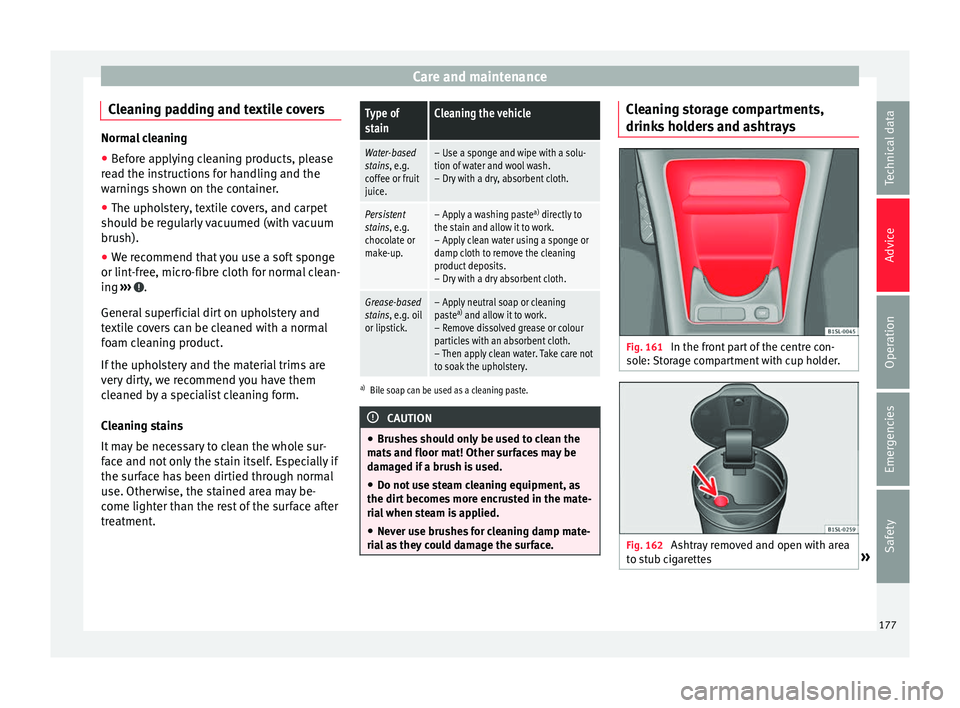
lders and ashtrays Fig. 161
In the front part of the centre con-
so l
e:
Storage compartment with cup holder. Fig. 162
Ashtray removed and open with area
t o s t
ub cigarettes » 177
Technical data
Advice
Operation
Emergencies
Safety
Page 190 of 232
Advice
parts of the engine. Before any work, re-
mov
e tie
s and jewellery (necklaces, etc),
tie long hair back and tie all items of
loose clothing to your body to make sure
that they cannot be trapped by engine
components.
– Take extreme caution when operating the
accelerator and remain attentive. The ve-
hicle could move, even if the handbrake
is applied.
● Always make sure you have not left any ob-
jects, s
uch as cleaning cloths and tools, in
the engine compartment. If any object is left
in the engine compartment, this could cause
malfunctions, engine faults and even a fire. WARNING
Refill liquids and certain materials can catch
fire e a
sily in the engine compartment, caus-
ing a fire and serious injury!
● Never smoke.
● Never work close to places exposed to
flames
or sparks.
● Never pour service fluids over the engine.
These fluid ma
y ignite hot engine parts and
cause injuries.
● If it is necessary to work on the fuel system
or the electrica
l system, please follow the in-
structions below:
–Always disconnect the vehicle battery.
– Never work close to heaters, heat sources
or places exposed to flames or sparks. ●
Alw a
ys keep a recently serviced and per-
fectly working fire extinguisher close by.
● Never cover the engine with additional in-
sul
ating materials such as a blanket. Risk of
fire! WARNING
If the bonnet is not correctly closed, it could
s ud den
ly open while driving leaving the driv-
er without visibility. This could result in a se-
rious accident.
● After closing the bonnet, always check that
it is
properly secured by the locking mecha-
nism in the lock carrier piece. The bonnet
must be flush with the surrounding body pan-
els.
● While driving, if you notice that the bonnet
is not
correctly closed then stop immediately
and close it correctly.
● Make sure the bonnet is opened and closed
safely
(when the engine is off, no smoke is
coming from the engine compartment, there
is enough space around the car, no people
are near, etc.). CAUTION
● When refi l
ling or changing service liquids,
ensure that you put the liquids into the right
tank. Making a mistake when refilling could
cause serious malfunctions and damage the
engine! ●
To av oid d
amage to the bonnet and to the
windscreen wiper arms, only open it when
the windscreen wipers are in place against
the windscreen.
● Before driving, always lower the wiper
arms. For the sake of the environment
Service fluids leaks are harmful to the envi-
r onment . F
or this reason you should make
regular checks on the ground underneath
your vehicle. Take the vehicle to a specialised
workshop to be checked if you see stains, oil
or other fluids on the ground. Collect any
spilt service fluids and allow a professional to
dispose of them. Engine oil
Intr oduction WARNING
Incorrectly handling engine oil can cause in-
jury and seriou
s burns.
● Always protect your eyes when handling
engine oil
.
● Oil is toxic and must be kept out of the
reac
h of children. 188
Page 191 of 232
Checking and refilling levels
●
Engine oi l
should only be kept in its origi-
nal packaging; the same goes for used oil un-
til it is disposed of.
● Never store engine oil in empty food con-
tainers
or bottles as other people may acci-
dentally drink it.
● Regular contact with engine oil can be bad
for the skin. If
you come into contact with en-
gine oil, wash your skin with soap and water.
● With the engine running, the engine oil
gets
extremely hot and can cause severe skin
burns. Always wait until the engine has fully
cooled. For the sake of the environment
Similar to the other service liquids, spilled
engine oi l
can be bad for the environment.
Collect these liquids in suitable containers
and dispose of them while respecting the en-
vironment. Warning and control lamps
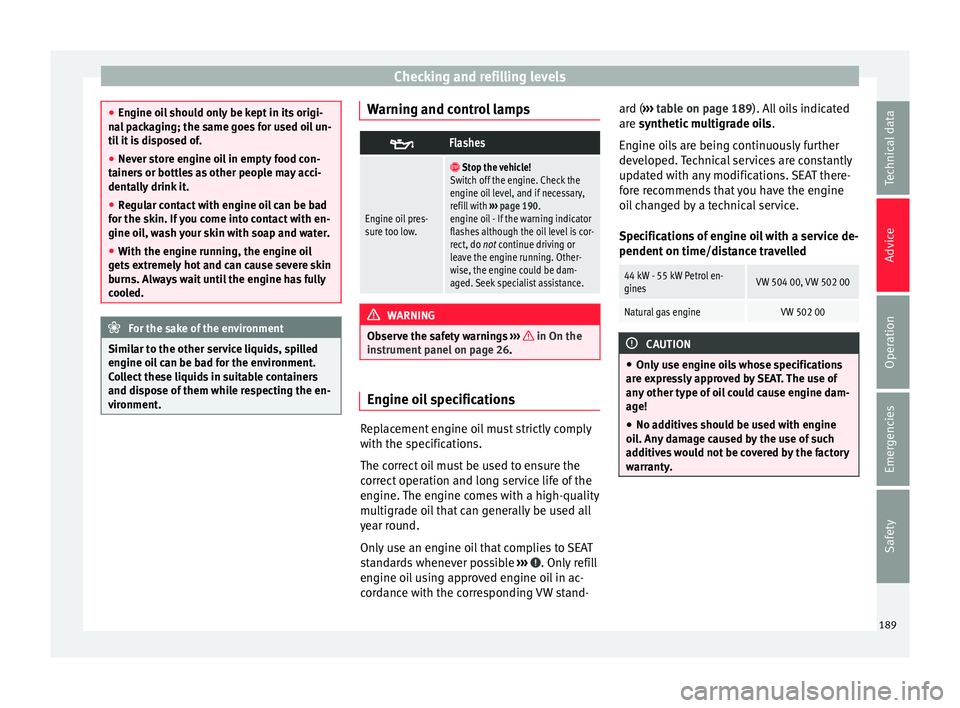
Flashes
Engine oil pres-
sure too low.
Stop the vehicle!
Switch off the engine. Check the
engine oil level, and if necessary,
refill with ››› page 190.
engine oil - If the warning indicator
flashes although the oil level is cor-
rect, do not continue driving or
leave the engine running. Other-
wise, the engine could be dam-
aged. Seek specialist assistance. WARNING
Observe the safety warnings ›››
in On the
ins trument
panel on page 26. Engine oil specifications
Replacement engine oil must strictly comply
w
ith the s
pec
ifications.
The correct oil must be used to ensure the
correct operation and long service life of the
engine. The engine comes with a high-quality
multigrade oil that can generally be used all
year round.
Only use an engine oil that complies to SEAT
standards whenever possible ››› . Only refill
en gine oi l
using approved engine oil in ac-
cordance with the corresponding VW stand- ard (
››› table on page 189). All oils indicated
ar
e synthetic multigrade oils .
Engine oils are being continuously further
developed. Technical services are constantly
updated with any modifications. SEAT there-
fore recommends that you have the engine
oil changed by a technical service.
Specifications of engine oil with a service de-
pendent on time/distance travelled
44 kW - 55 kW Petrol en-
ginesVW 504 00, VW 502 00
Natural gas engineVW 502 00 CAUTION
● Only u
se engine oils whose specifications
are expressly approved by SEAT. The use of
any other type of oil could cause engine dam-
age!
● No additives should be used with engine
oil. An
y damage caused by the use of such
additives would not be covered by the factory
warranty. 189
Technical data
Advice
Operation
Emergencies
Safety
Page 192 of 232
Advice
Checking engine oil level and topping
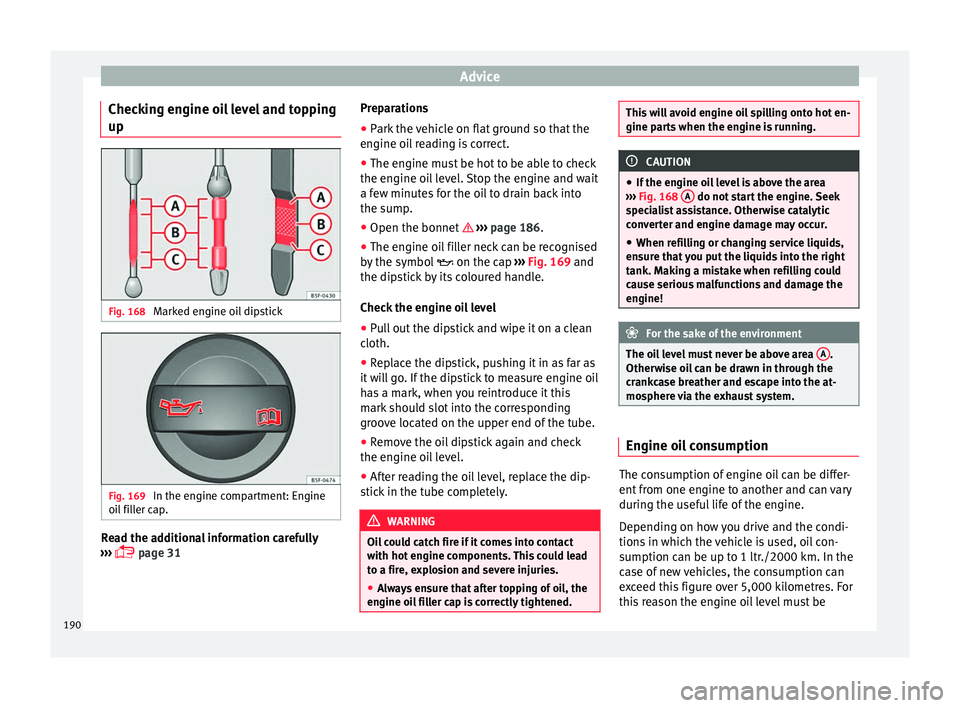
up Fig. 168
Marked engine oil dipstick Fig. 169
In the engine compartment: Engine
oi l
fi
ller cap. Read the additional information carefully
› ›
›
page 31 Preparations
●
Park the vehicle on flat ground so that the
engine oil
reading is correct.
● The engine must be hot to be able to check
the engine oil
level. Stop the engine and wait
a few minutes for the oil to drain back into
the sump.
● Open the bonnet ›››
page 186.
● The engine oil filler neck can be recognised
by the symbo
l on the cap ››› Fig. 169 and
the dipstick by its coloured handle.
Check the engine oil level
● Pull out the dipstick and wipe it on a clean
cloth.
● Rep
lace the dipstick, pushing it in as far as
it wi
ll go. If the dipstick to measure engine oil
has a mark, when you reintroduce it this
mark should slot into the corresponding
groove located on the upper end of the tube.
● Remove the oil dipstick again and check
the engine oil
level.
● After reading the oil level, replace the dip-
stick
in the tube completely. WARNING
Oil could catch fire if it comes into contact
with hot en
gine components. This could lead
to a fire, explosion and severe injuries.
● Always ensure that after topping of oil, the
engine oil
filler cap is correctly tightened. This will avoid engine oil spilling onto hot en-
gine par
t
s when the engine is running. CAUTION
● If the en gine oi
l level is above the area
››› Fig. 168 A do not start the engine. Seek
spec i
alist assistance. Otherwise catalytic
converter and engine damage may occur.
● When refilling or changing service liquids,
ensur
e that you put the liquids into the right
tank. Making a mistake when refilling could
cause serious malfunctions and damage the
engine! For the sake of the environment
The oil level must never be above area A .
Otherw i
se oil can be drawn in through the
crankcase breather and escape into the at-
mosphere via the exhaust system. Engine oil consumption
The consumption of engine oil can be differ-
ent
fr
om one en
gine to another and can vary
during the useful life of the engine.
Depending on how you drive and the condi-
tions in which the vehicle is used, oil con-
sumption can be up to 1 ltr./2000 km. In the
case of new vehicles, the consumption can
exceed this figure over 5,000 kilometres. For
this reason the engine oil level must be
190
Page 193 of 232
Checking and refilling levels
checked at regular intervals, preferably when
fi l
lin
g the tank and before a journey.
When the engine is working hard, for in-
stance during sustained high-speed motor-
way cruising in summer or when climbing
mountain passes, the oil level should pref-
erably be kept within area ››› Fig. 168 A .
Topping up engine oil Read the additional information carefully
›› ›
page 31.
The engine oil must be changed regularly ac-
cording to the specifications of the Mainte-
nance Programme.
Due to the problems linked with disposing of
used oil and the need for suitable tools and
special knowledge, always visit a specialised
workshop to have the engine oil and filter
changed. SEAT recommends taking your car
in for technical service.
Detailed information on the service intervals
is shown in the Maintenance Programme.
Engine oil additives make new oil darker after
the engine has been running for a short peri-
od. This is normal and does not mean more
frequent oil changes are required. WARNING
Only change the engine oil yourself if you
hav e the s
pecialist knowledge required!
● Before opening the bonnet, read and ob-
serve the w
arnings ››› page 186.
● Wait for the engine to cool down. Hot oil
may
cause burn injuries.
● Wear eye protection to avoid injuries, such
as ac
id burns, caused by splashes of oil.
● When removing the oil drain plug with your
finger
s, keep your arm horizontal to help pre-
vent oil from running down your arm.
● Wash your skin thoroughly if it comes into
contact
with engine oil.
● Engine oil is poisonous! Used oil must be
stor
ed in a safe place out of the reach of chil-
dren. CAUTION
No additives should be used with engine oil.
This c
ould result in engine damage. Any dam-
age caused by the use of such additives
would not be covered by the factory warranty. For the sake of the environment
Before changing the engine oil, find a suita-
bl e loc
ation or service for proper disposal. For the sake of the environment
Always dispose of engine oil with the utmost
re s
pect for the environment. Never dispose of used engine oil in places such as a garden,
wood
s, dr
ains, roads, paths, rivers and drain-
age systems. Engine coolant
Introduction WARNING
Engine coolant is toxic!
● Only keep engine coolant in its original
c ont ainer
, tightly shut and in a safe place.
● Never store engine coolant in empty food
container
s or bottles as other people may ac-
cidentally drink it.
● Always keep engine coolant out of reach of
chil
dren.
● Ensure that the proportion of engine cool-
ant ad
ditive corresponds to the lowest out-
side temperature to which the vehicle will be
exposed.
● If the outside temperature is extremely low,
the engine coo
lant could freeze causing the
vehicle to stop. As this would also cause the
heating to stop working, vehicle occupants
without warm clothing could freeze. For the sake of the environment
Coolants and additives can contaminate the
env ir
onment. If any fluids are spilled, they » 191
Technical data
Advice
Operation
Emergencies
Safety
Page 196 of 232
Advice
CAUTION
The original additives should never be mixed
with c oo
lants which are not approved by
SEAT. Otherwise, you run the risk of causing
severe damage to the engine and the engine
cooling system.
● If the fluid in the expansion tank is not pur-
ple b
ut is, for example, brown, this indicates
that the G13 additive has been mixed with an
inadequate coolant. The coolant must be
changed as soon as possible if this is the
case! This could result in serious faults and
engine damage. Brake fluid
Chec k
in
g the brake fluid levelRead the additional information carefully
› ›
›
page 33
In the course of time, the brake fluid absorbs
water from the ambient air. If there is too
much water in the brake fluid, the brake sys-
tem could be damaged. In addition, the boil-
ing point of the brake fluid is significantly
lowered. When the brake fluid contains too
much water and the brakes are subject to
considerable forces, bubbles of water vapour
can form in the system. These bubbles can
significantly reduce braking power, notably
increasing braking distance, and could even
result in the total failure of the brake system. Ensuring that the brake system is always
functionin
g correctly is essential for your own
safety and the safety of other road users
››› .
Br ak
e fluid s
pecifications
SEAT have developed a special brake fluid
optimised for the brake systems of their vehi-
cles. To ensure the optimum working of the
brake system, SEAT recommends the use of
brake fluid in accordance with the VW 501 14
standard. If this brake fluid is not available or
another brake fluid is used for different rea-
sons, use a brake fluid that complies with the
United States standard FMVSS 116 DOT 4 or
the German standard DIN ISO 4925 CLASS 4
››› .
Br ak
e fluid
s conforming to the standard
VW 501 14, fulfil the American requirements
of the FMVSS 116 DOT 4 standard and the
German DIN ISO 4925 CLASS 4 standard.
However, fluids that comply with the Ameri-
can FMVSS 116 DOT 4 standard or the Ger-
man DIN ISO 4925 CLASS 4 standard do not
necessarily comply with the VW 501 14
standard. Always check the information on
the brake fluid container and ensure that you
are using suitable brake fluid.
A suitable brake fluid can be obtained from
SEAT dealerships. Brake fluid level
The level
of the brake fluid should always be
between the MIN and MAX marks, or above
the MIN mark ››› .
It i
s
not always possible to check the level of
the brake fluid, as in some models the en-
gine components make it difficult to see the
brake fluid reservoir. If you cannot read the
exact brake fluid level, consult a specialist.
The brake fluid level drops slightly when the
vehicle is being used due to wear of the
brake pads and the automatic readjustment
of the brake.
Changing the brake fluid
The brake fluid should be changed in accord-
ance with the instructions given in the Main-
tenance Programme. Have the brake fluid
changed by a specialised workshop. SEAT
recommends taking your car in for technical
service. This means that only brake fluid
complying with the required specifications
will be used. WARNING
If the brake fluid level is low or unsuita-
bl e/o
ld brake fluid is used, the brake system
may fail or braking power may be reduced.
● Check the brake system and the brake fluid
level
regularly!194
Page 202 of 232
Advice
used in an emergency and with extreme cau-
tion.
Note
For technical reasons, it is not generally pos-
s ib l
e to use the wheels from other vehicles.
In some cases, this may also be true for the
same model of wheel. Please refer to the ve-
hicle documentation or ask at a technical
service. Handling tyres and wheels
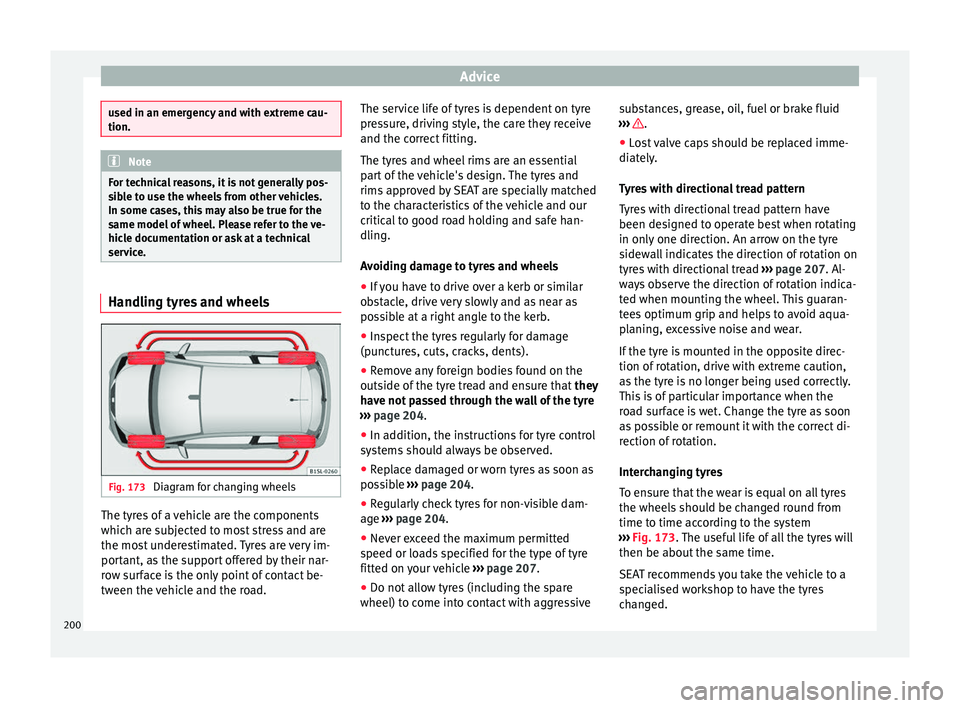
Fig. 173
Diagram for changing wheels The tyres of a vehicle are the components
whic
h ar
e s
ubjected to most stress and are
the most underestimated. Tyres are very im-
portant, as the support offered by their nar-
row surface is the only point of contact be-
tween the vehicle and the road. The service life of tyres is dependent on tyre
pres
sure, driving style, the care they receive
and the correct fitting.
The tyres and wheel rims are an essential
part of the vehicle's design. The tyres and
rims approved by SEAT are specially matched
to the characteristics of the vehicle and our
critical to good road holding and safe han-
dling.
Avoiding damage to tyres and wheels
● If you have to drive over a kerb or similar
obs
tacle, drive very slowly and as near as
possible at a right angle to the kerb.
● Inspect the tyres regularly for damage
(punct
ures, cuts, cracks, dents).
● Remove any foreign bodies found on the
outside of the ty
re tread and ensure that they
have not passed through the wall of the tyre
››› page 204.
● In addition, the instructions for tyre control
syst
ems should always be observed.
● Replace damaged or worn tyres as soon as
poss
ible ››› page 204.
● Regularly check tyres for non-visible dam-
age ››
› page 204.
● Never exceed the maximum permitted
speed or loa
ds specified for the type of tyre
fitted on your vehicle ››› page 207.
● Do not allow tyres (including the spare
wheel) to come int
o contact with aggressive substances, grease, oil, fuel or brake fluid
›››
.
● Lost valve caps should be replaced imme-
di at
ely
.
Tyres with directional tread pattern
Tyres with directional tread pattern have
been designed to operate best when rotating
in only one direction. An arrow on the tyre
sidewall indicates the direction of rotation on
tyres with directional tread ››› page 207. Al-
ways observe the direction of rotation indica-
ted when mounting the wheel. This guaran-
tees optimum grip and helps to avoid aqua-
planing, excessive noise and wear.
If the tyre is mounted in the opposite direc-
tion of rotation, drive with extreme caution,
as the tyre is no longer being used correctly.
This is of particular importance when the
road surface is wet. Change the tyre as soon
as possible or remount it with the correct di-
rection of rotation.
Interchanging tyres
To ensure that the wear is equal on all tyres
the wheels should be changed round from
time to time according to the system
››› Fig. 173. The useful life of all the tyres will
then be about the same time.
SEAT recommends you take the vehicle to a
specialised workshop to have the tyres
changed.
200
Page 203 of 232
Wheels and tyres
Tyres over 6 years old
T y
r
es are subject to an ageing process as a
result of physical and chemical processes.
This may affect their performance. Tyres
which are stored for long periods of time
without being used, harden and become
more fragile than tyres which are in constant
use.
SEAT recommends that tyres over six years
old are replaced with new tyres. This also ap-
plies to tyres (including the spare wheel)
which appear to be in perfect condition on
the outside and which have a tread depth
within the values stipulated by the Law ››› .
The d at
e of
manufacture, part of the tyre
identification number (TIN), indicates the age
of the tyre ( ) ››› page 207.
Storing tyres
Mark tyres when you remove them to indicate
the direction of rotation (left, right, forwards,
backwards). This ensures you will be able to
mount them correctly when you replace
them. When removed, the wheels and/or
tyres should be stored in a cool, dry and pref-
erably dark location. Do not place tyres
mounted on the wheel in a vertical position.
Protect tyres not mounted on wheels from
dirt by storing them in suitable bags and
standing them on the ground on their tread. WARNING
Aggressive fluids or substances could result
in v i
sible or invisible damage with the conse-
quent risks.
● Always ensure that tyres do not come into
contact
with chemical products, oil, grease,
fuel, brake fluid or other aggressive substan-
ces. WARNING
Old tyres, even if they have never been used,
ma y
lose air or burst unexpectedly while driv-
ing, resulting in serious accident or damage.
● If tyres are over six years old, they should
only be u
sed in an emergency and with ex-
treme caution. For the sake of the environment
Old tyres must be disposed of by qualified
personnel ac
cording to the laws in the coun-
try concerned. Wheels
The design of wheel bolts is matched to the
rims. If
diff
er
ent rims are fitted, the correct
wheel bolts with the right length and correct-
ly shaped bolt heads must be used. This en-
sures that wheels are fitted securely and that
the brake system functions correctly
››› page 72. For technical reasons, it is not generally pos-
sibl
e to use the wheels from other vehicles.
In some cases, this may also be true for the
same model of wheel.
The tyres and rims approved by SEAT are spe-
cially matched to the characteristics of the
vehicle and are critical to good road holding
and safe handling.
Wheel bolts
Wheel bolts must be tightened to the correct
torque ››› page 72.
Beadlock wheel rims
Beadlock wheel rims have various compo-
nents. These are joined together by special
bolts using a special procedure. This ensures
good performance, a better seal, improved
safety and wheel run out. Therefore, worn
rims should always be replaced and must on-
ly be repaired in a specialised workshop.
SEAT recommends visiting a technical service
››› .
Wheel rims
w
ith bolted trims
Wheel rims may be fitted with interchangea-
ble trim parts which are attached to the rim
using self-locking bolts. Worn trims should
only be replaced at a specialised workshop.
SEAT recommends visiting a technical service
››› .
»
201
Technical data
Advice
Operation
Emergencies
Safety