tow Seat Mii 2016 Owner's Guide
[x] Cancel search | Manufacturer: SEAT, Model Year: 2016, Model line: Mii, Model: Seat Mii 2016Pages: 232, PDF Size: 4.9 MB
Page 138 of 232
Operation
in the car in an emergency and not be able to
get
themselv
es to safety. For example, de-
pending on the time of the year, tempera-
tures inside a locked and closed vehicle can
be extremely high or extremely low resulting
in serious injuries and illness or even death,
particularly for young children.
● Never remove the key from the ignition if
the vehic
le is in motion. The steering may
lock and it will not be possible to turn the
steering wheel. CAUTION
● An attempt t
o start the engine while driving
or starting the engine immediately after turn-
ing it off can cause damage to the engine or
starter motor.
● When the engine is cold, avoid high revs
and heavy ac
celeration and do not make the
engine work hard.
● Do not push or tow start the engine. Un-
burnt f
uel could damage the catalytic con-
verter. For the sake of the environment
Do not warm the engine at idle speed; start
drivin g immedi
ately if the visibility is OK.
This helps the engine reach operating tem-
perature faster and reduces emissions. Note
● If the k ey
is left in the ignition lock with the
engine off for long periods, the vehicle bat-
tery will run flat.
● For automatic gearbox vehicles, the key can
only be r
emoved from the ignition lock if the
gear selector lever is in position N. In this
case, press and release the selector lever
locking button.
● Electrical devices with a high power con-
sumption are sw
itched off temporarily when
the engine starts.
● When the engine is started cold, there may
be stron
g vibrations for a few moments for
technical reasons. This is quite normal, and
no cause for concern.
● Natural gas engines always start up with
petrol, a
s a certain operating temperature is
required for running with gas. Once the re-
quired operating temperature is reached, the
engine will change to operate with natural
gas. Stopping the engine
Switching off the engine
– Stop the vehicle ››
›
.
– Turn the ignition key to position 1 ›››
Fig. 145. Engaging the steering wheel lock
In
v
ehic
les with automatic gearbox, the igni-
tion key can only be removed when the selec-
tor lever is in position N.
– Remove the key from the ignition in posi-
tion 1
› ››
Fig. 145
›
›› .
– Turn the steering wheel until you hear it en-
gag
e.
P
ossible vehicle theft is prevented with the
steering lock engaged. WARNING
Never switch off the engine while the vehicle
is mo
ving. You may lose control of the vehicle
and there is a risk of serious accident.
● The airbags and belt tensioners do not
work when the ignition i
s switched off.
● The brake servo does not work with the en-
gine off. T
o stop, the brake pedal must be
pressed with more force.
● As the power steering does not work if the
engine is
not running, you will need more
strength to steer than normally.
● If the key is removed from the ignition, the
steerin
g may lock and it will not be possible
to steer the vehicle. 136
Page 144 of 232
Operation
Additional information for steep slopes and
hi l
l
s
Before switching off the engine, rotate the
steering wheel so that if the vehicle should
move, it will be held by the kerb.
● On slopes, turn the front wheels so that
they are ag
ainst the edge of the kerb.
● Uphill, turn the wheels towards the centre
of the ro
ad. WARNING
The components of the exhaust system reach
ver y
high temperatures. This could cause a
fire and considerable damage.
● Always park your vehicle so that no part of
the exhau
st system can come in contact with
flammable materials (such as wood,
leaves,dried grass, or spilled fuel). CAUTION
● Spec i
al care should be taken when parking
in areas with high kerbs or fixed barriers. Ob-
jects protruding from the ground may dam-
age the bumper or other parts of the vehicle
during manoeuvres. To avoid damage, stop
before the wheels touch the barrier or kerb.
● Special attention is required when driving
through entranc
es, over ramps, kerbs or oth-
er objects. The vehicle underbody, bumpers,
mudguards and running gear, and the engine
and exhaust system could be damaged as
you drive over these objects. Information on the brakes
For the first 200 to 300 km, the new brak
e
p
ads have not yet reached their maximum
braking capacity, and need to be “run in”
first ››› . The slightly reduced braking effect
can be c ompen
sated for by increasing pres-
sure on the brake pedal. While running in,
the full braking distance or emergency brak-
ing distance is larger then when the brake
pads have been run in. While running in,
avoid full power braking or situations requir-
ing braking performance. For example, in
heavy traffic.
The rate of wear of the brake pads depends
to a great extent on the conditions in which
the vehicle is used and the way the vehicle is
driven. If the vehicle is used frequently in city
traffic or for short trips or driven sport style,
visit a specialised workshop regularly, more
frequently than advised in the Maintenance
Programme, to have the brake pads checked.
If you drive with wet brakes, for example, af-
ter crossing areas of water, in heavy rainfall
or even after washing the car, the effect of
the brakes is lessened as the brake discs are
wet or even frozen (in winter). At higher
speed, “dry” the brakes as quickly as possi-
ble by braking gently several times. Only do
this without endangering vehicles behind
you or any other road users ››› .
A l ay
er of salt on the discs and brake pads
will reduce the effectiveness of the brakes and increase braking distance. If you drive for
a prolon
ged period on salted roads without
braking then brake carefully several times to
eliminate the layer of salt on the brakes ››› .
If the
v
ehicle remains parked for considera-
ble lengths of time, is used little, or if the
brakes are not used, there may be corrosion
on the brake discs and a build up of dirt on
the brake pads. If the brakes are not used fre-
quently, or if rust has formed on the discs,
SEAT recommends cleaning the pads and
discs by braking firmly a few times at a mod-
erately high speed. Only do this without en-
dangering vehicles behind you or any other
road users ››› .
F au
lt
s in the brake system
During braking, if you notice that the vehicle
does not react as usual (that the braking dis-
tance has increased suddenly) it may be pos-
sible that there is a fault in the braking sys-
tem. This is indicated by the warning lamp
. Take the vehicle to a specialised work-
shop immediately and have the fault re-
paired. Drive at a moderate speed and be
prepared to use more pressure on the brake
pedal, and allow for longer stopping distan-
ces.
Brake servo
The brake servo only operates when the en-
gine is running and the pressure applied by
the driver on the brake pedal increases.
142
Page 145 of 232
Driving
If the brake servo does not operate or the ve-
hic l
e mu
st be towed, then the brake pedal
will have to be pressed with more force given
that the braking distance will be increased
when the brake servo does not operate ››› .
WARNING
New brake pads do not brake to full efficien-
cy.
● For the fir
st 320 km, new brake pads have
not y
et reached their maximum braking ca-
pacity, and need to be “run in” first. For this,
to compensate for reduced braking efficiency
the brake pedal will have to be pressed with
more force.
● To avoid losing control of the vehicle and
caus
ing serious accidents, always take great
care when driving with new brake pads.
● When running in new brake pads, always
res
pect the safety distances between you and
other vehicles and do not cause situations re-
quiring extreme braking performance. WARNING
When brakes overheat, braking is less effi-
cient and br
aking distances increase.
● When driving on slopes, brakes can be
overlo
aded and overheat quickly.
● Reduce speed or change down a gear when
faced w
ith steep and long slopes. This allows
you to use the engine braking effect and to
reduce the strain on the brake system. ●
Non-s t
andard or damaged front spoilers
could restrict the airflow to the brakes and
cause them to overheat. WARNING
Wet, frozen or salt-covered brakes take lon-
g er t o en
gage and this increases braking dis-
tances.
● Test the brakes carefully.
● Dry the brakes, free them of ice and salt by
brakin
g gently several times, when visibility,
weather, and road and traffic conditions per-
mit. WARNING
Driving without the brake servo may signifi-
cantly inc
rease the braking distance and re-
sult in a severe accident.
● Never allow the vehicle to move forwards
when the engine is
switched off.
● If the brake servo does not operate or the
vehicl
e must be towed, then the brake pedal
will have to be pressed with more force given
that the braking distance will be increased
when the brake servo does not operate. CAUTION
● Never m ak
e the brakes “slip” by pressing
the pedal gently, if it is not really necessary
to brake. Continuously pressing on the brake
pedal will heat the brakes. This could signifi-
cantly reduce braking power, increase brak- ing distance or even result in the total failure
of the br
ak
e system.
● Reduce speed or change down a gear when
faced w
ith steep and long slopes. This allows
you to use the engine braking effect and to
reduce the strain on the brake system. Other-
wise, the brakes may overheat and fail. Only
use the brakes to reduce speed or to stop. Note
Make use, when having the front brake pads
c hec k
ed, and have the rear pads checked al-
so. The thickness of the brake pads should be
checked visually and regularly, by looking
through the openings in the wheel rims or
from underneath the vehicle. If necessary, re-
move the wheels to check them thoroughly.
SEAT recommends taking your car in for tech-
nical service. Changing gear
Intr oduction When reverse gear is engaged and the igni-
tion i
s
sw
itched on the following takes place:
● Reverse lights light up.
● The rear wiper blade performs one move-
ment when the wind
screen wiper is activa-
ted. »
143
Technical data
Advice
Operation
Emergencies
Safety
Page 154 of 232
Operation
It lights up
Fault in the
emission control
system.Reduce speed and drive carefully to
the nearest specialised workshop to
have the engine checked.
Flashes
Combustion
fault which could
damage the cat-
alytic converter.Reduce speed and drive carefully to
the nearest specialised workshop to
have the engine checked.
Several warning and control lamps light up
f
or a f
ew sec
onds when the ignition is switch-
ed on, signalling that the function is being
verified. They will switch off after a few sec-
onds. CAUTION
Always pay attention to any lit control lamps
and to the c orr
esponding descriptions and in-
structions to avoid damage to the vehicle. Note
Whereas the control lamps may remain lit
or , ther
e may be engine problems, fuel
consumption may increase and the engine
may lose power Catalytic converter
The catalytic converter permits the subse-
quent tr
e
atment of the exhaust gases thus
reducing contaminating gas emissions. To
ensure a longer working life for the exhaust
system and catalytic converter in a petrol en-
gine:
● Always use unleaded petrol.
● Never run the fuel tank completely dry.
● Do not top up with too much engine oil
›››
page 188.
● Do not tow-start the vehicle; use the starter
cab l
es ›››
page 43.
If you should notice misfiring, uneven run-
ning or loss of power when the car is moving,
reduce speed immediately. Have the car in-
spected by a specialised workshop. If this
happens, unburnt fuel can enter the exhaust
system and escape into the atmosphere. The
catalytic converter can also be damaged by
overheating. For the sake of the environment
Even when the emission control system is
work in
g perfectly, there may be a smell of
sulphur under certain conditions. This de-
pends on the sulphur content of the fuel
used. Driving tips
Driv in
g abr
oad In some countries, certain safety regulations
and requir
ements
are in force relating to ex-
haust gas emissions, which differ from the
technical characteristics of the vehicle. Be-
fore travelling abroad, SEAT recommends you
consult a technical service about the legal re-
quirements and the following points:
● Does the vehicle need technical modifica-
tions f
or driving abroad, for example, adjust-
ment of the headlamps?
● Does the vehicle have all the tools, diag-
nostic
s equipment and spare parts required
for inspections and repairs?
● Are there any SEAT dealers in the destina-
tion countr
y?
● For petrol vehicles: Is unleaded petrol avail-
able at
the right octane rating?
● For diesel engines: is diesel fuel available
with a low s
ulphur content?
● Are a suitable engine oil ( ›››
page 188) and
other engine fluids complying with SEAT
specifications available in the destination
country?
● Are special tyres required in the destination
countr
y?
152
Page 161 of 232
Driver assistance systems
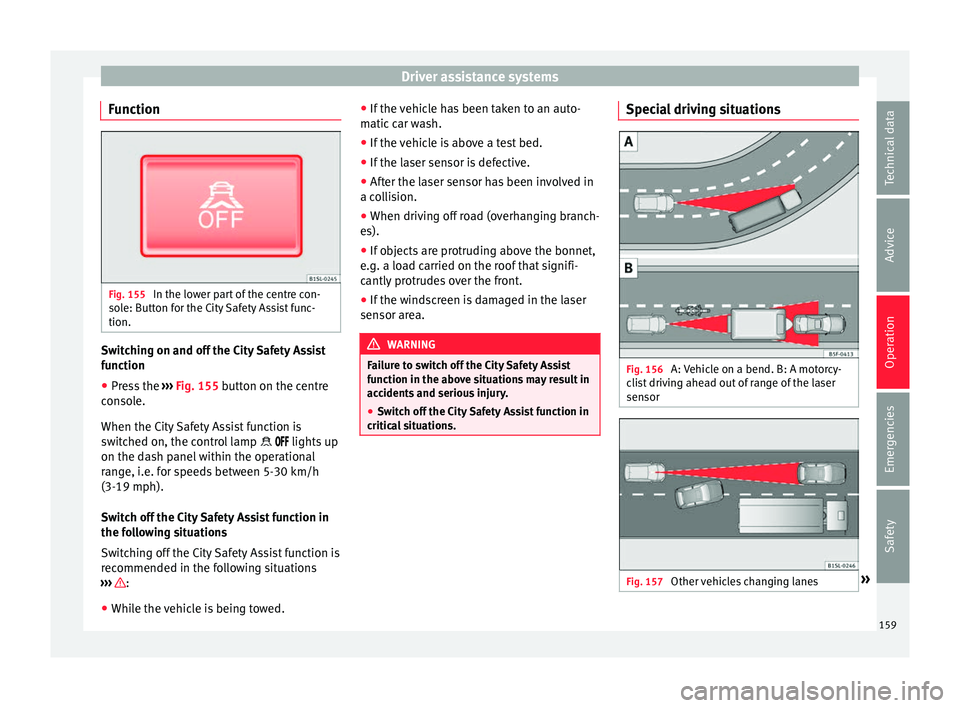
Function Fig. 155
In the lower part of the centre con-
so l
e: B
utton for the City Safety Assist func-
tion. Switching on and off the City Safety Assist
f
u
nction
● Pr
ess the ››› Fig. 155
button on the centre
console.
When the City Safety Assist function is
switched on, the control lamp lights up
on the dash panel within the operational
range, i.e. for speeds between 5-30 km/h
(3-19 mph).
Switch off the City Safety Assist function in
the following situations
Switching off the City Safety Assist function is
recommended in the following situations
››› :
● While the vehicle is being towed. ●
If the
v
ehicle has been taken to an auto-
matic car wash.
● If the vehicle is above a test bed.
● If the laser sensor is defective.
● After the laser sensor has been involved in
a col
lision.
● When driving off road (overhanging branch-
es).
● If o
bjects are protruding above the bonnet,
e.g. a loa
d carried on the roof that signifi-
cantly protrudes over the front.
● If the windscreen is damaged in the laser
sensor are
a. WARNING
Failure to switch off the City Safety Assist
fu nction in the abo
ve situations may result in
accidents and serious injury.
● Switch off the City Safety Assist function in
critica
l situations. Special driving situations
Fig. 156
A: Vehicle on a bend. B: A motorcy-
c li
s
t driving ahead out of range of the laser
sensor Fig. 157
Other vehicles changing lanes » 159
Technical data
Advice
Operation
Emergencies
Safety
Page 165 of 232
Towing bracket device
the corresponding control lamp on the instru-
ment p
anel
. Towing bracket device
Driv in
g w
ith a trailer
Information on driving with a trailer The vehicle is
not certified f
or trailer cou-
pling. The vehicle is not factory-equipped
with a towing bracket, nor is it possible to ret-
rofit it. WARNING
Installing a towing bracket on the vehicle
ma y
cause accidents and serious injuries
while operating the vehicle.
● Never install a towing bracket on the vehi-
cle.
● The tr
ailer may be released from the vehicle
when the vehic
le is moving. CAUTION
Any type of towing bracket installed on the
vehic l
e can cause serious and costly damage
that are not covered under the SEAT guaran-
tee. 163
Technical data
Advice
Operation
Emergencies
Safety
Page 169 of 232
Care and maintenance
The optimal reach of the equipment is only
ac hiev
ed w
ith an external aerial.
Check first with a specialised workshop that
understands the technical possibilities of in-
stallation if you wish to use a two-way radio
with a transmitting power of over 10 watts.
SEAT recommends taking your car in for tech-
nical service.
All legal requirements, together with the in-
structions for the use of two-way radios must
be observed. WARNING
If the two-way radio is not securely fastened
in pos ition, it
could be sent flying around the
vehicle in the event of sharp braking, sudden
manoeuvres or accident, causing injury.
● While driving, two-way radios must be se-
curely
fastened in position, outside the air-
bags deployment zones, or safely stowed
away. WARNING
When using a two-way radio without a con-
nection to an e xt
erior aerial, the maximum
permitted levels of electromagnetic radiation
may be exceeded. This is also the case if the
aerial has not been correctly installed.
● You should only use a two-way radio inside
the vehic
le if it has first been correctly con-
nected to an exterior aerial. Information stored by the control
u
nit
s Your vehicle is fitted at the factory with a ser-
ies
of
electronic control units responsible for
the engine and gearbox management. In ad-
dition, the control units supervise the per-
formance of the exhaust gas system and the
airbag systems.
Therefore, while the vehicle is being driven,
these electronic control units are continuous-
ly analysing the vehicle data. In the event of
faults or deviations from the theoretical val-
ues, only this data is stored. Normally, the
warning lamps on the instrument panel light
up in the event of faults.
This data can only be read and analysed us-
ing special equipment.
The storing of the data allows specialised
workshops to detect and repair faults. Stored
data may include:
● Data relating to the engine or the gearbox
● Speed
● Direction of travel
● Braking force
● Detection of seat belt
The v ehic
le control units never record conver-
sations held by passengers in the vehicle.
In vehicles equipped with an emergency call
function via the mobile phone or other appli- ances connected in the vehicle, it is possible
to send the v
ehicle position. If the control
unit records an accident with airbag activa-
tion, the system may automatically send a
signal. This will depend on the network oper-
ator. Normally, transmission is only possible
in areas with good coverage.
Event Data Recorder
The vehicle is not fitted with an event data re-
corder.
An event data recorder temporarily stores the
vehicle information. Therefore, in the event of
an accident, it is possible to obtain detailed
information about how the accident occur-
red. Vehicles with airbag systems can store
data relating to impact speed, seat belt sta-
tus, seat positions and airbag activation
times may be stored, etc. The volume of data
depends on the manufacturer.
Event data recorders can only be mounted
with authorisation from the vehicle owner
and, in some countries, they are governed by
local legislation.
Reprogramming control units
On the whole, all the data required for the
component management is stored in the con-
trol units. The programming of certain con-
venience functions, such as the turn signals,
individual door opening and instructions on
the display can be modified using special »
167
Technical data
Advice
Operation
Emergencies
Safety
Page 212 of 232
Technical data
Technical data
T ec
hnic
al features
Important information Introduction The information in the vehicle documentation
alwa
y
s takes precedence over the informa-
tion in this Instruction Manual.
All technical specifications provided in this
documentation are valid for the standard
model in Spain. The vehicle data card inclu-
ded in the Maintenance Programme or the
vehicle registration documents shows which
engine is installed in the vehicle.
The figures may be different depending
whether additional equipment is fitted, for
different models, for special vehicles and for
other countries. Abbreviations used in the Technical Specifi-
cation
s
section
kWKilowatt, engine power measurement.
PSPferdestärke (horsepower), formerly
used to denote engine power.
rpmRevolutions per minute - engine speed.
NmNewton metres, unit of engine torque.
CZCetane number, indication of the diesel
combustion power.
RONResearch octane number, indication of
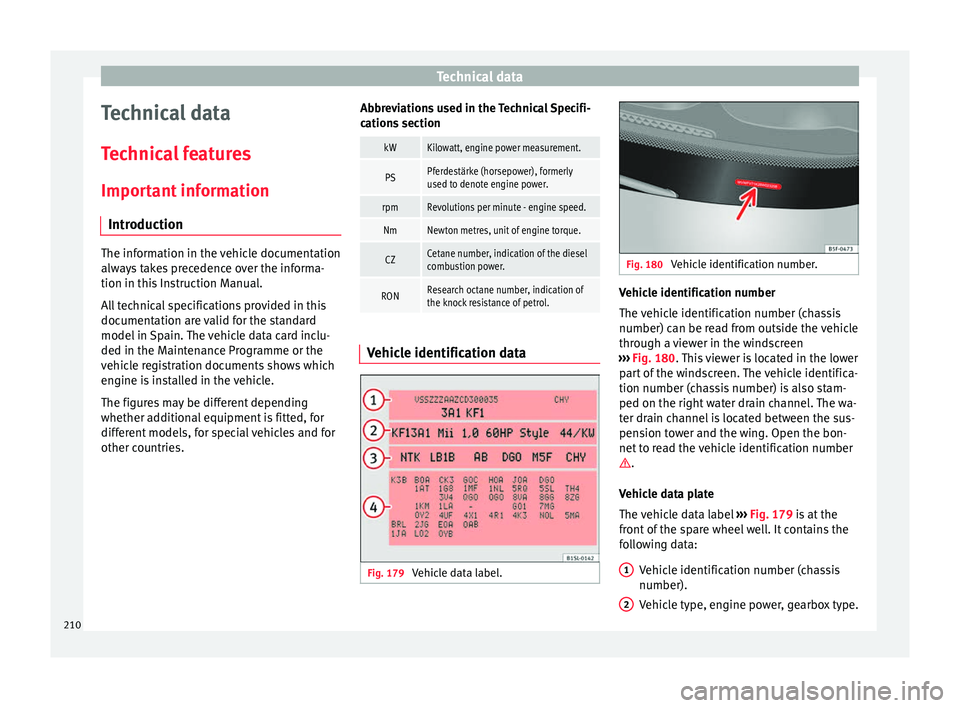
the knock resistance of petrol. Vehicle identification data
Fig. 179
Vehicle data label. Fig. 180
Vehicle identification number. Vehicle identification number
The
v
ehic
le identification number (chassis
number) can be read from outside the vehicle
through a viewer in the windscreen
››› Fig. 180. This viewer is located in the lower
part of the windscreen. The vehicle identifica-
tion number (chassis number) is also stam-
ped on the right water drain channel. The wa-
ter drain channel is located between the sus-
pension tower and the wing. Open the bon-
net to read the vehicle identification number
.
Vehicle data plate
The vehicle data label ››› Fig. 179 is at the
front of the spare wheel well. It contains the
following data:
Vehicle identification number (chassis
number).
Vehicle type, engine power, gearbox type.
1 2
210
Page 222 of 232
Index
tyre pressure . . . . . . . . . . . . . . . . . . . . . . . . . . . 203
w ind
s
creen washer bottle . . . . . . . . . . . . . . . . 173
Driving safety . . . . . . . . . . . . . . . . . . . . . . . . . . . . . 47
Driving through water . . . . . . . . . . . . . . . . . . . . . 153
Driving tips for a loaded vehicle . . . . . . . . . . . . . . . . . . . . . 114
Duplicate keys . . . . . . . . . . . . . . . . . . . . . . . . . . . . 92
Dust filter . . . . . . . . . . . . . . . . . . . . . . . . . . . . . . . 133
Dynamic headlight range control . . . . . . . . . . . . 107
E E10 see Ethanol (fuel) . . . . . . . . . . . . . . . . . . . . . . . 181
EDL see Electronic differential lock . . . . . . . . . . . . . 139
EDS see "Brake assist systems" . . . . . . . . . . . . . . . 140
Electric windows . . . . . . . . . . . . . . . . . . . . . . . . . . . . . . . 11
Electrical devices . . . . . . . . . . . . . . . . . . . . 121, 122
Electric windows . . . . . . . . . . . . . . . . . . . . . . . . . . . 11 buttons . . . . . . . . . . . . . . . . . . . . . . . . . . . . . . . 101
closing . . . . . . . . . . . . . . . . . . . . . . . . . . . . . . . . 101
opening . . . . . . . . . . . . . . . . . . . . . . . . . . . . . . . 101
see Windows . . . . . . . . . . . . . . . . . . . . . . . . . . . 101
Electronic differential lock . . . . . . . . . . . . . . . . . . 139
Electronic immobiliser . . . . . . . . . . . . . . . . . . . . . 137 operating fault . . . . . . . . . . . . . . . . . . . . . . . . . 135
Electronic Stability Control (ESC) . . . . . . . . . . . . 139
Emergencies . . . . . . . . . . . . . . . . . . . . . . . . . . . . . . 70 bulbs . . . . . . . . . . . . . . . . . . . . . . . . . . . . . . . . . . 35
changing a wheel . . . . . . . . . . . . . . . . . . . . . . . . 36
emergency towing of the vehicle . . . . . . . . . . . . 42
fire extinguishers . . . . . . . . . . . . . . . . . . . . . . . . 70
first aid kit . . . . . . . . . . . . . . . . . . . . . . . . . . . . . . 70
fuses . . . . . . . . . . . . . . . . . . . . . . . . . . . . . . . . . . 34
hazard warning lights . . . . . . . . . . . . . . . . . . . 106 Jump leads . . . . . . . . . . . . . . . . . . . . . . . . . . . . . 43
punct
ure . . . . . . . . . . . . . . . . . . . . . . . . . . . . . . . 35
replacing a blown fuse . . . . . . . . . . . . . . . . . . . . 34
vehicle tool kit . . . . . . . . . . . . . . . . . . . . . . . . . . 70
warning triangle . . . . . . . . . . . . . . . . . . . . . . . . . 70
Emergency closing or opening driver door . . . . . . . . . . . . . . . . . . . . . . . . . . . . . . 8
passenger door . . . . . . . . . . . . . . . . . . . . . . . . . . . 9
Emergency locking and unlocking . . . . . . . . . . . . 77
Emergency unlocking boot hatch . . . . . . . . . . . . . . . . . . . . . . . . . . . . . . 10
Emergency unlocking the boot hatch boot hatch . . . . . . . . . . . . . . . . . . . . . . . . . . . . . . 10
Emission control system control and warning lamps . . . . . . . . . . . . . . . 151
Emissions data . . . . . . . . . . . . . . . . . . . . . . . . . . . 210
Engine assisted starting . . . . . . . . . . . . . . . . . . . . . . . . . 43
noises . . . . . . . . . . . . . . . . . . . . . . . . . . . . . . . . 136
running in . . . . . . . . . . . . . . . . . . . . . . . . . . . . . 148
start-Stop system . . . . . . . . . . . . . . . . . . . . . . . 161
Engine and ignition . . . . . . . . . . . . . . . . . . . . . . . 135 12 Volt sockets . . . . . . . . . . . . . . . . . . . . . . . . . 122
ignition lock . . . . . . . . . . . . . . . . . . . . . . . . . . . 135
immobiliser . . . . . . . . . . . . . . . . . . . . . . . . . . . . 137
starting the engine . . . . . . . . . . . . . . . . . . . . . . 135
stopping the engine . . . . . . . . . . . . . . . . . . . . . 136
unauthorised vehicle key . . . . . . . . . . . . . . . . . 135
Engine compartment . . . . . . . . . . . . . . . . . . 10, 186 battery . . . . . . . . . . . . . . . . . . . . . . . . . . . . 33, 196
brake fluid . . . . . . . . . . . . . . . . . . . . . . . . . 33, 194
coolant . . . . . . . . . . . . . . . . . . . . . . . . . . . 32, 191
engine oil . . . . . . . . . . . . . . . . . . . . . 31, 190, 191
windscreen washer reservoir . . . . . . . . . . 33, 195
Engine coolant . . . . . . . . . . . . . . . . . . . . . . . . . . . . 32 checking the level . . . . . . . . . . . . . . . . . . . . . . . 191
G 12 plus-plus . . . . . . . . . . . . . . . . . . . . . . . . . . 32 G 13 . . . . . . . . . . . . . . . . . . . . . . . . . . . . . . . . . . . 32
specific
ations . . . . . . . . . . . . . . . . . . . . . . . . . . . 32
temperature display . . . . . . . . . . . . . . . . . . . . . 192
Engine data . . . . . . . . . . . . . . . . . . . . . . . . . . . . . . 213
Engine management . . . . . . . . . . . . . . . . . . . . . . 151 control lamps . . . . . . . . . . . . . . . . . . . . . . . . . . 151
Engine oil . . . . . . . . . . . . . . . . . . . . . . . . . . . 31, 188 changing . . . . . . . . . . . . . . . . . . . . . . . . . . . . . . 188
checking oil level . . . . . . . . . . . . . . . . . . . . . . . 190
consumption . . . . . . . . . . . . . . . . . . . . . . . . . . . 190
control and warning lamps . . . . . . . . . . . . . . . 189
dipstick . . . . . . . . . . . . . . . . . . . . . . . . . . . . . . . 190
oil properties . . . . . . . . . . . . . . . . . . . . . . . . . . . 32
specifications . . . . . . . . . . . . . . . . . . . . . . . . . . 189
topping up . . . . . . . . . . . . . . . . . . . . . . . . . . . . 191
Environment environmental compatibility . . . . . . . . . . . . . . 149
Environmental ecological driving . . . . . . . . . . . . . . . . . . . . . . . 149
Environmental tips refuelling . . . . . . . . . . . . . . . . . . . . . . . . . . . . . . 185
Equipment . . . . . . . . . . . . . . . . . . . . . . . . . . . . . . 164 safety . . . . . . . . . . . . . . . . . . . . . . . . . . . . . . . . . . 60
ESC electronic stability control . . . . . . . . . . . . . . . . 139
Ethanol (fuel) . . . . . . . . . . . . . . . . . . . . . . . . . . . . 181
Event Data Recorder . . . . . . . . . . . . . . . . . . . . . . . 167
Exhaust gas purification system . . . . . . . . . . . . . 151
Exterior mirrors adjusting . . . . . . . . . . . . . . . . . . . . . . . . . . . . . . . 13
vehicle care . . . . . . . . . . . . . . . . . . . . . . . . . . . . 172
Exterior rear view mirrors control of the function . . . . . . . . . . . . . . . . . . . 112
electric exterior mirrors . . . . . . . . . . . . . . . . . . 112
exterior . . . . . . . . . . . . . . . . . . . . . . . . . . . . . . . 111
Exterior view . . . . . . . . . . . . . . . . . . . . . . . . . . . . . 5, 6
220
Page 227 of 232
Index
Storage compartments . . . . . . . . . . . . . . . . . . . . 116 driv er s
ide
. . . . . . . . . . . . . . . . . . . . . . . . . . . . . 116
Sunglasses storage compartment . . . . . . . . . . . 117
Sun protection . . . . . . . . . . . . . . . . . . . . . . . . . . . 108
Sun visors . . . . . . . . . . . . . . . . . . . . . . . . . . . . . . . 108
Switch hazard warning lights . . . . . . . . . . . . . . . . . . . 106
Switching lights off . . . . . . . . . . . . . . . . . . . . . . . 103
Switching lights on . . . . . . . . . . . . . . . . . . . . . . . 103
Switching the ignition on and off . . . . . . . . . . . . . 20
Symbols see control and warning lamps . . . . . . . . . . . . . 24
T TC see Brake assist systems . . . . . . . . . . . . . . . . . 140
Technical data axle loads . . . . . . . . . . . . . . . . . . . . . . . . . . . . . 211
engine oil specifications . . . . . . . . . . . . . . . . . 189
kerb weight . . . . . . . . . . . . . . . . . . . . . . . . . . . . 211
Roof load . . . . . . . . . . . . . . . . . . . . . . . . . . . . . . 129
total weight . . . . . . . . . . . . . . . . . . . . . . . . . . . . 211
tyre pressures . . . . . . . . . . . . . . . . . . . . . . . . . . 203
weights . . . . . . . . . . . . . . . . . . . . . . . . . . . . . . . 211
windscreen washer liquid amount . . . . . . . . . 195
windshield washer fluid container capacity . . . 31
Technical features . . . . . . . . . . . . . . . . . . . . . . . . 210
Technical modifications . . . . . . . . . . . . . . . . . . . . 165
Technical specifications dimensions . . . . . . . . . . . . . . . . . . . . . . . . . . . . 216
Temperature display liquid coolant temperature . . . . . . . . . . . . . . . . 24
temporary spare wheel snow chains . . . . . . . . . . . . . . . . . . . . . . . . . . . . 41
Tightening torque . . . . . . . . . . . . . . . . . . . . . . . . . 212 wheel bolts . . . . . . . . . . . . . . . . . . . . . . . . . . . . . 38
TIN . . . . . . . . . . . . . . . . . . . . . . . . . . . . . . . . . . . . . 208 Tiptronic . . . . . . . . . . . . . . . . . . . . . . . . . . . . . . . . 146
Top T
ether . . . . . . . . . . . . . . . . . . . . . . . . . . . . . . . . 19
Top Tether system . . . . . . . . . . . . . . . . . . . . . . . . . 19
Tow-starting . . . . . . . . . . . . . . . . . . . . . . . . . . . 43, 75
Towing bracket . . . . . . . . . . . . . . . . . . . . . . . . . . . 163 description . . . . . . . . . . . . . . . . . . . . . . . . . . . . 163
Towing the vehicle . . . . . . . . . . . . . . . . . 42, 75, 135 front towline anchorage . . . . . . . . . . . . . . . . . . . 77
special features . . . . . . . . . . . . . . . . . . . . . . . . . 76
tow bar . . . . . . . . . . . . . . . . . . . . . . . . . . . . . . . . 76
tow rope . . . . . . . . . . . . . . . . . . . . . . . . . . . . . . . 76
Towline anchorages . . . . . . . . . . . . . . . . . . . . . . . . 42
Traction control . . . . . . . . . . . . . . . . . . . . . . . . . . . 140
Traction control system . . . . . . . . . . . . . . . . . . . . 139
Traction Control (TC) . . . . . . . . . . . . . . . . . . . . . . . 140
Traction (tyres) . . . . . . . . . . . . . . . . . . . . . . . . . . . 208
Trailer . . . . . . . . . . . . . . . . . . . . . . . . . . . . . . . . . . 163
Transporting driving with the rear lid open . . . . . . . . . . . . . . 115
load . . . . . . . . . . . . . . . . . . . . . . . . . . . . . . . . . . 115
loaded vehicle . . . . . . . . . . . . . . . . . . . . . . . . . 115
Transporting children . . . . . . . . . . . . . . . . . . . . . . . 64
Transporting items fastening rings . . . . . . . . . . . . . . . . . . . . . . . . . 126
roof carrier . . . . . . . . . . . . . . . . . . . . . . . . . . . . . 127
roof carrier system . . . . . . . . . . . . . . . . . . . . . . 127
Transporting objects roof carrier system . . . . . . . . . . . . . . . . . . . . . . 129
Treadwear . . . . . . . . . . . . . . . . . . . . . . . . . . . . . . . 208
Turn signal convenience function . . . . . . . . . . . . 105
Turn signal lever . . . . . . . . . . . . . . . . . . . . . . 21, 105
Tyre load rating . . . . . . . . . . . . . . . . . . . . . . . . . . . 209
Tyre mobility set . . . . . . . . . . . . . . . . . . . . . . . . . . . 35 components . . . . . . . . . . . . . . . . . . . . . . . . . . . . 74
do not use . . . . . . . . . . . . . . . . . . . . . . . . . . . . . . 73
sealing a tyre . . . . . . . . . . . . . . . . . . . . . . . . . . . 74 Tyre Mobility Set
inflating a ty re . . . . . . . . . . . . . . . . . . . . . . . . . . . 74
Tyre Mobility System see Anti-puncture kit . . . . . . . . . . . . . . . . . . . . . 72
Tyre pressure spare wheel or temporary spare wheel . . . . . . 203
Tyre pressures . . . . . . . . . . . . . . . . . . . . . . . 203, 211
Tyre profile . . . . . . . . . . . . . . . . . . . . . . . . . . . . . . 204
Tyre repair . . . . . . . . . . . . . . . . . . . . . . . . . . . . . . . . 72
Tyre repair kit see Anti-puncture kit . . . . . . . . . . . . . . . . . . . . . 72
Tyres avoiding damage . . . . . . . . . . . . . . . . . . . . . . . 200
changing . . . . . . . . . . . . . . . . . . . . . . . . . . . . . . . 36
code . . . . . . . . . . . . . . . . . . . . . . . . . . . . . . . . . . 207
damage . . . . . . . . . . . . . . . . . . . . . . . . . . . . . . . 204
errors in wheel alignment . . . . . . . . . . . . . . . . 205
foreign bodies in the tyres . . . . . . . . . . . . . . . . 205
handling . . . . . . . . . . . . . . . . . . . . . . . . . . . . . . 200
interchanging tyres . . . . . . . . . . . . . . . . . . . . . 200
new . . . . . . . . . . . . . . . . . . . . . . . . . . . . . . . . . . 202
old . . . . . . . . . . . . . . . . . . . . . . . . . . . . . . . . . . . 201
replacing . . . . . . . . . . . . . . . . . . . . . . . . . . . . . . 202
run-out . . . . . . . . . . . . . . . . . . . . . . . . . . . . . . . . 205
serial number . . . . . . . . . . . . . . . . . . . . . . . . . . 208
snow chains . . . . . . . . . . . . . . . . . . . . . . . . . . . . 41
speed rating . . . . . . . . . . . . . . . . . . . . . . . . . . . 209
storing . . . . . . . . . . . . . . . . . . . . . . . . . . . . . . . . 201
technical details . . . . . . . . . . . . . . . . . . . . . . . . 207
tyre code . . . . . . . . . . . . . . . . . . . . . . . . . . . . . . 207
Tyre identification number (TIN) . . . . . . . . . . . 208
tyre load rating . . . . . . . . . . . . . . . . . . . . . . . . . 209
Tyre pressures . . . . . . . . . . . . . . . . . . . . . . . . . . 203
tyres with directional tread pattern . . . . . . . . . 200
valve caps . . . . . . . . . . . . . . . . . . . . . . . . . . . . . 204
wear . . . . . . . . . . . . . . . . . . . . . . . . . . . . . . . . . . 205
wear indicators . . . . . . . . . . . . . . . . . . . . . . . . . 204
225