ESP Seat Mii 2016 Repair Manual
[x] Cancel search | Manufacturer: SEAT, Model Year: 2016, Model line: Mii, Model: Seat Mii 2016Pages: 232, PDF Size: 4.9 MB
Page 193 of 232
Checking and refilling levels
checked at regular intervals, preferably when
fi l
lin
g the tank and before a journey.
When the engine is working hard, for in-
stance during sustained high-speed motor-
way cruising in summer or when climbing
mountain passes, the oil level should pref-
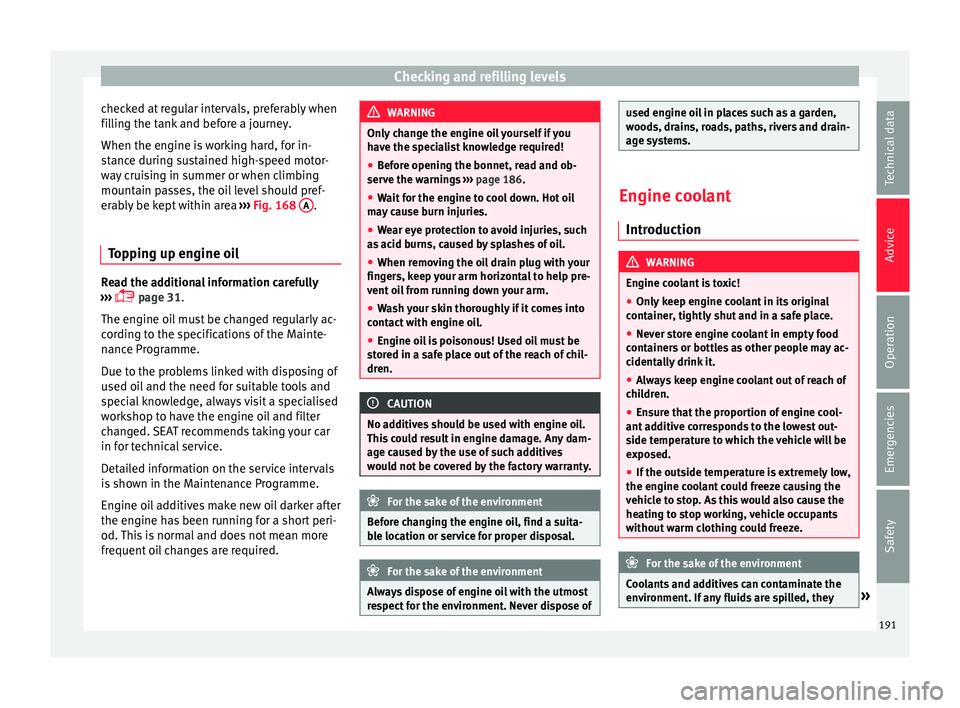
erably be kept within area ››› Fig. 168 A .
Topping up engine oil Read the additional information carefully
›› ›
page 31.
The engine oil must be changed regularly ac-
cording to the specifications of the Mainte-
nance Programme.
Due to the problems linked with disposing of
used oil and the need for suitable tools and
special knowledge, always visit a specialised
workshop to have the engine oil and filter
changed. SEAT recommends taking your car
in for technical service.
Detailed information on the service intervals
is shown in the Maintenance Programme.
Engine oil additives make new oil darker after
the engine has been running for a short peri-
od. This is normal and does not mean more
frequent oil changes are required. WARNING
Only change the engine oil yourself if you
hav e the s
pecialist knowledge required!
● Before opening the bonnet, read and ob-
serve the w
arnings ››› page 186.
● Wait for the engine to cool down. Hot oil
may
cause burn injuries.
● Wear eye protection to avoid injuries, such
as ac
id burns, caused by splashes of oil.
● When removing the oil drain plug with your
finger
s, keep your arm horizontal to help pre-
vent oil from running down your arm.
● Wash your skin thoroughly if it comes into
contact
with engine oil.
● Engine oil is poisonous! Used oil must be
stor
ed in a safe place out of the reach of chil-
dren. CAUTION
No additives should be used with engine oil.
This c
ould result in engine damage. Any dam-
age caused by the use of such additives
would not be covered by the factory warranty. For the sake of the environment
Before changing the engine oil, find a suita-
bl e loc
ation or service for proper disposal. For the sake of the environment
Always dispose of engine oil with the utmost
re s
pect for the environment. Never dispose of used engine oil in places such as a garden,
wood
s, dr
ains, roads, paths, rivers and drain-
age systems. Engine coolant
Introduction WARNING
Engine coolant is toxic!
● Only keep engine coolant in its original
c ont ainer
, tightly shut and in a safe place.
● Never store engine coolant in empty food
container
s or bottles as other people may ac-
cidentally drink it.
● Always keep engine coolant out of reach of
chil
dren.
● Ensure that the proportion of engine cool-
ant ad
ditive corresponds to the lowest out-
side temperature to which the vehicle will be
exposed.
● If the outside temperature is extremely low,
the engine coo
lant could freeze causing the
vehicle to stop. As this would also cause the
heating to stop working, vehicle occupants
without warm clothing could freeze. For the sake of the environment
Coolants and additives can contaminate the
env ir
onment. If any fluids are spilled, they » 191
Technical data
Advice
Operation
Emergencies
Safety
Page 194 of 232
Advice
should be collected and correctly disposed
of, w
ith r
espect to the environment. Coolant warning lamp
Several warning and control lamps light up
for a f
ew sec
onds when the ignition is switch-
ed on, signalling that the function is being
verified. They will switch off after a few sec-
onds.
It lights up red
Excessive engine
coolant temperature.
Stop the vehicle!
Stop the vehicle safely as soon
as possible. Switch off the en-
gine and let it cool.
Insufficient engine
coolant level.
¡Stop the vehicle!
Check the engine coolant
when the engine has cooled
and, if it is low, refill with en-
gine coolant ››› page 192.
Engine coolant sys-
tem faulty. Do not drive any further.
Obtain professional assis-
tance.
Flashes red
Engine coolant sys-
tem faulty.Seek specialist assistance.
It lights up blue
The temperature of
the natural gas en-
gine coolant is too
low. The engine has
not reached the oper-
ating temperature.Avoid high engine speeds and
pushing the engine too hard
while the warning lamp re-
mains lit.
WARNING
Observe the safety warnings ›››
in On the
ins trument
panel on page 26. Checking the coolant level and top-
pin
g up Fig. 170
In the engine compartment: Marking
on c oo
l
ant expansion tank Fig. 171
In the engine compartment: Coolant
exp an
sion tank cap Read the additional information carefully
› ›
›
page 32
If the coolant level is low, the coolant warn-
ing indicator will light.
Preparations
● Park the vehicle on even, flat and firm
ground.
● A
llow the engine to cool ›››
.
● Open the bonnet › ›
›
page 186.
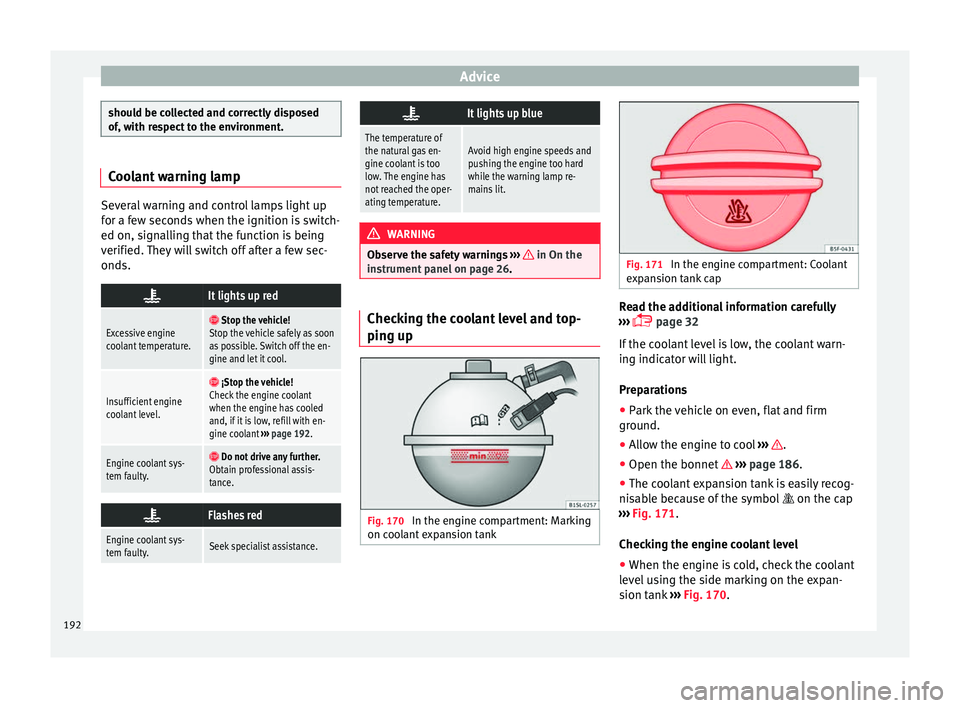
● The coolant expansion tank is easily recog-
nisab
le because of the symbol on the cap
››› Fig. 171.
Checking the engine coolant level ● When the engine is cold, check the coolant
level
using the side marking on the expan-
sion tank ››› Fig. 170.
192
Page 195 of 232
Checking and refilling levels
● If the l
ev
el is below the “MIN” mark, top up
with coolant. When the engine is hot it may
be slightly above the marked area.
Topping up the engine coolant level
● Always protect your face, hands and arms
from hot c
oolant and steam using a large,
thick cloth over the coolant expansion tank
cap.
● Remove the cap very carefully ›››
.
● Only refill using new engine c
oo
lant ac-
cording to SEAT specifications
( ›››
page 32)
››› .
● The engine coolant level should be be-
tw een the m
ark
s on the coolant expansion
tank ››› Fig. 170. Do not exceed the top level
of the marked area ››› .
● Screw on the cap tightly.
● If, in the event of an emergency, you have
no c oo
l
ant that is compliant to the required
specifications ( ›››
page 32), do not use
another type of additive. Instead, top up with
distilled water only ››› . Then re-establish
the c orr
ect
proportion of the mixture with the
correct additive as soon as possible
››› page 32. WARNING
Hot vapours and coolant can cause serious
burn s. ●
Never open the c oo
lant expansion tank if
steam or coolant is coming from the engine
compartment. Wait until you cannot see or
hear any steam or coolant escaping.
● Always wait until the engine has complete-
ly coo
led before very carefully opening the
expansion tank cap. Contact with hot ele-
ments of the engine can cause skin burns.
● When the engine is warm or hot, the cool-
ing sys
tem is pressurised. Do not unscrew
the cap on the expansion tank when the en-
gine is hot. Otherwise, coolant may spray out
under pressure causing burns and serious in-
jury.
– Carefully and slowly unscrew the cap an-
ti-clockwise, gently pressing down on it.
– Always protect your face, hands and arms
from hot coolant and steam using a large,
thick cloth.
● When refilling liquids, avoid spilling them
on part
s of the engine and the exhaust sys-
tem. Spilled liquids could cause a fire. Under
specific circumstances, the ethylene glycol
can catch fire. WARNING
If there is not enough anti-freeze in the cool-
ant sy s
tem, the engine may fail leading to se-
rious damage.
● Please make sure that the percentage of
additiv
e is correct with respect to the lowest
expected ambient temperature in the zone in
which the vehicle is to be used. ●
When the outs ide t
emperature is very low,
the coolant could freeze and the vehicle
would be immobilised. In this case, the heat-
ing would not work either and inadequately
dressed passengers could die of cold. CAUTION
● If ther e i
s no appropriate coolant liquid
available, fill it using distilled water, and
nothing else. Any other type of water may
lead to considerable rusting in the engine
due to its chemical components. This could
consequently damage the engine. If you have
not used distilled water but another type of
water to top up the coolant, a specialised
workshop must immediately replace all of the
fluid in the engine cooling system.
● Only top up coolant to the top level of the
marked ar
ea ››› Fig. 170. Otherwise the ex-
cess coolant will be forced out of the cooling
system when the engine is hot, causing dam-
age.
● If a lot of liquid coolant has been lost, wait
for the engine t
o cool down completely before
adding coolant. Extensive coolant loss is an
indication of leaks in the engine cooling sys-
tem. Have the engine cooling system inspec-
ted immediately by a specialised workshop.
Otherwise engine damage may occur.
● When refilling service liquids, ensure that
you put
the liquids into the right tank. Mak-
ing a mistake when refilling could cause seri-
ous malfunctions and damage the engine! » 193
Technical data
Advice
Operation
Emergencies
Safety
Page 200 of 232
Advice
safety features. If the battery must be re-
p l
ac
ed, consult a technical service for infor-
mation on electromagnetic compatibility, the
size and maintenance, performance and
safety requirements of the new battery in
your vehicle before you purchase one. SEAT
recommends you have the battery replaced
by a technical service.
Use only maintenance-free genuine batteries
conforming to TL 825 06 and VW 7 50 73
Standards. These standards must be dated
April 2008 or later.
Vehicles fitted with the Start-Stop system are
equipped with a special battery. Therefore,
this battery must only be replaced by another
with the same specifications.
Disconnecting the vehicle's battery
If you must disconnect the battery from the
electrical system, please note the following:
● Switch off the ignition and all electrical
equipment.
● The v
ehicle must be unlocked before dis-
connecting the b
attery, otherwise the alarm
will be triggered.
● First disconnect the negative cable and
then the positiv
e ››› .
C onnectin
g the
vehicle's battery
● Before reconnecting the battery, switch off
the engine and all
electrical devices. ●
First
reconnect the positive cable and then
the negative ››› .
Diff er
ent
control lamps may light up after
connecting the battery and switching the ig-
nition on. They will be turned off after a short
trip at a speed of between 15-20 km/h
(10-12 mph). If the warning indicators remain
lit, please visit a specialised workshop to
have the vehicle checked.
If the battery has been disconnected for a
long time, it is possible that the next service
date is not displayed or calculated correctly
››› page 88. Respect the maximum service in-
tervals permitted ››› Booklet Maintenance
Programme.
Automatic device disconnection
The intelligent vehicle electrical system auto-
matically implements a range of measures to
prevent the battery from discharging when
high demands are made on it:
● The idling speed is increased so that the al-
ternat
or provides more electricity.
● Where necessary, the power to the most
power
ful devices is reduced or even com-
pletely disconnected.
● On starting the engine, the power supply
from the 12-v
olt power sockets and the ciga-
rette lighter may be interrupted for a short
time. The on-board management program cannot
alway
s prevent the battery from running flat.
For example, if the ignition is left on for a
long period with the engine off or if the side
lights or parking lights are left on while the
vehicle is stationary.
Why the battery runs flat:
● When stationary for a long time without
star
ting the engine, particularly if the ignition
is switched on.
● Use of electrical devices with the engine
switc
hed off. WARNING
Incorrectly securing the battery or using the
wron g b
attery can cause short-circuits, fire
and serious injuries.
● Always use only maintenance-free batter-
ies, prot
ected to prevent a leak, and whose
properties, specifications and size corre-
spond to the standard battery. WARNING
A highly explosive mixture of gases is re-
le a
sed when the battery is under charge.
● The batteries should be charged in a well-
ventil
ated room only.
● Never charge a frozen or recently thawed
batter
y. A flat battery can also freeze at tem-
peratures close to 0 °C (+32 °F).
● Always replace a battery which has frozen. 198
Page 201 of 232
Wheels and tyres
●
Batt er
y cables not correctly connected may
cause a short circuit. Reconnect first the posi-
tive cable and then the negative cable. CAUTION
● Nev er di s
connect the battery if the ignition
is switched on or if the engine is running.
This could damage the electrical system or
electronic components.
● Never plug accessories that supply current,
such a
s solar panels or a battery charger, to
the 12-volt power socket or the cigarette
lighter. This could damage the vehicle's elec-
trical system. For the sake of the environment
Dispose of the battery in an environment-
friendly m anner
. Batteries contain toxic sub-
stances such as sulphuric acid and lead. For the sake of the environment
Battery acid can contaminate the environ-
ment. C o
llect any spilt service fluids and dis-
pose of them correctly. Wheels and tyres
T y
r
es
Introduction SEAT recommend that all work on tyres and
wheels
i
s carried out by a specialised work-
shop. These workshops have the necessary
special tools and replacement parts, trained
personnel and facilities for disposing of the
old tyres while respecting the environment.
SEAT recommends taking your car in for tech-
nical service. WARNING
The vehicle cannot be totally controlled or
brak ed if
the tyres (new or used) are worn or
damaged.
● Incorrect use of wheels and tyres could
make driv
ing more dangerous and result in
serious accidents and damage.
● All four wheels must be fitted with radial
tyre
s of the same type, size (rolling circumfer-
ence) and the same tread pattern.
● New tyres do not give maximum grip and
wil
l not have reached their maximum braking
capacity to start with, and therefore need
running in. To prevent accidents and major
damage, extreme caution should be taken for
the first 600 km. ●
Check ty
re pressures regularly and ensure
they are maintained at the pressures indica-
ted. If the tyre pressure is too low, they could
overheat, resulting in tread detachment or
even burst tyres.
● Never drive on damaged (punctured, cut,
crac
ked or dented) or worn tyres. Driving on
damaged or worn tyres could result in burst
tyres, serious accidents or damage. Worn or
damaged tyres must be replaced immediate-
ly.
● Never exceed the maximum permitted
speed or loa
ds specified for the type of tyre
fitted on your vehicle.
● The effectiveness of driver and brake assist
syst
ems also depends on the grip of the
tyres.
● If you notice unusual vibration or if the ve-
hicle p
ulls to one side when driving, stop the
car immediately and check the tyres and
wheels for damage.
● To minimise the risk of losing control of the
vehicl
e or causing a serious accident, never
undo the bolted joints of beadlock wheels.
● Never mount used tyres or wheels if you are
not sur
e of their previous history. They may
be damaged, although the damage is not im-
mediately visible.
● Old tyres, even if they have never been
used, ma
y lose air or burst unexpectedly
while driving, especially at high speeds, re-
sulting in serious accident and injury. If tyres
are over six years old, they should only be » 199
Technical data
Advice
Operation
Emergencies
Safety
Page 204 of 232
Advice
WARNING
The use of worn or damaged wheel rims could
mak e driv
ing more dangerous and result in
serious accidents and damage.
● Only wheel rims which have been approved
for use w
ith your vehicle should be used.
● Inspect wheel rims regularly for damage
and repl
ace as required. WARNING
If the bolted joints of wheel rims with bolted
ring trims ar
e not correctly tightened or loos-
ened, this could result in serious accident.
● Never loosen the bolted joints of wheel
rims with bo
lted ring trims.
● Any work relating to wheel rims with bolted
rims shoul
d be carried out at specialised
workshop. SEAT recommends taking your car
in for technical service. Note
A SEAT Service Centre should be consulted to
find out whether wheel s
or tyres of different
sizes to those originally fitted by SEAT can be
fitted, and to find out about the combinations
allowed between the front axle (axle 1) and
the rear axle (axle 2). Replacement of wheel rims and new
ty
r
e
s New tyres
● When tyres are new, drive with extreme
caution f or the fir
st 600 km, as all tyres need
to be run-in. Tyres which have not been run
in do not have such good grip or ››› brak-
ing c ap
acity ››› .
● All four wheels must be fitted with radial
tyr e
s of the same type, size (rolling circumfer-
ence) and the same tread pattern.
● The tread depth of new tyres may vary, ac-
cor din
g to the type and make of tyre and the
tread pattern.
Replacing tyres
● Where possible, always replace both
wheels on an ax
le (both wheels on the front
axle or both wheels on the rear axle) ››› .
● Only replace used tyres with those author-
i sed b
y
SEAT for the corresponding type vehi-
cle. Pay special attention to size, diameter,
and maximum load and speed capacity.
● Never use tyres which are larger than SEAT
appro
ved tyres. If the tyres are too big, they
may knock or rub against the chassis or other
components, resulting in damage. WARNING
New tyres do not give maximum grip and will
not h av
e reached their maximum braking ca-
pacity to start with, and therefore need run-
ning in.
● To prevent accidents and major damage,
extreme c
aution should be taken for the first
600 km. WARNING
There should be adequate space between the
tyr e
s and the vehicle in accordance with the
vehicle design. If this is not the case, the
tyres may rub against parts of the running
gear, chassis or brake lines, leading to faults
in the brake system or to tread detachment,
and the risk of burst tyres.
● The true tyre dimension should not be
great
er than the dimensions of tyres manu-
factured and approved by SEAT and should
not rub against parts of the vehicle. Note
Although tyres may be shown as being the
same s iz
e, the true dimensions of different
types of tyre may vary with respect to the
nominal size, or tread patterns may be differ-
ent. Note
If you use tyres that are approved by SEAT,
you c an be s
ure that the true tyre dimensions202
Page 205 of 232
Wheels and tyres
will be correct for your vehicle. For other tyre
models, the ty
r
e vendor should provide the
manufacturer's certificate with the tyre, indi-
cating that this type of tyre is suitable for
your vehicle. This certificate should always
be carried with the vehicle. Tyre pressures
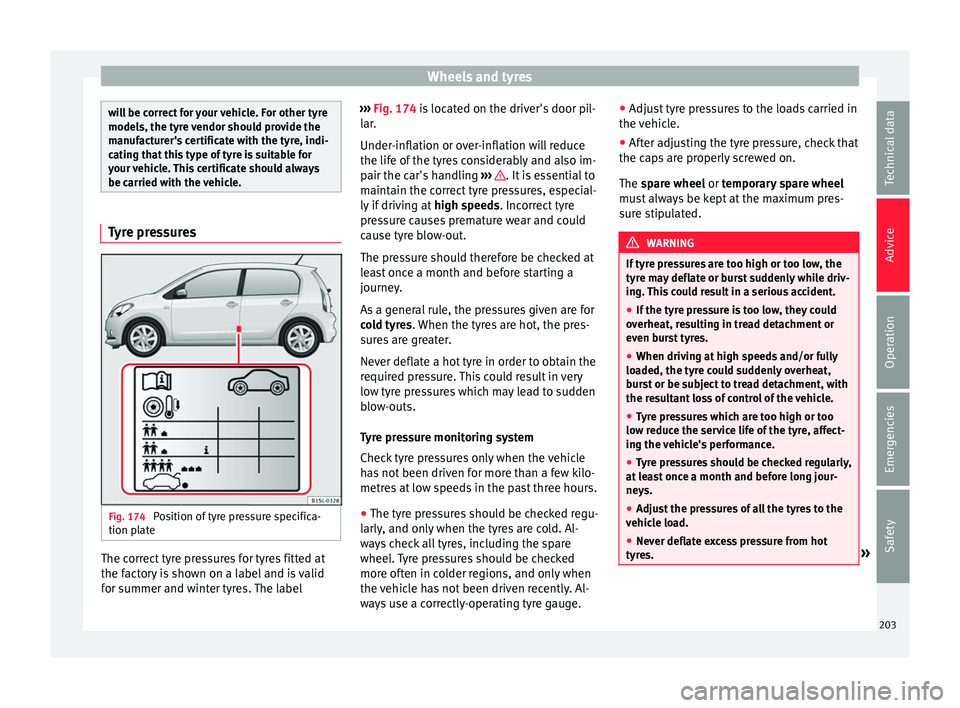
Fig. 174
Position of tyre pressure specifica-
tion p l
at
e The correct tyre pressures for tyres fitted at
the f
act
or
y is shown on a label and is valid
for summer and winter tyres. The label ›››
Fig. 174 is loc
ated on the driver's door pil-
lar.
Under-inflation or over-inflation will reduce
the life of the tyres considerably and also im-
pair the car's handling ››› . It is essential to
m aint
ain the c
orrect tyre pressures, especial-
ly if driving at high speeds. Incorrect tyre
pressure causes premature wear and could
cause tyre blow-out.
The pressure should therefore be checked at
least once a month and before starting a
journey.
As a general rule, the pressures given are for
cold tyres. When the tyres are hot, the pres-
sures are greater.
Never deflate a hot tyre in order to obtain the
required pressure. This could result in very
low tyre pressures which may lead to sudden
blow-outs.
Tyre pressure monitoring system
Check tyre pressures only when the vehicle
has not been driven for more than a few kilo-
metres at low speeds in the past three hours.
● The tyre pressures should be checked regu-
larly, and on
ly when the tyres are cold. Al-
ways check all tyres, including the spare
wheel. Tyre pressures should be checked
more often in colder regions, and only when
the vehicle has not been driven recently. Al-
ways use a correctly-operating tyre gauge. ●
Adjust
tyre pressures to the loads carried in
the vehicle.
● After adjusting the tyre pressure, check that
the caps
are properly screwed on.
The spare wheel or temporary spare wheel
must always be kept at the maximum pres-
sure stipulated. WARNING
If tyre pressures are too high or too low, the
tyr e m
ay deflate or burst suddenly while driv-
ing. This could result in a serious accident.
● If the tyre pressure is too low, they could
overhe
at, resulting in tread detachment or
even burst tyres.
● When driving at high speeds and/or fully
loaded, the ty
re could suddenly overheat,
burst or be subject to tread detachment, with
the resultant loss of control of the vehicle.
● Tyre pressures which are too high or too
low reduc
e the service life of the tyre, affect-
ing the vehicle's performance.
● Tyre pressures should be checked regularly,
at le
ast once a month and before long jour-
neys.
● Adjust the pressures of all the tyres to the
vehicl
e load.
● Never deflate excess pressure from hot
tyre
s. » 203
Technical data
Advice
Operation
Emergencies
Safety
Page 206 of 232
Advice
CAUTION
● Tak e c
are not to tilt the manometer when
placing it on the valve. Otherwise, the valve
may be damaged.
● If tyre valves are not protected by caps, or if
the caps
are not screwed on correctly, they
may become damaged. Check that the caps
are identical to the standard caps and have
been correctly tightened. For the sake of the environment
Under-inflated tyres will increase fuel con-
sumption. Wear indicator depth profile
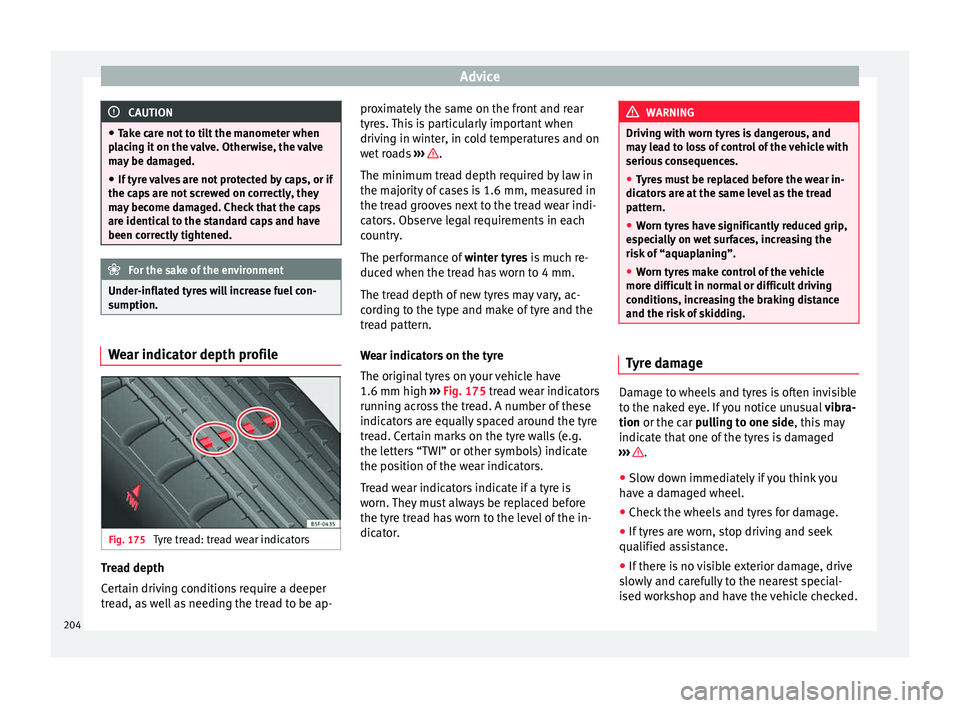
Fig. 175
Tyre tread: tread wear indicators Tread depth
C
er
t
ain driving conditions require a deeper
tread, as well as needing the tread to be ap- proximately the same on the front and rear
tyre
s. This is particularly important when
driving in winter, in cold temperatures and on
wet roads ››› .
The minimum tr e
a
d depth required by law in
the majority of cases is 1.6 mm, measured in
the tread grooves next to the tread wear indi-
cators. Observe legal requirements in each
country.
The performance of winter tyres is much re-
duced when the tread has worn to 4 mm.
The tread depth of new tyres may vary, ac-
cording to the type and make of tyre and the
tread pattern.
Wear indicators on the tyre
The original tyres on your vehicle have
1.6 mm high ››› Fig. 175 tread wear indicators
running across the tread. A number of these
indicators are equally spaced around the tyre
tread. Certain marks on the tyre walls (e.g.
the letters “TWI” or other symbols) indicate
the position of the wear indicators.
Tread wear indicators indicate if a tyre is
worn. They must always be replaced before
the tyre tread has worn to the level of the in-
dicator. WARNING
Driving with worn tyres is dangerous, and
ma y
lead to loss of control of the vehicle with
serious consequences.
● Tyres must be replaced before the wear in-
dicator
s are at the same level as the tread
pattern.
● Worn tyres have significantly reduced grip,
espec
ially on wet surfaces, increasing the
risk of “aquaplaning”.
● Worn tyres make control of the vehicle
more difficu
lt in normal or difficult driving
conditions, increasing the braking distance
and the risk of skidding. Tyre damage
Damage to wheels and tyres is often invisible
t
o the n
ak
ed eye. If you notice unusual vibra-
tion or the car pulling to one side, this may
indicate that one of the tyres is damaged
››› .
● Slow down immediately if you think you
h av
e a d
amaged wheel.
● Check the wheels and tyres for damage.
● If tyres are worn, stop driving and seek
qualified ass
istance.
● If there is no visible exterior damage, drive
slowly
and carefully to the nearest special-
ised workshop and have the vehicle checked.
204
Page 208 of 232

Advice
The tyre pressure control lamp lights
up
If the tyre pressure of a wheel is much lower
than the value set by the driver, then the tyre
pressure control lamp ››› will light up.
WARNING
● When the tyr e pr
essure control lamp lights
up, reduce speed immediately and avoid any
sudden turning or braking manoeuvre. Stop
when possible, and check the tyre pressure
and status.
● The driver is responsible for maintaining
correct
tyre pressures. For this reason, tyre
pressure must be regularly checked.
● Under certain circumstances (e.g. when
driving in a s
porty manner, in winter condi-
tions or on a dirt track) the tyre control lamp
may light up belatedly or may function incor-
rectly. Note
If the battery is disconnected, the yellow
warnin g l
amp lights up after turning the
ignition on. This should turn off after a brief
journey. Spare wheel or temporary spare
wheel*
Fig. 177
In the luggage compartment: hand
c ontr
o
lled wheel for securing the spare wheel Removing the spare wheel
● Open the rear lid and lift the luggage com-
p ar
tment
shelf ››› page 123.
● If necessary, remove the boot variable floor
›››
page 123.
● Lift up the carpet from the recess and re-
move it
from the luggage compartment.
● If necessary, take out the vehicle tool kit
with the cont
ainer.
● Completely remove the hand controlled
wheel from the c
entre of the spare wheel
››› Fig. 177 by turning it in an anticlockwise
direction, and take out the spare wheel. Storing the replaced wheel
● Pull back the carpet.
● With the wheel rim facing downwards, sit-
uate the rep
laced wheel in the spare wheel
well so that the wheel rim central hole coin-
cides with the opening.
● Turn the hand controlled wheel with the
shank s
crewed clockwise until the replaced
wheel is secured.
● If necessary, store the vehicle tool in the
container
, inside the boot.
● Replace the carpet on the boot floor.
● Lower the rear shelf.
● Close the rear lid.
If the sp
are wheel is different to the rest of
the vehicle tyres
If the spare tyre is not the same as the tyres
that are mounted on the vehicle - for example
with winter tyres or the temporary spare
wheel - you should only use the spare tyre for
a short period of time and drive with extra
care ››› .
R efit
the norm
al road wheel as soon as possi-
ble.
Please observe driving advice:
● Do not drive faster than 80 km/h (50 mph).
● Avoid heavy acceleration, hard braking and
fas
t cornering.
206
Page 210 of 232
Advice
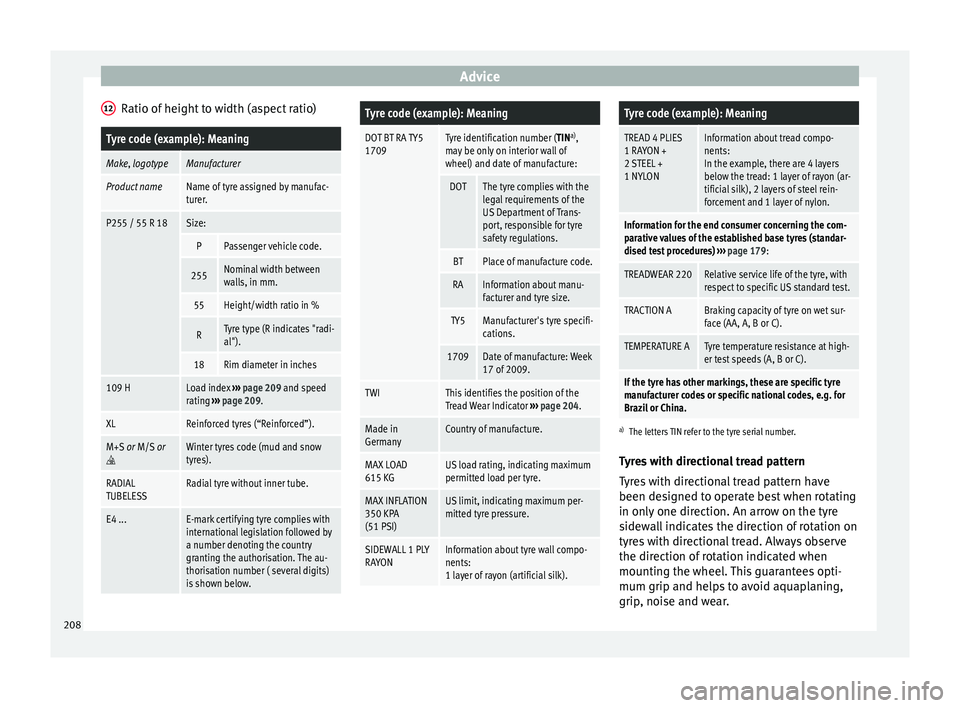
Ratio of height to width (aspect ratio)Tyre code (example): Meaning
Make, logotypeManufacturer
Product nameName of tyre assigned by manufac-
turer.
P255 / 55 R 18Size:
PPassenger vehicle code.
255Nominal width between
walls, in mm.
55Height/width ratio in %
RTyre type (R indicates "radi-
al").
18Rim diameter in inches
109 HLoad index ››› page 209 and speed
rating ››› page 209.
XLReinforced tyres (“Reinforced”).
M+S or M/S orWinter tyres code (mud and snow
tyres).
RADIAL
TUBELESSRadial tyre without inner tube.
E4 ...E-mark certifying tyre complies with
international legislation followed by
a number denoting the country
granting the authorisation. The au-
thorisation number ( several digits)
is shown below. 12
Tyre code (example): Meaning
DOT BT RA TY5
1709Tyre identification number (TIN a)
,
may be only on interior wall of
wheel) and date of manufacture:
DOTThe tyre complies with the
legal requirements of the
US Department of Trans-
port, responsible for tyre
safety regulations.
BTPlace of manufacture code.
RAInformation about manu-
facturer and tyre size.
TY5Manufacturer's tyre specifi-
cations.
1709Date of manufacture: Week
17 of 2009.
TWIThis identifies the position of the
Tread Wear Indicator ››› page 204.
Made in
GermanyCountry of manufacture.
MAX LOAD
615 KGUS load rating, indicating maximum
permitted load per tyre.
MAX INFLATION
350 KPA
(51 PSI)US limit, indicating maximum per-
mitted tyre pressure.
SIDEWALL 1 PLY
RAYONInformation about tyre wall compo-
nents:
1 layer of rayon (artificial silk).
Tyre code (example): Meaning
TREAD 4 PLIES
1 RAYON +
2 STEEL +
1 NYLONInformation about tread compo-
nents:
In the example, there are 4 layers
below the tread: 1 layer of rayon (ar-
tificial silk), 2 layers of steel rein-
forcement and 1 layer of nylon.
Information for the end consumer concerning the com-
parative values of the established base tyres (standar-
dised test procedures) ››› page 179:
TREADWEAR 220Relative service life of the tyre, with
respect to specific US standard test.
TRACTION ABraking capacity of tyre on wet sur-
face (AA, A, B or C).
TEMPERATURE ATyre temperature resistance at high-
er test speeds (A, B or C).
If the tyre has other markings, these are specific tyre
manufacturer codes or specific national codes, e.g. for
Brazil or China.
a)
The letters TIN refer to the tyre serial number.
Tyres with directional tread pattern
Tyres with directional tread pattern have
been designed to operate best when rotating
in only one direction. An arrow on the tyre
sidewall indicates the direction of rotation on
tyres with directional tread. Always observe
the direction of rotation indicated when
mounting the wheel. This guarantees opti-
mum grip and helps to avoid aquaplaning,
grip, noise and wear.
208