Clean Seat Mii 2016 Owner's manual
[x] Cancel search | Manufacturer: SEAT, Model Year: 2016, Model line: Mii, Model: Seat Mii 2016Pages: 232, PDF Size: 4.9 MB
Page 6 of 232
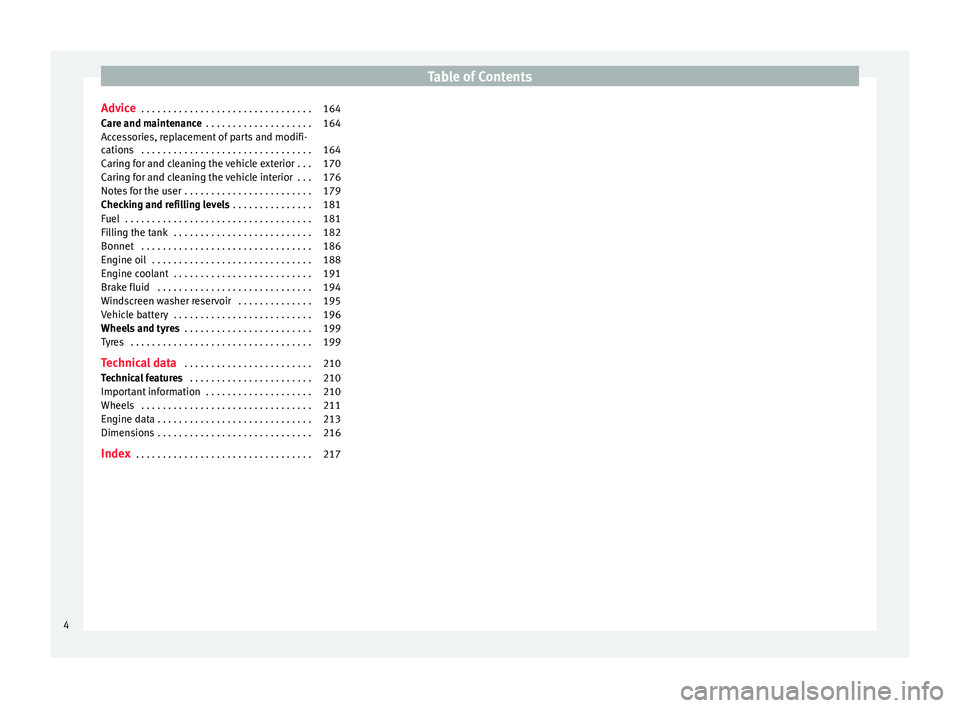
Table of Contents
Advice . . . . . . . . . . . . . . . . . . . . . . . . . . . . . . . . 164
Care and maintenance . . . . . . . . . . . . . . . . . . . . 164
Accessories, replacement of parts and modifi-
c ation
s
. . . . . . . . . . . . . . . . . . . . . . . . . . . . . . . . 164
Caring for and cleaning the vehicle exterior . . . 170
Caring for and cleaning the vehicle interior . . . 176
Notes for the user . . . . . . . . . . . . . . . . . . . . . . . . 179
Checking and refilling levels . . . . . . . . . . . . . . . 181
Fuel . . . . . . . . . . . . . . . . . . . . . . . . . . . . . . . . . . . 181
Filling the tank . . . . . . . . . . . . . . . . . . . . . . . . . . 182
Bonnet . . . . . . . . . . . . . . . . . . . . . . . . . . . . . . . . 186
Engine oil . . . . . . . . . . . . . . . . . . . . . . . . . . . . . . 188
Engine coolant . . . . . . . . . . . . . . . . . . . . . . . . . . 191
Brake fluid . . . . . . . . . . . . . . . . . . . . . . . . . . . . . 194
Windscreen washer reservoir . . . . . . . . . . . . . . 195
Vehicle battery . . . . . . . . . . . . . . . . . . . . . . . . . . 196
Wheels and tyres . . . . . . . . . . . . . . . . . . . . . . . . 199
Tyres . . . . . . . . . . . . . . . . . . . . . . . . . . . . . . . . . . 199
Technical data . . . . . . . . . . . . . . . . . . . . . . . . 210
Technical features . . . . . . . . . . . . . . . . . . . . . . . 210
Important information . . . . . . . . . . . . . . . . . . . . 210
Wheels . . . . . . . . . . . . . . . . . . . . . . . . . . . . . . . . 211
Engine data . . . . . . . . . . . . . . . . . . . . . . . . . . . . . 213
Dimensions . . . . . . . . . . . . . . . . . . . . . . . . . . . . . 216
Index . . . . . . . . . . . . . . . . . . . . . . . . . . . . . . . . . 217
4
Page 24 of 232
The essentials
● In an emer g
ency
● The
vehicle has broken down
● When towing or being towed
››› in Hazard warning lights on
page 106
››› page 106 Interior lights
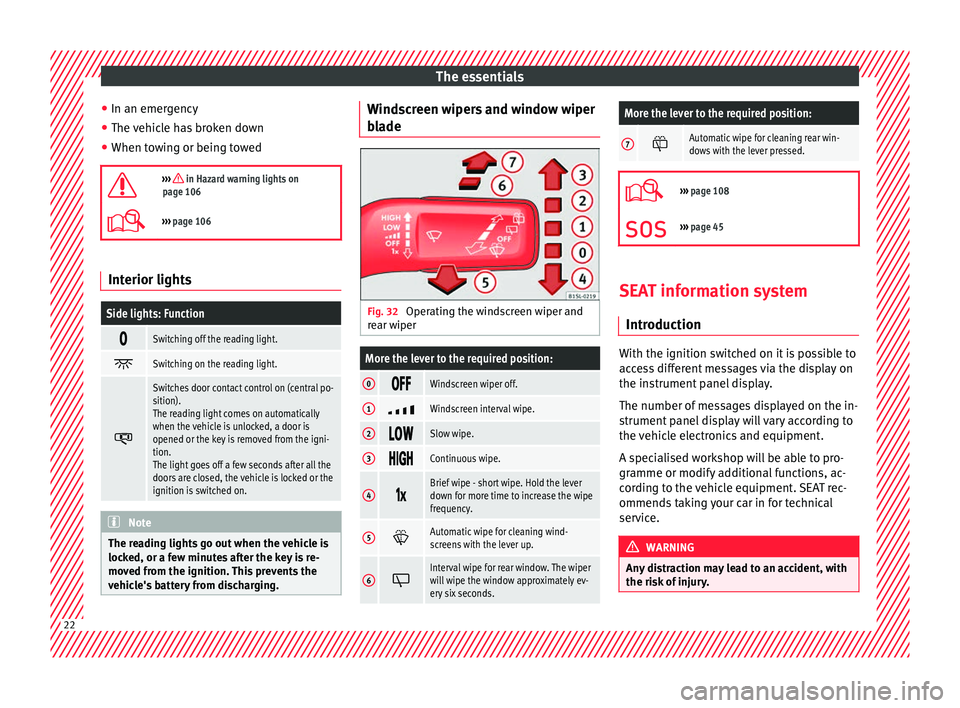
Side lights: Function
Switching off the reading light.
Switching on the reading light.
Switches door contact control on (central po-
sition).
The reading light comes on automatically
when the vehicle is unlocked, a door is
opened or the key is removed from the igni-
tion.
The light goes off a few seconds after all the
doors are closed, the vehicle is locked or the
ignition is switched on.
Note
The reading lights go out when the vehicle is
lock ed, or a f
ew minutes after the key is re-
moved from the ignition. This prevents the
vehicle's battery from discharging. Windscreen wipers and window wiper
b
l
a
de Fig. 32
Operating the windscreen wiper and
r e
ar w
iper
More the lever to the required position:
0 Windscreen wiper off.
1
Windscreen interval wipe.
2
Slow wipe.
3
Continuous wipe.
4
Brief wipe - short wipe. Hold the lever
down for more time to increase the wipe
frequency.
5
Automatic wipe for cleaning wind-
screens with the lever up.
6
Interval wipe for rear window. The wiper
will wipe the window approximately ev-
ery six seconds.
More the lever to the required position:
7 Automatic wipe for cleaning rear win-
dows with the lever pressed.
›››
page 108
››› page 45 SEAT information system
Intr oduction With the ignition switched on it is possible to
ac
c
e
ss different messages via the display on
the instrument panel display.
The number of messages displayed on the in-
strument panel display will vary according to
the vehicle electronics and equipment.
A specialised workshop will be able to pro-
gramme or modify additional functions, ac-
cording to the vehicle equipment. SEAT rec-
ommends taking your car in for technical
service. WARNING
Any distraction may lead to an accident, with
the risk of
injury.22
Page 30 of 232
The essentials
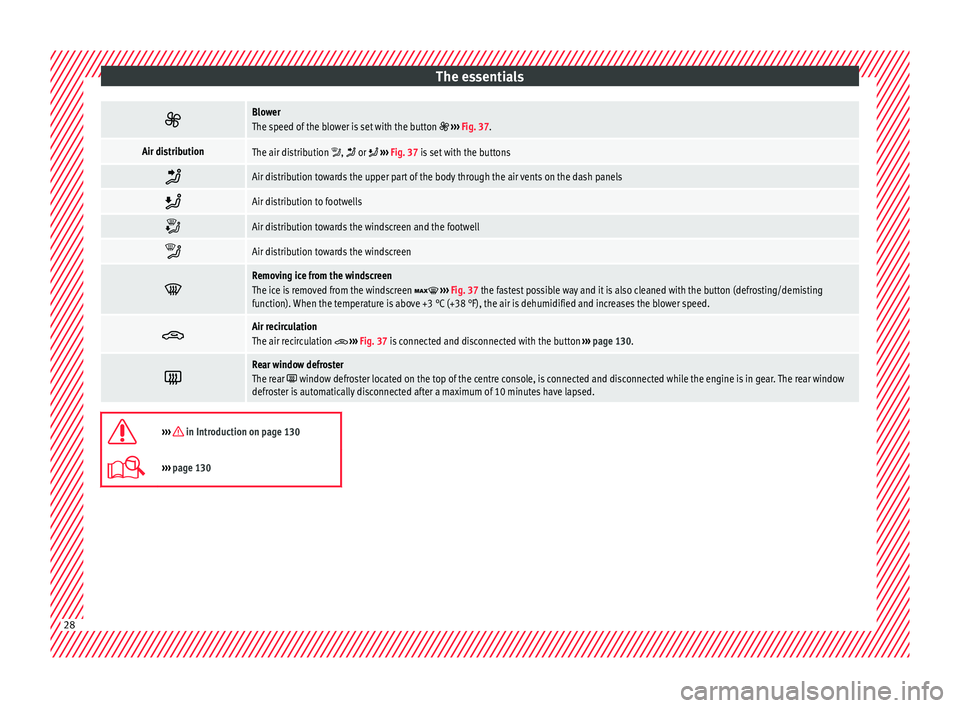
Blower
The speed of the blower is set with the button
››› Fig. 37.
Air distributionThe air distribution , or ››› Fig. 37 is set with the buttons
Air distribution towards the upper part of the body through the air vents on the dash panels
Air distribution to footwells
Air distribution towards the windscreen and the footwell
Air distribution towards the windscreen
Removing ice from the windscreen
The ice is removed from the windscreen
››› Fig. 37 the fastest possible way and it is also cleaned with the button (defrosting/demisting
function). When the temperature is above +3 °C (+38 °F), the air is dehumidified and increases the blower speed.
Air recirculation
The air recirculation
››› Fig. 37 is connected and disconnected with the button ››› page 130.
Rear window defroster
The rear window defroster located on the top of the centre console, is connected and disconnected while the engine is in gear. The rear window
defroster is automatically disconnected after a maximum of 10 minutes have lapsed.
››› in Introduction on page 130
›››
page 130 28
Page 32 of 232
The essentials
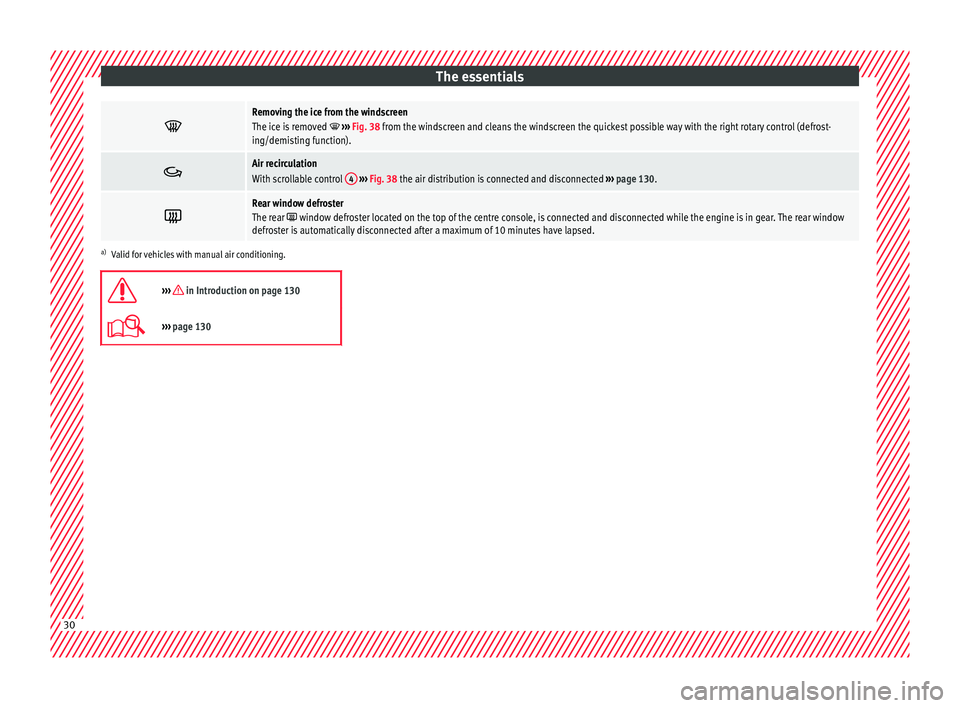
Removing the ice from the windscreen
The ice is removed
››› Fig. 38 from the windscreen and cleans the windscreen the quickest possible way with the right rotary control (defrost-
ing/demisting function).
Air recirculation
With scrollable control
4
››› Fig. 38 the air distribution is connected and disconnected ››› page 130.
Rear window defroster
The rear window defroster located on the top of the centre console, is connected and disconnected while the engine is in gear. The rear window
defroster is automatically disconnected after a maximum of 10 minutes have lapsed.
a) Valid for vehicles with manual air conditioning.
››› in Introduction on page 130
››› page 130 30
Page 35 of 232
The essentials
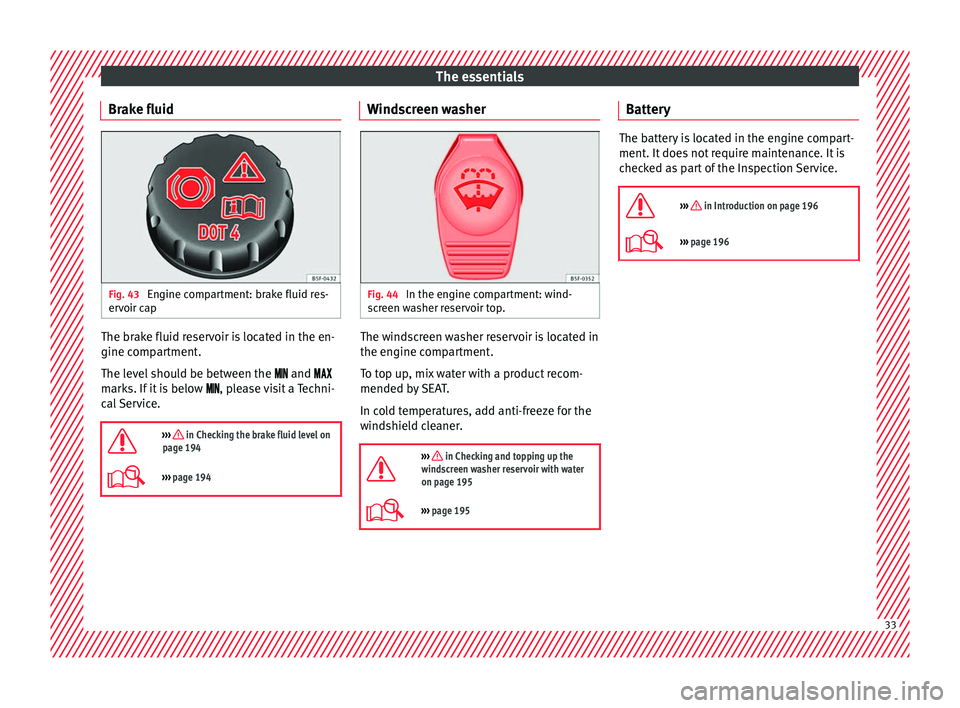
Brake fluid Fig. 43
Engine compartment: brake fluid res-
er v
oir c
ap The brake fluid reservoir is located in the en-
gine c
omp
ar
tment.
The level should be between the and
marks. If it is below , please visit a Techni-
cal Service.
››› in Checking the brake fluid level on
page 194
››› page 194 Windscreen washer
Fig. 44
In the engine compartment: wind-
s c
r
een washer reservoir top. The windscreen washer reservoir is located in
the en
gine c
omp
artment.
To top up, mix water with a product recom-
mended by SEAT.
In cold temperatures, add anti-freeze for the
windshield cleaner.
››› in Checking and topping up the
windscreen washer reservoir with water
on page 195
››› page 195 Battery
The battery is located in the engine compart-
ment. It
doe
s not require maintenance. It is
checked as part of the Inspection Service.
››› in Introduction on page 196
››› page 196 33
Page 37 of 232
The essentials
● Rep
l
ace the cover again or close the fuse
box lid.
Bulbs Bul
bs (12 V)
Light source used for each function
Halogen headlightsType
Daytime running light/side
lightW21/5W
Dipped beam headlightsH4 LL
Main beam headlightsH4 LL
Turn signalPY21W NA
Front fog lightType
Fog/cornering lights*HB4
Rear bulb lightType
Brake/side lightsP21/5W LL
Side lightsP21/5W LL
Turn signalPY21W NA LL
Retro fog lightP21W
Reverse lightsR10W Action in the event of a punc-
t
ur
e
Wh
at to do first ●
Park the vehicle on a horizontal surface
and in a saf e p
lace as far away from traffic as
possible.
● Apply the handbrake.
● Switch on the hazard warning lights.
● Manual gearbox: select the 1s
t gear.
● Automatic gearbox: position the sel
ector
lever to D or R.
● If you are towing a trailer, unhitch it from
your v
ehicle.
● Have the vehicle tool kit ›››
page 71
and the spare wheel* ready
››› page 206.
● Observe the applicable legislation for each
countr
y (reflective vest, warning triangles,
etc.).
● All occupants should leave the vehicle and
wait in a s
afe place (for instance behind the
roadside crash barrier). WARNING
● Alw a
ys observe the above steps and pro-
tect yourself and other road users.
● If you change the wheel on a slope, block
the wheel on the oppo
site side of the car with a stone or similar to prevent the vehicle from
mov
in
g. Repairing a tyre with the anti-punc-
tur
e k
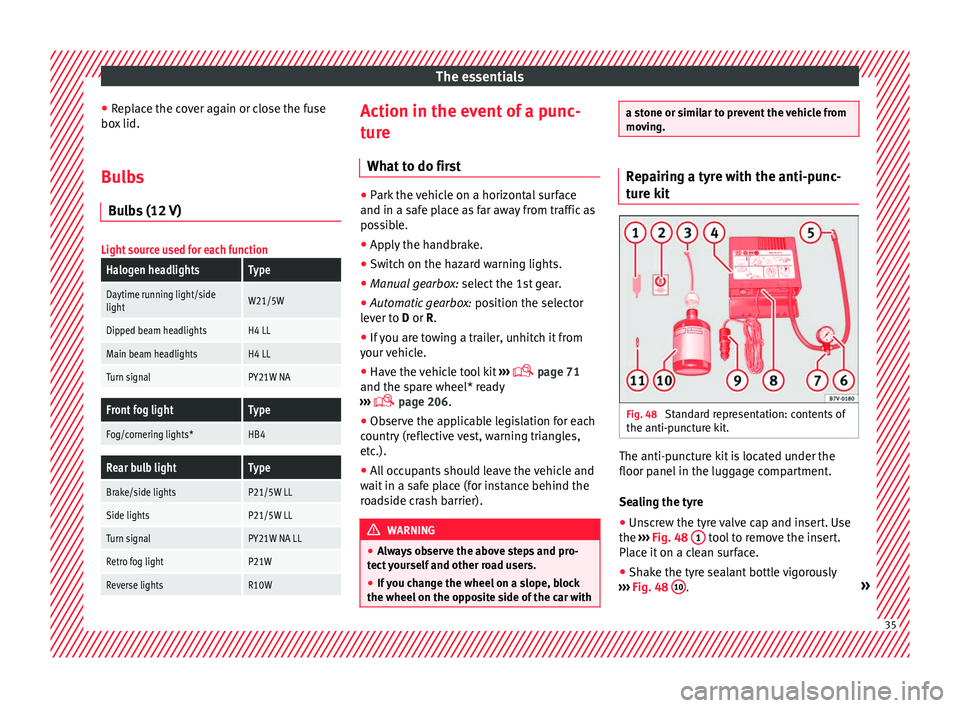
it Fig. 48
Standard representation: contents of
the anti-p u
nct
ure kit. The anti-puncture kit is located under the
floor p
anel
in the lug
gage compartment.
Sealing the tyre
● Unscrew the tyre valve cap and insert. Use
the ›››
Fig. 48 1 tool to remove the insert.
Pl ac
e it
on a clean surface.
● Shake the tyre sealant bottle vigorously
›› ›
Fig. 48 10 .
» 35
Page 40 of 232
The essentials
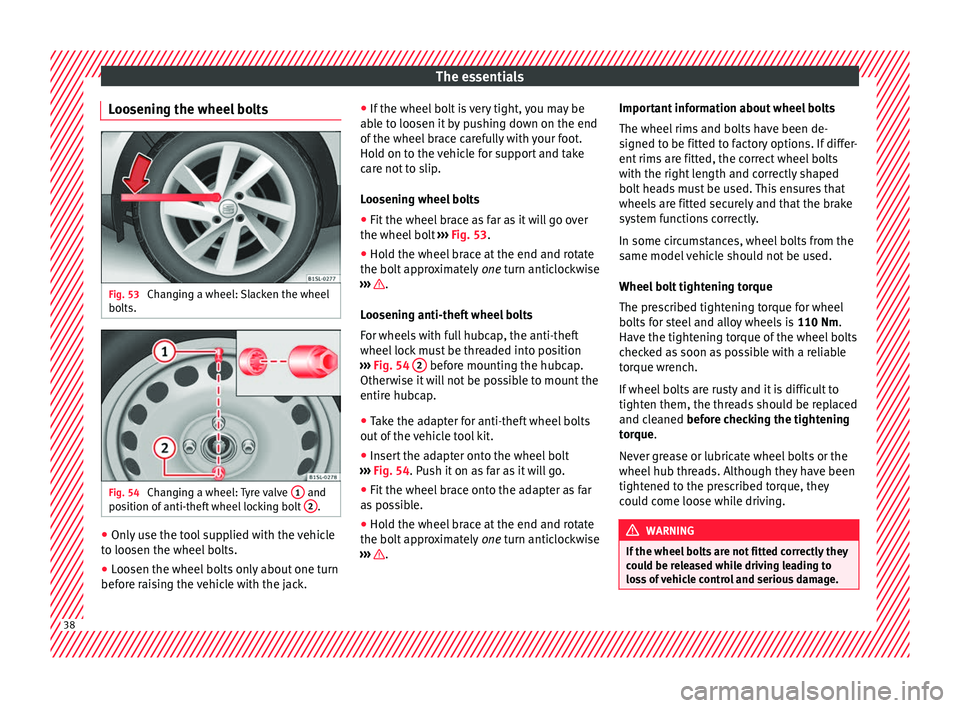
Loosening the wheel bolts Fig. 53
Changing a wheel: Slacken the wheel
bo lts. Fig. 54
Changing a wheel: Tyre valve 1 and
po s
ition of
anti-theft wheel locking bolt 2 .
●
Only use the tool supplied with the vehicle
t o loo
sen the wheel
bolts.
● Loosen the wheel bolts only about one turn
before r
aising the vehicle with the jack. ●
If the wheel bo
lt is very tight, you may be
able to loosen it by pushing down on the end
of the wheel brace carefully with your foot.
Hold on to the vehicle for support and take
care not to slip.
Loosening wheel bolts
● Fit the wheel brace as far as it will go over
the wheel bolt
››› Fig. 53.
● Hold the wheel brace at the end and rotate
the bolt ap
proximately one turn anticlockwise
››› .
L oo
senin
g anti-theft wheel bolts
For wheels with full hubcap, the anti-theft
wheel lock must be threaded into position
››› Fig. 54 2 before mounting the hubcap.
Other w
i
se it will not be possible to mount the
entire hubcap.
● Take the adapter for anti-theft wheel bolts
out of the
vehicle tool kit.
● Insert the adapter onto the wheel bolt
›››
Fig. 54. Push it on as far as it will go.
● Fit the wheel brace onto the adapter as far
as po
ssible.
● Hold the wheel brace at the end and rotate
the bolt ap
proximately one turn anticlockwise
››› .Important information about wheel bolts
The wheel
rims and bo
lts have been de-
signed to be fitted to factory options. If differ-
ent rims are fitted, the correct wheel bolts
with the right length and correctly shaped
bolt heads must be used. This ensures that
wheels are fitted securely and that the brake
system functions correctly.
In some circumstances, wheel bolts from the
same model vehicle should not be used.
Wheel bolt tightening torque
The prescribed tightening torque for wheel
bolts for steel and alloy wheels is 110 Nm.
Have the tightening torque of the wheel bolts
checked as soon as possible with a reliable
torque wrench.
If wheel bolts are rusty and it is difficult to
tighten them, the threads should be replaced
and cleaned before checking the tightening
torque.
Never grease or lubricate wheel bolts or the
wheel hub threads. Although they have been
tightened to the prescribed torque, they
could come loose while driving. WARNING
If the wheel bolts are not fitted correctly they
cou l
d be released while driving leading to
loss of vehicle control and serious damage. 38
Page 41 of 232
The essentials
●
Only u
se wheel bolts which correspond to
the wheel rims in question.
● Never use different wheel bolts.
● The bolts and threads should be clean, free
of oil
and grease and easy to thread.
● To loosen and tighten the wheel bolts, al-
way
s use the wheel brace supplied with the
vehicle.
● Loosen the wheel bolts only about one turn
before r
aising the vehicle with the jack.
● Never grease or lubricate wheel bolts or the
wheel hub thre
ads. Although they have been
tightened to the prescribed torque, they
could come loose while driving.
● Never loosen the bolted joints of wheel
rims with bo
lted ring trims.
● If the wheel bolts are not tightened to the
correct
torque, they may come loose while
driving, and the bolts and rims may come
out. If the tightening torque is too high, the
wheel bolts and threads can be damaged. Raising the vehicle with the jack
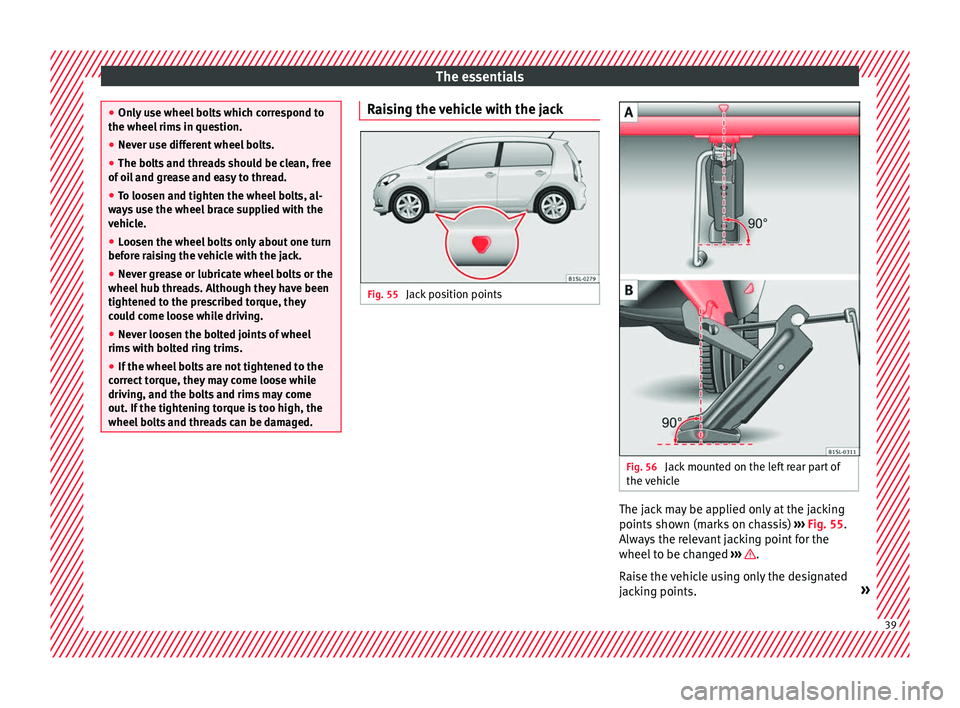
Fig. 55
Jack position points Fig. 56
Jack mounted on the left rear part of
the v
ehic
le The jack may be applied only at the jacking
points
sho
wn (m
arks on chassis) ››› Fig. 55.
Always the relevant jacking point for the
wheel to be changed ››› .
R ai
se the
vehicle using only the designated
jacking points. » 39
Page 42 of 232
The essentials
WARNING
If the vehicle is not correctly raised, it could
fa l
l off the jack causing serious injury. Please
observe the following rules to minimise the
risk of injury:
● You should only use a jack approved by
SEAT f
or your vehicle. Other jacks, even those
approved for other SEAT models, might slip
out of place.
● The ground should be firm and flat. If the
ground i
s sloped or soft then the vehicle
could slip and fall off the jack. If necessary,
support the jack on a wide solid base.
● If the ground is slippery, such as tiles,
plac
e a non-slip surface (a floor mat, for in-
stance) beneath the jack to avoid slipping.
● Only fit the jack at the prescribed jacking
points. The c
law of the jack should grip the
reinforcement nerve on the underbody
››› Fig. 56.
● You should never place a body limb such as
an arm or leg u
nder a raised vehicle that is
solely supported by the jack.
● If you have to work underneath the vehicle,
you mus
t use suitable stands additionally to
support the vehicle, there is a risk of acci-
dent!.
● Never raise the vehicle if it is tilting to one
side or the engine i
s running.
● Never start the engine when the vehicle is
raised.
The vehicle may come loose from the
jack due to the engine vibrations. Removing and fitting a wheel
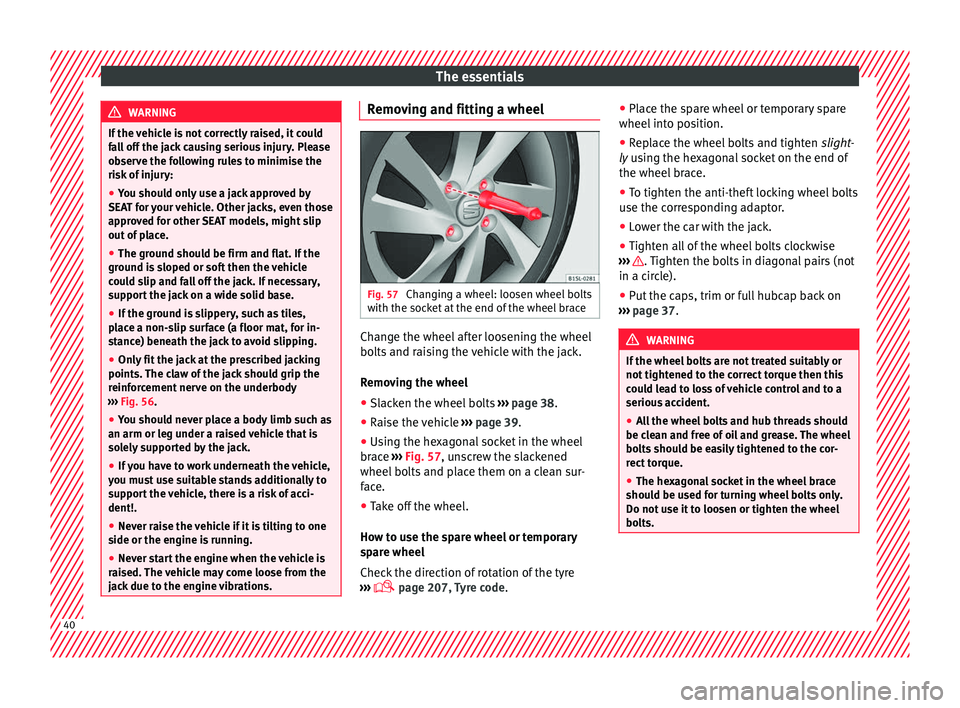
Fig. 57
Changing a wheel: loosen wheel bolts
w ith the soc
k
et at the end of the wheel brace Change the wheel after loosening the wheel
bo
lts
and r
aising the vehicle with the jack.
Removing the wheel
● Slacken the wheel bolts ›››
page 38.
● Raise the vehicle ›››
page 39.
● Using the hexagonal socket in the wheel
brace ›
›› Fig. 57, unscrew the slackened
wheel bolts and place them on a clean sur-
face.
● Take off the wheel.
How to u
se the spare wheel or temporary
spare wheel
Check the direction of rotation of the tyre
››› page 207, Tyre code. ●
Place the s
pare wheel or temporary spare
wheel into position.
● Replace the wheel bolts and tighten slight
-
ly using the hexagonal socket on the end of
the wheel brace.
● To tighten the anti-theft locking wheel bolts
use the corr
esponding adaptor.
● Lower the car with the jack.
● Tighten all of the wheel bolts clockwise
›››
. Tighten the bolts in diagonal pairs (not
in a c ir
c
le).
● Put the caps, trim or full hubcap back on
›››
page 37. WARNING
If the wheel bolts are not treated suitably or
not tight ened t
o the correct torque then this
could lead to loss of vehicle control and to a
serious accident.
● All the wheel bolts and hub threads should
be cle
an and free of oil and grease. The wheel
bolts should be easily tightened to the cor-
rect torque.
● The hexagonal socket in the wheel brace
should be u
sed for turning wheel bolts only.
Do not use it to loosen or tighten the wheel
bolts. 40
Page 43 of 232
The essentials
Tyres with compulsory direction of ro-
t ation A directional tread pattern can be identified
by
the arr
ows on the sidewall that point in
the direction of rotation. Always observe the
direction of rotation indicated when fitting
the wheel to guarantee optimum properties
of this type of tyres with regard to grip,
noises, wear and aquaplaning.
If it is absolutely necessary to fit the spare
tyre* against the direction of rotation, drive
with care as this means the tyre does not of-
fer optimum driving properties. This is of par-
ticular importance when the road surface is
wet.
To return to directional tread tires, replace
the punctured tyre as soon as possible and
restore the obligatory direction of rotation of
all tyres.
After the wheel change ●
Clean the vehicle tools, if necessary and
p ut
them a
way in the luggage compartment
foam holder ›››
page 70.
● Store the spare wheel, the temporary spare
wheel or the ch
anged wheel securely in the
luggage compartment. ●
Have the tightenin
g torque of the wheel
bolts checked as soon as possible with a tor-
que wrench ››› page 38.
● Have the flat tyre replaced as quickly as
poss
ible.
Snow chains Use When using snow chains, applicable local
l
e
gi
slation and maximum permitted speed
limits must be observed.
In winter weather, snow chains not only help
to improve grip but also improve the braking
capacity.
The fitting of chains is permitted only on
front wheels and with the following combi-
nations of wheel trims and tyres :
Tyre sizeWheel rim
165/70 R145 J x 14 offset of 35175/65 R14 SEAT recommends you ask a technical serv-
ic
e f
or f
urther information on wheel, tyre and
chain sizes.
Wherever possible use fine-link chains meas-
uring less than 15 mm including the lock. Remove wheel hub covers and trim rings be-
fore fittin
g snow chains ››› . The wheel bolts
shou l
d be c
overed with caps for safety rea-
sons. These are available from technical serv-
ices.
Temporary spare wheel
For technical reasons, snow chains must not
be used on the compact temporary spare
wheel ›››
page 206.
If it is necessary to fit chains with the tempo-
rary spare wheel in use, install the wheel on
the rear axle in the event of a fault in a front
wheel. Then, fit the rear wheel that is free, in-
stead of the damaged front wheel. In this sit-
uation, observe the rotating direction of the
wheels. SEAT recommends attaching the
snow chains before fitting the wheel. WARNING
The use of unsuitable or incorrectly fitted
ch ain
s could lead to serious accidents and
damage.
● Always the appropriate snow chains.
● Observe the fitting instructions provided by
the snow c
hain manufacturer.
● Never exceed the maximum permitted
speeds
when driving with snow chains. » 41