Clean Seat Mii 2016 User Guide
[x] Cancel search | Manufacturer: SEAT, Model Year: 2016, Model line: Mii, Model: Seat Mii 2016Pages: 232, PDF Size: 4.9 MB
Page 48 of 232
The essentials
Before driving, always lower the wiper arms.
When the ignition i s
sw
itched on, the wind-
screen wiper arms return to their initial posi-
tion upon activating the windscreen wiper
lever.
››› page 75 Changing the front wiper blades
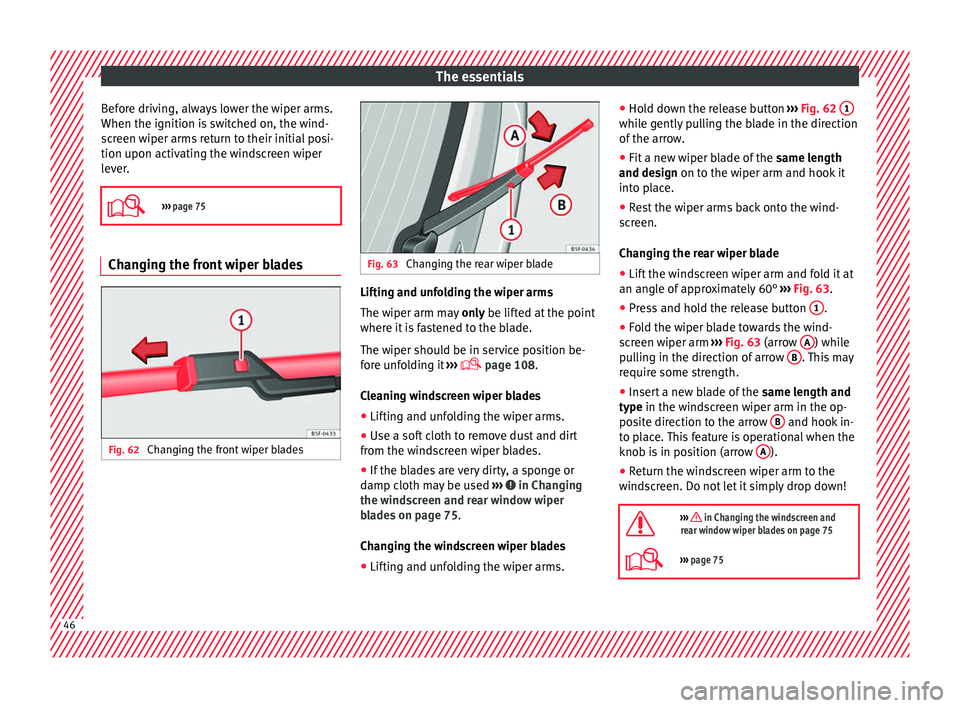
Fig. 62
Changing the front wiper blades Fig. 63
Changing the rear wiper blade Lifting and unfolding the wiper arms
The w
iper arm m
a
y only be lifted at the point
where it is fastened to the blade.
The wiper should be in service position be-
fore unfolding it ›››
page 108.
Cleaning windscreen wiper blades ● Lifting and unfolding the wiper arms.
● Use a soft cloth to remove dust and dirt
from the wind
screen wiper blades.
● If the blades are very dirty, a sponge or
damp cloth m
ay be used ››› in Changing
the w ind
s
creen and rear window wiper
blades on page 75.
Changing the windscreen wiper blades
● Lifting and unfolding the wiper arms. ●
Hold do
wn the release button ››› Fig. 62 1 while gently pulling the blade in the direction
of
the arr
o
w.
● Fit a new wiper blade of the same len
gth
and design on to the wiper arm and hook it
into place.
● Rest the wiper arms back onto the wind-
scr
een.
Changing the rear wiper blade
● Lift the windscreen wiper arm and fold it at
an angle of
approximately 60° ››› Fig. 63.
● Press and hold the release button 1 .
● Fold the wiper blade towards the wind-
s c
r
een wiper arm ››› Fig. 63 (arrow A ) while
p u
l
ling in the direction of arrow B . This may
r equir
e some s
trength.
● Insert a new blade of the same len
gth and
type in the windscreen wiper arm in the op-
posite direction to the arrow B and hook in-
t o p
l
ace. This feature is operational when the
knob is in position (arrow A ).
● Return the windscreen wiper arm to the
w ind
s
creen. Do not let it simply drop down!
››› in Changing the windscreen and
rear window wiper blades on page 75
››› page 75 46
Page 57 of 232
Seat belts
Using seat belts Twisted seat belt
If it
i
s difficult removing the seat belt from
the guide, the seat belt may have become
twisted inside the side trim after being
wound too quickly on unfastening:
● Pull out the seat belt completely, carefully
pul
ling on the latch plate.
● Untwist the belt and guide it back, assist-
ing it b
y hand.
The seat belt must be fastened even if it is
impossible to untwist it. In this case, the
twisted area must not be in an area in direct
contact with your body. Have the seat belt
untwisted urgently by a specialised work-
shop. WARNING
An improperly handled seat belt increases
the risk of
sustaining severe or fatal injuries.
● Regularly check that the seat belts and
their components
are in perfect condition.
● Always keep your seat belt clean.
● Do not jam or damage the seat belt or rub it
with sharp edg
es.
● Make sure there are no liquids or foreign
bodies on the l
atch plate and in the buckle. Head-on collisions and the laws of
ph
y
s
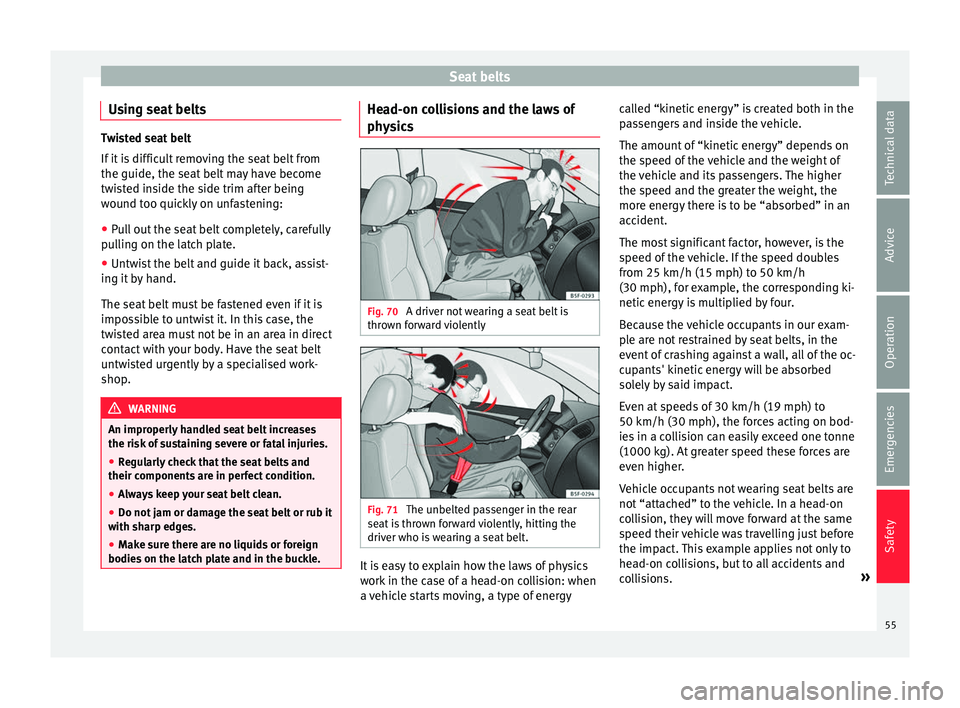
ics Fig. 70
A driver not wearing a seat belt is
thr o
wn f
orward violently Fig. 71
The unbelted passenger in the rear
se at
i
s thrown forward violently, hitting the
driver who is wearing a seat belt. It is easy to explain how the laws of physics
w
ork
in the c
ase of a head-on collision: when
a vehicle starts moving, a type of energy called “kinetic energy” is created both in the
pas
sengers and inside the vehicle.
The amount of “kinetic energy” depends on
the speed of the vehicle and the weight of
the vehicle and its passengers. The higher
the speed and the greater the weight, the
more energy there is to be “absorbed” in an
accident.
The most significant factor, however, is the
speed of the vehicle. If the speed doubles
from 25 km/h (15 mph) to 50 km/h
(30 mph), for example, the corresponding ki-
netic energy is multiplied by four.
Because the vehicle occupants in our exam-
ple are not restrained by seat belts, in the
event of crashing against a wall, all of the oc-
cupants' kinetic energy will be absorbed
solely by said impact.
Even at speeds of 30 km/h (19 mph) to
50 km/h (30 mph), the forces acting on bod-
ies in a collision can easily exceed one tonne
(1000 kg). At greater speed these forces are
even higher.
Vehicle occupants not wearing seat belts are
not “attached” to the vehicle. In a head-on
collision, they will move forward at the same
speed their vehicle was travelling just before
the impact. This example applies not only to
head-on collisions, but to all accidents and
collisions. »
55
Technical data
Advice
Operation
Emergencies
Safety
Page 62 of 232
Safety
●
Bef or
e each trip, every occupant must sit
properly, correctly fasten the seat belt be-
longing to his or her seat and keeping it fas-
tened throughout the trip. This rule is valid
for all vehicle occupants. WARNING
Occupants sitting in the front of the vehicle
mu st
never carry any objects in the deploy-
ment space between them and the airbags,
as this increases the risk of sustaining inju-
ries if the airbag is triggered. This modifies
the airbag deployment space or the objects
may fly uncontrollably and hit your body.
● Never carry objects in your hand or on your
lap whil
e the vehicle is in motion.
● Never transport objects on the front pas-
senger se
at. In the event of sudden braking
and manoeuvres, the objects may end up in
the airbag deployment space and fly uncon-
trollably around the interior if the airbag is
activated.
● Occupants of the front and rear seats must
never carr
y any other people, pets or objects
in the deployment space between them and
the airbags. Make sure children and other
passengers also respect this recommenda-
tion. WARNING
The airbag system provides protection for
one acc ident
only. If they have been de-
ployed, they must be replaced. ●
Ens ur
e deployed airbags and the system
components involved are immediately re-
placed with new, SEAT-approved components
for the vehicle.
● Have any repairs or modifications carried
out at a s
pecialised workshop. Specialised
workshops have the necessary tools, diag-
nostics equipment, repair information and
qualified personnel.
● Never fit recycled or reused airbag compo-
nents in
your vehicle.
● Never modify the airbag system compo-
nents. WARNING
If the airbags are triggered, a fine dust is pro-
duced. Thi
s is normal and it is not an indica-
tion of fire in the vehicle.
● This fine dust may irritate the skin and eyes
and cause br
eathing difficulties, particularly
in people suffering from or who have suffered
from asthma or other illnesses of the respira-
tory tract. To reduce breathing difficulties,
get out of the vehicle and open and doors and
windows to breath in fresh air.
● Should you touch the dust, wash your
hands
and face using a mild soap and water
before you eat.
● Prevent the dust from affecting the eyes or
open wound
s.
● Rinse your eyes with water if you have dust
in them. WARNING
Solvents cause the surfaces of the airbag
modul e
s to become porous. If an airbag is ac-
cidentally triggered, the detachment of plas-
tic parts could cause serious injury.
● Never clean the dash panel and the surfa-
ces
of the airbag modules with cleaners con-
taining solvents. Description of airbag system
Vehicle safety components
The f
o
l
lowing safety equipment makes up the
vehicle safety design to reduce the risk of se-
vere and fatal injuries. Depending on the ve-
hicle equipment, some equipment may not
be fitted in the vehicle or may not be availa-
ble in some markets.
● Optimised seat belts for all seats.
● Seat belt tension devices for driver and
pas
senger.
● Seat belt force limiters for driver and pas-
senger
.
● Seat belt warning lamp
● Front airbags for driver and passenger.
● Side airbags for driver and passenger.
● Airbag control lamp .
● Control units and sensors.
60
Page 77 of 232
Self-help
WARNING
Driving with an unsealed tyre is dangerous
and can c au
se accidents and serious injury.
● Do not continue driving if the tyre pressure
is 1.3
bar (19 psi / 130 kPa) and lower.
● Seek specialist assistance. Changing the windscreen wiper
bl
a
des
Changing the windscreen and rear
window wiper blades Read the additional information carefully
› ›
›
page 46.
The windscreen wiper blades are supplied as
standard with a layer of graphite. This layer is
responsible for ensuring that the wipe is si-
lent. If the graphite layer is damaged, the
noise of the water as it is wiped across the
windscreen will be louder.
Check the condition of the wiper blades regu-
larly. If the wipers scrape across the glass
they should be changed if they are damaged,
or cleaned if they are dirty ››› .
Dam ag
ed w
iper blades should be replaced
immediately. These are available from quali-
fied workshops. WARNING
Worn or dirty wiper blades reduce visibility
and incr e
ase the risk of accident and serious
injury.
● Always replace damaged or worn blades or
bla
des which do not clean the windscreen
correctly. CAUTION
● Damag ed or dir
ty windscreen wipers could
scratch the glass.
● If products containing solvents, rough
spong
es or sharp objects are used to clean
the blades, the graphite layer will be dam-
aged.
● Never use fuel, nail varnish remover, paint
thinner or simil
ar products to clean the win-
dows. CAUTION
● To pr ev
ent damage to the bonnet and the
wiper arms, only leave them in the service
position.
● Before driving, always lower the wiper
arms. Note
If wax deposits, other cleaning products from
the autom atic
car wash, or other care prod-
ucts, are left on the windscreen and the rear
window, the blades can scratch the glass. Re- move wax deposits with a special product or
cl
e
aning cloths. Tow-starting and towing
Ins truction
s for tow-starting Read the additional information carefully
›› ›
page 42.
When towing or tow starting, respect the le-
gal requirements.
For technical reasons, it is not possible to
tow a vehicle if the battery is flat.
In general, the vehicle should not be started
by towing. Jump-starting is much more pref-
erable ›››
page 43.
For technical reasons, the following vehicles
can not be tow started:
● Vehicles with an automatic gearbox.
● If the vehicle battery is flat, it is possible
that the en
gine control unit does not operate
correctly.
However, if your vehicle must absolutely be
tow-started (manual gearbox):
● Put it into second or third gear.
● Keep the clutch pressed down. »
75
Technical data
Advice
Operation
Emergencies
Safety
Page 85 of 232
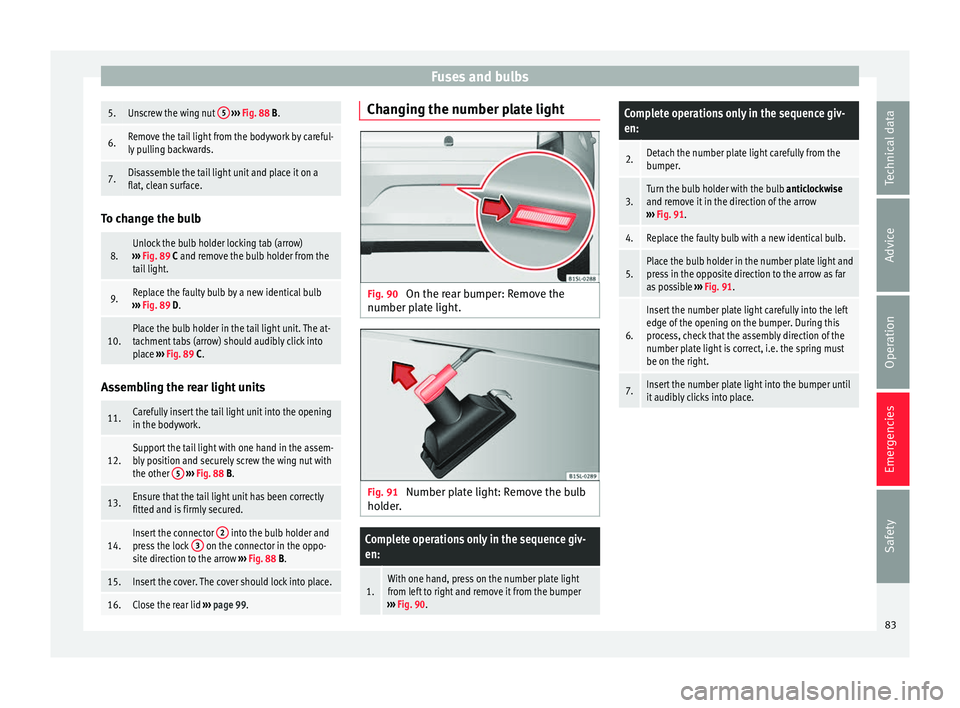
Fuses and bulbs5.Unscrew the wing nut
5
››› Fig. 88 B.
6.Remove the tail light from the bodywork by careful-
ly pulling backwards.
7.Disassemble the tail light unit and place it on a
flat, clean surface. To change the bulb
8.Unlock the bulb holder locking tab (arrow)
››› Fig. 89 C and remove the bulb holder from the
tail light.
9.Replace the faulty bulb by a new identical bulb
››› Fig. 89 D.
10.Place the bulb holder in the tail light unit. The at-
tachment tabs (arrow) should audibly click into
place ››› Fig. 89 C. Assembling the rear light units
11.Carefully insert the tail light unit into the opening
in the bodywork.
12.Support the tail light with one hand in the assem-
bly position and securely screw the wing nut with
the other
5
››› Fig. 88 B.
13.Ensure that the tail light unit has been correctly
fitted and is firmly secured.
14.Insert the connector 2 into the bulb holder and
press the lock 3 on the connector in the oppo-
site direction to the arrow ››› Fig. 88 B.
15.Insert the cover. The cover should lock into place.
16.Close the rear lid ››› page 99. Changing the number plate light
Fig. 90
On the rear bumper: Remove the
number p l
at
e light. Fig. 91
Number plate light: Remove the bulb
ho lder
.
Complete operations only in the sequence giv-
en:
1.With one hand, press on the number plate light
from left to right and remove it from the bumper
››› Fig. 90.
Complete operations only in the sequence giv-
en:
2.Detach the number plate light carefully from the
bumper.
3.Turn the bulb holder with the bulb anticlockwise
and remove it in the direction of the arrow
››› Fig. 91.
4.Replace the faulty bulb with a new identical bulb.
5.Place the bulb holder in the number plate light and
press in the opposite direction to the arrow as far
as possible ››› Fig. 91.
6.
Insert the number plate light carefully into the left
edge of the opening on the bumper. During this
process, check that the assembly direction of the
number plate light is correct, i.e. the spring must
be on the right.
7.Insert the number plate light into the bumper until
it audibly clicks into place. 83
Technical data
Advice
Operation
Emergencies
Safety
Page 104 of 232
Operation
Sliding/tilting electric panor-
amic s
u
nroof
Opening and closing the panoramic
sunroof Read the additional information carefully
›› ›
page 11
The sliding/tilting sunroof only works when
switched on. After switching off, it is still pos-
sible to open or close the sliding/tilting sun-
roof during a short space of time provided
that neither the driver nor passenger door is
opened.
All operations are interrupted when the rotary
knob is actuated.
If it were not possible to close the sliding/tilt-
ing sunroof electrically, it would need to be
closed manually. It is not possible to do an
emergency close of the sliding/tilting sun-
roof without removing components of the ve-
hicle. In such a case, obtain professional as-
sistance.
Sliding blind
With the roof grab handle situated in the rear
part of the roof opening, it is possible to
move the sliding blind to the required posi-
tion. WARNING
If the sliding/tilting electric panoramic sun-
roof i
s used negligently or without paying
due attention, it can cause serious injury.
● The sliding/tilting sunroof should only be
opened or closed when no one i
s blocking its
path.
● After switching off, it is still possible to
open or close the s
liding/tilting sunroof dur-
ing a short space of time provided that nei-
ther the driver nor passenger door is opened. CAUTION
● To pr ev
ent damage, when there are winter
temperatures any ice or snow that there may
be on the roof of the vehicle must be removed
before opening or raising the sliding/tilting
electric panoramic sunroof.
● Before leaving the vehicle or in the case of
heavy r
ain, the sliding/tilting sunroof must
always be closed. With the sliding/tilting
sunroof open or raised, water can enter the
passenger compartment and can cause con-
siderable damage to the electrical system. As
a result, other damage can occur in the vehi-
cle.
● In the case of heavy rain, if the sliding/tilt-
ing su
nroof is open, the interior equipment of
the vehicle may get wet, destroying the seat
heating and damaging the electrical system
of the vehicle. Note
● Le av
es and other loose objects that land in
the guides of the sliding/tilting sunroof
should be removed periodically by hand or
using a vacuum cleaner.
● If the sliding/tilting sunroof does not work
correctly
, the anti-trap function will not work
either. In this case, you should take the vehi-
cle to a specialised workshop.
● The convenience position permits sufficient
ventil
ation with a level of sound produced by
low wind. Anti-trap function of the sliding/tilt-
in
g el
ectric
panoramic sunroof The anti-trap function can reduce the risk of
injur
y
when c
losing the sliding/tilting electric
panoramic sunroof ››› . If the sliding/tilting
s u
nr
oof encounters resistance or an obstacle
when closing, it will immediately reopen.
● Check why the sliding/tilting sunroof has
not clo
sed.
● Try to close it again.
● If it is still not possible to close it due to an
obs
tacle or resistance, it will remain in the
corresponding position. Close it without the
anti-trap function.
102
Page 111 of 232
Lights and visibility
●
Alw a
ys replace damaged or worn blades or
blades which do not clean the windscreen
correctly. CAUTION
In icy conditions, always check that the wiper
b la
des are not frozen to the glass before us-
ing the wipers for the first time. In cold
weather, it may help to leave the vehicle
parked with the wipers in service position
››› page 45. CAUTION
If the ignition is switched off while the wind-
sc r
een wipers are on, the windscreen wipers
carry on wiping at the same level when the
ignition is switched back on. Ice, snow and
other obstacles may damage the windscreen
wiper and the respective motor.
● If necessary, remove snow and ice from the
winds
creen wipers before starting your jour-
ney.
● Carefully lift the frozen windscreen wipers
from the gla
ss. SEAT recommends a de-icer
spray for this operation. Note
● The wind s
creen wipers will only work when
the ignition is switched on.
● The interval wipe speed varies according to
the vehic
le speed. The faster the vehicle is moving, the more often the windscreen is
cl
e
aned.
● The rear wiper is automatically switched on
when the winds
creen wiper is on and the car
is in reverse gear. Functions of the windscreen wiper
Windscreen wiper performance in different sit-
uations
If the vehicle is at a
standstillThe activated position provision-
ally changes to the previous posi-
tion.
For intermittent wip-
ersIntervals between wipes depend
on the vehicle's speed. The high-
er the vehicle speed the shorter
the intervals.
Note
The wiper will try to wipe away any obstacles
that ar
e on the windscreen. The wiper will
stop moving if the obstacle blocks its path.
Remove the obstacle and switch the wiper
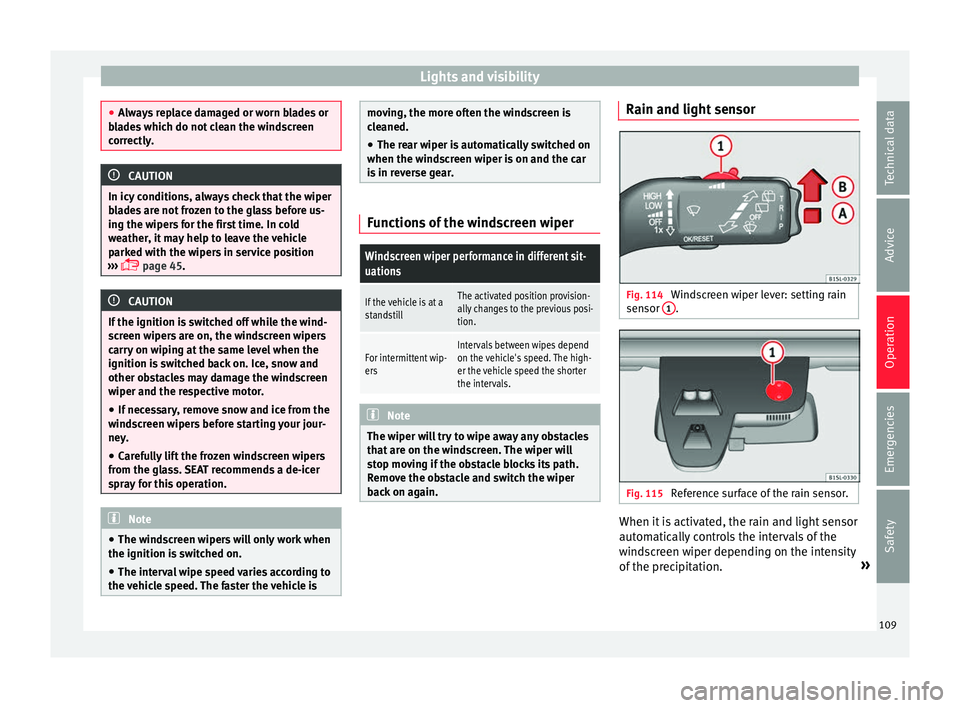
back on again. Rain and light sensor
Fig. 114
Windscreen wiper lever: setting rain
sen sor 1 .
Fig. 115
Reference surface of the rain sensor. When it is activated, the rain and light sensor
aut
om
atic
ally controls the intervals of the
windscreen wiper depending on the intensity
of the precipitation. »
109
Technical data
Advice
Operation
Emergencies
Safety
Page 112 of 232
Operation
When the rain and light sensor is deactiva-
t ed, the dur
ation of
the intervals is set to
fixed levels.
Activating and deactivating the rain and
light sensor
Press the lever to the desired position.
››› Fig. 114:
● Position A - The rain and light sensor is
de activ
at
ed.
● Position B - The rain and light sensor is
activ at
ed and the aut
omatic wipe shall occur,
if necessary.
When the ignition is disconnected and con-
nects again, the rain and light sensor re-
mains activated and starts operating again
when the windscreen wiper lever is in posi-
tion B and the vehicle is travelling at more
th an 4 km/h (2 mph).
Settin g the sen
sitivity level of the rain and
light sensor
The sensitivity of the rain and light sensor
can automatically be set with switch 1 loca-
t ed on the w
ind
screen wiper lever ››› .
● Moving the switch to the right: highly sen-
s itiv
e.
● Mo
ving the switch to the left: less sensi-
tive. Ma
lfunction of the rain and light sensor
Some examp
les of possible causes of mal-
functions and mistaken readings in the area
of reference surface ››› Fig. 115 1 of the rain
and light sen
sor:
● W
indscreen wiper blades in poor condi-
tion: the presenc
e of a film or strips of water
due to the poor condition of the wiper blades
can lead to the windscreen blade function
possibly being prolonged, or the wipe inter-
vals may get shorter or the wipe may happen
to be quick and continuous.
● Insects: the impact of
gnats/mosquitoes
on the windscreen can lead to the wind-
screen wiper operation starting up.
● Salt traces: in winter it
is possible that the
windscreen wipers may run longer than usual
due to the presence of salt traces on the al-
most dry windscreen.
● Dirt: the presence of dry dust, wax, protec-
tive fi
lms (lotus effect), remnant of detergent
(from the car wash tunnel), etc., on the wind-
screen can possibly lead to the rain and light
sensor reacting in a more sensitive way, later,
slower, or that it may not react at all.
● Cracked windscreen: the impact of
a stone
may make the windscreen wipers to carry out
a wipe cycle if the rain and light sensor is ac-
tivated. Subsequently, the sensor detects
that the reference surface has been reduced
and adapts. The behaviour of the sensor acti- vation can vary based on the size of the im-
pact.
C
lean the reference surface of rain and light
sensor 1 regularly and check that the wind-
s c
r
een wiper blades are not damaged. CAUTION
The rain and light sensor may not always de-
tect the pr
ecipitation accurately enough and
connect the windscreen wipers properly.
● If necessary, connect the wipers manually
and appropri
ately when water on the wind-
screen obstructs visibility. Note
It is recommended using a windscreen clean-
ing pr oduct
that may contain alcohol to re-
move the remnant of wax or polish. 110
Page 125 of 232
Transport and practical equipment
Mount the holder
● Insert universal base ››
› Fig. 134 3 into
soc k
ets
2 of the support arm
1 .
● Move the universal base sideways in the di-
r ection of
loc
k 4 until it clicks into
p l
ac
e. ››› .
● Place support arm ››
›
Fig. 135 1 in retain-
in g l
ev
er ››› Fig. 135 3 from above and press
it do
wn
wards until you hear that is locked
››› .
WARNING
If the Smartphone is not secured or is incor-
rectly sec
ured in the vehicle, it could be
thrown though the passenger compartment
during a sudden driving or braking manoeu-
vre, just like in the event of an accident and
lead to injuries.
● The infotainment support system mus be
mounted sec
urely in the corresponding space
of the dash panel.
● The infotainment system must always be
well
secured in its support or kept safely in
the vehicle. CAUTION
If the lean and the angle of visibility are set
up incorr ectly
, the Smartphone can be dam-
aged.
● When performing the set-up, move the
Smartphone c
arefully and not beyond its lim-
its. CAUTION
At very high and very low temperatures, func-
tioning of the
Smartphone can be adversely
affected or the device itself can be damaged.
● Always take the Smartphone with you
when you l
eave the vehicle to protect it from
excessively high or low temperatures, as well
as from intense solar radiation. CAUTION
Humidity can damage the existing electrical
connect or
s in the dash panel for the Smart-
phone.
● Do not clean the Smartphone holder while
wet. On
ly use a dry cloth. Note
SEAT recommends always taking your Smart-
phone when y ou l
eave the vehicle so as to
avoid possible theft. Luggage compartment
Intr oduction Always transport heavy loads in the luggage
c
omp
ar
tment and place the seat backs in a
vertical position. Never overload the vehicle.
Both the carrying capacity as well as the dis-
tribution of the load in the vehicle have ef- fects on the driving behaviour and braking
ability
››› .
WARNING
When the vehicle is not in use or being
wat c
hed, always lock the doors and the rear
lid to reduce the risk of serious injury or
death.
● Do not leave children unwatched, especial-
ly when the boot i
s open. Children could
climb into the luggage compartment, close
the rear lid from inside and be unable to es-
cape themselves. This could lead to serious
injury or death.
● Never allow children to play in or around
the vehic
le.
● Never transport people in the luggage com-
partment
. WARNING
Unsecured or incorrectly secured objects can
cau se seriou
s injury in case of a sudden ma-
noeuvring or breaking or in case of an acci-
dent. This is especially true when objects are
struck by a detonating airbag and fired
through the vehicle interior. To reduce the
risks, please note the following:
● Secure all objects in the vehicle. Always
plac
e equipment and heavy objects in the
boot.
● Always secure objects to the fastening
rings
with suitable rope or straps to prevent
them from being thrown around the interior » 123
Technical data
Advice
Operation
Emergencies
Safety
Page 144 of 232
Operation
Additional information for steep slopes and
hi l
l
s
Before switching off the engine, rotate the
steering wheel so that if the vehicle should
move, it will be held by the kerb.
● On slopes, turn the front wheels so that
they are ag
ainst the edge of the kerb.
● Uphill, turn the wheels towards the centre
of the ro
ad. WARNING
The components of the exhaust system reach
ver y
high temperatures. This could cause a
fire and considerable damage.
● Always park your vehicle so that no part of
the exhau
st system can come in contact with
flammable materials (such as wood,
leaves,dried grass, or spilled fuel). CAUTION
● Spec i
al care should be taken when parking
in areas with high kerbs or fixed barriers. Ob-
jects protruding from the ground may dam-
age the bumper or other parts of the vehicle
during manoeuvres. To avoid damage, stop
before the wheels touch the barrier or kerb.
● Special attention is required when driving
through entranc
es, over ramps, kerbs or oth-
er objects. The vehicle underbody, bumpers,
mudguards and running gear, and the engine
and exhaust system could be damaged as
you drive over these objects. Information on the brakes
For the first 200 to 300 km, the new brak
e
p
ads have not yet reached their maximum
braking capacity, and need to be “run in”
first ››› . The slightly reduced braking effect
can be c ompen
sated for by increasing pres-
sure on the brake pedal. While running in,
the full braking distance or emergency brak-
ing distance is larger then when the brake
pads have been run in. While running in,
avoid full power braking or situations requir-
ing braking performance. For example, in
heavy traffic.
The rate of wear of the brake pads depends
to a great extent on the conditions in which
the vehicle is used and the way the vehicle is
driven. If the vehicle is used frequently in city
traffic or for short trips or driven sport style,
visit a specialised workshop regularly, more
frequently than advised in the Maintenance
Programme, to have the brake pads checked.
If you drive with wet brakes, for example, af-
ter crossing areas of water, in heavy rainfall
or even after washing the car, the effect of
the brakes is lessened as the brake discs are
wet or even frozen (in winter). At higher
speed, “dry” the brakes as quickly as possi-
ble by braking gently several times. Only do
this without endangering vehicles behind
you or any other road users ››› .
A l ay
er of salt on the discs and brake pads
will reduce the effectiveness of the brakes and increase braking distance. If you drive for
a prolon
ged period on salted roads without
braking then brake carefully several times to
eliminate the layer of salt on the brakes ››› .
If the
v
ehicle remains parked for considera-
ble lengths of time, is used little, or if the
brakes are not used, there may be corrosion
on the brake discs and a build up of dirt on
the brake pads. If the brakes are not used fre-
quently, or if rust has formed on the discs,
SEAT recommends cleaning the pads and
discs by braking firmly a few times at a mod-
erately high speed. Only do this without en-
dangering vehicles behind you or any other
road users ››› .
F au
lt
s in the brake system
During braking, if you notice that the vehicle
does not react as usual (that the braking dis-
tance has increased suddenly) it may be pos-
sible that there is a fault in the braking sys-
tem. This is indicated by the warning lamp
. Take the vehicle to a specialised work-
shop immediately and have the fault re-
paired. Drive at a moderate speed and be
prepared to use more pressure on the brake
pedal, and allow for longer stopping distan-
ces.
Brake servo
The brake servo only operates when the en-
gine is running and the pressure applied by
the driver on the brake pedal increases.
142