coolant level Seat Mii 2016 Owner's manual
[x] Cancel search | Manufacturer: SEAT, Model Year: 2016, Model line: Mii, Model: Seat Mii 2016Pages: 232, PDF Size: 4.9 MB
Page 6 of 232
Table of Contents
Advice . . . . . . . . . . . . . . . . . . . . . . . . . . . . . . . . 164
Care and maintenance . . . . . . . . . . . . . . . . . . . . 164
Accessories, replacement of parts and modifi-
c ation
s
. . . . . . . . . . . . . . . . . . . . . . . . . . . . . . . . 164
Caring for and cleaning the vehicle exterior . . . 170
Caring for and cleaning the vehicle interior . . . 176
Notes for the user . . . . . . . . . . . . . . . . . . . . . . . . 179
Checking and refilling levels . . . . . . . . . . . . . . . 181
Fuel . . . . . . . . . . . . . . . . . . . . . . . . . . . . . . . . . . . 181
Filling the tank . . . . . . . . . . . . . . . . . . . . . . . . . . 182
Bonnet . . . . . . . . . . . . . . . . . . . . . . . . . . . . . . . . 186
Engine oil . . . . . . . . . . . . . . . . . . . . . . . . . . . . . . 188
Engine coolant . . . . . . . . . . . . . . . . . . . . . . . . . . 191
Brake fluid . . . . . . . . . . . . . . . . . . . . . . . . . . . . . 194
Windscreen washer reservoir . . . . . . . . . . . . . . 195
Vehicle battery . . . . . . . . . . . . . . . . . . . . . . . . . . 196
Wheels and tyres . . . . . . . . . . . . . . . . . . . . . . . . 199
Tyres . . . . . . . . . . . . . . . . . . . . . . . . . . . . . . . . . . 199
Technical data . . . . . . . . . . . . . . . . . . . . . . . . 210
Technical features . . . . . . . . . . . . . . . . . . . . . . . 210
Important information . . . . . . . . . . . . . . . . . . . . 210
Wheels . . . . . . . . . . . . . . . . . . . . . . . . . . . . . . . . 211
Engine data . . . . . . . . . . . . . . . . . . . . . . . . . . . . . 213
Dimensions . . . . . . . . . . . . . . . . . . . . . . . . . . . . . 216
Index . . . . . . . . . . . . . . . . . . . . . . . . . . . . . . . . . 217
4
Page 27 of 232
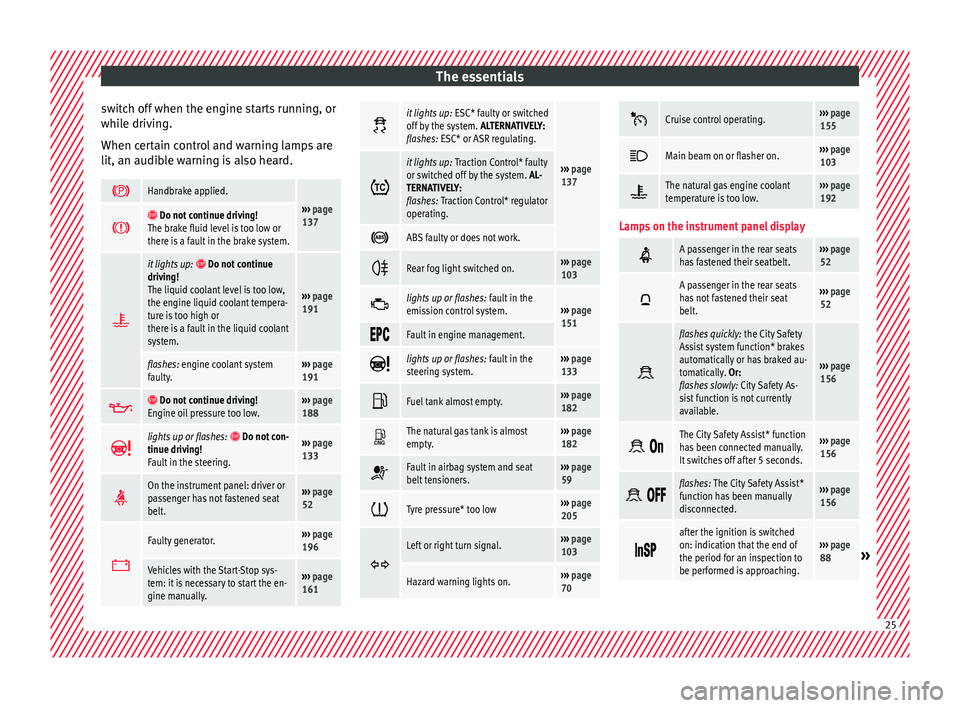
The essentials
switch off when the engine starts running, or
whi l
e driv
ing.
When certain control and warning lamps are
lit, an audible warning is also heard.
Handbrake applied.
›››
page
137 Do not continue driving!
The brake fluid level is too low or
there is a fault in the brake system.
it lights up:
Do not continue
driving!
The liquid coolant level is too low,
the engine liquid coolant tempera-
ture is too high or
there is a fault in the liquid coolant
system.
››› page
191
flashes: engine coolant system
faulty.››› page
191
Do not continue driving!
Engine oil pressure too low.››› page
188
lights up or flashes:
Do not con-
tinue driving!
Fault in the steering.››› page
133
On the instrument panel: driver or
passenger has not fastened seat
belt.›››
page
52
Faulty generator.›››
page
196
Vehicles with the Start-Stop sys-
tem: it is necessary to start the en-
gine manually.››› page
161
it lights up:
ESC* faulty or switched
off by the system. ALTERNATIVELY:
flashes: ESC* or ASR regulating.
››› page
137 it lights up:
Traction Control* faulty
or switched off by the system. AL-
TERNATIVELY:
flashes: Traction Control* regulator
operating.
ABS faulty or does not work.
Rear fog light switched on.›››
page
103
lights up or flashes:
fault in the
emission control system.››› page
151
Fault in engine management.
lights up or flashes:
fault in the
steering system.››› page
133
Fuel tank almost empty.›››
page
182
The natural gas tank is almost
empty.›››
page
182
Fault in airbag system and seat
belt tensioners.›››
page
59
Tyre pressure* too low›››
page
205
Left or right turn signal.›››
page
103
Hazard warning lights on.››› page
70
Cruise control operating.›››
page
155
Main beam on or flasher on.›››
page
103
The natural gas engine coolant
temperature is too low.›››
page
192
Lamps on the instrument panel display
A passenger in the rear seats
has fastened their seatbelt.›››
page
52
A passenger in the rear seats
has not fastened their seat
belt.›››
page
52
flashes quickly:
the City Safety
Assist system function* brakes
automatically or has braked au-
tomatically. Or:
flashes slowly: City Safety As-
sist function is not currently
available.
››› page
156
The City Safety Assist* function
has been connected manually.
It switches off after 5 seconds.›››
page
156
flashes: The City Safety Assist*
function has been manually
disconnected.›››
page
156
after the ignition is switched
on: indication that the end of
the period for an inspection to
be performed is approaching.›››
page
88» 25
Page 34 of 232
The essentials
● Zone B : You can add oil but keep the level
in th at
zone.
● Zone C : Add oil up to zone
B .
T op
pin
g up engine oil
● Unscrew cap from oil filler opening.
● Add oil slowly.
● At the same time, check the level to ensure
you do not a
dd too much.
● When the oil level reaches at least zone B ,
u n
s
crew the engine oil filler cap carefully.
Specifications of engine oil with a service de-
pendent on time/distance travelled
44 kW - 55 kW Petrol en-
ginesVW 504 00, VW 502 00
Natural gas engineVW 502 00
››› in Topping up engine oil on
page 191
››› page 188 Coolant
Fig. 42
Engine compartment: coolant expan-
s ion t
ank
cap. The coolant tank is located in the engine
c
omp
ar
tment.
When the engine is cold, replace the coolant
when the level is below .
Coolant specifications
The engine cooling system is supplied from
the factory with a specially treated mixture of
water and at least 40 % of the additive G13
(TL-VW 774 J), purple. This mixture gives the
necessary frost protection down to -25 °C
(-13 °F) and protects the light alloy parts of
the engine cooling system against corrosion.
It also prevents scaling and considerably rai-
ses the boiling point of the coolant.
To protect the cooling system, the percentage
of additive must always be at least 40 %, even in warm climates where anti-freeze pro-
tection is
not required.
If for weather reasons further protection is
necessary, the proportion of additive may be
increased, but only up to 60 %; otherwise an-
tifreeze protection will diminish and this will
worsen cooling.
When the coolant is topped up, use a mixture
of distilled water and at least 40 % of the
G13 or G12 plus-plus (TL-VW 774 G) additive
(both are purple) to obtain an optimum anti-
corrosion protection ››› in Checking the
c oo
l
ant level and topping up on page 194.
The mixture of G13 with G12 plus (TL-VW 774
F), G12 (red) or G11 (green-blue) engine cool-
ants will significantly reduce anti-corrosion
protection and should therefore be avoided
››› in Checking the coolant level and top-
pin g up on p
ag
e 194.
››› in Checking the coolant level and
topping up on page 193
››› page 191 32
Page 189 of 232
Checking and refilling levels
●
Never w ork
under the vehicle if it has not
been immobilized. If you must work under-
neath the vehicle with the wheels in contact
with the ground then it should be parked on
flat ground, the wheels should be prevented
from moving and the key should be removed
from the ignition.
● If you have to work underneath the vehicle,
you mus
t use suitable stands additionally to
support the vehicle, there is a risk of acci-
dent!. The jack is not intended for this kind of
work and its failure could lead to severe inju-
ries.
● Disconnect the Start-Stop system. WARNING
The engine compartment is a dangerous area
cap ab
le of causing serious injury.
● For all type of work, always take the utmost
precaution
s, work carefully and note the gen-
eral safety standards in force. Never take per-
sonal risks.
● Never work on the engine or in the engine
compar
tment if you are not familiar with the
necessary operations. If you are not sure
about procedures then visit a specialised
workshop to carry out the necessary work.
Working incorrectly can cause serious inju-
ries.
● Never open the bonnet if you see steam or
cool
ant escaping from the engine compart-
ment. This may cause serious burns. Always
wait until you cannot see or hear the sound of steam or coolant coming from the engine
comp
ar
tment.
● Always allow the engine to cool down be-
fore openin
g the bonnet.
● Contact with hot elements of the engine
and the exhau
st system can cause burns.
● Once the engine has cooled, follow the in-
structions
below before opening the bonnet:
– Engage the handbrake and place the gear
selector lever in N or the gear stick in
neutral.
– Remove the key from the ignition.
– Keep children away from the engine com-
partment and never leave them unsuper-
vised.
● When the engine is warm or hot, the cool-
ing sys
tem is pressurised. Do not unscrew
the cap on the expansion tank when the en-
gine is hot. Otherwise, coolant may spray out
under pressure causing burns and serious in-
jury.
– After cooling, carefully and slowly un-
screw the cap anticlockwise, gently
pressing down on it.
– Always protect your face, hands and arms
from hot coolant and steam using a large,
thick cloth.
● When refilling liquids, avoid spilling them
on part
s of the engine and the exhaust sys-
tem. Spilled liquids could cause a fire. WARNING
The high voltages of the electrical system can
give el ectric
shocks as well as causing burns
and serious injury and possibly even death!
● Never cause short circuits in the electrical
syst
em. The battery could explode.
● To minimise the risk of electric shock and
serious c
onsequences while the engine is
running or starting the engine, note the fol-
lowing:
– Never touch the electrical wiring of the
ignition system. WARNING
In the engine compartment, there are rotat-
ing p ar
ts that could cause serious injury.
● Never place your hands directly on or near
the radi
ator fan. Touching the rotor blades
could seriously harm you. The ventilator
works according to the engine temperature
and could start suddenly even when the igni-
tion is turned off and the key is removed.
● If any work has to be performed when the
engine is
started or with the engine running,
there is an additional, potentially fatal, safety
risk from rotating parts, such as the drive
belts, alternator, radiator fan, etc., as well as
from the high-voltage ignition system. Al-
ways work with the utmost caution.
– Always make sure that no parts of your
body, jewellery, ties, loose clothing and
long hair can be trapped by the rotating » 187
Technical data
Advice
Operation
Emergencies
Safety
Page 193 of 232
Checking and refilling levels
checked at regular intervals, preferably when
fi l
lin
g the tank and before a journey.
When the engine is working hard, for in-
stance during sustained high-speed motor-
way cruising in summer or when climbing
mountain passes, the oil level should pref-
erably be kept within area ››› Fig. 168 A .
Topping up engine oil Read the additional information carefully
›› ›
page 31.
The engine oil must be changed regularly ac-
cording to the specifications of the Mainte-
nance Programme.
Due to the problems linked with disposing of
used oil and the need for suitable tools and
special knowledge, always visit a specialised
workshop to have the engine oil and filter
changed. SEAT recommends taking your car
in for technical service.
Detailed information on the service intervals
is shown in the Maintenance Programme.
Engine oil additives make new oil darker after
the engine has been running for a short peri-
od. This is normal and does not mean more
frequent oil changes are required. WARNING
Only change the engine oil yourself if you
hav e the s
pecialist knowledge required!
● Before opening the bonnet, read and ob-
serve the w
arnings ››› page 186.
● Wait for the engine to cool down. Hot oil
may
cause burn injuries.
● Wear eye protection to avoid injuries, such
as ac
id burns, caused by splashes of oil.
● When removing the oil drain plug with your
finger
s, keep your arm horizontal to help pre-
vent oil from running down your arm.
● Wash your skin thoroughly if it comes into
contact
with engine oil.
● Engine oil is poisonous! Used oil must be
stor
ed in a safe place out of the reach of chil-
dren. CAUTION
No additives should be used with engine oil.
This c
ould result in engine damage. Any dam-
age caused by the use of such additives
would not be covered by the factory warranty. For the sake of the environment
Before changing the engine oil, find a suita-
bl e loc
ation or service for proper disposal. For the sake of the environment
Always dispose of engine oil with the utmost
re s
pect for the environment. Never dispose of used engine oil in places such as a garden,
wood
s, dr
ains, roads, paths, rivers and drain-
age systems. Engine coolant
Introduction WARNING
Engine coolant is toxic!
● Only keep engine coolant in its original
c ont ainer
, tightly shut and in a safe place.
● Never store engine coolant in empty food
container
s or bottles as other people may ac-
cidentally drink it.
● Always keep engine coolant out of reach of
chil
dren.
● Ensure that the proportion of engine cool-
ant ad
ditive corresponds to the lowest out-
side temperature to which the vehicle will be
exposed.
● If the outside temperature is extremely low,
the engine coo
lant could freeze causing the
vehicle to stop. As this would also cause the
heating to stop working, vehicle occupants
without warm clothing could freeze. For the sake of the environment
Coolants and additives can contaminate the
env ir
onment. If any fluids are spilled, they » 191
Technical data
Advice
Operation
Emergencies
Safety
Page 194 of 232
Advice
should be collected and correctly disposed
of, w
ith r
espect to the environment. Coolant warning lamp
Several warning and control lamps light up
for a f
ew sec
onds when the ignition is switch-
ed on, signalling that the function is being
verified. They will switch off after a few sec-
onds.
It lights up red
Excessive engine
coolant temperature.
Stop the vehicle!
Stop the vehicle safely as soon
as possible. Switch off the en-
gine and let it cool.
Insufficient engine
coolant level.
¡Stop the vehicle!
Check the engine coolant
when the engine has cooled
and, if it is low, refill with en-
gine coolant ››› page 192.
Engine coolant sys-
tem faulty. Do not drive any further.
Obtain professional assis-
tance.
Flashes red
Engine coolant sys-
tem faulty.Seek specialist assistance.
It lights up blue
The temperature of
the natural gas en-
gine coolant is too
low. The engine has
not reached the oper-
ating temperature.Avoid high engine speeds and
pushing the engine too hard
while the warning lamp re-
mains lit.
WARNING
Observe the safety warnings ›››
in On the
ins trument
panel on page 26. Checking the coolant level and top-
pin
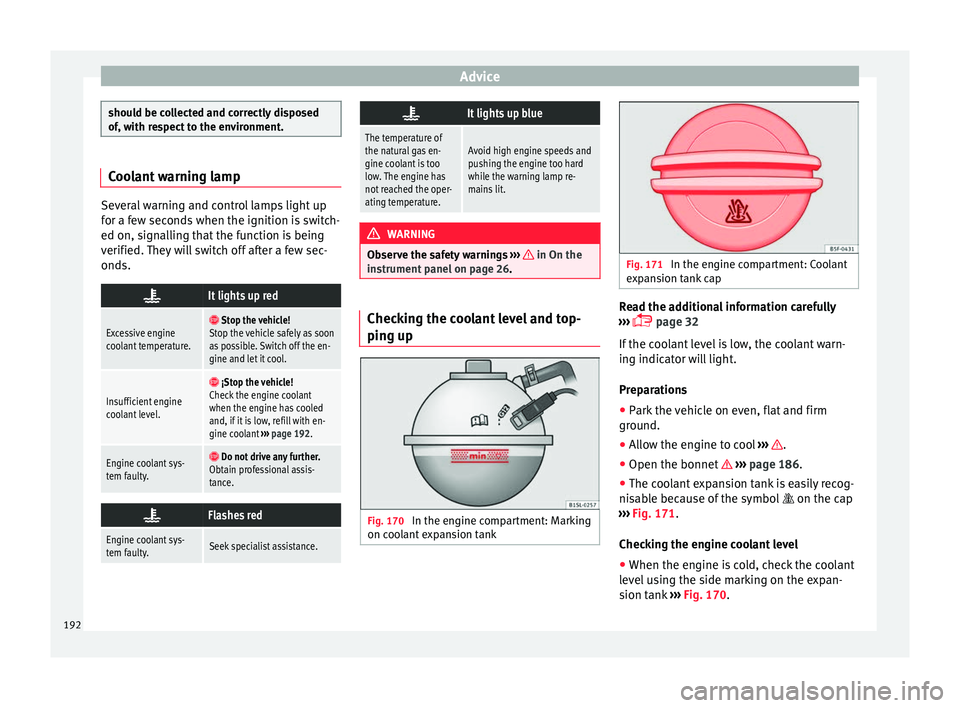
g up Fig. 170
In the engine compartment: Marking
on c oo
l
ant expansion tank Fig. 171
In the engine compartment: Coolant
exp an
sion tank cap Read the additional information carefully
› ›
›
page 32
If the coolant level is low, the coolant warn-
ing indicator will light.
Preparations
● Park the vehicle on even, flat and firm
ground.
● A
llow the engine to cool ›››
.
● Open the bonnet › ›
›
page 186.
● The coolant expansion tank is easily recog-
nisab
le because of the symbol on the cap
››› Fig. 171.
Checking the engine coolant level ● When the engine is cold, check the coolant
level
using the side marking on the expan-
sion tank ››› Fig. 170.
192
Page 195 of 232
Checking and refilling levels
● If the l
ev
el is below the “MIN” mark, top up
with coolant. When the engine is hot it may
be slightly above the marked area.
Topping up the engine coolant level
● Always protect your face, hands and arms
from hot c
oolant and steam using a large,
thick cloth over the coolant expansion tank
cap.
● Remove the cap very carefully ›››
.
● Only refill using new engine c
oo
lant ac-
cording to SEAT specifications
( ›››
page 32)
››› .
● The engine coolant level should be be-
tw een the m
ark
s on the coolant expansion
tank ››› Fig. 170. Do not exceed the top level
of the marked area ››› .
● Screw on the cap tightly.
● If, in the event of an emergency, you have
no c oo
l
ant that is compliant to the required
specifications ( ›››
page 32), do not use
another type of additive. Instead, top up with
distilled water only ››› . Then re-establish
the c orr
ect
proportion of the mixture with the
correct additive as soon as possible
››› page 32. WARNING
Hot vapours and coolant can cause serious
burn s. ●
Never open the c oo
lant expansion tank if
steam or coolant is coming from the engine
compartment. Wait until you cannot see or
hear any steam or coolant escaping.
● Always wait until the engine has complete-
ly coo
led before very carefully opening the
expansion tank cap. Contact with hot ele-
ments of the engine can cause skin burns.
● When the engine is warm or hot, the cool-
ing sys
tem is pressurised. Do not unscrew
the cap on the expansion tank when the en-
gine is hot. Otherwise, coolant may spray out
under pressure causing burns and serious in-
jury.
– Carefully and slowly unscrew the cap an-
ti-clockwise, gently pressing down on it.
– Always protect your face, hands and arms
from hot coolant and steam using a large,
thick cloth.
● When refilling liquids, avoid spilling them
on part
s of the engine and the exhaust sys-
tem. Spilled liquids could cause a fire. Under
specific circumstances, the ethylene glycol
can catch fire. WARNING
If there is not enough anti-freeze in the cool-
ant sy s
tem, the engine may fail leading to se-
rious damage.
● Please make sure that the percentage of
additiv
e is correct with respect to the lowest
expected ambient temperature in the zone in
which the vehicle is to be used. ●
When the outs ide t
emperature is very low,
the coolant could freeze and the vehicle
would be immobilised. In this case, the heat-
ing would not work either and inadequately
dressed passengers could die of cold. CAUTION
● If ther e i
s no appropriate coolant liquid
available, fill it using distilled water, and
nothing else. Any other type of water may
lead to considerable rusting in the engine
due to its chemical components. This could
consequently damage the engine. If you have
not used distilled water but another type of
water to top up the coolant, a specialised
workshop must immediately replace all of the
fluid in the engine cooling system.
● Only top up coolant to the top level of the
marked ar
ea ››› Fig. 170. Otherwise the ex-
cess coolant will be forced out of the cooling
system when the engine is hot, causing dam-
age.
● If a lot of liquid coolant has been lost, wait
for the engine t
o cool down completely before
adding coolant. Extensive coolant loss is an
indication of leaks in the engine cooling sys-
tem. Have the engine cooling system inspec-
ted immediately by a specialised workshop.
Otherwise engine damage may occur.
● When refilling service liquids, ensure that
you put
the liquids into the right tank. Mak-
ing a mistake when refilling could cause seri-
ous malfunctions and damage the engine! » 193
Technical data
Advice
Operation
Emergencies
Safety
Page 196 of 232
Advice
CAUTION
The original additives should never be mixed
with c oo
lants which are not approved by
SEAT. Otherwise, you run the risk of causing
severe damage to the engine and the engine
cooling system.
● If the fluid in the expansion tank is not pur-
ple b
ut is, for example, brown, this indicates
that the G13 additive has been mixed with an
inadequate coolant. The coolant must be
changed as soon as possible if this is the
case! This could result in serious faults and
engine damage. Brake fluid
Chec k
in
g the brake fluid levelRead the additional information carefully
› ›
›
page 33
In the course of time, the brake fluid absorbs
water from the ambient air. If there is too
much water in the brake fluid, the brake sys-
tem could be damaged. In addition, the boil-
ing point of the brake fluid is significantly
lowered. When the brake fluid contains too
much water and the brakes are subject to
considerable forces, bubbles of water vapour
can form in the system. These bubbles can
significantly reduce braking power, notably
increasing braking distance, and could even
result in the total failure of the brake system. Ensuring that the brake system is always
functionin
g correctly is essential for your own
safety and the safety of other road users
››› .
Br ak
e fluid s
pecifications
SEAT have developed a special brake fluid
optimised for the brake systems of their vehi-
cles. To ensure the optimum working of the
brake system, SEAT recommends the use of
brake fluid in accordance with the VW 501 14
standard. If this brake fluid is not available or
another brake fluid is used for different rea-
sons, use a brake fluid that complies with the
United States standard FMVSS 116 DOT 4 or
the German standard DIN ISO 4925 CLASS 4
››› .
Br ak
e fluid
s conforming to the standard
VW 501 14, fulfil the American requirements
of the FMVSS 116 DOT 4 standard and the
German DIN ISO 4925 CLASS 4 standard.
However, fluids that comply with the Ameri-
can FMVSS 116 DOT 4 standard or the Ger-
man DIN ISO 4925 CLASS 4 standard do not
necessarily comply with the VW 501 14
standard. Always check the information on
the brake fluid container and ensure that you
are using suitable brake fluid.
A suitable brake fluid can be obtained from
SEAT dealerships. Brake fluid level
The level
of the brake fluid should always be
between the MIN and MAX marks, or above
the MIN mark ››› .
It i
s
not always possible to check the level of
the brake fluid, as in some models the en-
gine components make it difficult to see the
brake fluid reservoir. If you cannot read the
exact brake fluid level, consult a specialist.
The brake fluid level drops slightly when the
vehicle is being used due to wear of the
brake pads and the automatic readjustment
of the brake.
Changing the brake fluid
The brake fluid should be changed in accord-
ance with the instructions given in the Main-
tenance Programme. Have the brake fluid
changed by a specialised workshop. SEAT
recommends taking your car in for technical
service. This means that only brake fluid
complying with the required specifications
will be used. WARNING
If the brake fluid level is low or unsuita-
bl e/o
ld brake fluid is used, the brake system
may fail or braking power may be reduced.
● Check the brake system and the brake fluid
level
regularly!194
Page 221 of 232
Index
Close . . . . . . . . . . . . . . . . . . . . . . . . . . . . . . . . . . . . 92 bonnet . . . . . . . . . . . . . . . . . . . . . . . . . . . . . . . . .
10
C lo
sing . . . . . . . . . . . . . . . . . . . . . . . . . . . . . . . . . . 92
bonnet . . . . . . . . . . . . . . . . . . . . . . . . . . . . . . . . . 10
electric windows . . . . . . . . . . . . . . . . . . . . . . . . . 11
luggage compartment . . . . . . . . . . . . . . . . . . . 100
panoramic sunroof . . . . . . . . . . . . . . . . . . . . . . . 11
windows . . . . . . . . . . . . . . . . . . . . . . . . . . . . . . 101
Clothes hook . . . . . . . . . . . . . . . . . . . . . . . . . . . . 119
Code number . . . . . . . . . . . . . . . . . . . . . . . . . . . . . 71
Coming Home lights . . . . . . . . . . . . . . . . . . . . . . . . . . . . . . . . . 105
Coming Home Function . . . . . . . . . . . . . . . . . . . . 105
Compartments . . . . . . . . . . . . . . . . . . . . . . . . . . . 116 centre console . . . . . . . . . . . . . . . . . . . . . . . . . 117
glove compartment . . . . . . . . . . . . . . . . 117, 118
passenger side . . . . . . . . . . . . . . . . . . . . 117, 118
sunglasses storage compartment . . . . . . . . . . 117
Conformity certification . . . . . . . . . . . . . . . . . . . . 180
control and warning lamps changing gear . . . . . . . . . . . . . . . . . . . . . . . . . . 144
Control and warning lamps airbag system . . . . . . . . . . . . . . . . . . . . . . . . . . . 63
brake system . . . . . . . . . . . . . . . . . . . . . . . . . . . 138
catalytic converter . . . . . . . . . . . . . . . . . . . . . . 151
City Safety Assist function . . . . . . . . . . . . . . . . 157
coolant . . . . . . . . . . . . . . . . . . . . . . . . . . . . . . . 192
cruise control . . . . . . . . . . . . . . . . . . . . . . . . . . 155
emission control system . . . . . . . . . . . . . . . . . 151
engine management . . . . . . . . . . . . . . . . . . . . 151
engine oil sensor . . . . . . . . . . . . . . . . . . . . . . . 189
ESC . . . . . . . . . . . . . . . . . . . . . . . . . . . . . . . . . . 138
for the seat belt . . . . . . . . . . . . . . . . . . . . . . . . . 53
fuel level . . . . . . . . . . . . . . . . . . . . . . . . . . . . . . 184
general view . . . . . . . . . . . . . . . . . . . . . . . . . . . . 24
generator . . . . . . . . . . . . . . . . . . . . . . . . . . . . . . 196
hill hold . . . . . . . . . . . . . . . . . . . . . . . . . . . . . . . 161 indication of brake pad wear . . . . . . . . . . . . . . 138
key . . . . . . . . . . . . . . . . . . . . . . . . . . . . . . . . . . . . 93
lights
. . . . . . . . . . . . . . . . . . . . . . . . . . . . . . . . . 103
locking the steering column . . . . . . . . . . . . . . 134
on the driver door . . . . . . . . . . . . . . . . . . . . . . . . 98
refuelling . . . . . . . . . . . . . . . . . . . . . . . . . . . . . . 185
tyres . . . . . . . . . . . . . . . . . . . . . . . . . . . . . . . . . . 205
vehicle battery . . . . . . . . . . . . . . . . . . . . . . . . . 196
Control lamp refuelling . . . . . . . . . . . . . . . . . . . . . . . . . . . . . . 184
Control units . . . . . . . . . . . . . . . . . . . . . . . . . . . . . 167 reprogramming . . . . . . . . . . . . . . . . . . . . . . . . . 167
Coolant checking the level . . . . . . . . . . . . . . . . . . . . . . . 192
control and warning lamps . . . . . . . . . . . . . . . 192
filler neck . . . . . . . . . . . . . . . . . . . . . . . . . . . . . 192
topping up . . . . . . . . . . . . . . . . . . . . . . . . . . . . 192
Cooling system checking the coolant . . . . . . . . . . . . . . . . . . . . 191
topping up with coolant . . . . . . . . . . . . . . . . . . 191
Correct position . . . . . . . . . . . . . . . . . . . . . . . . . . . 48 driver . . . . . . . . . . . . . . . . . . . . . . . . . . . . . . . . . . 48
Cruise control . . . . . . . . . . . . . . . . . . . . . . . . 24, 155 control and warning lamps . . . . . . . . . . . . . . . 155
operation . . . . . . . . . . . . . . . . . . . . . . . . . . . . . . 156
D Dangers in not using the seat belt . . . . . . . . . . . . 55
Dash panel . . . . . . . . . . . . . . . . . . . . . . . . . . . . . . . 87 airbag system . . . . . . . . . . . . . . . . . . . . . . . . . . 178
Data registry . . . . . . . . . . . . . . . . . . . . . . . . . . . . . 167
Data storage during the journey . . . . . . . . . . . . . 167
Daytime running lights . . . . . . . . . . . . . . . . . . . . 104
De-icing the locks . . . . . . . . . . . . . . . . . . . . . . . . . 175
Diagnostics connector . . . . . . . . . . . . . . . . . . . . . 168
Digital clock . . . . . . . . . . . . . . . . . . . . . . . . . . . . . . 88
Dimensions . . . . . . . . . . . . . . . . . . . . . . . . . . . . . . 216 Direction of rotation
tyre s . . . . . . . . . . . . . . . . . . . . . . . . . . . . . . . . . . . 41
Disabling the front passenger front airbag . . . . . 15
Display . . . . . . . . . . . . . . . . . . . . . . . . . . . . . . . 88, 89
Disposal belt tension device . . . . . . . . . . . . . . . . . . . . . . . 58
Door cylinder . . . . . . . . . . . . . . . . . . . . . . . . . . . . . . 8
Door lock . . . . . . . . . . . . . . . . . . . . . . . . . . . . . . . . . . 8
Door release lever . . . . . . . . . . . . . . . . . . . . . . . . . . 8 interior . . . . . . . . . . . . . . . . . . . . . . . . . . . . . . . . . 87
Doors . . . . . . . . . . . . . . . . . . . . . . . . . . . . . . . . . . . . 98 childproof locks . . . . . . . . . . . . . . . . . . . . . . . . . 98
emergency closing or opening . . . . . . . . . . . . . . 8
opening and closing . . . . . . . . . . . . . . . . . . . . . . 8
Drink holders . . . . . . . . . . . . . . . . . . . . . . . . . . . . 119 Centre console . . . . . . . . . . . . . . . . . . . . . . . . . 120
Driving automatic gearbox . . . . . . . . . . . . . . . . . . . . . . 147
data storage . . . . . . . . . . . . . . . . . . . . . . . . . . . 167
driving abroad . . . . . . . . . . . . . . . . . . . . . . . . . 152
driving through water . . . . . . . . . . . . . . . . . . . . 153
economical . . . . . . . . . . . . . . . . . . . . . . . . . . . . 149
fuel gauge . . . . . . . . . . . . . . . . . . . . . . . . . . . . . 184
fuel level too low . . . . . . . . . . . . . . . . . . . . . . . 184
parking downhill . . . . . . . . . . . . . . . . . . . . . . . . 142
parking uphill . . . . . . . . . . . . . . . . . . . . . . . . . . 142
starting on a slope . . . . . . . . . . . . . . . . . . . . . . 147
stopping on a slope . . . . . . . . . . . . . . . . . . . . . 147
through salt water . . . . . . . . . . . . . . . . . . . . . . 153
with a trailer . . . . . . . . . . . . . . . . . . . . . . . . . . . 163
Driving abroad headlights . . . . . . . . . . . . . . . . . . . . . . . . . . . . . 107
Driving in winter fuel consumption . . . . . . . . . . . . . . . . . . . . . . . 151
salt traces . . . . . . . . . . . . . . . . . . . . . . . . . . . . . 110
snow chains . . . . . . . . . . . . . . . . . . . . . . . . . . . . 41
tread depth . . . . . . . . . . . . . . . . . . . . . . . . . . . . 204
219
Page 222 of 232
Index
tyre pressure . . . . . . . . . . . . . . . . . . . . . . . . . . . 203
w ind
s
creen washer bottle . . . . . . . . . . . . . . . . 173
Driving safety . . . . . . . . . . . . . . . . . . . . . . . . . . . . . 47
Driving through water . . . . . . . . . . . . . . . . . . . . . 153
Driving tips for a loaded vehicle . . . . . . . . . . . . . . . . . . . . . 114
Duplicate keys . . . . . . . . . . . . . . . . . . . . . . . . . . . . 92
Dust filter . . . . . . . . . . . . . . . . . . . . . . . . . . . . . . . 133
Dynamic headlight range control . . . . . . . . . . . . 107
E E10 see Ethanol (fuel) . . . . . . . . . . . . . . . . . . . . . . . 181
EDL see Electronic differential lock . . . . . . . . . . . . . 139
EDS see "Brake assist systems" . . . . . . . . . . . . . . . 140
Electric windows . . . . . . . . . . . . . . . . . . . . . . . . . . . . . . . 11
Electrical devices . . . . . . . . . . . . . . . . . . . . 121, 122
Electric windows . . . . . . . . . . . . . . . . . . . . . . . . . . . 11 buttons . . . . . . . . . . . . . . . . . . . . . . . . . . . . . . . 101
closing . . . . . . . . . . . . . . . . . . . . . . . . . . . . . . . . 101
opening . . . . . . . . . . . . . . . . . . . . . . . . . . . . . . . 101
see Windows . . . . . . . . . . . . . . . . . . . . . . . . . . . 101
Electronic differential lock . . . . . . . . . . . . . . . . . . 139
Electronic immobiliser . . . . . . . . . . . . . . . . . . . . . 137 operating fault . . . . . . . . . . . . . . . . . . . . . . . . . 135
Electronic Stability Control (ESC) . . . . . . . . . . . . 139
Emergencies . . . . . . . . . . . . . . . . . . . . . . . . . . . . . . 70 bulbs . . . . . . . . . . . . . . . . . . . . . . . . . . . . . . . . . . 35
changing a wheel . . . . . . . . . . . . . . . . . . . . . . . . 36
emergency towing of the vehicle . . . . . . . . . . . . 42
fire extinguishers . . . . . . . . . . . . . . . . . . . . . . . . 70
first aid kit . . . . . . . . . . . . . . . . . . . . . . . . . . . . . . 70
fuses . . . . . . . . . . . . . . . . . . . . . . . . . . . . . . . . . . 34
hazard warning lights . . . . . . . . . . . . . . . . . . . 106 Jump leads . . . . . . . . . . . . . . . . . . . . . . . . . . . . . 43
punct
ure . . . . . . . . . . . . . . . . . . . . . . . . . . . . . . . 35
replacing a blown fuse . . . . . . . . . . . . . . . . . . . . 34
vehicle tool kit . . . . . . . . . . . . . . . . . . . . . . . . . . 70
warning triangle . . . . . . . . . . . . . . . . . . . . . . . . . 70
Emergency closing or opening driver door . . . . . . . . . . . . . . . . . . . . . . . . . . . . . . 8
passenger door . . . . . . . . . . . . . . . . . . . . . . . . . . . 9
Emergency locking and unlocking . . . . . . . . . . . . 77
Emergency unlocking boot hatch . . . . . . . . . . . . . . . . . . . . . . . . . . . . . . 10
Emergency unlocking the boot hatch boot hatch . . . . . . . . . . . . . . . . . . . . . . . . . . . . . . 10
Emission control system control and warning lamps . . . . . . . . . . . . . . . 151
Emissions data . . . . . . . . . . . . . . . . . . . . . . . . . . . 210
Engine assisted starting . . . . . . . . . . . . . . . . . . . . . . . . . 43
noises . . . . . . . . . . . . . . . . . . . . . . . . . . . . . . . . 136
running in . . . . . . . . . . . . . . . . . . . . . . . . . . . . . 148
start-Stop system . . . . . . . . . . . . . . . . . . . . . . . 161
Engine and ignition . . . . . . . . . . . . . . . . . . . . . . . 135 12 Volt sockets . . . . . . . . . . . . . . . . . . . . . . . . . 122
ignition lock . . . . . . . . . . . . . . . . . . . . . . . . . . . 135
immobiliser . . . . . . . . . . . . . . . . . . . . . . . . . . . . 137
starting the engine . . . . . . . . . . . . . . . . . . . . . . 135
stopping the engine . . . . . . . . . . . . . . . . . . . . . 136
unauthorised vehicle key . . . . . . . . . . . . . . . . . 135
Engine compartment . . . . . . . . . . . . . . . . . . 10, 186 battery . . . . . . . . . . . . . . . . . . . . . . . . . . . . 33, 196
brake fluid . . . . . . . . . . . . . . . . . . . . . . . . . 33, 194
coolant . . . . . . . . . . . . . . . . . . . . . . . . . . . 32, 191
engine oil . . . . . . . . . . . . . . . . . . . . . 31, 190, 191
windscreen washer reservoir . . . . . . . . . . 33, 195
Engine coolant . . . . . . . . . . . . . . . . . . . . . . . . . . . . 32 checking the level . . . . . . . . . . . . . . . . . . . . . . . 191
G 12 plus-plus . . . . . . . . . . . . . . . . . . . . . . . . . . 32 G 13 . . . . . . . . . . . . . . . . . . . . . . . . . . . . . . . . . . . 32
specific
ations . . . . . . . . . . . . . . . . . . . . . . . . . . . 32
temperature display . . . . . . . . . . . . . . . . . . . . . 192
Engine data . . . . . . . . . . . . . . . . . . . . . . . . . . . . . . 213
Engine management . . . . . . . . . . . . . . . . . . . . . . 151 control lamps . . . . . . . . . . . . . . . . . . . . . . . . . . 151
Engine oil . . . . . . . . . . . . . . . . . . . . . . . . . . . 31, 188 changing . . . . . . . . . . . . . . . . . . . . . . . . . . . . . . 188
checking oil level . . . . . . . . . . . . . . . . . . . . . . . 190
consumption . . . . . . . . . . . . . . . . . . . . . . . . . . . 190
control and warning lamps . . . . . . . . . . . . . . . 189
dipstick . . . . . . . . . . . . . . . . . . . . . . . . . . . . . . . 190
oil properties . . . . . . . . . . . . . . . . . . . . . . . . . . . 32
specifications . . . . . . . . . . . . . . . . . . . . . . . . . . 189
topping up . . . . . . . . . . . . . . . . . . . . . . . . . . . . 191
Environment environmental compatibility . . . . . . . . . . . . . . 149
Environmental ecological driving . . . . . . . . . . . . . . . . . . . . . . . 149
Environmental tips refuelling . . . . . . . . . . . . . . . . . . . . . . . . . . . . . . 185
Equipment . . . . . . . . . . . . . . . . . . . . . . . . . . . . . . 164 safety . . . . . . . . . . . . . . . . . . . . . . . . . . . . . . . . . . 60
ESC electronic stability control . . . . . . . . . . . . . . . . 139
Ethanol (fuel) . . . . . . . . . . . . . . . . . . . . . . . . . . . . 181
Event Data Recorder . . . . . . . . . . . . . . . . . . . . . . . 167
Exhaust gas purification system . . . . . . . . . . . . . 151
Exterior mirrors adjusting . . . . . . . . . . . . . . . . . . . . . . . . . . . . . . . 13
vehicle care . . . . . . . . . . . . . . . . . . . . . . . . . . . . 172
Exterior rear view mirrors control of the function . . . . . . . . . . . . . . . . . . . 112
electric exterior mirrors . . . . . . . . . . . . . . . . . . 112
exterior . . . . . . . . . . . . . . . . . . . . . . . . . . . . . . . 111
Exterior view . . . . . . . . . . . . . . . . . . . . . . . . . . . . . 5, 6
220