fuel cap Seat Mii 2016 Owner's manual
[x] Cancel search | Manufacturer: SEAT, Model Year: 2016, Model line: Mii, Model: Seat Mii 2016Pages: 232, PDF Size: 4.9 MB
Page 33 of 232
The essentials
Fluid Level control Fi l
lin
g the fuel tank
Fuel tank capacity
Petrol enginesAround 35.0 l,
of which approximately 4.0 are the reserve.
Natural gas en-
gineNatural gas: approx. 11 kg; of whichmax. 1.5 kg reserve
Petrol: approx. 10 l; of which approx. 5 l reserve
Windscreen washer tank capacity
The washer bottle capacity is approximately 3 litres.Fuel
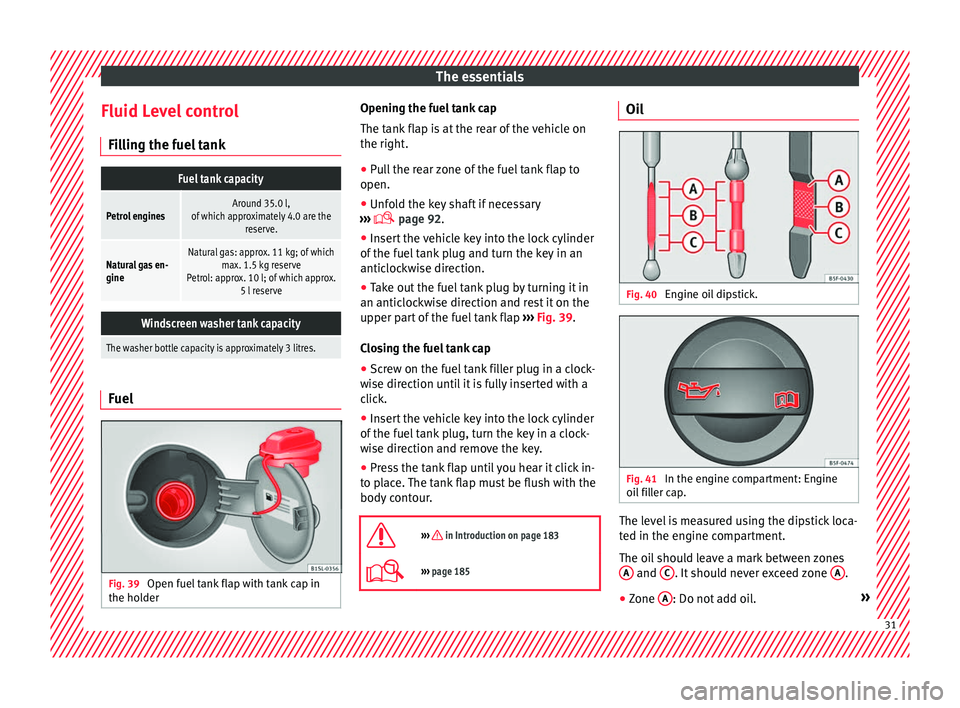
Fig. 39
Open fuel tank flap with tank cap in
the ho l
der Opening the fuel tank cap
The t
ank fl
ap is at the rear of the vehicle on
the right.
● Pull the rear zone of the fuel tank flap to
open.
● Unfold the key shaft if necessary
›››
page 92.
● Insert the vehicle key into the lock cylinder
of the fuel
tank plug and turn the key in an
anticlockwise direction.
● Take out the fuel tank plug by turning it in
an anticlock
wise direction and rest it on the
upper part of the fuel tank flap ››› Fig. 39.
Closing the fuel tank cap
● Screw on the fuel tank filler plug in a clock-
wise dir
ection until it is fully inserted with a
click.
● Insert the vehicle key into the lock cylinder
of the fuel
tank plug, turn the key in a clock-
wise direction and remove the key.
● Press the tank flap until you hear it click in-
to pl
ace. The tank flap must be flush with the
body contour.
››› in Introduction on page 183
››› page 185 Oil
Fig. 40
Engine oil dipstick. Fig. 41
In the engine compartment: Engine
oi l
fi
ller cap. The level is measured using the dipstick loca-
t
ed in the en
gine c
ompartment.
The oil should leave a mark between zones A and
C . It should never exceed zone
A .
● Zone A : Do not add oil.
» 31
Page 47 of 232
The essentials
8. Start the engine of the vehicle with the flat batt
er
y and wait for 2 or 3 minutes until
the engine is running.
Removing the jump leads
9. Before you remove the jump leads, switch off the dipped be
am headlights (if they
are switched on).
10.Turn on the heater blower and heated rear window in the
vehicle with the flat battery.
This helps minimise voltage peaks which
are generated when the leads are discon-
nected.
11.
When the engine is running, disconnect
the leads in reverse order to the details
given above.
Make sure the battery clamps have sufficient
metal-to-metal contact with the battery termi-
nals.
If the engine fails to start, switch off the start-
er after about 10 seconds and try again after
about 1 minute. WARNING
● Ple a
se note the safety warnings referring to
working in the engine compartment
››› page 186.
● The battery providing assistance must have
the same v
oltage as the flat battery (12V) and
approximately the same capacity (see imprint on battery). Failure to comply could result in
an exp
lo
sion.
● Never use jump leads when one of the bat-
teries
is frozen. Danger of explosion! Even af-
ter the battery has thawed, battery acid could
leak and cause chemical burns. If a battery
freezes, it should be replaced.
● Keep sparks, flames and lighted cigarettes
awa
y from batteries, danger of explosion.
Failure to comply could result in an explo-
sion.
● Observe the instructions provided by the
manufact
urer of the jump leads.
● Do not connect the negative cable from the
other vehic
le directly to the negative terminal
of the flat battery. The gas emitted from the
battery could be ignited by sparks. Danger of
explosion.
● Do not attach the negative cable from the
other vehic
le to parts of the fuel system or to
the brake line.
● The non-insulated parts of the battery
clamp
s must not be allowed to touch. The
jump lead attached to the positive battery
terminal must not touch metal parts of the ve-
hicle, this can cause a short circuit.
● Position the leads in such a way that they
cannot c
ome into contact with any moving
parts in the engine compartment.
● Do not lean on the batteries. This could re-
sult
in chemical burns. Note
The vehicles must not touch each other, oth-
erw i
se electricity could flow as soon as the
positive terminals are connected. Changing the wiper blades
Wind s
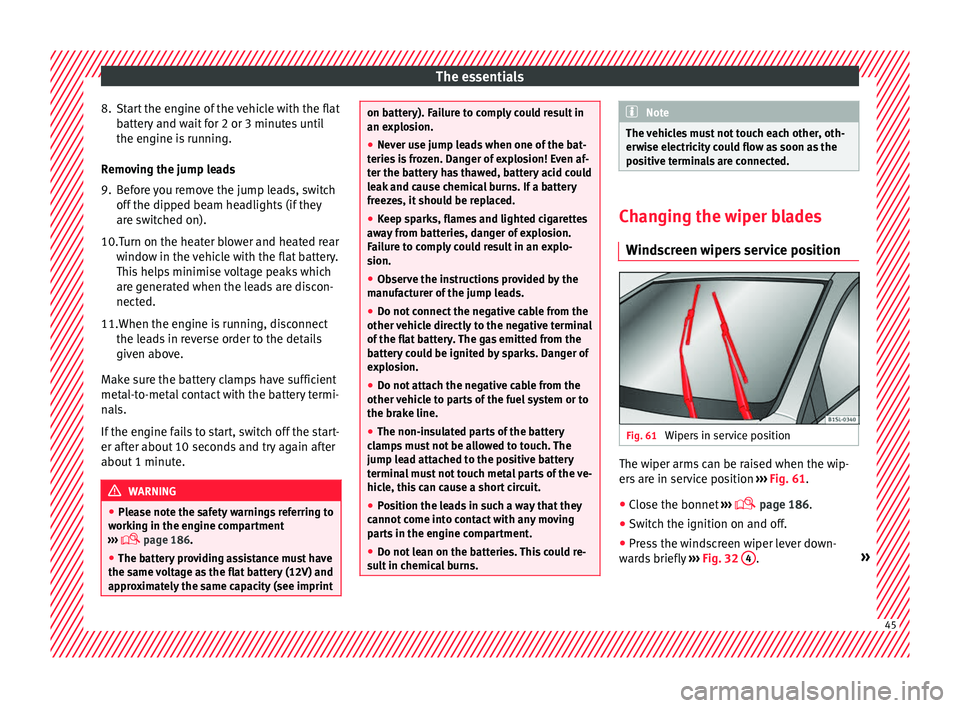
creen wipers service position Fig. 61
Wipers in service position The wiper arms can be raised when the wip-
er
s
ar
e in service position ›››
Fig. 61.
● Close the bonnet ›››
page 186.
● Switch the ignition on and off.
● Press the windscreen wiper lever down-
ward
s briefly ›››
Fig. 32 4 .
» 45
Page 116 of 232
Operation
●
Prior to u s
ing the seat heating, be certain
that the seat cushion is dry.
● Avoid sitting down with damp or wet cloth-
ing.
● Do not p
lace damp or wet objects or gar-
ments on t
op of the seat.
● Do not spill liquids on the seat. CAUTION
● To av oid d
amaging the heating compo-
nents, please refrain from kneeling on the
seats or applying excessive pressure to a sin-
gle point of the seat cushion and backrest.
● If liquids are spilled, sharps objects are left
or insu
lating materials are placed (such as a
covering or child seat), this can manage to
damage the seat heating.
● In any odour were noted, disconnect the
seat he
ating immediately and have the unit
inspected by a specialised workshop. For the sake of the environment
The seat heating must only remain connected
when it i s
necessary. Otherwise, it incurs an
unnecessary waste of fuel. Transport and practical
equipment
T r
an
sporting objects
Introduction Always transport heavy loads in the luggage
comp
ar
tment and place the seat backs in a
vertical position. Never overload the vehicle.
Both the carrying capacity as well as the dis-
tribution of the load in the vehicle affect driv-
ing behaviour and braking ability ››› .
WARNING
Unsecured or incorrectly secured objects can
cau se seriou
s injury in case of a sudden ma-
noeuvring or breaking or in case of an acci-
dent. This is especially true when objects are
struck by a detonating airbag and fired
through the vehicle interior. To reduce the
risks, please note the following:
● Secure all objects in the vehicle. Always
keep equipment and he
avy objects in the lug-
gage compartment.
● Always secure objects with suitable rope or
sling
s so that they cannot enter the deploy-
ment areas around the frontal or side airbags
in case of sudden braking or an accident.
● Always ensure that objects inside the vehi-
cle c
annot move into the deployment area of
the bags while driving. ●
Whil e driv
ing, always keep object compart-
ments closed.
● Remove all objects from the front passen-
ger seat
when it is folded down. When the
seat backrest is folded down, it presses on
small and light objects and these are detec-
ted by the weight sensor on the seat; this
sends false information to the airbag control
unit.
● While the backrest of the front passenger
seat i
s folded, the frontal airbag must remain
disconnected and the PASSENGER AIRBAG
OFF light on.
● Objects secured in the vehicle should never
be plac
ed in such a way as to make passen-
gers sit in an incorrect position.
● If secured objects occupy a seat, this seat
should not
be occupied or used by anyone. WARNING
The driving behaviour and braking ability
ch an
ge when transporting heavy and large
objects.
● Adjust your speed and driving style to visi-
bility
, road, traffic and weather conditions.
● Accelerate gently and carefully.
● Avoid sudden braking and manoeuvres.
● Brake early. 114
Page 144 of 232
Operation
Additional information for steep slopes and
hi l
l
s
Before switching off the engine, rotate the
steering wheel so that if the vehicle should
move, it will be held by the kerb.
● On slopes, turn the front wheels so that
they are ag
ainst the edge of the kerb.
● Uphill, turn the wheels towards the centre
of the ro
ad. WARNING
The components of the exhaust system reach
ver y
high temperatures. This could cause a
fire and considerable damage.
● Always park your vehicle so that no part of
the exhau
st system can come in contact with
flammable materials (such as wood,
leaves,dried grass, or spilled fuel). CAUTION
● Spec i
al care should be taken when parking
in areas with high kerbs or fixed barriers. Ob-
jects protruding from the ground may dam-
age the bumper or other parts of the vehicle
during manoeuvres. To avoid damage, stop
before the wheels touch the barrier or kerb.
● Special attention is required when driving
through entranc
es, over ramps, kerbs or oth-
er objects. The vehicle underbody, bumpers,
mudguards and running gear, and the engine
and exhaust system could be damaged as
you drive over these objects. Information on the brakes
For the first 200 to 300 km, the new brak
e
p
ads have not yet reached their maximum
braking capacity, and need to be “run in”
first ››› . The slightly reduced braking effect
can be c ompen
sated for by increasing pres-
sure on the brake pedal. While running in,
the full braking distance or emergency brak-
ing distance is larger then when the brake
pads have been run in. While running in,
avoid full power braking or situations requir-
ing braking performance. For example, in
heavy traffic.
The rate of wear of the brake pads depends
to a great extent on the conditions in which
the vehicle is used and the way the vehicle is
driven. If the vehicle is used frequently in city
traffic or for short trips or driven sport style,
visit a specialised workshop regularly, more
frequently than advised in the Maintenance
Programme, to have the brake pads checked.
If you drive with wet brakes, for example, af-
ter crossing areas of water, in heavy rainfall
or even after washing the car, the effect of
the brakes is lessened as the brake discs are
wet or even frozen (in winter). At higher
speed, “dry” the brakes as quickly as possi-
ble by braking gently several times. Only do
this without endangering vehicles behind
you or any other road users ››› .
A l ay
er of salt on the discs and brake pads
will reduce the effectiveness of the brakes and increase braking distance. If you drive for
a prolon
ged period on salted roads without
braking then brake carefully several times to
eliminate the layer of salt on the brakes ››› .
If the
v
ehicle remains parked for considera-
ble lengths of time, is used little, or if the
brakes are not used, there may be corrosion
on the brake discs and a build up of dirt on
the brake pads. If the brakes are not used fre-
quently, or if rust has formed on the discs,
SEAT recommends cleaning the pads and
discs by braking firmly a few times at a mod-
erately high speed. Only do this without en-
dangering vehicles behind you or any other
road users ››› .
F au
lt
s in the brake system
During braking, if you notice that the vehicle
does not react as usual (that the braking dis-
tance has increased suddenly) it may be pos-
sible that there is a fault in the braking sys-
tem. This is indicated by the warning lamp
. Take the vehicle to a specialised work-
shop immediately and have the fault re-
paired. Drive at a moderate speed and be
prepared to use more pressure on the brake
pedal, and allow for longer stopping distan-
ces.
Brake servo
The brake servo only operates when the en-
gine is running and the pressure applied by
the driver on the brake pedal increases.
142
Page 154 of 232
Operation
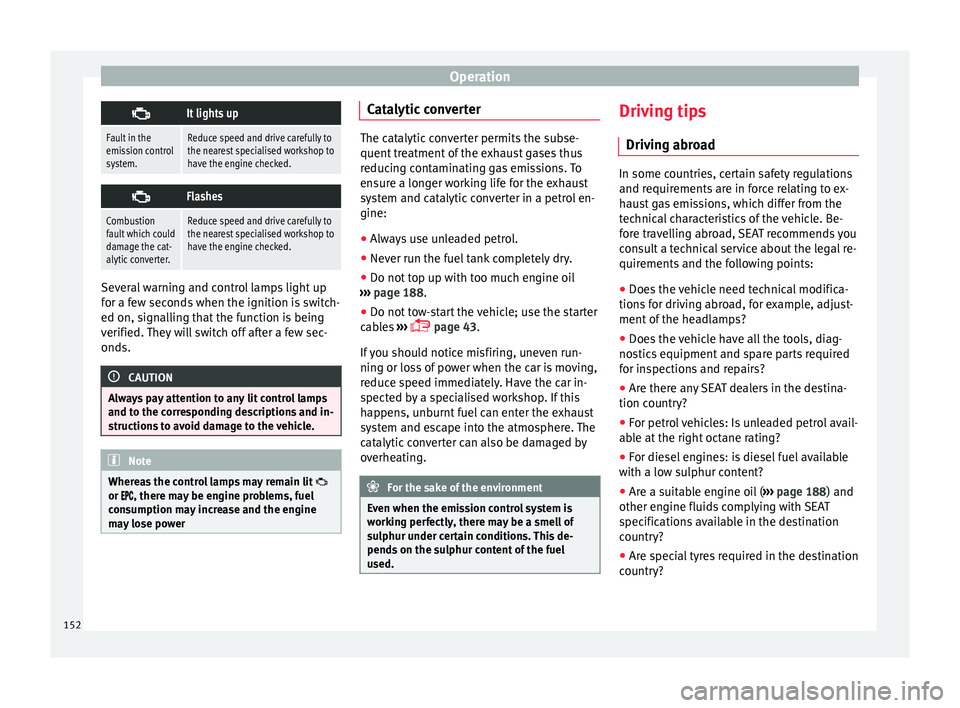
It lights up
Fault in the
emission control
system.Reduce speed and drive carefully to
the nearest specialised workshop to
have the engine checked.
Flashes
Combustion
fault which could
damage the cat-
alytic converter.Reduce speed and drive carefully to
the nearest specialised workshop to
have the engine checked.
Several warning and control lamps light up
f
or a f
ew sec
onds when the ignition is switch-
ed on, signalling that the function is being
verified. They will switch off after a few sec-
onds. CAUTION
Always pay attention to any lit control lamps
and to the c orr
esponding descriptions and in-
structions to avoid damage to the vehicle. Note
Whereas the control lamps may remain lit
or , ther
e may be engine problems, fuel
consumption may increase and the engine
may lose power Catalytic converter
The catalytic converter permits the subse-
quent tr
e
atment of the exhaust gases thus
reducing contaminating gas emissions. To
ensure a longer working life for the exhaust
system and catalytic converter in a petrol en-
gine:
● Always use unleaded petrol.
● Never run the fuel tank completely dry.
● Do not top up with too much engine oil
›››
page 188.
● Do not tow-start the vehicle; use the starter
cab l
es ›››
page 43.
If you should notice misfiring, uneven run-
ning or loss of power when the car is moving,
reduce speed immediately. Have the car in-
spected by a specialised workshop. If this
happens, unburnt fuel can enter the exhaust
system and escape into the atmosphere. The
catalytic converter can also be damaged by
overheating. For the sake of the environment
Even when the emission control system is
work in
g perfectly, there may be a smell of
sulphur under certain conditions. This de-
pends on the sulphur content of the fuel
used. Driving tips
Driv in
g abr
oad In some countries, certain safety regulations
and requir
ements
are in force relating to ex-
haust gas emissions, which differ from the
technical characteristics of the vehicle. Be-
fore travelling abroad, SEAT recommends you
consult a technical service about the legal re-
quirements and the following points:
● Does the vehicle need technical modifica-
tions f
or driving abroad, for example, adjust-
ment of the headlamps?
● Does the vehicle have all the tools, diag-
nostic
s equipment and spare parts required
for inspections and repairs?
● Are there any SEAT dealers in the destina-
tion countr
y?
● For petrol vehicles: Is unleaded petrol avail-
able at
the right octane rating?
● For diesel engines: is diesel fuel available
with a low s
ulphur content?
● Are a suitable engine oil ( ›››
page 188) and
other engine fluids complying with SEAT
specifications available in the destination
country?
● Are special tyres required in the destination
countr
y?
152
Page 172 of 232
Advice
●
Never s t
art the engine when the vehicle is
raised! The vehicle may fall from the platform
due to the engine vibrations.
● If it is necessary to work underneath the ve-
hicle whi
le it is raised, you should check that
the supporting stands have an adequate load
capacity.
● Never climb onto the lifting platform.
● Always make sure that the weight of the ve-
hicle doe
s not exceed the lifting platform
load capacity. CAUTION
● Never r ai
se the vehicle at the engine oil
sump, the gearbox or the rear or front axles.
● Always use an intermediate rubber support
to prev
ent damage to the vehicle underbody.
Check that the arms of the lifting platform are
able to move with obstruction.
● The arms should not come into contact with
the side runnin
g boards or other parts of the
vehicle. Caring for and cleaning the ve-
hic
le e
xterior
Introduction Regular maintenance and washing help to
m
aint
ain the
value of the vehicle. This may
also be one of the requirements for acknowl- edging warranty claims in the event of body-
work c
orrosion or paint defects.
Products suitable for the care of your vehicle
are available at any technical service. WARNING
Car-care products may be toxic and hazard-
ous. If c
ar care products are not suitable or
are used inappropriately, this could result in
accident, serious injury, burns or intoxica-
tion.
● Car care products must always be stored in
the original
container which should be kept
closed.
● Observe information provided by the manu-
factur
er.
● To prevent confusion, never store car care
products
in empty food cans, bottles or other
containers.
● Keep all care products out of reach of chil-
dren.
● Harmfu
l vapours may be produced when us-
ing car c
are products. Therefore, care prod-
ucts should only be used in well-ventilated
spaces or in the open air.
● Never use fuel, turpentine, engine oil, ace-
tone or any
other volatile liquid to wash,
clean or care for the vehicle. These are toxic
and highly flammable. WARNING
Inappropriate care and cleaning of vehicle
component s
may effect the vehicle safety
equipment, increasing the risk of severe in-
jury.
● Vehicle components should only be
cle
aned and maintained in accordance with
the manufacturer's instructions.
● Only use approved or recommended care
products. CAUTION
Cleaning products which contain solvents will
dam ag
e the material. For the sake of the environment
Only wash the vehicle in areas allocated for
this p
urpose, to prevent dirty water which
may be contaminated by oil, grease or fuel,
from entering the drains. In some places,
even washing it outside the planned areas is
banned. For the sake of the environment
Where possible, always use products which
re s
pect the environment. For the sake of the environment
The remains of car care products should not
be dis po
sed of with ordinary household170
Page 187 of 232
Checking and refilling levels
CAUTION
● Alw a
ys pay attention to any lit control
lamps and to the corresponding descriptions
and instructions to avoid damage to the vehi-
cle.
● Never run the fuel tank completely dry. An
irregu
lar fuel supply may lead to ignition
faults and unburnt fuel could enter the ex-
haust system. This could damage the catalyt-
ic converter. Note
The arrow next to the fuel pump symbol on
the ins trument
panel ››› Fig. 164 indicates the
side of the vehicle on which the fuel tank flap
is located. Refuelling with petrol
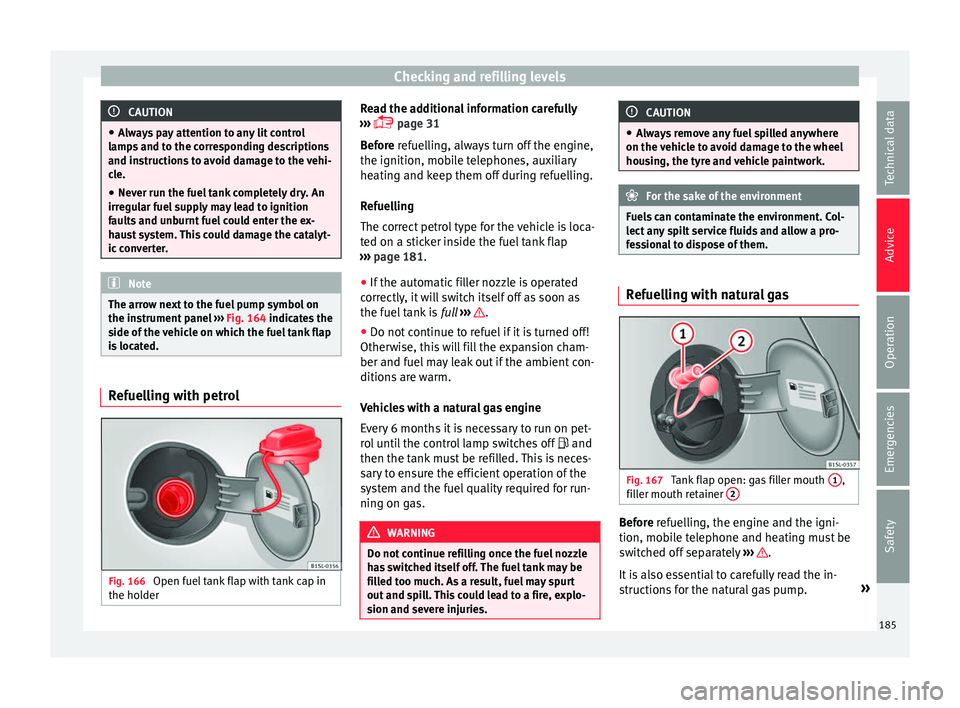
Fig. 166
Open fuel tank flap with tank cap in
the ho l
der Read the additional information carefully
› ›
›
page 31
Before refuelling, always turn off the engine,
the ignition, mobile telephones, auxiliary
heating and keep them off during refuelling.
Refuelling
The correct petrol type for the vehicle is loca-
ted on a sticker inside the fuel tank flap
››› page 181.
● If the automatic filler nozzle is operated
correctly
, it will switch itself off as soon as
the fuel tank is full ››› .
● Do not continue to refuel if it is turned off!
Other w
i
se, this will fill the expansion cham-
ber and fuel may leak out if the ambient con-
ditions are warm.
Vehicles with a natural gas engine
Every 6 months it is necessary to run on pet-
rol until the control lamp switches off and
then the tank must be refilled. This is neces-
sary to ensure the efficient operation of the
system and the fuel quality required for run-
ning on gas. WARNING
Do not continue refilling once the fuel nozzle
ha s
switched itself off. The fuel tank may be
filled too much. As a result, fuel may spurt
out and spill. This could lead to a fire, explo-
sion and severe injuries. CAUTION
● Alw a
ys remove any fuel spilled anywhere
on the vehicle to avoid damage to the wheel
housing, the tyre and vehicle paintwork. For the sake of the environment
Fuels can contaminate the environment. Col-
lect an
y spilt service fluids and allow a pro-
fessional to dispose of them. Refuelling with natural gas
Fig. 167
Tank flap open: gas filler mouth 1 ,
fi l
l
er mouth retainer 2 Before r
efuelling, the engine and the igni-
tion, mo b
ile telephone and heating must be
switched off separately ››› .
It i
s
also essential to carefully read the in-
structions for the natural gas pump. »
185
Technical data
Advice
Operation
Emergencies
Safety
Page 188 of 232
Advice
The vehicle is equipped for refuelling only
w ith C
ompr
essed Natural Gas (CNG) ››› . Re-
f uel
lin
g with another type of natural gas is
not allowed, e.g. Liquefied Natural Gas (LNG)
or hydromethane.
Opening the fuel tank cap
The natural gas filler mouth is behind the fuel
tank cap, next to the petrol filler mouth.
● Unlock the vehicle with the key or with the
central
locking button situated on the driv-
er door ››› page 97.
● Press on the rear area of the flap and open
it.
Ref
uelling
Problem: If the ambient temperature is very
high, the natural gas pump protection
against overheating disconnects this auto-
matically.
● Remove the plug from the gas filler mouth
›››
Fig. 167 1 .
● Connect the pump filling nozzle to the gas
fi l
l
er mouth.
● The fuel tank will be full when the p
ump
compressor automatically cuts the supply.
● If you wish to finish refuelling in advance,
pres
s the button on the pump to stop the
flow. Closing the fuel tank cap
●
Check that the gas filler mouth retainer 2 is not trapped with the filler nozzle. If neces-
s
ar
y
, place it in the filler mouth again.
● Insert the plug in the filler mouth.
● Close the tank flap. Make sure you hear it
click
into place. WARNING
Natural gas is a highly explosive, easily flam-
mab l
e substance. Incorrect handling of the
natural gas can cause accidents serious
burns and other injuries.
● Before refuelling with natural gas, the fill-
ing mouth mus
t be correctly engaged. If you
can smell gas, stop refuelling immediately. WARNING
The vehicle is not prepared to use liquefied
nat ur
al gas (LNG) and this fuel must not be
added under any circumstances. Liquefied
natural gas can cause the natural gas tank to
explode, resulting in serious injury. Note
● The fil lin
g nozzles of natural gas pumps
can differ in the way they are operated. If you
are unacquainted with the pump, it is advisa-
ble that a member of staff of the service sta-
tion performs the refuelling operation. ●
Noise s
heard when refuelling are normal
and do not indicate the presence of a fault in
the system.
● The vehicle natural gas system is prepared
both for ref
uelling with a small compressor
(slow refuel) and a large compressor (fast re-
fuel) in natural gas service stations. Bonnet
Work in
g in the engine compartment Read the additional information carefully
› ›
›
page 10
Before working in the engine compartment,
make sure that the vehicle is parked on hori-
zontal and firm ground.
The engine compartment of the vehicle is a
hazardous area. Never work on the engine or
in the engine compartment if you are not fa-
miliar with the operations to be carried out,
the applicable safety standards and especial-
ly if you do not have the necessary instru-
ments, liquids and tools ››› ! If required,
h av
e an
y work carried out by a specialised
workshop. Negligent work can cause serious
injury. WARNING
If the vehicle moves unexpectedly, this could
cau se seriou
s injury.186
Page 202 of 232
Advice
used in an emergency and with extreme cau-
tion.
Note
For technical reasons, it is not generally pos-
s ib l
e to use the wheels from other vehicles.
In some cases, this may also be true for the
same model of wheel. Please refer to the ve-
hicle documentation or ask at a technical
service. Handling tyres and wheels
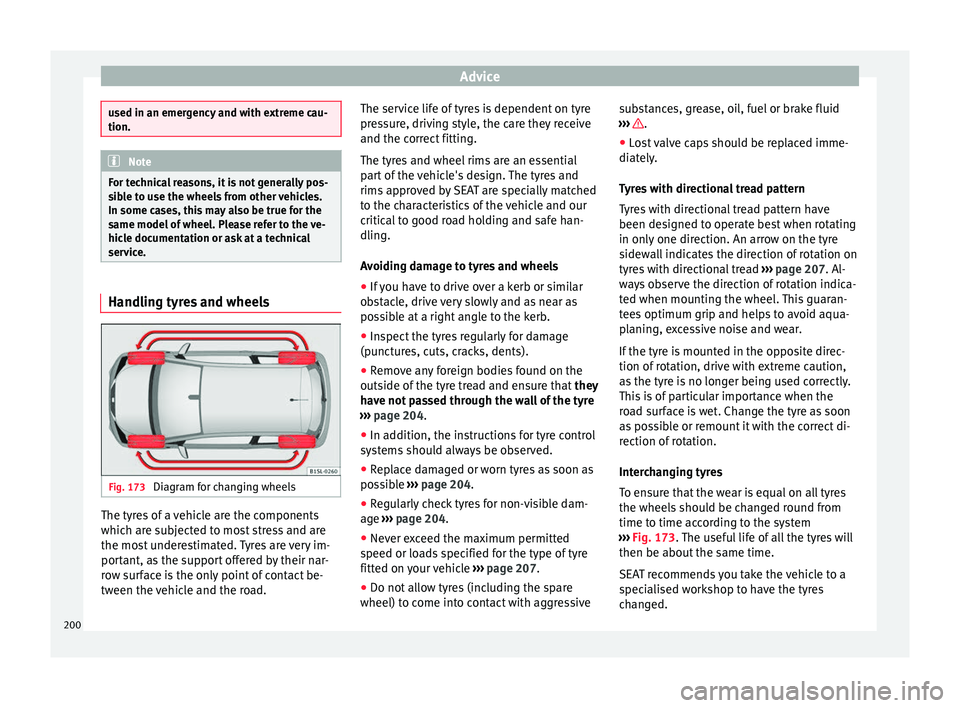
Fig. 173
Diagram for changing wheels The tyres of a vehicle are the components
whic
h ar
e s
ubjected to most stress and are
the most underestimated. Tyres are very im-
portant, as the support offered by their nar-
row surface is the only point of contact be-
tween the vehicle and the road. The service life of tyres is dependent on tyre
pres
sure, driving style, the care they receive
and the correct fitting.
The tyres and wheel rims are an essential
part of the vehicle's design. The tyres and
rims approved by SEAT are specially matched
to the characteristics of the vehicle and our
critical to good road holding and safe han-
dling.
Avoiding damage to tyres and wheels
● If you have to drive over a kerb or similar
obs
tacle, drive very slowly and as near as
possible at a right angle to the kerb.
● Inspect the tyres regularly for damage
(punct
ures, cuts, cracks, dents).
● Remove any foreign bodies found on the
outside of the ty
re tread and ensure that they
have not passed through the wall of the tyre
››› page 204.
● In addition, the instructions for tyre control
syst
ems should always be observed.
● Replace damaged or worn tyres as soon as
poss
ible ››› page 204.
● Regularly check tyres for non-visible dam-
age ››
› page 204.
● Never exceed the maximum permitted
speed or loa
ds specified for the type of tyre
fitted on your vehicle ››› page 207.
● Do not allow tyres (including the spare
wheel) to come int
o contact with aggressive substances, grease, oil, fuel or brake fluid
›››
.
● Lost valve caps should be replaced imme-
di at
ely
.
Tyres with directional tread pattern
Tyres with directional tread pattern have
been designed to operate best when rotating
in only one direction. An arrow on the tyre
sidewall indicates the direction of rotation on
tyres with directional tread ››› page 207. Al-
ways observe the direction of rotation indica-
ted when mounting the wheel. This guaran-
tees optimum grip and helps to avoid aqua-
planing, excessive noise and wear.
If the tyre is mounted in the opposite direc-
tion of rotation, drive with extreme caution,
as the tyre is no longer being used correctly.
This is of particular importance when the
road surface is wet. Change the tyre as soon
as possible or remount it with the correct di-
rection of rotation.
Interchanging tyres
To ensure that the wear is equal on all tyres
the wheels should be changed round from
time to time according to the system
››› Fig. 173. The useful life of all the tyres will
then be about the same time.
SEAT recommends you take the vehicle to a
specialised workshop to have the tyres
changed.
200
Page 206 of 232
Advice
CAUTION
● Tak e c
are not to tilt the manometer when
placing it on the valve. Otherwise, the valve
may be damaged.
● If tyre valves are not protected by caps, or if
the caps
are not screwed on correctly, they
may become damaged. Check that the caps
are identical to the standard caps and have
been correctly tightened. For the sake of the environment
Under-inflated tyres will increase fuel con-
sumption. Wear indicator depth profile
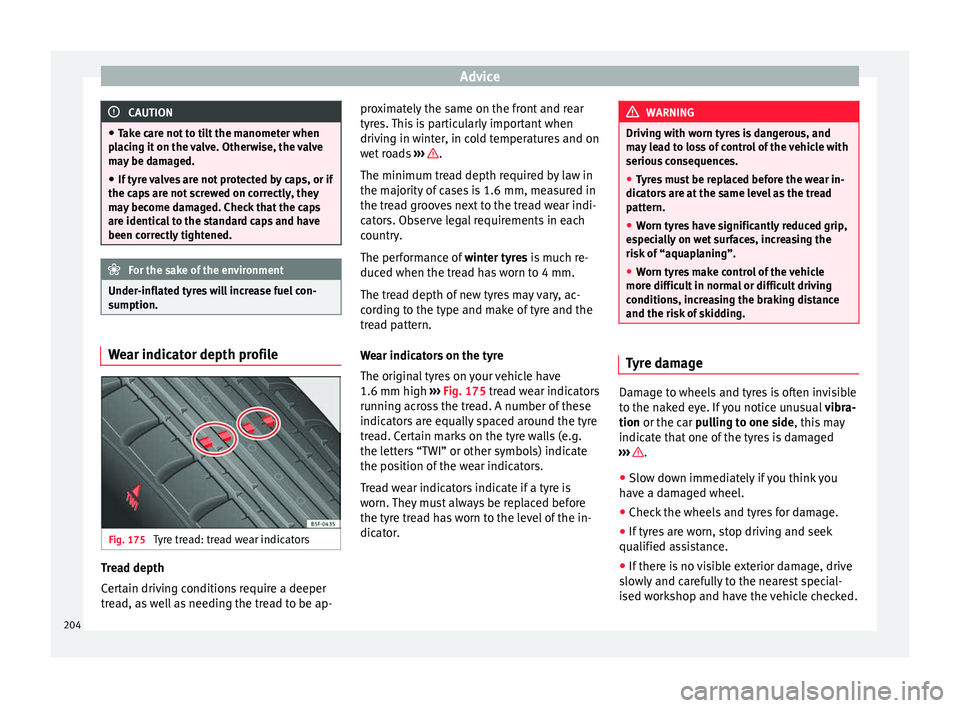
Fig. 175
Tyre tread: tread wear indicators Tread depth
C
er
t
ain driving conditions require a deeper
tread, as well as needing the tread to be ap- proximately the same on the front and rear
tyre
s. This is particularly important when
driving in winter, in cold temperatures and on
wet roads ››› .
The minimum tr e
a
d depth required by law in
the majority of cases is 1.6 mm, measured in
the tread grooves next to the tread wear indi-
cators. Observe legal requirements in each
country.
The performance of winter tyres is much re-
duced when the tread has worn to 4 mm.
The tread depth of new tyres may vary, ac-
cording to the type and make of tyre and the
tread pattern.
Wear indicators on the tyre
The original tyres on your vehicle have
1.6 mm high ››› Fig. 175 tread wear indicators
running across the tread. A number of these
indicators are equally spaced around the tyre
tread. Certain marks on the tyre walls (e.g.
the letters “TWI” or other symbols) indicate
the position of the wear indicators.
Tread wear indicators indicate if a tyre is
worn. They must always be replaced before
the tyre tread has worn to the level of the in-
dicator. WARNING
Driving with worn tyres is dangerous, and
ma y
lead to loss of control of the vehicle with
serious consequences.
● Tyres must be replaced before the wear in-
dicator
s are at the same level as the tread
pattern.
● Worn tyres have significantly reduced grip,
espec
ially on wet surfaces, increasing the
risk of “aquaplaning”.
● Worn tyres make control of the vehicle
more difficu
lt in normal or difficult driving
conditions, increasing the braking distance
and the risk of skidding. Tyre damage
Damage to wheels and tyres is often invisible
t
o the n
ak
ed eye. If you notice unusual vibra-
tion or the car pulling to one side, this may
indicate that one of the tyres is damaged
››› .
● Slow down immediately if you think you
h av
e a d
amaged wheel.
● Check the wheels and tyres for damage.
● If tyres are worn, stop driving and seek
qualified ass
istance.
● If there is no visible exterior damage, drive
slowly
and carefully to the nearest special-
ised workshop and have the vehicle checked.
204