inflation pressure Seat Mii 2016 Owner's manual
[x] Cancel search | Manufacturer: SEAT, Model Year: 2016, Model line: Mii, Model: Seat Mii 2016Pages: 232, PDF Size: 4.9 MB
Page 38 of 232
The essentials
● Sc r
ew the infl
ator tube ››› Fig. 48 3 into
the se al
ant
bottle. The bottle's seal will break
automatically.
● Remove the lid from the filling tube
›››
Fig. 48 3 and screw the open end of the
t ube int
o the ty
re valve.
● With the tyre sealant bottle upside down,
fill
the tyre with the contents of the sealant
bottle.
● Remove the bottle from the valve.
● Place the insert back into the tyre valve us-
ing the too
l ››› Fig. 48 1 .
Infl atin
g the ty
re
● Screw the compressor tyre inflator tube
›››
Fig. 48 5 into the tyre valve.
● Check that the air bleed screw is closed
› ›
›
Fig. 48 7 .
● Start the engine and leave it running.
● Insert the connector ››
›
Fig. 48 9 into the
v ehic
l
e's 12-volt socket ›››
page 121.
● Turn the air compressor on with the ON/OFF
switc
h ››› Fig. 48 8 .
● Keep the air compressor running until it
r e
ac
hes 2.0 to 2.5 bar
(29-36 psi/200-250 kPa). A maximum of 8
minutes.
● Disconnect the air compressor.
● If it does not reach the pressure indicated,
uns
crew the tyre inflator tube from the valve. ●
Move the
vehicle 10m so that the sealant is
distributed throughout the tyre.
● Screw the compressor tyre inflator into the
valve.
● R
epeat the inflation process.
● If the indicated pressure still cannot be
reac
hed, the tyre is too badly damaged. Stop
and request assistance from an authorised
technician.
● Disconnect the air compressor. Unscrew
the tyre infl
ator tube from the tyre valve.
● When the tyre pressure is between 2.5 and
2.0 bars, c
ontinue driving without exceeding
80 km/h (50 mph).
● Check the pressure again after 10 minutes
›››
page 74.
››› in TMS (Tyre Mobility System)* on
page 73
››› page 72 Changing a wheel
V ehic
l
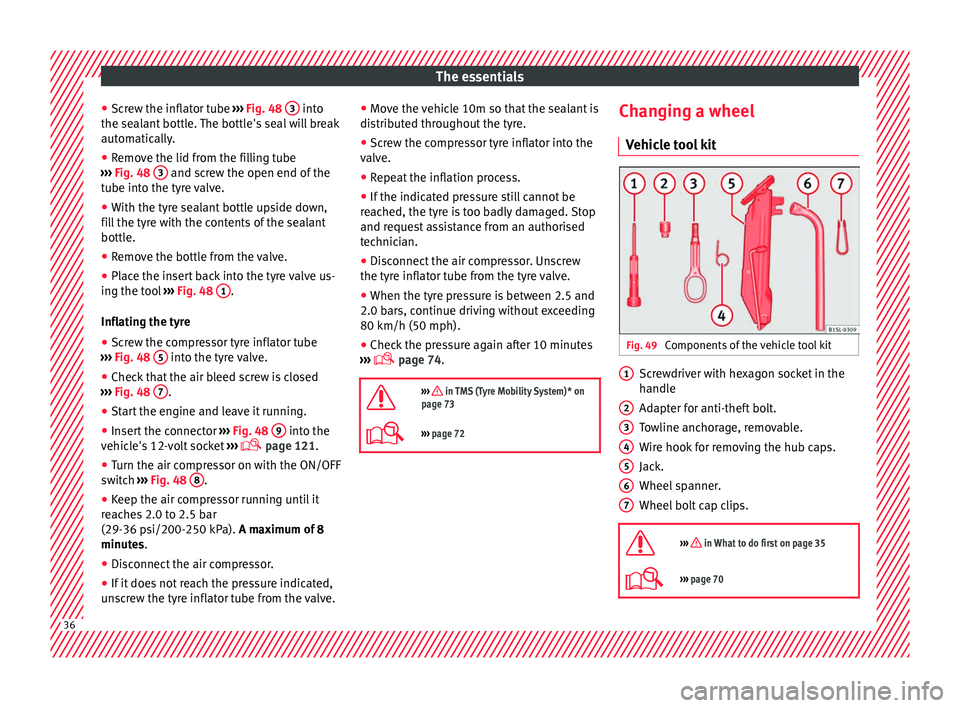
e tool kit Fig. 49
Components of the vehicle tool kit Screwdriver with hexagon socket in the
h
andl
e
Ad
apter for anti-theft bolt.
Towline anchorage, removable.
Wire hook for removing the hub caps.
Jack.
Wheel spanner.
Wheel bolt cap clips.
››› in What to do first on page 35
››› page 70 1
2
3
4
5
6
7
36
Page 205 of 232
Wheels and tyres
will be correct for your vehicle. For other tyre
models, the ty
r
e vendor should provide the
manufacturer's certificate with the tyre, indi-
cating that this type of tyre is suitable for
your vehicle. This certificate should always
be carried with the vehicle. Tyre pressures
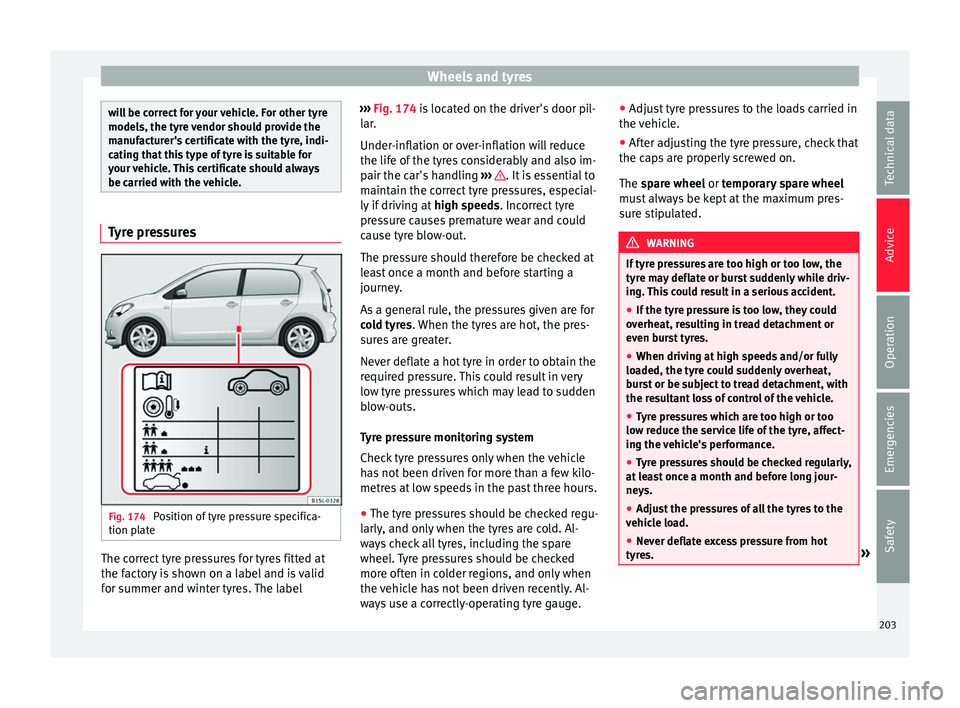
Fig. 174
Position of tyre pressure specifica-
tion p l
at
e The correct tyre pressures for tyres fitted at
the f
act
or
y is shown on a label and is valid
for summer and winter tyres. The label ›››
Fig. 174 is loc
ated on the driver's door pil-
lar.
Under-inflation or over-inflation will reduce
the life of the tyres considerably and also im-
pair the car's handling ››› . It is essential to
m aint
ain the c
orrect tyre pressures, especial-
ly if driving at high speeds. Incorrect tyre
pressure causes premature wear and could
cause tyre blow-out.
The pressure should therefore be checked at
least once a month and before starting a
journey.
As a general rule, the pressures given are for
cold tyres. When the tyres are hot, the pres-
sures are greater.
Never deflate a hot tyre in order to obtain the
required pressure. This could result in very
low tyre pressures which may lead to sudden
blow-outs.
Tyre pressure monitoring system
Check tyre pressures only when the vehicle
has not been driven for more than a few kilo-
metres at low speeds in the past three hours.
● The tyre pressures should be checked regu-
larly, and on
ly when the tyres are cold. Al-
ways check all tyres, including the spare
wheel. Tyre pressures should be checked
more often in colder regions, and only when
the vehicle has not been driven recently. Al-
ways use a correctly-operating tyre gauge. ●
Adjust
tyre pressures to the loads carried in
the vehicle.
● After adjusting the tyre pressure, check that
the caps
are properly screwed on.
The spare wheel or temporary spare wheel
must always be kept at the maximum pres-
sure stipulated. WARNING
If tyre pressures are too high or too low, the
tyr e m
ay deflate or burst suddenly while driv-
ing. This could result in a serious accident.
● If the tyre pressure is too low, they could
overhe
at, resulting in tread detachment or
even burst tyres.
● When driving at high speeds and/or fully
loaded, the ty
re could suddenly overheat,
burst or be subject to tread detachment, with
the resultant loss of control of the vehicle.
● Tyre pressures which are too high or too
low reduc
e the service life of the tyre, affect-
ing the vehicle's performance.
● Tyre pressures should be checked regularly,
at le
ast once a month and before long jour-
neys.
● Adjust the pressures of all the tyres to the
vehicl
e load.
● Never deflate excess pressure from hot
tyre
s. » 203
Technical data
Advice
Operation
Emergencies
Safety
Page 209 of 232
Wheels and tyres
● Sno w c
h
ains on the temporary spare wheel
are not permitted ›››
page 41.
● After mounting the spare wheel or the tem-
porary
spare wheel, check the tyre pressure
as soon as possible ››› page 203.
It is advisable to check the spare wheel or
temporary spare wheel tyre pressure when
checking the rest of the vehicle wheels at
least once a month. The spare wheel should
have the highest pressure allowed for the ve-
hicle ››› page 203. The sticker situated on the
temporary spare wheel shows the tyre pres-
sure. WARNING
Incorrect handling of the spare wheel or the
tempor ar
y spare wheel can cause loss of ve-
hicle control, producing collisions or other
serious accidents and injury.
● Never use the spare wheel or the temporary
spar
e wheel if it is damaged or worn to the
wear indicator.
● In some vehicles the spare wheel is smaller
than the origina
l tyres. This can be seen on a
sticker showing the text “80 km/h” and
“50 mph”. This text indicates the maximum
velocity permitted for this type of tyre.
● Never drive faster than 80 km/h (50 mph).
Avoid po
werful acceleration, hard braking
and taking corners at high speed.
● Never drive more than 200 km with a tem-
porary
spare wheel fitted to the drive axle. ●
Rep l
ace the temporary spare wheel for a
normal wheel as soon as possible. The com-
pact temporary spare wheel is only intended
for temporary use over short distances.
● The temporary spare wheel must always be
secured w
ith the factory supplied wheel
bolts.
● You should never use more than one tem-
porary
spare wheel.
● After mounting the temporary spare wheel,
check
the tyre pressure as soon as possible
››› page 203.
● Snow chains on the temporary spare wheel
are not permitt
ed. Note
Wherever possible, secure the spare wheel,
tempor ar
y spare wheel or the replaced wheel
safely in the luggage compartment. In vehi-
cles with anti-puncture kit, it is not possible
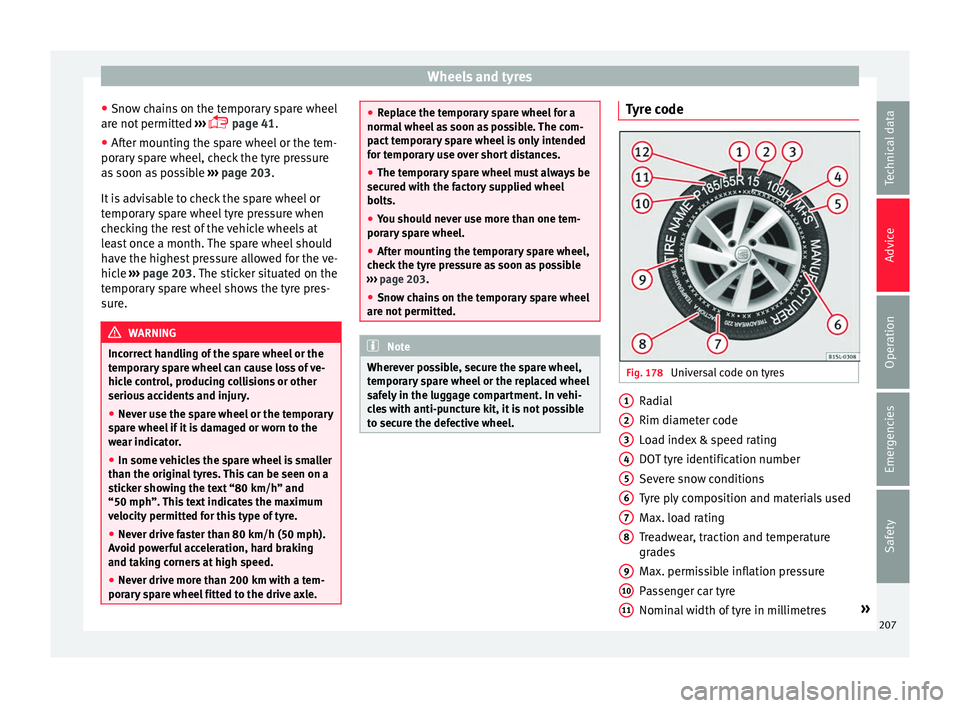
to secure the defective wheel. Tyre code
Fig. 178
Universal code on tyres Radial
Rim di
amet
er c
ode
Load index & speed rating
DOT tyre identification number
Severe snow conditions
Tyre ply composition and materials used
Max. load rating
Treadwear, traction and temperature
grades
Max. permissible inflation pressure
Passenger car tyre
Nominal width of tyre in millimetres »
1 2
3
4
5
6
7
8
9
10
11
207
Technical data
Advice
Operation
Emergencies
Safety
Page 210 of 232
Advice
Ratio of height to width (aspect ratio)Tyre code (example): Meaning
Make, logotypeManufacturer
Product nameName of tyre assigned by manufac-
turer.
P255 / 55 R 18Size:
PPassenger vehicle code.
255Nominal width between
walls, in mm.
55Height/width ratio in %
RTyre type (R indicates "radi-
al").
18Rim diameter in inches
109 HLoad index ››› page 209 and speed
rating ››› page 209.
XLReinforced tyres (“Reinforced”).
M+S or M/S orWinter tyres code (mud and snow
tyres).
RADIAL
TUBELESSRadial tyre without inner tube.
E4 ...E-mark certifying tyre complies with
international legislation followed by
a number denoting the country
granting the authorisation. The au-
thorisation number ( several digits)
is shown below. 12
Tyre code (example): Meaning
DOT BT RA TY5
1709Tyre identification number (TIN a)
,
may be only on interior wall of
wheel) and date of manufacture:
DOTThe tyre complies with the
legal requirements of the
US Department of Trans-
port, responsible for tyre
safety regulations.
BTPlace of manufacture code.
RAInformation about manu-
facturer and tyre size.
TY5Manufacturer's tyre specifi-
cations.
1709Date of manufacture: Week
17 of 2009.
TWIThis identifies the position of the
Tread Wear Indicator ››› page 204.
Made in
GermanyCountry of manufacture.
MAX LOAD
615 KGUS load rating, indicating maximum
permitted load per tyre.
MAX INFLATION
350 KPA
(51 PSI)US limit, indicating maximum per-
mitted tyre pressure.
SIDEWALL 1 PLY
RAYONInformation about tyre wall compo-
nents:
1 layer of rayon (artificial silk).
Tyre code (example): Meaning
TREAD 4 PLIES
1 RAYON +
2 STEEL +
1 NYLONInformation about tread compo-
nents:
In the example, there are 4 layers
below the tread: 1 layer of rayon (ar-
tificial silk), 2 layers of steel rein-
forcement and 1 layer of nylon.
Information for the end consumer concerning the com-
parative values of the established base tyres (standar-
dised test procedures) ››› page 179:
TREADWEAR 220Relative service life of the tyre, with
respect to specific US standard test.
TRACTION ABraking capacity of tyre on wet sur-
face (AA, A, B or C).
TEMPERATURE ATyre temperature resistance at high-
er test speeds (A, B or C).
If the tyre has other markings, these are specific tyre
manufacturer codes or specific national codes, e.g. for
Brazil or China.
a)
The letters TIN refer to the tyre serial number.
Tyres with directional tread pattern
Tyres with directional tread pattern have
been designed to operate best when rotating
in only one direction. An arrow on the tyre
sidewall indicates the direction of rotation on
tyres with directional tread. Always observe
the direction of rotation indicated when
mounting the wheel. This guarantees opti-
mum grip and helps to avoid aquaplaning,
grip, noise and wear.
208