washer Seat Mii 2016 Owner's manual
[x] Cancel search | Manufacturer: SEAT, Model Year: 2016, Model line: Mii, Model: Seat Mii 2016Pages: 232, PDF Size: 4.9 MB
Page 6 of 232
Table of Contents
Advice . . . . . . . . . . . . . . . . . . . . . . . . . . . . . . . . 164
Care and maintenance . . . . . . . . . . . . . . . . . . . . 164
Accessories, replacement of parts and modifi-
c ation
s
. . . . . . . . . . . . . . . . . . . . . . . . . . . . . . . . 164
Caring for and cleaning the vehicle exterior . . . 170
Caring for and cleaning the vehicle interior . . . 176
Notes for the user . . . . . . . . . . . . . . . . . . . . . . . . 179
Checking and refilling levels . . . . . . . . . . . . . . . 181
Fuel . . . . . . . . . . . . . . . . . . . . . . . . . . . . . . . . . . . 181
Filling the tank . . . . . . . . . . . . . . . . . . . . . . . . . . 182
Bonnet . . . . . . . . . . . . . . . . . . . . . . . . . . . . . . . . 186
Engine oil . . . . . . . . . . . . . . . . . . . . . . . . . . . . . . 188
Engine coolant . . . . . . . . . . . . . . . . . . . . . . . . . . 191
Brake fluid . . . . . . . . . . . . . . . . . . . . . . . . . . . . . 194
Windscreen washer reservoir . . . . . . . . . . . . . . 195
Vehicle battery . . . . . . . . . . . . . . . . . . . . . . . . . . 196
Wheels and tyres . . . . . . . . . . . . . . . . . . . . . . . . 199
Tyres . . . . . . . . . . . . . . . . . . . . . . . . . . . . . . . . . . 199
Technical data . . . . . . . . . . . . . . . . . . . . . . . . 210
Technical features . . . . . . . . . . . . . . . . . . . . . . . 210
Important information . . . . . . . . . . . . . . . . . . . . 210
Wheels . . . . . . . . . . . . . . . . . . . . . . . . . . . . . . . . 211
Engine data . . . . . . . . . . . . . . . . . . . . . . . . . . . . . 213
Dimensions . . . . . . . . . . . . . . . . . . . . . . . . . . . . . 216
Index . . . . . . . . . . . . . . . . . . . . . . . . . . . . . . . . . 217
4
Page 33 of 232
The essentials
Fluid Level control Fi l
lin
g the fuel tank
Fuel tank capacity
Petrol enginesAround 35.0 l,
of which approximately 4.0 are the reserve.
Natural gas en-
gineNatural gas: approx. 11 kg; of whichmax. 1.5 kg reserve
Petrol: approx. 10 l; of which approx. 5 l reserve
Windscreen washer tank capacity
The washer bottle capacity is approximately 3 litres.Fuel
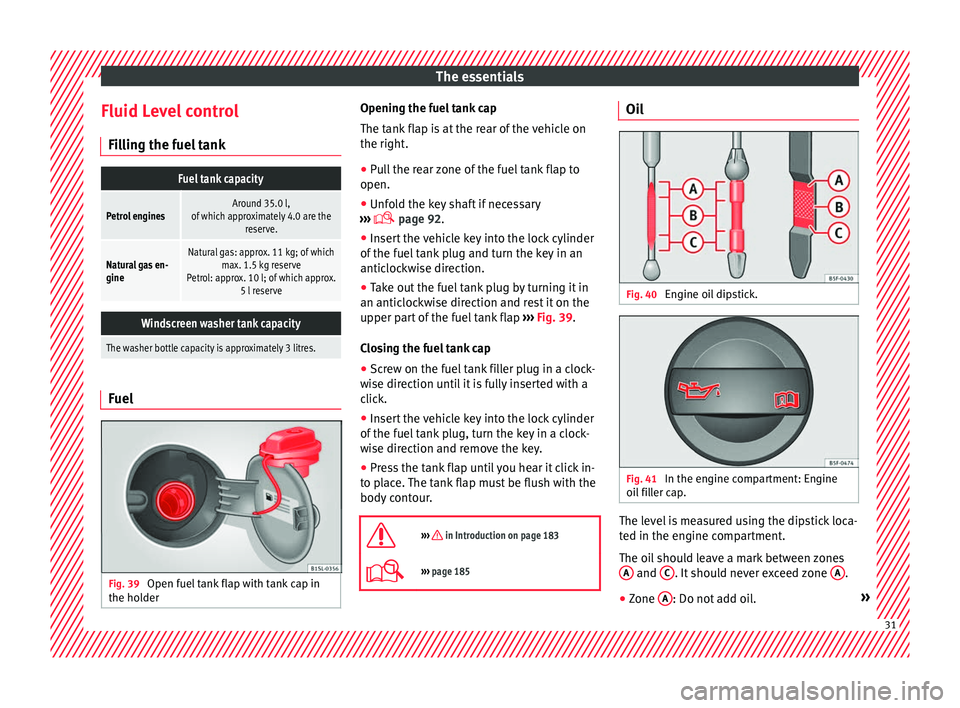
Fig. 39
Open fuel tank flap with tank cap in
the ho l
der Opening the fuel tank cap
The t
ank fl
ap is at the rear of the vehicle on
the right.
● Pull the rear zone of the fuel tank flap to
open.
● Unfold the key shaft if necessary
›››
page 92.
● Insert the vehicle key into the lock cylinder
of the fuel
tank plug and turn the key in an
anticlockwise direction.
● Take out the fuel tank plug by turning it in
an anticlock
wise direction and rest it on the
upper part of the fuel tank flap ››› Fig. 39.
Closing the fuel tank cap
● Screw on the fuel tank filler plug in a clock-
wise dir
ection until it is fully inserted with a
click.
● Insert the vehicle key into the lock cylinder
of the fuel
tank plug, turn the key in a clock-
wise direction and remove the key.
● Press the tank flap until you hear it click in-
to pl
ace. The tank flap must be flush with the
body contour.
››› in Introduction on page 183
››› page 185 Oil
Fig. 40
Engine oil dipstick. Fig. 41
In the engine compartment: Engine
oi l
fi
ller cap. The level is measured using the dipstick loca-
t
ed in the en
gine c
ompartment.
The oil should leave a mark between zones A and
C . It should never exceed zone
A .
● Zone A : Do not add oil.
» 31
Page 35 of 232
The essentials
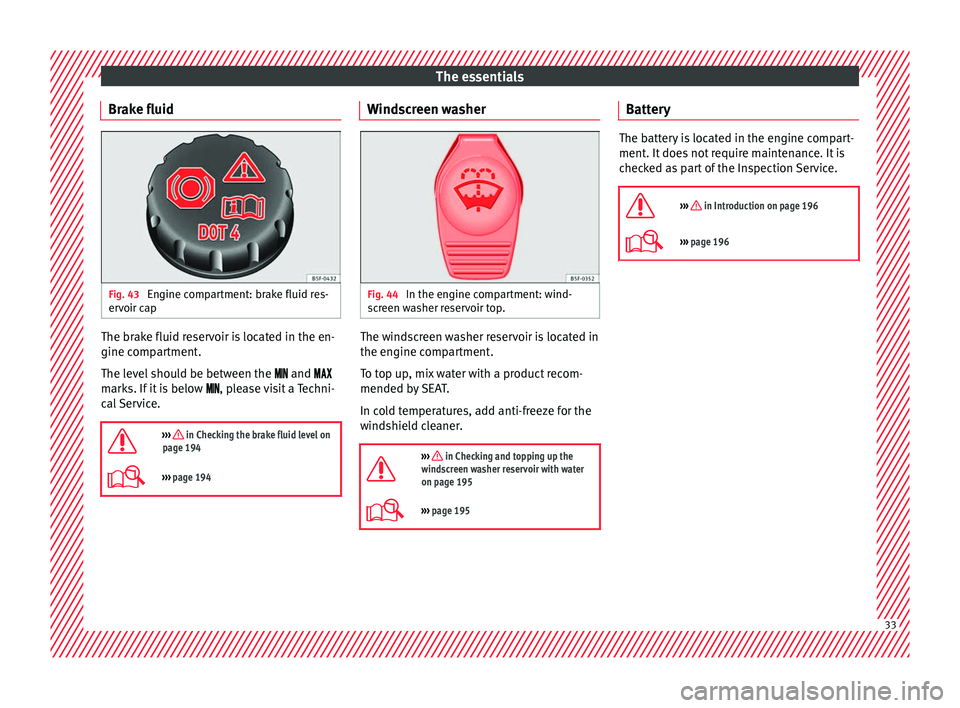
Brake fluid Fig. 43
Engine compartment: brake fluid res-
er v
oir c
ap The brake fluid reservoir is located in the en-
gine c
omp
ar
tment.
The level should be between the and
marks. If it is below , please visit a Techni-
cal Service.
››› in Checking the brake fluid level on
page 194
››› page 194 Windscreen washer
Fig. 44
In the engine compartment: wind-
s c
r
een washer reservoir top. The windscreen washer reservoir is located in
the en
gine c
omp
artment.
To top up, mix water with a product recom-
mended by SEAT.
In cold temperatures, add anti-freeze for the
windshield cleaner.
››› in Checking and topping up the
windscreen washer reservoir with water
on page 195
››› page 195 Battery
The battery is located in the engine compart-
ment. It
doe
s not require maintenance. It is
checked as part of the Inspection Service.
››› in Introduction on page 196
››› page 196 33
Page 44 of 232
The essentials
CAUTION
● Remo v
e the snow chains to drive on roads
without snow. Otherwise they will impair
vehicle handling, damage the tyres and wear
out very quickly.
● Wheel rims may be damaged or scratched if
the chain
s come into direct contact with
them. SEAT recommends the use of covered
snow chains. Note
Snow chains are available in different sizes
acc or
ding to the vehicle type. Emergency towing of the vehi-
c
l
e
T
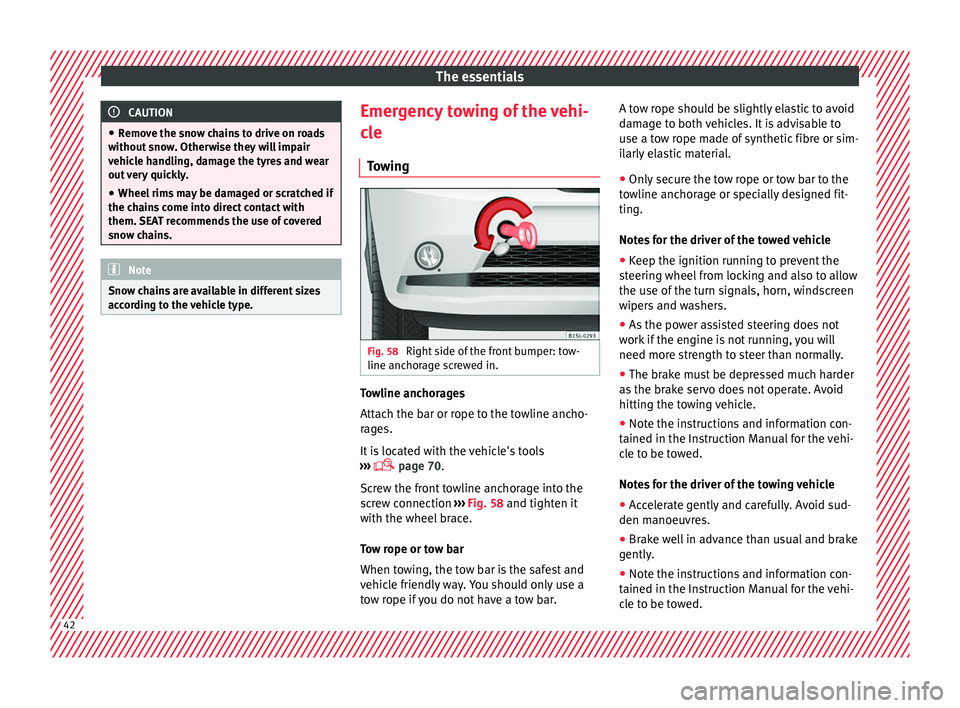
owing Fig. 58
Right side of the front bumper: tow-
line anc hor
ag
e screwed in. Towline anchorages
Att
ac
h the b
ar or rope to the towline ancho-
rages.
It is located with the vehicle's tools
››› page 70.
Screw the front towline anchorage into the
screw connection ››› Fig. 58 and tighten it
with the wheel brace.
Tow rope or tow bar
When towing, the tow bar is the safest and
vehicle friendly way. You should only use a
tow rope if you do not have a tow bar. A tow rope should be slightly elastic to avoid
damag
e to both vehicles. It is advisable to
use a tow rope made of synthetic fibre or sim-
ilarly elastic material.
● Only secure the tow rope or tow bar to the
towline anc
horage or specially designed fit-
ting.
Notes for the driver of the towed vehicle
● Keep the ignition running to prevent the
steerin
g wheel from locking and also to allow
the use of the turn signals, horn, windscreen
wipers and washers.
● As the power assisted steering does not
work if
the engine is not running, you will
need more strength to steer than normally.
● The brake must be depressed much harder
as the br
ake servo does not operate. Avoid
hitting the towing vehicle.
● Note the instructions and information con-
tained in the Ins
truction Manual for the vehi-
cle to be towed.
Notes for the driver of the towing vehicle
● Accelerate gently and carefully. Avoid sud-
den manoeuvr
es.
● Brake well in advance than usual and brake
gently.
● Not
e the instructions and information con-
tained in the In s
truction Manual for the vehi-
cle to be towed. 42
Page 45 of 232
The essentials
Driving style
T o
w
ing requires some experience, especially
when using a tow rope. Both drivers should
realise how difficult it is to tow a vehicle. In-
experienced drivers should not attempt to
tow.
Do not pull too hard with the towing vehicle
and take care to avoid jerking the tow rope.
When towing on an unpaved road, there is al-
ways a risk of overloading and damaging the
anchorage points.
Switch on the ignition so that the turn sig-
nals, windscreen wipers and windscreen
washer can work. Ensure that the steering
wheel is unlocked and moves freely.
Place the gear lever in neutral on vehicles
with a manual gearbox. With an automatic
gearbox, place the lever in N.
To brake, press the brake pedal firmly. The
brake servo does not work when the engine
is switched off.
The power steering only works when the igni-
tion is switched on and the vehicle is moving,
provided that the battery is sufficiently charg-
ed. Otherwise, it will need more force.
Ensure that the tow rope remains taut at all
times. ››› in Instructions for tow-starting on
page 76
››› page 75 Tow-starting
In general, the vehicle should not be started
by
t
owing. Jump-starting is much more pref-
erable ››› page 43.
For technical reasons, the following vehicles
can not be tow started:
● Vehicles with an automatic gearbox.
● If the vehicle battery is flat, it is possible
that the en
gine control unit does not operate
correctly.
However, if your vehicle must absolutely be
tow-started (manual gearbox):
● Put it into second or third gear.
● Keep the clutch pressed down.
● Switch on the ignition and the hazard warn-
ing lights.
● Rel
ease the clutch when both vehicles are
movin
g.
● As soon as the engine starts, press the
clutc
h and move the gear lever into neutral.
This helps to prevent a collision with the tow-
ing vehicle. How to jump start
Jump lea
ds If the engine fails to start because of a dis-
ch
ar
ged battery, the battery of another vehi-
cle can be used to start the engine. Before
starting, check the magic eye on the battery
››› page 196.
For starting assistance, jump lead cables con-
forming to the standard DIN 72553 are re-
quired (see the cable manufacturer instruc-
tions). The cable section in vehicles with pet-
rol engine must be at least 25 mm 2
. WARNING
Incorrect use of jump leads and incorrectly
jump st ar
ting could cause the battery to ex-
plode resulting in serious injury. Please ob-
serve the following rules to minimise the risk
of a battery explosion:
● The battery providing current must have
the same v
oltage (12V) and approximately
the same capacity (see markings on battery)
as the flat battery.
● Never charge a frozen or recently thawed
batter
y. A flat battery can also freeze at tem-
peratures close to 0 °C (+32 °F).
● If a battery is frozen and/or has been frozen
then it mus
t be replaced.
● A highly explosive mixture of gases is re-
lea
sed when the battery is being charged. Al-
ways keep lit cigarettes, flames, sparks and » 43
Page 110 of 232
Operation
Visibility S u
n
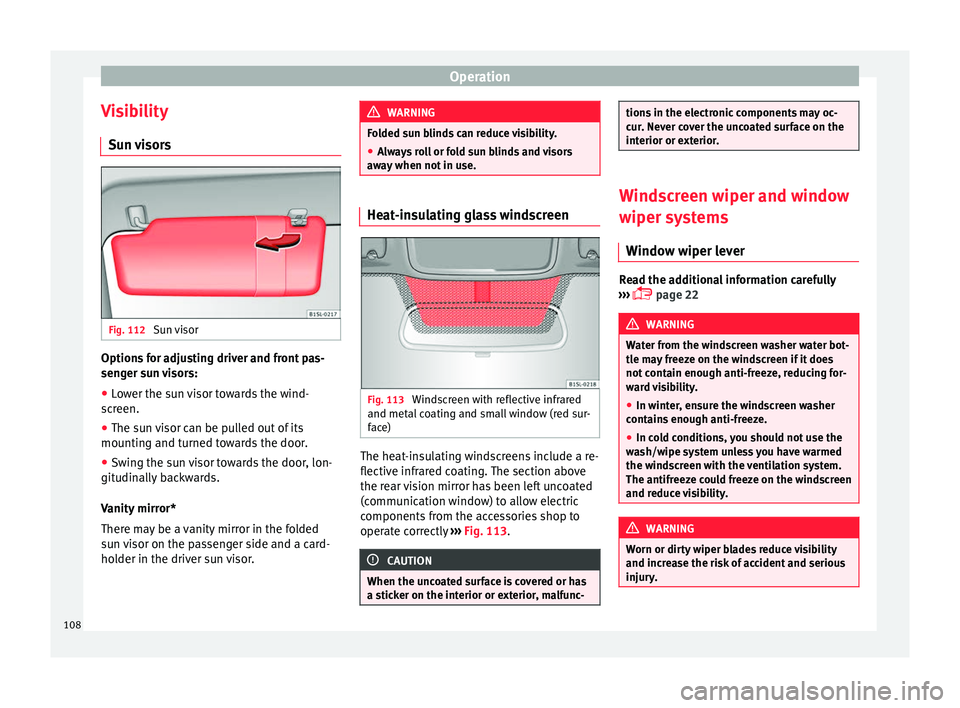
visors Fig. 112
Sun visor Options for adjusting driver and front pas-
sen
g
er s
un visors:
● Lower the sun visor towards the wind-
scr
een.
● The sun visor can be pulled out of its
mounting and t
urned towards the door.
● Swing the sun visor towards the door, lon-
gitudinal
ly backwards.
Vanity mirror*
There may be a vanity mirror in the folded
sun visor on the passenger side and a card-
holder in the driver sun visor. WARNING
Folded sun blinds can reduce visibility.
● Always roll or fold sun blinds and visors
aw a
y when not in use. Heat-insulating glass windscreen
Fig. 113
Windscreen with reflective infrared
and met al
c
oating and small window (red sur-
face) The heat-insulating windscreens include a re-
fl
ectiv
e infr
ared coating. The section above
the rear vision mirror has been left uncoated
(communication window) to allow electric
components from the accessories shop to
operate correctly ›››
Fig. 113. CAUTION
When the uncoated surface is covered or has
a stic k
er on the interior or exterior, malfunc- tions in the electronic components may oc-
cur
. Nev
er cover the uncoated surface on the
interior or exterior. Windscreen wiper and window
wiper sy
s
tems
Window wiper lever Read the additional information carefully
›› ›
page 22 WARNING
Water from the windscreen washer water bot-
tle m a
y freeze on the windscreen if it does
not contain enough anti-freeze, reducing for-
ward visibility.
● In winter, ensure the windscreen washer
contain
s enough anti-freeze.
● In cold conditions, you should not use the
wash/w
ipe system unless you have warmed
the windscreen with the ventilation system.
The antifreeze could freeze on the windscreen
and reduce visibility. WARNING
Worn or dirty wiper blades reduce visibility
and incr e
ase the risk of accident and serious
injury. 108
Page 175 of 232
Care and maintenance
with wax deposits which could smear the
w indo
w
s.
Use window cleaner or a silicone remover to
clean rubber, oil, grease and silicone depos-
its off ››› .
R emo
v
ing wax residue
Automatic car washes and certain car care
products may leave wax deposits on the win-
dows. These deposits can only be removed
with a special product or cleaning cloths. If
wax deposits are left on the windscreen and
the rear window, the blades can scratch the
glass. SEAT recommends you wipe the wax
deposits off the windscreen and the rear win-
dow with a soft cloth each time after you
have washed the vehicle.
A window cleaning detergent which helps to
dissolve the wax may be added to the wind-
screen washer fluid to prevent the wiper
blades from scratching the windscreen.
Please ensure you add the cleaning product
in the correct proportions. Products for re-
moving grease do not eliminate the wax de-
posits ››› .
S pec
i
al cleaning products or window cloths
are available at any technical service. To re-
move wax deposits, SEAT recommends the
following products:
● For the hottest time of the year: the window
cle
aner for summer use G 052 184 A1. Pro- portion 1:100 (1 part detergent, 100 parts
water) in the w
indscreen washer reservoir.
● All year round: the window clean-
er G 052 164 A2; proportion 1:2 in w
ind-
screen washer bottle (1 part concentrate, 2
parts water) in winter, up to -18 ℃ (-0.4°F), or
1:4, during the rest of the year.
● Window cloths G 052 522 A1 for all win-
dows
and exterior mirrors.
Removing snow
Use a small brush to remove snow from the
windows and exterior mirrors.
Removing ice
If possible, use a de-icing spray to remove
ice. If you use an ice scraper, push it in one
direction only without swinging it. If you pull
the scraper backwards, the dirt may scratch
the window. WARNING
Dirty or misted windows reduce visibility in
al l
directions and increase the risk of acci-
dent and serious injury.
● Do not drive unless you have good visibility
through al
l windows!
● Remove ice and snow from the windows
and demist
inside and out. CAUTION
● Never mi x
our cleaning products with other
products not recommended by SEAT in the
windscreen washer reservoir. This could lead
to flocculation and may block the windscreen
washer jets.
● Do not use hot or warm water to remove ice
or snow fr
om the windows and exterior mir-
rors. The glass could crack!
● The heating element for the rear window is
located on the inner s
ide of the window. Do
not stick adhesive labels over the heating el-
ements and never clean the inside of the rear
window with corrosive or acid products or
other similar chemical cleaning products. Caring for and polishing the vehicle
p
aintw
ork Waxing
R
e
gu
lar waxing protects the paintwork. It is
time to apply a good coat of wax when water
no longer forms droplets and rolls off the
clean paintwork.
Even if a wax solution is used regularly in the
automatic car wash, SEAT recommends pro-
tecting the paint with a hard wax coating at
least twice a year. »
173
Technical data
Advice
Operation
Emergencies
Safety
Page 197 of 232
Checking and refilling levels
●
The brak e fluid shou
ld be changed regular-
ly in accordance with the instructions given
in the Maintenance Programme.
● Always ensure that you use suitable brake
fluid. Only u
sed brake fluid that conforms to
the VW 501 14 standard, FMVSS 116 DOT 4
standard or even the DIN ISO 4925 CLASS 4
standard. Other types of brake fluid could af-
fect brake operation and reduce braking pow-
er. Do not use a brake fluid if the container
does not specify compliance with the
VW 501 14, FMVSS 116 DOT 4 or
DIN ISO 4925 CLASS 4 standards.
● The replacement brake fluid must be new.
● Brake fluid should be stored in the closed
original
container in a safe place out of reach
of children. Risk of poisoning!
● If the brake fluid is left in the system for
too long and the br
akes are subjected to
heavy use, vapour bubbles may form in the
brake system. This would seriously affect the
efficiency of the brakes and the safety of the
vehicle. This may cause an accident. CAUTION
Brake fluid damages the vehicle paintwork.
Wipe off an
y brake fluid from the paintwork
immediately. For the sake of the environment
Brake fluid is an environmental pollutant.
Co l
lect any spilt service fluids and allow a
professional to dispose of them. Windscreen washer reservoir
Chec k
in
g and topping up the wind-
screen washer reservoir with water Read the additional information carefully
›› ›
page 33
Check the water level in the windscreen
washer reservoir regularly and top up as re-
quired.
● Open the bonnet ›››
page 186.
● The washer reservoir is marked with the
symbol
on the lid.
● Check there is enough water in the reser-
voir.
● T
o top up, mix water with a window cleaner
recommended b
y SEAT ››› . Please follow
the in s
truction
s for use found on the packag-
ing.
● In cold weather, a special antifreeze should
also be ad
ded to prevent the water from
freezing.
Reservoir capacity
The washer bottle capacity is approximately 3
litres. WARNING
If the water from the windscreen washer does
not c ont
ain enough anti-freeze, it may freeze on the windscreen and rear window, reducing
for
w
ard and rear visibility.
● In winter, ensure the windscreen washer
contain
s enough anti-freeze.
● In cold conditions, you should not use the
winds
creen wiper system unless you have
warmed the windscreen with the ventilation
system. The antifreeze could freeze on the
windscreen and reduce visibility. WARNING
Never mix an unsuitable antifreeze or other
s imi l
ar additives with the windscreen washer
water. A greasy layer may be formed on the
windscreen which will impair visibility.
● Use clean water with a window cleaner rec-
ommended by
SEAT.
● If necessary, add a suitable antifreeze to
the water in the r
eservoir. CAUTION
● Do not mi x
cleaning products recommen-
ded by SEAT with other products. This could
lead to flocculation and may block the wind-
screen washer jets.
● When topping up service fluids, make abso-
lutely c
ertain that you fill the fluids into the
correct reservoirs. Using the wrong fluids
could cause serious malfunctions and engine
damage! 195
Technical data
Advice
Operation
Emergencies
Safety
Page 220 of 232
Index
Boot hatch emer g
ency
locking and unlocking . . . . . . . . . . . 10
Brake assist system . . . . . . . . . . . . . . . . . . . . . . . 139
Brake assist systems . . . . . . . . . . . . . . . . . . . . . . 139
brake fluid . . . . . . . . . . . . . . . . . . . . . . . . . . . . . . . . 33
Brake fluid specification . . . . . . . . . . . . . . . . . . . . . . . . . . . 194
Brakes . . . . . . . . . . . . . . . . . . . . . . . . . . . . . . . . . . 137 brake assist systems . . . . . . . . . . . . . . . . . . . . 139
brake fluid . . . . . . . . . . . . . . . . . . . . . . . . . . . . . 194
brake fluid level . . . . . . . . . . . . . . . . . . . . . . . . 194
brake pads . . . . . . . . . . . . . . . . . . . . . . . . . . . . 142
brake servo . . . . . . . . . . . . . . . . . . . . . . . . . . . . 142
changing the brake fluid . . . . . . . . . . . . . . . . . 194
control and warning lamps . . . . . . . . . . . . . . . 138
running in new brake pads . . . . . . . . . . . . . . . 142
Brake servo . . . . . . . . . . . . . . . . . . . . . . . . . 139, 142
Brake system fault . . . . . . . . . . . . . . . . . . . . . . . . . . . . . . . . . . 142
Brake systems . . . . . . . . . . . . . . . . . . . . . . . . . . . 139
Braking brake assist system . . . . . . . . . . . . . . . . . . . . . 139
Bulb fault see "Changing bulbs" . . . . . . . . . . . . . . . . . . . . 79
C Capacities . . . . . . . . . . . . . . . . . . . . . . . . . . . . . . . . 31 windscreen washer liquid . . . . . . . . . . . . . . . . 195
Capacity natural gas tank . . . . . . . . . . . . . . . . . . . . . . . . 185
Caring for paintwork . . . . . . . . . . . . . . . . . . . . . . . 173
Caring for the vehicle exterior . . . . . . . . . . . . . . . . . . . . . . . . . . . . . . . 171
Catalytic converter . . . . . . . . . . . . . . . . . . . . . . . . 152 control and warning lamps . . . . . . . . . . . . . . . 151
malfunction in the operation . . . . . . . . . . . . . . 152 CCS
see cruise c ontrol . . . . . . . . . . . . . . . . . . . . . . . . 24
Central locking . . . . . . . . . . . . . . . . . . . . . . . . . . . . 94 emergency locking . . . . . . . . . . . . . . . . . . . . . . . . 9
opening doors individually . . . . . . . . . . . . . . . . 95
Central locking system after airbag deployment . . . . . . . . . . . . . . . . . . 95
description . . . . . . . . . . . . . . . . . . . . . . . . . . . . . 95
remote control key . . . . . . . . . . . . . . . . . . . . . . . 95
Changes . . . . . . . . . . . . . . . . . . . . . . . . . . . . . . . . 165
Changing a wheel . . . . . . . . . . . . . . . . . . . . . . 36, 72 subsequent tasks . . . . . . . . . . . . . . . . . . . . . . . . 41
wheel bolts . . . . . . . . . . . . . . . . . . . . . . . . . . . . . 38
Changing bulbs . . . . . . . . . . . . . . . . . . . . . . . . . . . 79 front bumper . . . . . . . . . . . . . . . . . . . . . . . . . . . . 81
headlights . . . . . . . . . . . . . . . . . . . . . . . . . . . . . . 80
number plate light . . . . . . . . . . . . . . . . . . . . . . . 83
rear lights . . . . . . . . . . . . . . . . . . . . . . . . . . . . . . 82
side turn signal . . . . . . . . . . . . . . . . . . . . . . . . . . 84
Changing gear . . . . . . . . . . . . . . . . . . . . . . . . . . . 143 automatic gear change . . . . . . . . . . . . . . . . . . 145
control and warning lamps . . . . . . . . . . . . . . . 144
engaging the gears (automatic gearbox) . . . . 145
tiptronic . . . . . . . . . . . . . . . . . . . . . . . . . . . . . . . 146
Changing the blades . . . . . . . . . . . . . . . . . . . . . . . 75
Changing the wiper blades . . . . . . . . . . . . . . . . . . 45
Charging the battery . . . . . . . . . . . . . . . . . . . . . . . 43
Child safety seat securing with the seat belt . . . . . . . . . . . . . . . . 18
Child seats . . . . . . . . . . . . . . . . . . . . . . . . . . . . 16, 66 disabling the front passenger front airbag . . . . 15
ISOFIX system . . . . . . . . . . . . . . . . . . . . . . . . 18, 69
mounting child seats . . . . . . . . . . . . . . . . . . . . . 17
mounting systems . . . . . . . . . . . . . . . . . . . . . . . 17
on the front passenger seat . . . . . . . . . . . . . . . . 68
on the rear seats . . . . . . . . . . . . . . . . . . . . . . . . . 69 regulations . . . . . . . . . . . . . . . . . . . . . . . . . . . . . 67
safety
instructions . . . . . . . . . . . . . . . . . . . . 16, 65
top Tether system . . . . . . . . . . . . . . . . . . . . . . . . 19
transporting children in the vehicle . . . . . . . . . 67
weight categories . . . . . . . . . . . . . . . . . . . . . . . . 67
Cigarette lighter . . . . . . . . . . . . . . . . . . . . . . . . . . 120
City Safety Assist function . . . . . . . . . . . . . . . . . . 156 control and warning lamps . . . . . . . . . . . . . . . 157
function . . . . . . . . . . . . . . . . . . . . . . . . . . . . . . . 159
sensor . . . . . . . . . . . . . . . . . . . . . . . . . . . . . . . . 158
special driving situations . . . . . . . . . . . . . . . . . 159
Cleaning . . . . . . . . . . . . . . . . . . . . . . . . . . . . . . . . 170 compartments . . . . . . . . . . . . . . . . . . . . . . . . . 177
dash panel . . . . . . . . . . . . . . . . . . . . . . . . . . . . 178
engine compartment . . . . . . . . . . . . . . . . . . . . 175
fabrics . . . . . . . . . . . . . . . . . . . . . . . . . . . . . . . . 176
padding . . . . . . . . . . . . . . . . . . . . . . . . . . . . . . . 177
seatbelts . . . . . . . . . . . . . . . . . . . . . . . . . . . . . . 178
textile covers . . . . . . . . . . . . . . . . . . . . . . . . . . . 177
washing the vehicle . . . . . . . . . . . . . . . . . . . . . 171
washing the vehicle with high pressure clean-ers . . . . . . . . . . . . . . . . . . . . . . . . . . . . . . . . . 172
wheels . . . . . . . . . . . . . . . . . . . . . . . . . . . . . . . . 174
windows . . . . . . . . . . . . . . . . . . . . . . . . . . . . . . 172
Cleaning the vehicle high pressure cleaners . . . . . . . . . . . . . . . . . . . 172
climatronic air recirculation . . . . . . . . . . . . . . . . . . . . . . . . . . 28
Climatronic air distribution . . . . . . . . . . . . . . . . . . . . . . . . . . 28
AUTO (automatic mode) . . . . . . . . . . . . . . . . . . . 27blower . . . . . . . . . . . . . . . . . . . . . . . . . . . . . . . . . 28
controls . . . . . . . . . . . . . . . . . . . . . . . . . . . . . . . . 27
cooling mode . . . . . . . . . . . . . . . . . . . . . . . . . . . 27
disconnecting . . . . . . . . . . . . . . . . . . . . . . . . . . . 27
regulating the temperature . . . . . . . . . . . . . . . . 27
removing ice from the windows . . . . . . . . . . . . . 28
218
Page 222 of 232
Index
tyre pressure . . . . . . . . . . . . . . . . . . . . . . . . . . . 203
w ind
s
creen washer bottle . . . . . . . . . . . . . . . . 173
Driving safety . . . . . . . . . . . . . . . . . . . . . . . . . . . . . 47
Driving through water . . . . . . . . . . . . . . . . . . . . . 153
Driving tips for a loaded vehicle . . . . . . . . . . . . . . . . . . . . . 114
Duplicate keys . . . . . . . . . . . . . . . . . . . . . . . . . . . . 92
Dust filter . . . . . . . . . . . . . . . . . . . . . . . . . . . . . . . 133
Dynamic headlight range control . . . . . . . . . . . . 107
E E10 see Ethanol (fuel) . . . . . . . . . . . . . . . . . . . . . . . 181
EDL see Electronic differential lock . . . . . . . . . . . . . 139
EDS see "Brake assist systems" . . . . . . . . . . . . . . . 140
Electric windows . . . . . . . . . . . . . . . . . . . . . . . . . . . . . . . 11
Electrical devices . . . . . . . . . . . . . . . . . . . . 121, 122
Electric windows . . . . . . . . . . . . . . . . . . . . . . . . . . . 11 buttons . . . . . . . . . . . . . . . . . . . . . . . . . . . . . . . 101
closing . . . . . . . . . . . . . . . . . . . . . . . . . . . . . . . . 101
opening . . . . . . . . . . . . . . . . . . . . . . . . . . . . . . . 101
see Windows . . . . . . . . . . . . . . . . . . . . . . . . . . . 101
Electronic differential lock . . . . . . . . . . . . . . . . . . 139
Electronic immobiliser . . . . . . . . . . . . . . . . . . . . . 137 operating fault . . . . . . . . . . . . . . . . . . . . . . . . . 135
Electronic Stability Control (ESC) . . . . . . . . . . . . 139
Emergencies . . . . . . . . . . . . . . . . . . . . . . . . . . . . . . 70 bulbs . . . . . . . . . . . . . . . . . . . . . . . . . . . . . . . . . . 35
changing a wheel . . . . . . . . . . . . . . . . . . . . . . . . 36
emergency towing of the vehicle . . . . . . . . . . . . 42
fire extinguishers . . . . . . . . . . . . . . . . . . . . . . . . 70
first aid kit . . . . . . . . . . . . . . . . . . . . . . . . . . . . . . 70
fuses . . . . . . . . . . . . . . . . . . . . . . . . . . . . . . . . . . 34
hazard warning lights . . . . . . . . . . . . . . . . . . . 106 Jump leads . . . . . . . . . . . . . . . . . . . . . . . . . . . . . 43
punct
ure . . . . . . . . . . . . . . . . . . . . . . . . . . . . . . . 35
replacing a blown fuse . . . . . . . . . . . . . . . . . . . . 34
vehicle tool kit . . . . . . . . . . . . . . . . . . . . . . . . . . 70
warning triangle . . . . . . . . . . . . . . . . . . . . . . . . . 70
Emergency closing or opening driver door . . . . . . . . . . . . . . . . . . . . . . . . . . . . . . 8
passenger door . . . . . . . . . . . . . . . . . . . . . . . . . . . 9
Emergency locking and unlocking . . . . . . . . . . . . 77
Emergency unlocking boot hatch . . . . . . . . . . . . . . . . . . . . . . . . . . . . . . 10
Emergency unlocking the boot hatch boot hatch . . . . . . . . . . . . . . . . . . . . . . . . . . . . . . 10
Emission control system control and warning lamps . . . . . . . . . . . . . . . 151
Emissions data . . . . . . . . . . . . . . . . . . . . . . . . . . . 210
Engine assisted starting . . . . . . . . . . . . . . . . . . . . . . . . . 43
noises . . . . . . . . . . . . . . . . . . . . . . . . . . . . . . . . 136
running in . . . . . . . . . . . . . . . . . . . . . . . . . . . . . 148
start-Stop system . . . . . . . . . . . . . . . . . . . . . . . 161
Engine and ignition . . . . . . . . . . . . . . . . . . . . . . . 135 12 Volt sockets . . . . . . . . . . . . . . . . . . . . . . . . . 122
ignition lock . . . . . . . . . . . . . . . . . . . . . . . . . . . 135
immobiliser . . . . . . . . . . . . . . . . . . . . . . . . . . . . 137
starting the engine . . . . . . . . . . . . . . . . . . . . . . 135
stopping the engine . . . . . . . . . . . . . . . . . . . . . 136
unauthorised vehicle key . . . . . . . . . . . . . . . . . 135
Engine compartment . . . . . . . . . . . . . . . . . . 10, 186 battery . . . . . . . . . . . . . . . . . . . . . . . . . . . . 33, 196
brake fluid . . . . . . . . . . . . . . . . . . . . . . . . . 33, 194
coolant . . . . . . . . . . . . . . . . . . . . . . . . . . . 32, 191
engine oil . . . . . . . . . . . . . . . . . . . . . 31, 190, 191
windscreen washer reservoir . . . . . . . . . . 33, 195
Engine coolant . . . . . . . . . . . . . . . . . . . . . . . . . . . . 32 checking the level . . . . . . . . . . . . . . . . . . . . . . . 191
G 12 plus-plus . . . . . . . . . . . . . . . . . . . . . . . . . . 32 G 13 . . . . . . . . . . . . . . . . . . . . . . . . . . . . . . . . . . . 32
specific
ations . . . . . . . . . . . . . . . . . . . . . . . . . . . 32
temperature display . . . . . . . . . . . . . . . . . . . . . 192
Engine data . . . . . . . . . . . . . . . . . . . . . . . . . . . . . . 213
Engine management . . . . . . . . . . . . . . . . . . . . . . 151 control lamps . . . . . . . . . . . . . . . . . . . . . . . . . . 151
Engine oil . . . . . . . . . . . . . . . . . . . . . . . . . . . 31, 188 changing . . . . . . . . . . . . . . . . . . . . . . . . . . . . . . 188
checking oil level . . . . . . . . . . . . . . . . . . . . . . . 190
consumption . . . . . . . . . . . . . . . . . . . . . . . . . . . 190
control and warning lamps . . . . . . . . . . . . . . . 189
dipstick . . . . . . . . . . . . . . . . . . . . . . . . . . . . . . . 190
oil properties . . . . . . . . . . . . . . . . . . . . . . . . . . . 32
specifications . . . . . . . . . . . . . . . . . . . . . . . . . . 189
topping up . . . . . . . . . . . . . . . . . . . . . . . . . . . . 191
Environment environmental compatibility . . . . . . . . . . . . . . 149
Environmental ecological driving . . . . . . . . . . . . . . . . . . . . . . . 149
Environmental tips refuelling . . . . . . . . . . . . . . . . . . . . . . . . . . . . . . 185
Equipment . . . . . . . . . . . . . . . . . . . . . . . . . . . . . . 164 safety . . . . . . . . . . . . . . . . . . . . . . . . . . . . . . . . . . 60
ESC electronic stability control . . . . . . . . . . . . . . . . 139
Ethanol (fuel) . . . . . . . . . . . . . . . . . . . . . . . . . . . . 181
Event Data Recorder . . . . . . . . . . . . . . . . . . . . . . . 167
Exhaust gas purification system . . . . . . . . . . . . . 151
Exterior mirrors adjusting . . . . . . . . . . . . . . . . . . . . . . . . . . . . . . . 13
vehicle care . . . . . . . . . . . . . . . . . . . . . . . . . . . . 172
Exterior rear view mirrors control of the function . . . . . . . . . . . . . . . . . . . 112
electric exterior mirrors . . . . . . . . . . . . . . . . . . 112
exterior . . . . . . . . . . . . . . . . . . . . . . . . . . . . . . . 111
Exterior view . . . . . . . . . . . . . . . . . . . . . . . . . . . . . 5, 6
220