child lock Seat Mii 2017 User Guide
[x] Cancel search | Manufacturer: SEAT, Model Year: 2017, Model line: Mii, Model: Seat Mii 2017Pages: 232, PDF Size: 4.91 MB
Page 103 of 232

Opening and closing
● The r e
ar lid i
s also locked by a central lock-
ing.
● If the vehicle rear lid is locked or unlocked
usin
g the button of the vehicle key, when
it is closed again it will lock automatically.
● A closed but not locked rear lid will lock au-
tomatic
ally at a speed above about 9 km/h
(6 mph).
Locking the rear lid with the vehicle mechan-
ical key
Locking is only possible when the rear lid is
correctly and fully closed.
● Insert the vehicle key into the lock cylinder
of the driver door and t
urn the key in a clock-
wise direction ››› page 94. WARNING
Unsuitable or careless closing and locking of
the re ar lid c
ould cause serious injuries.
● Never leave the vehicle unattended, or al-
low chi
ldren to play inside or around the vehi-
cle without supervision, especially if the rear
lid is open. Children could enter the luggage
compartment, close the rear lid and become
trapped. A locked vehicle can be subjected to
extremely high and low temperatures, de-
pending on the time of year, thus causing se-
rious injuries/illness and even death. Note
Before closing the rear lid, make sure that the
key h
as not been left inside the luggage com-
partment. Controls for the windows
Opening and c lo
sing the windows
electrically Read the additional information carefully
› ›
›
page 11 WARNING
Careless use of the electric windows can
cau se seriou
s injury.
● Only operate the electric windows when
nobody i
s in the way.
● Never leave children or disabled people
alone in the v
ehicle if the doors are to be
locked. The windows cannot be opened in
case of an emergency.
● Always take all the keys with you whenever
you le
ave the vehicle. After turning off the ig-
nition, the windows can be opened and
closed for a short time using the buttons on
the door as long as the driver door or passen-
ger side door is not open. CAUTION
When the windows are open, rain can enter
the v ehic
le, dampening the interior equip-
ment and causing damage to the vehicle. Side-opening rear windows
Fig. 108
Lever to open and close the rear win-
do w Opening
P
u
l
l the release lever in the direction of arrow
A and press outward until the lever engag-
e s.
C lo
sing
Pull the release lever in the direction of arrow B and then press the lever backward until it
en gag
es.
101
Technical data
Advice
Operation
Emergencies
Safety
Page 108 of 232
Operation
●
If an y
of both turn signals fails, the warning
lamp will start flashing twice faster than nor-
mal.
● The main beam headligh
ts can only be
switched on if the dipped beam headlights
are already on. Hazard warning lights
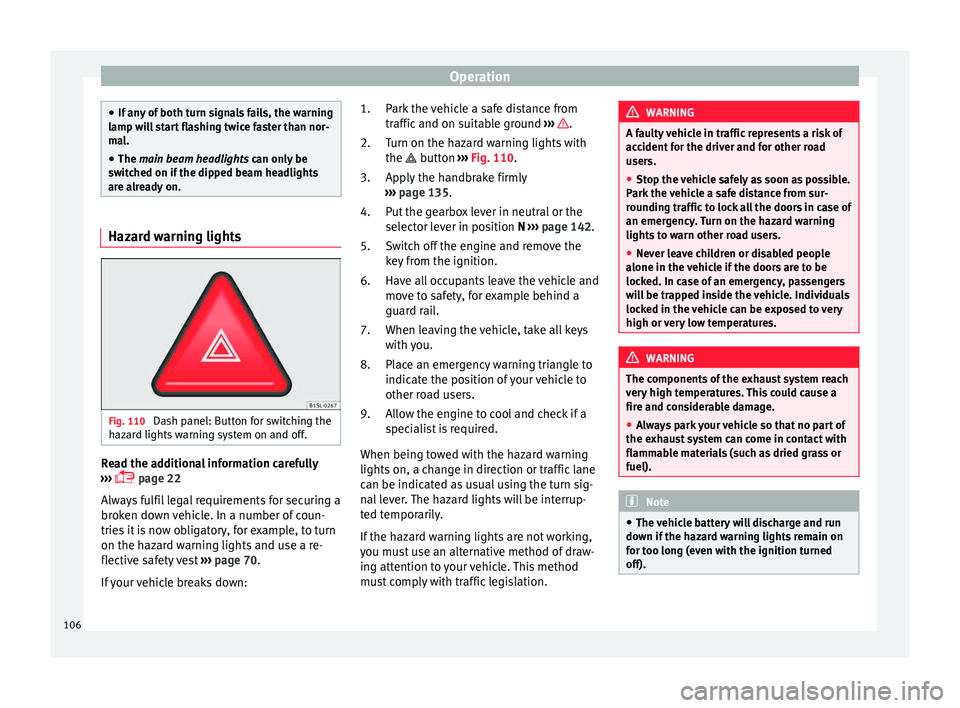
Fig. 110
Dash panel: Button for switching the
h az
ar
d lights warning system on and off. Read the additional information carefully
› ›
›
page 22
Always fulfil legal requirements for securing a
broken down vehicle. In a number of coun-
tries it is now obligatory, for example, to turn
on the hazard warning lights and use a re-
flective safety vest ››› page 70.
If your vehicle breaks down: Park the vehicle a safe distance from
traffic and on s
uitable ground ››› .
T urn on the h
az
ard warning lights with
the button ››› Fig. 110.
Apply the handbrake firmly
››› page 135.
Put the gearbox lever in neutral or the
selector lever in position N ››› page 142.
Switch off the engine and remove the
key from the ignition.
Have all occupants leave the vehicle and
move to safety, for example behind a
guard rail.
When leaving the vehicle, take all keys
with you.
Place an emergency warning triangle to
indicate the position of your vehicle to
other road users.
Allow the engine to cool and check if a
specialist is required.
When being towed with the hazard warning
lights on, a change in direction or traffic lane
can be indicated as usual using the turn sig-
nal lever. The hazard lights will be interrup-
ted temporarily.
If the hazard warning lights are not working,
you must use an alternative method of draw-
ing attention to your vehicle. This method
must comply with traffic legislation. 1.
2.
3.
4.
5.
6.
7.
8.
9. WARNING
A faulty vehicle in traffic represents a risk of
acc ident
for the driver and for other road
users.
● Stop the vehicle safely as soon as possible.
Park the
vehicle a safe distance from sur-
rounding traffic to lock all the doors in case of
an emergency. Turn on the hazard warning
lights to warn other road users.
● Never leave children or disabled people
alone in the v
ehicle if the doors are to be
locked. In case of an emergency, passengers
will be trapped inside the vehicle. Individuals
locked in the vehicle can be exposed to very
high or very low temperatures. WARNING
The components of the exhaust system reach
ver y
high temperatures. This could cause a
fire and considerable damage.
● Always park your vehicle so that no part of
the exhau
st system can come in contact with
flammable materials (such as dried grass or
fuel). Note
● The v ehic
le battery will discharge and run
down if the hazard warning lights remain on
for too long (even with the ignition turned
off). 106
Page 125 of 232
Transport and practical equipment
CAUTION
At very high or very low temperatures the
smar tphone might
not operate properly, or
the actual device could get damaged.
● Take your smart phone with you when you
get out
of the vehicle to protect it from very
high or very low temperatures, and from in-
tense solar radiation. CAUTION
Humidity can damage the electrical contacts
for the sm ar
tphone on the instrument panel.
● Do not wet the smartphone’s housing when
cle
aning it. Use only a dry cloth. Note
SEAT recommends that you always take your
smar t
phone with you when you get out of
the vehicle to avoid possible thefts. Luggage compartment
Intr oduction Always transport heavy loads in the luggage
c
omp
ar
tment and place the seat backs in a
vertical position. Never overload the vehicle.
Both the carrying capacity as well as the dis-
tribution of the load in the vehicle have ef- fects on the driving behaviour and braking
ability
››› .
WARNING
When the vehicle is not in use or being
wat c
hed, always lock the doors and the rear
lid to reduce the risk of serious injury or
death.
● Do not leave children unwatched, especial-
ly when the boot i
s open. Children could
climb into the luggage compartment, close
the rear lid from inside and be unable to es-
cape themselves. This could lead to serious
injury or death.
● Never allow children to play in or around
the vehic
le.
● Never transport people in the luggage com-
partment
. WARNING
Unsecured or incorrectly secured objects can
cau se seriou
s injury in case of a sudden ma-
noeuvring or breaking or in case of an acci-
dent. This is especially true when objects are
struck by a detonating airbag and fired
through the vehicle interior. To reduce the
risks, please note the following:
● Secure all objects in the vehicle. Always
plac
e equipment and heavy objects in the
boot.
● Always secure objects to the fastening
rings
with suitable rope or straps to prevent
them from being thrown around the interior and moving to the airbag deployment area in
the event
of
sudden movements or accidents.
● While driving, always keep object compart-
ments c
losed.
● Do not place hard, heavy or sharp objects
inside the
vehicle interior, in open storage
compartments, the rear shelf or on the dash
panel.
● Remove hard, heavy and sharp objects from
clothes
and pockets inside the vehicle and
store securely. WARNING
The transport of heavy object changes vehi-
cl e h
andling and increases braking distance.
Heavy loads that have not been stored or se-
cured correctly could cause loss of control
and result in serious injury.
● Vehicle handling changes when transport-
ing heavy
objects due to a change in the cen-
tre of gravity.
● Distribute the load as uniformly and as low
down on the v
ehicle as possible.
● Store heavy objects in the luggage com-
partment
as far from the rear axle as possi-
ble. CAUTION
Hard objects on the rear shelf could chafe
again s
t the wires of the heating element in
the heated rear window and cause damage. » 123
Technical data
Advice
Operation
Emergencies
Safety
Page 136 of 232
Operation
●
Never l e
ave the vehicle unattended if the
engine is running. The vehicle could move off
suddenly or something unexpected could
happen resulting in damage and serious in-
jury.
● Never use start boosters. Cold start sprays
coul
d explode or increase the engine speed
unexpectedly. WARNING
The components of the exhaust system reach
v er y
high temperatures. This could cause a
fire and considerable damage.
● Always park your vehicle so that no part of
the exhau
st system can come in contact with
flammable materials (such as wood, leaves,
spilled fuel, dried grass, etc).
● Never apply additional underseal or anti-
corro
sion coatings to the exhaust pipes, cata-
lytic converter or the heat shields on the ex-
haust system. WARNING
Unsuitable or careless use of the vehicle key
cou l
d result in serious injury.
● Always take all the keys with you whenever
you le
ave the vehicle. If not, the engine could
accidentally be started and electrical equip-
ment such as the windows could accidentally
be operated resulting in serious injury.
● Never leave children or disabled people
alone in the car
. Passengers could be trapped in the car in an emergency and not be able to
get
themselv
es to safety. For example, de-
pending on the time of the year, tempera-
tures inside a locked and closed vehicle can
be extremely high or extremely low resulting
in serious injuries and illness or even death,
particularly for young children.
● Never remove the key from the ignition if
the vehic
le is in motion. The steering may
lock and it will not be possible to turn the
steering wheel. CAUTION
● An attempt t
o start the engine while driving
or starting the engine immediately after turn-
ing it off can cause damage to the engine or
starter motor.
● When the engine is cold, avoid high revs
and heavy ac
celeration and do not make the
engine work hard.
● Do not push or tow start the engine. Un-
burnt f
uel could damage the catalytic con-
verter. For the sake of the environment
Do not warm the engine at idle speed; start
drivin g immedi
ately if the visibility is OK.
This helps the engine reach operating tem-
perature faster and reduces emissions. Note
● If the k ey
is left in the ignition lock with the
engine off for long periods, the vehicle bat-
tery will run flat.
● In automatic gearbox vehicles, the key can
only be r
emoved from the ignition lock if the
gear selector lever is in position N. In this
case, press and release the selector lever
locking button.
● Electrical devices with a high power con-
sumption are sw
itched off temporarily when
the engine starts.
● When the engine is started cold, there may
be stron
g vibrations for a few moments for
technical reasons. This is quite normal, and
no cause for concern.
● Natural gas engines always start up with
petrol, a
s a certain operating temperature is
required for running with gas. Once the re-
quired operating temperature is reached, the
engine will change to operate with natural
gas. Stopping the engine
Switching off the engine
– Stop the vehicle ››
›
.
– Turn the ignition key to position 1 ›››
Fig. 145.
134
Page 138 of 232
Operation
may engage and lock the steering wheel mak-
ing the
v
ehicle impossible to control.
● Always park your vehicle so that no part of
the exhau
st system can come in contact with
flammable materials (such as wood, leaves,
dried grass, spilled fuel, etc.).
● Always apply the handbrake when you
leav
e your vehicle and when you park.
● Never leave children or disabled people
alone in the v
ehicle. They could release the
electronic parking brake, activate the selec-
tor lever or gear stick and start the vehicle
moving. This could result in a serious acci-
dent.
● Always take all the keys with you whenever
you le
ave the vehicle. The engine could acci-
dentally be started and electrical equipment
such as the windows could accidentally be
operated resulting in serious injury.
● Never leave children or disabled people
alone in the car
. They could be trapped in the
car in an emergency and will not be able to
get themselves to safety. For example, de-
pending on the time of the year, tempera-
tures inside a locked and closed vehicle can
be extremely high or extremely low resulting
in serious injuries and illness or even death,
particularly for young children. CAUTION
● Spec i
al care should be taken when parking
in areas with high kerbs or fixed barriers. Ob-
jects protruding from the ground may dam- age the bumper or other parts of the vehicle
during m
anoeu
vres. To avoid damage, stop
before the wheels touch the barrier or kerb.
● Special attention is required when driving
through entranc
es, over ramps, kerbs or oth-
er objects. The vehicle underbody, bumpers,
mudguards and running gear, and the engine
and exhaust system could be damaged as
you drive over these objects. Control and warning lamps
It lights up
›››
Handbrake applied.››› page 139.
It lights up
›››
Fault in the brake
system Do not drive on!
Seek professional advice
››› page 141.
Brake fluid level in-
adequate. Do not drive on!
Check brake fluid level
››› page 195.
Together with the
ABS control lamp
: ABS and EBV do
not function.
Do not drive on!
Seek professional advice
››› page 141.
It lights up
›››
ESC* disconnected
by system.Switching the ignition on and off
If necessary, drive for a short dis-
tance.
Fault in ESC*.Contact a specialised workshop.
Together with the
ABS control lamp
: Fault in the ABS.
Contact a specialised workshop.
The vehicle can be braked with-
out ABS.
The battery has
been reconnected.››› page 196.
It lights up
›››
Traction Control*
faulty or switched
off by the system.Contact a specialised workshop.
It lights up
›››
Together with the
ESC* control lamp
: Fault in the ABS.
Contact a specialised workshop.
The vehicle can be braked with-
out ABS.
Together with the
warning lamp :
ABS and EBV do not
function. Do not drive on!
Seek professional advice
››› page 141.
Flashes
ESC* or ASR regulat-
ing.Take your foot off the accelera-
tor. Adjust your driving style to
the road conditions. 136
Page 189 of 232
Checking and refilling levels
●
Noise s
heard when refuelling are normal
and do not indicate the presence of a fault in
the system.
● The vehicle natural gas system is prepared
both for ref
uelling with a small compressor
(slow refuel) and a large compressor (fast re-
fuel) in natural gas service stations. Bonnet
Work in
g in the engine compartment Read the additional information carefully
› ›
›
page 10
Before working in the engine compartment,
make sure that the vehicle is parked on hori-
zontal and firm ground.
The engine compartment of the vehicle is a
hazardous area. Never work on the engine or
in the engine compartment if you are not fa-
miliar with the operations to be carried out,
the applicable safety standards and especial-
ly if you do not have the necessary instru-
ments, liquids and tools ››› ! If required,
h av
e an
y work carried out by a specialised
workshop. Negligent work can cause serious
injury. WARNING
If the vehicle moves unexpectedly, this could
cau se seriou
s injury. ●
Never w ork
under the vehicle if it has not
been immobilized. If you must work under-
neath the vehicle with the wheels in contact
with the ground then it should be parked on
flat ground, the wheels should be prevented
from moving and the key should be removed
from the ignition.
● If you have to work underneath the vehicle,
you mus
t use suitable stands additionally to
support the vehicle, there is a risk of acci-
dent!. The jack is not intended for this kind of
work and its failure could lead to severe inju-
ries.
● Disconnect the Start-Stop system. WARNING
The engine compartment is a dangerous area
cap ab
le of causing serious injury.
● For all type of work, always take the utmost
precaution
s, work carefully and note the gen-
eral safety standards in force. Never take per-
sonal risks.
● Never work on the engine or in the engine
compar
tment if you are not familiar with the
necessary operations. If you are not sure
about procedures then visit a specialised
workshop to carry out the necessary work.
Working incorrectly can cause serious inju-
ries.
● Never open the bonnet if you see steam or
cool
ant escaping from the engine compart-
ment. This may cause serious burns. Always
wait until you cannot see or hear the sound of steam or coolant coming from the engine
comp
ar
tment.
● Always allow the engine to cool down be-
fore openin
g the bonnet.
● Contact with hot elements of the engine
and the exhau
st system can cause burns.
● Once the engine has cooled, follow the in-
structions
below before opening the bonnet:
– Engage the handbrake and place the gear
selector lever in N or the gear stick in
neutral.
– Remove the key from the ignition.
– Keep children away from the engine com-
partment and never leave them unsuper-
vised.
● When the engine is warm or hot, the cool-
ing sys
tem is pressurised. Do not unscrew
the cap on the expansion tank when the en-
gine is hot. Otherwise, coolant may spray out
under pressure causing burns and serious in-
jury.
– After cooling, carefully and slowly un-
screw the cap anticlockwise, gently
pressing down on it.
– Always protect your face, hands and arms
from hot coolant and steam using a large,
thick cloth.
● When refilling liquids, avoid spilling them
on part
s of the engine and the exhaust sys-
tem. Spilled liquids could cause a fire. » 187
Technical data
Advice
Operation
Emergencies
Safety
Page 198 of 232
Advice
● Chec k
ther
e is enough water in the reser-
voir.
● To top up, mix water with a window cleaner
recommended b
y SEAT ››› . Please follow
the in s
truction
s for use found on the packag-
ing.
● In cold weather, a special antifreeze should
also be ad
ded to prevent the water from
freezing.
Reservoir capacity
The washer bottle capacity is approximately 3
litres. WARNING
If the water from the windscreen washer does
not c ont
ain enough anti-freeze, it may freeze
on the windscreen and rear window, reducing
forward and rear visibility.
● In winter, ensure the windscreen washer
contain
s enough anti-freeze.
● In cold conditions, you should not use the
winds
creen wiper system unless you have
warmed the windscreen with the ventilation
system. The antifreeze could freeze on the
windscreen and reduce visibility. WARNING
Never mix an unsuitable antifreeze or other
simi l
ar additives with the windscreen washer
water. A greasy layer may be formed on the
windscreen which will impair visibility. ●
Use c l
ean water with a window cleaner rec-
ommended by SEAT.
● If necessary, add a suitable antifreeze to
the water in the r
eservoir. CAUTION
● Do not mix
cleaning products recommen-
ded by SEAT with other products. This could
lead to flocculation and may block the wind-
screen washer jets.
● When topping up service fluids, make abso-
lutely c
ertain that you fill the fluids into the
correct reservoirs. Using the wrong fluids
could cause serious malfunctions and engine
damage! Vehicle battery
Intr oduction Read the additional information carefully
› ›
›
page 33.
The battery is a component of the vehicle's
electrical system.
Never work on the electrical system without
fully understanding the operations required,
the applicable safety standards and without
the correct tools ››› ! If required, have any
w ork
c
arried out by a specialised workshop.
SEAT recommends taking your car in for tech- nical service. Negligent work can cause seri-
ous injur
y.
Location of the vehicle battery
The battery is located in the engine compart-
ment.
Explanation of the warning indications on
the vehicle's battery
Wear eye protection!
Battery acid is very corrosive and caustic.
Always wear protective gloves and eye
protection!
Fires, sparks, open flames and smoking
are prohibited.
A highly explosive mixture of gases is re-
leased when the battery is under charge.
Keep children away from acid and batter-
ies!
WARNING
Working on the vehicle battery and the elec-
trica l
system can cause corrosion, fire and
electric shocks. Always read and take into ac-
count the following warnings and safety
standards before carrying out any work:
● Before working on the battery, switch off
the engine, the ignition and al
l electrical de-
vices then disconnect the negative connec-
tion on the battery. 196
Page 221 of 232
Index
Index
A
Abr o
a
d
extended stay abroad with your vehicle . . . . . 179
sale of vehicle . . . . . . . . . . . . . . . . . . . . . . . . . . 179
ABS see Anti-lock brake system . . . . . . . . . . . . . . . 137
Accessories . . . . . . . . . . . . . . . . . . . . . . . . . . . . . . 164
Acoustic alarm seatbelt unfastened . . . . . . . . . . . . . . . . . . . . . . 53
Adjust front seat . . . . . . . . . . . . . . . . . . . . . . . . . . . . . . 112
Adjusting lights . . . . . . . . . . . . . . . . . . . . . . . . . . . . . . . . . 107
rear head restraints . . . . . . . . . . . . . . . . . 51, 112
seats . . . . . . . . . . . . . . . . . . . . . . . . . . . . . . . . . . 48
Adjusting the head restraints rear head restraints . . . . . . . . . . . . . . . . . . . . . 112
Advice for driving spare wheel or temporary spare wheel . . . . . . 207
Airbag covers . . . . . . . . . . . . . . . . . . . . . . . . . . . . . 14
Airbags . . . . . . . . . . . . . . . . . . . . . . . . . . . . . . . . . . 58 description . . . . . . . . . . . . . . . . . . . . . . . . . . . . . 60
Airbag system . . . . . . . . . . . . . . . . . . . . . . . . . . 14, 58 activation . . . . . . . . . . . . . . . . . . . . . . . . . . . . . . 61
cleaning dash panel . . . . . . . . . . . . . . . . . . . . . 178
control and warning lamps . . . . . . . . . . . . . . . . 62
description . . . . . . . . . . . . . . . . . . . . . . . . . . . . . 60
front airbags . . . . . . . . . . . . . . . . . . . . . . . . . 14, 61
functioning . . . . . . . . . . . . . . . . . . . . . . . . . . . . . 61
locking the vehicle after deployment . . . . . . . . 95
repairs . . . . . . . . . . . . . . . . . . . . . . . . . . . . . . . . 166
side airbags . . . . . . . . . . . . . . . . . . . . . . . . . . . . 16
use of child seats . . . . . . . . . . . . . . . . . . . . . . . . 15
vehicle care . . . . . . . . . . . . . . . . . . . . . . . . . . . . 178 Air conditioning . . . . . . . . . . . . . . . . . . . . . . . . . . 129
air recir culation . . . . . . . . . . . . . . . . . . . . . . . . . 130
air vents . . . . . . . . . . . . . . . . . . . . . . . . . . . . . . 131
climatronic . . . . . . . . . . . . . . . . . . . . . . . . 28, 129
instructions for use . . . . . . . . . . . . . . . . . . . . . 132
malfunction . . . . . . . . . . . . . . . . . . . . . . . . . . . . 132
tips . . . . . . . . . . . . . . . . . . . . . . . . . . . . . . . . . . 132
water under vehicle . . . . . . . . . . . . . . . . . . . . . 133
Air recirculation . . . . . . . . . . . . . . . . . . . . . . . . . . 130 climatronic . . . . . . . . . . . . . . . . . . . . . . . . . . . . . 29
how it works . . . . . . . . . . . . . . . . . . . . . . . . . . . 130
switching off . . . . . . . . . . . . . . . . . . . . . . . . . . . 130
switching on . . . . . . . . . . . . . . . . . . . . . . . . . . . 130
Air vents . . . . . . . . . . . . . . . . . . . . . . . . . . . . . . . . 131
Antenna . . . . . . . . . . . . . . . . . . . . . . . . . . . 166, 180
Anti-freeze . . . . . . . . . . . . . . . . . . . . . . . . . . . . . . . 32
Anti-lock brake system . . . . . . . . . . . . . . . . . . . . . 137
Anti-lock system . . . . . . . . . . . . . . . . . . . . . . . . . . 138
Anti-puncture . . . . . . . . . . . . . . . . . . . . . . . . . . 35, 72
Anti-puncture kit . . . . . . . . . . . . . . . . . . . . . . . . 35, 72 check after 10 minutes . . . . . . . . . . . . . . . . . . . . 74
do not use . . . . . . . . . . . . . . . . . . . . . . . . . . . . . . 73
Anti-puncture set . . . . . . . . . . . . . . . . . . . . . . . . . . 72
Anti-theft security system . . . . . . . . . . . . . . . . . . . 97
Ashtray . . . . . . . . . . . . . . . . . . . . . . . . . . . . . . . . . 120
Aspects to take into account before starting the vehicle . . . . . . . . . . . . . . . . . . . . . . . . . . . . . . . . . 47
ASR see Traction control system . . . . . . . . . . . . . . . 137
Assistance systems brake assist system (BAS) . . . . . . . . . . . . . . . . 138
cruise control . . . . . . . . . . . . . . . . . . . . . . . . . . 155
electronic differential lock (EDS) . . . . . . . . . . . 138
optical parking system (OPS) . . . . . . . . . . . . . 154
parking aid . . . . . . . . . . . . . . . . . . . . . . . . . . . . 154
parking distance warning system . . . . . . . . . . 154
safety Assist . . . . . . . . . . . . . . . . . . . . . . . . . . . 156 traction control (ASR) . . . . . . . . . . . . . . . . . . . . 138
traction contr
ol (TC) . . . . . . . . . . . . . . . . . . . . . 138
Assisted starting . . . . . . . . . . . . . . . . . . . . . . . . . . 43
Audible warning control and warning lamps . . . . . . . . . . . . . . . . 25
lights . . . . . . . . . . . . . . . . . . . . . . . . . . . . . . . . . 103
speed . . . . . . . . . . . . . . . . . . . . . . . . . . . . . . . . . 24
Automatic belt retractor . . . . . . . . . . . . . . . . . . . . . 57
Automatic device disconnection battery . . . . . . . . . . . . . . . . . . . . . . . . . . . . . . . . 199
Automatic dipped beam control . . . . . . . . . . . . . 104
Automatic gearbox driving tips . . . . . . . . . . . . . . . . . . . . . . . . . . . . 145
ignition key removal lock . . . . . . . . . . . . . . . . . 134
kick-down . . . . . . . . . . . . . . . . . . . . . . . . . . . . . 145
malfunction . . . . . . . . . . . . . . . . . . . . . . . . . . . . 146
starting on a slope . . . . . . . . . . . . . . . . . . . . . . 145
stopping on a slope . . . . . . . . . . . . . . . . . . . . . 145
Automatic gear change . . . . . . . . . . . . . . . . . . . . 144
Axle loads . . . . . . . . . . . . . . . . . . . . . . . . . . . . . . . 212
B Bag support . . . . . . . . . . . . . . . . . . . . . . . . . . . . . 117
BAS see Brake assist system . . . . . . . . . . . . . . . . . . 138
Battery changing in the vehicle key . . . . . . . . . . . . . . . . 93
Battery acid . . . . . . . . . . . . . . . . . . . . . . . . . . . . . . 198
Before starting the vehicle . . . . . . . . . . . . . . . . . . 47
Belt tension device service and disposal . . . . . . . . . . . . . . . . . . . . . 58
Belt tensioner . . . . . . . . . . . . . . . . . . . . . . . . . . . . . 57
Belt tension limiter . . . . . . . . . . . . . . . . . . . . . . . . . 57
Belt tightening . . . . . . . . . . . . . . . . . . . . . . . . . . . . 57
Bonnet . . . . . . . . . . . . . . . . . . . . . . . . . . . . . 10, 187
Brake assist system . . . . . . . . . . . . . . . . . . . . . . . 137
219
Page 222 of 232
Index
Brake fluid . . . . . . . . . . . . . . . . . . . . . . . . . . . . . . . 33 spec
ific
ation . . . . . . . . . . . . . . . . . . . . . . . . . . . 194
Brakes . . . . . . . . . . . . . . . . . . . . . . . . . . . . . . . . . . 135 brake assist system . . . . . . . . . . . . . . . . . . . . . 137
brake fluid . . . . . . . . . . . . . . . . . . . . . . . . . . . . . 194
brake fluid level . . . . . . . . . . . . . . . . . . . . . . . . 195
brake pads . . . . . . . . . . . . . . . . . . . . . . . . . . . . 140
brake servo . . . . . . . . . . . . . . . . . . . . . . . . . . . . 141
changing the brake fluid . . . . . . . . . . . . . . . . . 195
control and warning lamps . . . . . . . . . . . . . . . 136
running in new brake pads . . . . . . . . . . . . . . . 140
Brake servo . . . . . . . . . . . . . . . . . . . . . . . . . 137, 141
Brake system . . . . . . . . . . . . . . . . . . . . . . . . . . . . 137 fault . . . . . . . . . . . . . . . . . . . . . . . . . . . . . . . . . . 141
Braking brake assist system . . . . . . . . . . . . . . . . . . . . . 137
Bulb fault see "Changing bulbs" . . . . . . . . . . . . . . . . . . . . 79
C Capacities . . . . . . . . . . . . . . . . . . . . . . . . . . . . . . . . 31 windscreen washer liquid reservoir . . . . . . . . 196
Capacity natural gas tank . . . . . . . . . . . . . . . . . . . . . . . . 186
Caring for paintwork . . . . . . . . . . . . . . . . . . . . . . . 173
Caring for the vehicle exterior . . . . . . . . . . . . . . . . . . . . . . . . . . . . . . . 171
Catalytic converter . . . . . . . . . . . . . . . . . . . . . . . . 152 control and warning lamps . . . . . . . . . . . . . . . 151
malfunction . . . . . . . . . . . . . . . . . . . . . . . . . . . . 151
CCS see cruise control . . . . . . . . . . . . . . . . . . . . . . . . 24
Central locking . . . . . . . . . . . . . . . . . . . . . . . . . . . . 94 emergency locking . . . . . . . . . . . . . . . . . . . . . . . . 9
opening doors individually . . . . . . . . . . . . . . . . 95 Central locking system
after airb ag deployment . . . . . . . . . . . . . . . . . . 95
description . . . . . . . . . . . . . . . . . . . . . . . . . . . . . 95
remote control key . . . . . . . . . . . . . . . . . . . . . . . 95
Changes . . . . . . . . . . . . . . . . . . . . . . . . . . . . . . . . 165
Changing a wheel . . . . . . . . . . . . . . . . . . . . . . 36, 72 subsequent tasks . . . . . . . . . . . . . . . . . . . . . . . . 41
wheel bolts . . . . . . . . . . . . . . . . . . . . . . . . . . . . . 38
Changing bulbs . . . . . . . . . . . . . . . . . . . . . . . . . . . 79 front bumper . . . . . . . . . . . . . . . . . . . . . . . . . . . . 81
headlights . . . . . . . . . . . . . . . . . . . . . . . . . . . . . . 80
number plate light . . . . . . . . . . . . . . . . . . . . . . . 83
rear lights . . . . . . . . . . . . . . . . . . . . . . . . . . . . . . 82
side turn signal . . . . . . . . . . . . . . . . . . . . . . . . . . 84
Changing gear . . . . . . . . . . . . . . . . . . . . . . . . . . . 142 automatic gear change . . . . . . . . . . . . . . . . . . 144
control and warning lamps . . . . . . . . . . . . . . . 142
engaging the gears (automatic gearbox) . . . . 144
tiptronic . . . . . . . . . . . . . . . . . . . . . . . . . . . . . . . 145
Changing the blades . . . . . . . . . . . . . . . . . . . . . . . 75
Changing the wiper blades . . . . . . . . . . . . . . . . . . 45
Charging the battery . . . . . . . . . . . . . . . . . . . . . . . 43
Child safety seat Securing with the seat belt . . . . . . . . . . . . . . . . 18
Child seat . . . . . . . . . . . . . . . . . . . . . . . . . . . . . 16, 65 disabling the front passenger front airbag . . . . 15
ISOFIX system . . . . . . . . . . . . . . . . . . . . . . . . 18, 69
mounting child seats . . . . . . . . . . . . . . . . . . . . . 17
mounting systems . . . . . . . . . . . . . . . . . . . . . . . 17
on the front passenger seat . . . . . . . . . . . . . . . . 68
on the rear seats . . . . . . . . . . . . . . . . . . . . . . . . . 69
regulations . . . . . . . . . . . . . . . . . . . . . . . . . . . . . 67
safety instructions . . . . . . . . . . . . . . . . . . . . 16, 64
Top Tether system . . . . . . . . . . . . . . . . . . . . . . . . 20
transporting children in the vehicle . . . . . . . . . 67
weight categories . . . . . . . . . . . . . . . . . . . . . . . . 67
Cigarette lighter . . . . . . . . . . . . . . . . . . . . . . . . . . 120 City Safety Assist function . . . . . . . . . . . . . . . . . . 156
contro l and warning lamps . . . . . . . . . . . . . . . 157
function . . . . . . . . . . . . . . . . . . . . . . . . . . . . . . . 158
sensor . . . . . . . . . . . . . . . . . . . . . . . . . . . . . . . . 158
special driving situations . . . . . . . . . . . . . . . . . 159
Cleaning . . . . . . . . . . . . . . . . . . . . . . . . . . . . . . . . 170 compartments . . . . . . . . . . . . . . . . . . . . . . . . . 177
dash panel . . . . . . . . . . . . . . . . . . . . . . . . . . . . 178
engine compartment . . . . . . . . . . . . . . . . . . . . 175
fabrics . . . . . . . . . . . . . . . . . . . . . . . . . . . . . . . . 176
padding . . . . . . . . . . . . . . . . . . . . . . . . . . . . . . . 177
seat belts . . . . . . . . . . . . . . . . . . . . . . . . . . . . . 178
textile covers . . . . . . . . . . . . . . . . . . . . . . . . . . . 177
washing the vehicle . . . . . . . . . . . . . . . . . . . . . 171
washing the vehicle with high pressure clean-ers . . . . . . . . . . . . . . . . . . . . . . . . . . . . . . . . . 172
wheels . . . . . . . . . . . . . . . . . . . . . . . . . . . . . . . . 174
windows . . . . . . . . . . . . . . . . . . . . . . . . . . . . . . 172
Cleaning the vehicle high pressure cleaners . . . . . . . . . . . . . . . . . . . 172
Climatronic adjusting the temperature . . . . . . . . . . . . . . . . . 28
air distribution . . . . . . . . . . . . . . . . . . . . . . . . . . 28
air recirculation . . . . . . . . . . . . . . . . . . . . . . . . . . 29
AUTO (automatic mode) . . . . . . . . . . . . . . . . . . . 28
controls . . . . . . . . . . . . . . . . . . . . . . . . . . . . . . . . 28
cooling mode . . . . . . . . . . . . . . . . . . . . . . . . . . . 28
fan . . . . . . . . . . . . . . . . . . . . . . . . . . . . . . . . . . . . 28
removing ice from windows . . . . . . . . . . . . . . . . 28
switch off . . . . . . . . . . . . . . . . . . . . . . . . . . . . . . . 28
Close . . . . . . . . . . . . . . . . . . . . . . . . . . . . . . . . . . . . 92 bonnet . . . . . . . . . . . . . . . . . . . . . . . . . . . . . . . . . 10
Closing . . . . . . . . . . . . . . . . . . . . . . . . . . . . . . . . . . 92 bonnet . . . . . . . . . . . . . . . . . . . . . . . . . . . . . . . . . 10
electric windows . . . . . . . . . . . . . . . . . . . . . . . . . 11
luggage compartment . . . . . . . . . . . . . . . . . . . 100
panoramic sunroof . . . . . . . . . . . . . . . . . . . . . . . 11
windows . . . . . . . . . . . . . . . . . . . . . . . . . . . . . . 101
220
Page 228 of 232
Index
Replacement par
ts
. . . . . . . . . . . . . . . . . . . . . . . . . . . . . . . . . 164
Replacement parts . . . . . . . . . . . . . . . . . . . . . . . . 164
Replacing bulbs see "Changing bulbs" . . . . . . . . . . . . . . . . . . . . 79
Reprogramming control units . . . . . . . . . . . . . . . 167
Retaining hooks . . . . . . . . . . . . . . . . . . . . . . . . . . 127
Revolution counter . . . . . . . . . . . . . . . . . . . . . . . . . 88
Rims changing a wheel . . . . . . . . . . . . . . . . . . . . . . . . 36
RON (petrol) . . . . . . . . . . . . . . . . . . . . . . . . . . . . . 181
Roof carrier . . . . . . . . . . . . . . . . . . . . . . . . . . . . . . 127
Roof carrier system . . . . . . . . . . . . . . . . . . . . . . . . 127 fastening the supports . . . . . . . . . . . . . . . . . . . 128
Roof rack . . . . . . . . . . . . . . . . . . . . . . . . . . . . . . . . 127
Rubber seals . . . . . . . . . . . . . . . . . . . . . . . . . . . . . 174
Running in brake pads . . . . . . . . . . . . . . . . . . . . . . . . . . . . 140
new engine . . . . . . . . . . . . . . . . . . . . . . . . . . . . 148
wheels and tyres . . . . . . . . . . . . . . . . . . . . . . . . 203
S SAFE . . . . . . . . . . . . . . . . . . . . . . . . . . . . . . . 97, 135
Safe driving . . . . . . . . . . . . . . . . . . . . . . . . . . . . . . 47
Safety child safety . . . . . . . . . . . . . . . . . . . . . . . . . . . . . 64
child seats . . . . . . . . . . . . . . . . . . . . . . . . . . . . . . 64
disabling the front passenger front airbag . . . . 15
safe driving . . . . . . . . . . . . . . . . . . . . . . . . . . . . . 47
Safety Assist . . . . . . . . . . . . . . . . . . . . . . . . . . . . . 156
Safety equipment . . . . . . . . . . . . . . . . . . . . . . . . . . 48
Safety instructions using child seats . . . . . . . . . . . . . . . . . . . . . 16, 64
using seat belts . . . . . . . . . . . . . . . . . . . . . . . . . 54
Sale of vehicle in other countries / continents . . . . . . . . . . . . 179 Scrapping . . . . . . . . . . . . . . . . . . . . . . . . . . . . . . . 180
airbag sys tem . . . . . . . . . . . . . . . . . . . . . . . . . . 180
vend-of-life vehicles . . . . . . . . . . . . . . . . . . . . . 180
Seat belt adjustment . . . . . . . . . . . . . . . . . . . . . . . . . . . . . 56
Seat belts . . . . . . . . . . . . . . . . . . . . . . . . . . . . . . . . 52 adjustment . . . . . . . . . . . . . . . . . . . . . . . . . . . . . 13
automatic belt retractor . . . . . . . . . . . . . . . . . . . 57
belt tensioner . . . . . . . . . . . . . . . . . . . . . . . . . . . 57
belt tension limiter . . . . . . . . . . . . . . . . . . . . . . . 57
cleaning . . . . . . . . . . . . . . . . . . . . . . . . . . . . . . 178
protective function . . . . . . . . . . . . . . . . . . . . . . . 54
purpose . . . . . . . . . . . . . . . . . . . . . . . . . . . . . . . . 52
safety instructions . . . . . . . . . . . . . . . . . . . . . . . 54
twisted belt . . . . . . . . . . . . . . . . . . . . . . . . . . . . . 54
unfastened . . . . . . . . . . . . . . . . . . . . . . . . . . . . . 55
warning lamp . . . . . . . . . . . . . . . . . . . . . . . . . . . 53
Seat belt tensioner . . . . . . . . . . . . . . . . . . . . . . 13, 57
Seat heating . . . . . . . . . . . . . . . . . . . . . . . . . . . . . 113
SEAT information system . . . . . . . . . . . . . . . . . . . . 23
Seats . . . . . . . . . . . . . . . . . . . . . . . . . . . . . . . . . . . . 49 heating . . . . . . . . . . . . . . . . . . . . . . . . . . . . . . . 113
incorrect position . . . . . . . . . . . . . . . . . . . . . . . . 49
number of seats . . . . . . . . . . . . . . . . . . . . . . . . . 49
rear backrest . . . . . . . . . . . . . . . . . . . . . . . . . . . 124
Service fluids . . . . . . . . . . . . . . . . . . . . . . . . . . . . 164
Service interval display . . . . . . . . . . . . . . . . . . . . . 90
Side airbags description . . . . . . . . . . . . . . . . . . . . . . . . . . . . . 16
Smartphone holder removing and inserting . . . . . . . . . . . . . . . . . . 122
Smell of gas . . . . . . . . . . . . . . . . . . . . . . . . . . . . . 182
Snow chains . . . . . . . . . . . . . . . . . . . . . . . . . 41, 213 temporary spare wheel . . . . . . . . . . . . . . . . . . . 41
Spare fuel canister . . . . . . . . . . . . . . . . . . . . . . . . 183
Spare parts . . . . . . . . . . . . . . . . . . . . . . . . . . . . . . 164 Spare wheel
remov ing . . . . . . . . . . . . . . . . . . . . . . . . . . . . . . 207
Spare wheel or temporary spare wheel advice for driving . . . . . . . . . . . . . . . . . . . . . . . 207
Speed limiter . . . . . . . . . . . . . . . . . . . . . . . . . . . . 155
Speed rating . . . . . . . . . . . . . . . . . . . . . . . . . . . . . 209
Start-Stop system . . . . . . . . . . . . . . . . . . . . 160, 161 operation . . . . . . . . . . . . . . . . . . . . . . . . . . . . . . 160
Starting the vehicle . . . . . . . . . . . . . . . . . . . . . . . . 20
Steering . . . . . . . . . . . . . . . . . . . . . . . . . . . . . . . . 147 control and warning lamps . . . . . . . . . . . . . . . 147
electromechanical . . . . . . . . . . . . . . . . . . . . . . 148
power steering . . . . . . . . . . . . . . . . . . . . . . . . . 148
steering column lock . . . . . . . . . . . . . . . . . . . . 148
tendency to pull to one side . . . . . . . . . . . . . . 205
Steering wheel adjustment . . . . . . . . . . . . . . . . . . . . . . . . . . 14, 49
Storage compartments . . . . . . . . . . . . . . . . . . . . 115 centre console . . . . . . . . . . . . . . . . . . . . . . . . . 118
driver side . . . . . . . . . . . . . . . . . . . . . . . . . . . . . 116
other storage compartments . . . . . . . . . . . . . . 118
Sunglasses storage compartment . . . . . . . . . . . 117
Sun protection . . . . . . . . . . . . . . . . . . . . . . . . . . . 108
Sun visors . . . . . . . . . . . . . . . . . . . . . . . . . . . . . . . 108
Switch hazard warning lights . . . . . . . . . . . . . . . . . . . 106
Switching lights off . . . . . . . . . . . . . . . . . . . . . . . 103
Switching lights on . . . . . . . . . . . . . . . . . . . . . . . 103
Switching the ignition on and off . . . . . . . . . . . . . 20
Symbols see control and warning lamps . . . . . . . . . . . . . 25
T
TC see Brake assist system . . . . . . . . . . . . . . . . . . 138
226