heating Seat Mii 2017 User Guide
[x] Cancel search | Manufacturer: SEAT, Model Year: 2017, Model line: Mii, Model: Seat Mii 2017Pages: 232, PDF Size: 4.91 MB
Page 125 of 232
Transport and practical equipment
CAUTION
At very high or very low temperatures the
smar tphone might
not operate properly, or
the actual device could get damaged.
● Take your smart phone with you when you
get out
of the vehicle to protect it from very
high or very low temperatures, and from in-
tense solar radiation. CAUTION
Humidity can damage the electrical contacts
for the sm ar
tphone on the instrument panel.
● Do not wet the smartphone’s housing when
cle
aning it. Use only a dry cloth. Note
SEAT recommends that you always take your
smar t
phone with you when you get out of
the vehicle to avoid possible thefts. Luggage compartment
Intr oduction Always transport heavy loads in the luggage
c
omp
ar
tment and place the seat backs in a
vertical position. Never overload the vehicle.
Both the carrying capacity as well as the dis-
tribution of the load in the vehicle have ef- fects on the driving behaviour and braking
ability
››› .
WARNING
When the vehicle is not in use or being
wat c
hed, always lock the doors and the rear
lid to reduce the risk of serious injury or
death.
● Do not leave children unwatched, especial-
ly when the boot i
s open. Children could
climb into the luggage compartment, close
the rear lid from inside and be unable to es-
cape themselves. This could lead to serious
injury or death.
● Never allow children to play in or around
the vehic
le.
● Never transport people in the luggage com-
partment
. WARNING
Unsecured or incorrectly secured objects can
cau se seriou
s injury in case of a sudden ma-
noeuvring or breaking or in case of an acci-
dent. This is especially true when objects are
struck by a detonating airbag and fired
through the vehicle interior. To reduce the
risks, please note the following:
● Secure all objects in the vehicle. Always
plac
e equipment and heavy objects in the
boot.
● Always secure objects to the fastening
rings
with suitable rope or straps to prevent
them from being thrown around the interior and moving to the airbag deployment area in
the event
of
sudden movements or accidents.
● While driving, always keep object compart-
ments c
losed.
● Do not place hard, heavy or sharp objects
inside the
vehicle interior, in open storage
compartments, the rear shelf or on the dash
panel.
● Remove hard, heavy and sharp objects from
clothes
and pockets inside the vehicle and
store securely. WARNING
The transport of heavy object changes vehi-
cl e h
andling and increases braking distance.
Heavy loads that have not been stored or se-
cured correctly could cause loss of control
and result in serious injury.
● Vehicle handling changes when transport-
ing heavy
objects due to a change in the cen-
tre of gravity.
● Distribute the load as uniformly and as low
down on the v
ehicle as possible.
● Store heavy objects in the luggage com-
partment
as far from the rear axle as possi-
ble. CAUTION
Hard objects on the rear shelf could chafe
again s
t the wires of the heating element in
the heated rear window and cause damage. » 123
Technical data
Advice
Operation
Emergencies
Safety
Page 131 of 232
Air conditioning
support, the roof carrier system and the load
bein g tr
an
sported ››› .
A lw
a
ys check the weight of the base support,
the roof carrier system and the weight of the
load to be transported and, if necessary,
weigh them. Never exceed the maximum au-
thorised roof load.
If you are using a roof carrier with a lower
weight rating, you cannot transport the maxi-
mum roof load. Do not exceed the maximum
weight limit for the roof carrier given in the
fitting instructions.
Distributing a load
Uniformly distribute loads and secure them
correctly ››› .
Chec k
att
achments
After fitting the base supports and the roof
carrier system, always check the attachments
after a short trip and at regular intervals. WARNING
Exceeding the maximum authorised roof load
can r e
sult in accidents and/or vehicle dam-
age.
● Never surpass the maximum authorised
weight f
or the roof, the maximum authorised
weight on the axles and the total maximum
authorised weight of the vehicle. ●
Never e x
ceed the capacity of the roof carri-
er system even if this is less than the maxi-
mum authorised roof load.
● Secure heavy items as far forward as possi-
ble and di
stribute the vehicle load uniformly. WARNING
Loose and incorrectly secured loads can fall
fr om the r oof
carrier system causing acci-
dents and injury.
● Always use suitable ropes and straps in
good condition.
● A
lways secure loads correctly. Air conditioning
He atin
g,
ventilation and air
conditioning
Introduction Read the additional information carefully
›› ›
page 28
One of the following systems can be installed
in the vehicle:
● Heating and fresh air system
● Manual air conditioning
● Climatronic
The heatin g and fr
esh air system heats and
ventilates the interior. The heating and fresh
air system cannot cool.
The manual air conditioning and the Clima-
tronic cool and dehumidify the air. They oper-
ate most effectively with the windows and
the sunroof closed. If a great deal of heat ac-
cumulates in the interior, ventilating it can
accelerate the cooling process.
Display of active functions
The LEDs that light up on the rotary controls
on the buttons indicate that the function in
question is activated. »
129
Technical data
Advice
Operation
Emergencies
Safety
Page 132 of 232
Operation
In the case of the Climatronic, the control
p anel
s
creen shows the functions that are
currently activated. WARNING
When visibility through the window display is
poor, the ri sk
of collisions and accidents
which may cause serious injury increases.
● To guarantee good visibility, keep all win-
dows
free of ice and snow and properly dem-
isted.
● Adjust the heating, air conditioning and the
heated r
ear window so that the windows do
not mist up.
● Drive off only when you have good visibility
through the windo
ws.
● Do not use the air recirculation for long pe-
riods of
time. When the cooling is switched
off and the air recirculation is on, the win-
dows can mist over very quickly and seriously
impair visibility.
● Switch the air recirculation off when you do
not need it. WARNING
Used air can quickly cause driver tiredness
and reduc e their att
ention span, which could
lead to collisions, accidents and serious in-
jury.
● Never switch off the fan for a long time or
leav
e the air recirculation on for too long, since no exterior air enters the interior during
that
time. CAUTION
If the air conditioning is not working, switch
it off immedi
ately, together with the de-
frost/demist function (in the case of manual
air conditioning) and have a specialised
workshop check it out. This may help to avoid
other possible damage. CAUTION
To avoid damaging the heated rear window,
nev er affi x
adhesives to the electric filaments
on the inside of it. Air recirculation
In air recirculation mode, no fresh air enters
the
v
ehic
le interior.
To switch on the air recirculation, turn the ad-
juster to the right or press the button.
To switch off the air recirculation, turn the ad-
juster to the left or press the button
again ››› .
WARNING
Used air can quickly cause driver tiredness
and reduc e their att
ention span, which could lead to collisions, accidents and serious in-
jury
.
● Nev
er use the air recirculation for too long,
since no e
xterior air enters the interior during
that time.
● When the cooling is switched off and the
air recir
culation is on, the windows can mist
over very quickly and seriously impair visibil-
ity.
● Switch the air recirculation off when you do
not need it. CAUTION
In vehicles with an air conditioner, do not
smoke when air r ec
irculation is switched on.
The smoke taken in could impregnate the
cooling vaporiser and the activated charcoal
cartridge of the dust and pollen filter, leading
to permanent unpleasant odours. Note
● Climatr onic:
When reverse gear is engaged,
the air recirculation switches on briefly to
prevent exhaust gas from entering the interi-
or.
● When the outside temperature is very high,
it is
recommendable to switch the air recircu-
lation on briefly to cool down the interior
faster. 130
Page 133 of 232
Air conditioning
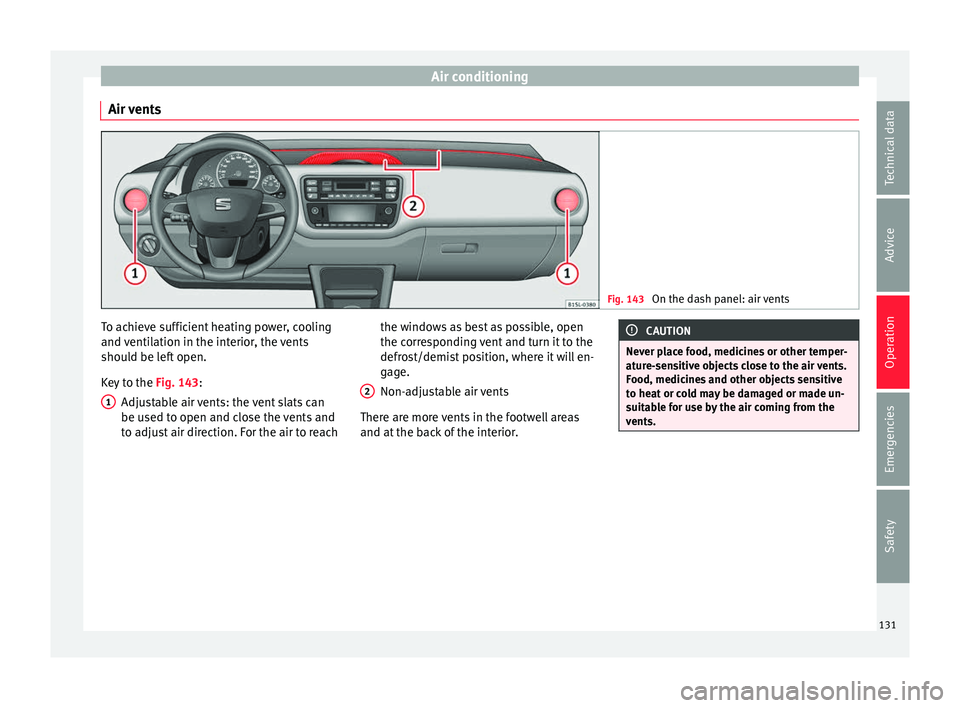
Air vents Fig. 143
On the dash panel: air vents To achieve sufficient heating power, cooling
and
v
enti
lation in the interior, the vents
should be left open.
Key to the Fig. 143:
Adjustable air vents: the vent slats can
be used to open and close the vents and
to adjust air direction. For the air to reach
1 the windows as best as possible, open
the c
orr
e
sponding vent and turn it to the
defrost/demist position, where it will en-
gage.
Non-adjustable air vents
There are more vents in the footwell areas
and at the back of the interior. 2 CAUTION
Never place food, medicines or other temper-
atur e-
sensitive objects close to the air vents.
Food, medicines and other objects sensitive
to heat or cold may be damaged or made un-
suitable for use by the air coming from the
vents. 131
Technical data
Advice
Operation
Emergencies
Safety
Page 134 of 232
Operation
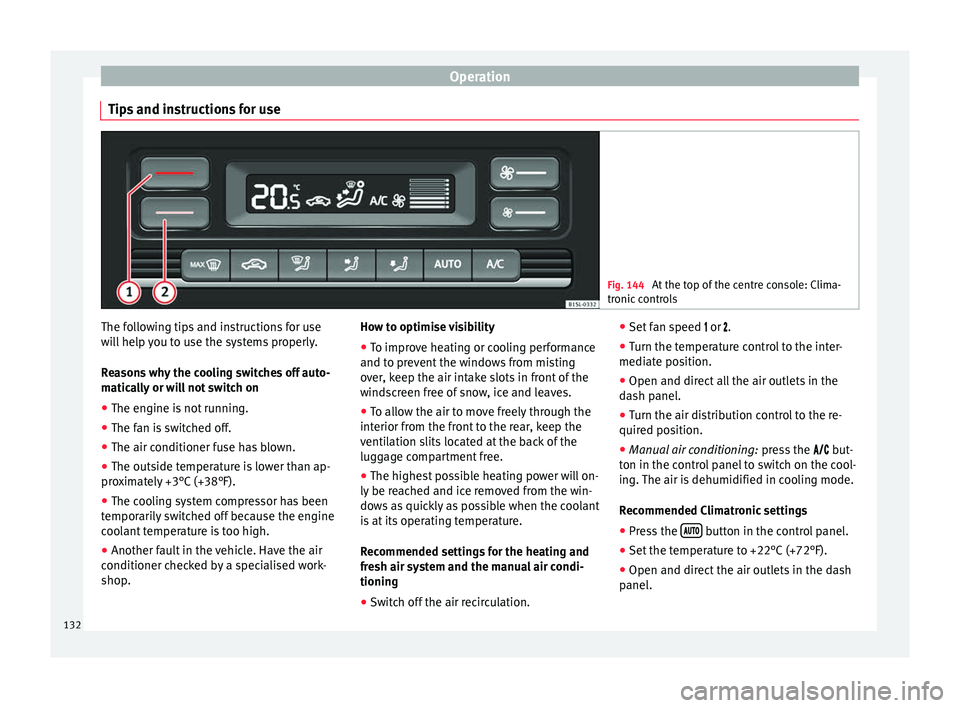
Tips and instructions for use Fig. 144
At the top of the centre console: Clima-
tronic c
ontrols The following tips and instructions for use
w
i
l
l help you to use the systems properly.
Reasons why the cooling switches off auto-
matically or will not switch on
● The engine is not running.
● The fan is switched off.
● The air conditioner fuse has blown.
● The outside temperature is lower than ap-
prox
imately +3°C (+38°F).
● The cooling system compressor has been
temporari
ly switched off because the engine
coolant temperature is too high.
● Another fault in the vehicle. Have the air
conditioner chec
ked by a specialised work-
shop. How to optimise visibility
●
To improve heating or cooling performance
and to prev
ent the windows from misting
over, keep the air intake slots in front of the
windscreen free of snow, ice and leaves.
● To allow the air to move freely through the
interior from the fr
ont to the rear, keep the
ventilation slits located at the back of the
luggage compartment free.
● The highest possible heating power will on-
ly be re
ached and ice removed from the win-
dows as quickly as possible when the coolant
is at its operating temperature.
Recommended settings for the heating and
fresh air system and the manual air condi-
tioning
● Switch off the air recirculation. ●
Set fan s
peed or .
● Turn the temperature control to the inter-
mediate po
sition.
● Open and direct all the air outlets in the
dash p
anel.
● Turn the air distribution control to the re-
quired pos
ition.
● Manual air conditioning: pres
s the but-
ton in the control panel to switch on the cool-
ing. The air is dehumidified in cooling mode.
Recommended Climatronic settings
● Press the button in the control panel.
● Set the temperature to +22°C (+72°F).
● Open and direct the air outlets in the dash
p anel
.
132
Page 135 of 232
Driving
Maximum cooling power or heating power in
the c a
se of
Climatronic
When driving, the maximum cooling power or
heating power can be adjusted by pressing
the 1 or
2
› ››
Fig. 144
b
utton repeatedly.
The temperature is not regulated.
● Maximum cooling power: adjus
t the tem-
perature below +16°C (+60°F). The display
then shows LO.
● Maximum heating power: adjus
t the tem-
perature above +29°C (+84°F). The display
then shows HI.
Dust and pollen filter
The dust and pollen filter should be changed
regularly in order to maintain air conditioner
performance.
If the vehicle is used frequently in areas
where the outside air is highly polluted, it
may be necessary to change the filter before
the next scheduled service.
Water under the vehicle
If the humidity and temperature outside the
vehicle are high, condensation can drip off
the evaporator in the cooling system and
form a small pool underneath the vehicle.
This is normal and does not indicate a leak! Driving
St op
pin
g and starting the en-
gine
Switching on the ignition and starting
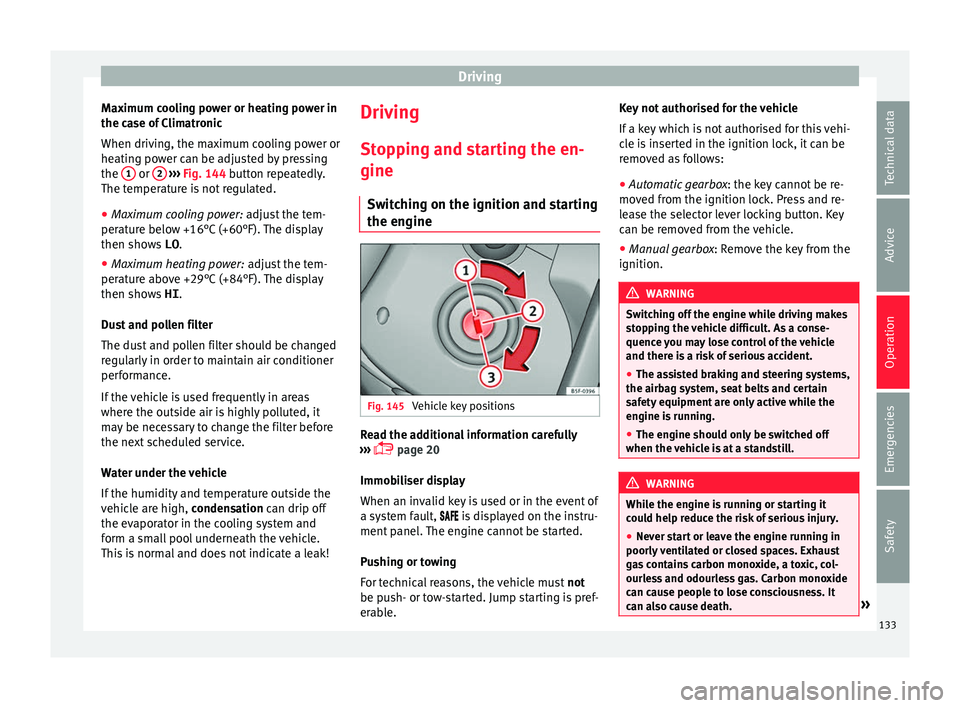
the engine Fig. 145
Vehicle key positions Read the additional information carefully
› ›
›
page 20
Immobiliser display
When an invalid key is used or in the event of
a system fault, is displayed on the instru-
ment panel. The engine cannot be started.
Pushing or towing
For technical reasons, the vehicle must not
be push- or tow-started. Jump starting is pref-
erable. Key not authorised for the vehicle
If a key
which is not authorised for this vehi-
cle is inserted in the ignition lock, it can be
removed as follows:
● Automatic gearbox : the key c
annot be re-
moved from the ignition lock. Press and re-
lease the selector lever locking button. Key
can be removed from the vehicle.
● Manual gearbox: Remov
e the key from the
ignition. WARNING
Switching off the engine while driving makes
st op
ping the vehicle difficult. As a conse-
quence you may lose control of the vehicle
and there is a risk of serious accident.
● The assisted braking and steering systems,
the airbag sys
tem, seat belts and certain
safety equipment are only active while the
engine is running.
● The engine should only be switched off
when the vehic
le is at a standstill. WARNING
While the engine is running or starting it
cou l
d help reduce the risk of serious injury.
● Never start or leave the engine running in
poorly v
entilated or closed spaces. Exhaust
gas contains carbon monoxide, a toxic, col-
ourless and odourless gas. Carbon monoxide
can cause people to lose consciousness. It
can also cause death. » 133
Technical data
Advice
Operation
Emergencies
Safety
Page 140 of 232
Operation
road before ESC* can intervene then the sys-
t em c
annot
provide assistance.
The ABS, BAS, ASR and EDL systems are in-
corporated into the ESC*. The ESC* is always
on 1)
.
Anti-lock system (ABS)
ABS can prevent the wheels from locking dur- ing braking until just before the vehicle stops
thus helping the driver to steer the vehicle
and maintain control. This means that, even
during full braking, the risk of skidding is re-
duced:
● Press and hold the brake pedal fully. Do not
remov
e your foot from the brake pedal or re-
duce braking force!
● Do not “pump” the brake pedal, or reduce
brakin
g force!
● Maintain vehicle direction when braking
ful
ly.
● When the brake pedal is released or when
the brake f
orce is reduced, ABS is turned off.
ABS control can be observed by vibration of
the brake pedal and noise. You should never
expect the ABS to reduce the braking dis-
tance under any circumstances. This distance
will increase when driving on gravel, recent
snow or on icy or slippery ground. Brake assist system (BAS)
The brake a
ssist system may reduce the re-
quired braking distance. The brake assist
system boosts the braking force if you press
the brake pedal quickly in an emergency. As
a result, the braking pressure increases rap-
idly, the braking force is multiplied and the
braking distance is reduced. This enables the
ABS to be activated more quickly and effec-
tively.
¡Do not lift your foot off the brake pedal!
When the brake pedal is released or when
the brake force is reduced, braking assist au-
tomatically turns off the brake servo.
Traction control system (ASR) or Traction
Control (TC)*
In the event of wheelspin, the traction control
system ASR or TC reduces the engine torque
to match the amount of grip available. The
ASR or TC makes some situations easier, for
example, when starting, accelerating or go-
ing uphill, even in unfavourable road condi-
tions.
Electronic differential lock (EDS)
EDL is available when driving in straight lines
under normal conditions. When the EDL de-
tects wheelspin, it brakes the spinning wheel
and directs the power to the other one. To prevent the disc brake of the braked wheel
from ov
erheating, the EDL cuts out automati-
cally if subjected to excessive loads. The EDL
will switch on again automatically when the
brake has cooled down. WARNING
Driving at high speed on icy, slippery or wet
grou nd c
an result in loss of vehicle control
and serious injury to the driver and passen-
gers.
● Adjust your speed and driving style to visi-
bility
, road, traffic and weather conditions.
Even though the brake assist systems, ABS,
BAS, EDL, ASR and ESC* provide more securi-
ty, do not take unnecessary risks while driv-
ing.
● Brake assist systems can not overcome the
law
s of physics. Even with ESC* and other
systems, slippery and wet roads will always
be dangerous.
● Driving to quickly on wet ground can result
in the wheels lo
sing contact with the ground
in an effect known as “aquaplaning”. Without
adherence, it is impossible to brake, steer or
control the vehicle.
● Brake assist systems cannot avoid acci-
dents if
, for example, the driver does not re-
spect safety distances or drives to quickly in
difficult conditions. 1)
Depending on the version.
138
Page 148 of 232

Operation
●
Alw a
ys adapt your driving style to suit the
flow of traffic.
● Only use the kick-down function or rapid
accel
eration if visibility, weather, road and
traffic conditions so permit.
● Never put other road users in danger by ac-
celer
ating or with your driving style. CAUTION
If you stop on a hill with a gear range engag-
ed, do not try
to prevent the vehicle from roll-
ing back by pressing on the accelerator. Oth-
erwise, the automatic gearbox may overheat
causing damage. Automatic gearbox malfunction
Back-up programme
When aut
om
atic
gearbox warning and indica-
tion lamps light up on the instrument panel,
there may be a system malfunction
››› page 142. In the event of some faults the
automatic gearbox functions using a backup
programme. When the programme is activa-
ted, it is possible to drive the vehicle, howev-
er, at low speeds and within a selected range
of gears.
With the manual gearbox, in some cases it is
not possible to drive with all the gears .
In all cases the automatic gearbox must be
checked at a specialised workshop. Automatic gearbox overheating
The automatic
gearbox can overheat with a
prolonged start up, or when stopping and
starting continuously. This overheating is dis-
played with a warning lamp in the instru-
ment panel. Additionally, an audible warning
can be heard. Stop and let the gearbox cool
››› .
The v
ehic
le moves forward or back despite
having selected a gear range
When the vehicle does not move in the re-
quired direction, the system may not have
the gear range correctly engaged. Press the
brake pedal and engage the gear range
again. If the vehicle still does not move in the
required direction, there is a system malfunc-
tion. Seek specialist assistance and have the
system checked. CAUTION
● When the ge arbo
x is displayed as overheat-
ing for the first time, the vehicle must be
parked safely or must be driven at a speed of
more than 20 km/h (12 mph).
● When the warning lamp lights up and the
audible w
arning is heard, the vehicle must be
parked safely and the engine switched off.
Let the gearbox cool down.
● To prevent damage to the gearbox, driving
must
only be continued when the warning
lamps are no longer lit up. While the gearbox is overheated, starting up and driving, even
at a s
lo
w speed should be avoided. Recommended gear display
In some vehicles, the recommended gear for
reduc
in
g fuel consumption is displayed on
the instrument panel:
DisplayMeaning
Optimum gear.
Recommendation to change up a gear.
Recommendation to change down a
gear.
WARNING
The recommended gear display is intended as
a guideline only; it shou
ld never replace the
driver's attention to driving carefully.
● Responsibility for selecting the correct gear
for eac
h situation continues to lie with the
driver, for example when overtaking or climb-
ing a hill. For the sake of the environment
Selecting the most appropriate gear for the
sit uation w
ill help you to save fuel.146
Page 152 of 232
Operation
ahead as you drive and keep a safe distance
fr om the
v
ehicle in front, it is possible to slow
down by simply lifting your foot off the accel-
erator. This eliminates the need for constant
braking and acceleration.
Calm and steady driving
Constancy is more important than speed: The
more you drive at a constant speed, the lower
the fuel consumption.
When driving on the motorway, it is more effi-
cient to drive at a constant and more moder-
ate speed than to be continuously accelerat-
ing and braking. As a general rule, you will
reach your destination just as quickly when
you drive at a constant speed.
The cruise control function helps you to ach-
ieve a constant style of driving.
Moderate use of additional devices
It is important to travel in comfort, but con-
venience systems should be used ecological-
ly.
Some equipment, when connected, increase
fuel consumption considerably, for example:
● Air conditioning cooling system: If the air
conditioning sy
stem is required to cool to
significantly lower temperatures than the true
outside temperature, it will require a large
amount of energy from the engine. Therefore,
we recommend that the selected temperature for the vehicle is not too different to the out-
side temper
ature. It is a good idea to air the
vehicle before starting your journey and to
drive a short distance with the windows
open. Then you can close the windows and
switch on the air conditioning. Keep windows
closed when travelling at high speeds. Driv-
ing with the windows open increases fuel
consumption.
● Switch off the seat heating when the seats
have w
armed up.
● Switch off the heated rear window when it
is not
moist or covered in ice.
Avoid short journeys
Fuel consumption is much higher when the
engine is cold, immediately after it has been
started. It takes a few kilometres of driving
for the engine to warm up and to normalise
consumption.
The engine and catalytic converter need to
reach their proper working temperature in or-
der to minimise fuel consumption and emis-
sions. The ambient temperature has a deci-
sive influence.
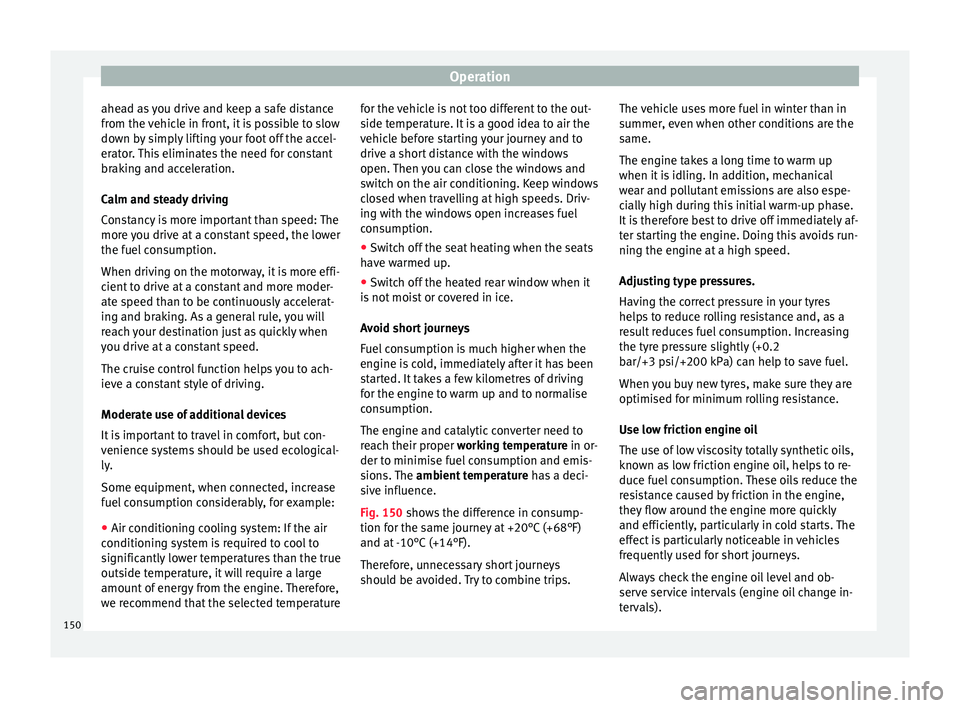
Fig. 150 shows the difference in consump-
tion for the same journey at +20°C (+68°F)
and at -10°C (+14°F).
Therefore, unnecessary short journeys
should be avoided. Try to combine trips. The vehicle uses more fuel in winter than in
summer, ev
en when other conditions are the
same.
The engine takes a long time to warm up
when it is idling. In addition, mechanical
wear and pollutant emissions are also espe-
cially high during this initial warm-up phase.
It is therefore best to drive off immediately af-
ter starting the engine. Doing this avoids run-
ning the engine at a high speed.
Adjusting type pressures.
Having the correct pressure in your tyres
helps to reduce rolling resistance and, as a
result reduces fuel consumption. Increasing
the tyre pressure slightly (+0.2
bar/+3 psi/+200 kPa) can help to save fuel.
When you buy new tyres, make sure they are
optimised for minimum rolling resistance.
Use low friction engine oil
The use of low viscosity totally synthetic oils,
known as low friction engine oil, helps to re-
duce fuel consumption. These oils reduce the
resistance caused by friction in the engine,
they flow around the engine more quickly
and efficiently, particularly in cold starts. The
effect is particularly noticeable in vehicles
frequently used for short journeys.
Always check the engine oil level and ob-
serve service intervals (engine oil change in-
tervals).
150
Page 154 of 232
Operation
Catalytic converter The catalytic converter permits the subse-
quent tr
e
atment of the exhaust gases thus
reducing contaminating gas emissions. To
ensure a longer working life for the exhaust
system and catalytic converter in a petrol en-
gine:
● Always use unleaded petrol.
● Never run the fuel tank completely dry.
● Do not top up with too much engine oil
›››
page 189.
● Do not tow-start the vehicle; use the starter
cab l
es ›››
page 43.
If you should notice misfiring, uneven run-
ning or loss of power when the car is moving,
reduce speed immediately. Have the car in-
spected by a specialised workshop. If this
happens, unburnt fuel can enter the exhaust
system and escape into the atmosphere. The
catalytic converter can also be damaged by
overheating. For the sake of the environment
Even when the emission control system is
work in
g perfectly, there may be a smell of
sulphur under certain conditions. This de-
pends on the sulphur content of the fuel
used. Driving tips
Driv in
g abr
oad In some countries, certain safety regulations
and requir
ements
are in force relating to ex-
haust gas emissions, which differ from the
technical characteristics of the vehicle. Be-
fore travelling abroad, SEAT recommends you
consult a technical service about the legal re-
quirements and the following points:
● Does the vehicle need technical modifica-
tions f
or driving abroad, for example, adjust-
ment of the headlamps?
● Does the vehicle have all the tools, diag-
nostic
s equipment and spare parts required
for inspections and repairs?
● Are there any SEAT dealers in the destina-
tion countr
y?
● For petrol vehicles: Is unleaded petrol avail-
able at
the right octane rating?
● For diesel engines: is diesel fuel available
with a low s
ulphur content?
● Are a suitable engine oil ( ›››
page 189) and
other engine fluids complying with SEAT
specifications available in the destination
country?
● Are special tyres required in the destination
countr
y? CAUTION
SEAT does not accept liability for any damage
to the v
ehicle due to the use of a lower quali-
ty fuel, an inadequate service or the non-
availability of genuine spare parts. Driving through flooded roadways
To prevent damage to the vehicle when driv-
ing thr
ough w
ater, for example, along a floo-
ded road, please observe the following:
● Check the depth of the water before enter-
ing the flooded z
one. The water should never
come above the lower edge of the bodywork
››› .
● Do not drive faster than a pedestrian.
● Do not stop in the water, use reverse gear
or sw it
c
h off the engine.
● Oncoming traffic will cause waves which
raise the l
evel of the water, making it difficult
to cross the water.
● Disconnect the Start-Stop system whenever
cro
ssing water. WARNING
When driving through water, mud, melted
sno w
, etc., please remember that due to
damp or frozen brake discs and shoes in win-
ter, the braking effect may be delayed, there-
fore the required braking distance is greater. 152