fuel Seat Mii 2017 Service Manual
[x] Cancel search | Manufacturer: SEAT, Model Year: 2017, Model line: Mii, Model: Seat Mii 2017Pages: 232, PDF Size: 4.91 MB
Page 203 of 232
Wheels and tyres
The service life of tyres is dependent on tyre
pr e
s
sure, driving style, the care they receive
and the correct fitting.
The tyres and wheel rims are an essential
part of the vehicle's design. The tyres and
rims approved by SEAT are specially matched
to the characteristics of the vehicle and our
critical to good road holding and safe han-
dling.
Avoiding damage to tyres and wheels
● If you have to drive over a kerb or similar
obs
tacle, drive very slowly and as near as
possible at a right angle to the kerb.
● Inspect the tyres regularly for damage
(punct
ures, cuts, cracks, dents).
● Remove any foreign bodies found on the
outside of the ty
re tread and ensure that they
have not passed through the wall of the tyre
››› page 205.
● In addition, the instructions for tyre control
syst
ems should always be observed.
● Replace damaged or worn tyres as soon as
poss
ible ››› page 205.
● Regularly check tyres for non-visible dam-
age ››
› page 205.
● Never exceed the maximum permitted
speed or loa
ds specified for the type of tyre
fitted on your vehicle ››› page 208.
● Do not allow tyres (including the spare
wheel) to come int
o contact with aggressive substances, grease, oil, fuel or brake fluid
›››
.
● Lost valve caps should be replaced imme-
di at
ely
.
Tyres with directional tread pattern
Tyres with directional tread pattern have
been designed to operate best when rotating
in only one direction. An arrow on the tyre
sidewall indicates the direction of rotation on
tyres with directional tread ››› page 208. Al-
ways observe the direction of rotation indica-
ted when mounting the wheel. This guaran-
tees optimum grip and helps to avoid aqua-
planing, excessive noise and wear.
If the tyre is mounted in the opposite direc-
tion of rotation, drive with extreme caution,
as the tyre is no longer being used correctly.
This is of particular importance when the
road surface is wet. Change the tyre as soon
as possible or remount it with the correct di-
rection of rotation.
Interchanging tyres
To ensure that the wear is equal on all tyres
the wheels should be changed round from
time to time according to the system
››› Fig. 173. The useful life of all the tyres will
then be about the same time.
SEAT recommends you take the vehicle to a
specialised workshop to have the tyres
changed. Tyres over 6 years old
Tyr
es are subject to an ageing process as a
result of physical and chemical processes.
This may affect their performance. Tyres
which are stored for long periods of time
without being used, harden and become
more fragile than tyres which are in constant
use.
SEAT recommends that tyres over six years
old are replaced with new tyres. This also ap-
plies to tyres (including the spare wheel)
which appear to be in perfect condition on
the outside and which have a tread depth
within the values stipulated by the Law ››› .
The d at
e of
manufacture, part of the tyre
identification number (TIN), indicates the age
of the tyre ( ) ››› page 208.
Storing tyres
Mark tyres when you remove them to indicate
the direction of rotation (left, right, forwards,
backwards). This ensures you will be able to
mount them correctly when you replace
them. When removed, the wheels and/or
tyres should be stored in a cool, dry and pref-
erably dark location. Do not place tyres
mounted on the wheel in a vertical position.
Protect tyres not mounted on wheels from
dirt by storing them in suitable bags and
standing them on the ground on their tread. »
201
Technical data
Advice
Operation
Emergencies
Safety
Page 204 of 232
Advice
WARNING
Aggressive fluids or substances could result
in v i
sible or invisible damage with the conse-
quent risks.
● Always ensure that tyres do not come into
contact
with chemical products, oil, grease,
fuel, brake fluid or other aggressive substan-
ces. WARNING
Old tyres, even if they have never been used,
ma y
lose air or burst unexpectedly while driv-
ing, resulting in serious accident or damage.
● If tyres are over six years old, they should
only be u
sed in an emergency and with ex-
treme caution. For the sake of the environment
Old tyres must be disposed of by qualified
personnel ac
cording to the laws in the coun-
try concerned. Wheels
The design of wheel bolts is matched to the
rims. If
diff
er
ent rims are fitted, the correct
wheel bolts with the right length and correct-
ly shaped bolt heads must be used. This en-
sures that wheels are fitted securely and that
the brake system functions correctly
››› page 72. For technical reasons, it is not generally pos-
sibl
e to use the wheels from other vehicles.
In some cases, this may also be true for the
same model of wheel.
The tyres and rims approved by SEAT are spe-
cially matched to the characteristics of the
vehicle and are critical to good road holding
and safe handling.
Wheel bolts
Wheel bolts must be tightened to the correct
torque ››› page 72.
Beadlock wheel rims
Beadlock wheel rims have various compo-
nents. These are joined together by special
bolts using a special procedure. This ensures
good performance, a better seal, improved
safety and wheel run out. Therefore, worn
rims should always be replaced and must on-
ly be repaired in a specialised workshop.
SEAT recommends visiting a technical service
››› .
Wheel rims
w
ith bolted trims
Wheel rims may be fitted with interchangea-
ble trim parts which are attached to the rim
using self-locking bolts. Worn trims should
only be replaced at a specialised workshop.
SEAT recommends visiting a technical service
››› . WARNING
The use of worn or damaged wheel rims could
mak e driv
ing more dangerous and result in
serious accidents and damage.
● Only wheel rims which have been approved
for use w
ith your vehicle should be used.
● Inspect wheel rims regularly for damage
and repl
ace as required. WARNING
If the bolted joints of wheel rims with bolted
ring trims ar
e not correctly tightened or loos-
ened, this could result in serious accident.
● Never loosen the bolted joints of wheel
rims with bo
lted ring trims.
● Any work relating to wheel rims with bolted
rims shoul
d be carried out at specialised
workshop. SEAT recommends taking your car
in for technical service. Note
A SEAT Service Centre should be consulted to
find out whether wheel s
or tyres of different
sizes to those originally fitted by SEAT can be
fitted, and to find out about the combinations
allowed between the front axle (axle 1) and
the rear axle (axle 2). 202
Page 206 of 232
Advice
››› Fig. 174 i s
loc ated on the driver's door pil-
lar.
Under-inflation or over-inflation will reduce
the life of the tyres considerably and also im-
pair the car's handling ››› . It is essential to
m aint
ain the c
orrect tyre pressures, especial-
ly if driving at high speeds. Incorrect tyre
pressure causes premature wear and could
cause tyre blow-out.
The pressure should therefore be checked at
least once a month and before starting a
journey.
As a general rule, the pressures given are for
cold tyres. When the tyres are hot, the pres-
sures are greater.
Never deflate a hot tyre in order to obtain the
required pressure. This could result in very
low tyre pressures which may lead to sudden
blow-outs.
Tyre pressure monitoring system
Check tyre pressures only when the vehicle
has not been driven for more than a few kilo-
metres at low speeds in the past three hours.
● The tyre pressures should be checked regu-
larly, and on
ly when the tyres are cold. Al-
ways check all tyres, including the spare
wheel. Tyre pressures should be checked
more often in colder regions, and only when
the vehicle has not been driven recently. Al-
ways use a correctly-operating tyre gauge. ●
Adjust
tyre pressures to the loads carried in
the vehicle.
● After adjusting the tyre pressure, check that
the caps
are properly screwed on.
The spare wheel or temporary spare wheel
must always be kept at the maximum pres-
sure stipulated. WARNING
If tyre pressures are too high or too low, the
tyr e m
ay deflate or burst suddenly while driv-
ing. This could result in a serious accident.
● If the tyre pressure is too low, they could
overhe
at, resulting in tread detachment or
even burst tyres.
● When driving at high speeds and/or fully
loaded, the ty
re could suddenly overheat,
burst or be subject to tread detachment, with
the resultant loss of control of the vehicle.
● Tyre pressures which are too high or too
low reduc
e the service life of the tyre, affect-
ing the vehicle's performance.
● Tyre pressures should be checked regularly,
at le
ast once a month and before long jour-
neys.
● Adjust the pressures of all the tyres to the
vehicl
e load.
● Never deflate excess pressure from hot
tyre
s. CAUTION
● Tak e c
are not to tilt the manometer when
placing it on the valve. Otherwise, the valve
may be damaged.
● If tyre valves are not protected by caps, or if
the caps
are not screwed on correctly, they
may become damaged. Check that the caps
are identical to the standard caps and have
been correctly tightened. For the sake of the environment
Under-inflated tyres will increase fuel con-
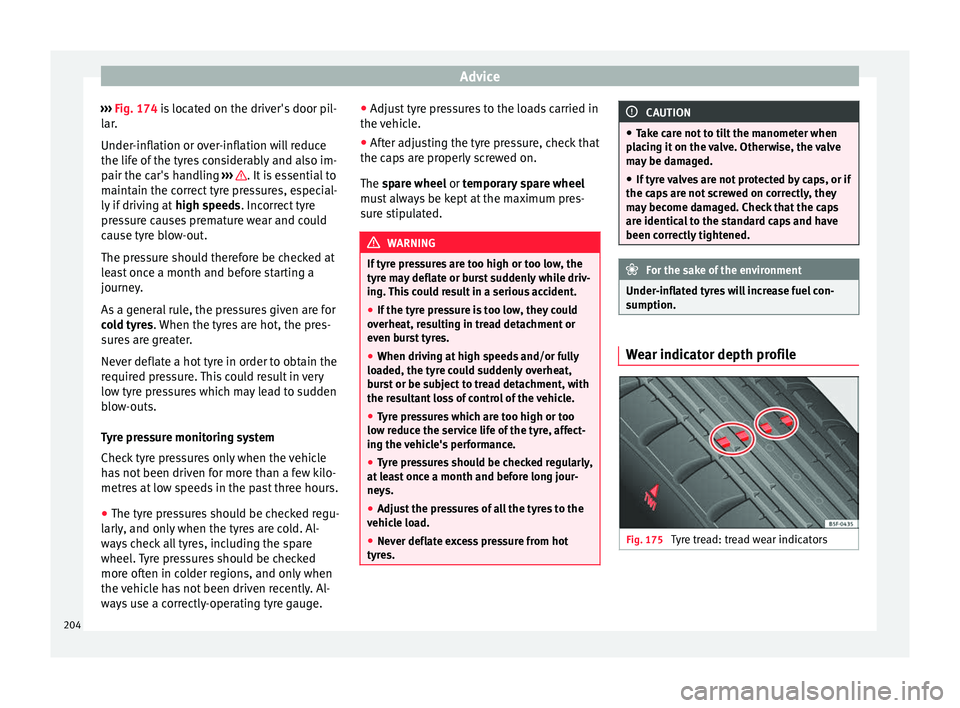
sumption. Wear indicator depth profile
Fig. 175
Tyre tread: tread wear indicators204
Page 208 of 232
Advice
tyres wear too quickly, have the wheel align-
ment c
hec
ked at a specialised workshop. WARNING
If you notice unusual vibration or the car pulls
to one s ide whi
le driving, this may indicate
that one of the tyres is damaged.
● Reduce speed immediately and stop, while
obser
ving the highway code.
● Check the wheels and tyres for damage.
● Never carry on driving on worn tyres or
wheels. Reque
st qualified assistance immedi-
ately.
● If there is no visible exterior damage, drive
slowly
and carefully to the nearest special-
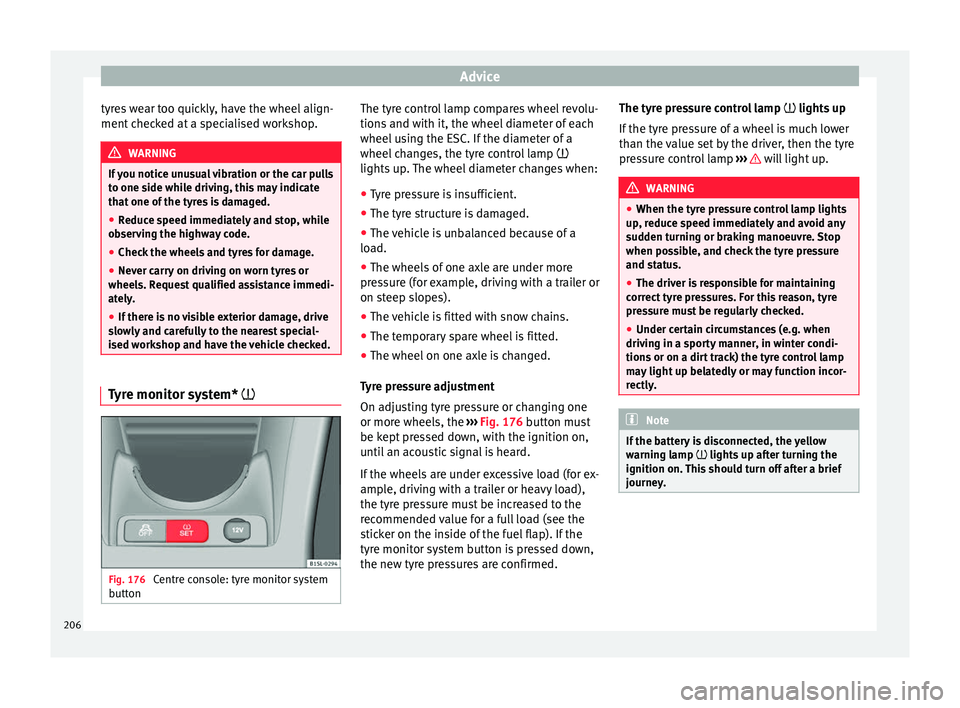
ised workshop and have the vehicle checked. Tyre monitor system*
Fig. 176
Centre console: tyre monitor system
b utt
on The tyre control lamp compares wheel revolu-
tion
s
and w
ith it, the wheel diameter of each
wheel using the ESC. If the diameter of a
wheel changes, the tyre control lamp
lights up. The wheel diameter changes when:
● Tyre pressure is insufficient.
● The tyre structure is damaged.
● The vehicle is unbalanced because of a
load.
● The wheel
s of one axle are under more
pres
sure (for example, driving with a trailer or
on steep slopes).
● The vehicle is fitted with snow chains.
● The temporary spare wheel is fitted.
● The wheel on one axle is changed.
Tyr
e pressure adjustment
On adjusting tyre pressure or changing one
or more wheels, the ››› Fig. 176 button must
be kept pressed down, with the ignition on,
until an acoustic signal is heard.
If the wheels are under excessive load (for ex-
ample, driving with a trailer or heavy load),
the tyre pressure must be increased to the
recommended value for a full load (see the
sticker on the inside of the fuel flap). If the
tyre monitor system button is pressed down,
the new tyre pressures are confirmed. The tyre pressure control lamp
lights up
If
the tyre pressure of a wheel is much lower
than the value set by the driver, then the tyre
pressure control lamp ››› will light up.
WARNING
● When the tyr e pr
essure control lamp lights
up, reduce speed immediately and avoid any
sudden turning or braking manoeuvre. Stop
when possible, and check the tyre pressure
and status.
● The driver is responsible for maintaining
correct
tyre pressures. For this reason, tyre
pressure must be regularly checked.
● Under certain circumstances (e.g. when
driving in a s
porty manner, in winter condi-
tions or on a dirt track) the tyre control lamp
may light up belatedly or may function incor-
rectly. Note
If the battery is disconnected, the yellow
warnin g l
amp lights up after turning the
ignition on. This should turn off after a brief
journey. 206
Page 214 of 232
Technical data
Engine and gearbox code, paint number,
int erior equipment
.
Option
al extras, PR numbers.
These data are also provided in the Mainte-
nance Programme.
Specific vehicle weight information The instructions in the official vehicle docu-
ments t
ak
e precedence. All the technical data
provided in this documentation is applicable
to the basic model. The vehicle data label in
the Maintenance Programme or the vehicle
documentation shows which engine is instal-
led in your vehicle.
The figures may be different depending
whether additional equipment is fitted, for
different models and for special vehicles.
Kerb weight values shown in the following ta-
ble apply to a vehicle with driver (75 kg), liq-
uids including a fuel tank 90% full, in addi-
tion to tools and a spare wheel ››› . The
k erb w
eight
indicated increases with optional
equipment and retrofitting of accessories,
while proportionally reducing carrying ca-
pacity.
The load is equivalent to the following
weights:
● Passengers.
● Total equipment.
3 4 ●
Roof
lo
ad, included in the carrier. WARNING
Exceeding the maximum authorised weight
and the loa d on the ax
les could cause dam-
age to the vehicle, accidents and serious in-
juries.
● The real load on the axles should never ex-
ceed the max
imum permitted.
● The load and its distribution in the vehicle
have eff
ects on the vehicle handling and the
braking ability. Always drive at a suitable
speed. CAUTION
Distribute the load as uniformly and as low
down on the v
ehicle as possible. When trans-
porting heavy objects in the luggage com-
partment, these should be placed as far for-
ward as possible or over the rear axle to have
as little influence on handling as possible. Fuel consumption
Approved consumption values are derived
fr
om me
a
surements performed or supervised
by certified EU laboratories, according to the
legislation in force at the time (for more infor-
mation, see the Publications Office of the Eu-
ropean Union on the EUR-Lex website: © Eu-
ropean Union, http://eur-lex.europa.eu/) and
apply to the specified vehicle characteristics. The values relating to fuel consumption and
CO
2 emis
sions can be found in the documen-
tation provided to the purchaser of the vehi-
cle at the time of purchase.
Fuel consumption and CO 2 emissions depend
on the equipment/features of each individual
vehicle, as well as on the driving style, road
conditions, traffic conditions, environmental
conditions, load or number of passengers. Note
In practice, and considering all the factors
mentioned here, c on
sumption values can dif-
fer from those calculated in the current Euro-
pean regulations. Wheels
Ty
r
e pressure, snow chains and wheel
bolts Tyre pressure
The s
tic
k
er with the tyre pressure values can
be found on the inside of the fuel tank flap.
The tyre pressure values are given for cold
tyres ›››
page 203. The slightly raised pres-
sures of warm tyres must not be reduced.
››› 212
Page 216 of 232

Technical data
Engine data P etr
o
l engine 1.0 44 kW (60 PS) Engine specifications
Power output in kW (PS) at rpmMaximum torque (Nm at rpm)No. of cylinders/displacement (cm
3
)Fuel
44 (60)/5,000-6,00095/3,000-4,3003/999Super 95 ROZ / Normal 91 a)
ROZ
a) Slight power loss.
PerformanceManualEcomotiveStart-Stop
EcomotiveAutomatic
Top speed (km/h)161 (4)161 (4)161 (4)161 (4)
Acceleration from 0-80 km/h (seconds)9.19.110.910.9
Acceleration from 0-100 km/h (seconds)14.414.416.716.7
Weights (in kg)
Gross vehicle weight1,3201,3301,3301,330
Weight in running order (with driver)926934940937
Gross front axle weight680680680680
Gross rear axle weight640640640640
Permitted roof load50505050 214
Page 217 of 232
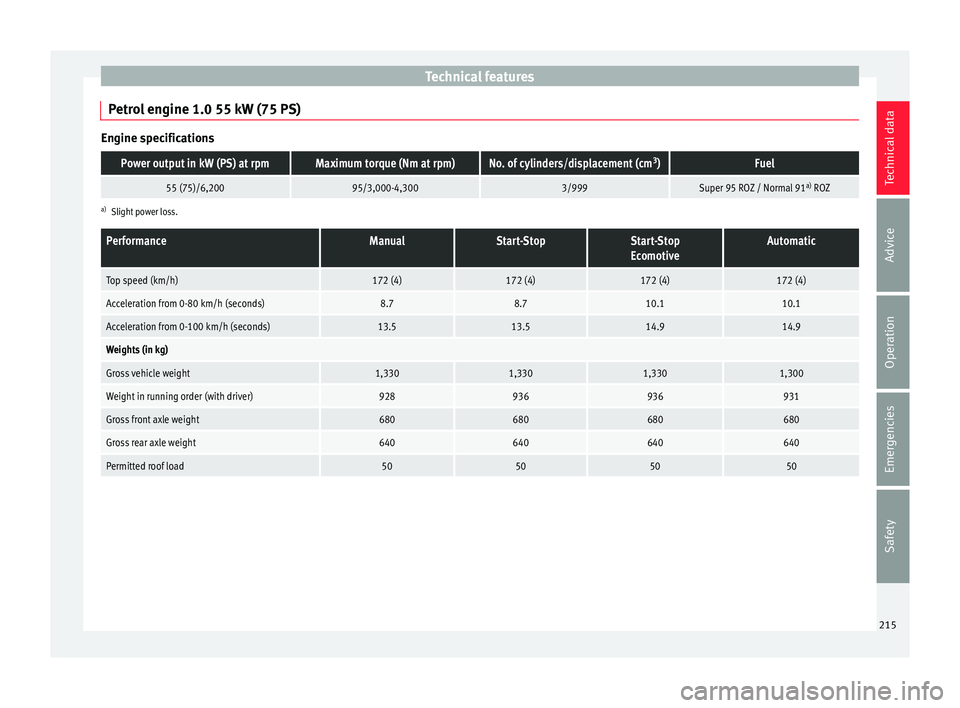
Technical features
Petrol engine 1.0 55 kW (75 PS) Engine specificationsPower output in kW (PS) at rpmMaximum torque (Nm at rpm)No. of cylinders/displacement (cm
3
)Fuel
55 (75)/6,20095/3,000-4,3003/999Super 95 ROZ / Normal 91 a)
ROZ
a) Slight power loss.
PerformanceManualStart-StopStart-Stop
EcomotiveAutomatic
Top speed (km/h)172 (4)172 (4)172 (4)172 (4)
Acceleration from 0-80 km/h (seconds)8.78.710.110.1
Acceleration from 0-100 km/h (seconds)13.513.514.914.9
Weights (in kg)
Gross vehicle weight1,3301,3301,3301,300
Weight in running order (with driver)928936936931
Gross front axle weight680680680680
Gross rear axle weight640640640640
Permitted roof load50505050 215
Technical data
Advice
Operation
Emergencies
Safety
Page 218 of 232
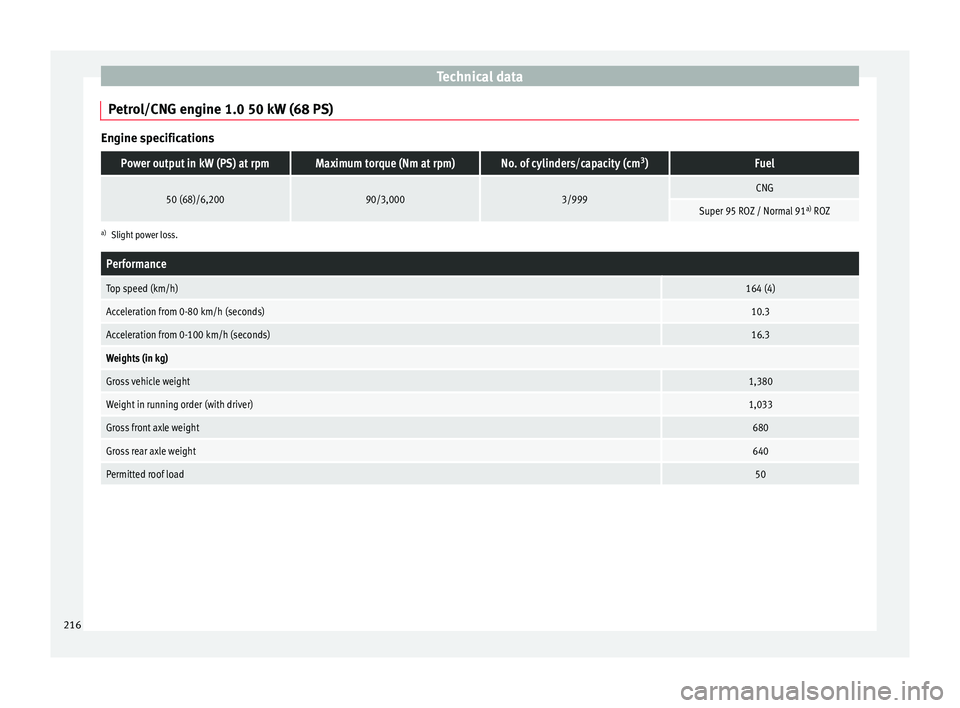
Technical data
Petrol/CNG engine 1.0 50 kW (68 PS) Engine specificationsPower output in kW (PS) at rpmMaximum torque (Nm at rpm)No. of cylinders/capacity (cm
3
)Fuel
50 (68)/6,20090/3,0003/999CNG
Super 95 ROZ / Normal 91 a)
ROZ
a) Slight power loss.
Performance
Top speed (km/h)164 (4)
Acceleration from 0-80 km/h (seconds)10.3
Acceleration from 0-100 km/h (seconds)16.3
Weights (in kg)
Gross vehicle weight1,380
Weight in running order (with driver)1,033
Gross front axle weight680
Gross rear axle weight640
Permitted roof load50 216
Page 223 of 232
Index
Clothes hook . . . . . . . . . . . . . . . . . . . . . . . . . . . . 118
C ode number
. . . . . . . . . . . . . . . . . . . . . . . . . . . . .
71
Coming Home Function . . . . . . . . . . . . . . . . . . . . 105
Compartments . . . . . . . . . . . . . . . . . . . . . . . . . . . 115 centre console . . . . . . . . . . . . . . . . . . . . . . . . . 116
glove compartment . . . . . . . . . . . . . . . . 117, 118
passenger side . . . . . . . . . . . . . . . . . . . . 117, 118
Sunglasses storage compartment . . . . . . . . . . 117
Conformity certification . . . . . . . . . . . . . . . . . . . . 180
Control and warning lamps airbag system . . . . . . . . . . . . . . . . . . . . . . . . . . . 62
brake system . . . . . . . . . . . . . . . . . . . . . . . . . . . 136
catalytic converter . . . . . . . . . . . . . . . . . . . . . . 151
changing gear . . . . . . . . . . . . . . . . . . . . . . . . . . 142
City Safety Assist function . . . . . . . . . . . . . . . . 157
coolant . . . . . . . . . . . . . . . . . . . . . . . . . . . . . . . 192
cruise control . . . . . . . . . . . . . . . . . . . . . . . . . . 155
emission control system . . . . . . . . . . . . . . . . . 151
engine management . . . . . . . . . . . . . . . . . . . . 151
engine oil sensor . . . . . . . . . . . . . . . . . . . . . . . 189
ESC . . . . . . . . . . . . . . . . . . . . . . . . . . . . . . . . . . 136
for the seat belt . . . . . . . . . . . . . . . . . . . . . . . . . 53
fuel level . . . . . . . . . . . . . . . . . . . . . . . . . . . . . . 184
general view . . . . . . . . . . . . . . . . . . . . . . . . . . . . 25
generator . . . . . . . . . . . . . . . . . . . . . . . . . . . . . . 197
hill hold . . . . . . . . . . . . . . . . . . . . . . . . . . . . . . . 160
indication of brake pad wear . . . . . . . . . . . . . . 136
key . . . . . . . . . . . . . . . . . . . . . . . . . . . . . . . . . . . . 93
lights . . . . . . . . . . . . . . . . . . . . . . . . . . . . . . . . . 103
locking the steering column . . . . . . . . . . . . . . 147
on the driver door . . . . . . . . . . . . . . . . . . . . . . . . 98
refuelling . . . . . . . . . . . . . . . . . . . . . . . . . 184, 185
tyres . . . . . . . . . . . . . . . . . . . . . . . . . . . . . . . . . . 206
vehicle battery . . . . . . . . . . . . . . . . . . . . . . . . . 197
Controls for the windows . . . . . . . . . . . . . . . 11, 101
Control units . . . . . . . . . . . . . . . . . . . . . . . . . . . . . 167 reprogramming . . . . . . . . . . . . . . . . . . . . . . . . . 167 Coolant
check ing the level . . . . . . . . . . . . . . . . . . . . . . . 193
control and warning lamps . . . . . . . . . . . . . . . 192
filler neck . . . . . . . . . . . . . . . . . . . . . . . . . . . . . 193
topping up . . . . . . . . . . . . . . . . . . . . . . . . . . . . 193
Cooling system checking the coolant . . . . . . . . . . . . . . . . . . . . 192
topping up with coolant . . . . . . . . . . . . . . . . . . 192
Correct sitting position . . . . . . . . . . . . . . . . . . . . . 48 driver . . . . . . . . . . . . . . . . . . . . . . . . . . . . . . . . . . 48
Cruise control . . . . . . . . . . . . . . . . . . . . . . . . 24, 155 control and warning lamps . . . . . . . . . . . . . . . 155
operation . . . . . . . . . . . . . . . . . . . . . . . . . . . . . . 155
D Dangers in not using the seat belt . . . . . . . . . . . . 55
Dash panel . . . . . . . . . . . . . . . . . . . . . . . . . . . . . . . 87 airbag system . . . . . . . . . . . . . . . . . . . . . . . . . . 178
Data label . . . . . . . . . . . . . . . . . . . . . . . . . . . . . . . 211
Data registry . . . . . . . . . . . . . . . . . . . . . . . . . . . . . 167
Data storage during the journey . . . . . . . . . . . . . 167
Daytime running lights . . . . . . . . . . . . . . . . . . . . 104
De-icing the locks . . . . . . . . . . . . . . . . . . . . . . . . . 175
Diagnostics connector . . . . . . . . . . . . . . . . . . . . . 168
Digital clock . . . . . . . . . . . . . . . . . . . . . . . . . . . . . . 88
Dimensions . . . . . . . . . . . . . . . . . . . . . . . . . . . . . . 217
Direction of rotation tyres . . . . . . . . . . . . . . . . . . . . . . . . . . . . . . . . . . . 41
Disabling the front passenger front airbag . . . . . 15
Display . . . . . . . . . . . . . . . . . . . . . . . . . . . . . . . 88, 89
Disposal belt tension device . . . . . . . . . . . . . . . . . . . . . . . 58
Door cylinder . . . . . . . . . . . . . . . . . . . . . . . . . . . . . . 8
Door lock . . . . . . . . . . . . . . . . . . . . . . . . . . . . . . . . . . 8
Door release lever . . . . . . . . . . . . . . . . . . . . . . . . . . 8 interior . . . . . . . . . . . . . . . . . . . . . . . . . . . . . . . . . 87 Doors . . . . . . . . . . . . . . . . . . . . . . . . . . . . . . . . . . . . 98
chil dproof locks . . . . . . . . . . . . . . . . . . . . . . . . . 99
Emergency closing or opening . . . . . . . . . . . . . . 8
opening and closing . . . . . . . . . . . . . . . . . . . . . . 8
Drink holders . . . . . . . . . . . . . . . . . . . . . . . . . . . . 119 Centre console . . . . . . . . . . . . . . . . . . . . . . . . . 119
Driver see Correct sitting position . . . . . . . . . . . . . . . . 48
Driving automatic gearbox . . . . . . . . . . . . . . . . . . . . . . 145
data storage . . . . . . . . . . . . . . . . . . . . . . . . . . . 167
driving abroad . . . . . . . . . . . . . . . . . . . . . . . . . 152
driving through water . . . . . . . . . . . . . . . . . . . . 152
economical . . . . . . . . . . . . . . . . . . . . . . . . . . . . 149
fuel gauge . . . . . . . . . . . . . . . . . . . . . . . . . . . . . 184
fuel level too low . . . . . . . . . . . . . . . . . . . . . . . 185
parking downhill . . . . . . . . . . . . . . . . . . . . . . . . 140
parking uphill . . . . . . . . . . . . . . . . . . . . . . . . . . 140
safe . . . . . . . . . . . . . . . . . . . . . . . . . . . . . . . . . . . 47
starting on a slope . . . . . . . . . . . . . . . . . . . . . . 145
stopping on a slope . . . . . . . . . . . . . . . . . . . . . 145
through salt water . . . . . . . . . . . . . . . . . . . . . . 153
with a trailer . . . . . . . . . . . . . . . . . . . . . . . . . . . 163
Driving abroad headlights . . . . . . . . . . . . . . . . . . . . . . . . . . . . . 107
Driving in winter fuel consumption . . . . . . . . . . . . . . . . . . . . . . . 150
snow chains . . . . . . . . . . . . . . . . . . . . . . . . . . . . 41
traces of salt . . . . . . . . . . . . . . . . . . . . . . . . . . . 110
tread depth . . . . . . . . . . . . . . . . . . . . . . . . . . . . 205
tyre pressure . . . . . . . . . . . . . . . . . . . . . . . . . . . 204
windscreen washer reservoir . . . . . . . . . . . . . . 173
Driving through water . . . . . . . . . . . . . . . . . . . . . 152
Driving tips For a loaded vehicle . . . . . . . . . . . . . . . . . . . . . 114
Duplicate keys . . . . . . . . . . . . . . . . . . . . . . . . . . . . 92
Dust filter . . . . . . . . . . . . . . . . . . . . . . . . . . . . . . . 133
221
Page 224 of 232
Index
Dynamic headlight range control . . . . . . . . . . . . 107
E E10 se
e
Ethanol (fuel) . . . . . . . . . . . . . . . . . . . . . . . 181
EDL see Electronic differential lock . . . . . . . . . . . . . 137
EDS see Brake assist system . . . . . . . . . . . . . . . . . . 138
Electrical devices . . . . . . . . . . . . . . . . . . . . 120, 121
Electric windows . . . . . . . . . . . . . . . . . . . . . . . . . . . 11 buttons . . . . . . . . . . . . . . . . . . . . . . . . . . . . . . . 101
closing . . . . . . . . . . . . . . . . . . . . . . . . . . . . . . . . 101
opening . . . . . . . . . . . . . . . . . . . . . . . . . . . . . . . 101
see Windows . . . . . . . . . . . . . . . . . . . . . . . . . . . 101
Electronic differential lock . . . . . . . . . . . . . . . . . . 137
Electronic immobiliser . . . . . . . . . . . . . . . . . . . . . 135 operating fault . . . . . . . . . . . . . . . . . . . . . . . . . 133
Electronic Stability Control (ESC) . . . . . . . . . . . . 137
Emergencies . . . . . . . . . . . . . . . . . . . . . . . . . . . . . . 70 bulbs . . . . . . . . . . . . . . . . . . . . . . . . . . . . . . . . . . 35
changing a wheel . . . . . . . . . . . . . . . . . . . . . . . . 36
emergency towing of the vehicle . . . . . . . . . . . . 42
fire extinguishers . . . . . . . . . . . . . . . . . . . . . . . . 70
first aid kit . . . . . . . . . . . . . . . . . . . . . . . . . . . . . . 70
fuses . . . . . . . . . . . . . . . . . . . . . . . . . . . . . . . . . . 34
hazard warning lights . . . . . . . . . . . . . . . . . . . 106
jump leads . . . . . . . . . . . . . . . . . . . . . . . . . . . . . 43
puncture . . . . . . . . . . . . . . . . . . . . . . . . . . . . . . . 35
replacing a blown fuse . . . . . . . . . . . . . . . . . . . . 34
vehicle tool kit . . . . . . . . . . . . . . . . . . . . . . . . . . 70
warning triangle . . . . . . . . . . . . . . . . . . . . . . . . . 70
Emergency closing or opening driver door . . . . . . . . . . . . . . . . . . . . . . . . . . . . . . 8
passenger door . . . . . . . . . . . . . . . . . . . . . . . . . . . 9
Emergency locking and unlocking . . . . . . . . . . . . 77 rear lid . . . . . . . . . . . . . . . . . . . . . . . . . . . . . . . . . 10 Emergency unlocking
rear lid . . . . . . . . . . . . . . . . . . . . . . . . . . . . . . . . . 10
Emission control system control and warning lamps . . . . . . . . . . . . . . . 151
Emissions data . . . . . . . . . . . . . . . . . . . . . . . . . . . 212
Engine assisted starting . . . . . . . . . . . . . . . . . . . . . . . . . 43
noises . . . . . . . . . . . . . . . . . . . . . . . . . . . . . . . . 134
running in . . . . . . . . . . . . . . . . . . . . . . . . . . . . . 148
Start-Stop system . . . . . . . . . . . . . . . . . . . . . . . 160
Engine and ignition . . . . . . . . . . . . . . . . . . . . . . . 133 12 Volt sockets . . . . . . . . . . . . . . . . . . . . . . . . . 121
ignition lock . . . . . . . . . . . . . . . . . . . . . . . . . . . 133
Immobiliser . . . . . . . . . . . . . . . . . . . . . . . . . . . . 135
starting the engine . . . . . . . . . . . . . . . . . . . . . . 133
stopping the engine . . . . . . . . . . . . . . . . . . . . . 134
unauthorised vehicle key . . . . . . . . . . . . . . . . . 133
Engine compartment . . . . . . . . . . . . . . . . . . 10, 187 battery . . . . . . . . . . . . . . . . . . . . . . . . . . . . 33, 196
brake fluid . . . . . . . . . . . . . . . . . . . . . . . . . 33, 194
coolant . . . . . . . . . . . . . . . . . . . . . . . . . . . 32, 192
engine oil . . . . . . . . . . . . . . . . . . . . . . . . . 31, 191
windscreen washer reservoir . . . . . . . . . . 33, 195
Engine coolant . . . . . . . . . . . . . . . . . . . . . . . . . . . . 32 checking the level . . . . . . . . . . . . . . . . . . . . . . . 192
G 12 plus-plus . . . . . . . . . . . . . . . . . . . . . . . . . . 32
G 13 . . . . . . . . . . . . . . . . . . . . . . . . . . . . . . . . . . . 32
specifications . . . . . . . . . . . . . . . . . . . . . . . . . . . 32
temperature display . . . . . . . . . . . . . . . . . . . . . 192
Engine data . . . . . . . . . . . . . . . . . . . . . . . . . . . . . . 214
Engine management . . . . . . . . . . . . . . . . . . . . . . 151 control lamps . . . . . . . . . . . . . . . . . . . . . . . . . . 151
Engine oil . . . . . . . . . . . . . . . . . . . . . . . . . . . 31, 189 changing . . . . . . . . . . . . . . . . . . . . . . . . . . . . . . 189
checking oil level . . . . . . . . . . . . . . . . . . . . . . . 190
consumption . . . . . . . . . . . . . . . . . . . . . . 190, 191
control and warning lamps . . . . . . . . . . . . . . . 189 dipstick . . . . . . . . . . . . . . . . . . . . . . . . . . . . . . . 190
oil pr
operties . . . . . . . . . . . . . . . . . . . . . . . . . . . 32
specifications . . . . . . . . . . . . . . . . . . . . . . . . . . 189
topping up . . . . . . . . . . . . . . . . . . . . . . . . . . . . 191
Environment environmental compatibility . . . . . . . . . . . . . . 148
Environmental ecological driving . . . . . . . . . . . . . . . . . . . . . . . 149
Environmental tips refuelling . . . . . . . . . . . . . . . . . . . . . . . . . . . . . . 185
Equipment . . . . . . . . . . . . . . . . . . . . . . . . . . . . . . 164 safety . . . . . . . . . . . . . . . . . . . . . . . . . . . . . . . . . . 60
ESC electronic stability control . . . . . . . . . . . . . . . . 137
Ethanol (fuel) . . . . . . . . . . . . . . . . . . . . . . . . . . . . 181
Event Data Recorder . . . . . . . . . . . . . . . . . . . . . . . 167
Exhaust gas purification system . . . . . . . . . . . . . 151
Exterior mirrors adjusting . . . . . . . . . . . . . . . . . . . . . . . . . . . . . . . 13
vehicle care . . . . . . . . . . . . . . . . . . . . . . . . . . . . 172
Exterior rear view mirrors control of the function . . . . . . . . . . . . . . . . . . . 111
electric exterior mirrors . . . . . . . . . . . . . . . . . . 111
exterior . . . . . . . . . . . . . . . . . . . . . . . . . . . . . . . 111
Exterior view . . . . . . . . . . . . . . . . . . . . . . . . . . . . . 5, 6
F Fabrics: cleaning . . . . . . . . . . . . . . . . . . . . . . . . . 176
Fastening rings . . . . . . . . . . . . . . . . . . . . . . . . . . . 126
Fault parking distance warning system . . . . . . . . . . 154
Fault memory connector . . . . . . . . . . . . . . . . . . . . . . . . . . . . . 168
reading . . . . . . . . . . . . . . . . . . . . . . . . . . . . . . . 168
Filling the tank . . . . . . . . . . . . . . . . . . . . . . 183, 185
Fire extinguisher . . . . . . . . . . . . . . . . . . . . . . . . . . . 70
222