Adjust time Seat Mii 2017 Owner's manual
[x] Cancel search | Manufacturer: SEAT, Model Year: 2017, Model line: Mii, Model: Seat Mii 2017Pages: 232, PDF Size: 4.91 MB
Page 4 of 232
Frequently Asked Ques-
tion
sBefore driving
How do you adjust the seat?
››› page 12
How do you adjust the steering wheel? ››› page 14
How do you adjust the exterior mirrors? ››› page 13
How do you turn on the exterior lights? ››› page 21
How does the automatic gearbox selector lever work?
››› page 27
How do you refuel? ››› page 31
How do you activate the windscreen wipers and wind-
screen washer system? ››› page 22
Emergency situations
A warning lamp lights up or flashes. What does this
mean? ››› page 25
Where are the first-aid kit and the warning triangle in
the vehicle? ››› page 70
How do you open the bonnet? ››› page 10
How do you perform a jump start? ››› page 43
Where is the vehicle tool kit located? ››› page 70
How do you repair a tyre with the anti-puncture kit?
››› page 35
How do you change a wheel? ››› page 36
How do you change a fuse? ››› page 34
How do you change a light? ››› page 79
How do you tow a vehicle? ››› page 42
Useful tips
How do you set the time? ››› page 89
When should the vehicle inspection should be per-
formed? ››› page 90
How do you remove the luggage compartment cover?
››› page 125
How do you drive in an economical and environmental-
ly-friendly way? ››› page 149
How do you check and top up the engine oil?
››› page 31
How do you check and top up the engine coolant?
››› page 32
How do you top up the windscreen washer fluid?
››› page 33
How do you check and top up the brake fluid?
››› page 33
How do you check and adjust tyre pressure values?
››› page 203
Vehicle washing tips ››› page 171
Functions of interest
How does the START-STOP system work? ››› page 160
What parking assistants are available? ››› page 153
How does tyre pressure monitoring work? ››› page 206
Interior lighting ››› page 22
Page 14 of 232
The essentials
● Con
v
enience position: Turn the switch to
position ››› Fig. 11 2 .
● Closing: Turn the switch to position
› ›
›
Fig. 11 1 .
● To tilt open: Push the switch to position
› ›
›
Fig. 12 4 . For an intermediate position,
ho l
d do
wn the switch until you reach the de-
sired position.
● Lowering: Pull the switch to position
›››
Fig. 12 5 . For an intermediate position,
ho l
d do
wn the switch until you reach the de-
sired position.
››› in Opening and closing the panor-
amic sunroof on page 102
››› page 102 Before driving
M anua
l
ly adjusting the seats Fig. 13
Front left seat controls The front seat head restraints are integrated
in the b
ac
k
rests and adjusting them is not
possible.
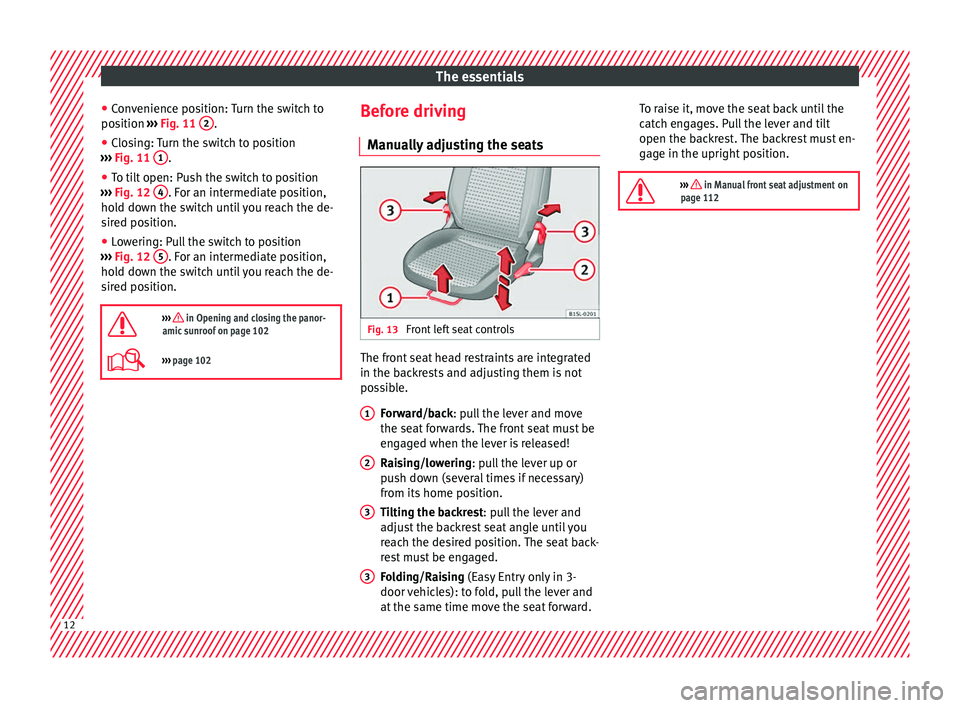
Forward/back: pull the lever and move
the seat forwards. The front seat must be
engaged when the lever is released!
Raising/lowering: pull the lever up or
push down (several times if necessary)
from its home position.
Tilting the backrest: pull the lever and
adjust the backrest seat angle until you
reach the desired position. The seat back-
rest must be engaged.
Folding/Raising (Easy Entry only in 3-
door vehicles): to fold, pull the lever and
at the same time move the seat forward.
1
2
3
3 To raise it, move the seat back until the
c
at
c
h engages. Pull the lever and tilt
open the backrest. The backrest must en-
gage in the upright position.
››› in Manual front seat adjustment on
page 112 12
Page 30 of 232
The essentials
Air conditioning Ho w doe
s
the Climatronic* work? Fig. 37
At the top of the centre console: Clima-
tronic c
ontrols
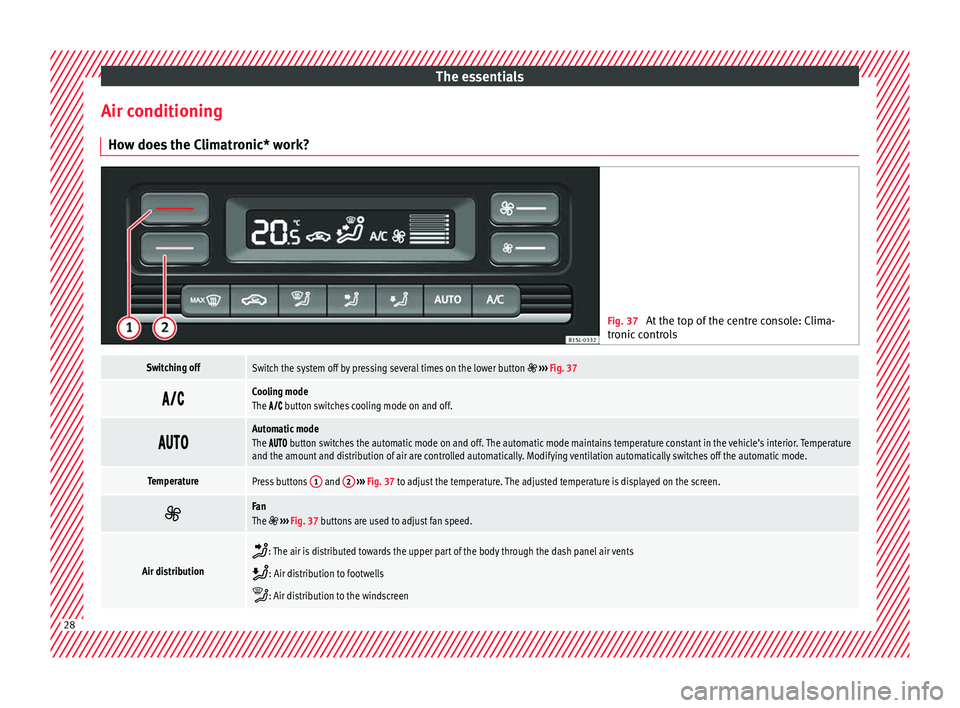
Switching offSwitch the system off by pressing several times on the lower button ››› Fig. 37
Cooling mode
The button switches cooling mode on and off.
Automatic mode
The button switches the automatic mode on and off. The automatic mode maintains temperature constant in the vehicle’s interior. Temperature
and the amount and distribution of air are controlled automatically. Modifying ventilation automatically switches off the automatic mode.
TemperaturePress buttons 1 and 2
››› Fig. 37 to adjust the temperature. The adjusted temperature is displayed on the screen.
Fan
The
››› Fig. 37 buttons are used to adjust fan speed.
Air distribution
: The air is distributed towards the upper part of the body through the dash panel air vents
: Air distribution to footwells
: Air distribution to the windscreen
28
Page 49 of 232
Safe driving
Safety
Saf e driv
in
g
Safety first! WARNING
● This m
anual contains important informa-
tion about the operation of the vehicle, both
for the driver and the passengers. The other
sections of the on-board documentation also
contain further information that you should
be aware of for your own safety and for the
safety of your passengers.
● Ensure that the on-board documentation is
kept in the
vehicle at all times. This is espe-
cially important when lending or selling the
vehicle to another person. WARNING
Driving under the influence of alcohol, drugs,
medication or n ar
cotics may result in severe
accidents and even loss of life.
● Alcohol, drugs, medication and narcotics
may
significantly alter perception, affect re-
action times and safety while driving, which
could result in the loss of control of the vehi-
cle. Driving advice
B ef
or
e driving For your own safety and the safety of your
pa
s
sengers, always note the following points
before every trip:
– Make sure that the vehicle's lights and turn
signal
s are working properly.
– Check tyre pressure.
– Ensure that all windows provide a clear and
good v
iew of the surroundings.
– Make sure all luggage is secured
›› ›
page 114.
– Make sure that no objects can interfere
with the pedal
s.
– Adjust front seat, head restraint and mir-
rors
properly according to your size.
– Ensure that the passengers in the rear
seats alw
ays have the head restraints in
the in-use position ›››
page 51.
– Instruct passengers to adjust the head re-
straints
according to their height.
– Protect children with appropriate child
seats and pr
operly applied seat belts
››› page 64.
– Assume the correct sitting position. Instruct
your pa
ssengers also to assume a proper
sitting position ›››
page 48. –
Fas
ten your seat belt securely. Instruct your
passengers also to fasten their seat belts
properly ››› page 52.
What affects driving safety? As a driver, you are responsible for yourself
and y
our p
assengers. When your concentra-
tion or driving safety is affected by any cir-
cumstance, you endanger yourself as well as
others on the road ››› , for this reason:
– Always pay attention to traffic and do not
g et di
stracted by passengers or telephone
calls.
– Never drive when your driving ability is im-
paired (e.
g. by medication, alcohol, drugs).
– Observe traffic laws and speed limits.
– Always reduce your speed as appropriate
for ro
ad, traffic and weather conditions.
– When travelling long distances, take
break
s regularly - at least every two hours.
– If possible, avoid driving when you are tired
or stre
ssed. WARNING
When driving safety is impaired during a trip,
the risk of
injury and accidents increases. 47
Technical data
Advice
Operation
Emergencies
Safety
Page 51 of 232
Safe driving
● Adju s
t
the height of the driver seat so that
you can easily reach the top of the steering
wheel.
● Keep both feet in the footwell so that you
have the
vehicle under control at all times.
● Adjust and fasten your seat belt correctly
›››
page 52.
Valid for the passenger:
● Adjust the seat backrest to an upright posi-
tion so that
your back rests completely
against it.
● Move the front passenger seat back as far
as po
ssible for optimum protection should
the airbag deploy.
● Always keep your feet in the footwell while
the vehic
le is in motion.
● Adjust and fasten your seat belt correctly
›››
page 52.
Valid for the passengers in the rear section:
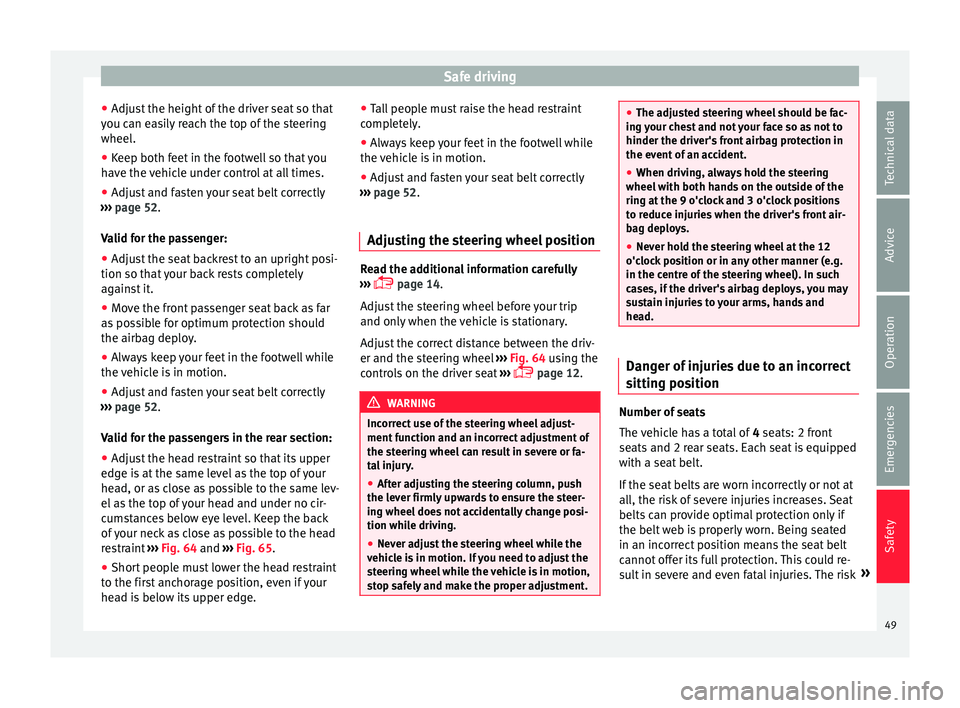
● Adjust the head restraint so that its upper
edge is
at the same level as the top of your
head, or as close as possible to the same lev-
el as the top of your head and under no cir-
cumstances below eye level. Keep the back
of your neck as close as possible to the head
restraint ››› Fig. 64 and ››› Fig. 65.
● Short people must lower the head restraint
to the fir s
t anchorage position, even if your
head is below its upper edge. ●
Tal l
people must raise the head restraint
completely.
● Always keep your feet in the footwell while
the vehic
le is in motion.
● Adjust and fasten your seat belt correctly
›››
page 52.
Adjusting the steering wheel position Read the additional information carefully
›› ›
page 14.
Adjust the steering wheel before your trip
and only when the vehicle is stationary.
Adjust the correct distance between the driv-
er and the steering wheel ››› Fig. 64 using the
controls on the driver seat ›››
page 12. WARNING
Incorrect use of the steering wheel adjust-
ment f u
nction and an incorrect adjustment of
the steering wheel can result in severe or fa-
tal injury.
● After adjusting the steering column, push
the lever firm
ly upwards to ensure the steer-
ing wheel does not accidentally change posi-
tion while driving.
● Never adjust the steering wheel while the
vehicl
e is in motion. If you need to adjust the
steering wheel while the vehicle is in motion,
stop safely and make the proper adjustment. ●
The adju s
ted steering wheel should be fac-
ing your chest and not your face so as not to
hinder the driver's front airbag protection in
the event of an accident.
● When driving, always hold the steering
wheel with both h
ands on the outside of the
ring at the 9 o'clock and 3 o'clock positions
to reduce injuries when the driver's front air-
bag deploys.
● Never hold the steering wheel at the 12
o'clock
position or in any other manner (e.g.
in the centre of the steering wheel). In such
cases, if the driver's airbag deploys, you may
sustain injuries to your arms, hands and
head. Danger of injuries due to an incorrect
s
ittin
g po
sition Number of seats
The
v
ehic
le has a total of 4 seats: 2 front
seats and 2 rear seats. Each seat is equipped
with a seat belt.
If the seat belts are worn incorrectly or not at
all, the risk of severe injuries increases. Seat
belts can provide optimal protection only if
the belt web is properly worn. Being seated
in an incorrect position means the seat belt
cannot offer its full protection. This could re-
sult in severe and even fatal injuries. The risk »
49
Technical data
Advice
Operation
Emergencies
Safety
Page 59 of 232
Seat belts
● The l ap p
ar
t of the seat belt must lie across
the pelvis, never across the stomach.
● The seat belt must lie flat and fit comforta-
bly. P
ull the belt tight if necessary to take up
any slack.
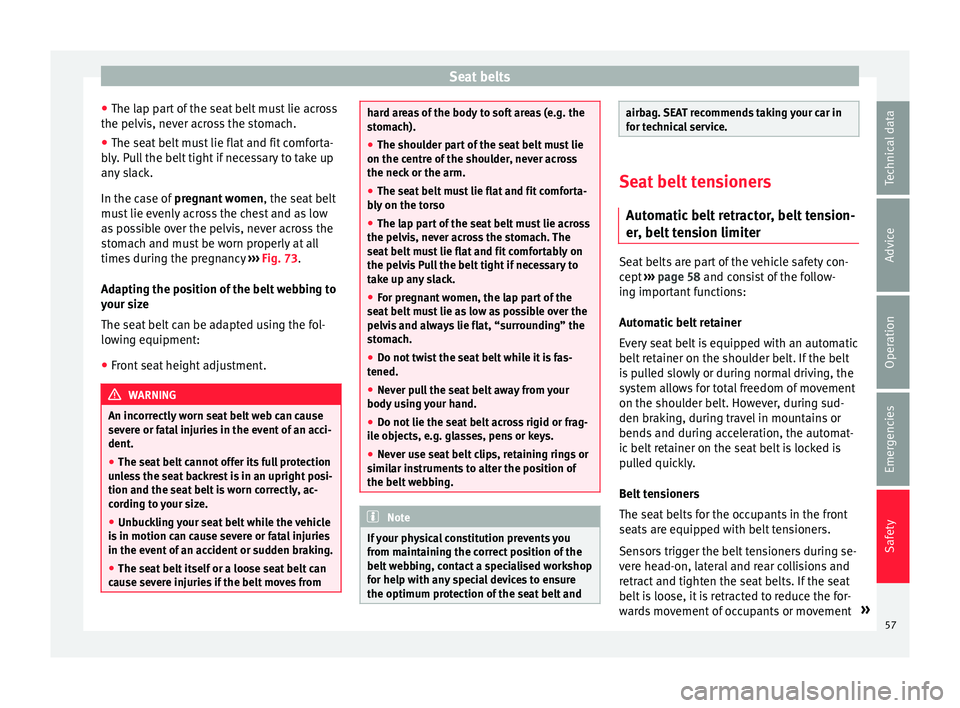
In the case of pregnant women , the seat belt
must lie evenly across the chest and as low
as possible over the pelvis, never across the
stomach and must be worn properly at all
times during the pregnancy ››› Fig. 73.
Adapting the position of the belt webbing to
your size
The seat belt can be adapted using the fol-
lowing equipment:
● Front seat height adjustment. WARNING
An incorrectly worn seat belt web can cause
sever e or f
atal injuries in the event of an acci-
dent.
● The seat belt cannot offer its full protection
unl
ess the seat backrest is in an upright posi-
tion and the seat belt is worn correctly, ac-
cording to your size.
● Unbuckling your seat belt while the vehicle
is in motion c
an cause severe or fatal injuries
in the event of an accident or sudden braking.
● The seat belt itself or a loose seat belt can
cause sev
ere injuries if the belt moves from hard areas of the body to soft areas (e.g. the
st
om
ach).
● The shoulder part of the seat belt must lie
on the centre of
the shoulder, never across
the neck or the arm.
● The seat belt must lie flat and fit comforta-
bly on the t
orso
● The lap part of the seat belt must lie across
the pelvis, nev
er across the stomach. The
seat belt must lie flat and fit comfortably on
the pelvis Pull the belt tight if necessary to
take up any slack.
● For pregnant women, the lap part of the
seat belt
must lie as low as possible over the
pelvis and always lie flat, “surrounding” the
stomach.
● Do not twist the seat belt while it is fas-
tened.
● Never p
ull the seat belt away from your
body us
ing your hand.
● Do not lie the seat belt across rigid or frag-
ile o
bjects, e.g. glasses, pens or keys.
● Never use seat belt clips, retaining rings or
simil
ar instruments to alter the position of
the belt webbing. Note
If your physical constitution prevents you
from m aint
aining the correct position of the
belt webbing, contact a specialised workshop
for help with any special devices to ensure
the optimum protection of the seat belt and airbag. SEAT recommends taking your car in
for t
ec
hnical service. Seat belt tensioners
Autom atic
belt retractor, belt tension-
er, belt tension limiter Seat belts are part of the vehicle safety con-
cept
›
›› page 58 and consist of the follow-
ing important functions:
Automatic belt retainer
Every seat belt is equipped with an automatic
belt retainer on the shoulder belt. If the belt
is pulled slowly or during normal driving, the
system allows for total freedom of movement
on the shoulder belt. However, during sud-
den braking, during travel in mountains or
bends and during acceleration, the automat-
ic belt retainer on the seat belt is locked is
pulled quickly.
Belt tensioners
The seat belts for the occupants in the front
seats are equipped with belt tensioners.
Sensors trigger the belt tensioners during se-
vere head-on, lateral and rear collisions and
retract and tighten the seat belts. If the seat
belt is loose, it is retracted to reduce the for-
wards movement of occupants or movement »
57
Technical data
Advice
Operation
Emergencies
Safety
Page 60 of 232
Safety
in the direction of the collision. The belt ten-
s ioner w
ork
s in combination with the airbag
system. The belt tensioner will not be trig-
gered in the event of the vehicle overturning
if the side airbags are not deployed.
If the belt tensioner is triggered, a fine dust is
produced. This is normal and it is not an indi-
cation of fire in the vehicle.
Belt tension limiter
The belt tension limiter reduces the force of
the seat belt on the body in the event of an
accident. Note
The relevant safety requirements must be ob-
serv ed when the
vehicle is dismantled or sys-
tem components are removed. These require-
ments are known to specialised workshops
››› page 58. Service and disposal of belt tension
dev
ice
s If you work on the belt tensioners or remove
and in
s
t
all other parts of the vehicle when
performing other repair work, the seat belt
may be damaged. The consequence may be
that, in the event of an accident, the belt ten-
sioners function incorrectly or not at all. So that the effectiveness of the belt tensioner
is not
reduced and that removed parts do not
cause any injuries or environmental pollu-
tion, regulations must be observed. These re-
quirements are known to specialised work-
shops. WARNING
● Improper u se or r
epairs not carried out by
qualified mechanics increase the risk of se-
vere or fatal injuries. The belt tensioners may
fail to trigger or may trigger in the wrong cir-
cumstances.
● Never attempt to repair, adjust, remove or
inst
all parts of the belt tensioners or seat
belts.
● The seat belt tensioner, seat belt and auto-
matic r
etractor cannot be repaired.
● Any work on the belt tensioners and seat
belts, includin
g the removal and refitting of
system parts in conjunction with other repair
work, must be performed by a specialised
workshop only.
● The belt tensioners will only provide pro-
tection for one ac
cident and must be changed
if they have been activated. For the sake of the environment
Airbag modules and belt tensioners may con-
tain per c
hlorate. Observe the legal require-
ments for their disposal. Airbag system
Brief intr
oduction
Intr
oduction Front airbags have been installed for both
driver and p
a
ssenger. The front airbags can
also protect the chest and head of driver and
passenger if the seats, seat belts head re-
straints and, for the driver, the steering
wheel are correctly adjusted and used. Air-
bags are considered as additional safety
equipment. An airbag cannot replace the
seat belt, which must be worn at all times,
even in front seats where front airbags have
been installed.
The airbag can protect vehicle occupants in
the event of an accidents, cushioning the
movement of the occupants in the direction
of the collision in frontal and side accidents.
Deployed airbags fill with a propellant gas.
This causes the airbag covers to break and
the airbags to deploy extremely quickly in
their entire deployment space within frac-
tions of a second. When an occupant with the
seat belt properly fastened puts pressure on
the inflated airbag, the propellant gas es-
capes to absorb the force of the impact and
slow the movement. This reduces the risk of
severe or fatal injuries. Airbag deployment
does not mean that other types of injury such
58
Page 61 of 232
Airbag system
as swelling, bruising and skin injuries can be
ru l
ed out
. Upon deployment of the airbag,
friction can cause the generation of heat.
Airbags do not protect the arms or the lower
part of the body.
The most important factors for triggering the
airbag are the type of accident, the angle of
impact, the vehicle speed and the character-
istics of the object the vehicle hits. Therefore,
airbags are not triggered every time the vehi-
cle is visibly damaged.
The activation of the airbag system depends
on the magnitude of the deceleration of the
vehicle caused by a collision, which registers
through an electronic control unit. If the de-
celeration magnitude value is below the ref-
erence value programmed in the control unit,
the airbags will not deploy even though seri-
ous damage might be caused to the vehicle
as the result of an accident. Damage suffered
by the vehicle, reparation costs or absence of
damage suffered from the accident are not
indications of whether an airbag should have
been deployed. Due to the varying nature of
collision situations, it is impossible to define
a speed range of the vehicle and reference
values. For this reason, it is not possible to
cover all types of collisions and collision an-
gles resulting in the deployment of the air-
bag. Factors necessary for the airbag to be
deployed can be, the characteristics of the
object (hard or soft) against which the vehi- cle collides, the collision angle and the vehi-
cle s
peed.
Airbags act in conjunction with the three-
point seat belts in certain accident situa-
tions, when the vehicle deceleration rate is
severe enough to trigger the airbags. Airbags
only deploy once and only under certain cir-
cumstances. Seat belts remain present to of-
fer protection in situations where airbags are
not triggered or where they have already de-
ployed. For example, when a vehicle hits an-
other after an initial collision or is hit by an-
other vehicle.
The airbag system is an integral part of the
car's passive safety system. The airbag sys-
tem can only work effectively when the vehi-
cle occupants are wearing their seat belts
correctly and have adjusted the head re-
straints properly ››› page 48. WARNING
Never exclusively trust the airbag system as a
mean s
of protection.
● Even when triggered, airbag protection is
only aux
iliary.
● The airbags provide the best protection
when the seat belt
s are properly fastened,
thus reducing the risk of sustaining injuries
››› page 52, Why wear a set belt .
● Before each trip, every occupant must sit
properly, c
orrectly fasten the seat belt be-
longing to his or her seat and keeping it fas- tened throughout the trip. This rule is valid
for a
l
l vehicle occupants. WARNING
Occupants sitting in the front of the vehicle
mu st
never carry any objects in the deploy-
ment space between them and the airbags,
as this increases the risk of sustaining inju-
ries if the airbag is triggered. This modifies
the airbag deployment space or the objects
may fly uncontrollably and hit your body.
● Never carry objects in your hand or on your
lap whil
e the vehicle is in motion.
● Never transport objects on the front pas-
senger se
at. In the event of sudden braking
and manoeuvres, the objects may end up in
the airbag deployment space and fly uncon-
trollably around the interior if the airbag is
activated.
● Occupants of the front and rear seats must
never carr
y any other people, pets or objects
in the deployment space between them and
the airbags. Make sure children and other
passengers also respect this recommenda-
tion. WARNING
The airbag system provides protection for
one acc ident
only. If they have been de-
ployed, they must be replaced. » 59
Technical data
Advice
Operation
Emergencies
Safety
Page 106 of 232
Operation
● When the light sw
it
ch is in position .
● When the light switch is in position .WARNING
The side lights or daytime running lights are
not bright enough t
o illuminate the road
ahead and to ensure that other road users are
able to see you.
● Always use your dipped beam head lights if
it is
raining or if visibility is poor. WARNING
If the headlights are set too high and not
used c orr
ectly, there is a risk of dazzling or
distracting other road users. This could result
in a serious accident.
● Always make sure that the headlights are
correctly
adjusted. Note
The legal requirements regarding the use of
vehic l
e lights in each country must be ob-
served. Lights and visibility: functions
Parking light remains on both sides
If
when sw
it
ching off the ignition, the light
control remains in the position and the ve-
hicle is closed from outside, both headlights, in addition to the side lights and the rear
lights wi
ll light up.
Daytime running lights
The daytime driving light consists of individu-
al lights in the front headlamps.
When the daytime driving light is switched
on, only the individual lights come on ››› .
The d a
ytime lights
are switched on each time
the ignition is turned on if the light setting is
in position or in position . WARNING
If the road is not well-lit and the vehicle is
not c l
early visible to other drivers, an acci-
dent may occur.
● Never use the daytime driving light if the
roa
d is not well-lit as a result of the weather
conditions and poor visibility. The daytime
driving lights are not bright enough to illumi-
nate the road ahead and to ensure that other
road users are able to see you.
● The rear lights do not come on with the
daytime driv
ing light. A vehicle which does
not have the rear lights on may not be visible
to other drivers in the darkness, if it is rain-
ing or in conditions of poor visibility. Note
The headlights, rear lights and turn signals
ma y
mist up temporarily on the inside in cool
or damp weather. This is normal and in no way effects the useful life of the vehicle light-
ing sy
s
tem. Automatic dipped beam control
* The automatic dipped beam control is merely
intended a
s
an aid and is not able to recog-
nise all driving situations.
When the light switch is in position , the
vehicle lights and the instrument panel and
switch lighting switch on and off automatical-
ly in the following situations ››› in Lights
and v
i
sibility: functions on page 104:
Automatic switching
onAutomatic switching
off
The photo sensor detects
darkness, for example,
when driving through a
tunnel.When adequate lighting is
detected.
The rain sensor detects
rain and activates the
windscreen wipers.When the windscreen wip-
ers have been inactive for
a few minutes. WARNING
If the road is not well lit and other road users
cannot see the
vehicle well enough or at all,
accidents may occur.
● The automatic dipped beam control ( )
only sw
itches on the dipped beam when104
Page 111 of 232
Lights and visibility
●
Alw a
ys replace damaged or worn blades or
blades which do not clean the windscreen
correctly. CAUTION
In icy conditions, always check that the wiper
b la
des are not frozen to the glass before us-
ing the wipers for the first time. In cold
weather, it may help to leave the vehicle
parked with the wipers in service position
››› page 45. CAUTION
If the ignition is switched off while the wind-
sc r
een wipers are on, the windscreen wipers
carry on wiping at the same level when the
ignition is switched back on. Ice, snow and
other obstacles may damage the windscreen
wiper and the respective motor.
● If necessary, remove snow and ice from the
winds
creen wipers before starting your jour-
ney.
● Carefully lift the frozen windscreen wipers
from the gla
ss. SEAT recommends a de-icer
spray for this operation. Note
● The wind s
creen wipers will only work when
the ignition is switched on.
● The interval wipe speed varies according to
the vehic
le speed. The faster the vehicle is moving, the more often the windscreen is
cl
e
aned.
● The rear wiper is automatically switched on
when the winds
creen wiper is on and the car
is in reverse gear. Windscreen wiper functions
Windscreen wiper performance in different sit-
uations
If the vehicle is at a
standstillThe activated position provision-
ally changes to the previous posi-
tion.
For intermittent wip-
ersIntervals between wipes depend
on the vehicle's speed. The high-
er the vehicle speed the shorter
the intervals.
Note
The wiper will try to wipe away any obstacles
that ar
e on the windscreen. The wiper will
stop moving if the obstacle blocks its path.
Remove the obstacle and switch the wiper
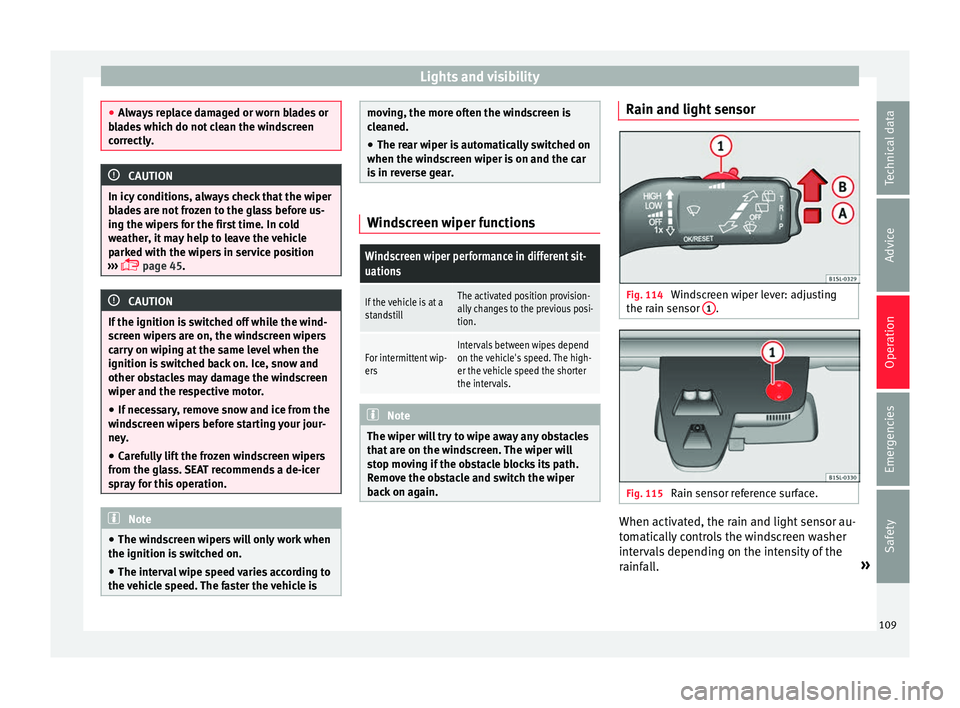
back on again. Rain and light sensor
Fig. 114
Windscreen wiper lever: adjusting
the r ain sen
sor 1 .
Fig. 115
Rain sensor reference surface. When activated, the rain and light sensor au-
t
om
atic
ally controls the windscreen washer
intervals depending on the intensity of the
rainfall. »
109
Technical data
Advice
Operation
Emergencies
Safety