Adjust time Seat Mii 2017 User Guide
[x] Cancel search | Manufacturer: SEAT, Model Year: 2017, Model line: Mii, Model: Seat Mii 2017Pages: 232, PDF Size: 4.91 MB
Page 115 of 232
Seats and head restraints
Seat functions Se at
he
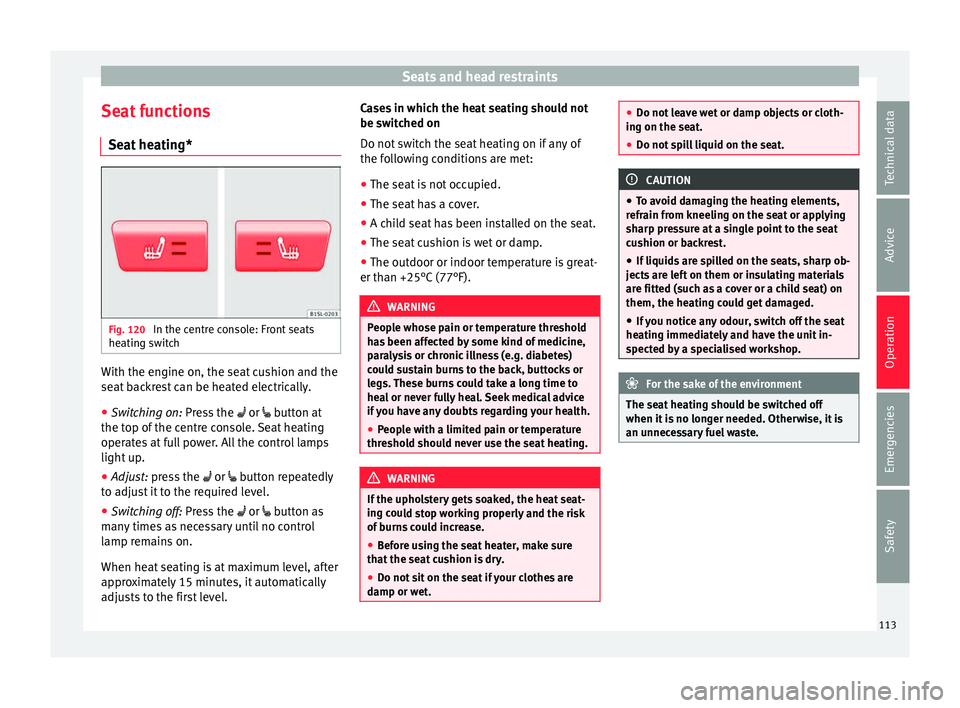
ating* Fig. 120
In the centre console: Front seats
he atin
g sw
itch With the engine on, the seat cushion and the
se
at
b
ackrest can be heated electrically.
● Switching on: Pres
s the or button at
the top of the centre console. Seat heating
operates at full power. All the control lamps
light up.
● Adjust: press the or butt
on repeatedly
to adjust it to the required level.
● Switching off: Pres
s the or button as
many times as necessary until no control
lamp remains on.
When heat seating is at maximum level, after
approximately 15 minutes, it automatically
adjusts to the first level. Cases in which the heat seating should not
be switc
hed on
Do not switch the seat heating on if any of
the following conditions are met:
● The seat is not occupied.
● The seat has a cover.
● A child seat has been installed on the seat.
● The seat cushion is wet or damp.
● The outdoor or indoor temperature is great-
er than +25°C (77°F). WARNING
People whose pain or temperature threshold
ha s
been affected by some kind of medicine,
paralysis or chronic illness (e.g. diabetes)
could sustain burns to the back, buttocks or
legs. These burns could take a long time to
heal or never fully heal. Seek medical advice
if you have any doubts regarding your health.
● People with a limited pain or temperature
thresho
ld should never use the seat heating. WARNING
If the upholstery gets soaked, the heat seat-
ing c ou
ld stop working properly and the risk
of burns could increase.
● Before using the seat heater, make sure
that the se
at cushion is dry.
● Do not sit on the seat if your clothes are
damp or wet
. ●
Do not l e
ave wet or damp objects or cloth-
ing on the seat.
● Do not spill liquid on the seat. CAUTION
● To av oid d
amaging the heating elements,
refrain from kneeling on the seat or applying
sharp pressure at a single point to the seat
cushion or backrest.
● If liquids are spilled on the seats, sharp ob-
jects
are left on them or insulating materials
are fitted (such as a cover or a child seat) on
them, the heating could get damaged.
● If you notice any odour, switch off the seat
heating immedi
ately and have the unit in-
spected by a specialised workshop. For the sake of the environment
The seat heating should be switched off
when it i s
no longer needed. Otherwise, it is
an unnecessary fuel waste. 113
Technical data
Advice
Operation
Emergencies
Safety
Page 132 of 232
Operation
In the case of the Climatronic, the control
p anel
s
creen shows the functions that are
currently activated. WARNING
When visibility through the window display is
poor, the ri sk
of collisions and accidents
which may cause serious injury increases.
● To guarantee good visibility, keep all win-
dows
free of ice and snow and properly dem-
isted.
● Adjust the heating, air conditioning and the
heated r
ear window so that the windows do
not mist up.
● Drive off only when you have good visibility
through the windo
ws.
● Do not use the air recirculation for long pe-
riods of
time. When the cooling is switched
off and the air recirculation is on, the win-
dows can mist over very quickly and seriously
impair visibility.
● Switch the air recirculation off when you do
not need it. WARNING
Used air can quickly cause driver tiredness
and reduc e their att
ention span, which could
lead to collisions, accidents and serious in-
jury.
● Never switch off the fan for a long time or
leav
e the air recirculation on for too long, since no exterior air enters the interior during
that
time. CAUTION
If the air conditioning is not working, switch
it off immedi
ately, together with the de-
frost/demist function (in the case of manual
air conditioning) and have a specialised
workshop check it out. This may help to avoid
other possible damage. CAUTION
To avoid damaging the heated rear window,
nev er affi x
adhesives to the electric filaments
on the inside of it. Air recirculation
In air recirculation mode, no fresh air enters
the
v
ehic
le interior.
To switch on the air recirculation, turn the ad-
juster to the right or press the button.
To switch off the air recirculation, turn the ad-
juster to the left or press the button
again ››› .
WARNING
Used air can quickly cause driver tiredness
and reduc e their att
ention span, which could lead to collisions, accidents and serious in-
jury
.
● Nev
er use the air recirculation for too long,
since no e
xterior air enters the interior during
that time.
● When the cooling is switched off and the
air recir
culation is on, the windows can mist
over very quickly and seriously impair visibil-
ity.
● Switch the air recirculation off when you do
not need it. CAUTION
In vehicles with an air conditioner, do not
smoke when air r ec
irculation is switched on.
The smoke taken in could impregnate the
cooling vaporiser and the activated charcoal
cartridge of the dust and pollen filter, leading
to permanent unpleasant odours. Note
● Climatr onic:
When reverse gear is engaged,
the air recirculation switches on briefly to
prevent exhaust gas from entering the interi-
or.
● When the outside temperature is very high,
it is
recommendable to switch the air recircu-
lation on briefly to cool down the interior
faster. 130
Page 138 of 232
Operation
may engage and lock the steering wheel mak-
ing the
v
ehicle impossible to control.
● Always park your vehicle so that no part of
the exhau
st system can come in contact with
flammable materials (such as wood, leaves,
dried grass, spilled fuel, etc.).
● Always apply the handbrake when you
leav
e your vehicle and when you park.
● Never leave children or disabled people
alone in the v
ehicle. They could release the
electronic parking brake, activate the selec-
tor lever or gear stick and start the vehicle
moving. This could result in a serious acci-
dent.
● Always take all the keys with you whenever
you le
ave the vehicle. The engine could acci-
dentally be started and electrical equipment
such as the windows could accidentally be
operated resulting in serious injury.
● Never leave children or disabled people
alone in the car
. They could be trapped in the
car in an emergency and will not be able to
get themselves to safety. For example, de-
pending on the time of the year, tempera-
tures inside a locked and closed vehicle can
be extremely high or extremely low resulting
in serious injuries and illness or even death,
particularly for young children. CAUTION
● Spec i
al care should be taken when parking
in areas with high kerbs or fixed barriers. Ob-
jects protruding from the ground may dam- age the bumper or other parts of the vehicle
during m
anoeu
vres. To avoid damage, stop
before the wheels touch the barrier or kerb.
● Special attention is required when driving
through entranc
es, over ramps, kerbs or oth-
er objects. The vehicle underbody, bumpers,
mudguards and running gear, and the engine
and exhaust system could be damaged as
you drive over these objects. Control and warning lamps
It lights up
›››
Handbrake applied.››› page 139.
It lights up
›››
Fault in the brake
system Do not drive on!
Seek professional advice
››› page 141.
Brake fluid level in-
adequate. Do not drive on!
Check brake fluid level
››› page 195.
Together with the
ABS control lamp
: ABS and EBV do
not function.
Do not drive on!
Seek professional advice
››› page 141.
It lights up
›››
ESC* disconnected
by system.Switching the ignition on and off
If necessary, drive for a short dis-
tance.
Fault in ESC*.Contact a specialised workshop.
Together with the
ABS control lamp
: Fault in the ABS.
Contact a specialised workshop.
The vehicle can be braked with-
out ABS.
The battery has
been reconnected.››› page 196.
It lights up
›››
Traction Control*
faulty or switched
off by the system.Contact a specialised workshop.
It lights up
›››
Together with the
ESC* control lamp
: Fault in the ABS.
Contact a specialised workshop.
The vehicle can be braked with-
out ABS.
Together with the
warning lamp :
ABS and EBV do not
function. Do not drive on!
Seek professional advice
››› page 141.
Flashes
ESC* or ASR regulat-
ing.Take your foot off the accelera-
tor. Adjust your driving style to
the road conditions. 136
Page 152 of 232
Operation
ahead as you drive and keep a safe distance
fr om the
v
ehicle in front, it is possible to slow
down by simply lifting your foot off the accel-
erator. This eliminates the need for constant
braking and acceleration.
Calm and steady driving
Constancy is more important than speed: The
more you drive at a constant speed, the lower
the fuel consumption.
When driving on the motorway, it is more effi-
cient to drive at a constant and more moder-
ate speed than to be continuously accelerat-
ing and braking. As a general rule, you will
reach your destination just as quickly when
you drive at a constant speed.
The cruise control function helps you to ach-
ieve a constant style of driving.
Moderate use of additional devices
It is important to travel in comfort, but con-
venience systems should be used ecological-
ly.
Some equipment, when connected, increase
fuel consumption considerably, for example:
● Air conditioning cooling system: If the air
conditioning sy
stem is required to cool to
significantly lower temperatures than the true
outside temperature, it will require a large
amount of energy from the engine. Therefore,
we recommend that the selected temperature for the vehicle is not too different to the out-
side temper
ature. It is a good idea to air the
vehicle before starting your journey and to
drive a short distance with the windows
open. Then you can close the windows and
switch on the air conditioning. Keep windows
closed when travelling at high speeds. Driv-
ing with the windows open increases fuel
consumption.
● Switch off the seat heating when the seats
have w
armed up.
● Switch off the heated rear window when it
is not
moist or covered in ice.
Avoid short journeys
Fuel consumption is much higher when the
engine is cold, immediately after it has been
started. It takes a few kilometres of driving
for the engine to warm up and to normalise
consumption.
The engine and catalytic converter need to
reach their proper working temperature in or-
der to minimise fuel consumption and emis-
sions. The ambient temperature has a deci-
sive influence.
Fig. 150 shows the difference in consump-
tion for the same journey at +20°C (+68°F)
and at -10°C (+14°F).
Therefore, unnecessary short journeys
should be avoided. Try to combine trips. The vehicle uses more fuel in winter than in
summer, ev
en when other conditions are the
same.
The engine takes a long time to warm up
when it is idling. In addition, mechanical
wear and pollutant emissions are also espe-
cially high during this initial warm-up phase.
It is therefore best to drive off immediately af-
ter starting the engine. Doing this avoids run-
ning the engine at a high speed.
Adjusting type pressures.
Having the correct pressure in your tyres
helps to reduce rolling resistance and, as a
result reduces fuel consumption. Increasing
the tyre pressure slightly (+0.2
bar/+3 psi/+200 kPa) can help to save fuel.
When you buy new tyres, make sure they are
optimised for minimum rolling resistance.
Use low friction engine oil
The use of low viscosity totally synthetic oils,
known as low friction engine oil, helps to re-
duce fuel consumption. These oils reduce the
resistance caused by friction in the engine,
they flow around the engine more quickly
and efficiently, particularly in cold starts. The
effect is particularly noticeable in vehicles
frequently used for short journeys.
Always check the engine oil level and ob-
serve service intervals (engine oil change in-
tervals).
150
Page 156 of 232
Operation
●
When cl e
aning the sensors with high-pres-
sure or steam cleaning equipment, spray the
sensors briefly at a distance of no less than
10 cm.
● Different sources of noise can produce er-
rors
in the parking distance warning system,
e.g. parking distance warning systems from
other vehicles, inductive loops or construc-
tion works machines.
● Retrofitting of components to the vehicle,
such a
s a bicycle carrier, may interfere with
the function of the parking distance warning
system. Parking distance warning system
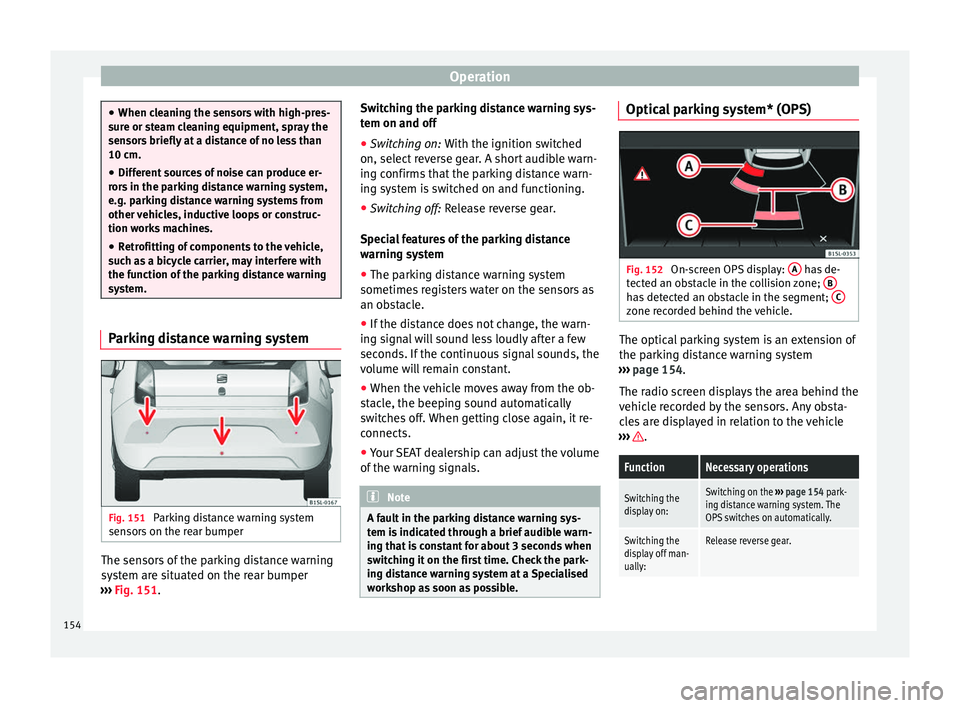
Fig. 151
Parking distance warning system
sen sor
s
on the rear bumper The sensors of the parking distance warning
sy
s
t
em are situated on the rear bumper
››› Fig. 151. Switching the parking distance warning sys-
tem on and off
●
Swit
ching on: With the ignition swit
ched
on, select reverse gear. A short audible warn-
ing confirms that the parking distance warn-
ing system is switched on and functioning.
● Switching off: Rele
ase reverse gear.
Special features of the parking distance
warning system
● The parking distance warning system
sometimes r
egisters water on the sensors as
an obstacle.
● If the distance does not change, the warn-
ing sign
al will sound less loudly after a few
seconds. If the continuous signal sounds, the
volume will remain constant.
● When the vehicle moves away from the ob-
stac
le, the beeping sound automatically
switches off. When getting close again, it re-
connects.
● Your SEAT dealership can adjust the volume
of the warnin
g signals. Note
A fault in the parking distance warning sys-
tem i s
indicated through a brief audible warn-
ing that is constant for about 3 seconds when
switching it on the first time. Check the park-
ing distance warning system at a Specialised
workshop as soon as possible. Optical parking system* (OPS)
Fig. 152
On-screen OPS display: A has de-
tect ed an o
bstacle in the collision zone; B has detected an obstacle in the segment;
C zone recorded behind the vehicle.
The optical parking system is an extension of
the p
ark
in
g distance warning system
››› page 154.
The radio screen displays the area behind the
vehicle recorded by the sensors. Any obsta-
cles are displayed in relation to the vehicle
››› .
FunctionNecessary operations
Switching the
display on:Switching on the
››› page 154 park-
ing distance warning system. The
OPS switches on automatically.
Switching the
display off man-
ually:Release reverse gear. 154
Page 226 of 232
Index
ISOFIX . . . . . . . . . . . . . . . . . . . . . . . . . . . . . . . . . . . 18
ISOFIX
S
ystem . . . . . . . . . . . . . . . . . . . . . . . . . . . . . 18
J Jack . . . . . . . . . . . . . . . . . . . . . . . . . . . . . . 36, 70, 72 mounting points . . . . . . . . . . . . . . . . . . . . . . . . . 39
Jump leads . . . . . . . . . . . . . . . . . . . . . . . . . . . . . . . 43
K
Keys control and warning lamps . . . . . . . . . . . . . . . . 93
duplicates . . . . . . . . . . . . . . . . . . . . . . . . . . . . . . 93
mechanical key . . . . . . . . . . . . . . . . . . . . . . . . . . 93
remote control . . . . . . . . . . . . . . . . . . . . . . . . . . 92
replacing the battery . . . . . . . . . . . . . . . . . . . . . 93
spare key . . . . . . . . . . . . . . . . . . . . . . . . . . . . . . . 92
synchronising . . . . . . . . . . . . . . . . . . . . . . . . . . . 94
unlocking and locking . . . . . . . . . . . . . . 8, 95, 97
vehicle key . . . . . . . . . . . . . . . . . . . . . . . . . . . . . 92
Kick-down . . . . . . . . . . . . . . . . . . . . . . . . . . . . . . . 145
L
Labels and plates . . . . . . . . . . . . . . . . . . . . . . . . . 179
Laser sensor . . . . . . . . . . . . . . . . . . . . . . . . . . . . . 158
Leaving Home Function . . . . . . . . . . . . . . . . . . . . 105
Lift platform . . . . . . . . . . . . . . . . . . . . . . . . . . . . . 169
Lights . . . . . . . . . . . . . . . . . . . . . . . . . . . . . . 21, 103 audible warnings . . . . . . . . . . . . . . . . . . . . . . . 103
AUTO . . . . . . . . . . . . . . . . . . . . . . . . . . . . . . . . . 104
Coming home . . . . . . . . . . . . . . . . . . . . . . . . . . 105
control and warning lamps . . . . . . . . . . . . . . . 103
control lighting . . . . . . . . . . . . . . . . . . . . . . . . . 107
daytime running lights . . . . . . . . . . . . . . . . . . . 104
dipped beam headlights . . . . . . . . . . . . . . . . . 103
driving abroad . . . . . . . . . . . . . . . . . . . . . . . . . 107
fog lights . . . . . . . . . . . . . . . . . . . . . . . . . . . . . . . 21
functions . . . . . . . . . . . . . . . . . . . . . . . . . . . . . . 104 hazard warning lights . . . . . . . . . . . . . . . . . . . . 22
headlight
range control . . . . . . . . . . . . . . . . . . 107
instrument panel lighting . . . . . . . . . . . . . . . . 107
Leaving home . . . . . . . . . . . . . . . . . . . . . . . . . . 105
light controls . . . . . . . . . . . . . . . . . . . . . . . . . . . 103
luggage compartment . . . . . . . . . . . . . . . . . . . 107
main beam . . . . . . . . . . . . . . . . . . . . . . . . . . . . . 21
main beam headlights . . . . . . . . . . . . . . . . . . . 103
main beam lever . . . . . . . . . . . . . . . . . . . . . . . . 105
parking light remains on both sides . . . . . . . . 104
side lights . . . . . . . . . . . . . . . . . . . . . . . . . . . . . 103
switch . . . . . . . . . . . . . . . . . . . . . . . . . . . . . . . . . 21
turn signal lever . . . . . . . . . . . . . . . . . . . . . . . . 105
Load compartment in the luggage compartment see Loading the luggage compartment . . . . . 123
Loading general advice . . . . . . . . . . . . . . . . . . . . . . . . . 114
loaded vehicle . . . . . . . . . . . . . . . . . . . . . . . . . 115
transporting the load . . . . . . . . . . . . . . . . . . . . 114
Loading the luggage compartment . . . . . . . . . . . 123 driving with the rear lid open . . . . . . . . . . . . . . 114
Loading the vehicle class N1 . . . . . . . . . . . . . . . . . . . . . . . . . . . . . . . 126
fastening rings . . . . . . . . . . . . . . . . . . . . . . . . . 126
luggage compartment . . . . . . . . . . . . . . . . . . . . . 9
retaining hooks . . . . . . . . . . . . . . . . . . . . . . . . 127
roof carrier system . . . . . . . . . . . . . . . . . . . . . . 128
Locking and unlocking in the door cylinder . . . . . . . . . . . . . . . . . . . . . . . 8
luggage compartment . . . . . . . . . . . . . . . . . . . 100
panoramic sunroof . . . . . . . . . . . . . . . . . . . . . . 102
Luggage . . . . . . . . . . . . . . . . . . . . . . . . . . . . . . . . 123
Luggage compartment . . . . . . . . . . . . . . . 9, 99, 123 closing . . . . . . . . . . . . . . . . . . . . . . . . . . . . . . . . 100
cover . . . . . . . . . . . . . . . . . . . . . . . . . . . . . . . . . 125
driving with the rear lid open . . . . . . . . . . . . . . 114
luggage compartment variable floor . . . . . . . . 125 manual release mechanism . . . . . . . . . . . . . . . . 10
opening . . . . . . . . . . . . . . . . . . . . . . . . . . . . . . .
100
unlocking . . . . . . . . . . . . . . . . . . . . . . . . . . . . . 100
see also Loading the luggage compartment . 123
Luggage compartment floor . . . . . . . . . . . . . . . . 125
Luggage compartment variable floor . . . . . . . . . 125
M Main beam lever . . . . . . . . . . . . . . . . . . . . . . . . . . 105
Main panel turn signal and main beam lever . . . . . . . . . . . 105
Malfunction air conditioner . . . . . . . . . . . . . . . . . . . . . . . . . 132
automatic gearbox . . . . . . . . . . . . . . . . . . . . . . 146
catalytic converter . . . . . . . . . . . . . . . . . . . . . . 151
rain and light sensor . . . . . . . . . . . . . . . . . . . . 110
Manual air conditioning . . . . . . . . . . . . . . . . . . . 129 adjusting the temperature . . . . . . . . . . . . . . . . . 30
air distribution . . . . . . . . . . . . . . . . . . . . . . . . . . 30
controls . . . . . . . . . . . . . . . . . . . . . . . . . . . . . . . . 29
cooling mode . . . . . . . . . . . . . . . . . . . . . . . . . . . 30
fan . . . . . . . . . . . . . . . . . . . . . . . . . . . . . . . . . . . . 30
switching off . . . . . . . . . . . . . . . . . . . . . . . . . . . . 29
Mirror . . . . . . . . . . . . . . . . . . . . . . . . . . . . . . . . . . 110
Mobile telephone . . . . . . . . . . . . . . . . . . . . . . . . . 166 use without an exterior aerial . . . . . . . . . . . . . 168
Model plate . . . . . . . . . . . . . . . . . . . . . . . . . . . . . . 211
N
Natural gas . . . . . . . . . . . . . . . . . . . . . . . . . . . . . . 182 fuel tank cap . . . . . . . . . . . . . . . . . . . . . . . . . . . 186
refuelling . . . . . . . . . . . . . . . . . . . . . . . . . 182, 186
smell . . . . . . . . . . . . . . . . . . . . . . . . . . . . . . . . . 182
Noises brake assist system . . . . . . . . . . . . . . . . . . . . . 139
engine . . . . . . . . . . . . . . . . . . . . . . . . . . . . . . . . 134
Notes for the user . . . . . . . . . . . . . . . . . . . . . . . . . 179
224