spare wheel Seat Toledo 2013 Owner's manual
[x] Cancel search | Manufacturer: SEAT, Model Year: 2013, Model line: Toledo, Model: Seat Toledo 2013Pages: 258, PDF Size: 3.94 MB
Page 6 of 258
Care of the vehicle and cleaning . . . . . . . . . . . . 172
Care of the vehicle . . . . . . . . . . . . . . . . . . . . . . . . 172
Checking and refilling levels . . . . . . . . . . . . . . . 179
Fuel . . . . . . . . . . . . . . . . . . . . . . . . . . . . . . . . . . . . 179
Engine compartment . . . . . . . . . . . . . . . . . . . . . . 182
Engine oil . . . . . . . . . . . . . . . . . . . . . . . . . . . . . . . . 184
Coolant . . . . . . . . . . . . . . . . . . . . . . . . . . . . . . . . . 187
Brake fluid . . . . . . . . . . . . . . . . . . . . . . . . . . . . . . . 189
Windscreen washer . . . . . . . . . . . . . . . . . . . . . . . . 190
Battery . . . . . . . . . . . . . . . . . . . . . . . . . . . . . . . . . . 191
Wheels and tyres . . . . . . . . . . . . . . . . . . . . . . . . . . 196
Wheels . . . . . . . . . . . . . . . . . . . . . . . . . . . . . . . . . . 196
Accessories, modifications and spare parts . 204
General notes . . . . . . . . . . . . . . . . . . . . . . . . . . . . 204
Modifications and effects of the airbag system . 205
Self-help . . . . . . . . . . . . . . . . . . . . . . . . . . . . . . . . . . 206
First-aid kit and warning triangle* . . . . . . . . . . . . 206
Fire extinguisher* . . . . . . . . . . . . . . . . . . . . . . . . . 206
Vehicle tool kit* . . . . . . . . . . . . . . . . . . . . . . . . . . . 207
Changing a wheel . . . . . . . . . . . . . . . . . . . . . . . . . 207
Tyre repair kit* . . . . . . . . . . . . . . . . . . . . . . . . . . . . 211
Jump-starting . . . . . . . . . . . . . . . . . . . . . . . . . . . . . 214
Towing the vehicle . . . . . . . . . . . . . . . . . . . . . . . . 216
Fuses and bulbs . . . . . . . . . . . . . . . . . . . . . . . . . . . 219
Fuses . . . . . . . . . . . . . . . . . . . . . . . . . . . . . . . . . . . 219
Changing bulbs . . . . . . . . . . . . . . . . . . . . . . . . . . . 222
Changing front fog light bulbs . . . . . . . . . . . . . . . 226
Changing bulbs for rear lights (in side panel) . . 227
Changing rear lights (in rear lid) . . . . . . . . . . . . . 230
Changing bulb for the number plate light . . . . . . 232
Technical specifications . . . . . . . . . . . . 233
Description of the data . . . . . . . . . . . . . . . . . . . . 233
Important information . . . . . . . . . . . . . . . . . . . . . 233
Information on fuel consumption . . . . . . . . . . . . 235 Towing a trailer . . . . . . . . . . . . . . . . . . . . . . . . . . . 236
Wheels . . . . . . . . . . . . . . . . . . . . . . . . . . . . . . . . . . 236
Technical Data . . . . . . . . . . . . . . . . . . . . . . . . . . . . 238
Checking fluid levels . . . . . . . . . . . . . . . . . . . . . . . 238
Petrol engine 1.2 55 kW (75 PS) . . . . . . . . . . . . . 239
Petrol engine 1.2 TSI 63 kW (85 PS) . . . . . . . . . . 240
Petrol engine 1.2 TSI 77 kW (105 PS) . . . . . . . . . 241
Petrol engine 1.6 77 kW (105 PS) . . . . . . . . . . . . 242
Petrol engine 1.4 90 kW (122 PS) Automatic . . . 243
Diesel Engine 1.6 CR 66 kW (90 PS) . . . . . . . . . . 244
Diesel Engine 1.6 CR 77 kW (105 PS) . . . . . . . . . 245
Dimensions . . . . . . . . . . . . . . . . . . . . . . . . . . . . . . 246
Capacities . . . . . . . . . . . . . . . . . . . . . . . . . . . . . . . 246
Index . . . . . . . . . . . . . . . . . . . . . . . . . . . . . . . . . . . 247
4Table of Contents
Page 145 of 258
143
Driving
● Vehicle modifications (e.g. to the engine, brakes, frame or a combina-
tion of wheels and tyres) could impair the brake assist systems
⇒ page 204, Accessories, modifications and spare parts.
● In the event of a fault in the ABS system, the ESC, ASR and EDL are
switched off automatically. A fault in the ABS is indicated by the
⇒ page 73 warning lamp.
Brakes
Wear
The rate of wear of the brake pads depends on the driving style and on the
way in which the vehicle is used. The brake pads will wear more quickly if
you use your vehicle frequently in urban traffic and short trips or drive in a
sporty style. Under these demanding conditions, visit your specialised serv-
ice, even before the scheduled service date, so that the thickness of the
brake pads can be measured.
Wet roads or road salt
If brakes are wet or frozen, or if you are driving on roads which have been
gritted with salt, braking power may set in later than normal. Dry the brakes
as soon as possible by braking repeatedly.
Corrosion
Long periods of inactivity and little use can lead to rust on the brake discs
and dirt on the brake pads. Where the brake system is subjected to light
stress or in the case of corrosion, clean the brake discs by braking fully sev-
eral times at a high speed.
Brake system fault
If you notice that the braking distance suddenly increases and the brake
pedal can be pressed down more fully, there may be a fault in the brake sys-
tem. Visit a specialised service immediately and adjust your driving style to
the extent of the damage and to limit the effect of the brakes. Low brake fluid level
Insufficient brake fluid could cause faults in the brake system. The brake flu-
id level is controlled electronically
⇒ page 70, Brake system .
Brake servo
The brake servo supplements the pressure you exert on the brake pedal.
The brake servo only works when the engine is running.
Handbrake
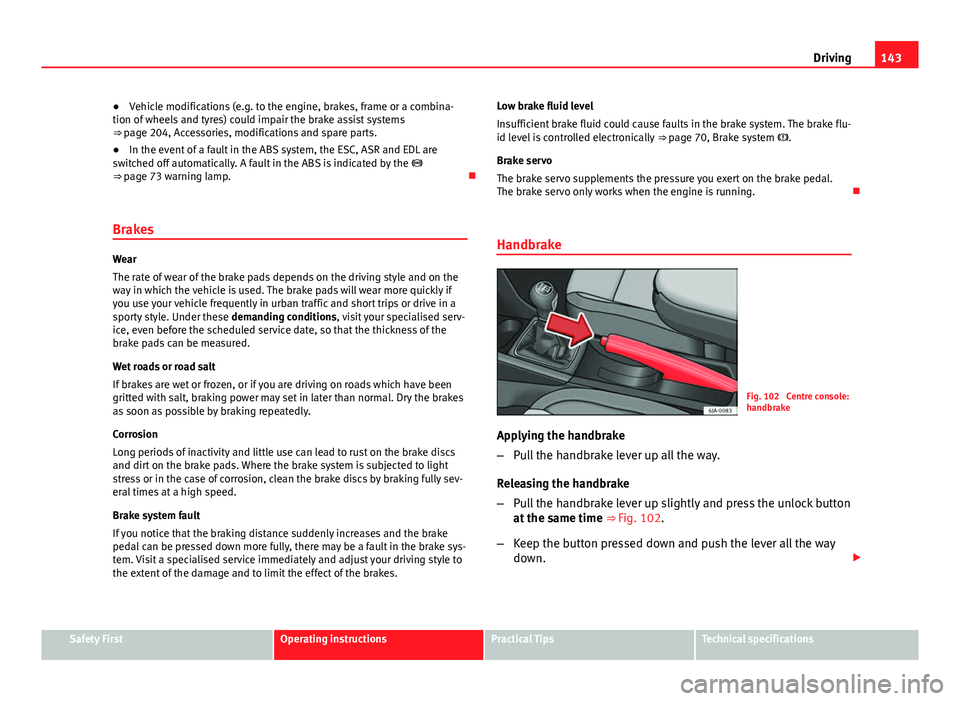
Fig. 102 Centre console:
handbrake
Applying the handbrake
– Pull the handbrake lever up all the way.
Releasing the handbrake
– Pull the handbrake lever up slightly and press the unlock button
at the same time ⇒ Fig. 102.
– Keep the button pressed down and push the lever all the way
down.
Safety FirstOperating instructionsPractical TipsTechnical specifications
Page 163 of 258
161
Driving and the environment
Environmental friendliness
Environmental protection is a top priority in the design, choice of materials
and manufacture of your new SEAT.
Constructive measures to encourage recycling
● Joints and connections designed for easy dismantling
● Modular construction to facilitate dismantling
● Increased use of single-grade materials.
● Plastic parts and elastomers are marked in accordance with ISO 1043,
ISO 11469 and ISO 1629.
Choice of materials
● Use of recycled materials.
● Use of compatible plastics in the same part if its components are not
easily separated.
● Use of recycled materials and/or materials originating from renewable
sources.
● Reduction of volatile components, including odour, in plastic materials.
● Use of CFC-free coolants.
Ban on heavy metals, with the exceptions dictated by law (Annex II of ELV
Directive 2000/53/EC): cadmium, lead, mercury, hexavalent chromium.
Manufacturing methods
● Reduction of the quantity of thinner in the protective wax for cavities.
● Use of plastic film as protection during vehicle transport.
● Use of solvent-free adhesives.
● Use of CFC-free coolants in cooling systems.
● Recycling and energy recovery from residues (RDF).
● Improvement in the quality of waste water. ●
Use of systems for the recovery of residual heat (thermal recovery, en-
thalpy wheels, etc.).
● The use of water-soluble paints
Driving abroad General notes
It is possible that in some countries the SEAT dealer network is limited or
inexistent. Therefore it is difficult to acquire certain spare parts and the
workers at the specialised workshops can only carry out limited repair
works. SEAT will inform you about the technical requirements of your vehi-
cle, necessary maintenance work and possibilities for repair.
Unleaded petrol
Refuel only using unleaded petrol ⇒ page 157, Catalytic converter in petrol
engine vehicles. Automobile associations will provide information regarding
the network of petrol stations offering unleaded petrol.
Headlights
Your dipped beam headlights are adjusted in an asymmetrical formation.
The side of the road on which you are driving is illuminated more brightly.
If you are driving in a foreign country where traffic drives on the opposite
side of the road this will dazzle the oncoming traffic. In order to avoid daz-
zling oncoming traffic, it is essential to have the headlights adjusted at an
authorised SEAT dealer.
Safety FirstOperating instructionsPractical TipsTechnical specifications
Page 166 of 258
164Driving the vehicle with a trailer
Driving the vehicle with a trailer
Driving the vehicle with a trailer
Technical requirements
If your vehicle has a factory-fitted towing bracket or is equipped with a se-
lection of SEAT Original Accessories, it meets all the relevant technical and
legal requirements.
In vehicles with a towing bracket it is possible to remove the ball joint, situ-
ated (together with the special assembly instructions) in the housing for the
spare wheel in the vehicle luggage compartment ⇒ page 207, Vehicle tool
kit*.
Your vehicle is fitted with a 13-pole power socket for the electrical connec-
tion between the trailer and the vehicle. If the trailer you are going to use
has a 7-pin connector, the corresponding adaptor, acquired from the SEAT
Original Accessories Catalogue, can be used.
If a towing bracket is to be retro-fitted to the car, it must be done according
to the instructions of the towing bracket manufacturer.
Note
Any queries that may arise can be directed to an authorised SEAT dealer.
Trailer weight
Trailer weight
The combined vehicle and trailer must be balanced. To do so use the maxi-
mum permitted towing bracket load. An insufficient weight exerted by the trailer drawbar on the ball joint of the towing bracket will have a negative
impact upon the response of the vehicle-trailer assembly on the road.
Weight distribution
Distribute loads in the trailer so that heavy objects are as near to the axle as
possible. Ensure that the objects do not move.
If the towing vehicle is empty and the trailer loaded then the load distribu-
tion is incorrect. However, if these conditions cannot be avoided, drive very
slowly.
Tyre pressure values
Correct the tyre pressure in your vehicle to “total load” ⇒
page 197, Tyre
useful life.
Trailer weight
Never exceed the authorised trailer weight under any circumstances
⇒ page 233, Description of the data.
The trailer weights listed are only applicable for altitudes up to 1000 m
above sea level. Due to a lower air density the engine power decreases de-
pending on the increase in altitude, this also causes the climbing ability to
decrease, which requires a reduction of the weight of the vehicle with a
trailer by 10 % for every 1000 m increase in altitude. The weight of the as-
sembly is calculated by adding the vehicle weight (loaded) to the trailer
weight (loaded). Always drive with special care when towing a trailer.
The towed load and support load information that is displayed on the tow-
ing bracket manufacturers label are only values for the verification of the
device. The correct figures for your specific vehicle, which are usually lower
than these figures, are given in the documentation of your vehicle.
Page 169 of 258
167
Driving the vehicle with a trailer
Towing bracket device Introduction
If the vehicle is equipped with a towing bracket device from the factory or
consisting of genuine SEAT accessories, it meets all the national technical
and legal requirements for towing.
Your vehicle is fitted with a 13-pin power socket for the electrical connection
between the trailer and the vehicle. If the towing bracket is equipped with a
7-pin connector, the corresponding available adaptor may be used as a
genuine SEAT accessory.
The towing device has a maximum vertical load of 50 kg.
WARNING
● Before driving with the ball-headed bar fitted, verify its correct as-
sembly and placement in the clamping bush.
● Do not use the ball-headed bar if it is not correctly placed and fixed in
the clamping bush.
● Do not use the towing device for towing if it is damaged or missing
parts.
● Do not modify or adapt the towing device for towing.
● Never disengage the ball-headed bar with the trailer still hitched.
CAUTION
Be careful not to damage the paint on the bumper when handling the ball-
headed bar. Description
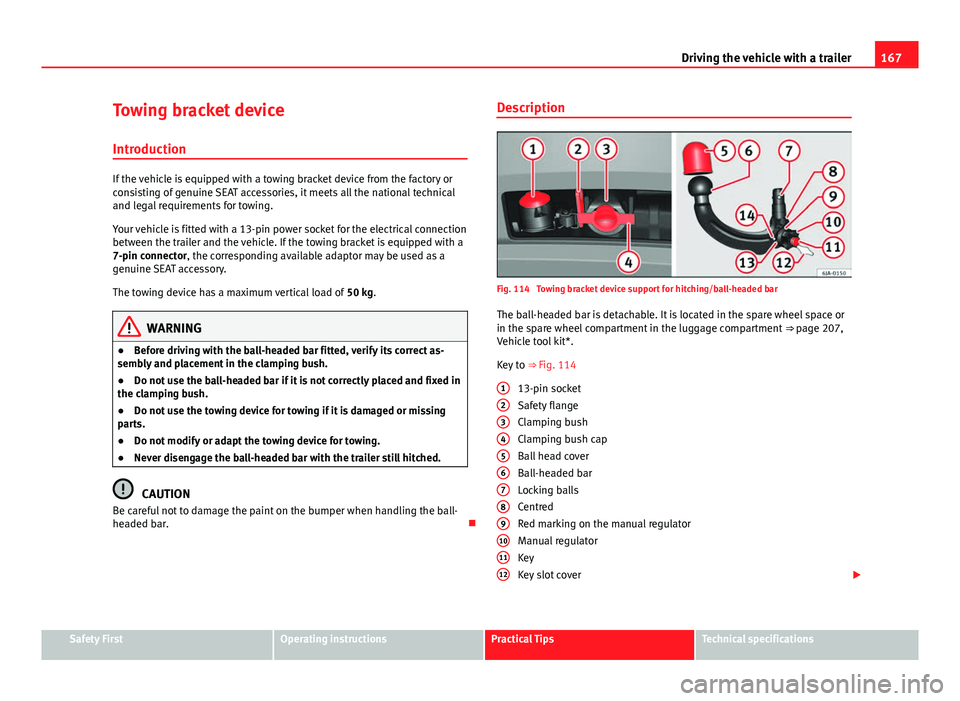
Fig. 114 Towing bracket device support for hitching/ball-headed bar
The ball-headed bar is detachable. It is located in the spare wheel space or
in the spare wheel compartment in the luggage compartment ⇒ page 207,
Vehicle tool kit*.
Key to ⇒ Fig. 114
13-pin socket
Safety flange
Clamping bush
Clamping bush cap
Ball head cover
Ball-headed bar
Locking balls
Centred
Red marking on the manual regulator
Manual regulator
Key
Key slot cover
1
23456789101112
Safety FirstOperating instructionsPractical TipsTechnical specifications
Page 198 of 258
196Wheels and tyres
Wheels and tyres
Wheels
Introduction
WARNING
● During the first 500 km (300 miles), new tyres do not give maximum
grip, therefore you should drive carefully. Risk of accident!
● Never drive with damaged tyres. Risk of accident!
● Only use wheels and tyres that been authorised by SEAT or your vehi-
cle model. Failure to do so could impair road safety. Risk of accident!
● Never exceed the maximum speed permitted for your tyres. Risk of ac-
cident due to tyre damage and loss of vehicle control.
● Under-inflated tyres are submitted to greater rolling resistance. This
means that they can overheat at high speeds. This can cause tread sepa-
ration and even tyre blow-out.
● For driving safety, tyres should be replaced at least in pairs according
to the axle and not individually. The tyres with the deepest tread should
always be used on the front wheels.
● Never fit used tyres of an unknown age or prior use.
● Tyres must be immediately changed at the very latest when they have
worn down to the tread wear indicators.
● Worn tyres reduce the necessary grip at high speeds on damp surfa-
ces. This could lead to “aquaplaning” (uncontrolled vehicle movement –
“skidding” on damp surfaces).
● Damaged wheels and tyres must be replaced immediately.
WARNING (Continued)
● Do not use summer or winter tyres that are more than 6 or 4 years old
respectively.
● Wheel bolts should be clean and screw easily. However, they must
never be treated with grease or oil.
● If the tightening torque of the wheel bolts is too low, they could loos-
en while the vehicle is moving. Risk of accident! If the tightening torque
of the wheel bolts is too high, the bolts and threads could be damaged,
leading to the permanent deforming of the rim support surfaces.
● Incorrectly handled wheel bolts could lead to a wheel coming loose
while the vehicle is moving. Risk of accident!
● The national regulations on the use of snow tyres and chains should
be observed.
CAUTION
● Where a spare wheel that is not compatible with the wheels fitted is
used, follow the instructions ⇒ page 199.
● The prescribed tightening torque for wheel bolts on steel and alloy
wheels is 120 Nm.
● Protect your tyres from coming into contact with oil, grease and fuel.
● Replace any lost valve caps immediately.
For the sake of the environment
Under-inflated tyres increases fuel consumption.
Page 199 of 258
197
Wheels and tyres
Note
● We recommend having all work on tyres and wheels carried out by an
authorised SEAT dealer.
● We recommend using wheels, tyres, hub caps and snow chains from the
SEAT Original Accessories programme.
Tyre useful life
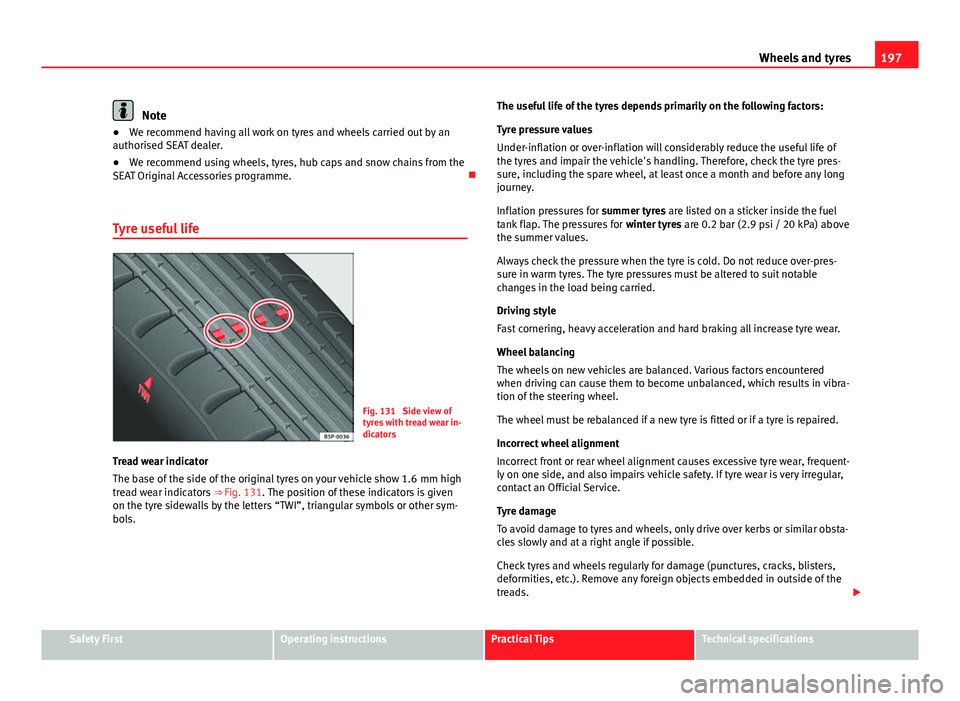
Fig. 131 Side view of
tyres with tread wear in-
dicators
Tread wear indicator
The base of the side of the original tyres on your vehicle show 1.6 mm high
tread wear indicators ⇒ Fig. 131. The position of these indicators is given
on the tyre sidewalls by the letters “TWI”, triangular symbols or other sym-
bols. The useful life of the tyres depends primarily on the following factors:
Tyre pressure values
Under-inflation or over-inflation will considerably reduce the useful life of
the tyres and impair the vehicle's handling. Therefore, check the tyre pres-
sure, including the spare wheel, at least once a month and before any long
journey.
Inflation pressures for
summer tyres are listed on a sticker inside the fuel
tank flap. The pressures for winter tyres are 0.2 bar (2.9 psi / 20 kPa) above
the summer values.
Always check the pressure when the tyre is cold. Do not reduce over-pres-
sure in warm tyres. The tyre pressures must be altered to suit notable
changes in the load being carried.
Driving style
Fast cornering, heavy acceleration and hard braking all increase tyre wear.
Wheel balancing
The wheels on new vehicles are balanced. Various factors encountered
when driving can cause them to become unbalanced, which results in vibra-
tion of the steering wheel.
The wheel must be rebalanced if a new tyre is fitted or if a tyre is repaired.
Incorrect wheel alignment
Incorrect front or rear wheel alignment causes excessive tyre wear, frequent-
ly on one side, and also impairs vehicle safety. If tyre wear is very irregular,
contact an Official Service.
Tyre damage
To avoid damage to tyres and wheels, only drive over kerbs or similar obsta-
cles slowly and at a right angle if possible.
Check tyres and wheels regularly for damage (punctures, cracks, blisters,
deformities, etc.). Remove any foreign objects embedded in outside of the
treads.
Safety FirstOperating instructionsPractical TipsTechnical specifications
Page 201 of 258
199
Wheels and tyres
The manufacturing date is also indicated on the tyre sidewall (possibly only
on the inner side of the wheel). DOT … 27 12…
means, for example, that the tyre was produced in the 27th week of 2012.
Follow the instructions ⇒ page 199 if you only have a temporary spare
wheel.
Tyres with directional tread pattern
The direction of rotation is indicated by the arrows on the tyre sidewall. The
direction of rotation indicated must be respected. This guarantees optimum
grip and helps avoid excessive noise, wear and aquaplaning.
In the event of a flat tyre, a spare wheel with an undetermined tread pattern
or an opposite tread pattern must be used and you must drive carefully, as
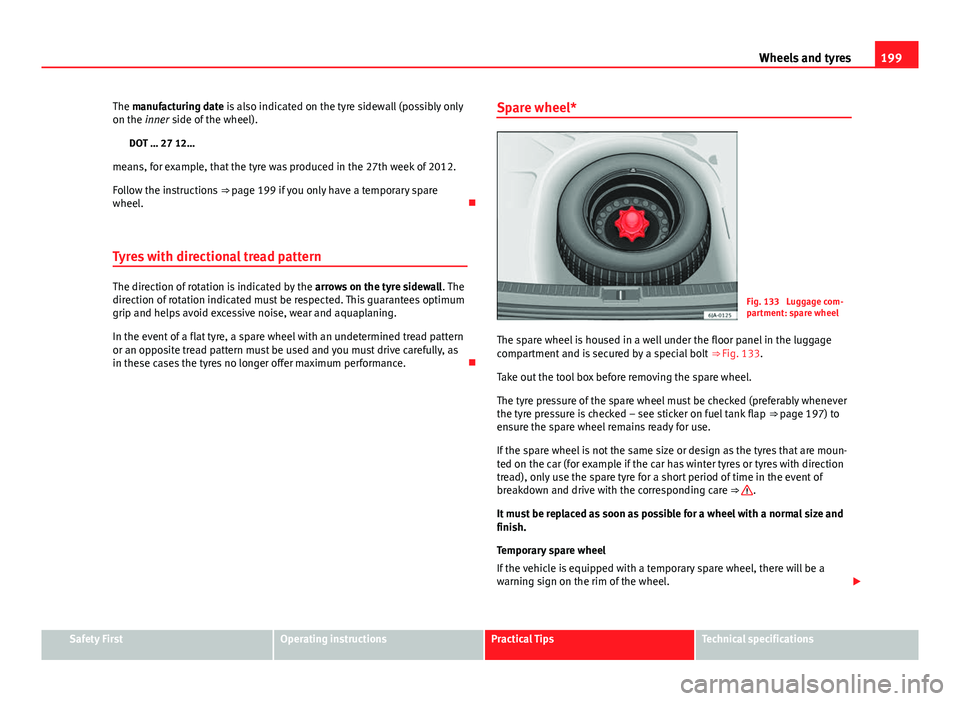
in these cases the tyres no longer offer maximum performance. Spare wheel*Fig. 133 Luggage com-
partment: spare wheel
The spare wheel is housed in a well under the floor panel in the luggage
compartment and is secured by a special bolt ⇒ Fig. 133.
Take out the tool box before removing the spare wheel.
The tyre pressure of the spare wheel must be checked (preferably whenever
the tyre pressure is checked – see sticker on fuel tank flap ⇒ page 197) to
ensure the spare wheel remains ready for use.
If the spare wheel is not the same size or design as the tyres that are moun-
ted on the car (for example if the car has winter tyres or tyres with direction
tread), only use the spare tyre for a short period of time in the event of
breakdown and drive with the corresponding care ⇒
.
It must be replaced as soon as possible for a wheel with a normal size and
finish.
Temporary spare wheel
If the vehicle is equipped with a temporary spare wheel, there will be a
warning sign on the rim of the wheel.
Safety FirstOperating instructionsPractical TipsTechnical specifications
Page 202 of 258
200Wheels and tyres
Follow the instructions below when driving with this wheel fitted.
● After fitting the wheel, the warning sign must not be covered.
● Do not drive faster than 80 km/h (50 mph) with this spare wheel and
take great care during the trip. Avoid heavy acceleration, hard braking and
fast cornering.
● The tyre pressure is the same as that of the standard tyres.
● Only use this spare wheel to reach the nearest Official Service, as it is
not designed for permanent use.
WARNING
● Under no circumstances must damaged spare wheels be used.
● If the spare wheel is different in size or design to the tyres currently
fitted, never drive faster than 80 km/h (50 mph). Avoid heavy accelera-
tion, hard braking and fast cornering.
CAUTION
Follow the instructions given on the temporary spare wheel label.
Note
The tyre pressure of the spare wheel must always correspond to the highest
pressure prescribed for the model of vehicle in question.
Wheel trim
Removing
– Place the hook from the vehicle tool kit on the reinforced edge
of the wheel trim. –
Insert the box spanner through the hook, supporting it on the
tyre and remove the wheel trim.
Fitting
– First press the wheel trim onto the wheel at the cut out de-
signed for the valve. Then press the wheel trim on both sides in
the direction of the valve so that it fits correctly in place around
all the perimeter.
CAUTION
● Press down by hand, do not hit the wheel trim! Knocking it sharply, par-
ticularly at points where the wheel trim has not yet been inserted, could re-
sult in damage to the wheel trim guiding and centring elements.
● Before fitting the trim on a steel alloy wheel attached with an anti-theft
wheel bolt, make sure the bolt is in the hole in the valve area ⇒ page 211,
Anti-theft wheel bolts*.
● Where trim is fitted at a later date, ensure enough air inflow is guaran-
teed in order to cool the brake system.
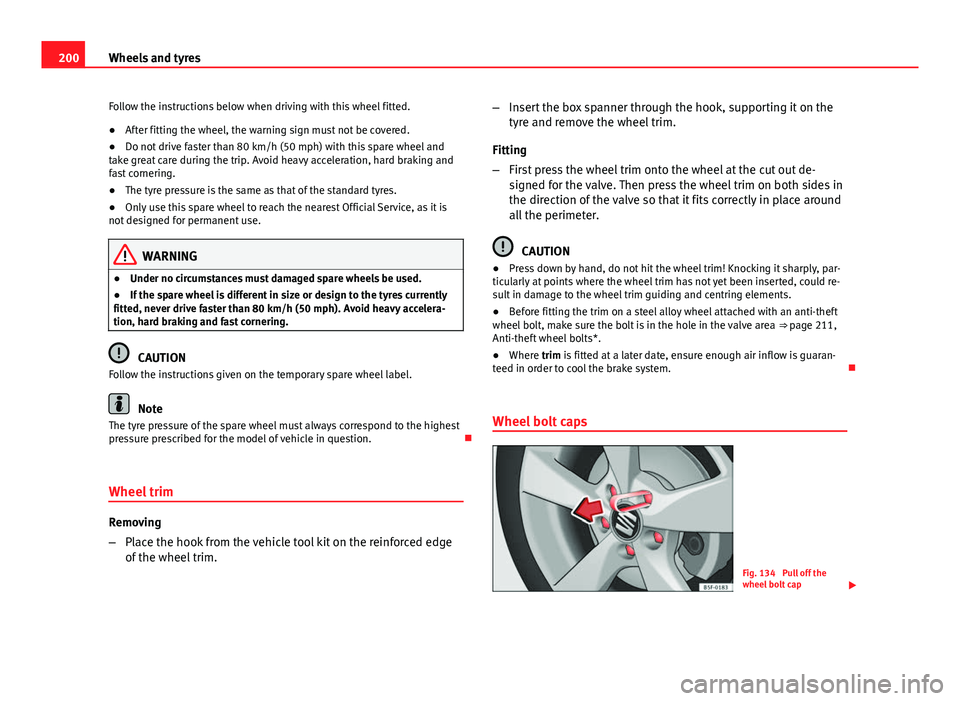
Wheel bolt caps
Fig. 134 Pull off the
wheel bolt cap
Page 203 of 258

201
Wheels and tyres
Removing
– Insert the plastic clip into the cap until the inner retaining
notches on the clips touch the collar of the cap and then re-
move ⇒ Fig. 134.
Fitting
– Insert the caps as far as they will go over the wheel bolts.
The wheel bolt caps are stored in a box on the spare wheel or in the spare
wheel well.
Tyre pressure *
Fig. 135 Tyre pressure
setting switch
The tyre pressure monitoring system uses ABS sensors to compare the revo-
lutions and the circumference of each wheel. Should the circumference of
any wheel change, the warning lamp in the general instrument panel
⇒ page 76 will light up and an audible warning will be heard.
Tyre circumference may change if:
● Tyre pressure is too low
● Tyre structure is damaged ●
Vehicle load not evenly distributed
● Wheels on one axle are subjected to greater load, (e.g. driving with trail-
er, uphill, downhill)
● Snow chains are fitted
● The temporary spare wheel is fitted
● One wheel on the axle has been changed
Basic system settings
Should the tyre pressure change or if one or more wheels are changed or
the position of the wheel on the vehicle is changed, e.g. changing round the
front and rear wheels, or where a warning lamp lights up when driving, the
system must be adjusted as follows:
● Inflate all tyres to the prescribed pressures ⇒ page 197.
● Switch the ignition on.
● Hold the
⇒ Fig. 135 button down for at least 2 seconds. The warn-
ing lamp will light up when the button is pressed. The system memory is
also deleted and a new calibration system will begin, which is indicated by
an audible warning before the warning lamp switches off .
● If the warning lamp remains lit and does not switch off, not even once
the basic setting process is complete, this indicates a fault in the system.
Contact an Official Service.
The warning lamp lights up
If the pressure on at least one tyre is significantly lower than the pressure
set by the driver, the warning lamp ⇒
will light up.
The warning lamp flashes
If the warning lamp flashes, there is a fault in the system. Contact a special-
ised service to have it fixed.
Safety FirstOperating instructionsPractical TipsTechnical specifications