spare wheel Seat Toledo 2013 User Guide
[x] Cancel search | Manufacturer: SEAT, Model Year: 2013, Model line: Toledo, Model: Seat Toledo 2013Pages: 258, PDF Size: 3.94 MB
Page 207 of 258
205
Accessories, modifications and spare parts
Modifications and effects of the airbag
system
In the adjustment and modification, respect the SEAT directive.
Modifications and corrections of the front bumper, doors, front seats, roof
or bodywork must be carried out at authorised SEAT workshops. Compo-
nents of the airbag system can be found in these parts of the vehicle.
WARNING
● Airbag modules must never be repaired. They must be replaced.
● Never fit components of the airbag system removed from old vehicles
or those originating from a recycling process in the vehicle.
● The modification of the suspension of the vehicle wheels, including
the use of non-permitted combinations of tyres and rims can alter the op-
eration of the airbag system and increase the risk of serious or fatal inju-
ries in an accident.
● During all jobs on the airbag system, in addition to the removal and
fitting of parts of the system in the course of other repair jobs, parts of
the airbag system can be damaged. Therefore in the event of an accident,
this may cause the airbags to activate incorrectly or not activate al all.
Safety FirstOperating instructionsPractical TipsTechnical specifications
Page 209 of 258
207
Self-help
Vehicle tool kit*
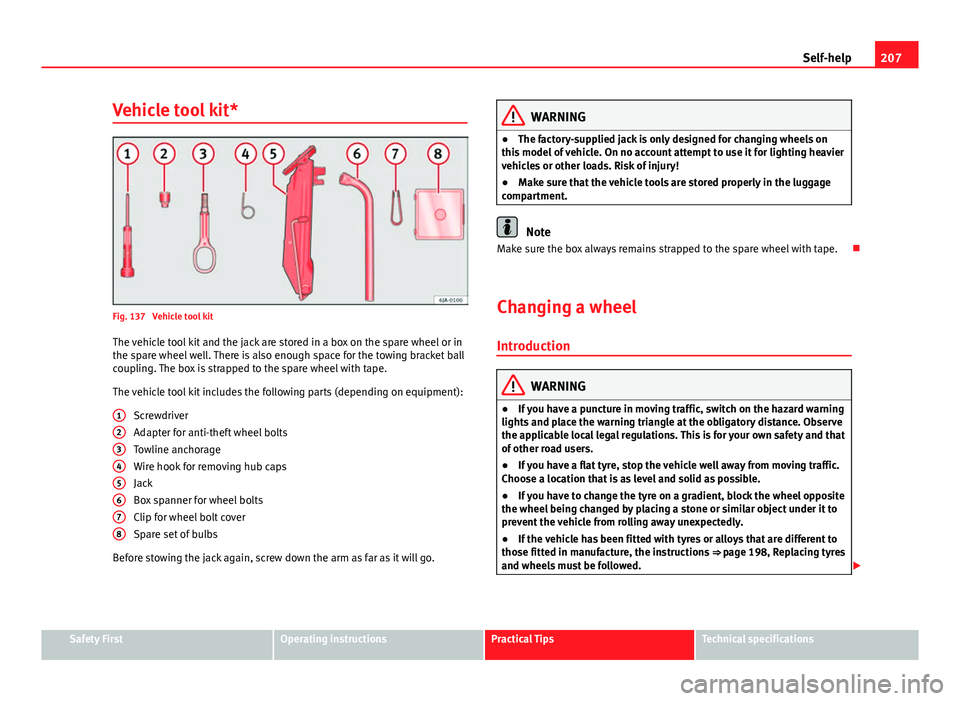
Fig. 137 Vehicle tool kit
The vehicle tool kit and the jack are stored in a box on the spare wheel or in
the spare wheel well. There is also enough space for the towing bracket ball
coupling. The box is strapped to the spare wheel with tape.
The vehicle tool kit includes the following parts (depending on equipment): Screwdriver
Adapter for anti-theft wheel bolts
Towline anchorage
Wire hook for removing hub caps
Jack
Box spanner for wheel bolts
Clip for wheel bolt cover
Spare set of bulbs
Before stowing the jack again, screw down the arm as far as it will go. 1
2345678
WARNING
● The factory-supplied jack is only designed for changing wheels on
this model of vehicle. On no account attempt to use it for lighting heavier
vehicles or other loads. Risk of injury!
● Make sure that the vehicle tools are stored properly in the luggage
compartment.
Note
Make sure the box always remains strapped to the spare wheel with tape.
Changing a wheel Introduction
WARNING
● If you have a puncture in moving traffic, switch on the hazard warning
lights and place the warning triangle at the obligatory distance. Observe
the applicable local legal regulations. This is for your own safety and that
of other road users.
● If you have a flat tyre, stop the vehicle well away from moving traffic.
Choose a location that is as level and solid as possible.
● If you have to change the tyre on a gradient, block the wheel opposite
the wheel being changed by placing a stone or similar object under it to
prevent the vehicle from rolling away unexpectedly.
● If the vehicle has been fitted with tyres or alloys that are different to
those fitted in manufacture, the instructions ⇒ page 198, Replacing tyres
and wheels must be followed.
Safety FirstOperating instructionsPractical TipsTechnical specifications
Page 210 of 258
208Self-help
WARNING (Continued)
● Always raise the vehicle with the doors closed.
● Never place parts of your body, e.g. arms and legs, underneath the
vehicle when supported only by the jack.
● Secure the base of the jack with suitable supports so that it cannot
slip. The jack could slide if the ground below it is soft and slippery and
the vehicle could slip off it. Therefore, place the jack on a firm surface or
use a large, stable base. On a slippery surface, e.g. tiles, use a non-slip
base such as a rubber mat.
● Never start the engine when the vehicle is raised. Risk of injury.
● The jack should only be used in the correct jacking points.
CAUTION
● The prescribed tightening torque for wheel bolts on steel and alloy
wheels is 120 Nm.
● If the anti-theft wheel bolt is overly tightened, this could damage the
bolt and the adapter
Note
● The set of anti-theft wheel bolts or the adapter are available from au-
thorised SEAT dealers.
● Please observe the relevant local legal regulations when changing the
wheel.
Preparation work
Some preparation is required before changing a wheel:
– If you have a flat tyre, stop the vehicle as far away as possible
from moving traffic. The surface must be horizontal.–
All vehicle occupants should leave the vehicle . Vehicle occu-
pants should waiting in a safe place, e.g. behind the roadside
crash barrier) while the wheel is being changed.
– Switch off the ignition and engage neutral or move the selector
lever on the automatic gearbox to position P.
– Apply the handbrake firmly.
– If towing a trailer, unhitch it.
– Take the vehicle tool kit ⇒ page 207 and the spare wheel
⇒ page 207 out of the luggage compartment.
Changing a wheel
If possible, change the wheel on a level surface.
– Pull off the hub cap ⇒ page 200 or the wheel bolt covers
⇒ page 200.
– First loosen the anti-theft wheel bolts and then the other wheel
bolts ⇒ page 209.
– Raise the vehicle until the wheel to be changed is no longer
touching the ground ⇒ page 210.
– Remove the wheel bolts and place them on a clean surface
(cloth, paper, etc.).
– Take off the wheel.
– Lift the spare wheel into position and tighten the wheel bolts
lightly.
Page 211 of 258
209
Self-help
– Lower the vehicle.
– Tighten the wheel bolts firmly in diagonal sequence with the
box spanner and then the anti-theft wheel bolt ⇒ page 209.
– Replace the hub cap and/or the bolt covers.
Note
● All bolts must be clean and turn easily.
● Never grease or oil the wheel bolts!
● Note the direction of rotation when putting on a tyre with directional
tread pattern ⇒ page 196.
After changing a wheel
Tasks that must be carried out after changing a wheel.
– Place the wheel with the defective tyre in the spare wheel well
and secure it using a special bolt ⇒ page 199.
– Put the vehicle tools back in their storage location.
– Check the tyre pressure of the newly fitted spare wheel as soon
as possible.
– Have the tightening torque of the wheel bolts checked as soon
as possible with a torque wrench.
– Have the flat tyre replaced or ask an Official Service about the
possibility of repair.
Note
● If you notice that the wheel bolts are rusty and difficult to turn when
changing a wheel, they must be replaced before having the tightening tor-
que checked.
● Drive carefully and at moderate speeds until the tightening torque of the
wheel bolts has been checked.
Loosening and tightening wheel bolts
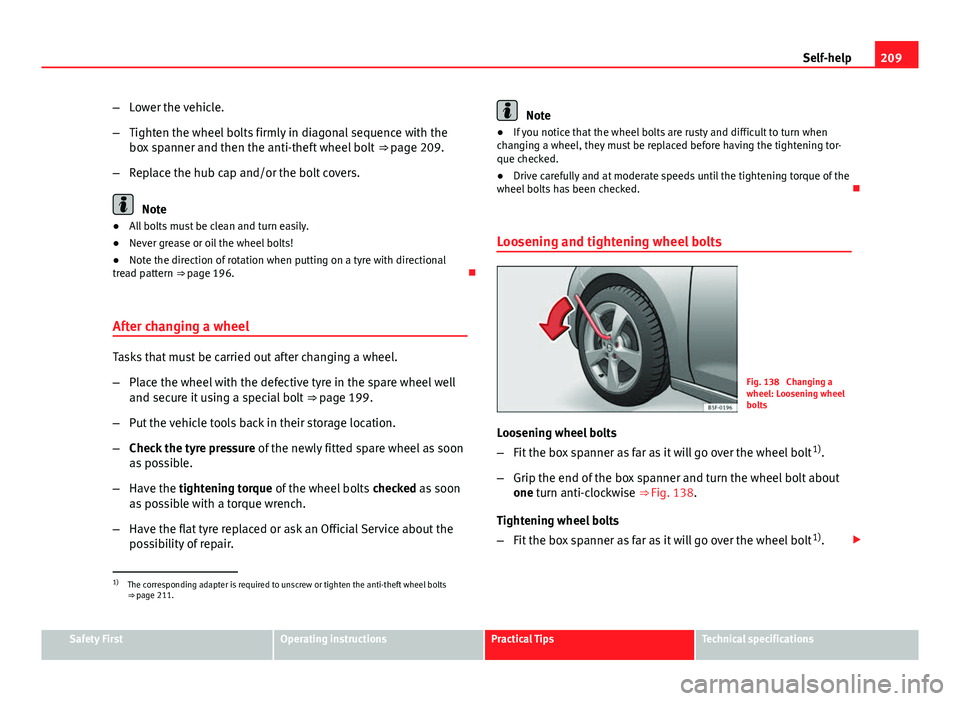
Fig. 138 Changing a
wheel: Loosening wheel
bolts
Loosening wheel bolts
– Fit the box spanner as far as it will go over the wheel bolt 1)
.
– Grip the end of the box spanner and turn the wheel bolt about
one turn anti-clockwise ⇒ Fig. 138.
Tightening wheel bolts
– Fit the box spanner as far as it will go over the wheel bolt 1)
.
1)
The corresponding adapter is required to unscrew or tighten the anti-theft wheel bolts
⇒ page 211.
Safety FirstOperating instructionsPractical TipsTechnical specifications
Page 213 of 258
211
Self-help
Anti-theft wheel bolts*
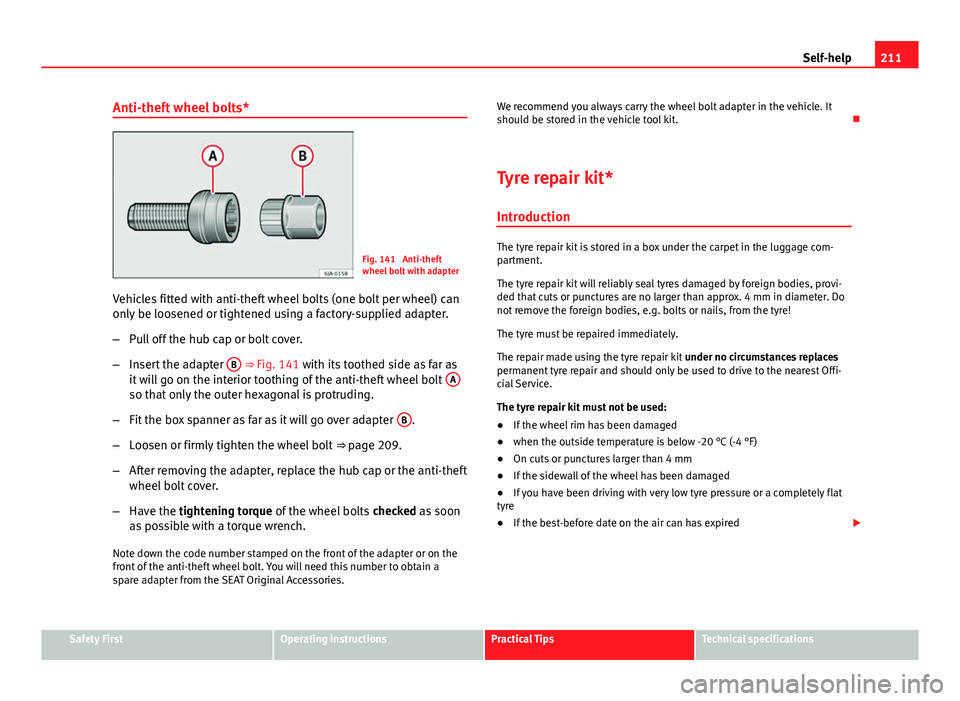
Fig. 141 Anti-theft
wheel bolt with adapter
Vehicles fitted with anti-theft wheel bolts (one bolt per wheel) can
only be loosened or tightened using a factory-supplied adapter.
– Pull off the hub cap or bolt cover.
– Insert the adapter B
⇒ Fig. 141 with its toothed side as far as
it will go on the interior toothing of the anti-theft wheel bolt A
so that only the outer hexagonal is protruding.
– Fit the box spanner as far as it will go over adapter B
.
– Loosen or firmly tighten the wheel bolt ⇒ page 209.
– After removing the adapter, replace the hub cap or the anti-theft
wheel bolt cover.
– Have the tightening torque of the wheel bolts checked as soon
as possible with a torque wrench.
Note down the code number stamped on the front of the adapter or on the
front of the anti-theft wheel bolt. You will need this number to obtain a
spare adapter from the SEAT Original Accessories. We recommend you always carry the wheel bolt adapter in the vehicle. It
should be stored in the vehicle tool kit.
Tyre repair kit* Introduction
The tyre repair kit is stored in a box under the carpet in the luggage com-
partment.
The tyre repair kit will reliably seal tyres damaged by foreign bodies, provi-
ded that cuts or punctures are no larger than approx. 4 mm in diameter. Do
not remove the foreign bodies, e.g. bolts or nails, from the tyre!
The tyre must be repaired immediately.
The repair made using the tyre repair kit under no circumstances replaces
permanent tyre repair and should only be used to drive to the nearest Offi-
cial Service.
The tyre repair kit must not be used:
● If the wheel rim has been damaged
● when the outside temperature is below -20 °C (-4 °F)
● On cuts or punctures larger than 4 mm
● If the sidewall of the wheel has been damaged
● If you have been driving with very low tyre pressure or a completely flat
tyre
● If the best-before date on the air can has expired
Safety FirstOperating instructionsPractical TipsTechnical specifications
Page 222 of 258
220Fuses and bulbs
Fuses in the dash panel
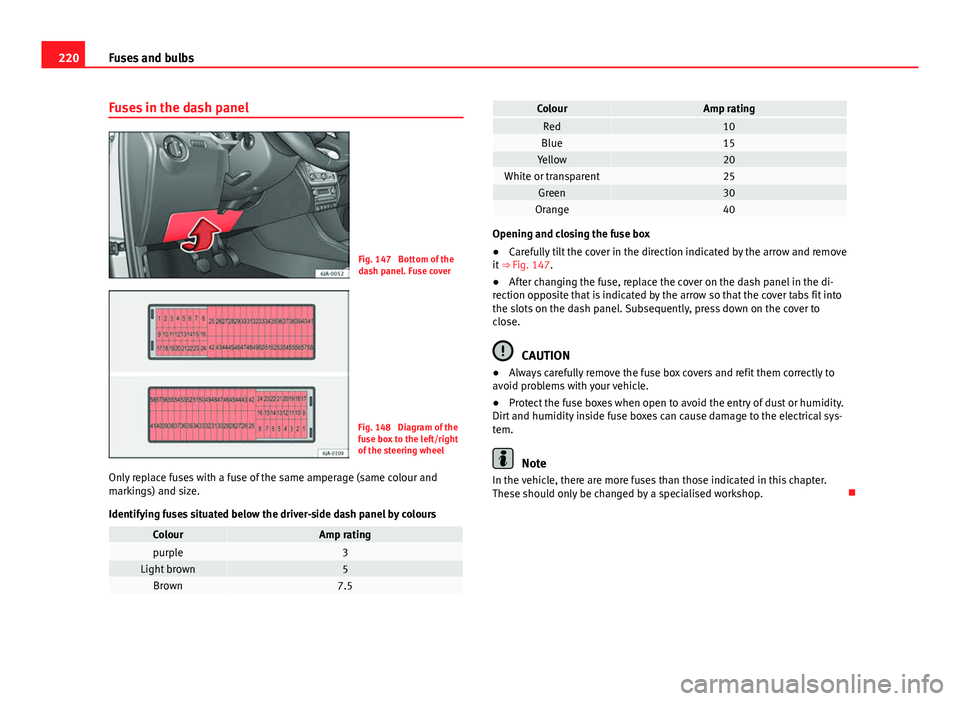
Fig. 147 Bottom of the
dash panel. Fuse cover
Fig. 148 Diagram of the
fuse box to the left/right
of the steering wheel
Only replace fuses with a fuse of the same amperage (same colour and
markings) and size.
Identifying fuses situated below the driver-side dash panel by colours
ColourAmp ratingpurple3Light brown5Brown7.5
ColourAmp ratingRed10Blue15Yellow20White or transparent25Green30Orange40
Opening and closing the fuse box
● Carefully tilt the cover in the direction indicated by the arrow and remove
it ⇒ Fig. 147.
● After changing the fuse, replace the cover on the dash panel in the di-
rection opposite that is indicated by the arrow so that the cover tabs fit into
the slots on the dash panel. Subsequently, press down on the cover to
close.
CAUTION
● Always carefully remove the fuse box covers and refit them correctly to
avoid problems with your vehicle.
● Protect the fuse boxes when open to avoid the entry of dust or humidity.
Dirt and humidity inside fuse boxes can cause damage to the electrical sys-
tem.
Note
In the vehicle, there are more fuses than those indicated in this chapter.
These should only be changed by a specialised workshop.
Page 224 of 258
222Fuses and bulbs
Changing bulbs
Introduction
Changing bulbs requires a certain degree of practical skill. If in doubt, we
recommend you have defective bulbs changed by a specialised service or,
in case of an emergency, seek professional assistance.
● Switch off the ignition and all of the lights before changing a bulb.
● Do not touch the glass part of the bulb with your bare hands. The finger-
prints left on the glass will vaporise as a result of the heat generated by the
bulb, causing a reduction in bulb life and condensation on the mirror sur-
face, thus reducing effectiveness.
● A bulb must only be replaced by one of the same type. The type is indi-
cated on the bulb, either on the glass part or on the base.
● There is a storage area for the bulb box in the spare wheel well or below
the carpet in the luggage compartment.
The light source used for each function is listed below:
Double headlights
H7 Long Life
H7
W5W Long Life PY21W NA P21W Super Long Life
Dipped beam:
Main beam:
Side lights:
Turn signals:
Daytime driving lights:
WARNING
● Take particular care when working on components in the engine com-
partment if the engine is warm. Risk of burns.
● Bulbs are highly sensitive to pressure. The glass can break when you
touch the bulb, causing injury.
● The high voltage element of gas discharge bulbs* (xenon light) must
be handled correctly. Otherwise, there is a risk of death.
● When changing bulbs, please take care not to injure yourself on sharp
parts in the headlight housing.
CAUTION
● Remove the ignition key before working on the electric system. Other-
wise, a short circuit could occur.
● Switch off the lights and the parking light before changing a bulb.
For the sake of the environment
Please ask your specialist retailer how to dispose of used bulbs in the prop-
er manner.
Note
● Depending on weather conditions (cold or wet), the front lights, the fog
lights, the rear lights and the turn signals may be temporarily misted. This
has no influence on the useful life of the lighting system. By switching on
the lights, the area through which the beam of light is projected will quickly
be demisted. However, the edges may continue to be misted.
● Please check at regular intervals that all lighting (especially the exterior
lighting) on your vehicle is functioning properly. This is not only in the inter-
est of your own safety, but also in that of all other road users.
Page 236 of 258
234Description of the data
Vehicle identification data on the data sticker
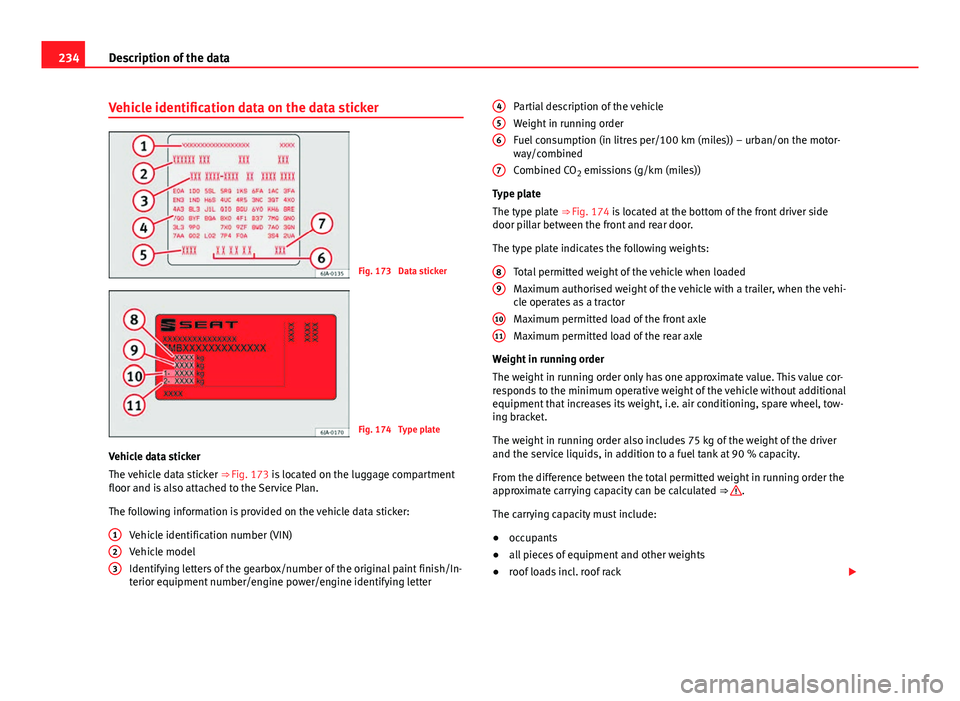
Fig. 173 Data sticker
Fig. 174 Type plate
Vehicle data sticker
The vehicle data sticker ⇒ Fig. 173 is located on the luggage compartment
floor and is also attached to the Service Plan.
The following information is provided on the vehicle data sticker:
Vehicle identification number (VIN)
Vehicle model
Identifying letters of the gearbox/number of the original paint finish/In-
terior equipment number/engine power/engine identifying letter
1
23
Partial description of the vehicle
Weight in running order
Fuel consumption (in litres per/100 km (miles)) – urban/on the motor-
way/combined
Combined CO
2 emissions (g/km (miles))
Type plate
The type plate ⇒ Fig. 174 is located at the bottom of the front driver side
door pillar between the front and rear door.
The type plate indicates the following weights:
Total permitted weight of the vehicle when loaded
Maximum authorised weight of the vehicle with a trailer, when the vehi-
cle operates as a tractor
Maximum permitted load of the front axle
Maximum permitted load of the rear axle
Weight in running order
The weight in running order only has one approximate value. This value cor-
responds to the minimum operative weight of the vehicle without additional
equipment that increases its weight, i.e. air conditioning, spare wheel, tow-
ing bracket.
The weight in running order also includes 75 kg of the weight of the driver
and the service liquids, in addition to a fuel tank at 90 % capacity.
From the difference between the total permitted weight in running order the
approximate carrying capacity can be calculated ⇒
.
The carrying capacity must include:
● occupants
● all pieces of equipment and other weights
● roof loads incl. roof rack
4
56
7
89
1011
Page 237 of 258

235
Description of the data
● equipment that is not included in the running order weight
● when using the towing bracket, the drawbar load (max. 50 kg)
Calculating fuel consumption and CO 2 emissions according to the ECE
regulations and the EU specifications
Calculation of fuel consumption for urban driving starts when cold-starting
the engine. Then, normal city driving is simulated.
In extra-urban driving fuel consumption calculation, the vehicle brakes and
accelerated in all gears, as in daily use of the vehicle. The driving speed
moves between a range of 0 and 120 km/h (75 mph).
The consumption value in combined driving is composed of 37 % of the val-
ue of urban driving and 63 % of the value of extra-urban driving.
WARNING
The maximum permitted weight values must not be exceeded – Risk of
an accident and damage to the vehicle!
Note
● If you wish to calculate the exact weight of your vehicle please contact a
SEAT dealer.
● Depending on the volume of equipment, the driving style, road condi-
tions, weather conditions and the condition of the vehicle, the consumption
values can differ from the theoretical values reproduced here. Information on fuel consumption
Fuel consumption
The consumption and emission details shown on the vehicle
data sticker differ from one vehicle to another.
The vehicle fuel consumption and CO 2 emissions can be consulted on the
vehicle data sticker in the spare wheel well, inside the luggage compart-
ment and on the rear cover of the Maintenance Programme.
The fuel consumption and CO 2 emission values refer to the weight category
assigned to your vehicle according to the engine and gearbox combination,
as well as the specific equipment fitted, and is only used to compare be-
tween the different models.
The fuel consumption and CO 2 emissions do not depend only on the per-
formance of the vehicle, they can also differ from the established values de-
pending on other factors such as driving style, road conditions, traffic con-
ditions, environmental conditions, load and number of passengers.
Calculation of fuel consumption
The consumption values have been calculated based on measurements per-
formed or supervised by certified CE laboratories according to the latest ver-
sion of directives 715/2007/EC and 80/1268/CEE (for more information
consult the European Union Publications Office at EUR-Lex: © European Un-
ion, http://eur-lex.europa.eu/en/index.htm) and are valid for the kerb
weight indicated for the vehicle.
Note
In practice, and considering all the factors mentioned here, consumption
values can differ from those calculated in the current European regulations.
Safety FirstOperating instructionsPractical TipsTechnical specifications
Page 255 of 258
head restraints . . . . . . . . . . . . . . . . . . . . . . 112
heating . . . . . . . . . . . . . . . . . . . . . . . . . . . . 112
Selector lever see selector lever positions . . . . . . . . . . . . 147
Selector lever positions . . . . . . . . . . . . . . . . . . 147
Service display . . . . . . . . . . . . . . . . . . . . . . . . . . 59
Setting clock . . . . . . . . . . . . . . . . . . . . . . . . . . . . . . . 60
Settings exterior mirrors . . . . . . . . . . . . . . . . . . . . . . 109
Interior rear vision mirror with manual anti-dazzle adjustment . . . . . . . . . . . . . . . . . . 109
light range control . . . . . . . . . . . . . . . . . . . . 99
Side airbags . . . . . . . . . . . . . . . . . . . . . . . . . . . . 38 Description . . . . . . . . . . . . . . . . . . . . . . . . . . 38
Operation . . . . . . . . . . . . . . . . . . . . . . . . . . . 39
Safety notes . . . . . . . . . . . . . . . . . . . . . . . . . 40
Sitting position driver . . . . . . . . . . . . . . . . . . . . . . . . . . . . . . . 11
Sitting position for vehicle occupants . . . . . . . 10
Snow chains . . . . . . . . . . . . . . . . . . . . . . . 202, 237
Spare changing a wheel . . . . . . . . . . . . . . . . . . . . 207
Spare parts . . . . . . . . . . . . . . . . . . . . . . . . . . . . 204
Spare wheel . . . . . . . . . . . . . . . . . . . . . . . . . . . 199
Speedometer . . . . . . . . . . . . . . . . . . . . . . . . . . . 58 see speedometer . . . . . . . . . . . . . . . . . . . . . 58
START-STOP description . . . . . . . . . . . . . . . . . . . . . . . . . 154
jump-starting . . . . . . . . . . . . . . . . . . . . . . . 216
Starting the engine . . . . . . . . . . . . . . . . . . . . . 141 Starting with jump leads
jump-starting . . . . . . . . . . . . . . . . . . . . . . . 214
Steering wheel . . . . . . . . . . . . . . . . . . . . . . . . . 140
Steering wheel controls . . . . . . . . . . . . . . . . . . . 78
Storage luggage compartment . . . . . . . . . . . . . . . . 115
Storage compartment . . . . . . . . . . . . . . . . . . . 123
Summary control lamps . . . . . . . . . . . . . . . . . . . . . . . . 69
controls and displays . . . . . . . . . . . . . . . . . . 55
Sun visors . . . . . . . . . . . . . . . . . . . . . . . . . . . . . 104 see sun visors . . . . . . . . . . . . . . . . . . . . . . . 104
Switching off the engine . . . . . . . . . . . . . . . . . 142
T Technical data . . . . . . . . . . . . . . . . . . . . . . . . . 238
Technical Data . . . . . . . . . . . . . . . . . . . . . . . . . 233
Temperature selection heating . . . . . . . . . . . . . . . . . . . . . . . . . . . . 130
The danger of not using the seat belt . . . . . . . . 23
Tightening torque of wheel bolts . . . . . . . . . . 237
Tiptronic . . . . . . . . . . . . . . . . . . . . . . . . . . . . . . 146 see automatic gearbox . . . . . . . . . . . . . . . 148
Tool kit . . . . . . . . . . . . . . . . . . . . . . . . . . . . . . . 207
Topping up coolant . . . . . . . . . . . . . . . . . . . . . . . . . . . . 188
engine oil . . . . . . . . . . . . . . . . . . . . . . . . . . 187
windscreen washer . . . . . . . . . . . . . . . . . . 190
Top Tether system . . . . . . . . . . . . . . . . . . . . . . . 52
Tow-away protection system . . . . . . . . . . . . . . . 92
Towing . . . . . . . . . . . . . . . . . . . . . . . . . . . . . . . . 216 Towing a trailer . . . . . . . . . . . . . . . . . . . . . . . . . 236
Towline anchorage . . . . . . . . . . . . . . . . . . . . . . 218
rear . . . . . . . . . . . . . . . . . . . . . . . . . . . . . . . 218
Traction control . . . . . . . . . . . . . . . . . . . . . . . . . 145
Trailer . . . . . . . . . . . . . . . . . . . . . . . . . . . . . . . . 164 Towing a trailer . . . . . . . . . . . . . . . . . . . . . . 165
Trailer weights . . . . . . . . . . . . . . . . . . . . . . . . . 236
Transport roof carrier . . . . . . . . . . . . . . . . . . . . . . . . . 119
Transporting children . . . . . . . . . . . . . . . . . . . . . 46
Trip . . . . . . . . . . . . . . . . . . . . . . . . . . . . . . . . . . . 59
Trip counter . . . . . . . . . . . . . . . . . . . . . . . . . . . . . 59
Tyre pressures . . . . . . . . . . . . . . . . . . . . . . . . . . 236
Tyre repair kit . . . . . . . . . . . . . . . . . . . . . . . . . . 211
Tyre repairs . . . . . . . . . . . . . . . . . . . . . . . . . . . . 211
Tyres see Wheels and tyres . . . . . . . . . . . . . . . . . 198
U Underbody sealant . . . . . . . . . . . . . . . . . . . . . . 176
Unlocking central locking system . . . . . . . . . . . . . . . . . 87
remote control . . . . . . . . . . . . . . . . . . . . . . . 90
USB . . . . . . . . . . . . . . . . . . . . . . . . . . . . . . . . . . . 81
V
Vehicle interior monitoring . . . . . . . . . . . . . . . . 92
Vehicle status see Auto-check system . . . . . . . . . . . . . . . . 68
Vehicle tool kit . . . . . . . . . . . . . . . . . . . . . . . . . 207
253
Index