technical specifications Seat Toledo 2013 Owners Manual
[x] Cancel search | Manufacturer: SEAT, Model Year: 2013, Model line: Toledo, Model: Seat Toledo 2013Pages: 258, PDF Size: 3.94 MB
Page 185 of 258
183
Checking and refilling levels
WARNING (Continued)
– Never work near naked flames.
– Always keep an approved fire extinguisher immediately available.
CAUTION
● When topping up fluids, make sure the correct fluid is put into the cor-
rect filler opening. Otherwise this can cause serious malfunctions or engine
damage!
● Never open the bonnet using the release catch. Risk of damage.
For the sake of the environment
Due to the environment-friendly disposal of fluids, the equipment necessary
and the knowledge required, fluids must be changed by an authorised SEAT
dealer during the service inspections of the vehicle.
Note
● Please contact an authorised SEAT dealer with any doubts regarding flu-
ids.
● Fluids of the correct specifications can be acquired from the selection of
SEAT Original Accessories. Opening and closing the bonnet
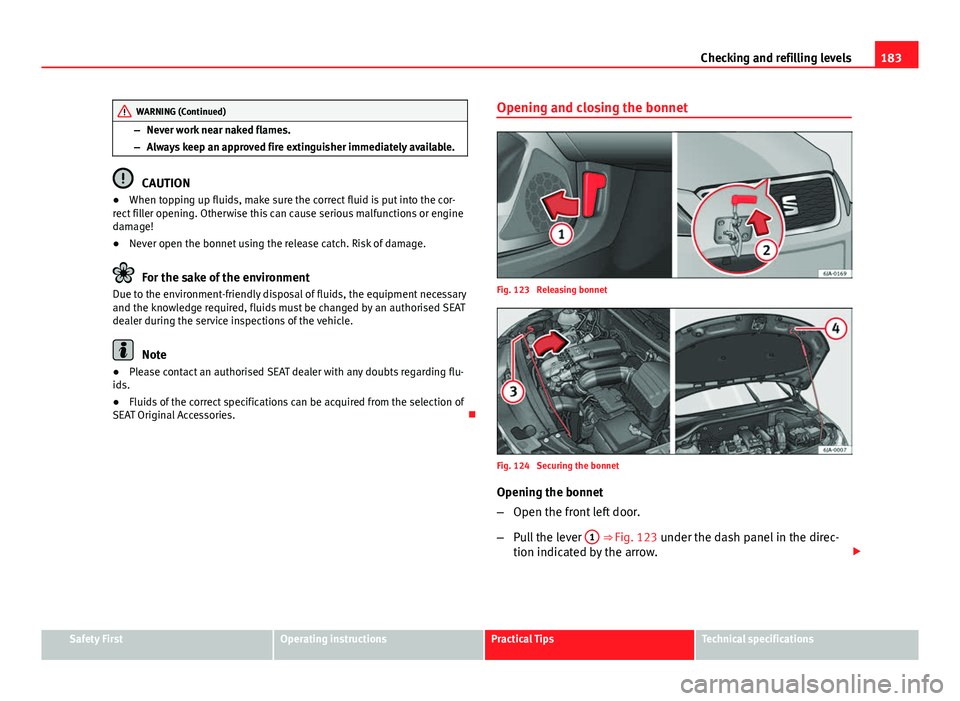
Fig. 123 Releasing bonnet
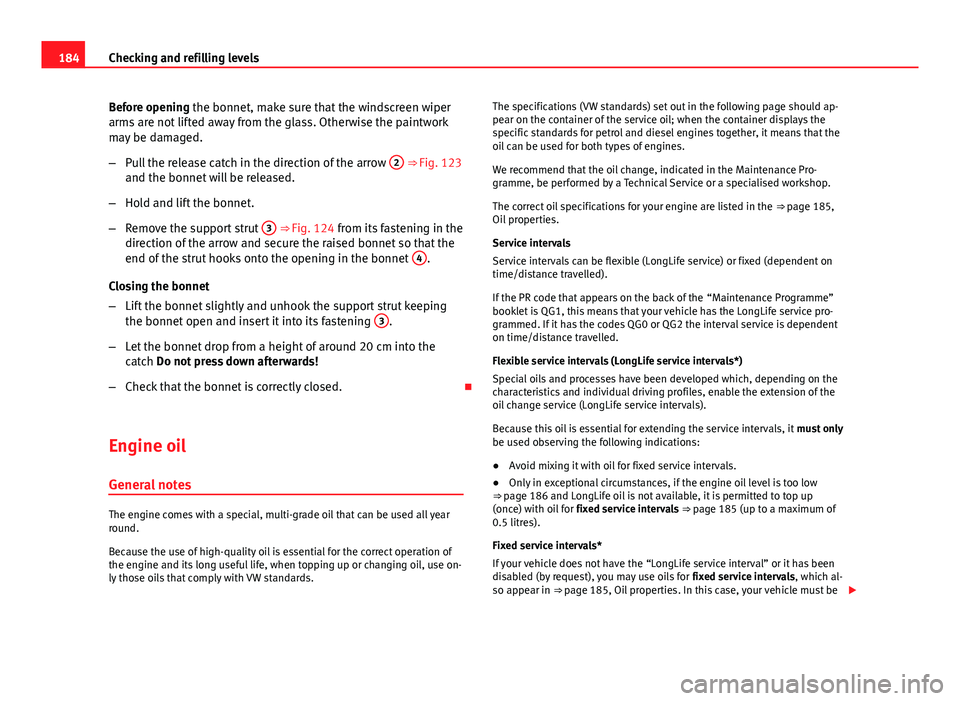
Fig. 124 Securing the bonnet
Opening the bonnet
– Open the front left door.
– Pull the lever 1
⇒ Fig. 123 under the dash panel in the direc-
tion indicated by the arrow.
Safety FirstOperating instructionsPractical TipsTechnical specifications
Page 186 of 258
184Checking and refilling levels
Before opening the bonnet, make sure that the windscreen wiper
arms are not lifted away from the glass. Otherwise the paintwork
may be damaged.
–Pull the release catch in the direction of the arrow 2
⇒ Fig. 123
and the bonnet will be released.
– Hold and lift the bonnet.
– Remove the support strut 3
⇒ Fig. 124 from its fastening in the
direction of the arrow and secure the raised bonnet so that the
end of the strut hooks onto the opening in the bonnet 4
.
Closing the bonnet
– Lift the bonnet slightly and unhook the support strut keeping
the bonnet open and insert it into its fastening 3
.
– Let the bonnet drop from a height of around 20 cm into the
catch Do not press down afterwards!
– Check that the bonnet is correctly closed.
Engine oil General notes
The engine comes with a special, multi-grade oil that can be used all year
round.
Because the use of high-quality oil is essential for the correct operation of
the engine and its long useful life, when topping up or changing oil, use on-
ly those oils that comply with VW standards. The specifications (VW standards) set out in the following page should ap-
pear on the container of the service oil; when the container displays the
specific standards for petrol and diesel engines together, it means that the
oil can be used for both types of engines.
We recommend that the oil change, indicated in the Maintenance Pro-
gramme, be performed by a Technical Service or a specialised workshop.
The correct oil specifications for your engine are listed in the
⇒ page 185,
Oil properties.
Service intervals
Service intervals can be flexible (LongLife service) or fixed (dependent on
time/distance travelled).
If the PR code that appears on the back of the “Maintenance Programme”
booklet is QG1, this means that your vehicle has the LongLife service pro-
grammed. If it has the codes QG0 or QG2 the interval service is dependent
on time/distance travelled.
Flexible service intervals (LongLife service intervals*)
Special oils and processes have been developed which, depending on the
characteristics and individual driving profiles, enable the extension of the
oil change service (LongLife service intervals).
Because this oil is essential for extending the service intervals, it must only
be used observing the following indications:
● Avoid mixing it with oil for fixed service intervals.
● Only in exceptional circumstances, if the engine oil level is too low
⇒ page 186 and LongLife oil is not available, it is permitted to top up
(once) with oil for fixed service intervals ⇒ page 185 (up to a maximum of
0.5 litres).
Fixed service intervals*
If your vehicle does not have the “LongLife service interval” or it has been
disabled (by request), you may use oils for fixed service intervals, which al-
so appear in ⇒ page 185, Oil properties. In this case, your vehicle must be
Page 187 of 258
185
Checking and refilling levels
serviced after a fixed interval of 1 year/15 000 km (10 000 miles)(whatever
comes first) ⇒ Booklet Maintenance Programme.
● In exceptional circumstances, if the engine oil level is too low
⇒ page 186 and you cannot obtain the oil specified for your vehicle, you
can put in a small quantity of oil conforming to the specification ACEA A2 or
ACEA A3 (petrol engines) or ACEA B3 or ACEA B4 (diesel engines) (up to 0.5
l).
Vehicles with diesel particulate filter*
The “Maintenance Programme” states whether your vehicle is fitted with a
diesel particulate filter.
Only VW 507 00 engine oil, with reduced ash formation, may be used in die-
sel engines equipped with particulate filter. Using other types of oil will
cause a higher soot concentration and reduce the life of the DPF. Therefore:
● Avoid mixing this oil with other engine oils.
● Only in exceptional circumstances, if the engine oil level is too low
⇒ page 186 and you cannot obtain the oil specified for your vehicle, you
can use a small quantity of oil (once) conforming to the VW 506 00,
VW 506 01, VW 505 00, VW 505 01 or ACEA B3/ACEA B4 specification. (up
to 0.5 l).
Oil properties
Engine typeSpecificationPetrol without flexible service in-
tervalVW 502 00/VW 504 00
Petrol with flexible service inter-
val (LongLife)VW 504 00
Engine typeSpecificationDiesel. Engines without Particu-
late filter (DPF)VW 505 01/VW 506 01/VW 507 00
Diesel. Particulate Filter Engines
(DPF).
With or without flexible service in-
terval (with and without Long-
life) a)VW 507 00
a)
Only use recommended oils, otherwise you may damage the engine.
Engine oil additives
No type of additive should be mixed with the engine oil. The deterioration
caused by these additives is not covered by the warranty.
Note
Before a long trip, we recommend finding an engine oil that conforms to the
corresponding VW specifications and recommend keeping it in the vehicle.
This way, the correct engine oil will always be available for a top-up if nee-
ded.
Safety FirstOperating instructionsPractical TipsTechnical specifications
Page 189 of 258
187
Checking and refilling levels
Topping up engine oil
– Check the engine oil level ⇒ page 186, Checking the engine oil
level.
– Unscrew the cap from the filler opening.
– Put in the specified grade of oil 0.5 litres at a time ⇒ page 184.
– Check the oil level ⇒ page 186.
– Replace the oil filler cap carefully and push the dipstick all the
way in.
Changing engine oil
Engine oil must be changed with the frequency indicated in the Mainte-
nance Programme or according to the service interval indicator ⇒ page 59.
CAUTION
Do not mix engine oil with additives. Risk of damage to the engine! Damage
caused by these products is not covered by the warranty.
Note
Wash your skin thoroughly if it comes into contact with engine oil. Coolant
General notes
The cooling system is factory-filled with an anti-freeze product.
Coolant consists of a mixture of water and 40% anti-freeze additive. This
mixture gives the required anti-freeze protection at temperatures down to
+25 °C (+77 °F) and protects the cooling and heating system against corro-
sion. It also prevents scaling and raises the boiling point of the coolant con-
siderably.
The coolant concentration must not be reduced by adding water, even in
warmer seasons or in warm countries. The concentration of the anti-freeze
additive in the coolant must be at least 40 %.
If greater anti-freeze protection is required in very cold climates, the propor-
tion of the anti-freeze additive can be increased, but only up to 60 % (anti-
freeze protection down to approx. -40 °C (-40 °F). Any excess in this propor-
tion would reduce the anti-freeze protection and affect the cooling effect.
Vehicles for countries with cold climate are are supplied with coolant protec-
tion down to around -35 °C (-31 °F). The proportion of the antifreeze addi-
tive in these countries should always be at least 50 %.
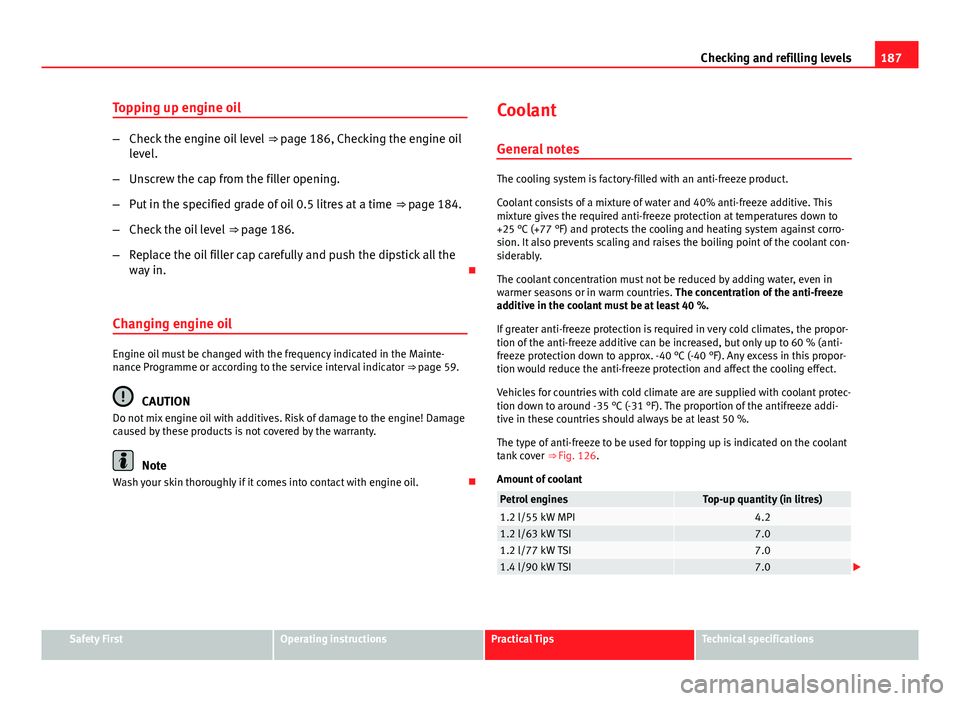
The type of anti-freeze to be used for topping up is indicated on the coolant
tank cover ⇒ Fig. 126.
Amount of coolant
Petrol enginesTop-up quantity (in litres)1.2 l/55 kW MPI4.21.2 l/63 kW TSI7.01.2 l/77 kW TSI7.01.4 l/90 kW TSI7.0
Safety FirstOperating instructionsPractical TipsTechnical specifications
Page 191 of 258
189
Checking and refilling levels
Always top up with unused coolant.
Never fill the coolant tank above mark A
(max.) ⇒ Fig. 126 Excess coolant
is forced out of the cooling system through the overpressure valve in the fill-
er cap of the expansion tank when the engine heats up.
WARNING
● The anti-freeze additive and, therefore, the entire coolant, are a
health hazard. Avoid touching the coolant. Coolant fumes are also a
health hazard. Store the coolant additive in a safe place out of the reach
of children. Risk of poisoning!
● If splashed into eyes, rinse immediately with clean water and seek
immediate medical advice.
● Seek immediate medical advice if the coolant is accidentally inges-
ted.
CAUTION
If the engine oil cannot be topped up under the given conditions, do not
drive on. We recommend contacting an authorised SEAT dealer, as this can
damage the engine.
Radiator fan
The radiator is driven by an electric motor and controlled according to the
temperature of the coolant.
After the engine has been stopped and the ignition switched off, the radia-
tor fan may continue running for around 10 minutes. Brake fluid
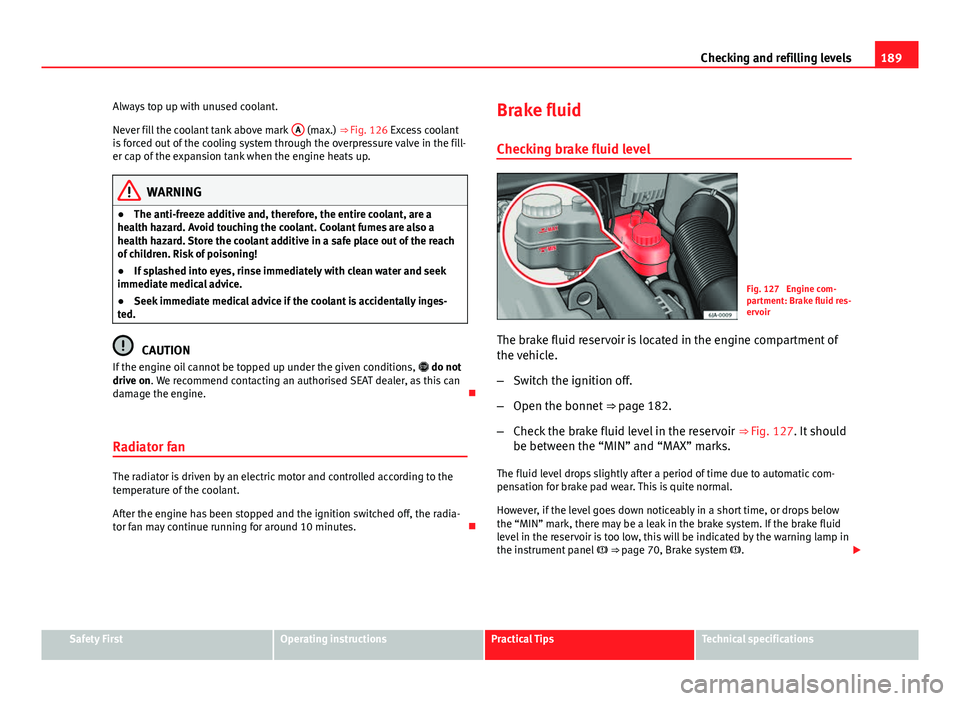
Checking brake fluid level
Fig. 127 Engine com-
partment: Brake fluid res-
ervoir
The brake fluid reservoir is located in the engine compartment of
the vehicle.
– Switch the ignition off.
– Open the bonnet ⇒ page 182.
– Check the brake fluid level in the reservoir ⇒ Fig. 127. It should
be between the “MIN” and “MAX” marks.
The fluid level drops slightly after a period of time due to automatic com-
pensation for brake pad wear. This is quite normal.
However, if the level goes down noticeably in a short time, or drops below
the “MIN” mark, there may be a leak in the brake system. If the brake fluid
level in the reservoir is too low, this will be indicated by the warning lamp in
the instrument panel
⇒ page 70, Brake system .
Safety FirstOperating instructionsPractical TipsTechnical specifications
Page 193 of 258
191
Checking and refilling levels
CAUTION
● Never mix the windscreen washing water with anti-freeze used for the
cooling system or other additives.
● If the vehicle is equipped with a headlight washer system, only mix a de-
tergent that does not damage polycarbonates with the water.
Note
On topping up the fluid, do not move the filter on the container opening, as
this could contaminate the fluid pipes and, therefore, lead to a windscreen
washer malfunction.
Battery Introduction
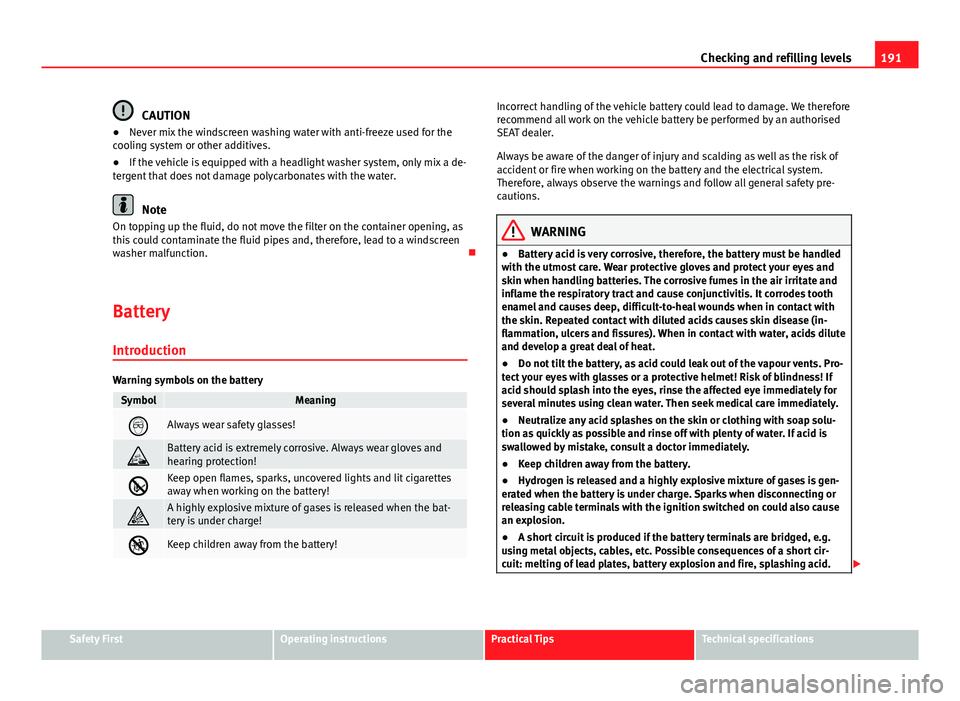
Warning symbols on the battery
SymbolMeaning
Always wear safety glasses!
Battery acid is extremely corrosive. Always wear gloves and
hearing protection!
Keep open flames, sparks, uncovered lights and lit cigarettes
away when working on the battery!
A highly explosive mixture of gases is released when the bat-
tery is under charge!
Keep children away from the battery!
Incorrect handling of the vehicle battery could lead to damage. We therefore
recommend all work on the vehicle battery be performed by an authorised
SEAT dealer.
Always be aware of the danger of injury and scalding as well as the risk of
accident or fire when working on the battery and the electrical system.
Therefore, always observe the warnings and follow all general safety pre-
cautions.
WARNING
● Battery acid is very corrosive, therefore, the battery must be handled
with the utmost care. Wear protective gloves and protect your eyes and
skin when handling batteries. The corrosive fumes in the air irritate and
inflame the respiratory tract and cause conjunctivitis. It corrodes tooth
enamel and causes deep, difficult-to-heal wounds when in contact with
the skin. Repeated contact with diluted acids causes skin disease (in-
flammation, ulcers and fissures). When in contact with water, acids dilute
and develop a great deal of heat.
● Do not tilt the battery, as acid could leak out of the vapour vents. Pro-
tect your eyes with glasses or a protective helmet! Risk of blindness! If
acid should splash into the eyes, rinse the affected eye immediately for
several minutes using clean water. Then seek medical care immediately.
● Neutralize any acid splashes on the skin or clothing with soap solu-
tion as quickly as possible and rinse off with plenty of water. If acid is
swallowed by mistake, consult a doctor immediately.
● Keep children away from the battery.
● Hydrogen is released and a highly explosive mixture of gases is gen-
erated when the battery is under charge. Sparks when disconnecting or
releasing cable terminals with the ignition switched on could also cause
an explosion.
● A short circuit is produced if the battery terminals are bridged, e.g.
using metal objects, cables, etc. Possible consequences of a short cir-
cuit: melting of lead plates, battery explosion and fire, splashing acid.
Safety FirstOperating instructionsPractical TipsTechnical specifications
Page 195 of 258

193
Checking and refilling levels
– The positive terminal (+) of the battery is connected in reverse
order.
Checking battery acid level
Fig. 130 Battery: Acid
level indicator
We recommend you have the acid level regularly checked at an official tech-
nical service, particularly in the following cases.
● At high outside temperatures.
● On long daily trips.
● Whenever the vehicle is loaded ⇒ page 193, Charging the battery.
In vehicles equipped with a battery with colour indicator, the so-called mag-
ic eye ⇒ Fig. 130 changes colour to indicate the acid level.
Air bubbles can influence the colour of the indicator. Therefore, carefully
knock the indicator before checking the acid level.
● Black – the acid level is correct.
● Colourless or light yellow – acid level too low, battery must be changed.
Note
● The battery acid level is also regularly checked during servicing at au-
thorised SEAT dealers.
● The acid level on “AGM” vehicle batteries cannot be checked for techni-
cal reasons.
● Vehicles equipped with the “START-STOP” system include a battery con-
trol unit to control the battery level for repeat engine starting.
Winter service
At low temperatures the battery provides only a fraction of the starting pow-
er it has at normal temperatures.
A flat battery can also freeze at temperatures slightly below 0 °C (32 °F).
We therefore recommend you have the battery checked and, if necessary,
charged at an official SEAT technical service before the start of winter.
Charging the battery
A fully-charged battery is essential for reliable starting.
– Switch off the ignition and all electrical equipment.
– For “fast-charging” only: disconnect both battery connection ca-
bles (first the “negative” terminal and then the “positive”).
– Connect the charger cables to the battery terminals (red = “pos-
itive”, black = “negative”).
– Plug in the battery charger and switch on.
Safety FirstOperating instructionsPractical TipsTechnical specifications
Page 197 of 258
195
Checking and refilling levels
Note
Despite any measures taken by the control unit, the battery could drain. e.g.
with the engine is switched off, the key is turned in the ignition for a long
period or the side lights or parking lights are switched on. The switching off
of certain electrical components does not impair driving comfort and the
driver will often not even realise.
Safety FirstOperating instructionsPractical TipsTechnical specifications
Page 199 of 258
197
Wheels and tyres
Note
● We recommend having all work on tyres and wheels carried out by an
authorised SEAT dealer.
● We recommend using wheels, tyres, hub caps and snow chains from the
SEAT Original Accessories programme.
Tyre useful life
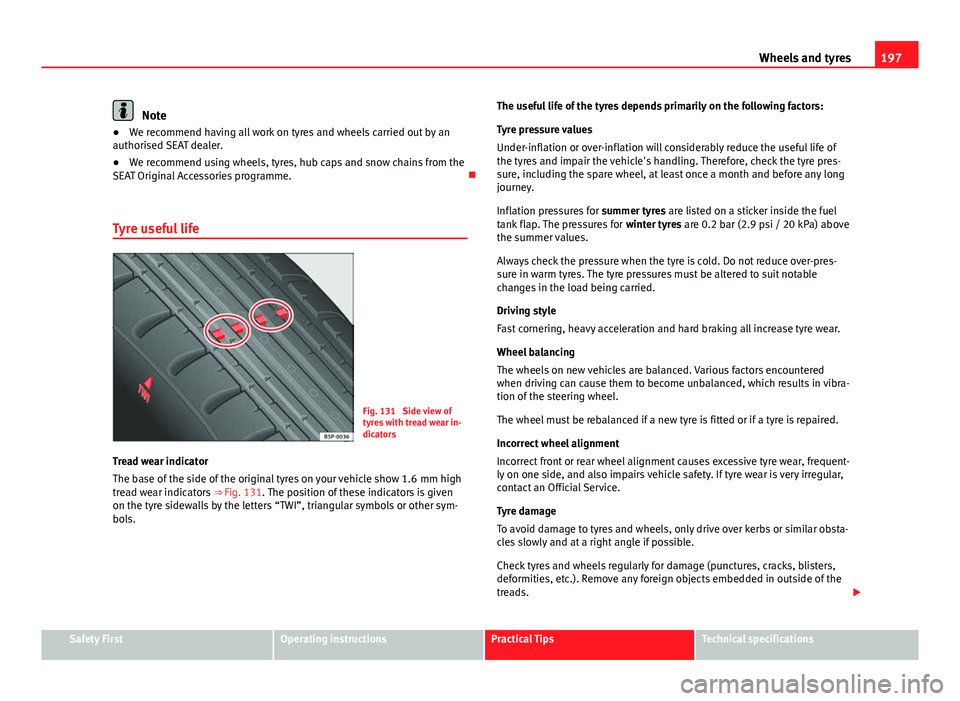
Fig. 131 Side view of
tyres with tread wear in-
dicators
Tread wear indicator
The base of the side of the original tyres on your vehicle show 1.6 mm high
tread wear indicators ⇒ Fig. 131. The position of these indicators is given
on the tyre sidewalls by the letters “TWI”, triangular symbols or other sym-
bols. The useful life of the tyres depends primarily on the following factors:
Tyre pressure values
Under-inflation or over-inflation will considerably reduce the useful life of
the tyres and impair the vehicle's handling. Therefore, check the tyre pres-
sure, including the spare wheel, at least once a month and before any long
journey.
Inflation pressures for
summer tyres are listed on a sticker inside the fuel
tank flap. The pressures for winter tyres are 0.2 bar (2.9 psi / 20 kPa) above
the summer values.
Always check the pressure when the tyre is cold. Do not reduce over-pres-
sure in warm tyres. The tyre pressures must be altered to suit notable
changes in the load being carried.
Driving style
Fast cornering, heavy acceleration and hard braking all increase tyre wear.
Wheel balancing
The wheels on new vehicles are balanced. Various factors encountered
when driving can cause them to become unbalanced, which results in vibra-
tion of the steering wheel.
The wheel must be rebalanced if a new tyre is fitted or if a tyre is repaired.
Incorrect wheel alignment
Incorrect front or rear wheel alignment causes excessive tyre wear, frequent-
ly on one side, and also impairs vehicle safety. If tyre wear is very irregular,
contact an Official Service.
Tyre damage
To avoid damage to tyres and wheels, only drive over kerbs or similar obsta-
cles slowly and at a right angle if possible.
Check tyres and wheels regularly for damage (punctures, cracks, blisters,
deformities, etc.). Remove any foreign objects embedded in outside of the
treads.
Safety FirstOperating instructionsPractical TipsTechnical specifications
Page 201 of 258
199
Wheels and tyres
The manufacturing date is also indicated on the tyre sidewall (possibly only
on the inner side of the wheel). DOT … 27 12…
means, for example, that the tyre was produced in the 27th week of 2012.
Follow the instructions ⇒ page 199 if you only have a temporary spare
wheel.
Tyres with directional tread pattern
The direction of rotation is indicated by the arrows on the tyre sidewall. The
direction of rotation indicated must be respected. This guarantees optimum
grip and helps avoid excessive noise, wear and aquaplaning.
In the event of a flat tyre, a spare wheel with an undetermined tread pattern
or an opposite tread pattern must be used and you must drive carefully, as
in these cases the tyres no longer offer maximum performance. Spare wheel*Fig. 133 Luggage com-
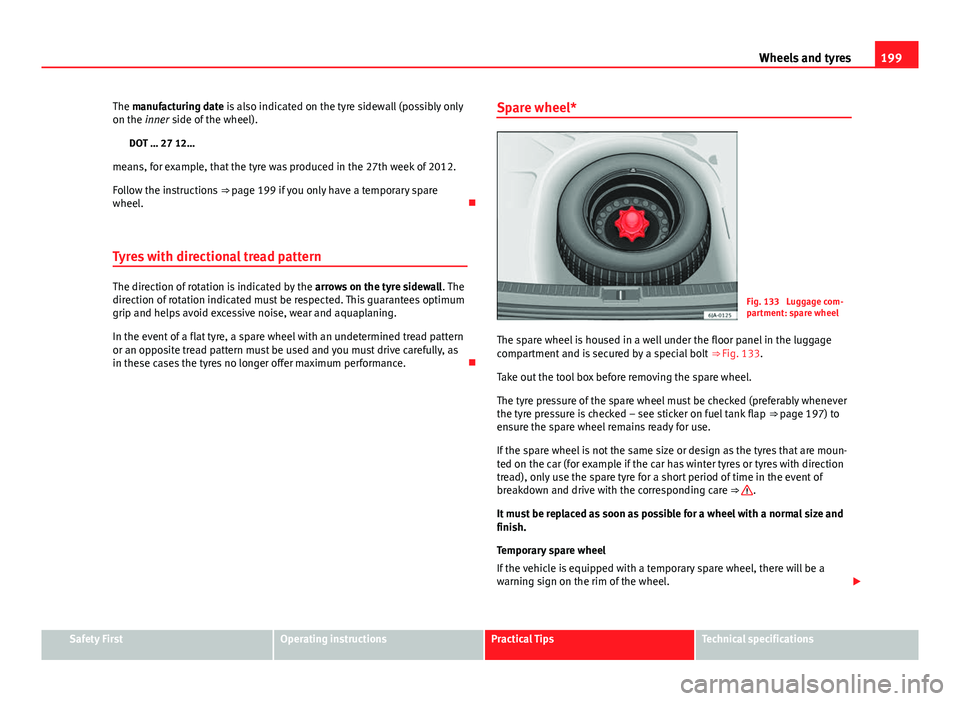
partment: spare wheel
The spare wheel is housed in a well under the floor panel in the luggage
compartment and is secured by a special bolt ⇒ Fig. 133.
Take out the tool box before removing the spare wheel.
The tyre pressure of the spare wheel must be checked (preferably whenever
the tyre pressure is checked – see sticker on fuel tank flap ⇒ page 197) to
ensure the spare wheel remains ready for use.
If the spare wheel is not the same size or design as the tyres that are moun-
ted on the car (for example if the car has winter tyres or tyres with direction
tread), only use the spare tyre for a short period of time in the event of
breakdown and drive with the corresponding care ⇒
.
It must be replaced as soon as possible for a wheel with a normal size and
finish.
Temporary spare wheel
If the vehicle is equipped with a temporary spare wheel, there will be a
warning sign on the rim of the wheel.
Safety FirstOperating instructionsPractical TipsTechnical specifications