technical specifications Seat Toledo 2013 Owner's manual
[x] Cancel search | Manufacturer: SEAT, Model Year: 2013, Model line: Toledo, Model: Seat Toledo 2013Pages: 258, PDF Size: 3.94 MB
Page 203 of 258

201
Wheels and tyres
Removing
– Insert the plastic clip into the cap until the inner retaining
notches on the clips touch the collar of the cap and then re-
move ⇒ Fig. 134.
Fitting
– Insert the caps as far as they will go over the wheel bolts.
The wheel bolt caps are stored in a box on the spare wheel or in the spare
wheel well.
Tyre pressure *
Fig. 135 Tyre pressure
setting switch
The tyre pressure monitoring system uses ABS sensors to compare the revo-
lutions and the circumference of each wheel. Should the circumference of
any wheel change, the warning lamp in the general instrument panel
⇒ page 76 will light up and an audible warning will be heard.
Tyre circumference may change if:
● Tyre pressure is too low
● Tyre structure is damaged ●
Vehicle load not evenly distributed
● Wheels on one axle are subjected to greater load, (e.g. driving with trail-
er, uphill, downhill)
● Snow chains are fitted
● The temporary spare wheel is fitted
● One wheel on the axle has been changed
Basic system settings
Should the tyre pressure change or if one or more wheels are changed or
the position of the wheel on the vehicle is changed, e.g. changing round the
front and rear wheels, or where a warning lamp lights up when driving, the
system must be adjusted as follows:
● Inflate all tyres to the prescribed pressures ⇒ page 197.
● Switch the ignition on.
● Hold the
⇒ Fig. 135 button down for at least 2 seconds. The warn-
ing lamp will light up when the button is pressed. The system memory is
also deleted and a new calibration system will begin, which is indicated by
an audible warning before the warning lamp switches off .
● If the warning lamp remains lit and does not switch off, not even once
the basic setting process is complete, this indicates a fault in the system.
Contact an Official Service.
The warning lamp lights up
If the pressure on at least one tyre is significantly lower than the pressure
set by the driver, the warning lamp ⇒
will light up.
The warning lamp flashes
If the warning lamp flashes, there is a fault in the system. Contact a special-
ised service to have it fixed.
Safety FirstOperating instructionsPractical TipsTechnical specifications
Page 205 of 258
203
Wheels and tyres
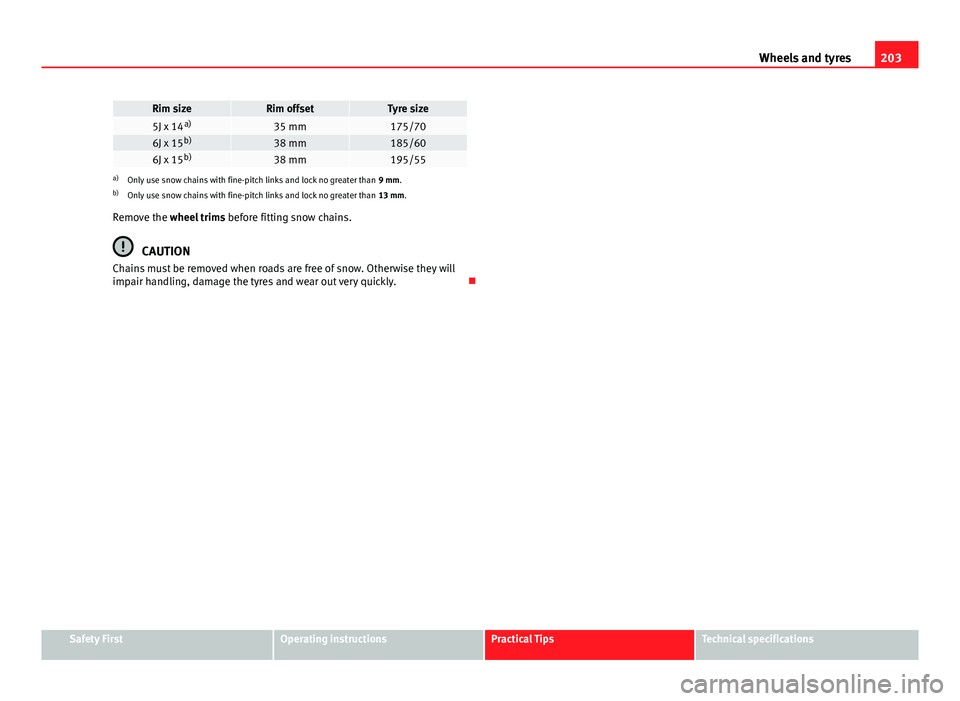
Rim sizeRim offsetTyre size5J x 14 a)35 mm175/706J x 15b)38 mm185/606J x 15b)38 mm195/55a)
Only use snow chains with fine-pitch links and lock no greater than 9 mm.
b) Only use snow chains with fine-pitch links and lock no greater than 13 mm.
Remove the wheel trims before fitting snow chains.
CAUTION
Chains must be removed when roads are free of snow. Otherwise they will
impair handling, damage the tyres and wear out very quickly.
Safety FirstOperating instructionsPractical TipsTechnical specifications
Page 207 of 258
205
Accessories, modifications and spare parts
Modifications and effects of the airbag
system
In the adjustment and modification, respect the SEAT directive.
Modifications and corrections of the front bumper, doors, front seats, roof
or bodywork must be carried out at authorised SEAT workshops. Compo-
nents of the airbag system can be found in these parts of the vehicle.
WARNING
● Airbag modules must never be repaired. They must be replaced.
● Never fit components of the airbag system removed from old vehicles
or those originating from a recycling process in the vehicle.
● The modification of the suspension of the vehicle wheels, including
the use of non-permitted combinations of tyres and rims can alter the op-
eration of the airbag system and increase the risk of serious or fatal inju-
ries in an accident.
● During all jobs on the airbag system, in addition to the removal and
fitting of parts of the system in the course of other repair jobs, parts of
the airbag system can be damaged. Therefore in the event of an accident,
this may cause the airbags to activate incorrectly or not activate al all.
Safety FirstOperating instructionsPractical TipsTechnical specifications
Page 209 of 258
207
Self-help
Vehicle tool kit*
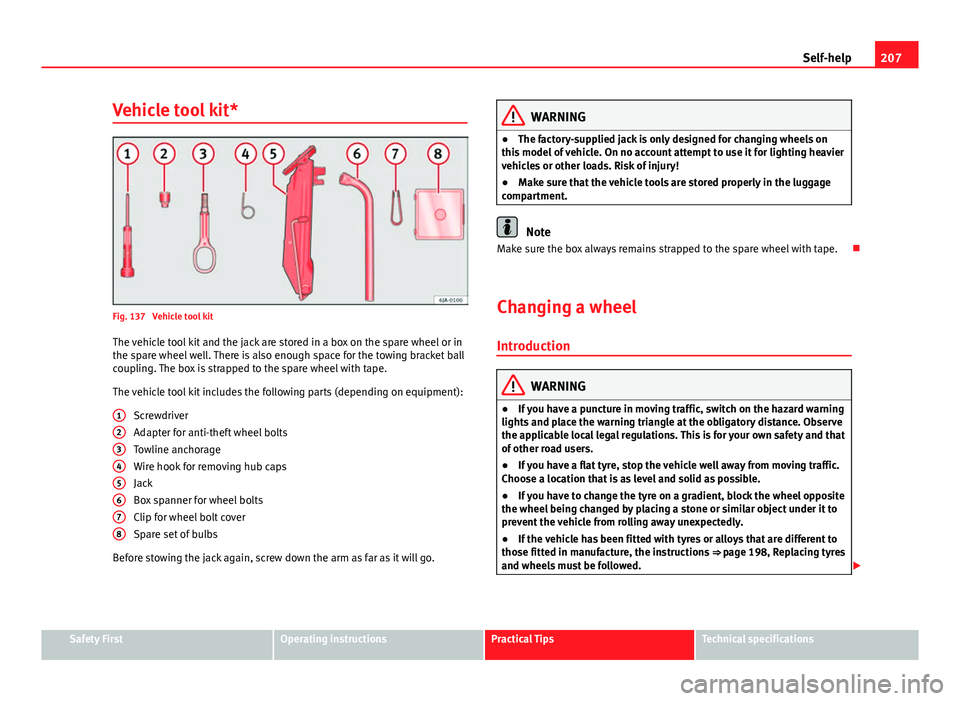
Fig. 137 Vehicle tool kit
The vehicle tool kit and the jack are stored in a box on the spare wheel or in
the spare wheel well. There is also enough space for the towing bracket ball
coupling. The box is strapped to the spare wheel with tape.
The vehicle tool kit includes the following parts (depending on equipment): Screwdriver
Adapter for anti-theft wheel bolts
Towline anchorage
Wire hook for removing hub caps
Jack
Box spanner for wheel bolts
Clip for wheel bolt cover
Spare set of bulbs
Before stowing the jack again, screw down the arm as far as it will go. 1
2345678
WARNING
● The factory-supplied jack is only designed for changing wheels on
this model of vehicle. On no account attempt to use it for lighting heavier
vehicles or other loads. Risk of injury!
● Make sure that the vehicle tools are stored properly in the luggage
compartment.
Note
Make sure the box always remains strapped to the spare wheel with tape.
Changing a wheel Introduction
WARNING
● If you have a puncture in moving traffic, switch on the hazard warning
lights and place the warning triangle at the obligatory distance. Observe
the applicable local legal regulations. This is for your own safety and that
of other road users.
● If you have a flat tyre, stop the vehicle well away from moving traffic.
Choose a location that is as level and solid as possible.
● If you have to change the tyre on a gradient, block the wheel opposite
the wheel being changed by placing a stone or similar object under it to
prevent the vehicle from rolling away unexpectedly.
● If the vehicle has been fitted with tyres or alloys that are different to
those fitted in manufacture, the instructions ⇒ page 198, Replacing tyres
and wheels must be followed.
Safety FirstOperating instructionsPractical TipsTechnical specifications
Page 211 of 258
209
Self-help
– Lower the vehicle.
– Tighten the wheel bolts firmly in diagonal sequence with the
box spanner and then the anti-theft wheel bolt ⇒ page 209.
– Replace the hub cap and/or the bolt covers.
Note
● All bolts must be clean and turn easily.
● Never grease or oil the wheel bolts!
● Note the direction of rotation when putting on a tyre with directional
tread pattern ⇒ page 196.
After changing a wheel
Tasks that must be carried out after changing a wheel.
– Place the wheel with the defective tyre in the spare wheel well
and secure it using a special bolt ⇒ page 199.
– Put the vehicle tools back in their storage location.
– Check the tyre pressure of the newly fitted spare wheel as soon
as possible.
– Have the tightening torque of the wheel bolts checked as soon
as possible with a torque wrench.
– Have the flat tyre replaced or ask an Official Service about the
possibility of repair.
Note
● If you notice that the wheel bolts are rusty and difficult to turn when
changing a wheel, they must be replaced before having the tightening tor-
que checked.
● Drive carefully and at moderate speeds until the tightening torque of the
wheel bolts has been checked.
Loosening and tightening wheel bolts
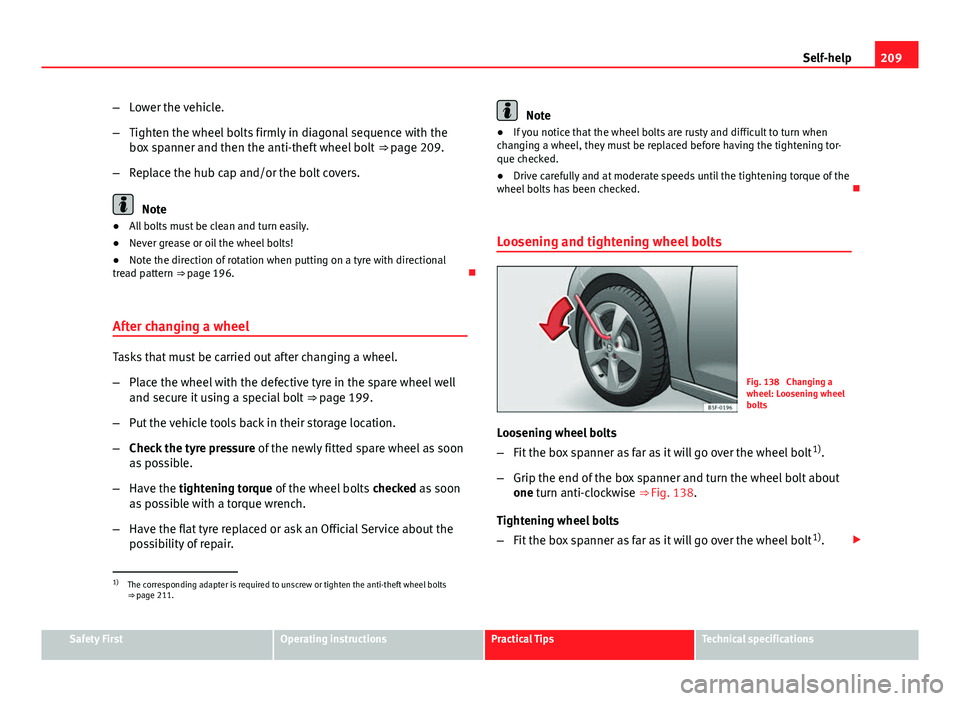
Fig. 138 Changing a
wheel: Loosening wheel
bolts
Loosening wheel bolts
– Fit the box spanner as far as it will go over the wheel bolt 1)
.
– Grip the end of the box spanner and turn the wheel bolt about
one turn anti-clockwise ⇒ Fig. 138.
Tightening wheel bolts
– Fit the box spanner as far as it will go over the wheel bolt 1)
.
1)
The corresponding adapter is required to unscrew or tighten the anti-theft wheel bolts
⇒ page 211.
Safety FirstOperating instructionsPractical TipsTechnical specifications
Page 213 of 258
211
Self-help
Anti-theft wheel bolts*
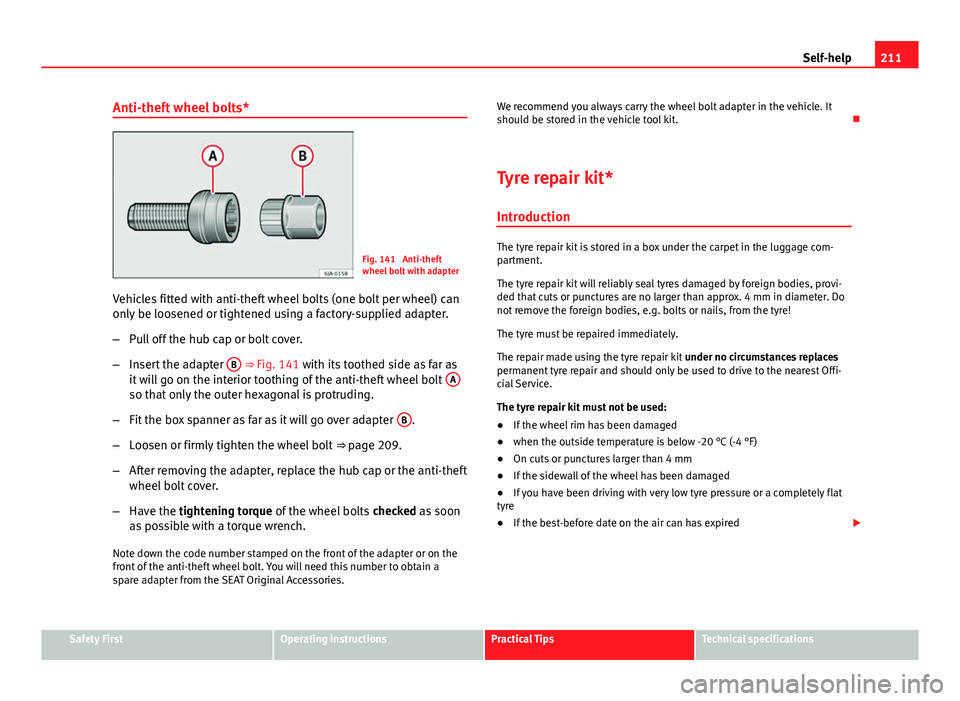
Fig. 141 Anti-theft
wheel bolt with adapter
Vehicles fitted with anti-theft wheel bolts (one bolt per wheel) can
only be loosened or tightened using a factory-supplied adapter.
– Pull off the hub cap or bolt cover.
– Insert the adapter B
⇒ Fig. 141 with its toothed side as far as
it will go on the interior toothing of the anti-theft wheel bolt A
so that only the outer hexagonal is protruding.
– Fit the box spanner as far as it will go over adapter B
.
– Loosen or firmly tighten the wheel bolt ⇒ page 209.
– After removing the adapter, replace the hub cap or the anti-theft
wheel bolt cover.
– Have the tightening torque of the wheel bolts checked as soon
as possible with a torque wrench.
Note down the code number stamped on the front of the adapter or on the
front of the anti-theft wheel bolt. You will need this number to obtain a
spare adapter from the SEAT Original Accessories. We recommend you always carry the wheel bolt adapter in the vehicle. It
should be stored in the vehicle tool kit.
Tyre repair kit* Introduction
The tyre repair kit is stored in a box under the carpet in the luggage com-
partment.
The tyre repair kit will reliably seal tyres damaged by foreign bodies, provi-
ded that cuts or punctures are no larger than approx. 4 mm in diameter. Do
not remove the foreign bodies, e.g. bolts or nails, from the tyre!
The tyre must be repaired immediately.
The repair made using the tyre repair kit under no circumstances replaces
permanent tyre repair and should only be used to drive to the nearest Offi-
cial Service.
The tyre repair kit must not be used:
● If the wheel rim has been damaged
● when the outside temperature is below -20 °C (-4 °F)
● On cuts or punctures larger than 4 mm
● If the sidewall of the wheel has been damaged
● If you have been driving with very low tyre pressure or a completely flat
tyre
● If the best-before date on the air can has expired
Safety FirstOperating instructionsPractical TipsTechnical specifications
Page 215 of 258
213
Self-help
Before using the tyre repair kit
The following jobs must be performed before using the tyre repair
kit:
– If you have a flat tyre, stop the vehicle well away from moving
traffic. Stop on flat, solid ground.
– All vehicle occupants should leave the vehicle. Vehicle occu-
pants should waiting in a safe place, e.g. behind the roadside
crash barrier) while the wheel is being changed.
– Switch off the ignition and engage neutral or move the selector
lever on the automatic gearbox to position P.
– Apply the handbrake firmly.
– Check whether the tyre can be repaired using the tyre repair kit
⇒ page 211.
– If towing a trailer, unhitch it.
– Take the tyre repair kit out of the luggage compartment.
– Fix the sticker 2
⇒ Fig. 142 ⇒
page 212 onto the dash panel
where the driver will see it.
– Do not remove the foreign body, e.g. bolts or nails, from the
tyre.
– Unscrew the tyre valve cap.
– Using the valve extractor 1
, unscrew the valve insert and place
it onto a clean surface (cloth, paper, etc.) Filling and inflating the tyre
Filling the tyre
–
Shake the tyre sealant can 10
⇒ Fig. 142 ⇒ page 212 thorough-
ly several times.
– Attach the flexible filling hose 3
onto the can 10. The foil seal-
ing the can will be automatically pierced.
– Remove the cap from the flexible filling hose 3
and insert the
open end as far as it will go into the tyre valve.
– Hold the can 10
upside down and fill the complete contents of
the can into the tyre.
– Remove the empty can from the tyre.
– Screw the valve insert back into the tyre valve using the valve
extractor 1
.
Inflating the tyre
– Screw the tyre filling hose 5
⇒ Fig. 142 ⇒ page 212 firmly onto
the tyre valve.
– Make sure that the bleed screw 7
is closed.
– Start the vehicle engine and leave it running.
– Plug the connector 9
into the 12-volt power socket.
– Turn the air compressor on with the switch 8
.
– Leave the air compressor running until the tyre pressure has
reached 2.0-2.5 bar (29-36 psi / 200-250 kPa). Max. operating
time for the compressor is 8 minutes ⇒
!
Safety FirstOperating instructionsPractical TipsTechnical specifications
Page 217 of 258
215
Self-help
Both batteries must be rated at 12 Volts. The capacity (Ah) of the booster
battery should not be significantly lower than that of the discharged battery.
Jump leads
The jump leads must be heavy enough to carry the starter current and must
be fitted with insulated battery clamps. Refer to the instructions given by
the manufacturer.
Positive cable – usually red
Negative cable – usually black
WARNING
● A flat battery can also freeze at temperatures slightly below 0 °C
(32 °F). Do not attempt a jump start with a frozen battery – Explosion
hazard!
● Please note the safety warnings referring to working in the engine
compartment ⇒ page 182.
● The non-insulated parts of the battery clamps must not be allowed to
touch. Additionally, the jump lead attached to the positive battery termi-
nal must not touch metal parts of the vehicle. Risk of short circuit!
● Do not connect the negative lead to the negative terminal of the dis-
charged battery. In the event of sparks when starting the engine, the ex-
plosive gas given off by the battery could catch fire.
● Position the jump leads in such a way that they cannot come into con-
tact with any moving parts in the engine compartment.
● Do not bend over the battery. Risk of acid burns!
● The screw plugs on the battery cells must be screwed in firmly.
● Keep sources of fire (flames, lit cigarettes, etc.) away from the bat-
tery. Risk of explosion!
● Never use the jump leads on batteries in which the electrolyte level is
too low. Risk of explosion and acid burns.
Note
● The vehicles must not touch each other, as electricity could flow as soon
as the positive terminals are connected.
● The discharged battery must be properly connected to the vehicle elec-
trical system.
● The jump leads should be checked in a specialist vehicle battery shop.
Starting the engine
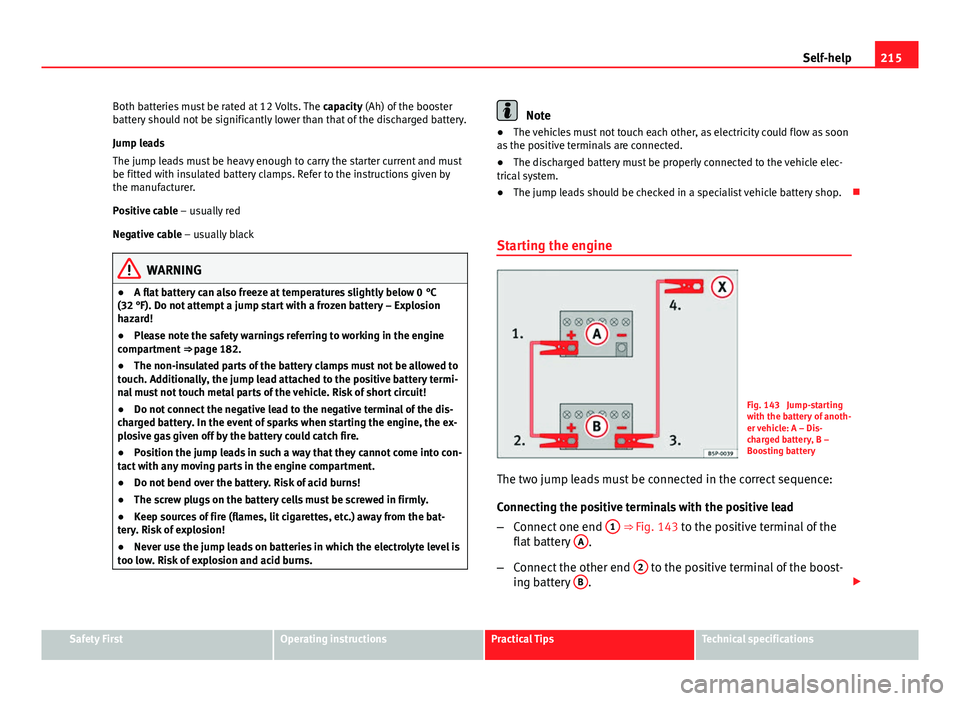
Fig. 143 Jump-starting
with the battery of anoth-
er vehicle: A – Dis-
charged battery, B –
Boosting battery
The two jump leads must be connected in the correct sequence:
Connecting the positive terminals with the positive lead
– Connect one end 1
⇒ Fig. 143 to the positive terminal of the
flat battery A.
– Connect the other end 2
to the positive terminal of the boost-
ing battery B.
Safety FirstOperating instructionsPractical TipsTechnical specifications
Page 219 of 258

217
Self-help
road. If the vehicle is towed with the rear wheels lifted off the road
the automatic gearbox will be damaged!
It is easier and safer to tow a vehicle with a towbar. A towrope
should only be used if you do not have a towbar.
Follow the instructions below when towing a vehicle:
Notes for the driver of the towing vehicle
– Engage the clutch very gently when starting to move or on vehi-
cles with automatic gearbox press the accelerator carefully.
– On vehicles with manual gearbox, the towrope must be taut be-
fore driving off.
The maximum towing speed is 50 km/h (31 mph).
Notes for the driver of the towed vehicle
– The ignition should be switched on so that the steering wheel
lock is not engaged and the turn signals, horn and windscreen
wipers and washers can be used.
– Put the gear lever in neutral or move the selector lever to posi-
tion N (automatic gearbox).
The brake servo and power steering only work when the engine is
running. Considerably more effort is required on the brake pedal
and steering wheel when the engine is switched off.
Ensure the towrope remains taut at all times when towing.
CAUTION
● Do not tow-start the engine. Risk of engine damage! In vehicles with a
catalytic converter, unburnt fuel could reach the catalytic converter and
catch fire in it. This could damage and destroy the catalytic converter. Use
the battery from another vehicle for help in starting the engine ⇒ page 215,
Starting the engine.
● If, due to a fault, there is no oil in the gearbox, the car may only be tow-
ed with the driven wheels lifted clear of the road and transported on a spe-
cial vehicle transporter or trailer.
● If normal towing is not possible or if the vehicle is to be towed for further
than 50 km (31 miles), the vehicle must be transported on a special vehicle
transporter or trailer.
● The towrope should be slightly elastic to reduce the loading on both ve-
hicles during towing. It is advisable to use a towrope made of synthetic fibre
or similar material only.
● Do not pull too hard with the towing vehicle and always take care to
avoid jerking the towrope. When towing on a loose surface there is always a
risk of overloading and damaging the anchorage points.
● Attach the towrope or towbar only to the towline anchorages or to the
removable towing bracket ⇒ page 164, or ⇒ page 218.
Note
● We recommend you use the towrope or towbar available in the SEAT
Original Accessories programme from authorised SEAT dealers.
● Towing a vehicle requires some experience. Both drivers should be fa-
miliar with the technique required for towing. Inexperienced drivers should
not attempt to tow away another vehicle or to have their vehicle towed.
● Note the legal regulations concerning towing, particularly those regard-
ing the signalling of the towed and towing vehicle.
● The towrope must not be twisted, as under certain circumstances this
could unscrew the front towline anchorage.
Safety FirstOperating instructionsPractical TipsTechnical specifications
Page 221 of 258
219
Fuses and bulbs
Fuses and bulbs Fuses
Introduction
Due to the constant update of vehicles, fuse assignments depending on
equipment and the use of the same fuse for various electrical components,
at the time of printing this manual it is not possible to provide an up-to-date
summary of the electrical components fuse positions. For detailed informa-
tion about the fuse positions, please consult a Technical Service.
In general, a fuse can be assigned to various electrical components. Like-
wise, an electrical component can be protected by several fuses.
Only replace fuses when the cause of the problem has been solved. If a
newly inserted fuse blows after a short time, you must have the electrical
system checked by a specialised workshop as soon as possible.
Additional information and warnings:
● Working in the engine compartment ⇒ page 182
WARNING
The high voltages in the electrical system can give serious electrical
shocks, causing burns and even death!
● Never touch the electrical wiring of the ignition system.
● Take care not to cause short circuits in the electrical system.
WARNING
Using unsuitable fuses, repairing fuses or bridging a current circuit with-
out fuses can cause a fire and serious injury.
● Never use a fuse with a higher value. Only replace fuses with a fuse of
the same amperage (same colour and markings) and size.
● Never repair a fuse.
● Never replace a fuse by a metal strip, staple or similar.
CAUTION
● To avoid damage to the vehicles electric system, before replacing a fuse
turn off the ignition, the lights and all electrical elements and remove the
keys from the ignition.
● If you replace a fuse with higher-rating fuse, you could cause damage to
another part of the electrical system.
● Protect the fuse boxes when open to avoid the entry of dust or humidity.
Dirt and humidity inside fuse boxes can cause damage to the electrical sys-
tem.
Note
● One single consumer could have more than one fuse.
● Several consumers could run over one single fuse.
Safety FirstOperating instructionsPractical TipsTechnical specifications