clutch Seat Toledo 2013 User Guide
[x] Cancel search | Manufacturer: SEAT, Model Year: 2013, Model line: Toledo, Model: Seat Toledo 2013Pages: 258, PDF Size: 3.94 MB
Page 157 of 258
155
Driving
● Engine at operating temperature
● Vehicle's battery sufficiently charged
● Vehicle not on a very steep slope
● Engine speed below 1200 rpm
● Vehicle's battery temperature is neither too high nor too low
● Sufficient brake system pressure
● Difference between outside temperature and set interior temperature
not too great
● Vehicle speed since last time the engine started was above 3 km/h (2
mph)
● Particulate filter ⇒ page 74 not being cleaned
● Front wheels not overly turned (steering wheel turned less than three
quarters of a turn)
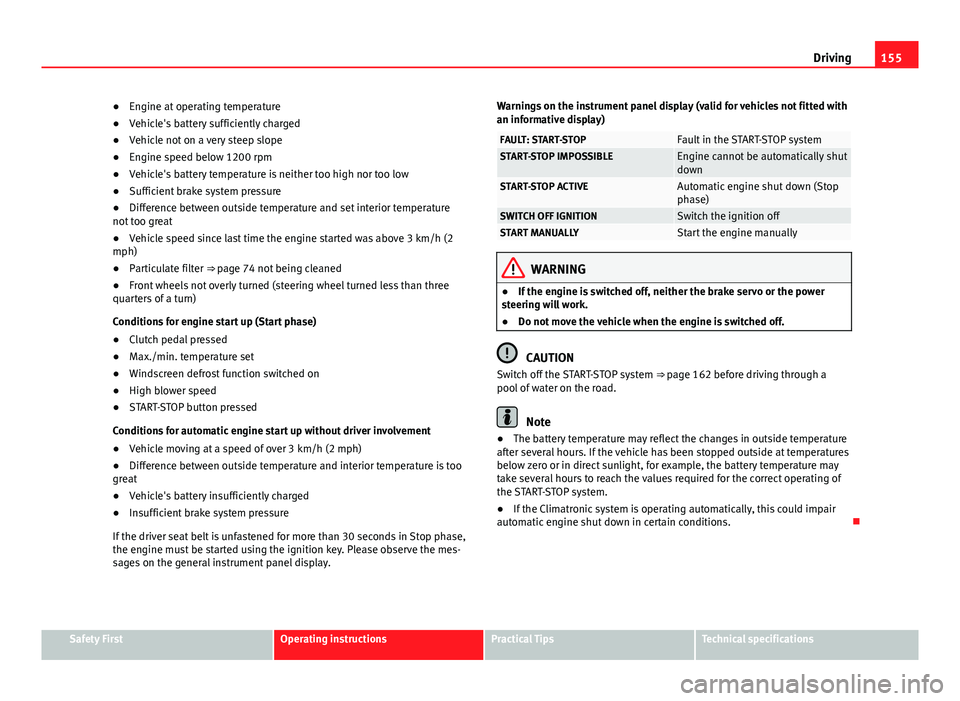
Conditions for engine start up (Start phase)
● Clutch pedal pressed
● Max./min. temperature set
● Windscreen defrost function switched on
● High blower speed
● START-STOP button pressed
Conditions for automatic engine start up without driver involvement
● Vehicle moving at a speed of over 3 km/h (2 mph)
● Difference between outside temperature and interior temperature is too
great
● Vehicle's battery insufficiently charged
● Insufficient brake system pressure
If the driver seat belt is unfastened for more than 30 seconds in Stop phase,
the engine must be started using the ignition key. Please observe the mes-
sages on the general instrument panel display. Warnings on the instrument panel display (valid for vehicles not fitted with
an informative display)
FAULT: START-STOPFault in the START-STOP systemSTART-STOP IMPOSSIBLEEngine cannot be automatically shut
down
START-STOP ACTIVEAutomatic engine shut down (Stop
phase)
SWITCH OFF IGNITIONSwitch the ignition offSTART MANUALLYStart the engine manually
WARNING
● If the engine is switched off, neither the brake servo or the power
steering will work.
● Do not move the vehicle when the engine is switched off.
CAUTION
Switch off the START-STOP system ⇒ page 162 before driving through a
pool of water on the road.
Note
● The battery temperature may reflect the changes in outside temperature
after several hours. If the vehicle has been stopped outside at temperatures
below zero or in direct sunlight, for example, the battery temperature may
take several hours to reach the values required for the correct operating of
the START-STOP system.
● If the Climatronic system is operating automatically, this could impair
automatic engine shut down in certain conditions.
Safety FirstOperating instructionsPractical TipsTechnical specifications
Page 219 of 258

217
Self-help
road. If the vehicle is towed with the rear wheels lifted off the road
the automatic gearbox will be damaged!
It is easier and safer to tow a vehicle with a towbar. A towrope
should only be used if you do not have a towbar.
Follow the instructions below when towing a vehicle:
Notes for the driver of the towing vehicle
– Engage the clutch very gently when starting to move or on vehi-
cles with automatic gearbox press the accelerator carefully.
– On vehicles with manual gearbox, the towrope must be taut be-
fore driving off.
The maximum towing speed is 50 km/h (31 mph).
Notes for the driver of the towed vehicle
– The ignition should be switched on so that the steering wheel
lock is not engaged and the turn signals, horn and windscreen
wipers and washers can be used.
– Put the gear lever in neutral or move the selector lever to posi-
tion N (automatic gearbox).
The brake servo and power steering only work when the engine is
running. Considerably more effort is required on the brake pedal
and steering wheel when the engine is switched off.
Ensure the towrope remains taut at all times when towing.
CAUTION
● Do not tow-start the engine. Risk of engine damage! In vehicles with a
catalytic converter, unburnt fuel could reach the catalytic converter and
catch fire in it. This could damage and destroy the catalytic converter. Use
the battery from another vehicle for help in starting the engine ⇒ page 215,
Starting the engine.
● If, due to a fault, there is no oil in the gearbox, the car may only be tow-
ed with the driven wheels lifted clear of the road and transported on a spe-
cial vehicle transporter or trailer.
● If normal towing is not possible or if the vehicle is to be towed for further
than 50 km (31 miles), the vehicle must be transported on a special vehicle
transporter or trailer.
● The towrope should be slightly elastic to reduce the loading on both ve-
hicles during towing. It is advisable to use a towrope made of synthetic fibre
or similar material only.
● Do not pull too hard with the towing vehicle and always take care to
avoid jerking the towrope. When towing on a loose surface there is always a
risk of overloading and damaging the anchorage points.
● Attach the towrope or towbar only to the towline anchorages or to the
removable towing bracket ⇒ page 164, or ⇒ page 218.
Note
● We recommend you use the towrope or towbar available in the SEAT
Original Accessories programme from authorised SEAT dealers.
● Towing a vehicle requires some experience. Both drivers should be fa-
miliar with the technique required for towing. Inexperienced drivers should
not attempt to tow away another vehicle or to have their vehicle towed.
● Note the legal regulations concerning towing, particularly those regard-
ing the signalling of the towed and towing vehicle.
● The towrope must not be twisted, as under certain circumstances this
could unscrew the front towline anchorage.
Safety FirstOperating instructionsPractical TipsTechnical specifications