weight Seat Toledo 2013 User Guide
[x] Cancel search | Manufacturer: SEAT, Model Year: 2013, Model line: Toledo, Model: Seat Toledo 2013Pages: 258, PDF Size: 3.94 MB
Page 113 of 258
111
Seats and storage
Adjusting the front seats
Fig. 69 Seat adjustment
controls/Adjustment con-
trols for a sports seat
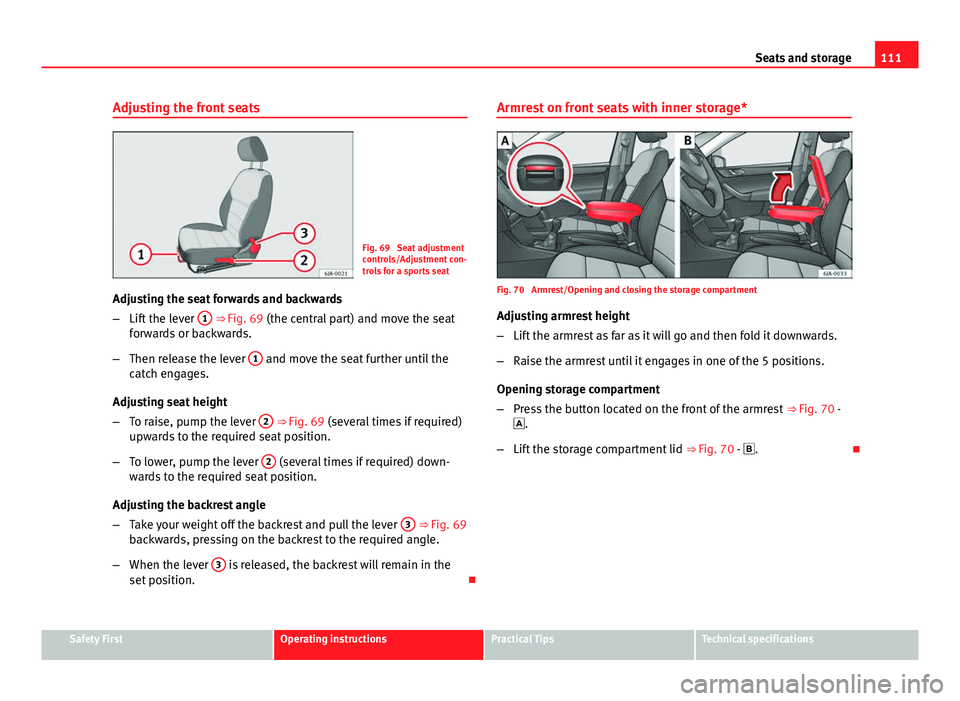
Adjusting the seat forwards and backwards
– Lift the lever 1
⇒ Fig. 69 (the central part) and move the seat
forwards or backwards.
– Then release the lever 1
and move the seat further until the
catch engages.
Adjusting seat height
– To raise, pump the lever 2
⇒ Fig. 69 (several times if required)
upwards to the required seat position.
– To lower, pump the lever 2
(several times if required) down-
wards to the required seat position.
Adjusting the backrest angle
– Take your weight off the backrest and pull the lever 3
⇒ Fig. 69
backwards, pressing on the backrest to the required angle.
– When the lever 3
is released, the backrest will remain in the
set position. Armrest on front seats with inner storage*
Fig. 70 Armrest/Opening and closing the storage compartment
Adjusting armrest height
– Lift the armrest as far as it will go and then fold it downwards.
– Raise the armrest until it engages in one of the 5 positions.
Opening storage compartment
– Press the button located on the front of the armrest ⇒ Fig. 70 -
.
– Lift the storage compartment lid ⇒ Fig. 70 - .
Safety FirstOperating instructionsPractical TipsTechnical specifications
Page 117 of 258
115
Seats and storage
Luggage compartment
Introduction
Please observe the following points to ensure the vehicle handles
well at all times:
– Distribute the load as evenly as possible.
– Place heavy objects as far forward in the luggage compartment
as possible.
– Secure luggage using the fastening rings or retaining net
⇒ page 116.
During an accident, even small and light objects can have so much kinetic
energy that they can cause very severe injuries. The amount of kinetic ener-
gy depends on the speed of the vehicle and the weight of the object. How-
ever, the speed of the vehicle is the most important factor.
Example: An unsecured object weighing 4.5 kg produces energy corre-
sponding to 20 times its weight in a frontal collision at 50 km/h (31 mph).
This means that its weight “reaches” around 90 kg. You can imagine the se-
verity of the injuries that might be sustained if this “projectile” strikes an
occupant as it flies through the vehicle interior.
WARNING
● Store objects in the luggage compartment and secure to the fastening
points.
● In an accident or sudden manoeuvre, loose objects in the interior can
be flung forwards and possibly injure vehicle occupants or others. This
risk is increased if the flying objects hit and trigger an airbag. In this
case, any rebounding objects could injure vehicle occupants. Risk of fatal
injuries!
● Take into account that transporting heavy objects changes the centre
of gravity that could also cause changes in vehicle handling. Risk of acci-
dent! Therefore, always adjust your speed and driving style to suit these
circumstances.
● Securing the load to the rings using unsuitable or damage straps
could lead to injuries in the event of an accident or sudden braking ma-
noeuvre. Secure suitable straps safely to the rings to ensure this does
not happen.
● Position the load so that it cannot moved forwards during a sudden
braking manoeuvre. Risk of injuries!
● If transporting sharp or dangerous objects in the space provided
when the rear seats are folded, ensure the safety of the occupant of the
remaining rear seat ⇒ page 13.
● If the rear seat located alongside a folding seat is occupied, ensure
safety by placing the load so that it stops the seat from folding back-
wards in the event of a collision, for example.
● Never drive with the rear lid open or half-closed, exhaust gases may
penetrate into the interior of the vehicle. Danger of poisoning!
● Never exceed the allowed axle loads or allowed maximum weight.
Risk of accident!
● Never transport passengers in the luggage compartment!
Safety FirstOperating instructionsPractical TipsTechnical specifications
Page 121 of 258
119
Seats and storage
Roof carrier*
Introduction
WARNING
● The load on the roof carrier must be properly secured. Risk of acci-
dent!
● Always secure the load using retaining straps in good condition.
● Distribute the load evenly.
● When transporting heavy or large objects on the roof, any change in
the normal vehicle behaviour due to a change in the centre of gravity or
an increased wind resistance must be taken into account. Risk of acci-
dent! For this reason, a suitable speed and driving style must be used.
● Avoid sudden manoeuvres and braking.
● Adjust your driving style to suit visibility, the weather and road and
traffic conditions.
● Never exceed the allowed axle loads or allowed maximum weight.
Risk of accident!
CAUTION
● Only use SEAT-authorised roof carriers.
● Where roof carriers from other systems are used or where they are not
fitted properly, any damage caused to the vehicle will not be covered by the
warranty. Therefore, carefully follow the Instruction Manual for installation
of the roof carrier.
● On vehicles fitted with a sliding sunroof, make sure it does not hit the
load on the roof when opened
● Remember that the rear lid must not hit the roof load.
● The total height of the vehicle increases according to the roof load. Com-
pare the height of the vehicle with the heights of bridges or, for example,
the size of the garage door. ●
Do not forget to remove the roof carrier before entering an automatic
carwash.
● Take into account that the load must not damage the aerial located on
the roof.
For the sake of the environment
The increased air resistance means that the vehicle uses more fuel.
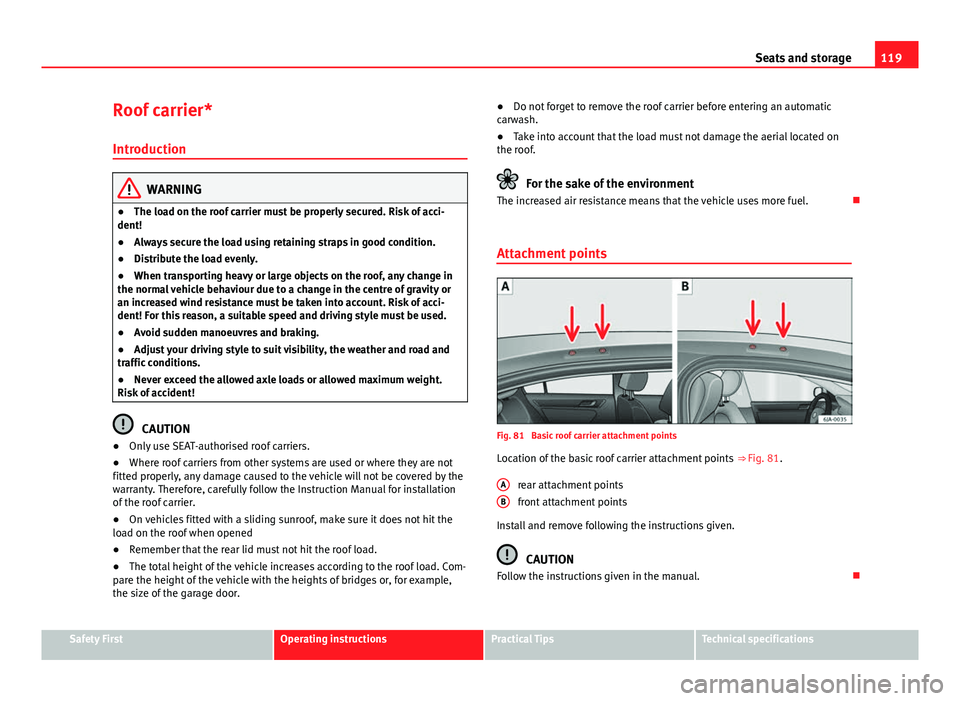
Attachment points
Fig. 81 Basic roof carrier attachment points
Location of the basic roof carrier attachment points ⇒ Fig. 81.
rear attachment points
front attachment points
Install and remove following the instructions given.
CAUTION
Follow the instructions given in the manual.
A
B
Safety FirstOperating instructionsPractical TipsTechnical specifications
Page 122 of 258
120Seats and storage
Roof load
The maximum permissible roof load (including the support system) of 75 kg
and the total authorised weight of the vehicle must not be exceeded.
It will not be possible to carry the full maximum load if the roof carrier you
are using is rated for a load which is less than this figure. In this case, you
can only load the roof carrier to the maximum load permitted in your instal-
lation manual.
Drink holder
Introduction
WARNING
● Do not put hot drinks in the drink holders. They could spill while the
vehicle is moving. Risk of scalding!
● Do not use cups or glasses made of fragile materials (e.g. glass or chi-
na). These could cause injury in the event of an accident.
CAUTION
Avoid putting open drinks containers in the drink holder while the vehicle is
moving. They could spill (e.g. on braking) and cause damage to the electri-
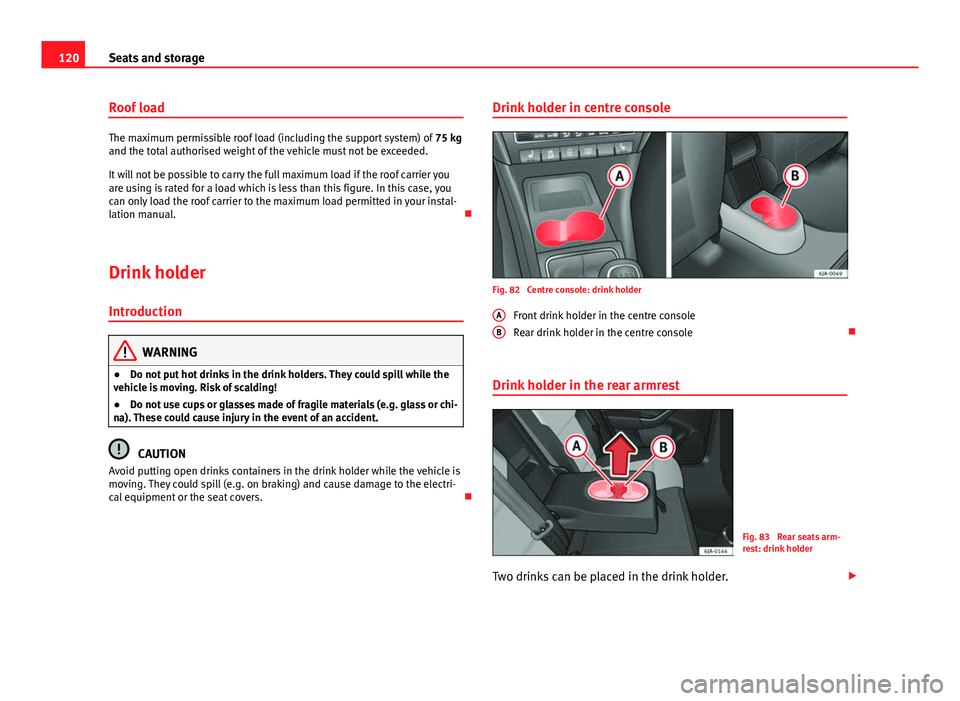
cal equipment or the seat covers. Drink holder in centre console
Fig. 82 Centre console: drink holder
Front drink holder in the centre console
Rear drink holder in the centre console
Drink holder in the rear armrest
Fig. 83 Rear seats arm-
rest: drink holder
Two drinks can be placed in the drink holder.
A
B
Page 127 of 258
125
Seats and storage
WARNING
Do not place heavy objects in the pockets. Risk of injury!
CAUTION
Do not place overly large objects in the pockets (e.g. bottles) or objects with
sharp edges. Risk of damage to the pockets and the upholstery.
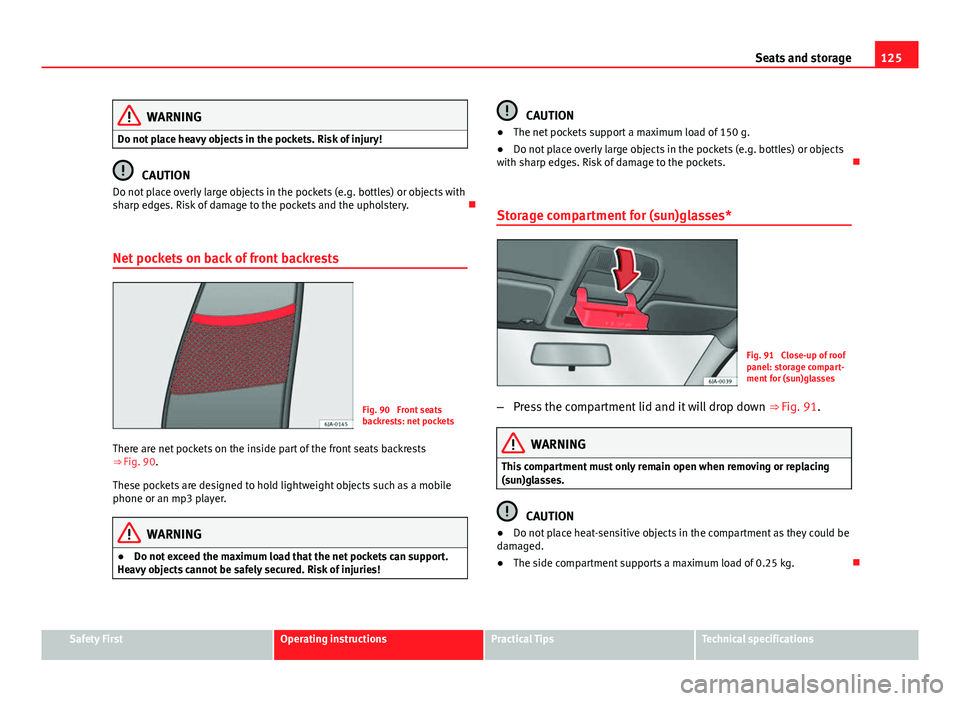
Net pockets on back of front backrests
Fig. 90 Front seats
backrests: net pockets
There are net pockets on the inside part of the front seats backrests
⇒ Fig. 90.
These pockets are designed to hold lightweight objects such as a mobile
phone or an mp3 player.
WARNING
● Do not exceed the maximum load that the net pockets can support.
Heavy objects cannot be safely secured. Risk of injuries!
CAUTION
● The net pockets support a maximum load of 150 g.
● Do not place overly large objects in the pockets (e.g. bottles) or objects
with sharp edges. Risk of damage to the pockets.
Storage compartment for (sun)glasses*
Fig. 91 Close-up of roof
panel: storage compart-
ment for (sun)glasses
– Press the compartment lid and it will drop down ⇒ Fig. 91.
WARNING
This compartment must only remain open when removing or replacing
(sun)glasses.
CAUTION
● Do not place heat-sensitive objects in the compartment as they could be
damaged.
● The side compartment supports a maximum load of 0.25 kg.
Safety FirstOperating instructionsPractical TipsTechnical specifications
Page 129 of 258
127
Seats and storage
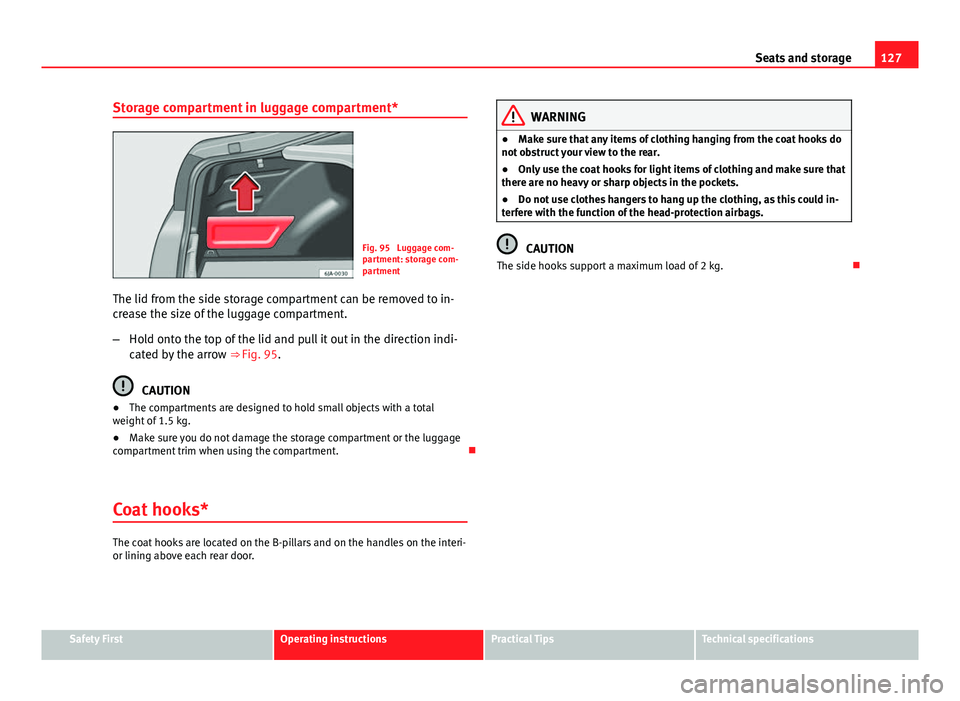
Storage compartment in luggage compartment*
Fig. 95 Luggage com-
partment: storage com-
partment
The lid from the side storage compartment can be removed to in-
crease the size of the luggage compartment.
– Hold onto the top of the lid and pull it out in the direction indi-
cated by the arrow ⇒ Fig. 95.
CAUTION
● The compartments are designed to hold small objects with a total
weight of 1.5 kg.
● Make sure you do not damage the storage compartment or the luggage
compartment trim when using the compartment.
Coat hooks*
The coat hooks are located on the B-pillars and on the handles on the interi-
or lining above each rear door.
WARNING
● Make sure that any items of clothing hanging from the coat hooks do
not obstruct your view to the rear.
● Only use the coat hooks for light items of clothing and make sure that
there are no heavy or sharp objects in the pockets.
● Do not use clothes hangers to hang up the clothing, as this could in-
terfere with the function of the head-protection airbags.
CAUTION
The side hooks support a maximum load of 2 kg.
Safety FirstOperating instructionsPractical TipsTechnical specifications
Page 154 of 258
152Driving
Switching the parking aid system on and off
Parking aid is switched on when the ignition is on and reverse gear engag-
ed. This is confirmed by a short audible warning.
Parking aid is switched off when reverse gear is released.
WARNING
● Parking aid does not free the driver from responsibility when parking
or performing similar manoeuvres. Pay special attention to small children
or animals, as the parking aid sensors may not always be able to detect
them.
● Before reversing or parking, make sure there are no small obstacles,
e.g. stones, narrow pillars, towing brackets, etc. in front and behind the
vehicle. These obstacles may not always be detected by the parking aid
device.
● The surface of certain objects may not reflect the signals of the park-
ing aid sensors. Therefore, people wearing clothing of this kind may not
be detected by the parking aid system.
● Outside noise may interfere with the parking aid system. Under cer-
tain unfavourable circumstances, certain objects or people may not be
detected.
Note
● If a constant sound at a higher frequency is emitted for 3 seconds when
the system is switched on then there is a fault in the system. Please take the
vehicle to a specialised technical service to solve this fault.
● To ensure that the parking aid system works properly, the sensors must
be kept clean (e.g. free of ice).
● If the parking aid system is switched on when the automatic gearbox se-
lector lever is in position P, the acoustic signal will be interrupted (the car
cannot be moved). Cruise control (Cruise control system)*
Introduction
The cruise control system allows you to drive at a constant speed of 30 km/
h (19 mph) or higher without having to press the accelerator. However, the
speed is only maintained within the margin permitted by the engine power
and the braking effect of the engine.
The warning lamp lights up on the general instrument panel if cruise con-
trol is switched on.
WARNING
● For safety reasons the cruise control system must not be used in
dense traffic or where roads conditions are poor (e.g. due to ice, aqua-
planing, loose grit, snow). Risk of accident!
● The programmed speed can only be re-established if it is not too high
for current traffic conditions.
● Always switch the cruise control system off after using it in order to
avoid involuntary use.
CAUTION
● The cruise control cannot maintain a constant speed when the vehicle is
moving downhill. The vehicle tends to accelerate under its own weight.
Therefore, shift down or use the brake pedal in good time to slow the vehi-
cle.
Note
● In vehicles with an automatic gearbox, the cruise control system cannot
be switched on if the selector lever is in position P, N or R.
● In vehicles with a manual gearbox, the cruise control cannot be switched
on if first gear or reverse gear is engaged.
Page 162 of 258
160Driving and the environment
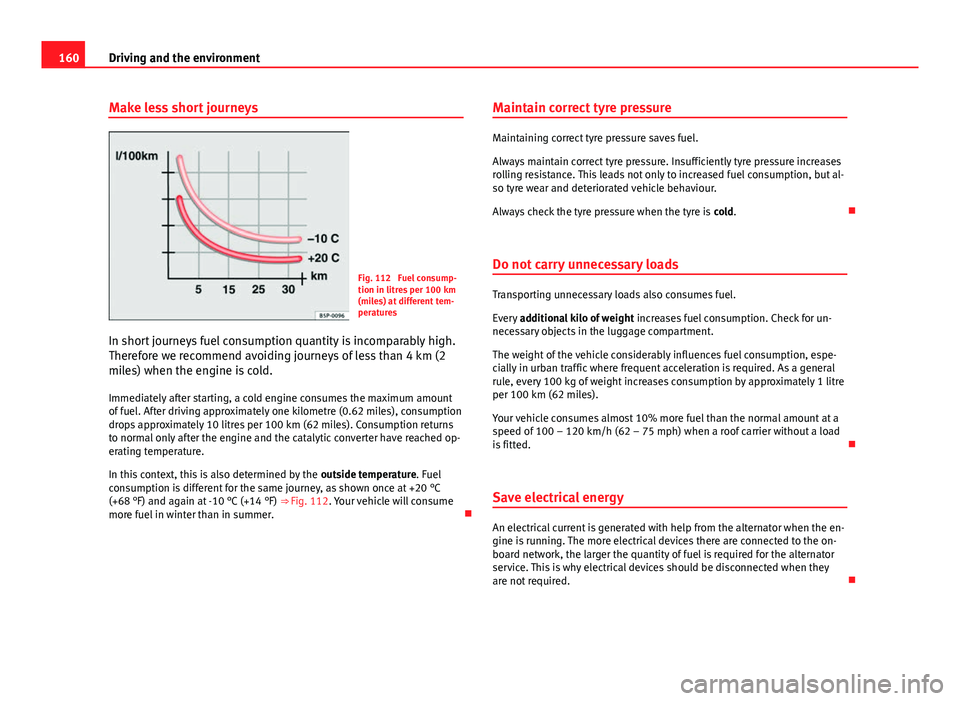
Make less short journeys
Fig. 112 Fuel consump-
tion in litres per 100 km
(miles) at different tem-
peratures
In short journeys fuel consumption quantity is incomparably high.
Therefore we recommend avoiding journeys of less than 4 km (2
miles) when the engine is cold. Immediately after starting, a cold engine consumes the maximum amount
of fuel. After driving approximately one kilometre (0.62 miles), consumption
drops approximately 10 litres per 100 km (62 miles). Consumption returns
to normal only after the engine and the catalytic converter have reached op-
erating temperature.
In this context, this is also determined by the outside temperature. Fuel
consumption is different for the same journey, as shown once at +20 °C
(+68 °F) and again at -10 °C (+14 °F) ⇒ Fig. 112. Your vehicle will consume
more fuel in winter than in summer. Maintain correct tyre pressure
Maintaining correct tyre pressure saves fuel.
Always maintain correct tyre pressure. Insufficiently tyre pressure increases
rolling resistance. This leads not only to increased fuel consumption, but al-
so tyre wear and deteriorated vehicle behaviour.
Always check the tyre pressure when the tyre is
cold.
Do not carry unnecessary loads
Transporting unnecessary loads also consumes fuel.
Every additional kilo of weight increases fuel consumption. Check for un-
necessary objects in the luggage compartment.
The weight of the vehicle considerably influences fuel consumption, espe-
cially in urban traffic where frequent acceleration is required. As a general
rule, every 100 kg of weight increases consumption by approximately 1 litre
per 100 km (62 miles).
Your vehicle consumes almost 10% more fuel than the normal amount at a
speed of 100 – 120 km/h (62 – 75 mph) when a roof carrier without a load
is fitted.
Save electrical energy
An electrical current is generated with help from the alternator when the en-
gine is running. The more electrical devices there are connected to the on-
board network, the larger the quantity of fuel is required for the alternator
service. This is why electrical devices should be disconnected when they
are not required.
Page 166 of 258
164Driving the vehicle with a trailer
Driving the vehicle with a trailer
Driving the vehicle with a trailer
Technical requirements
If your vehicle has a factory-fitted towing bracket or is equipped with a se-
lection of SEAT Original Accessories, it meets all the relevant technical and
legal requirements.
In vehicles with a towing bracket it is possible to remove the ball joint, situ-
ated (together with the special assembly instructions) in the housing for the
spare wheel in the vehicle luggage compartment ⇒ page 207, Vehicle tool
kit*.
Your vehicle is fitted with a 13-pole power socket for the electrical connec-
tion between the trailer and the vehicle. If the trailer you are going to use
has a 7-pin connector, the corresponding adaptor, acquired from the SEAT
Original Accessories Catalogue, can be used.
If a towing bracket is to be retro-fitted to the car, it must be done according
to the instructions of the towing bracket manufacturer.
Note
Any queries that may arise can be directed to an authorised SEAT dealer.
Trailer weight
Trailer weight
The combined vehicle and trailer must be balanced. To do so use the maxi-
mum permitted towing bracket load. An insufficient weight exerted by the trailer drawbar on the ball joint of the towing bracket will have a negative
impact upon the response of the vehicle-trailer assembly on the road.
Weight distribution
Distribute loads in the trailer so that heavy objects are as near to the axle as
possible. Ensure that the objects do not move.
If the towing vehicle is empty and the trailer loaded then the load distribu-
tion is incorrect. However, if these conditions cannot be avoided, drive very
slowly.
Tyre pressure values
Correct the tyre pressure in your vehicle to “total load” ⇒
page 197, Tyre
useful life.
Trailer weight
Never exceed the authorised trailer weight under any circumstances
⇒ page 233, Description of the data.
The trailer weights listed are only applicable for altitudes up to 1000 m
above sea level. Due to a lower air density the engine power decreases de-
pending on the increase in altitude, this also causes the climbing ability to
decrease, which requires a reduction of the weight of the vehicle with a
trailer by 10 % for every 1000 m increase in altitude. The weight of the as-
sembly is calculated by adding the vehicle weight (loaded) to the trailer
weight (loaded). Always drive with special care when towing a trailer.
The towed load and support load information that is displayed on the tow-
ing bracket manufacturers label are only values for the verification of the
device. The correct figures for your specific vehicle, which are usually lower
than these figures, are given in the documentation of your vehicle.
Page 236 of 258
234Description of the data
Vehicle identification data on the data sticker
Fig. 173 Data sticker
Fig. 174 Type plate
Vehicle data sticker
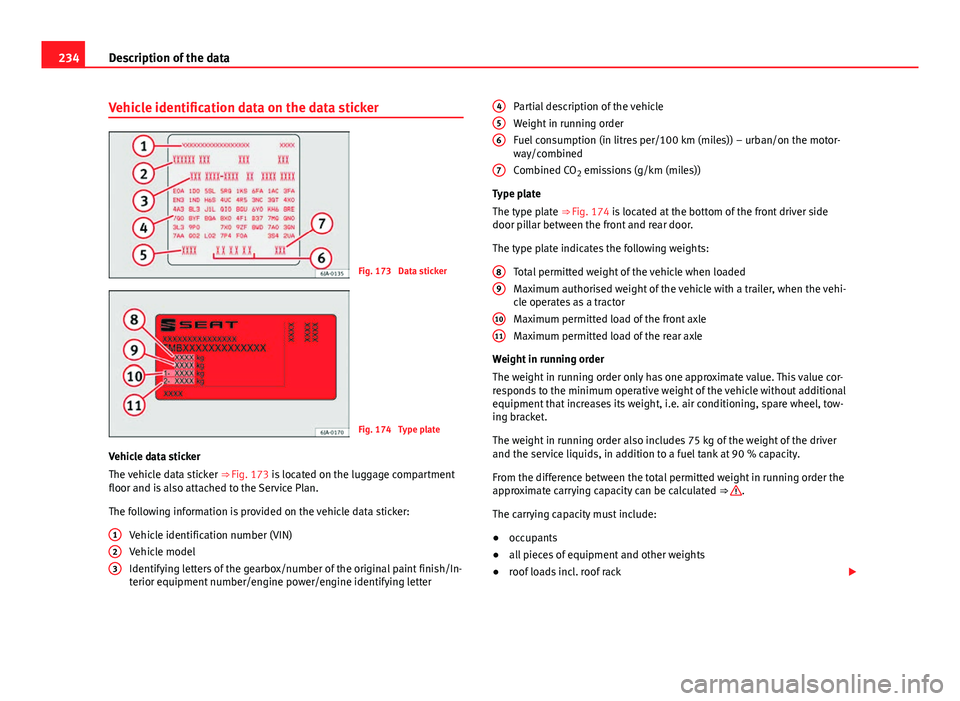
The vehicle data sticker ⇒ Fig. 173 is located on the luggage compartment
floor and is also attached to the Service Plan.
The following information is provided on the vehicle data sticker:
Vehicle identification number (VIN)
Vehicle model
Identifying letters of the gearbox/number of the original paint finish/In-
terior equipment number/engine power/engine identifying letter
1
23
Partial description of the vehicle
Weight in running order
Fuel consumption (in litres per/100 km (miles)) – urban/on the motor-
way/combined
Combined CO
2 emissions (g/km (miles))
Type plate
The type plate ⇒ Fig. 174 is located at the bottom of the front driver side
door pillar between the front and rear door.
The type plate indicates the following weights:
Total permitted weight of the vehicle when loaded
Maximum authorised weight of the vehicle with a trailer, when the vehi-
cle operates as a tractor
Maximum permitted load of the front axle
Maximum permitted load of the rear axle
Weight in running order
The weight in running order only has one approximate value. This value cor-
responds to the minimum operative weight of the vehicle without additional
equipment that increases its weight, i.e. air conditioning, spare wheel, tow-
ing bracket.
The weight in running order also includes 75 kg of the weight of the driver
and the service liquids, in addition to a fuel tank at 90 % capacity.
From the difference between the total permitted weight in running order the
approximate carrying capacity can be calculated ⇒
.
The carrying capacity must include:
● occupants
● all pieces of equipment and other weights
● roof loads incl. roof rack
4
56
7
89
1011