weight Seat Toledo 2013 Owner's Guide
[x] Cancel search | Manufacturer: SEAT, Model Year: 2013, Model line: Toledo, Model: Seat Toledo 2013Pages: 258, PDF Size: 3.94 MB
Page 237 of 258

235
Description of the data
● equipment that is not included in the running order weight
● when using the towing bracket, the drawbar load (max. 50 kg)
Calculating fuel consumption and CO 2 emissions according to the ECE
regulations and the EU specifications
Calculation of fuel consumption for urban driving starts when cold-starting
the engine. Then, normal city driving is simulated.
In extra-urban driving fuel consumption calculation, the vehicle brakes and
accelerated in all gears, as in daily use of the vehicle. The driving speed
moves between a range of 0 and 120 km/h (75 mph).
The consumption value in combined driving is composed of 37 % of the val-
ue of urban driving and 63 % of the value of extra-urban driving.
WARNING
The maximum permitted weight values must not be exceeded – Risk of
an accident and damage to the vehicle!
Note
● If you wish to calculate the exact weight of your vehicle please contact a
SEAT dealer.
● Depending on the volume of equipment, the driving style, road condi-
tions, weather conditions and the condition of the vehicle, the consumption
values can differ from the theoretical values reproduced here. Information on fuel consumption
Fuel consumption
The consumption and emission details shown on the vehicle
data sticker differ from one vehicle to another.
The vehicle fuel consumption and CO 2 emissions can be consulted on the
vehicle data sticker in the spare wheel well, inside the luggage compart-
ment and on the rear cover of the Maintenance Programme.
The fuel consumption and CO 2 emission values refer to the weight category
assigned to your vehicle according to the engine and gearbox combination,
as well as the specific equipment fitted, and is only used to compare be-
tween the different models.
The fuel consumption and CO 2 emissions do not depend only on the per-
formance of the vehicle, they can also differ from the established values de-
pending on other factors such as driving style, road conditions, traffic con-
ditions, environmental conditions, load and number of passengers.
Calculation of fuel consumption
The consumption values have been calculated based on measurements per-
formed or supervised by certified CE laboratories according to the latest ver-
sion of directives 715/2007/EC and 80/1268/CEE (for more information
consult the European Union Publications Office at EUR-Lex: © European Un-
ion, http://eur-lex.europa.eu/en/index.htm) and are valid for the kerb
weight indicated for the vehicle.
Note
In practice, and considering all the factors mentioned here, consumption
values can differ from those calculated in the current European regulations.
Safety FirstOperating instructionsPractical TipsTechnical specifications
Page 238 of 258
236Description of the data
Weights
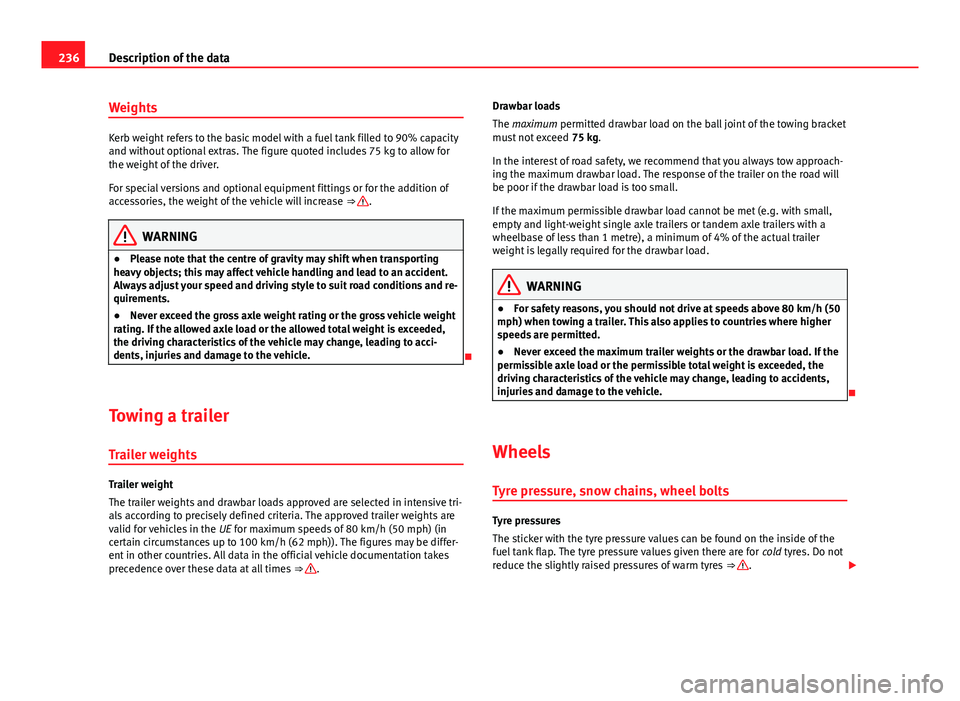
Kerb weight refers to the basic model with a fuel tank filled to 90% capacity
and without optional extras. The figure quoted includes 75 kg to allow for
the weight of the driver.
For special versions and optional equipment fittings or for the addition of
accessories, the weight of the vehicle will increase ⇒
.
WARNING
● Please note that the centre of gravity may shift when transporting
heavy objects; this may affect vehicle handling and lead to an accident.
Always adjust your speed and driving style to suit road conditions and re-
quirements.
● Never exceed the gross axle weight rating or the gross vehicle weight
rating. If the allowed axle load or the allowed total weight is exceeded,
the driving characteristics of the vehicle may change, leading to acci-
dents, injuries and damage to the vehicle.
Towing a trailer Trailer weights
Trailer weight
The trailer weights and drawbar loads approved are selected in intensive tri-
als according to precisely defined criteria. The approved trailer weights are
valid for vehicles in the UE for maximum speeds of 80 km/h (50 mph) (in
certain circumstances up to 100 km/h (62 mph)). The figures may be differ-
ent in other countries. All data in the official vehicle documentation takes
precedence over these data at all times ⇒
.Drawbar loads
The maximum permitted drawbar load on the ball joint of the towing bracket
must not exceed
75 kg.
In the interest of road safety, we recommend that you always tow approach-
ing the maximum drawbar load. The response of the trailer on the road will
be poor if the drawbar load is too small.
If the maximum permissible drawbar load cannot be met (e.g. with small,
empty and light-weight single axle trailers or tandem axle trailers with a
wheelbase of less than 1 metre), a minimum of 4% of the actual trailer
weight is legally required for the drawbar load.
WARNING
● For safety reasons, you should not drive at speeds above 80 km/h (50
mph) when towing a trailer. This also applies to countries where higher
speeds are permitted.
● Never exceed the maximum trailer weights or the drawbar load. If the
permissible axle load or the permissible total weight is exceeded, the
driving characteristics of the vehicle may change, leading to accidents,
injuries and damage to the vehicle.
Wheels
Tyre pressure, snow chains, wheel bolts
Tyre pressures
The sticker with the tyre pressure values can be found on the inside of the
fuel tank flap. The tyre pressure values given there are for cold tyres. Do not
reduce the slightly raised pressures of warm tyres ⇒
.
Page 241 of 258
239
Technical Data
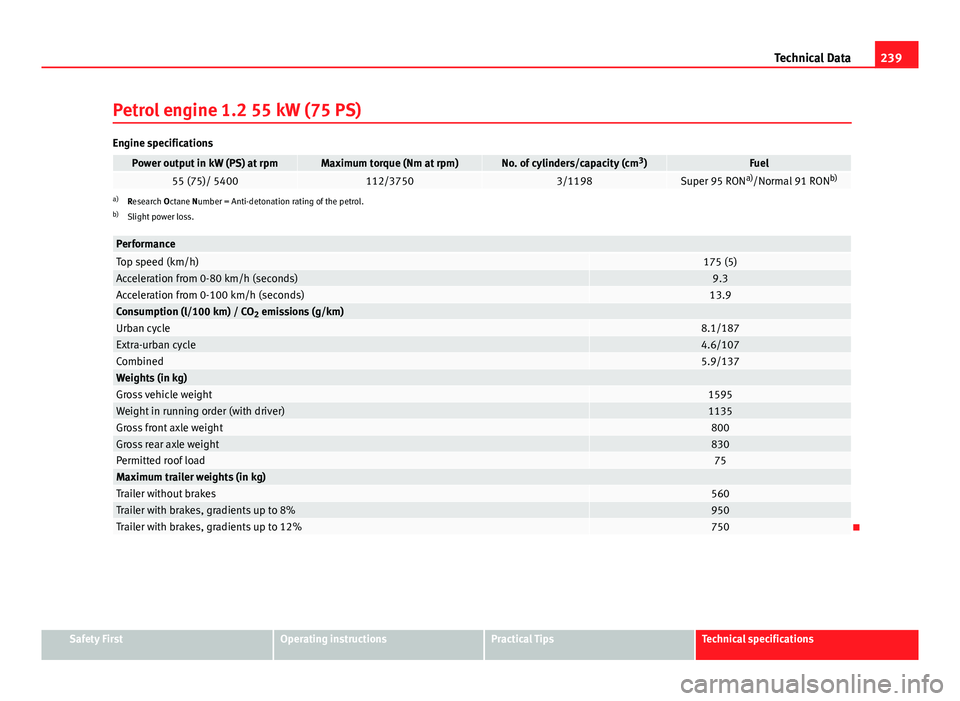
Petrol engine 1.2 55 kW (75 PS)
Engine specifications
Power output in kW (PS) at rpmMaximum torque (Nm at rpm)No. of cylinders/capacity (cm 3
)Fuel55 (75)/ 5400112/37503/1198Super 95 RON a)
/Normal 91 RON b)a)
Research Octane Number = Anti-detonation rating of the petrol.
b) Slight power loss.
PerformanceTop speed (km/h)175 (5)Acceleration from 0-80 km/h (seconds)9.3Acceleration from 0-100 km/h (seconds)13.9Consumption (l/100 km) / CO 2 emissions (g/km)Urban cycle8.1/187Extra-urban cycle4.6/107Combined5.9/137Weights (in kg)Gross vehicle weight1595Weight in running order (with driver)1135Gross front axle weight800Gross rear axle weight830Permitted roof load75Maximum trailer weights (in kg)Trailer without brakes560Trailer with brakes, gradients up to 8%950Trailer with brakes, gradients up to 12%750
Safety FirstOperating instructionsPractical TipsTechnical specifications
Page 242 of 258
240Technical Data
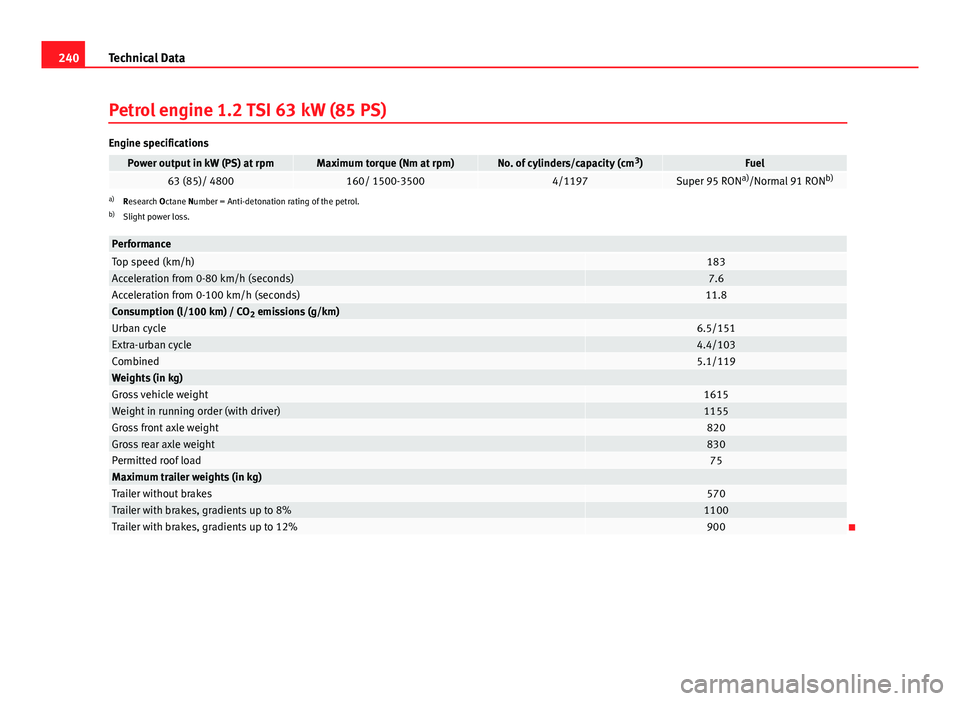
Petrol engine 1.2 TSI 63 kW (85 PS)
Engine specifications
Power output in kW (PS) at rpmMaximum torque (Nm at rpm)No. of cylinders/capacity (cm 3
)Fuel63 (85)/ 4800160/ 1500-35004/1197Super 95 RON a)
/Normal 91 RON b)a)
Research Octane Number = Anti-detonation rating of the petrol.
b) Slight power loss.
PerformanceTop speed (km/h)183Acceleration from 0-80 km/h (seconds)7.6Acceleration from 0-100 km/h (seconds)11.8Consumption (l/100 km) / CO 2 emissions (g/km)Urban cycle6.5/151Extra-urban cycle4.4/103Combined5.1/119Weights (in kg)Gross vehicle weight1615Weight in running order (with driver)1155Gross front axle weight820Gross rear axle weight830Permitted roof load75Maximum trailer weights (in kg)Trailer without brakes570Trailer with brakes, gradients up to 8%1100Trailer with brakes, gradients up to 12%900
Page 243 of 258
241
Technical Data
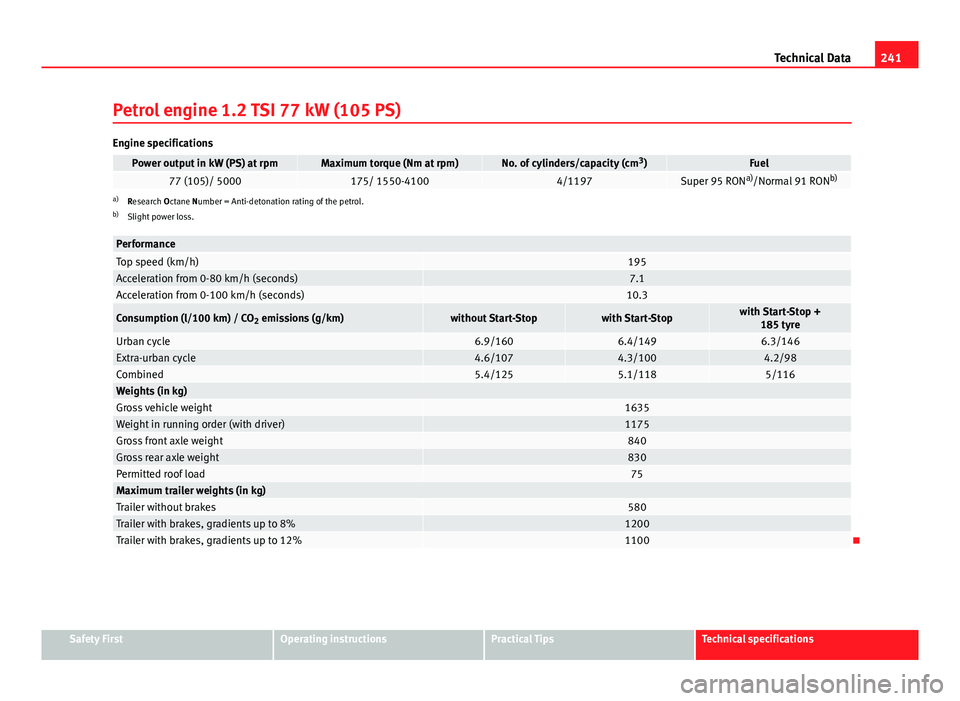
Petrol engine 1.2 TSI 77 kW (105 PS)
Engine specifications
Power output in kW (PS) at rpmMaximum torque (Nm at rpm)No. of cylinders/capacity (cm 3
)Fuel77 (105)/ 5000175/ 1550-41004/1197Super 95 RON a)
/Normal 91 RON b)a)
Research Octane Number = Anti-detonation rating of the petrol.
b) Slight power loss.
PerformanceTop speed (km/h)195Acceleration from 0-80 km/h (seconds)7.1Acceleration from 0-100 km/h (seconds)10.3
Consumption (l/100 km) / CO 2 emissions (g/km)without Start-Stopwith Start-Stopwith Start-Stop +
185 tyre
Urban cycle6.9/1606.4/1496.3/146Extra-urban cycle4.6/1074.3/1004.2/98Combined5.4/1255.1/1185/116Weights (in kg)Gross vehicle weight1635Weight in running order (with driver)1175Gross front axle weight840Gross rear axle weight830Permitted roof load75Maximum trailer weights (in kg)Trailer without brakes580Trailer with brakes, gradients up to 8%1200Trailer with brakes, gradients up to 12%1100
Safety FirstOperating instructionsPractical TipsTechnical specifications
Page 244 of 258
242Technical Data
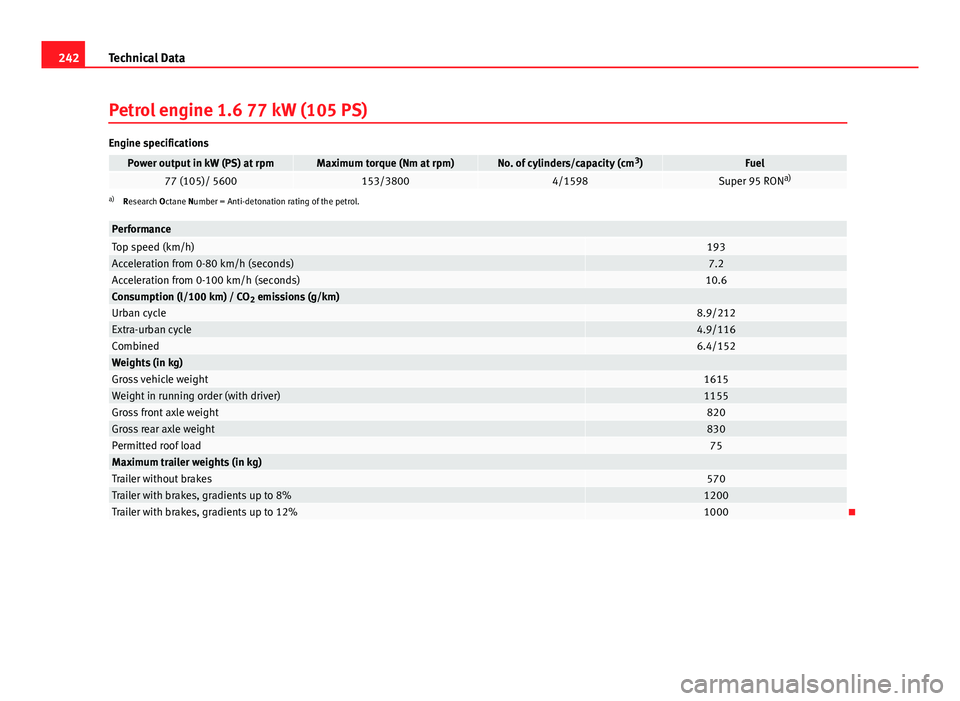
Petrol engine 1.6 77 kW (105 PS)
Engine specifications
Power output in kW (PS) at rpmMaximum torque (Nm at rpm)No. of cylinders/capacity (cm 3
)Fuel77 (105)/ 5600153/38004/1598Super 95 RON a)a)
Research Octane Number = Anti-detonation rating of the petrol.
PerformanceTop speed (km/h)193Acceleration from 0-80 km/h (seconds)7.2Acceleration from 0-100 km/h (seconds)10.6Consumption (l/100 km) / CO 2 emissions (g/km)Urban cycle8.9/212Extra-urban cycle4.9/116Combined6.4/152Weights (in kg)Gross vehicle weight1615Weight in running order (with driver)1155Gross front axle weight820Gross rear axle weight830Permitted roof load75Maximum trailer weights (in kg)Trailer without brakes570Trailer with brakes, gradients up to 8%1200Trailer with brakes, gradients up to 12%1000
Page 245 of 258
243
Technical Data
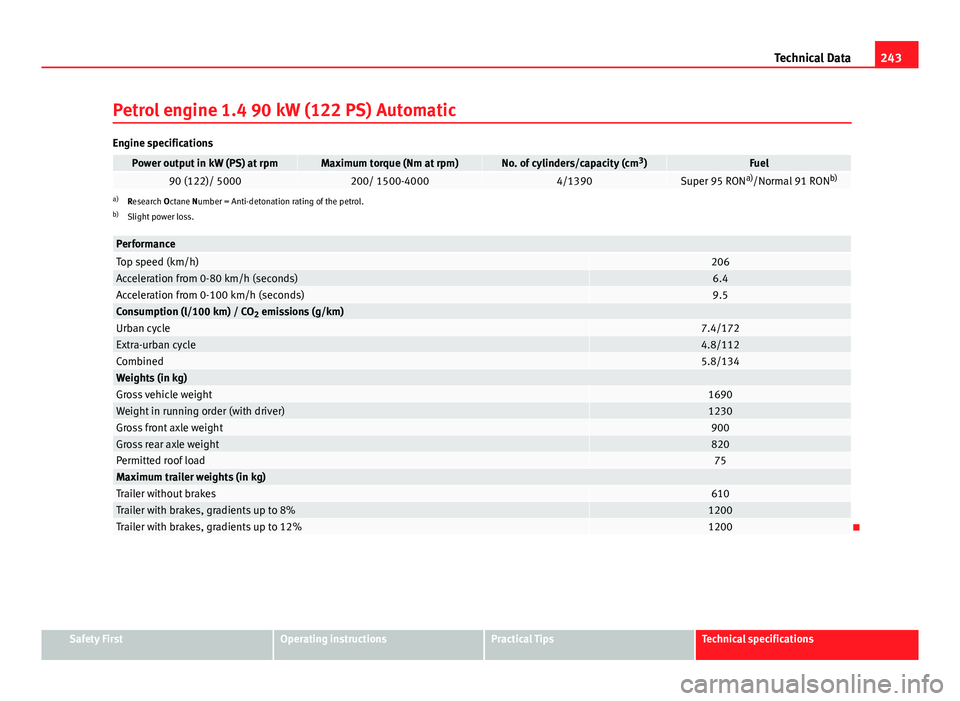
Petrol engine 1.4 90 kW (122 PS) Automatic
Engine specifications
Power output in kW (PS) at rpmMaximum torque (Nm at rpm)No. of cylinders/capacity (cm 3
)Fuel90 (122)/ 5000200/ 1500-40004/1390Super 95 RON a)
/Normal 91 RON b)a)
Research Octane Number = Anti-detonation rating of the petrol.
b) Slight power loss.
PerformanceTop speed (km/h)206Acceleration from 0-80 km/h (seconds)6.4Acceleration from 0-100 km/h (seconds)9.5Consumption (l/100 km) / CO 2 emissions (g/km)Urban cycle7.4/172Extra-urban cycle4.8/112Combined5.8/134Weights (in kg)Gross vehicle weight1690Weight in running order (with driver)1230Gross front axle weight900Gross rear axle weight820Permitted roof load75Maximum trailer weights (in kg)Trailer without brakes610Trailer with brakes, gradients up to 8%1200Trailer with brakes, gradients up to 12%1200
Safety FirstOperating instructionsPractical TipsTechnical specifications
Page 246 of 258
244Technical Data
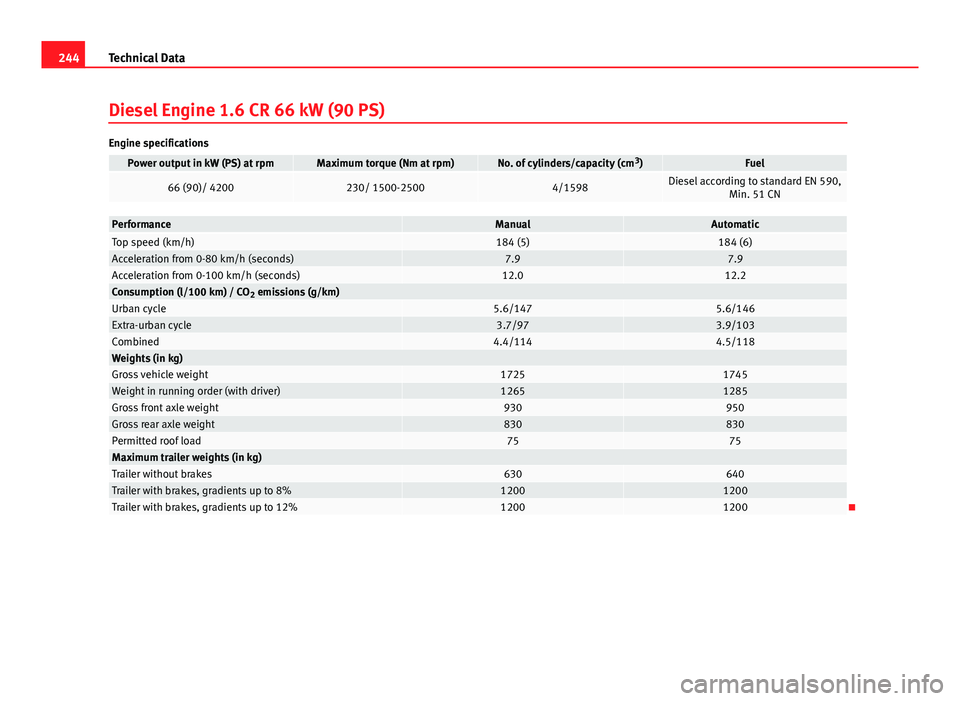
Diesel Engine 1.6 CR 66 kW (90 PS)
Engine specifications
Power output in kW (PS) at rpmMaximum torque (Nm at rpm)No. of cylinders/capacity (cm 3
)Fuel
66 (90)/ 4200230/ 1500-25004/1598Diesel according to standard EN 590,
Min. 51 CN
PerformanceManualAutomaticTop speed (km/h)184 (5)184 (6)Acceleration from 0-80 km/h (seconds)7.97.9Acceleration from 0-100 km/h (seconds)12.012.2Consumption (l/100 km) / CO 2 emissions (g/km)Urban cycle5.6/1475.6/146Extra-urban cycle3.7/973.9/103Combined4.4/1144.5/118Weights (in kg)Gross vehicle weight17251745Weight in running order (with driver)12651285Gross front axle weight930950Gross rear axle weight830830Permitted roof load7575Maximum trailer weights (in kg)Trailer without brakes630640Trailer with brakes, gradients up to 8%12001200Trailer with brakes, gradients up to 12%12001200
Page 247 of 258
245
Technical Data
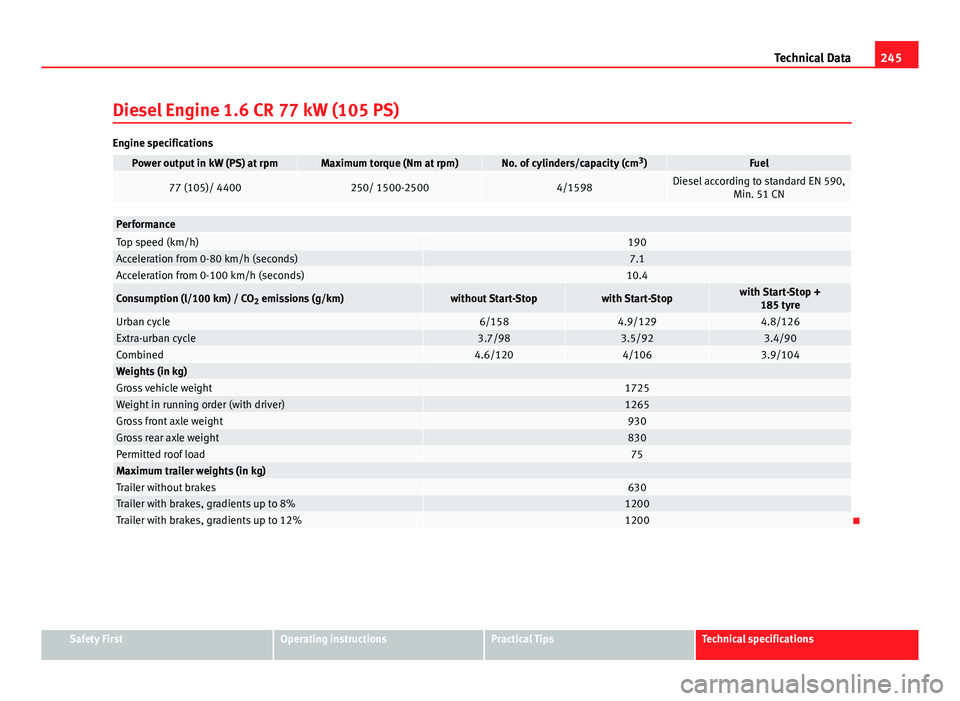
Diesel Engine 1.6 CR 77 kW (105 PS)
Engine specifications
Power output in kW (PS) at rpmMaximum torque (Nm at rpm)No. of cylinders/capacity (cm 3
)Fuel
77 (105)/ 4400250/ 1500-25004/1598Diesel according to standard EN 590,
Min. 51 CN
PerformanceTop speed (km/h)190Acceleration from 0-80 km/h (seconds)7.1Acceleration from 0-100 km/h (seconds)10.4
Consumption (l/100 km) / CO 2 emissions (g/km)without Start-Stopwith Start-Stopwith Start-Stop +
185 tyre
Urban cycle6/1584.9/1294.8/126Extra-urban cycle3.7/983.5/923.4/90Combined4.6/1204/1063.9/104Weights (in kg)Gross vehicle weight1725Weight in running order (with driver)1265Gross front axle weight930Gross rear axle weight830Permitted roof load75Maximum trailer weights (in kg)Trailer without brakes630Trailer with brakes, gradients up to 8%1200Trailer with brakes, gradients up to 12%1200
Safety FirstOperating instructionsPractical TipsTechnical specifications
Page 248 of 258
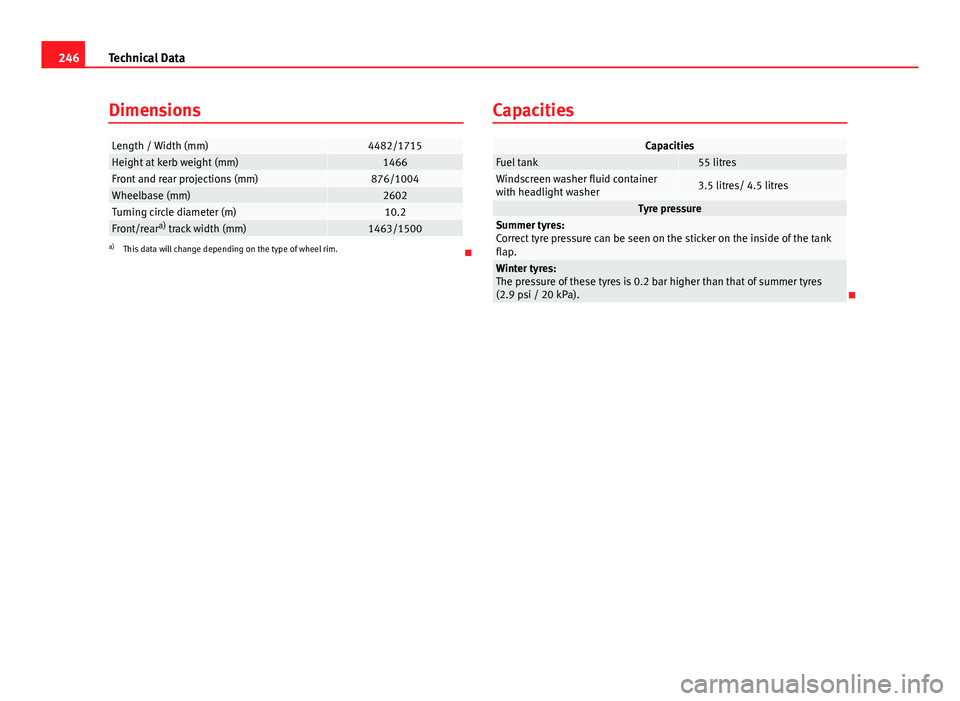
246Technical Data
Dimensions
Length / Width (mm)4482/1715Height at kerb weight (mm)1466Front and rear projections (mm)876/1004Wheelbase (mm)2602Turning circle diameter (m)10.2Front/reara)
track width (mm)1463/1500a) This data will change depending on the type of wheel rim.
Capacities
CapacitiesFuel tank 55 litresWindscreen washer fluid container
with headlight washer 3.5 litres/ 4.5 litres
Tyre pressureSummer tyres:
Correct tyre pressure can be seen on the sticker on the inside of the tank
flap.
Winter tyres:
The pressure of these tyres is 0.2 bar higher than that of summer tyres
(2.9 psi / 20 kPa).