tow Seat Toledo 2013 Owner's Guide
[x] Cancel search | Manufacturer: SEAT, Model Year: 2013, Model line: Toledo, Model: Seat Toledo 2013Pages: 258, PDF Size: 3.94 MB
Page 170 of 258
168Driving the vehicle with a trailer
Red marking on the manual regulator
White marking on the ball-headed bar
Note
Contact an Authorised Service Partner if you lose your key.
Placing in service position
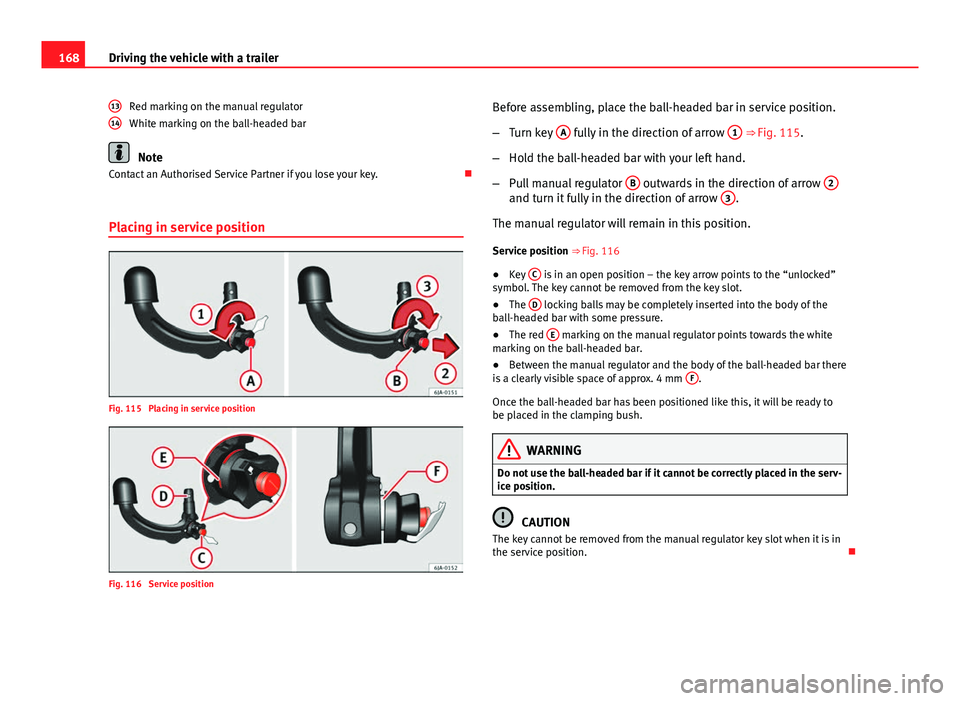
Fig. 115 Placing in service position
Fig. 116 Service position 13
14Before assembling, place the ball-headed bar in service position.
–
Turn key A
fully in the direction of arrow 1 ⇒ Fig. 115.
– Hold the ball-headed bar with your left hand.
– Pull manual regulator B
outwards in the direction of arrow 2and turn it fully in the direction of arrow 3.
The manual regulator will remain in this position.
Service position ⇒ Fig. 116
● Key C
is in an open position – the key arrow points to the “unlocked”
symbol. The key cannot be removed from the key slot.
● The D
locking balls may be completely inserted into the body of the
ball-headed bar with some pressure.
● The red E
marking on the manual regulator points towards the white
marking on the ball-headed bar.
● Between the manual regulator and the body of the ball-headed bar there
is a clearly visible space of approx. 4 mm F
.
Once the ball-headed bar has been positioned like this, it will be ready to
be placed in the clamping bush.
WARNING
Do not use the ball-headed bar if it cannot be correctly placed in the serv-
ice position.
CAUTION
The key cannot be removed from the manual regulator key slot when it is in
the service position.
Page 172 of 258
170Driving the vehicle with a trailer
Verification of correct placement
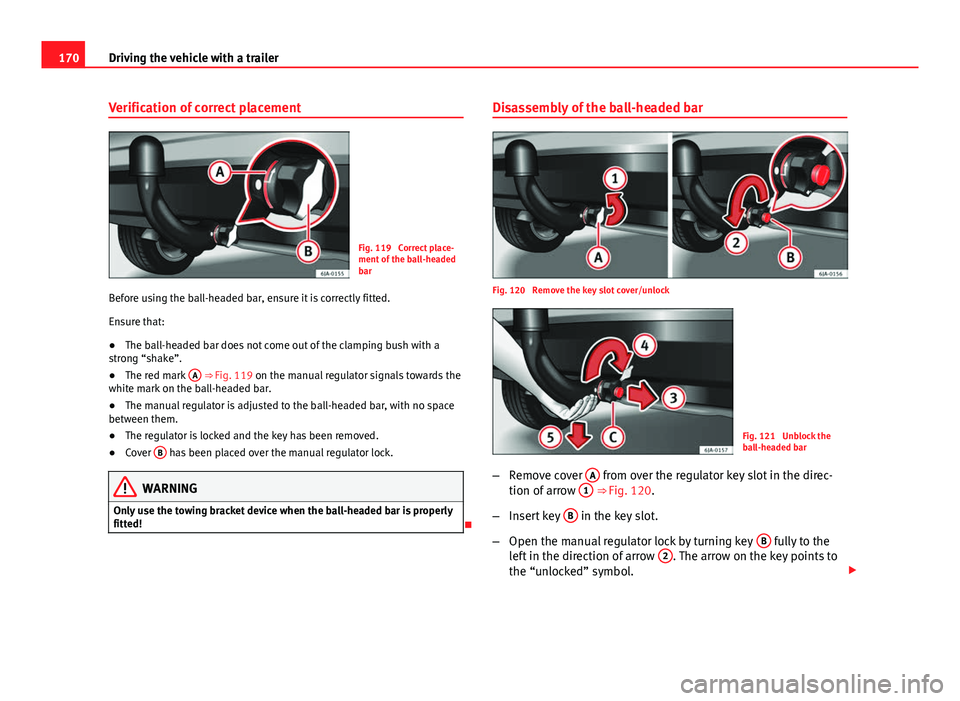
Fig. 119 Correct place-
ment of the ball-headed
bar
Before using the ball-headed bar, ensure it is correctly fitted.
Ensure that:
● The ball-headed bar does not come out of the clamping bush with a
strong “shake”.
● The red mark A
⇒ Fig. 119 on the manual regulator signals towards the
white mark on the ball-headed bar.
● The manual regulator is adjusted to the ball-headed bar, with no space
between them.
● The regulator is locked and the key has been removed.
● Cover B
has been placed over the manual regulator lock.
WARNING
Only use the towing bracket device when the ball-headed bar is properly
fitted!
Disassembly of the ball-headed bar
Fig. 120 Remove the key slot cover/unlock
Fig. 121 Unblock the
ball-headed bar
– Remove cover A
from over the regulator key slot in the direc-
tion of arrow 1 ⇒ Fig. 120.
– Insert key B
in the key slot.
– Open the manual regulator lock by turning key B
fully to the
left in the direction of arrow 2. The arrow on the key points to
the “unlocked” symbol.
Page 188 of 258
186Checking and refilling levels
Checking the engine oil level
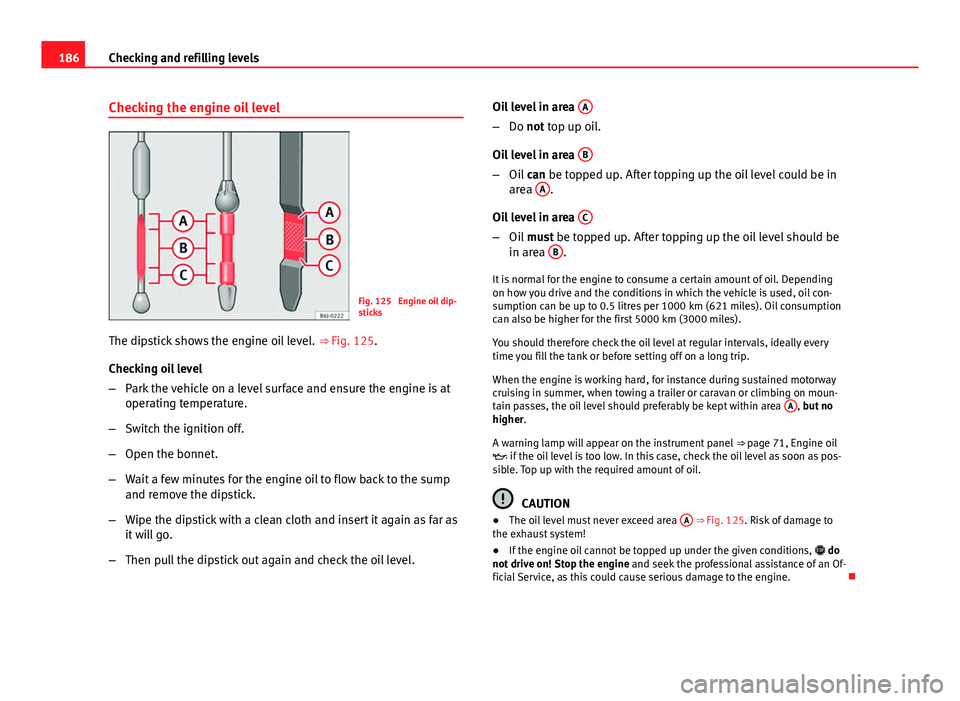
Fig. 125 Engine oil dip-
sticks
The dipstick shows the engine oil level. ⇒ Fig. 125.
Checking oil level
– Park the vehicle on a level surface and ensure the engine is at
operating temperature.
– Switch the ignition off.
– Open the bonnet.
– Wait a few minutes for the engine oil to flow back to the sump
and remove the dipstick.
– Wipe the dipstick with a clean cloth and insert it again as far as
it will go.
– Then pull the dipstick out again and check the oil level. Oil level in area
A
–
Do not top up oil.
Oil level in area B
–
Oil can be topped up. After topping up the oil level could be in
area A.
Oil level in area C
–
Oil must be topped up. After topping up the oil level should be
in area B.
It is normal for the engine to consume a certain amount of oil. Depending
on how you drive and the conditions in which the vehicle is used, oil con-
sumption can be up to 0.5 litres per 1000 km (621 miles). Oil consumption
can also be higher for the first 5000 km (3000 miles).
You should therefore check the oil level at regular intervals, ideally every
time you fill the tank or before setting off on a long trip.
When the engine is working hard, for instance during sustained motorway
cruising in summer, when towing a trailer or caravan or climbing on moun-
tain passes, the oil level should preferably be kept within area A
, but no
higher.
A warning lamp will appear on the instrument panel ⇒ page 71, Engine oil
if the oil level is too low. In this case, check the oil level as soon as pos-
sible. Top up with the required amount of oil.
CAUTION
● The oil level must never exceed area A ⇒ Fig. 125. Risk of damage to
the exhaust system!
● If the engine oil cannot be topped up under the given conditions, do
not drive on! Stop the engine and seek the professional assistance of an Of-
ficial Service, as this could cause serious damage to the engine.
Page 209 of 258
207
Self-help
Vehicle tool kit*
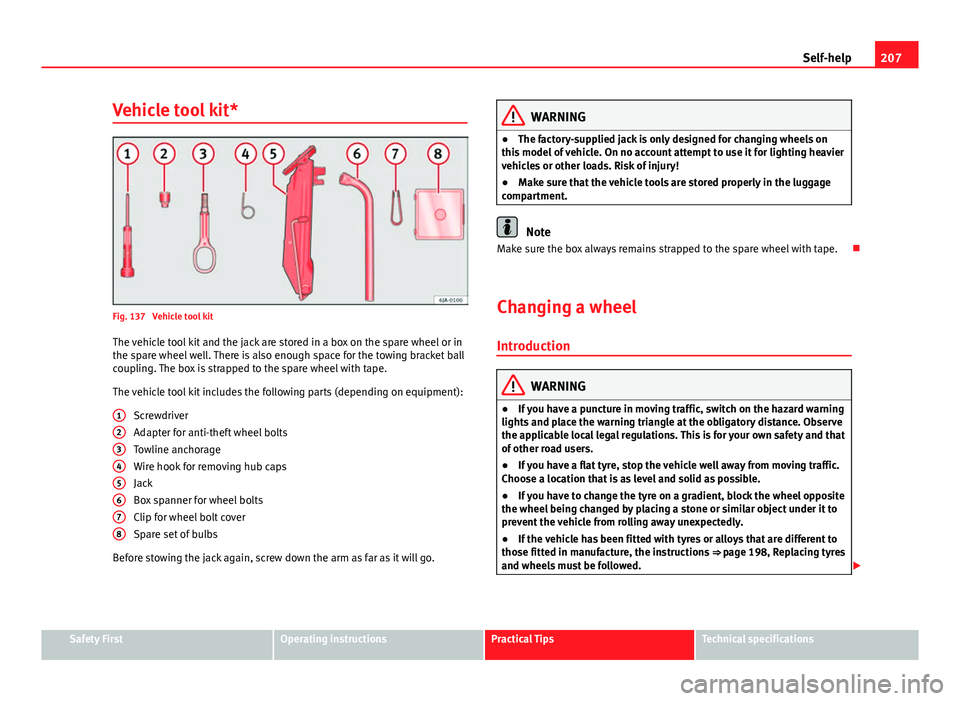
Fig. 137 Vehicle tool kit
The vehicle tool kit and the jack are stored in a box on the spare wheel or in
the spare wheel well. There is also enough space for the towing bracket ball
coupling. The box is strapped to the spare wheel with tape.
The vehicle tool kit includes the following parts (depending on equipment): Screwdriver
Adapter for anti-theft wheel bolts
Towline anchorage
Wire hook for removing hub caps
Jack
Box spanner for wheel bolts
Clip for wheel bolt cover
Spare set of bulbs
Before stowing the jack again, screw down the arm as far as it will go. 1
2345678
WARNING
● The factory-supplied jack is only designed for changing wheels on
this model of vehicle. On no account attempt to use it for lighting heavier
vehicles or other loads. Risk of injury!
● Make sure that the vehicle tools are stored properly in the luggage
compartment.
Note
Make sure the box always remains strapped to the spare wheel with tape.
Changing a wheel Introduction
WARNING
● If you have a puncture in moving traffic, switch on the hazard warning
lights and place the warning triangle at the obligatory distance. Observe
the applicable local legal regulations. This is for your own safety and that
of other road users.
● If you have a flat tyre, stop the vehicle well away from moving traffic.
Choose a location that is as level and solid as possible.
● If you have to change the tyre on a gradient, block the wheel opposite
the wheel being changed by placing a stone or similar object under it to
prevent the vehicle from rolling away unexpectedly.
● If the vehicle has been fitted with tyres or alloys that are different to
those fitted in manufacture, the instructions ⇒ page 198, Replacing tyres
and wheels must be followed.
Safety FirstOperating instructionsPractical TipsTechnical specifications
Page 210 of 258
208Self-help
WARNING (Continued)
● Always raise the vehicle with the doors closed.
● Never place parts of your body, e.g. arms and legs, underneath the
vehicle when supported only by the jack.
● Secure the base of the jack with suitable supports so that it cannot
slip. The jack could slide if the ground below it is soft and slippery and
the vehicle could slip off it. Therefore, place the jack on a firm surface or
use a large, stable base. On a slippery surface, e.g. tiles, use a non-slip
base such as a rubber mat.
● Never start the engine when the vehicle is raised. Risk of injury.
● The jack should only be used in the correct jacking points.
CAUTION
● The prescribed tightening torque for wheel bolts on steel and alloy
wheels is 120 Nm.
● If the anti-theft wheel bolt is overly tightened, this could damage the
bolt and the adapter
Note
● The set of anti-theft wheel bolts or the adapter are available from au-
thorised SEAT dealers.
● Please observe the relevant local legal regulations when changing the
wheel.
Preparation work
Some preparation is required before changing a wheel:
– If you have a flat tyre, stop the vehicle as far away as possible
from moving traffic. The surface must be horizontal.–
All vehicle occupants should leave the vehicle . Vehicle occu-
pants should waiting in a safe place, e.g. behind the roadside
crash barrier) while the wheel is being changed.
– Switch off the ignition and engage neutral or move the selector
lever on the automatic gearbox to position P.
– Apply the handbrake firmly.
– If towing a trailer, unhitch it.
– Take the vehicle tool kit ⇒ page 207 and the spare wheel
⇒ page 207 out of the luggage compartment.
Changing a wheel
If possible, change the wheel on a level surface.
– Pull off the hub cap ⇒ page 200 or the wheel bolt covers
⇒ page 200.
– First loosen the anti-theft wheel bolts and then the other wheel
bolts ⇒ page 209.
– Raise the vehicle until the wheel to be changed is no longer
touching the ground ⇒ page 210.
– Remove the wheel bolts and place them on a clean surface
(cloth, paper, etc.).
– Take off the wheel.
– Lift the spare wheel into position and tighten the wheel bolts
lightly.
Page 215 of 258
213
Self-help
Before using the tyre repair kit
The following jobs must be performed before using the tyre repair
kit:
– If you have a flat tyre, stop the vehicle well away from moving
traffic. Stop on flat, solid ground.
– All vehicle occupants should leave the vehicle. Vehicle occu-
pants should waiting in a safe place, e.g. behind the roadside
crash barrier) while the wheel is being changed.
– Switch off the ignition and engage neutral or move the selector
lever on the automatic gearbox to position P.
– Apply the handbrake firmly.
– Check whether the tyre can be repaired using the tyre repair kit
⇒ page 211.
– If towing a trailer, unhitch it.
– Take the tyre repair kit out of the luggage compartment.
– Fix the sticker 2
⇒ Fig. 142 ⇒
page 212 onto the dash panel
where the driver will see it.
– Do not remove the foreign body, e.g. bolts or nails, from the
tyre.
– Unscrew the tyre valve cap.
– Using the valve extractor 1
, unscrew the valve insert and place
it onto a clean surface (cloth, paper, etc.) Filling and inflating the tyre
Filling the tyre
–
Shake the tyre sealant can 10
⇒ Fig. 142 ⇒ page 212 thorough-
ly several times.
– Attach the flexible filling hose 3
onto the can 10. The foil seal-
ing the can will be automatically pierced.
– Remove the cap from the flexible filling hose 3
and insert the
open end as far as it will go into the tyre valve.
– Hold the can 10
upside down and fill the complete contents of
the can into the tyre.
– Remove the empty can from the tyre.
– Screw the valve insert back into the tyre valve using the valve
extractor 1
.
Inflating the tyre
– Screw the tyre filling hose 5
⇒ Fig. 142 ⇒ page 212 firmly onto
the tyre valve.
– Make sure that the bleed screw 7
is closed.
– Start the vehicle engine and leave it running.
– Plug the connector 9
into the 12-volt power socket.
– Turn the air compressor on with the switch 8
.
– Leave the air compressor running until the tyre pressure has
reached 2.0-2.5 bar (29-36 psi / 200-250 kPa). Max. operating
time for the compressor is 8 minutes ⇒
!
Safety FirstOperating instructionsPractical TipsTechnical specifications
Page 218 of 258

216Self-help
Connecting negative terminals with the engine block
–Connect one end 3
⇒ Fig. 143 to the negative terminal of the
boosting battery B.
– Attach the other end 4
to a solid metal part firmly attached to
the engine block or to the engine block itself.
Starting the engine
– Start the engine of the vehicle and let it run at idling speed.
– Now start the engine of the vehicle with the discharged battery.
– If the engine fails to start, do not operate the start for longer
than 10 seconds. Wait for about 30 seconds and try again.
– Remove the jump leads from the engine in exactly the opposite
sequence to that described above. Jump-starting vehicles with the START-STOP system
Fig. 144 Jump-starting
vehicles with the START-
STOP system
In vehicles fitted with the START-STOP system, the booster cable cannot be
directly connected to the negative terminal of the vehicle battery but must
be attached to the engine earthing point.
Towing the vehicle
Introduction
Vehicles with manual gearbox can be towed using a towbar or tow-
rope. They can also be towed with either the front or rear wheels
lifted off the road.
Vehicles with automatic gearbox can be towed using a towbar or
towrope. They can also be towed with the front wheels lifted off the
Page 219 of 258

217
Self-help
road. If the vehicle is towed with the rear wheels lifted off the road
the automatic gearbox will be damaged!
It is easier and safer to tow a vehicle with a towbar. A towrope
should only be used if you do not have a towbar.
Follow the instructions below when towing a vehicle:
Notes for the driver of the towing vehicle
– Engage the clutch very gently when starting to move or on vehi-
cles with automatic gearbox press the accelerator carefully.
– On vehicles with manual gearbox, the towrope must be taut be-
fore driving off.
The maximum towing speed is 50 km/h (31 mph).
Notes for the driver of the towed vehicle
– The ignition should be switched on so that the steering wheel
lock is not engaged and the turn signals, horn and windscreen
wipers and washers can be used.
– Put the gear lever in neutral or move the selector lever to posi-
tion N (automatic gearbox).
The brake servo and power steering only work when the engine is
running. Considerably more effort is required on the brake pedal
and steering wheel when the engine is switched off.
Ensure the towrope remains taut at all times when towing.
CAUTION
● Do not tow-start the engine. Risk of engine damage! In vehicles with a
catalytic converter, unburnt fuel could reach the catalytic converter and
catch fire in it. This could damage and destroy the catalytic converter. Use
the battery from another vehicle for help in starting the engine ⇒ page 215,
Starting the engine.
● If, due to a fault, there is no oil in the gearbox, the car may only be tow-
ed with the driven wheels lifted clear of the road and transported on a spe-
cial vehicle transporter or trailer.
● If normal towing is not possible or if the vehicle is to be towed for further
than 50 km (31 miles), the vehicle must be transported on a special vehicle
transporter or trailer.
● The towrope should be slightly elastic to reduce the loading on both ve-
hicles during towing. It is advisable to use a towrope made of synthetic fibre
or similar material only.
● Do not pull too hard with the towing vehicle and always take care to
avoid jerking the towrope. When towing on a loose surface there is always a
risk of overloading and damaging the anchorage points.
● Attach the towrope or towbar only to the towline anchorages or to the
removable towing bracket ⇒ page 164, or ⇒ page 218.
Note
● We recommend you use the towrope or towbar available in the SEAT
Original Accessories programme from authorised SEAT dealers.
● Towing a vehicle requires some experience. Both drivers should be fa-
miliar with the technique required for towing. Inexperienced drivers should
not attempt to tow away another vehicle or to have their vehicle towed.
● Note the legal regulations concerning towing, particularly those regard-
ing the signalling of the towed and towing vehicle.
● The towrope must not be twisted, as under certain circumstances this
could unscrew the front towline anchorage.
Safety FirstOperating instructionsPractical TipsTechnical specifications
Page 220 of 258
218Self-help
Front towline anchorage
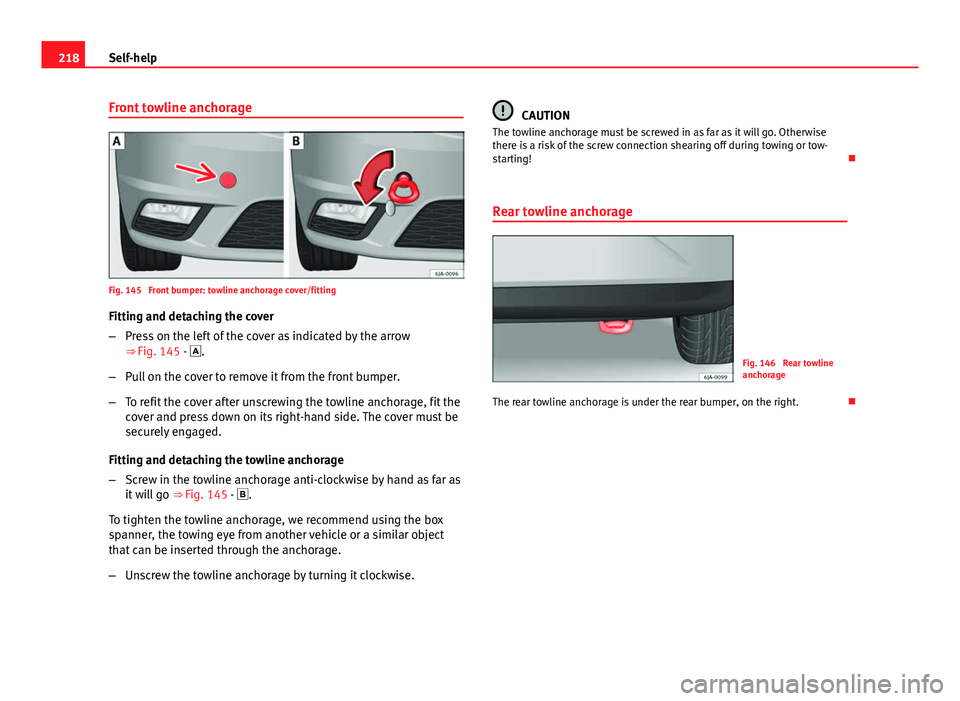
Fig. 145 Front bumper: towline anchorage cover/fitting
Fitting and detaching the cover
–Press on the left of the cover as indicated by the arrow
⇒ Fig. 145 - .
– Pull on the cover to remove it from the front bumper.
– To refit the cover after unscrewing the towline anchorage, fit the
cover and press down on its right-hand side. The cover must be
securely engaged.
Fitting and detaching the towline anchorage
– Screw in the towline anchorage anti-clockwise by hand as far as
it will go ⇒ Fig. 145 - .
To tighten the towline anchorage, we recommend using the box
spanner, the towing eye from another vehicle or a similar object
that can be inserted through the anchorage.
– Unscrew the towline anchorage by turning it clockwise.
CAUTION
The towline anchorage must be screwed in as far as it will go. Otherwise
there is a risk of the screw connection shearing off during towing or tow-
starting!
Rear towline anchorage
Fig. 146 Rear towline
anchorage
The rear towline anchorage is under the rear bumper, on the right.
Page 225 of 258
223
Fuses and bulbs
● Before changing a bulb, make sure you have the correct new bulb.
● Do not touch the glass part of the bulb with your bare hands, use a cloth
or paper towel instead. Otherwise, the fingerprints left on the glass will va-
porise as a result of the heat generated by the bulb, they will be deposited
on the reflector and will impair its surface.
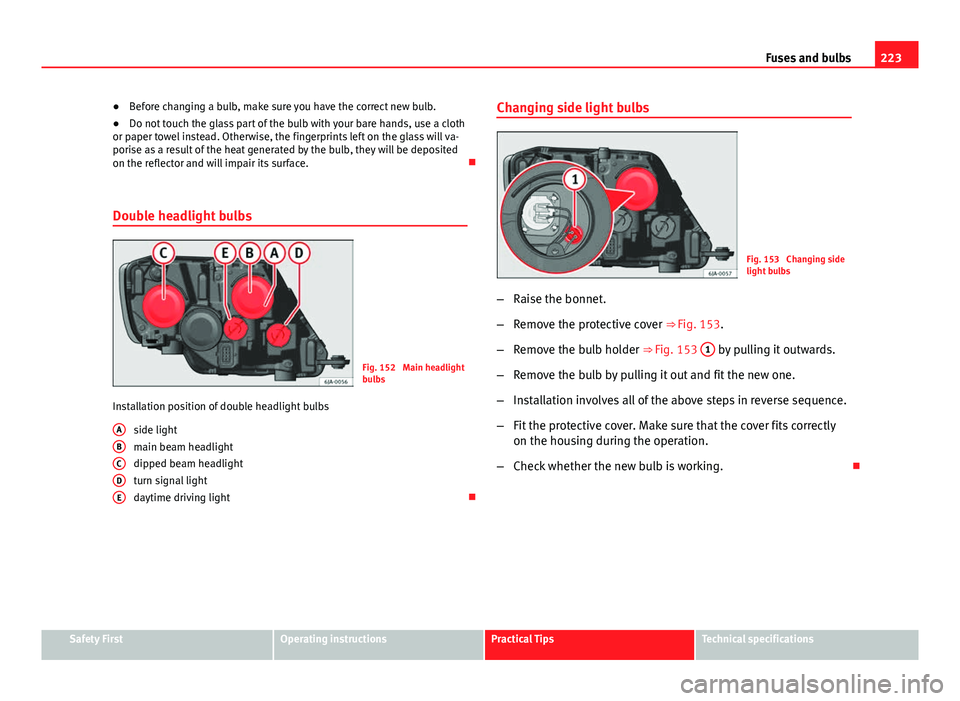
Double headlight bulbs
Fig. 152 Main headlight
bulbs
Installation position of double headlight bulbs side light
main beam headlight
dipped beam headlight
turn signal light
daytime driving light
A
BCDE
Changing side light bulbs
Fig. 153 Changing side
light bulbs
– Raise the bonnet.
– Remove the protective cover ⇒ Fig. 153.
– Remove the bulb holder ⇒ Fig. 153 1
by pulling it outwards.
– Remove the bulb by pulling it out and fit the new one.
– Installation involves all of the above steps in reverse sequence.
– Fit the protective cover. Make sure that the cover fits correctly
on the housing during the operation.
– Check whether the new bulb is working.
Safety FirstOperating instructionsPractical TipsTechnical specifications