service Seat Toledo 2013 Service Manual
[x] Cancel search | Manufacturer: SEAT, Model Year: 2013, Model line: Toledo, Model: Seat Toledo 2013Pages: 258, PDF Size: 3.94 MB
Page 186 of 258
184Checking and refilling levels
Before opening the bonnet, make sure that the windscreen wiper
arms are not lifted away from the glass. Otherwise the paintwork
may be damaged.
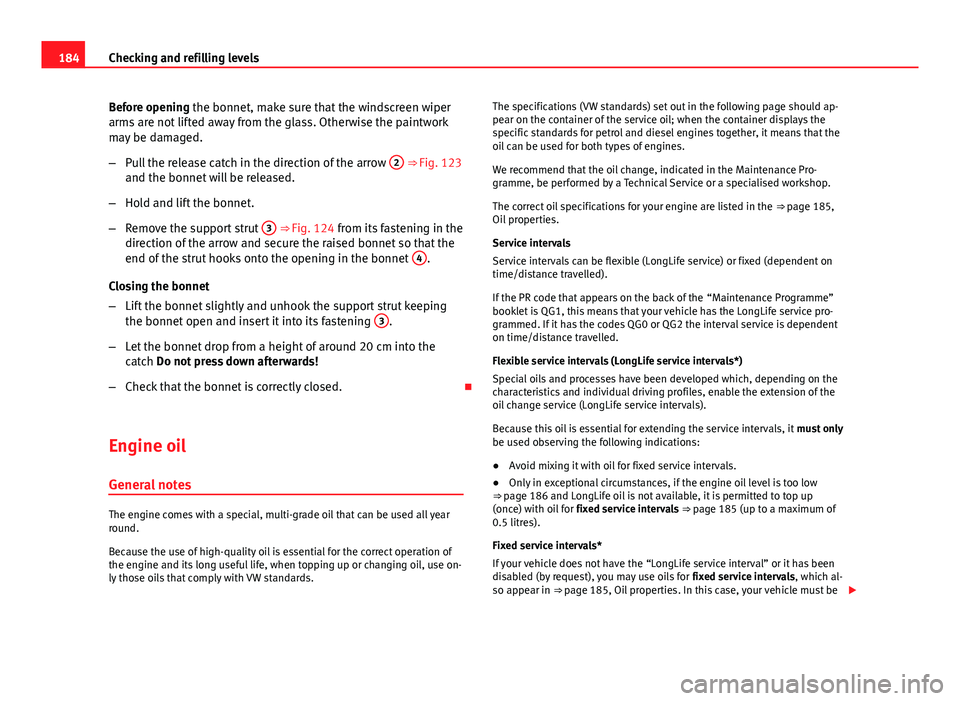
–Pull the release catch in the direction of the arrow 2
⇒ Fig. 123
and the bonnet will be released.
– Hold and lift the bonnet.
– Remove the support strut 3
⇒ Fig. 124 from its fastening in the
direction of the arrow and secure the raised bonnet so that the
end of the strut hooks onto the opening in the bonnet 4
.
Closing the bonnet
– Lift the bonnet slightly and unhook the support strut keeping
the bonnet open and insert it into its fastening 3
.
– Let the bonnet drop from a height of around 20 cm into the
catch Do not press down afterwards!
– Check that the bonnet is correctly closed.
Engine oil General notes
The engine comes with a special, multi-grade oil that can be used all year
round.
Because the use of high-quality oil is essential for the correct operation of
the engine and its long useful life, when topping up or changing oil, use on-
ly those oils that comply with VW standards. The specifications (VW standards) set out in the following page should ap-
pear on the container of the service oil; when the container displays the
specific standards for petrol and diesel engines together, it means that the
oil can be used for both types of engines.
We recommend that the oil change, indicated in the Maintenance Pro-
gramme, be performed by a Technical Service or a specialised workshop.
The correct oil specifications for your engine are listed in the
⇒ page 185,
Oil properties.
Service intervals
Service intervals can be flexible (LongLife service) or fixed (dependent on
time/distance travelled).
If the PR code that appears on the back of the “Maintenance Programme”
booklet is QG1, this means that your vehicle has the LongLife service pro-
grammed. If it has the codes QG0 or QG2 the interval service is dependent
on time/distance travelled.
Flexible service intervals (LongLife service intervals*)
Special oils and processes have been developed which, depending on the
characteristics and individual driving profiles, enable the extension of the
oil change service (LongLife service intervals).
Because this oil is essential for extending the service intervals, it must only
be used observing the following indications:
● Avoid mixing it with oil for fixed service intervals.
● Only in exceptional circumstances, if the engine oil level is too low
⇒ page 186 and LongLife oil is not available, it is permitted to top up
(once) with oil for fixed service intervals ⇒ page 185 (up to a maximum of
0.5 litres).
Fixed service intervals*
If your vehicle does not have the “LongLife service interval” or it has been
disabled (by request), you may use oils for fixed service intervals, which al-
so appear in ⇒ page 185, Oil properties. In this case, your vehicle must be
Page 187 of 258
185
Checking and refilling levels
serviced after a fixed interval of 1 year/15 000 km (10 000 miles)(whatever
comes first) ⇒ Booklet Maintenance Programme.
● In exceptional circumstances, if the engine oil level is too low
⇒ page 186 and you cannot obtain the oil specified for your vehicle, you
can put in a small quantity of oil conforming to the specification ACEA A2 or
ACEA A3 (petrol engines) or ACEA B3 or ACEA B4 (diesel engines) (up to 0.5
l).
Vehicles with diesel particulate filter*
The “Maintenance Programme” states whether your vehicle is fitted with a
diesel particulate filter.
Only VW 507 00 engine oil, with reduced ash formation, may be used in die-
sel engines equipped with particulate filter. Using other types of oil will
cause a higher soot concentration and reduce the life of the DPF. Therefore:
● Avoid mixing this oil with other engine oils.
● Only in exceptional circumstances, if the engine oil level is too low
⇒ page 186 and you cannot obtain the oil specified for your vehicle, you
can use a small quantity of oil (once) conforming to the VW 506 00,
VW 506 01, VW 505 00, VW 505 01 or ACEA B3/ACEA B4 specification. (up
to 0.5 l).
Oil properties
Engine typeSpecificationPetrol without flexible service in-
tervalVW 502 00/VW 504 00
Petrol with flexible service inter-
val (LongLife)VW 504 00
Engine typeSpecificationDiesel. Engines without Particu-
late filter (DPF)VW 505 01/VW 506 01/VW 507 00
Diesel. Particulate Filter Engines
(DPF).
With or without flexible service in-
terval (with and without Long-
life) a)VW 507 00
a)
Only use recommended oils, otherwise you may damage the engine.
Engine oil additives
No type of additive should be mixed with the engine oil. The deterioration
caused by these additives is not covered by the warranty.
Note
Before a long trip, we recommend finding an engine oil that conforms to the
corresponding VW specifications and recommend keeping it in the vehicle.
This way, the correct engine oil will always be available for a top-up if nee-
ded.
Safety FirstOperating instructionsPractical TipsTechnical specifications
Page 188 of 258
186Checking and refilling levels
Checking the engine oil level
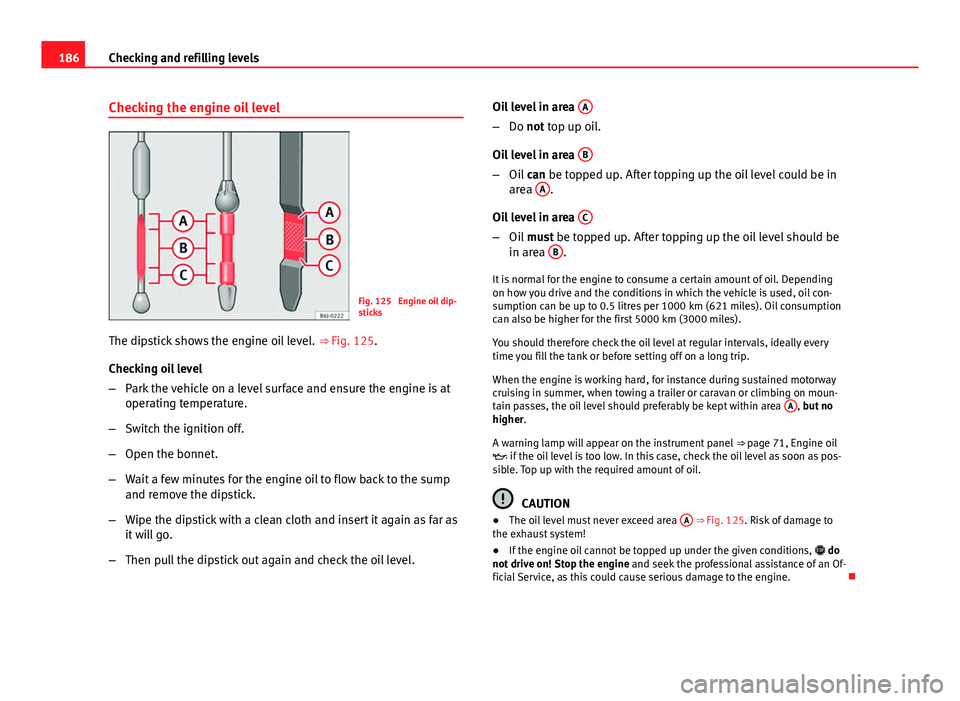
Fig. 125 Engine oil dip-
sticks
The dipstick shows the engine oil level. ⇒ Fig. 125.
Checking oil level
– Park the vehicle on a level surface and ensure the engine is at
operating temperature.
– Switch the ignition off.
– Open the bonnet.
– Wait a few minutes for the engine oil to flow back to the sump
and remove the dipstick.
– Wipe the dipstick with a clean cloth and insert it again as far as
it will go.
– Then pull the dipstick out again and check the oil level. Oil level in area
A
–
Do not top up oil.
Oil level in area B
–
Oil can be topped up. After topping up the oil level could be in
area A.
Oil level in area C
–
Oil must be topped up. After topping up the oil level should be
in area B.
It is normal for the engine to consume a certain amount of oil. Depending
on how you drive and the conditions in which the vehicle is used, oil con-
sumption can be up to 0.5 litres per 1000 km (621 miles). Oil consumption
can also be higher for the first 5000 km (3000 miles).
You should therefore check the oil level at regular intervals, ideally every
time you fill the tank or before setting off on a long trip.
When the engine is working hard, for instance during sustained motorway
cruising in summer, when towing a trailer or caravan or climbing on moun-
tain passes, the oil level should preferably be kept within area A
, but no
higher.
A warning lamp will appear on the instrument panel ⇒ page 71, Engine oil
if the oil level is too low. In this case, check the oil level as soon as pos-
sible. Top up with the required amount of oil.
CAUTION
● The oil level must never exceed area A ⇒ Fig. 125. Risk of damage to
the exhaust system!
● If the engine oil cannot be topped up under the given conditions, do
not drive on! Stop the engine and seek the professional assistance of an Of-
ficial Service, as this could cause serious damage to the engine.
Page 189 of 258
187
Checking and refilling levels
Topping up engine oil
– Check the engine oil level ⇒ page 186, Checking the engine oil
level.
– Unscrew the cap from the filler opening.
– Put in the specified grade of oil 0.5 litres at a time ⇒ page 184.
– Check the oil level ⇒ page 186.
– Replace the oil filler cap carefully and push the dipstick all the
way in.
Changing engine oil
Engine oil must be changed with the frequency indicated in the Mainte-
nance Programme or according to the service interval indicator ⇒ page 59.
CAUTION
Do not mix engine oil with additives. Risk of damage to the engine! Damage
caused by these products is not covered by the warranty.
Note
Wash your skin thoroughly if it comes into contact with engine oil. Coolant
General notes
The cooling system is factory-filled with an anti-freeze product.
Coolant consists of a mixture of water and 40% anti-freeze additive. This
mixture gives the required anti-freeze protection at temperatures down to
+25 °C (+77 °F) and protects the cooling and heating system against corro-
sion. It also prevents scaling and raises the boiling point of the coolant con-
siderably.
The coolant concentration must not be reduced by adding water, even in
warmer seasons or in warm countries. The concentration of the anti-freeze
additive in the coolant must be at least 40 %.
If greater anti-freeze protection is required in very cold climates, the propor-
tion of the anti-freeze additive can be increased, but only up to 60 % (anti-
freeze protection down to approx. -40 °C (-40 °F). Any excess in this propor-
tion would reduce the anti-freeze protection and affect the cooling effect.
Vehicles for countries with cold climate are are supplied with coolant protec-
tion down to around -35 °C (-31 °F). The proportion of the antifreeze addi-
tive in these countries should always be at least 50 %.
The type of anti-freeze to be used for topping up is indicated on the coolant
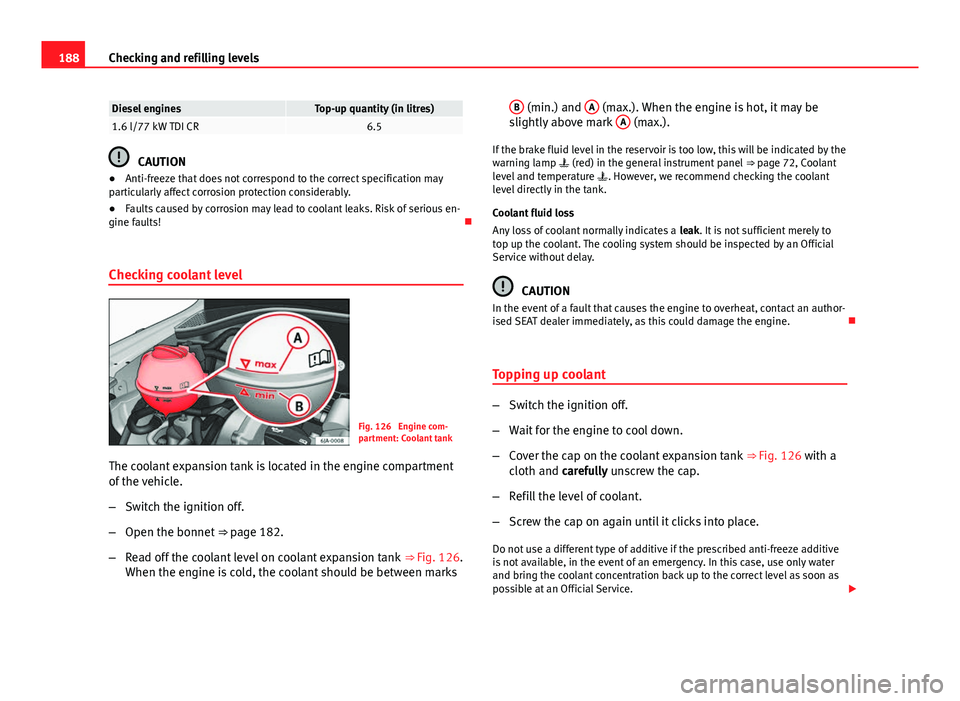
tank cover ⇒ Fig. 126.
Amount of coolant
Petrol enginesTop-up quantity (in litres)1.2 l/55 kW MPI4.21.2 l/63 kW TSI7.01.2 l/77 kW TSI7.01.4 l/90 kW TSI7.0
Safety FirstOperating instructionsPractical TipsTechnical specifications
Page 190 of 258
188Checking and refilling levels
Diesel enginesTop-up quantity (in litres)1.6 l/77 kW TDI CR6.5
CAUTION
● Anti-freeze that does not correspond to the correct specification may
particularly affect corrosion protection considerably.
● Faults caused by corrosion may lead to coolant leaks. Risk of serious en-
gine faults!
Checking coolant level
Fig. 126 Engine com-
partment: Coolant tank
The coolant expansion tank is located in the engine compartment
of the vehicle.
– Switch the ignition off.
– Open the bonnet ⇒ page 182.
– Read off the coolant level on coolant expansion tank ⇒
Fig. 126.
When the engine is cold, the coolant should be between marks B
(min.) and
A (max.). When the engine is hot, it may be
slightly above mark A (max.).
If the brake fluid level in the reservoir is too low, this will be indicated by the
warning lamp (red) in the general instrument panel ⇒ page 72, Coolant
level and temperature . However, we recommend checking the coolant
level directly in the tank.
Coolant fluid loss
Any loss of coolant normally indicates a leak. It is not sufficient merely to
top up the coolant. The cooling system should be inspected by an Official
Service without delay.
CAUTION
In the event of a fault that causes the engine to overheat, contact an author-
ised SEAT dealer immediately, as this could damage the engine.
Topping up coolant
– Switch the ignition off.
– Wait for the engine to cool down.
– Cover the cap on the coolant expansion tank ⇒ Fig. 126 with a
cloth and carefully unscrew the cap.
– Refill the level of coolant.
– Screw the cap on again until it clicks into place.
Do not use a different type of additive if the prescribed anti-freeze additive
is not available, in the event of an emergency. In this case, use only water
and bring the coolant concentration back up to the correct level as soon as
possible at an Official Service.
Page 195 of 258

193
Checking and refilling levels
– The positive terminal (+) of the battery is connected in reverse
order.
Checking battery acid level
Fig. 130 Battery: Acid
level indicator
We recommend you have the acid level regularly checked at an official tech-
nical service, particularly in the following cases.
● At high outside temperatures.
● On long daily trips.
● Whenever the vehicle is loaded ⇒ page 193, Charging the battery.
In vehicles equipped with a battery with colour indicator, the so-called mag-
ic eye ⇒ Fig. 130 changes colour to indicate the acid level.
Air bubbles can influence the colour of the indicator. Therefore, carefully
knock the indicator before checking the acid level.
● Black – the acid level is correct.
● Colourless or light yellow – acid level too low, battery must be changed.
Note
● The battery acid level is also regularly checked during servicing at au-
thorised SEAT dealers.
● The acid level on “AGM” vehicle batteries cannot be checked for techni-
cal reasons.
● Vehicles equipped with the “START-STOP” system include a battery con-
trol unit to control the battery level for repeat engine starting.
Winter service
At low temperatures the battery provides only a fraction of the starting pow-
er it has at normal temperatures.
A flat battery can also freeze at temperatures slightly below 0 °C (32 °F).
We therefore recommend you have the battery checked and, if necessary,
charged at an official SEAT technical service before the start of winter.
Charging the battery
A fully-charged battery is essential for reliable starting.
– Switch off the ignition and all electrical equipment.
– For “fast-charging” only: disconnect both battery connection ca-
bles (first the “negative” terminal and then the “positive”).
– Connect the charger cables to the battery terminals (red = “pos-
itive”, black = “negative”).
– Plug in the battery charger and switch on.
Safety FirstOperating instructionsPractical TipsTechnical specifications
Page 196 of 258
194Checking and refilling levels
–After charging the battery: Switch off the battery charger and
disconnect the cable.
– Remove the charger cables.
– If necessary, reconnect both battery cables to the battery (first
the “positive” cable, then the “negative” cable).
When charging with a low current (e.g. with a small battery charger), the
battery does not have to be disconnected. The instructions of the battery
charger manufacturer must be followed.
Use a current equivalent to or lower than 10% of the battery capacity to fully
charge the battery.
Before “fast-charging” the battery however, both battery cables must be
disconnected.
“Fast-charging” a battery is dangerous and requires a battery charger and
special knowledge. Fast charges should be performed by an official techni-
cal service.
The battery caps should not be opened while the battery is being charged.
CAUTION
In vehicles fitted with the “START-STOP” system, the charger cable cannot
be directly connected to the negative terminal of the vehicle battery but
must be attached to the engine earthing point ⇒ page 216.
Disconnecting and connecting the battery
The following functions will either be inoperative or will not work properly
after disconnecting and reconnecting the battery:
effectInstallationSetting the clock⇒ page 60The multifunction display data is deleted⇒ page 61
Note
We recommend having the vehicle checked by an authorised SEAT dealer to
guarantee the correct working order of all electrical systems.
Changing the battery
A replacement battery must have the same capacity, voltage, current rating
and size as the original. The appropriate types of battery can be acquired
from authorised SEAT dealers.
We recommend having the battery changed by an authorised SEAT dealer,
where the new battery will be correctly installed and the original disposed
of in line with regulations.
Automatic disconnection of electrical equipment
When heavily-charging a battery, the programme selected by the electrical
system control unit prevents the battery from automatically discharging.
This may result in the following:
● Increase in idling speed so that the alternator can supply more current
to the electrical system.
● The performance of certain electrical components could be limited or
some may switch off temporarily, e.g. the heated seats, the heated rear win-
dow, the 12V power socket.
Page 199 of 258
197
Wheels and tyres
Note
● We recommend having all work on tyres and wheels carried out by an
authorised SEAT dealer.
● We recommend using wheels, tyres, hub caps and snow chains from the
SEAT Original Accessories programme.
Tyre useful life
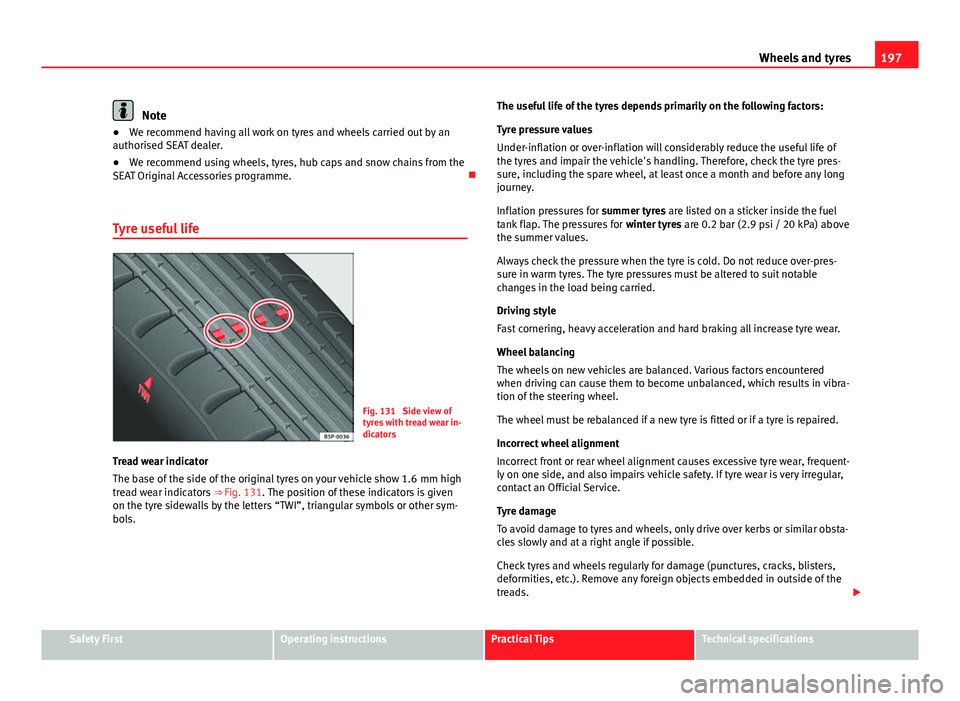
Fig. 131 Side view of
tyres with tread wear in-
dicators
Tread wear indicator
The base of the side of the original tyres on your vehicle show 1.6 mm high
tread wear indicators ⇒ Fig. 131. The position of these indicators is given
on the tyre sidewalls by the letters “TWI”, triangular symbols or other sym-
bols. The useful life of the tyres depends primarily on the following factors:
Tyre pressure values
Under-inflation or over-inflation will considerably reduce the useful life of
the tyres and impair the vehicle's handling. Therefore, check the tyre pres-
sure, including the spare wheel, at least once a month and before any long
journey.
Inflation pressures for
summer tyres are listed on a sticker inside the fuel
tank flap. The pressures for winter tyres are 0.2 bar (2.9 psi / 20 kPa) above
the summer values.
Always check the pressure when the tyre is cold. Do not reduce over-pres-
sure in warm tyres. The tyre pressures must be altered to suit notable
changes in the load being carried.
Driving style
Fast cornering, heavy acceleration and hard braking all increase tyre wear.
Wheel balancing
The wheels on new vehicles are balanced. Various factors encountered
when driving can cause them to become unbalanced, which results in vibra-
tion of the steering wheel.
The wheel must be rebalanced if a new tyre is fitted or if a tyre is repaired.
Incorrect wheel alignment
Incorrect front or rear wheel alignment causes excessive tyre wear, frequent-
ly on one side, and also impairs vehicle safety. If tyre wear is very irregular,
contact an Official Service.
Tyre damage
To avoid damage to tyres and wheels, only drive over kerbs or similar obsta-
cles slowly and at a right angle if possible.
Check tyres and wheels regularly for damage (punctures, cracks, blisters,
deformities, etc.). Remove any foreign objects embedded in outside of the
treads.
Safety FirstOperating instructionsPractical TipsTechnical specifications
Page 200 of 258
198Wheels and tyres
Unusual vibration or the car pulling to one side may indicate that one of the
tyres is damaged. Reduce speed immediately and stop if you suspect that
damage may have occurred! Check the tyres for damage (blisters, cracks,
etc.). If no external damage is visible, drive slowly and carefully to the near-
est Official Service and have the vehicle inspected.
Handling wheels and tyres
Fig. 132 Changing
wheels around
Changing wheels around
If the wear is visibly greater on the front tyres, they should be exchanged for
the rear tyres as shown in the diagram ⇒ Fig. 132. All the tyres will then last
for about the same time.
To ensure that the wear is equal on all tyres and maintain their optimum
useful life, they should be changed around every 10 000 km (6000 miles).
Storing tyres
When you remove the tyres, mark them in order to maintain the same direc-
tion of rotation when they are installed again.
When removed, the wheels and/or tyres should be stored in a cool, dry and
preferably dark location. Store tyres in a vertical position if they are not fit-
ted on wheel rims. Replacing tyres and wheels
All four wheels must be fitted only with tyres of the same type, size and the
same tread pattern.
The correct tyre/wheel combinations specified for your vehicle are listed in
its registration documentation.
Understanding the tyre designations makes it easier to choose the correct
tyres. The tyre designation is marked on the sidewall. For example.
195/55 R 15 85 H
This contains the following information:
195Tyre width in mm55Height/width ratio in %RTyre construction – Radial15Rim diameter in inches85Load rating codeHSpeed rating code letter
The tyres are subject to the following maximum speed limits:
Speed rating code letterMaximum speed limitQ160 km/h (99 mph)R170 km/h (106 mph)S180 km/h (112 mph)T190 km/h (118 mph)U200 km/h (124 mph)H210 km/h (130 mph)V240 km/h (149 mph)W270 km/h (168 mph)
Page 202 of 258
200Wheels and tyres
Follow the instructions below when driving with this wheel fitted.
● After fitting the wheel, the warning sign must not be covered.
● Do not drive faster than 80 km/h (50 mph) with this spare wheel and
take great care during the trip. Avoid heavy acceleration, hard braking and
fast cornering.
● The tyre pressure is the same as that of the standard tyres.
● Only use this spare wheel to reach the nearest Official Service, as it is
not designed for permanent use.
WARNING
● Under no circumstances must damaged spare wheels be used.
● If the spare wheel is different in size or design to the tyres currently
fitted, never drive faster than 80 km/h (50 mph). Avoid heavy accelera-
tion, hard braking and fast cornering.
CAUTION
Follow the instructions given on the temporary spare wheel label.
Note
The tyre pressure of the spare wheel must always correspond to the highest
pressure prescribed for the model of vehicle in question.
Wheel trim
Removing
– Place the hook from the vehicle tool kit on the reinforced edge
of the wheel trim. –
Insert the box spanner through the hook, supporting it on the
tyre and remove the wheel trim.
Fitting
– First press the wheel trim onto the wheel at the cut out de-
signed for the valve. Then press the wheel trim on both sides in
the direction of the valve so that it fits correctly in place around
all the perimeter.
CAUTION
● Press down by hand, do not hit the wheel trim! Knocking it sharply, par-
ticularly at points where the wheel trim has not yet been inserted, could re-
sult in damage to the wheel trim guiding and centring elements.
● Before fitting the trim on a steel alloy wheel attached with an anti-theft
wheel bolt, make sure the bolt is in the hole in the valve area ⇒ page 211,
Anti-theft wheel bolts*.
● Where trim is fitted at a later date, ensure enough air inflow is guaran-
teed in order to cool the brake system.
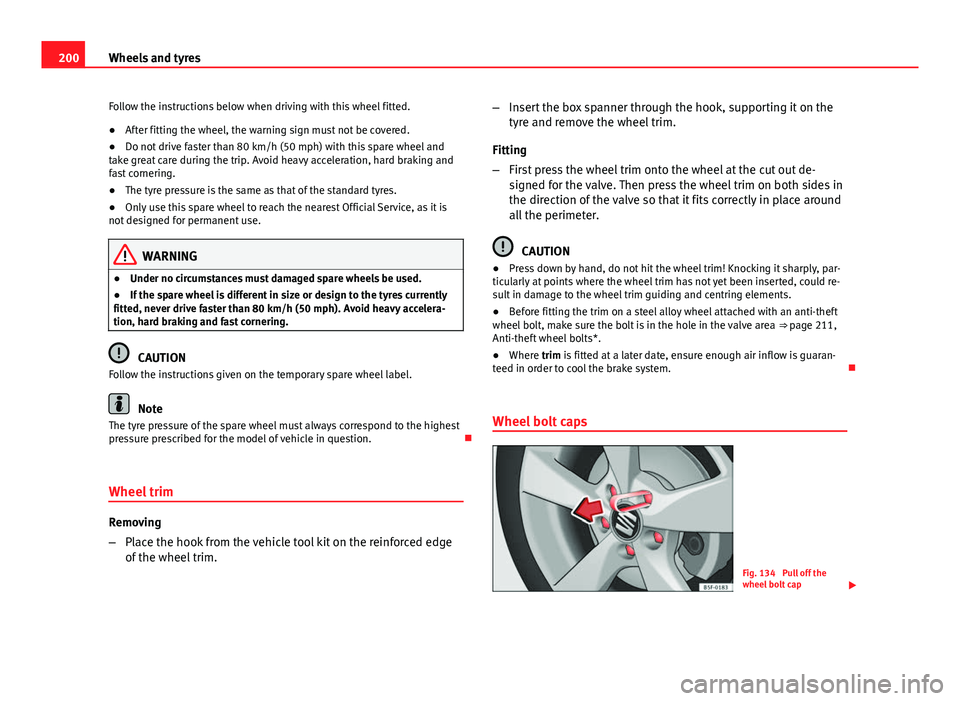
Wheel bolt caps
Fig. 134 Pull off the
wheel bolt cap