service Seat Toledo 2013 Owner's Guide
[x] Cancel search | Manufacturer: SEAT, Model Year: 2013, Model line: Toledo, Model: Seat Toledo 2013Pages: 258, PDF Size: 3.94 MB
Page 162 of 258
160Driving and the environment
Make less short journeys
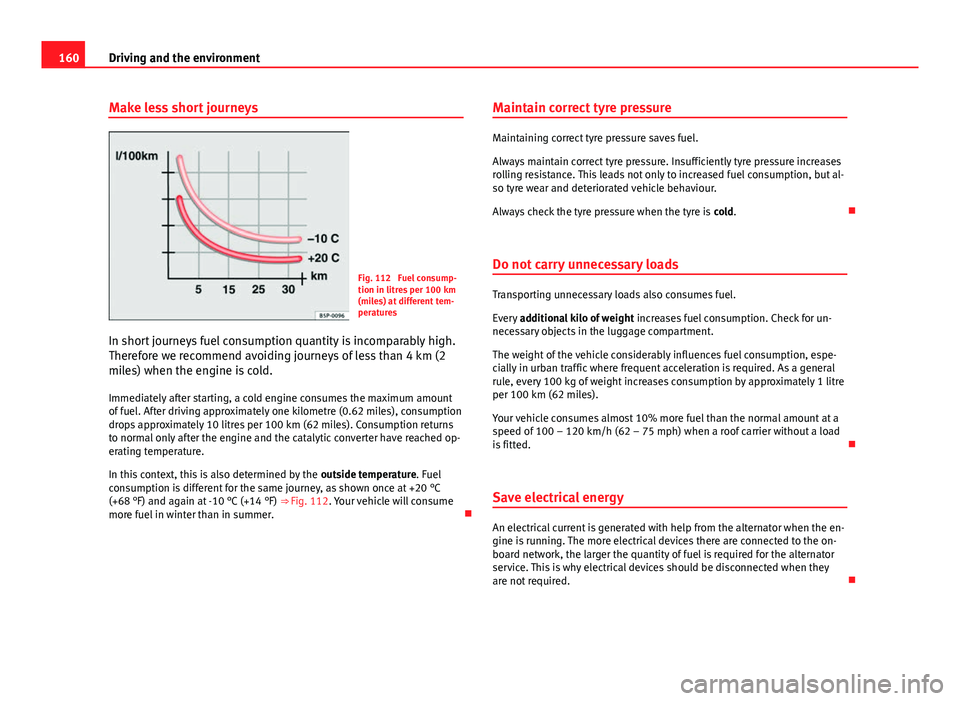
Fig. 112 Fuel consump-
tion in litres per 100 km
(miles) at different tem-
peratures
In short journeys fuel consumption quantity is incomparably high.
Therefore we recommend avoiding journeys of less than 4 km (2
miles) when the engine is cold. Immediately after starting, a cold engine consumes the maximum amount
of fuel. After driving approximately one kilometre (0.62 miles), consumption
drops approximately 10 litres per 100 km (62 miles). Consumption returns
to normal only after the engine and the catalytic converter have reached op-
erating temperature.
In this context, this is also determined by the outside temperature. Fuel
consumption is different for the same journey, as shown once at +20 °C
(+68 °F) and again at -10 °C (+14 °F) ⇒ Fig. 112. Your vehicle will consume
more fuel in winter than in summer. Maintain correct tyre pressure
Maintaining correct tyre pressure saves fuel.
Always maintain correct tyre pressure. Insufficiently tyre pressure increases
rolling resistance. This leads not only to increased fuel consumption, but al-
so tyre wear and deteriorated vehicle behaviour.
Always check the tyre pressure when the tyre is
cold.
Do not carry unnecessary loads
Transporting unnecessary loads also consumes fuel.
Every additional kilo of weight increases fuel consumption. Check for un-
necessary objects in the luggage compartment.
The weight of the vehicle considerably influences fuel consumption, espe-
cially in urban traffic where frequent acceleration is required. As a general
rule, every 100 kg of weight increases consumption by approximately 1 litre
per 100 km (62 miles).
Your vehicle consumes almost 10% more fuel than the normal amount at a
speed of 100 – 120 km/h (62 – 75 mph) when a roof carrier without a load
is fitted.
Save electrical energy
An electrical current is generated with help from the alternator when the en-
gine is running. The more electrical devices there are connected to the on-
board network, the larger the quantity of fuel is required for the alternator
service. This is why electrical devices should be disconnected when they
are not required.
Page 165 of 258
163
Driving and the environment
Note
After driving through water we recommend that you contact a specialised
service for an inspection.
Safety FirstOperating instructionsPractical TipsTechnical specifications
Page 168 of 258
166Driving the vehicle with a trailer
WARNING
● Adjust your speed to suit the road and traffic conditions.
● An electrical installation that is connected incorrectly or by non-spe-
cialised personnel can prevent the connection of the current to the trailer
and cause faults in the electrical system operation throughout the entire
vehicle, leading to accidents and serious injury.
● All electrical work must be carried out only by the specialised serv-
ices.
● Never directly connect the trailer electrical device to the electrical
sockets of the reverse driving lights or other sources of electrical current.
CAUTION
● Avoid corners, and sudden and sharp braking.
● Once the trailing arm has been removed, place the corresponding cover
on the hole of the fastening point. This prevents dirt from entering the hole
– see the trailer system assembly manual.
Note
● In the event of frequent journeys with a trailer, we recommend also hav-
ing the vehicle inspected in-between the service intervals.
● When connecting and disconnecting the trailer, the handbrake must be
applied.
● For technical reasons, trailers with LED reverse lights cannot be incorpo-
rated into the vehicle anti-theft alarm system.
Page 170 of 258
168Driving the vehicle with a trailer
Red marking on the manual regulator
White marking on the ball-headed bar
Note
Contact an Authorised Service Partner if you lose your key.
Placing in service position
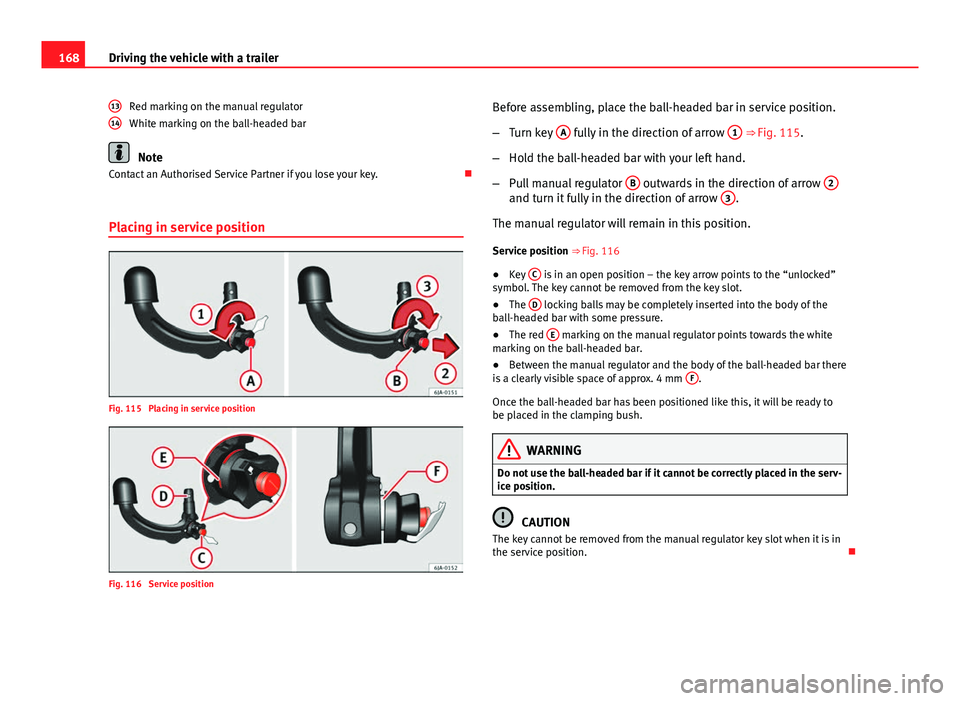
Fig. 115 Placing in service position
Fig. 116 Service position 13
14Before assembling, place the ball-headed bar in service position.
–
Turn key A
fully in the direction of arrow 1 ⇒ Fig. 115.
– Hold the ball-headed bar with your left hand.
– Pull manual regulator B
outwards in the direction of arrow 2and turn it fully in the direction of arrow 3.
The manual regulator will remain in this position.
Service position ⇒ Fig. 116
● Key C
is in an open position – the key arrow points to the “unlocked”
symbol. The key cannot be removed from the key slot.
● The D
locking balls may be completely inserted into the body of the
ball-headed bar with some pressure.
● The red E
marking on the manual regulator points towards the white
marking on the ball-headed bar.
● Between the manual regulator and the body of the ball-headed bar there
is a clearly visible space of approx. 4 mm F
.
Once the ball-headed bar has been positioned like this, it will be ready to
be placed in the clamping bush.
WARNING
Do not use the ball-headed bar if it cannot be correctly placed in the serv-
ice position.
CAUTION
The key cannot be removed from the manual regulator key slot when it is in
the service position.
Page 171 of 258
169
Driving the vehicle with a trailer
Assembling the ball-headed bar
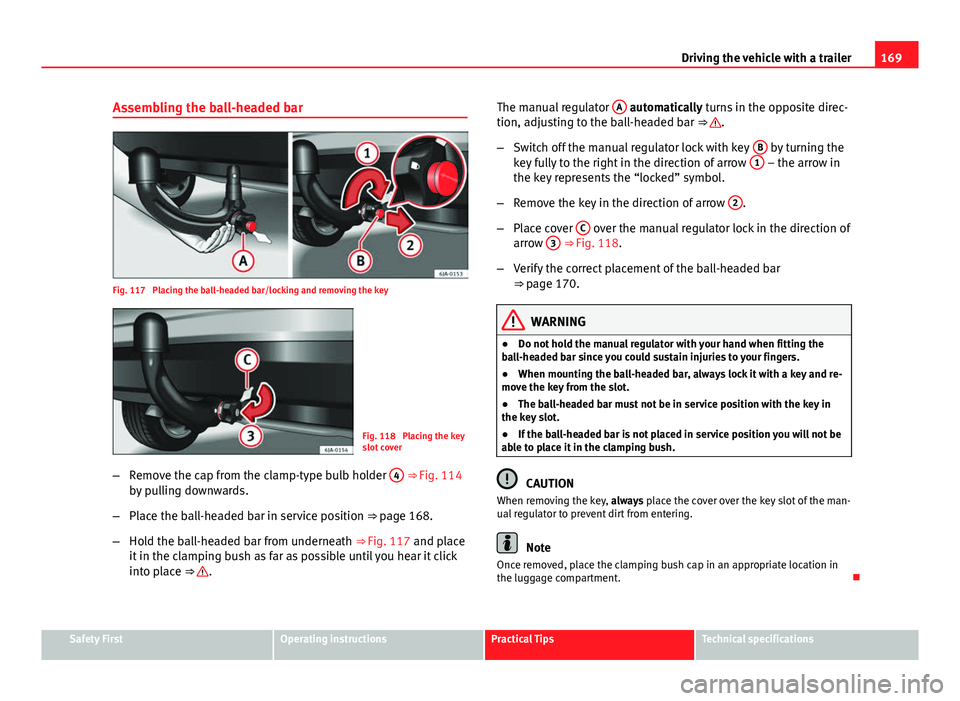
Fig. 117 Placing the ball-headed bar/locking and removing the key
Fig. 118 Placing the key
slot cover
– Remove the cap from the clamp-type bulb holder 4
⇒ Fig. 114
by pulling downwards.
– Place the ball-headed bar in service position ⇒ page 168.
– Hold the ball-headed bar from underneath ⇒ Fig. 117 and place
it in the clamping bush as far as possible until you hear it click
into place ⇒
. The manual regulator
A
automatically turns in the opposite direc-
tion, adjusting to the ball-headed bar ⇒ .
– Switch off the manual regulator lock with key B
by turning the
key fully to the right in the direction of arrow 1 – the arrow in
the key represents the “locked” symbol.
– Remove the key in the direction of arrow 2
.
– Place cover C
over the manual regulator lock in the direction of
arrow 3 ⇒ Fig. 118.
– Verify the correct placement of the ball-headed bar
⇒ page 170.
WARNING
● Do not hold the manual regulator with your hand when fitting the
ball-headed bar since you could sustain injuries to your fingers.
● When mounting the ball-headed bar, always lock it with a key and re-
move the key from the slot.
● The ball-headed bar must not be in service position with the key in
the key slot.
● If the ball-headed bar is not placed in service position you will not be
able to place it in the clamping bush.
CAUTION
When removing the key, always place the cover over the key slot of the man-
ual regulator to prevent dirt from entering.
Note
Once removed, place the clamping bush cap in an appropriate location in
the luggage compartment.
Safety FirstOperating instructionsPractical TipsTechnical specifications
Page 173 of 258
171
Driving the vehicle with a trailer
– Hold the ball-headed bar from underneath ⇒ Fig. 121 and re-
move manual regulator C
with your other hand in the direction
of arrow 3.
– Turn the removed regulator fully in the direction of arrow 4
and
firmly hold it in this position.
– Remove the ball-headed bar from the clamping bush, pulling
downwards in the direction of arrow 5
.
The ball-headed bar should be placed in service position so that it
is ready to be inserted in the clamping bush ⇒
.
– Place the cover over the clamping bush 4
⇒ Fig. 114.
WARNING
● Never leave the ball-headed bar unsecured in the luggage compart-
ment. It could be damaged in the event of sudden braking, putting the
safety of passengers at risk!
● Never disassemble the ball-headed bar with the trailer still hitched.
CAUTION
● If you do not turn the manual regulator fully, it will return to its original
position when the ball-headed bar is removed. The manual regulator will be
stuck to the ball-headed bar and you will not be able to put it in the service
position. Therefore, before you assemble it again, you must place the ball-
headed bar in this position.
● When disassembling, place the cap on the clamp-type bulb holder’s key
slot. You will thus prevent dirt from entering the key slot.
Note
● Before disassembling the ball-headed bar, we recommend placing the
cover on the ball head.
● Clean the ball-headed bar thoroughly before returning it to the on-board
toolbox.
Use and maintenance
Cover the clamping bush with the cap to prevent dirt from entering.
Before hooking on the trailer, check the ball head and, if necessary, lubri-
cate it with adequate lubricant.
Place the protective cover over the ball head when storing the bar. This way,
you will avoid getting the luggage compartment dirty.
If it gets dirty, clean and dry the clamping bush thoroughly with an appro-
priate product.
CAUTION
The top part of the clamping bush opening is lubricated. Be careful not to
remove this lubrication.
Safety FirstOperating instructionsPractical TipsTechnical specifications
Page 180 of 258
178Care of the vehicle and cleaning
CAUTION
● Avoid exposing leather to direct sunlight for long periods so that it does
not lose its colour. If the car is left for a prolonged period outdoors, cover
the leather so that it does not lose its colour.
● Sharp-edged objects on clothing, such as zips, rivets or belts can leave
permanent scratches and rough marks on the surface of the leather.
● Use of the mechanical steering wheel lock can damage the leather sur-
face of the steering wheel.
Note
● Use a suitable impregnating cream with ultra-violet protection at regular
intervals and after cleaning. The cream will nourish and moisturise the
leather, keep it supple and able to breathe. In addition, it will also help to
protect the surface of the leather.
● Clean the leather every 2 to 3 months and remove fresh dirt as necessa-
ry.
● Preserve the colour of the leather. A special coloured cream for leather
will renew the colour of more heavily worn areas as required.
● Leather is a natural material with specific properties. During vehicle use,
parts of the leather covers may change in appearance, such as folds or wrin-
kles, as a result of their use.
Seat belts
Keep the seat belts clean!
Wash soiled seat belts with mild, soapy water, removing any heavier dirt
with a soft brush.
Check the condition of all seat belts at regular intervals.
Very soiled belts may not retract properly.
WARNING
● The seat belts should never be removed from the vehicle for cleaning.
● Never clean using chemical products, as chemical detergents destroy
the fabric. Ensure that the seat belts do not come into contact with corro-
sive fluids such as acids, etc.
● If you find any damage to the belt webbing, belt fittings, the belt re-
tractor or the buckle, the belt in question must be replaced by an Official
Service.
● Make sure that the inertia reel seat belts are completely dry before
allowing them to retract.
Page 182 of 258
180Checking and refilling levels
–Press the tank flap with your hand to close it.
– Check that the fuel flap is correctly closed.
CAUTION
● Switch off the auxiliary heater (heater and independent heater) before
filling the tank.
● The fuel tank is full as soon as the automatic filler nozzle cuts out. Do
not continue filling, as this will fill the expansion chamber.
Note
The fuel tank capacity is around 55 litres, of which 7 litres are the reserve.
Unleaded petrol
Your vehicle must only be run on unleaded petrol that complies with the
Standard EN 228 (in Germany, also DIN 51626 – 1, or E10 for unleaded pet-
rol with 95 and 91 octane rating (RON) or DIN 51626 – 2, or E5 for unleaded
petrol with 95 and 98 RON).
Prescribed fuel – unleaded petrol (95/91 RON)
Use unleaded petrol with 95 RON. Unleaded petrol with 91 RON can also be
used, although this will result in a slight loss of power.
If, as an emergency measure, you have to fill the tank with petrol with a low-
er RON to that prescribed, use only moderate engine speeds and light throt-
tle. High engine speed and full throttle can seriously damage the engine!
Fill up with petrol with the correct RON as soon as possible.
Prescribed fuel – unleaded petrol (min. 95 RON)
Use unleaded petrol with 95 RON. If unleaded petrol with
95 RON is not available, you can fill up with petrol
with 91 RON as an emergency measure. In this case, use only moderate en-
gine speeds and a light throttle. High engine speed and full throttle can se-
riously damage the engine! Fill up with petrol with the correct RON as soon
as possible.
Petrol with a RON below 91 cannot be used, even as an emergency meas-
ure. Risk of seriously damaging the engine!
Unleaded petrol with higher RON
Unleaded petrol with a higher RON to that prescribed can be used without
limits.
In vehicles running on prescribed unleaded petrol with 95/91 RON, there is
no notable increase in power or lower fuel consumption when petrol with a
RON higher than 95 is used.
In vehicles running on prescribed unleaded petrol with min. 95 RON, there
is an increase in power and a lower fuel consumption when petrol with a
RON higher than 95 is used.
Prescribed fuel – unleaded petrol (98/(95) RON)
Use unleaded petrol with 98 RON. Unleaded petrol with 95 RON can also be
used, although this will result in a slight loss of power.
If unleaded petrol with 98 or 95 RON is not available, you can fill up with
petrol with 91 RON as an emergency measure. In this case, use only moder-
ate engine speeds and a light throttle. High engine speed and full throttle
can seriously damage the engine! Fill up with petrol with the correct RON as
soon as possible.
Petrol with a RON below 91 cannot be used, even as an emergency meas-
ure. Risk of seriously damaging the engine!
Petrol additives
The quality of the fuel influences the behaviour, performance and service
life of the engine. This is why the petrol you use should carry suitable addi-
tives already included by the petrol industry, free of metals. These additives
Page 183 of 258
181
Checking and refilling levels
will help to prevent corrosion, keep the fuel system clean and prevent de-
posits from building up in the engine.
If good quality petrol with metal-free additives is not available or engine
problems arise, the necessary additives must be added when refuelling
⇒
.
Not all petrol additives have been shown to be effective. The use of unsuita-
ble petrol additives may cause significant damage to the engine and the
catalytic converter. Metal additives should never be used. Metal additives
may also be contained in petrol additives for improving anti-detonation rat-
ings or octane ratings ⇒
.
SEAT recommends “genuine Volkswagen Group fuel additives for petrol en-
gines”. These additives can be bought at SEAT Authorised Services, where
information on how to use them can also be obtained.
CAUTION
● Do not refuel if the filler indicates that the fuel contains metal. LRP (lead
replacement petrol) fuels contain high concentrations of metal additives.
Using them may damage the engine!
● All SEAT vehicles with petrol engines can only run on unleaded petrol.
Refuelling just once with leaded petrol disables the exhaust system!
● Use of petrol with a lower RON to that prescribed could damage the en-
gine components.
● Fuels marked as containing metal on the garage fuel pump cannot be
used. Risk of damage to most engine parts or the exhaust system!
● The use of unsuitable additives in petrol can cause damage to most en-
gine parts or the exhaust system. Diesel fuel
Your vehicle can only run on
diesel fuel that complies with the Standard EN
590 (in Germany, also DIN 51628, in Austria also ÖNORM C 1590 , in Russia
also GOST R 52368-2005/EN 590:2004 ).
Winter driving – winter-grade diesel
In winter use diesel fuel that complies with the Standard EN 590 (in Germa-
ny, also DIN 51628, in Austria also ÖNORM C 1590, in Russia also GOST R
52368-2005/EN 590:2004). “Winter-grade diesel” still performs well at
-20 °C (-4 °F).
In countries with other weather conditions, diesel is often available that be-
haves differently with regards to the temperature. The authorised SEAT deal-
ers and petrol stations in each country will inform you on the normal diesel
fuel of the country in question.
Preheating the fuel filter
The vehicle is fitted with a glow plug system for the fuel filter. Therefore, the
reliability of the diesel is ensured at ambient temperatures of down to ap-
prox. -25 °C (-13 °F).
Fuel additives
Fuel additives, known as “thinners” (petrol or similar substances) should
not be mixed with the diesel fuel.
CAUTION
● Even one tankful of diesel fuel that does not comply with the standard
could damage engine parts, the fuel system and the exhaust system!
● If fuel different to the prescribed diesel fuel (e.g. petrol) is used by mis-
take, never start the engine or switch on the ignition! Risk of serious dam-
age to the engine! Contact an authorised SEAT dealer to clean the engine
fuel system.
Safety FirstOperating instructionsPractical TipsTechnical specifications
Page 185 of 258
183
Checking and refilling levels
WARNING (Continued)
– Never work near naked flames.
– Always keep an approved fire extinguisher immediately available.
CAUTION
● When topping up fluids, make sure the correct fluid is put into the cor-
rect filler opening. Otherwise this can cause serious malfunctions or engine
damage!
● Never open the bonnet using the release catch. Risk of damage.
For the sake of the environment
Due to the environment-friendly disposal of fluids, the equipment necessary
and the knowledge required, fluids must be changed by an authorised SEAT
dealer during the service inspections of the vehicle.
Note
● Please contact an authorised SEAT dealer with any doubts regarding flu-
ids.
● Fluids of the correct specifications can be acquired from the selection of
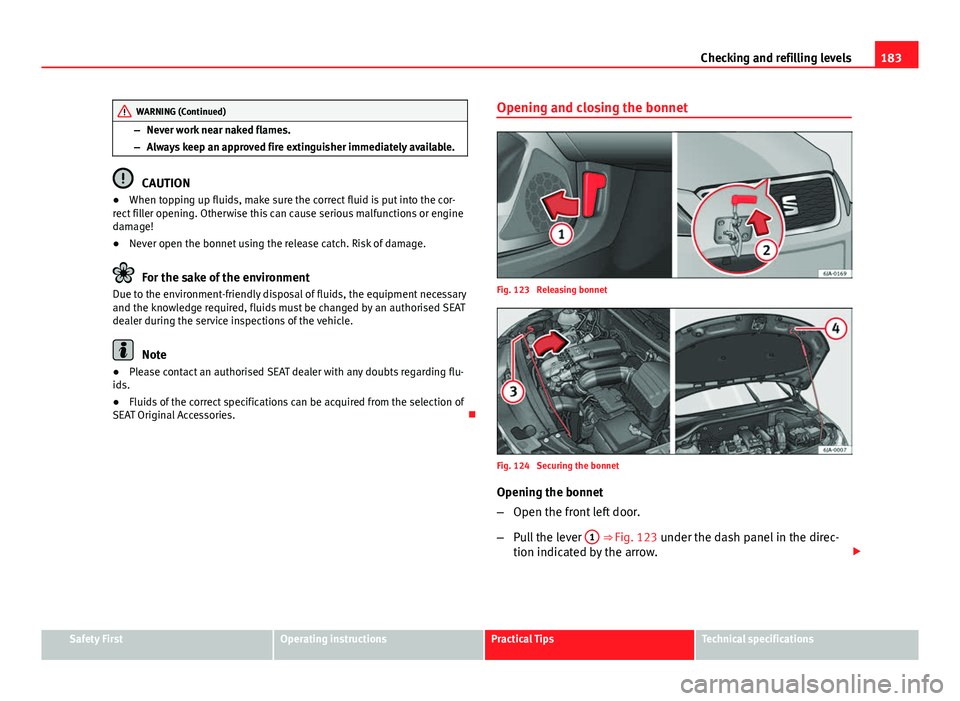
SEAT Original Accessories. Opening and closing the bonnet
Fig. 123 Releasing bonnet
Fig. 124 Securing the bonnet
Opening the bonnet
– Open the front left door.
– Pull the lever 1
⇒ Fig. 123 under the dash panel in the direc-
tion indicated by the arrow.
Safety FirstOperating instructionsPractical TipsTechnical specifications