brake light Seat Toledo 2013 Owner's manual
[x] Cancel search | Manufacturer: SEAT, Model Year: 2013, Model line: Toledo, Model: Seat Toledo 2013Pages: 258, PDF Size: 3.94 MB
Page 5 of 258
Table of Contents
About this manual . . . . . . . . . . . . . . . . . . . 5
Content . . . . . . . . . . . . . . . . . . . . . . . . . . . . . . . . 6
Safety First . . . . . . . . . . . . . . . . . . . . . . . . . . . . 7
Safe driving . . . . . . . . . . . . . . . . . . . . . . . . . . . . . . . 7
Brief introduction . . . . . . . . . . . . . . . . . . . . . . . . . 7
Sitting position for vehicle occupants . . . . . . . . . 10
Pedal area . . . . . . . . . . . . . . . . . . . . . . . . . . . . . . . 17
Storing objects . . . . . . . . . . . . . . . . . . . . . . . . . . . 17
Seat belts . . . . . . . . . . . . . . . . . . . . . . . . . . . . . . . . . 20
Brief introduction . . . . . . . . . . . . . . . . . . . . . . . . . 20
Why wear seat belts? . . . . . . . . . . . . . . . . . . . . . . 22
Seat belts . . . . . . . . . . . . . . . . . . . . . . . . . . . . . . . 26
Seat belt tensioners . . . . . . . . . . . . . . . . . . . . . . . 30
Airbag system . . . . . . . . . . . . . . . . . . . . . . . . . . . . . 31
Brief introduction . . . . . . . . . . . . . . . . . . . . . . . . . 31
Front airbags . . . . . . . . . . . . . . . . . . . . . . . . . . . . . 35
Side airbags* . . . . . . . . . . . . . . . . . . . . . . . . . . . . 38
Curtain airbags* . . . . . . . . . . . . . . . . . . . . . . . . . . 41
Deactivating airbags . . . . . . . . . . . . . . . . . . . . . . . 43
Child safety . . . . . . . . . . . . . . . . . . . . . . . . . . . . . . . 46
Brief introduction . . . . . . . . . . . . . . . . . . . . . . . . . 46
Child seats . . . . . . . . . . . . . . . . . . . . . . . . . . . . . . . 48
Securing child seats . . . . . . . . . . . . . . . . . . . . . . . 51 Operating instructions
. . . . . . . . . . . . . 55
Controls and displays . . . . . . . . . . . . . . . . . . . . . . 55
Overview . . . . . . . . . . . . . . . . . . . . . . . . . . . . . . . . 54
Instruments and warning lamps . . . . . . . . . . . . . 57
Multi-function display* (on board computer) . . . 61
MAXI DOT* (Informative display) . . . . . . . . . . . . . 66
Control lamps . . . . . . . . . . . . . . . . . . . . . . . . . . . . 69
Communication . . . . . . . . . . . . . . . . . . . . . . . . . . . 78
Steering wheel controls* . . . . . . . . . . . . . . . . . . . 78
Multimedia . . . . . . . . . . . . . . . . . . . . . . . . . . . . . . 81
Voice control . . . . . . . . . . . . . . . . . . . . . . . . . . . . . 82
Opening and closing . . . . . . . . . . . . . . . . . . . . . . 84
Keys . . . . . . . . . . . . . . . . . . . . . . . . . . . . . . . . . . . . 84
Central locking system . . . . . . . . . . . . . . . . . . . . . 86
Remote control . . . . . . . . . . . . . . . . . . . . . . . . . . . 89
Anti-theft alarm system* . . . . . . . . . . . . . . . . . . . 91
Vehicle interior monitoring and tow-away
protection system . . . . . . . . . . . . . . . . . . . . . . . . . 92
Rear lid . . . . . . . . . . . . . . . . . . . . . . . . . . . . . . . . . . 92
Opening and closing electric windows . . . . . . . . 95
Lights and visibility . . . . . . . . . . . . . . . . . . . . . . . . 97
Lights . . . . . . . . . . . . . . . . . . . . . . . . . . . . . . . . . . . 97
Interior lights . . . . . . . . . . . . . . . . . . . . . . . . . . . . . 102
Visibility . . . . . . . . . . . . . . . . . . . . . . . . . . . . . . . . . 104
Windscreen wipers and windscreen washers . . . 106
Rear vision mirrors . . . . . . . . . . . . . . . . . . . . . . . . 109
Seats and storage . . . . . . . . . . . . . . . . . . . . . . . . . 110
Front seats . . . . . . . . . . . . . . . . . . . . . . . . . . . . . . . 110
Head restraints . . . . . . . . . . . . . . . . . . . . . . . . . . . 112
Rear seats . . . . . . . . . . . . . . . . . . . . . . . . . . . . . . . 113
Luggage compartment . . . . . . . . . . . . . . . . . . . . . 115
Roof carrier* . . . . . . . . . . . . . . . . . . . . . . . . . . . . . 119
Drink holder . . . . . . . . . . . . . . . . . . . . . . . . . . . . . . 120 Cigarette lighter, 12V power socket . . . . . . . . . . . 121
Storage compartment . . . . . . . . . . . . . . . . . . . . . . 123
Coat hooks* . . . . . . . . . . . . . . . . . . . . . . . . . . . . . . 127
Heating and air conditioning . . . . . . . . . . . . . . . 128
Heating and air conditioning . . . . . . . . . . . . . . . . 128
Air vents . . . . . . . . . . . . . . . . . . . . . . . . . . . . . . . . . 129
Heating . . . . . . . . . . . . . . . . . . . . . . . . . . . . . . . . . 130
Air conditioning (manual)* . . . . . . . . . . . . . . . . . . 132
Climatronic* (automatic air conditioning) . . . . . . 135
Driving . . . . . . . . . . . . . . . . . . . . . . . . . . . . . . . . . . . . 139
Starting and stopping the engine . . . . . . . . . . . . 139
Brakes and brake servo systems . . . . . . . . . . . . . 142
Manual gearbox . . . . . . . . . . . . . . . . . . . . . . . . . . 145
Automatic gearbox . . . . . . . . . . . . . . . . . . . . . . . . 146
Foot pedals . . . . . . . . . . . . . . . . . . . . . . . . . . . . . . 151
Parking aid* . . . . . . . . . . . . . . . . . . . . . . . . . . . . . . 151
Cruise control (Cruise control system)* . . . . . . . . 152
START-STOP* . . . . . . . . . . . . . . . . . . . . . . . . . . . . . 154
Practical Tips . . . . . . . . . . . . . . . . . . . . . . . . . 156
Driving and the environment . . . . . . . . . . . . . . . 156
The first 1500 km (900 miles) . . . . . . . . . . . . . . . 156
Catalytic converter . . . . . . . . . . . . . . . . . . . . . . . . 157
Economical and ecological driving . . . . . . . . . . . 157
Environmental friendliness . . . . . . . . . . . . . . . . . 161
Driving abroad . . . . . . . . . . . . . . . . . . . . . . . . . . . . 161
Preventing damage to the vehicle . . . . . . . . . . . . 162
Driving through water . . . . . . . . . . . . . . . . . . . . . . 162
Driving the vehicle with a trailer . . . . . . . . . . . . 164
Driving the vehicle with a trailer . . . . . . . . . . . . . 164
Towing bracket device . . . . . . . . . . . . . . . . . . . . . 167
3
Table of Contents
Page 6 of 258
Care of the vehicle and cleaning . . . . . . . . . . . . 172
Care of the vehicle . . . . . . . . . . . . . . . . . . . . . . . . 172
Checking and refilling levels . . . . . . . . . . . . . . . 179
Fuel . . . . . . . . . . . . . . . . . . . . . . . . . . . . . . . . . . . . 179
Engine compartment . . . . . . . . . . . . . . . . . . . . . . 182
Engine oil . . . . . . . . . . . . . . . . . . . . . . . . . . . . . . . . 184
Coolant . . . . . . . . . . . . . . . . . . . . . . . . . . . . . . . . . 187
Brake fluid . . . . . . . . . . . . . . . . . . . . . . . . . . . . . . . 189
Windscreen washer . . . . . . . . . . . . . . . . . . . . . . . . 190
Battery . . . . . . . . . . . . . . . . . . . . . . . . . . . . . . . . . . 191
Wheels and tyres . . . . . . . . . . . . . . . . . . . . . . . . . . 196
Wheels . . . . . . . . . . . . . . . . . . . . . . . . . . . . . . . . . . 196
Accessories, modifications and spare parts . 204
General notes . . . . . . . . . . . . . . . . . . . . . . . . . . . . 204
Modifications and effects of the airbag system . 205
Self-help . . . . . . . . . . . . . . . . . . . . . . . . . . . . . . . . . . 206
First-aid kit and warning triangle* . . . . . . . . . . . . 206
Fire extinguisher* . . . . . . . . . . . . . . . . . . . . . . . . . 206
Vehicle tool kit* . . . . . . . . . . . . . . . . . . . . . . . . . . . 207
Changing a wheel . . . . . . . . . . . . . . . . . . . . . . . . . 207
Tyre repair kit* . . . . . . . . . . . . . . . . . . . . . . . . . . . . 211
Jump-starting . . . . . . . . . . . . . . . . . . . . . . . . . . . . . 214
Towing the vehicle . . . . . . . . . . . . . . . . . . . . . . . . 216
Fuses and bulbs . . . . . . . . . . . . . . . . . . . . . . . . . . . 219
Fuses . . . . . . . . . . . . . . . . . . . . . . . . . . . . . . . . . . . 219
Changing bulbs . . . . . . . . . . . . . . . . . . . . . . . . . . . 222
Changing front fog light bulbs . . . . . . . . . . . . . . . 226
Changing bulbs for rear lights (in side panel) . . 227
Changing rear lights (in rear lid) . . . . . . . . . . . . . 230
Changing bulb for the number plate light . . . . . . 232
Technical specifications . . . . . . . . . . . . 233
Description of the data . . . . . . . . . . . . . . . . . . . . 233
Important information . . . . . . . . . . . . . . . . . . . . . 233
Information on fuel consumption . . . . . . . . . . . . 235 Towing a trailer . . . . . . . . . . . . . . . . . . . . . . . . . . . 236
Wheels . . . . . . . . . . . . . . . . . . . . . . . . . . . . . . . . . . 236
Technical Data . . . . . . . . . . . . . . . . . . . . . . . . . . . . 238
Checking fluid levels . . . . . . . . . . . . . . . . . . . . . . . 238
Petrol engine 1.2 55 kW (75 PS) . . . . . . . . . . . . . 239
Petrol engine 1.2 TSI 63 kW (85 PS) . . . . . . . . . . 240
Petrol engine 1.2 TSI 77 kW (105 PS) . . . . . . . . . 241
Petrol engine 1.6 77 kW (105 PS) . . . . . . . . . . . . 242
Petrol engine 1.4 90 kW (122 PS) Automatic . . . 243
Diesel Engine 1.6 CR 66 kW (90 PS) . . . . . . . . . . 244
Diesel Engine 1.6 CR 77 kW (105 PS) . . . . . . . . . 245
Dimensions . . . . . . . . . . . . . . . . . . . . . . . . . . . . . . 246
Capacities . . . . . . . . . . . . . . . . . . . . . . . . . . . . . . . 246
Index . . . . . . . . . . . . . . . . . . . . . . . . . . . . . . . . . . . 247
4Table of Contents
Page 13 of 258
11
Safe driving
Correct sitting position for driver
The correct sitting position for the driver is important for
safe and relaxed driving.
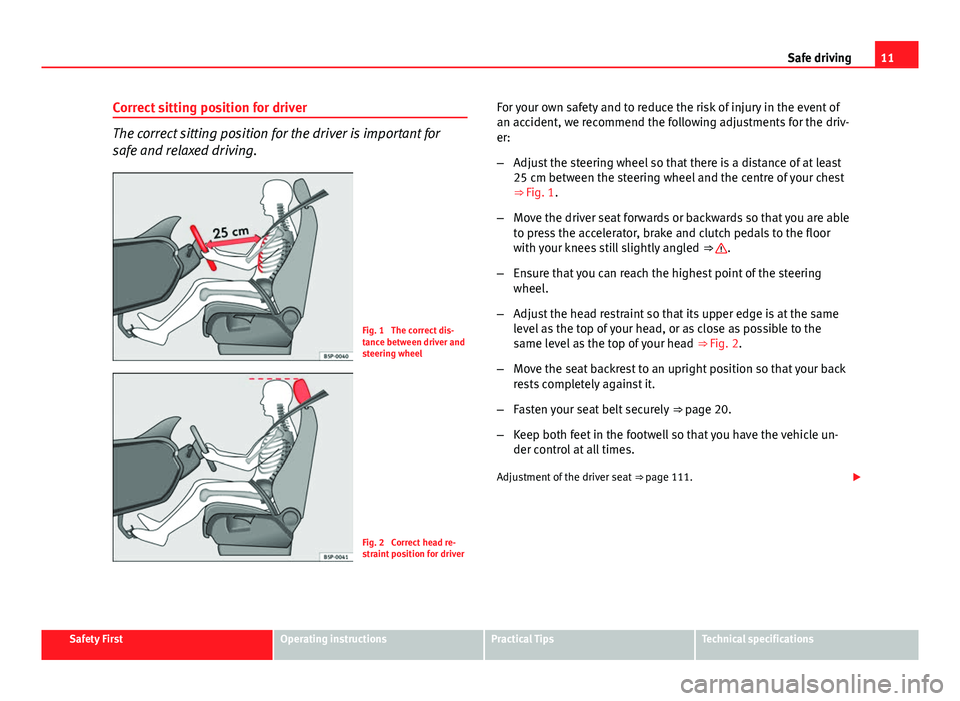
Fig. 1 The correct dis-
tance between driver and
steering wheel
Fig. 2 Correct head re-
straint position for driver For your own safety and to reduce the risk of injury in the event of
an accident, we recommend the following adjustments for the driv-
er:
–
Adjust the steering wheel so that there is a distance of at least
25 cm between the steering wheel and the centre of your chest
⇒ Fig. 1.
– Move the driver seat forwards or backwards so that you are able
to press the accelerator, brake and clutch pedals to the floor
with your knees still slightly angled ⇒
.
– Ensure that you can reach the highest point of the steering
wheel.
– Adjust the head restraint so that its upper edge is at the same
level as the top of your head, or as close as possible to the
same level as the top of your head ⇒ Fig. 2.
– Move the seat backrest to an upright position so that your back
rests completely against it.
– Fasten your seat belt securely ⇒ page 20.
– Keep both feet in the footwell so that you have the vehicle un-
der control at all times.
Adjustment of the driver seat ⇒ page 111.
Safety FirstOperating instructionsPractical TipsTechnical specifications
Page 71 of 258
69
Controls and displays
Control lamps
Summary
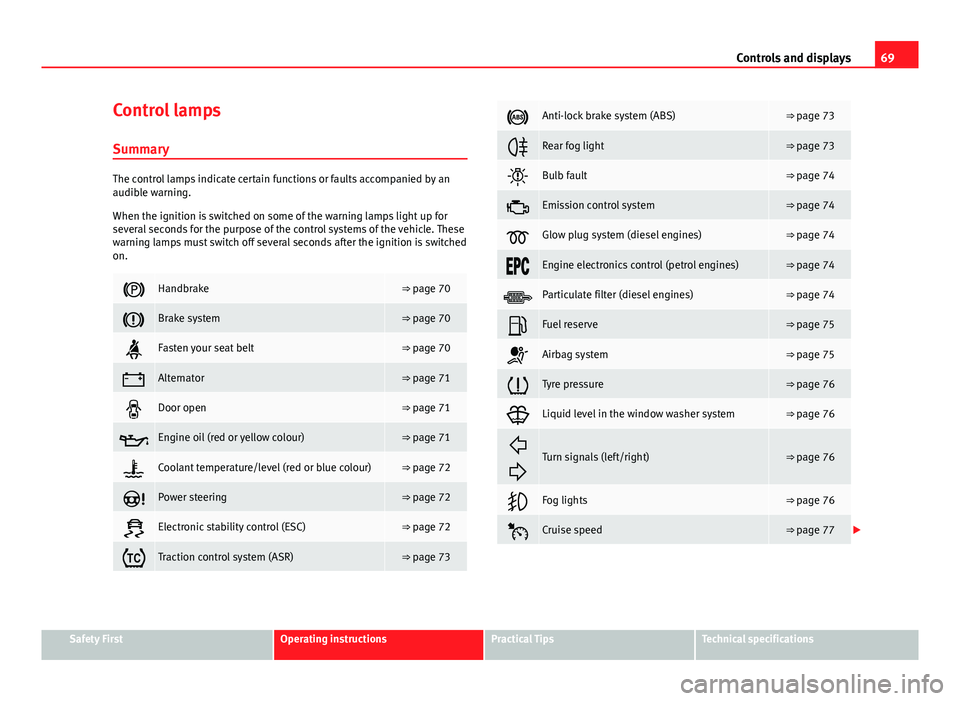
The control lamps indicate certain functions or faults accompanied by an
audible warning.
When the ignition is switched on some of the warning lamps light up for
several seconds for the purpose of the control systems of the vehicle. These
warning lamps must switch off several seconds after the ignition is switched
on.
Handbrake⇒ page 70
Brake system⇒ page 70
Fasten your seat belt⇒ page 70
Alternator⇒ page 71
Door open⇒ page 71
Engine oil (red or yellow colour)⇒ page 71
Coolant temperature/level (red or blue colour)⇒ page 72
Power steering⇒ page 72
Electronic stability control (ESC)⇒ page 72
Traction control system (ASR)⇒ page 73
Anti-lock brake system (ABS)⇒ page 73
Rear fog light⇒ page 73
Bulb fault⇒ page 74
Emission control system⇒ page 74
Glow plug system (diesel engines)⇒ page 74
Engine electronics control (petrol engines)⇒ page 74
Particulate filter (diesel engines)⇒ page 74
Fuel reserve⇒ page 75
Airbag system⇒ page 75
Tyre pressure⇒ page 76
Liquid level in the window washer system⇒ page 76
Turn signals (left/right)⇒ page 76
Fog lights⇒ page 76
Cruise speed⇒ page 77
Safety FirstOperating instructionsPractical TipsTechnical specifications
Page 72 of 258
70Controls and displays
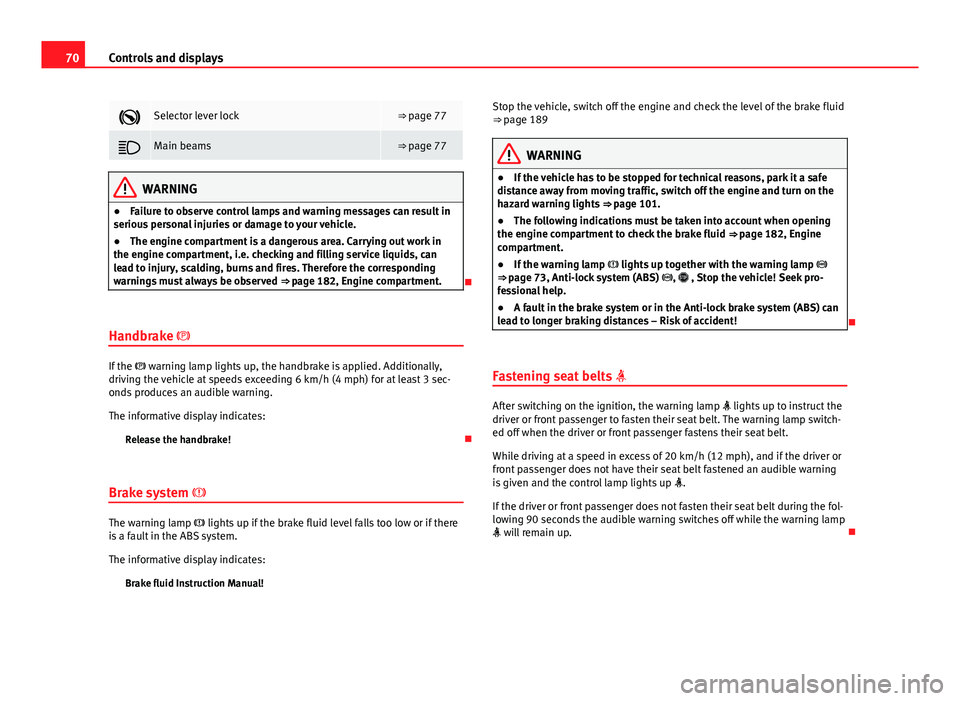
Selector lever lock⇒ page 77
Main beams⇒ page 77
WARNING
● Failure to observe control lamps and warning messages can result in
serious personal injuries or damage to your vehicle.
● The engine compartment is a dangerous area. Carrying out work in
the engine compartment, i.e. checking and filling service liquids, can
lead to injury, scalding, burns and fires. Therefore the corresponding
warnings must always be observed ⇒ page 182, Engine compartment.
Handbrake
If the warning lamp lights up, the handbrake is applied. Additionally,
driving the vehicle at speeds exceeding 6 km/h (4 mph) for at least 3 sec-
onds produces an audible warning.
The informative display indicates:
Release the handbrake!
Brake system
The warning lamp lights up if the brake fluid level falls too low or if there
is a fault in the ABS system.
The informative display indicates:
Brake fluid Instruction Manual! Stop the vehicle, switch off the engine and check the level of the brake fluid
⇒ page 189
WARNING
● If the vehicle has to be stopped for technical reasons, park it a safe
distance away from moving traffic, switch off the engine and turn on the
hazard warning lights ⇒ page 101.
● The following indications must be taken into account when opening
the engine compartment to check the brake fluid ⇒ page 182, Engine
compartment.
● If the warning lamp lights up together with the warning lamp
⇒ page 73, Anti-lock system (ABS) , , Stop the vehicle! Seek pro-
fessional help.
● A fault in the brake system or in the Anti-lock brake system (ABS) can
lead to longer braking distances – Risk of accident!
Fastening seat belts
After switching on the ignition, the warning lamp lights up to instruct the
driver or front passenger to fasten their seat belt. The warning lamp switch-
ed off when the driver or front passenger fastens their seat belt.
While driving at a speed in excess of 20 km/h (12 mph), and if the driver or
front passenger does not have their seat belt fastened an audible warning
is given and the control lamp lights up .
If the driver or front passenger does not fasten their seat belt during the fol-
lowing 90 seconds the audible warning switches off while the warning lamp
will remain up.
Page 75 of 258
73
Controls and displays
The informative display indicates: Report No.: Stability control (ESC)
or Report No.: Traction control system (ASR)
Seek professional help.
Further information ⇒ page 144, Stability system (ESC).
Note
If the battery is disconnected and connected again, the yellow warning
lamp lights up when the ignition is switched on. This warning lamp must
switch off after covering a short distance.
Traction control system (ASR)
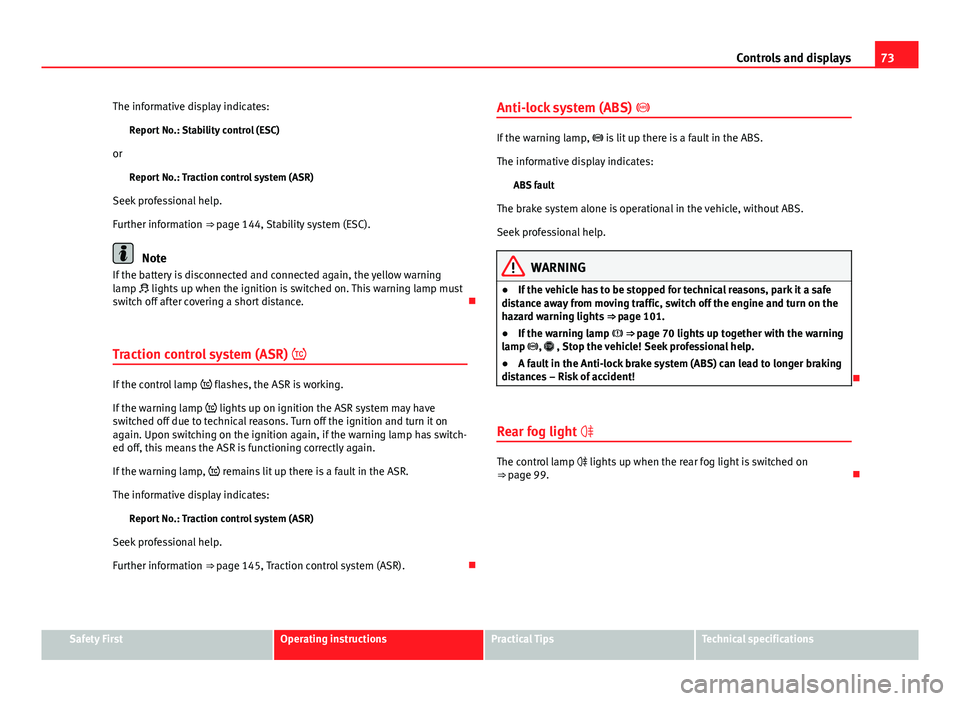
If the control lamp
flashes, the ASR is working.
If the warning lamp lights up on ignition the ASR system may have
switched off due to technical reasons. Turn off the ignition and turn it on
again. Upon switching on the ignition again, if the warning lamp has switch-
ed off, this means the ASR is functioning correctly again.
If the warning lamp, remains lit up there is a fault in the ASR.
The informative display indicates: Report No.: Traction control system (ASR)
Seek professional help.
Further information ⇒ page 145, Traction control system (ASR). Anti-lock system (ABS)
If the warning lamp, is lit up there is a fault in the ABS.
The informative display indicates: ABS fault
The brake system alone is operational in the vehicle, without ABS.
Seek professional help.
WARNING
● If the vehicle has to be stopped for technical reasons, park it a safe
distance away from moving traffic, switch off the engine and turn on the
hazard warning lights ⇒ page 101.
● If the warning lamp ⇒ page 70 lights up together with the warning
lamp , , Stop the vehicle! Seek professional help.
● A fault in the Anti-lock brake system (ABS) can lead to longer braking
distances – Risk of accident!
Rear fog light
The control lamp lights up when the rear fog light is switched on
⇒ page 99.
Safety FirstOperating instructionsPractical TipsTechnical specifications
Page 79 of 258
77
Controls and displays
Cruise speed
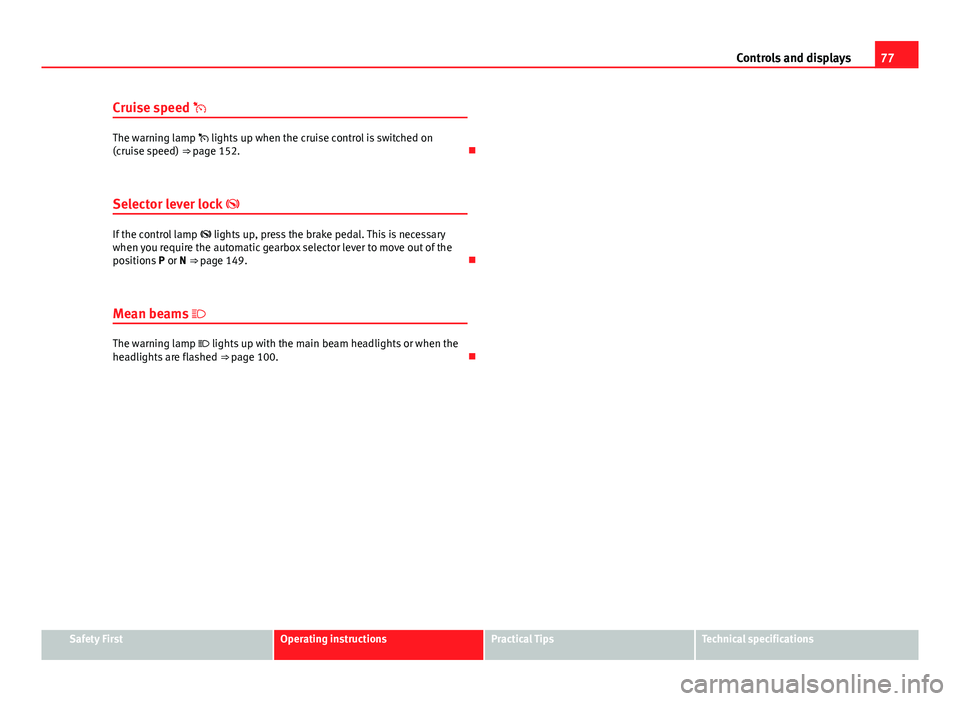
The warning lamp lights up when the cruise control is switched on
(cruise speed) ⇒ page 152.
Selector lever lock
If the control lamp lights up, press the brake pedal. This is necessary
when you require the automatic gearbox selector lever to move out of the
positions P or N ⇒ page 149.
Mean beams
The warning lamp lights up with the main beam headlights or when the
headlights are flashed ⇒ page 100.
Safety FirstOperating instructionsPractical TipsTechnical specifications
Page 112 of 258
110Seats and storage
Seats and storage
Front seats
Introduction
Set the driver seat in such a way that the pedals can be fully depressed with
your legs slightly bent.
Set the driver seat backrest in such a way that the upper point of the steer-
ing wheel can be reached with your arms slightly bent.
The correct seat position is very important for:
● Reaching all of the controls safely and quickly
● A relaxed low-fatigue posture
● maximum protection from the seat belts and airbag system
WARNING
● Adjust the driver seat only when the vehicle is stationary. Risk of ac-
cident!
● Be careful when adjusting the front seats! Careless and uncontrolled
adjustment can cause injuries.
● The backrests must not be reclined too far back while driving. This
could limit the effect of the seat belts and the airbag system. Risk of in-
jury!
● Never transport more than the permitted amount of people in your ve-
hicle.
WARNING (Continued)
● Every occupant in the vehicle must properly fasten and wear the seat
belt belonging to his or her seat. Children must be protected with an ap-
propriate child restraint system ⇒ page 46, Child safety.
● The front seats, head restraints and seat belts must always be adjus-
ted to the size of the vehicle occupant to provide you and your passen-
gers with the greatest possible protection.
● Your feet should remain in the footwell while the vehicle is moving;
never rest them on the dash panel, on the window or on the seat! This
also applies to passengers. An incorrect sitting position exposes you to
an increased risk of injury in case of a sudden braking or an accident. If
the airbag is triggered, you could sustain severe injuries due to an incor-
rect sitting position!
● It is important for the driver and front passenger to keep a distance of
at least 25 cm from the steering wheel and dash panel. Failure to respect
the minimum distance means that the airbag will not protect you. Risk of
fatal injury if triggered!
● No items must not be kept in the footwell, as they could block the
pedals in the event of a sudden braking manoeuvre or change of direc-
tion. You would no longer be able to brake, change gear or accelerate.
● Do not place any items on the front passenger seat other than those
allowed (e.g. child seat). Risk of accident!
Note
After a certain time, the backrest angle adjustment mechanism may gain a
certain amount of play.
Page 141 of 258
139
Driving
Driving Starting and stopping the engine
Introduction
WARNING
● Never adjust the steering wheel while the vehicle is moving!
● Maintain at least 25 cm distance between the steering wheel and the
upper part of your body 1
⇒ Fig. 100
⇒ page 140. The airbag system
will not be able to give the required protection if the minimum distance is
not observed. This can cause a risk of fatal injury!
● For safety reasons, the steering wheel adjustment lever must always
be pushed securely against the steering column to prevent the steering
wheel from accidentally changing position while driving. Risk of acci-
dent!
● If the steering wheel is adjusted closer to your face, the protective ef-
fect of the driver airbag will be decreased in the event of an accident.
Check that the steering wheel is pointing towards the upper part of your
body.
● When driving, always hold the steering wheel with both hands on the
outside part at the 9 o'clock and 3 o'clock positions. Never hold the
steering wheel at the 12 o'clock position, or in any other manner (e.g. in
the centre of the steering wheel). In such cases, if the airbag is triggered,
you may sustain injuries to the arms, hands and head.
● When moving with the engine switched off, the ignition key must al-
ways remain in position 2
⇒ Fig. 101 ⇒
page 141 (ignition on). The
control lamps will light up in this position. Otherwise, the steering lock
could engage suddenly. Risk of accident!
WARNING (Continued)
● Do not remove the key from the ignition until the vehicle has come to
a standstill and is secure (e.g. the handbrake is engaged). Otherwise, the
steering lock could suddenly engage. Risk of accident!
● Always take the ignition key with you when you leave the vehicle.
This is particularly important if you leave children in the vehicle. Children
could start the engine, for example, with the subsequent risk of accident.
● Never leave the engine running in unventilated or closed rooms. The
exhaust gases contain carbon monoxide, an odourless and colourless
poisonous gas. Risk of fatal accidents! Carbon monoxide can cause peo-
ple to lose consciousness and can cause death.
● Never leave the vehicle unattended if the engine is running.
● Never switch the engine off until the vehicle is stationary. Risk of ac-
cident!
CAUTION
● Turning the steering wheel fully in either direction when the vehicle is
stationary and the engine in gear puts the power steering under great
stress. This could lead to noise. Never leave the steering wheel turned fully
in either direction for more than 15 seconds. Risk of damage to the power
steering system!
● The starter motor may only be used (key position 3
⇒ Fig. 101
⇒ page 141 in the ignition) if the engine is off. Using the starter motor
when the engine is running could cause damage.
● Immediately release the ignition key when the engine starts, otherwise
damage could be caused to the starter motor.
● When the engine is cold, you should avoid high engine speeds, driving
at full throttle and over-loading the engine before it reaches operating tem-
perature. Risk of engine damage!
Safety FirstOperating instructionsPractical TipsTechnical specifications
Page 143 of 258

141
Driving
Start-up lock security system (immobiliser)
There is an electronic chip in the key. The electronic immobiliser is deactiva-
ted when the key is inserted into the ignition. The electronic immobiliser is
automatically activated when the key is removed from the ignition.
The engine will not start if an unauthorised key is used.
The informative display indicates: Immobiliser active!
Ignition lock
Fig. 101 Ignition key po-
sitions
Petrol engines 1
– Ignition switched off, engine stopped, steering can be locked
2
– Ignition switched on
3
– Starting Diesel engines
1
– Fuel supply stopped, ignition switched off, engine stopped,
steering can be locked
2
– Engine pre-heating, ignition switched on
3
– Starting
To engage the Steering lock without the key in the ignition, turn the steer-
ing wheel slightly until it engages
If the steering lock is engaged and it is difficult or impossible to turn the key
to position 2
, release the lock by turning the steering wheel slightly in
both directions.
Starting the engine
Vehicles with a diesel engine are equipped with a glow plug system. When
you switch on the ignition, the glow plug warning lamp will light up. The
engine can be started straight away when the lamp switches off.
Do not connect electrical appliances during preheating so as not the drain
the vehicle battery unnecessarily.
Starting the engine
● Move the gearbox lever into neutral or move the selector lever to posi-
tion P or N and pull firmly on the handbrake.
● Press the clutch pedal all the way down 2
⇒ Fig. 101 ⇒ page 141 and
start the engine 3 – without pressing the accelerator. Keep the clutch ped-
al pressed down until the engine starts.
● Release the ignition key as soon as the engine starts. The key returns to
position 2
.
Safety FirstOperating instructionsPractical TipsTechnical specifications