air condition Seat Toledo 2014 User Guide
[x] Cancel search | Manufacturer: SEAT, Model Year: 2014, Model line: Toledo, Model: Seat Toledo 2014Pages: 200, PDF Size: 4.37 MB
Page 91 of 200

Heating and air conditioning
Temperature selection – Turn rotary control A
››› Fig. 86 clockwise
t o inc
rease the temperature.
– Turn rotary control A anti-clockwise to re-
duce the temperature.
Blower selection
– Turn rotary control B
››› Fig. 86 to position
1 t o 4 t
o switch the blower on.
– Turn rotary control B to position 0 to
switch the blower off. –
Press button 1
››› in Air recirculation on
page 90 to close the fresh air vent.
Air di s
tribution selection
– Turn rotary control C
››› Fig. 86 to select
the air v
ents ››› page 88, Air vents you wish
to activate.
All controls, except control B
››› Fig. 86 , can
be set t
o any intermediate position.
Leave the blower activated at all times to pre-
vent the windows from misting over. Note
If the system is set so that all of the air is
used to defrost the windows, no air is sup-
plied to the footwell area. This could limit
heating comfort. Heating selection
Recommended settings for the different modes:
SettingsControl positionButton
1Air vents 4ABC
Windscreen and side window de-
frostClockwise as far as it will go3 Do not switch onOpen and direct towards the
side window
Windscreen and side window de-
frostRequired temperature2 or 3 / Do not switch onOpen and direct towards the
side window
Heat as quickly as possibleClockwise as far as it will go3 Switch on brieflyOpening
Mild heatingRequired temperature2 or 3
/ Do not switch onOpening
Fresh air mode - blowerAnti-clockwise as far as it
will goRequired position Do not switch onOpening»
89
Technical specifications
Advice
Operation
Safety
Page 92 of 200
Operation
Note
● Controls A
››› Fig. 86 ››› page 88, B ,
C and button
1 .
● Air vents 4 ››› page 88.
● We r
ecommend you leave the air vents 3
››› page 88 in the open position. Air recirculation
Air recirculation prevents unpleasant smells,
e.g. when passing through a tunnel or in
queuing traffic, from entering the interior.
Switching on air recirculation mode
– Press button
1
›››
Fig. 86 ›
›
›
page 88
and the lamp in the button will illuminate.
Switching off air recirculation mode
– Press button
1
›››
Fig. 86 ›
›
›
page 88
again and the lamp in the button will
switch off.
If air vent C
›››
Fig. 86 ›
›
›
page 88 is in posi-
tion , air recirculation mode switches off
automatically. Press the button to switch
air recirculation mode back on in this posi-
tion. WARNING
Read and observe the safety warnings ››› in
General notes on page 87. Air conditioning (manual)*
General notes The air cooling system only works if
A/C but-
ton 2
›››
Fig. 87 ›
›
›
page 90 is pressed and
under following conditions:
● The engine is running,
● The outside temperature is above +2 °C
(+36 °F),
● The blower control is in position 1–4.
When the cooling system is on and under cer-
tain conditions, air can be blown from the
vents at a temperature of approximately
+5 °C (+41 °F). In the event of prolonged, ir-
regular distribution of the air flow from the
outlets and significant differences in temper-
ature, e.g. on leaving the vehicle, sensitive
people may catch cold. Note
A visit to the specialised service once a year
is recommended to clean the air conditioning
system. Operation
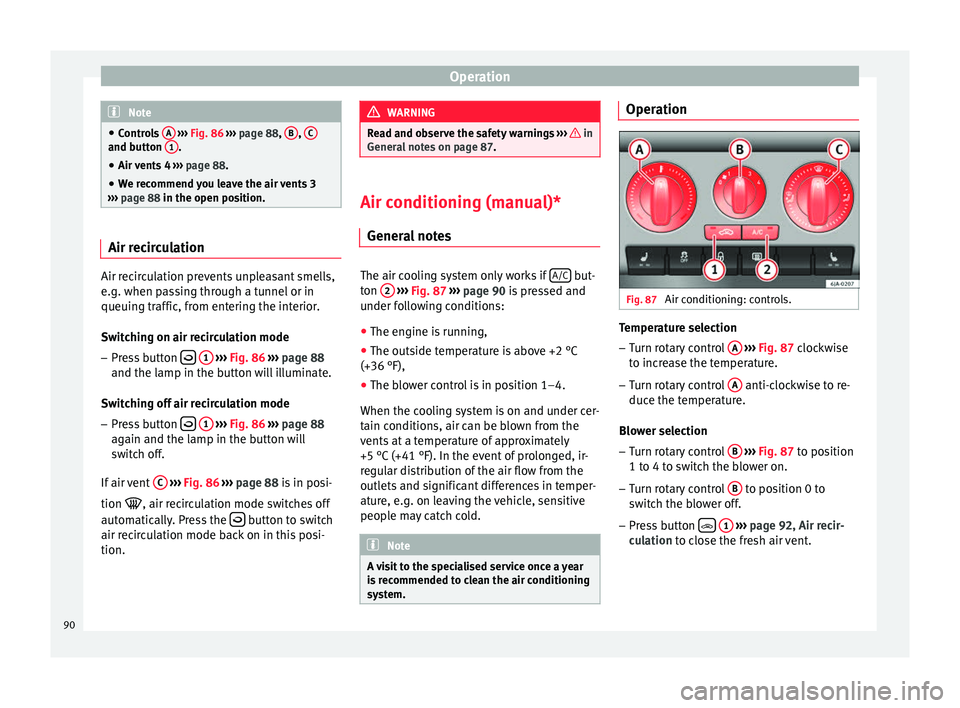
Fig. 87
Air conditioning: controls. Temperature selection
– Turn rotary control A
››› Fig. 87 clockwise
t o inc
rease the temperature.
– Turn rotary control A anti-clockwise to re-
duce the temperature.
Blower selection
– Turn rotary control B
››› Fig. 87 to position
1 t o 4 t
o switch the blower on.
– Turn rotary control B to position 0 to
switch the blower off.
– Press button
1
››› page 92, Air recir-
culation to close the fresh air vent.
90
Page 93 of 200

Heating and air conditioning
Air distribution selection – Turn rotary control C
››› Fig. 87 to select
the air v
ents ››› page 88 you wish to
activat
e.
Switching cooling on and off
– Press the button A/C
2
››› Fig. 87 and the
l amp in the b
utton will illuminate.
– Press the A/C
2 button again and the
light in the button will switch off. Note
● If the air distribution is directed towards
the windows, all, of the heating power is
used to defrost the windscreen. No warm air
is directed to the footwell area. This could
limit heating comfort.
● The AC button lamp will illuminate after
the system has been switched on, even if not
all of the conditions for cooling system oper-
ations are met. Cooling is indicated as availa-
ble once all of the conditions are met
››› page 90, General notes . 91Technical specifications
Advice
Operation
Safety
Page 94 of 200

Operation
Air conditioning selection Basic air conditioning control settings recom-
mended for the corresponding operating
modes:SettingsControl positionButtonAir vents 4ABC12
Windscreen and side window de-
frost
a)Required tempera-
ture3 or 4 Do not switch onSwitched on automati-
callyb)Open and direct towards the
side window
Heat as quickly as possibleClockwise as far asit will go3 Switch on brieflyOffOpening
Mild heatingRequired tempera-
ture2 or 3 / Do not switch onOffOpening
Heat as quickly as possibleAnti-clockwise as far
as it will goBriefly 4, then 2 or 3 Switch on briefly
c)IgnitionOpening
Optimum coolingRequired tempera-
ture1 or 2 Do not switch onIgnitionOpen and direct towards the
roof
Fresh air mode - blowerAnti-clockwise as faras it will goRequired position Do not switch onOffOpening
a)
This type of setting is not recommended in countries with high air humidity. The windows could cool too quickly and cause them to mist over on the outside.
b) The lamp in button 2
lights up, even if not all of the conditions for cooling system operations are met. Cooling is indicated as available once all of the conditions are met
››› page 90, General notes .
c) In certain conditions, air recirculation mode can switch on automatically ››› page 92, a lamp illuminates in the button. Note
● Controls A
››› Fig. 87 ››› p
age 90, B ,
C and buttons
1 and
2 .
● Air vents 4 ››› page 88 . ●
We recommend you leave the air vents 3
››› page 88 in the open position. Air recirculation
Air recirculation prevents unpleasant smells,
e.g. when passing through a tunnel or in
queuing traffic, from entering the interior.
92
Page 95 of 200

Heating and air conditioning
Switching on air recirculation mode
– Press button
1
››› Fig. 87
›
›› page 90
and the lamp in the button will illuminate.
Switching off air recirculation mode
– Press button
1
››› Fig. 87
›
›› p
age 90
again and the lamp in the button will
switch off.
If air distribution control C
››› Fig. 87
››› page 90 is in position
, air r
ec
irculation
mode switches off automatically Press the button to switch air recirculation mode
back on in this position. WARNING
Read and observe the safety warnings ››› in
General notes on page 87. Climatronic* (automatic air
conditioning)
General notes Climatronic automatically maintains a com-
fortable temperature. To do so, it automati- cally regulates the supplied air temperature
and the blower and air distribution levels.
The system also allows for the effect of sun-
light, so there is no need for manual adjust-
ment.
Automatic operations
›
›
› page 94
guarantee maximum comfort any time of
year.
Climatronic description
Cooling only works if the following conditions
are met:
● The engine is running
● the outside temperature is above +2 °C
(+36 °F);
● A/C
18
››› Fig. 88
›
›› p
age 94 switched
on.
In order to ensure engines subject to heavy
loads are cooled, the air conditioning com-
pressor is switched off in the event of high
coolant temperatures.
Recommended setting for all seasons of the
year
● Set the required temperature. We recom-
mend +22 °C (72 °F). ●
Press the AUTO button
12
››› Fig. 88
››› page 94 .
● Adju s
t vents 3 ››› p
age 88 and 4 so that the
air flow is directed slightly upwards.
Change between degrees Centigrade and
degrees Fahrenheit
Keep the AUTO and
A/C
››› Fig. 88
››› page 94 buttons pressed down at the
s ame time.
The data is displayed on the
screen in the units required. Note
A visit to the specialised service once a year
is recommended to clean the Climatronic sys-
tem. 93
Technical specifications
Advice
Operation
Safety
Page 96 of 200

Operation
Controls Fig. 88
Climatronic: controls. Buttons/controls
Interior temperature setting
Display Selected interior temperature
Degrees Centigrade or Fahrenheit
Automatic air conditioning mode
Defrost or demist windscreen
Air flow direction
Air recirculation
Cooling on/off
Selected blower speed
Buttons/controls Set blower speed
Interior temperature sensor
Automatic mode
1 2
3
4
5
6
7
8
9
10
11
12 Defrost or demist windscreen
Air distribution to windows
Air distribution to upper body
Air distribution to footwells
Air recirculation
Cooling on/off
Note
The interior temperature sensor 11
››› Fig. 88
››› page 94 is at the bottom. Do not cover it
w ith s
tickers or the like, as this could have a
negative effect on Climatronic operations. 13
14
15
16
17
18 Automatic mode
Automatic mode is used to maintain a con-
stant temperature and demist the windows
inside the vehicle.
Switching on automatic mode
– Set the interior temperature between
+18 °C (+64 °F) and +29 °C (+84 °F).
– Adjust vents 3 ››› page 88 and 4 so that the
air flow is directed slightly upwards.
– Press the AUTO button
12
››› Fig. 88 and
A UT
O displayed on the screen.
Automatic mode is switched off by pressing
the air distribution buttons or increasing or
decreasing the blower speed. However, the
temperature remains regulated.
94
Page 97 of 200

Heating and air conditioning
Temperature selection –
When you switch on the ignition, control 1›››
Fig. 88 ››› page 94 can be used to set the
required interior temperature.
It is possible to select interior temperatures
from +18 °C (+64 °F) to +29 °C (+84 °F). In
this range the temperature is regulated auto-
matically. If a temperature below +18 °C
(+64 °F) is selected, “LO” is displayed on the
screen. If a temperature above +29 °C
(+84 °F) is selected, “HI” is displayed on the
screen. At both extremes, Climatronic works
at maximum cooling or heating power, re-
spectively. The temperature is not regulated.
In the event of prolonged, irregular distribu-
tion of the air flow from the outlets (particu-
larly the footwells) and significant differen-
ces in temperature, e.g. on leaving the vehi-
cle, sensitive people may catch cold.
Air recirculation Air recirculation prevents unpleasant smells,
e.g. when passing through a tunnel or in
queuing traffic, from entering the interior.
Switching on air recirculation mode
– Press button
17
›››
Fig. 88 ›
›
›
page 94
and the symbol is displayed on the
screen. Switching off air recirculation mode
– Press button
17
››› Fig. 88
›
›› p
age 94
and the symbol disappears from the
screen. WARNING
Read and observe the safety warnings ››› in
General notes on page 87. Note
If air recirculation mode remains on for 15 mi-
nutes, the symbol will start to flash on
the screen to indicate prolonged air recircula-
tion. If air recirculation is not switched off,
the symbol will continue to flash for about 5
minutes. Blower selection
Climatronic automatically regulates the blow-
er speed according to the interior tempera-
ture. It is possible, however, to set the blower
speed to suit requirements.
–
Turn rotary control 10
›››
Fig. 88 ›
›
›
page 94
counter-clockwise (to lower the speed) or
clockwise (to increase the speed).
Climatronic will switch off when the blower
switches off. WARNING
● Used air can cause tiredness, reduce atten-
tion spans and cause the windows to mist
over. This increases the risk of an accident.
● Do not switch off Climatronic for longer
than necessary.
● Switch Climatronic back on as soon as the
windows begin to mist over. Windscreen defrosting
Switching on windscreen defrosting
– Press button
13
›››
Fig. 88 ›
›
›
page 94.
Switching off windscreen defrosting – Press button
13
›››
Fig. 88 ›
›
›
page 94
several times or press the AUTO button.
The temperature is regulated automatically.
The air output is increased from vents 1
››› page 88 and
2
. 95
Technical specifications
Advice
Operation
Safety
Page 116 of 200

Operation
CAUTION
Switch off the Start-Stop system ››› page 107
before driving through a pool of water on the
road. Note
● The battery temperature may reflect
changes in outside temperature after several
hours. If the vehicle has been stopped out-
side at temperatures below zero or in direct
sunlight, for example, the battery tempera-
ture may take several hours to reach the val-
ues required for the correct operating of the
Start-Stop system.
● If the Climatronic system is operating auto-
matically, this could impair automatic engine
shut down under certain conditions. Towing bracket device
Driving the vehicle with a
trailer Technical requirements If your vehicle has a factory-fitted towing
bracket or is equipped with a selection of
SEAT Original Accessories, it meets all the rel-
evant technical and legal requirements.
In vehicles with a towing bracket it is possi-
ble to remove the ball joint, situated (togeth-
er with the special assembly instructions) in
the housing for the spare wheel in the vehi-
cle luggage compartment
›››
page 150, Vehi-
cle tool kit* .
Y our
vehicle is fitted with a 13-pole power
socket for the electrical connection between
the trailer and the vehicle. If the trailer you
are going to use has a 7-pin connector, the
corresponding adaptor, acquired from the
SEAT Original Accessories Catalogue, can be
used.
If a towing bracket is to be retro-fitted to the
car, it must be done according to the instruc-
tions of the towing bracket manufacturer. Note
Any queries that may arise can be directed to
an authorised SEAT dealer. Trailer weight
Trailer weight
The combined vehicle and trailer must be
balanced. To do so use the maximum permit-
ted towing bracket load. An insufficient
weight exerted by the trailer drawbar on the
ball joint of the towing bracket will have a
negative impact upon the response of the ve-
hicle-trailer assembly on the road.
Weight distribution
Distribute loads in the trailer so that heavy
objects are as near to the axle as possible.
Ensure that the objects do not move.
If the towing vehicle is empty and the trailer
loaded then the load distribution is incorrect.
However, if these conditions cannot be avoi-
ded, drive very slowly.
Tyre pressure values
Correct the tyre pressure in your vehicle to
“total load”
›››
page 144, Life cycle of tyres .
Trailer weight
Never exceed the authorised trailer weight
under any circumstances ›››
page 174, Tech-
nical specifications .
The trailer weights listed are only applicable
for altitudes up to 1000 m above sea level.
D
ue to lower air density, engine power de-
creases depending on the increase in
114
Page 128 of 200

Advice
●
Make sure you do not damage the paint-
work on the vehicle on removing snow and
ice from the windows and rear vision mirrors.
● Do not remove the snow or ice dirty with
thick particles, e.g. gravel, sand or road salt,
from windows and mirrors. Risk of damage to
the glass and mirror surfaces. Radio reception and aerial
In vehicles factory-fitted with an audio or
navigation system, the aerial may be instal-
led in different places:
● inside the rear window next to the heating
elements,
● on the roof of the vehicle.
Headlights Use soap and clean, hot water to clean the
front headlights.
CAUTION
● Never rub the headlights to dry them and
do not use sharp objects to clean the plastic
glass material. These could damage the pro-
tective paint and cause the headlights to
crack. ●
Do not use aggressive cleaning products or
chemical solvents to clean the glass. This
could damage the headlights. Care of rubber seals
The weatherstrips on doors and windows will
remain pliable and last longer if they are oc-
casionally treated with a suitable rubber care
product. This will prevent premature ageing
and leaks. If they are properly cared for, the
seals will be less likely to freeze up in the
winter.
Door lock cylinder Special products must be used to defrost
lock cylinders.
Note
● Make sure, when washing the vehicle, that
the least amount of water possible enters the
lock cylinders.
● We recommend the use of products from
the selection of SEAT Original Accessories to
care for the door lock cylinder. Wheels
Wheel trims
If you wash the vehicle regularly, you should
also thoroughly wash the wheel trim. Regu-
larly remove any brake dust and road salt
from the wheels, otherwise the wheel materi-
al could be damaged. Repair any damage to
the wheel paintwork immediately.
Alloy wheels
After thorough washing, treat the wheels
with a protective product for alloy wheels. Do
not use abrasive products to care for the
wheels.
WARNING
Moisture, ice and road salt may affect braking
efficiency. Risk of accident! CAUTION
Heavy dirt on the wheels could lead to their
misalignment. This could result in vibrations
being transmitted to the steering wheel that
under certain conditions may cause prema-
ture steering wear. This dirt must be re-
moved. Note
We recommend you leave paint damage re-
pairs to a SEAT Authorised Service. 126
Page 151 of 200

Emergencies
Snow chains Snow chains must only be used on the front
wheels.
In winter road conditions, snow chains not
only help to improve grip but also improve
the braking capacity.
For technical reasons snow chains may only
be used on tyres with the following wheel
rim/tyre combinations.Rim sizeRim offsetTyre size
5J x 14
a)35 mm175/70
6J x 15b)38 mm185/60
6J x 15b)38 mm195/55
a)
Only use snow chains with fine-pitch links and lock no greater
than 9 mm.
b) Only use snow chains with fine-pitch links and lock no greater
than 13 mm.
Remove the wheel trims before fitting snow
chains. CAUTION
Chains must be removed when roads are free
of snow. Otherwise they will impair handling,
damage the tyres and wear out very quickly. Emergencies
Emergency equipment First-aid kit and warning triangle* Fig. 121
Location of the warning triangle. The warning triangle, measuring max.
436 x 45 x 32 mm, can be secured to the lin-
ing on the rear of the luggage compartment
with rubber straps
››› Fig. 121. WARNING
The first-aid kit and fire extinguisher must be
properly secured so that they are not catapul-
ted through the vehicle during driving and
braking manoeuvres or in the event of an ac-
cident. Risk of injury. Note
● Observe the expiry date of the contents of
the first aid kit.
● We recommend you use the first-aid kit and
the warning triangle from the SEAT Original
Accessories programme available in author-
ised SEAT dealers. Fire extinguisher*
Read the instructions given on the fire extin-
guisher carefully.
The fire extinguisher must be checked once a
year by an authorised person (take the appli-
cable legal regulations into account).
WARNING
The fire extinguisher must be properly se-
cured so that it is not catapulted through the
vehicle, causing injuries, during driving and
braking manoeuvres or in the event of an ac-
cident. Note
● The fire extinguisher must comply with lo-
cal legal requirements.
● Observe the expiry date of the fire extin-
guisher. The fire extinguisher may not work
properly if used after the expiry date. 149
Technical specifications
Advice
Operation
Safety