key Seat Toledo 2014 User Guide
[x] Cancel search | Manufacturer: SEAT, Model Year: 2014, Model line: Toledo, Model: Seat Toledo 2014Pages: 200, PDF Size: 4.37 MB
Page 56 of 200

Operation
– Unfold the key shaft.
– Remove the battery cover by pressing down
with your thumb or a flat screwdriver in the
location of the arrows 1
››› Fig. 37 .
– Remo
ve the flat battery from the key by
pressing downwards in the location of the
arrows 2 .
– Insert the new battery. Check that the “+”
symbol on the battery is facing upwards.
The correct polarity is indicated on the bat-
tery cover.
– Replace the battery cover and press down
until it clicks. CAUTION
● The correct polarity must always be ob-
served when replacing the battery.
● The new battery must be of the same type
as the original. For the sake of the environment
Dispose of the used battery in line with na-
tional legislation. Note
If it is not possible to unlock or lock the vehi-
cle with the remote control key once the bat- tery has been replaced, it will need to be re-
synchronised
››› page 52. Central locking system
General notes All of the doors, the boot lid and the fuel cap
fl ap w
ill1)
unlock at the same time when the
central locking system is used.
Warning lamp on the driver door
Once the doors are locked, the warning lamp
will flash quickly for 2 seconds and then at a
slower rate.
If the vehicle is locked with Safe lock engag-
ed ››› page 55, the warning lamp on the
driv er door w
ill flash quickly for 2 seconds
before switching off for 30 seconds and then
flashing at a slower rate.
If the warning lamp flashes quickly for 2 sec-
onds and then remains switched on before
flashing at a slower rate after 30 seconds,
there is a fault in the interior monitor and
tow-away protection system ››› page 58. Go
to a technical service. Individual settings Unlocking single doors
This optional function unlocks the driver door
only. The other doors remain locked and are
only unlocked when the next command is giv-
en (unlock).
Automatic unlock and lock
The doors and the rear lid are locked auto-
matically when the vehicle reaches a speed
of about 15 km/h (9 mph).
The doors unlock automatically when the key
is removed from the ignition. Additionally,
the driver or front passenger can unlock the
doors by pressing the
›››
page 56 central
lock button or by pulling the front door han-
dle. WARNING
Locking the doors prevents intruders from
getting into the car, e.g. while waiting at in-
tersections. However, it can also delay assis-
tance in the event of an accident. Risk of
death! Note
● Activation of the single door setting can be
requested at your SEAT dealer. 1)
Valid for vehicles with a keyless fuel tank cap.
54
Page 57 of 200

Opening and closing
●
In the event of an accident in which the air-
bags deploy, the doors will be automatically
unlocked for easier access and assistance.
● If the central locking system should fail to
work at any time, only the driver door can be
locked or unlocked using the key
››› page 55. All other doors and the boot
h at
ch can be operated manually.
– Manual release ››› page 161.
– Manual release of the rear lid
››› page 161. Unlocking the vehicle with the key
Fig. 38
Key positions during vehicle locking
and unlocking. –
Turn the key in the driver door in the for-
ward driving direction to its unlock position
A
››› Fig. 38 .
– Pu
ll the handle and open the door.
● All doors (driver door only on vehicles with
anti-theft alarm) are unlocked.
● The rear lid is unlocked.
● The fuel tank flap is unlocked 1)
.
● The courtesy lights switch on.
● The Safe lock is deactivated.
● The driver door warning lamp stops flash-
ing (on vehicles not equipped with an anti-
theft system) ››› page 57. Note
If the vehicle is equipped with an anti-theft
alarm system, you have 15 seconds from the
time the door is opened to insert the key in
the ignition and start the vehicle. If, during
these 15 seconds, the vehicle is not started,
the alarm is triggered. Locking the vehicle with the key
–
Turn the key in the driver door lock cylinder
in the reverse direction to its lock position
B
›››
Fig. 38 . ●
The door s, the boot
lid and the fuel tank
flap 1)
will be locked.
● The courtesy lights switch off.
● The Safe lock is immediately activated.
● Warning lamp on the driver door starts to
flash. Note
The vehicle doors cannot be locked if the
driver door is open. Safe Lock
The central locking system is equipped with a
Safe lock
. If the vehicle is closed from out-
s ide, the door loc
ks will automatically lock.
The warning lamp on the driver door will
flash quickly for about 2 seconds and then at
a slower rate. It is not possible to open any of
the doors from the inside or outside using
the handle. This limits the possibility of in-
truders getting into the vehicle.
The Safe lock can be deactivated by pressing
the lock button twice in less than 2 seconds.
If Safe lock is out of service, the control lamp
on the driver door will flash quickly for about
2 seconds before switching off for 30 sec-
onds and then flashing at a slower rate. »1)
Valid for vehicles with a keyless fuel tank cap.
55
Technical specifications
Advice
Operation
Safety
Page 58 of 200

Operation
The Safe lock is re-activated on unlocking
and locking the vehicle again.
If the vehicle is locked and the Safe lock is
deactivated, the vehicle can be opened from
inside by pulling on the door handle. WARNING
Do not leave people or animals in locked ve-
hicles with Safe lock activated: the doors and
windows cannot then be opened from the in-
side. Doors locked in this manner could delay
assistance in an emergency. Risk of death! Note
● The anti-theft alarm switches on automati-
cally when the vehicle is locked, even if the
Safe lock is deactivated. The Vehicle interior
monitoring, however, is not activated.
● Given that the Safe function will be activa-
ted on locking the vehicle, CHECK DEADLOCK
will be shown on the general instrument pan-
el display. On vehicles equipped with an in-
formative display, Caution SAFE! On-board doc- umentation! Central locking button
Fig. 39
Central lock button. If the vehicle has not been locked from out-
side, it is possible to lock and unlock the
doors from inside by pressing the
››› Fig. 39
button, even without the key in the ignition.
Locking of all doors, the boot lid and the fuel
tank flap 1)
– Press the button ››› Fig. 39 . The warning
l amp
on the button will light up.
Unlocking of all doors, the boot lid and the
fuel tank cap 1)
– Press the button ››› Fig. 39. The warning
lamp
on the button will switch off. If the vehicle has been locked using the cen-
tral lock button.
● The rear boot lid cannot be unlocked from
the outside (security measure, e.g. when
stopped at an intersection).
● The doors can be unlocked individually by
pulling the handle.
● The vehicle doors cannot be locked if any
of the doors are open.
● In the event of an accident in which the air-
bags activate, doors locked from the inside
will be automatically unlocked for easier ac-
cess and assistance. WARNING
The central locking system remains operative
when the ignition is switched off. Never leave
children unattended in the vehicle, as doors
locked from the inside delay assistance in an
emergency. Risk of sustaining fatal injuries! Note
The handles and the central lock buttons will
not work if the Safe lock ››› page 55 is activa-
ted. 1)
Valid for vehicles with a keyless fuel tank cap.
56
Page 59 of 200

Opening and closing
Childproof locks Fig. 40
Activating the childproof lock. The childproof lock prevents the rear doors
from being opened from the inside. Doors
can only be opened from the outside.
The childproof lock is activated and deactiva-
ted using the ignition key.
Activating the childproof lock
– Turn the slot in the direction of the arrow
››› Fig. 40 (in the other direction on the
right -h
and door).
Deactivating the childproof lock
– Turn the slot in the opposite direction of
the arrow (in the other direction on the
right-hand door). Anti-theft alarm system*
General notes The anti-theft alarm system increases vehicle
protection from intruders. The system will ini-
tiate acoustic and optical warning signals
when your vehicle is tried to be forced.
Activating the alarm system
The anti-theft alarm switches on automatical-
ly when the vehicle is locked using the re-
mote control key or inserting the key in the
driver door. The alarm is activated around 30
seconds after the vehicle is locked.
Deactivating the alarm system
The anti-theft alarm system is deactivated
when the remote control unlock button is
pressed. If the vehicle is not opened within
30 seconds after emitting the radio frequen-
cy signal, the system will be reactivated.
If the vehicle is unlocked using by inserting
the key in the driver door, the ignition must
be switched on within 15 seconds. This deac-
tivates the alarm system. If, during these 15
seconds,
the vehicle is not started , the alarm
i
s triggered . When does the system trigger an alarm?
The following areas of the vehicle are moni-
tored:
● Bonnet
● Rear lid
● Doors
● Ignition
● Tilt angle ››› page 58, Vehicle interior
monitoring and tow-away protection system
● The interior ››› page 58, Vehicle interior
monitoring and tow-away protection system
● Drop in voltage in the car systems
● The factory-fitted towing bracket
The alarm is triggered immediately if one of
the battery cables is disconnected while the
alarm system is active.
How to turn OFF the alarm
To deactivate the alarm, press the unlock but-
ton on the remote control key or switch on
the ignition. Note
● The alarm horn power supply has a 5-year
useful life. Contact an Official Service for
more detailed information.
● To make sure that the anti-theft alarm is
fully operative when leaving the vehicle, » 57
Technical specifications
Advice
Operation
Safety
Page 60 of 200
Operation
check that all the doors and windows are
closed.
● Remote control and receiver unit coding
means that the remote control cannot be
used on other vehicles. Vehicle interior monitoring and tow-
away protection system
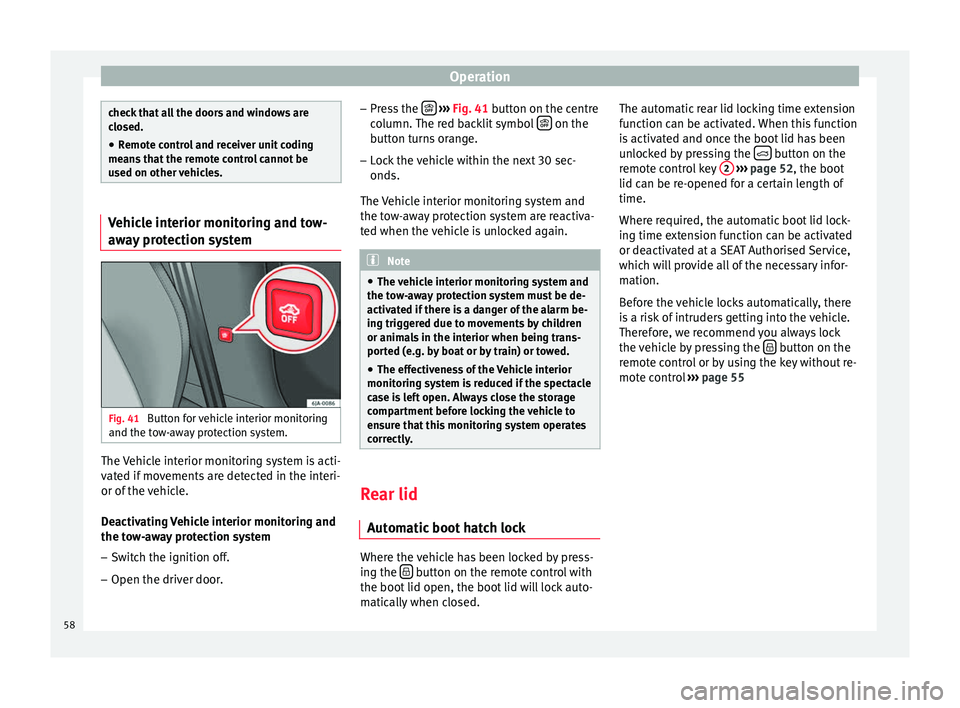
Fig. 41
Button for vehicle interior monitoring
and the tow-away protection system. The Vehicle interior monitoring system is acti-
vated if movements are detected in the interi-
or of the vehicle.
Deactivating Vehicle interior monitoring and
the tow-away protection system
– Switch the ignition off.
– Open the driver door. –
Press the
››› Fig. 41 button on the centre
column. The red backlit symbol on the
button turns orange.
– Lock the vehicle within the next 30 sec-
onds.
The Vehicle interior monitoring system and
the tow-away protection system are reactiva-
ted when the vehicle is unlocked again. Note
● The vehicle interior monitoring system and
the tow-away protection system must be de-
activated if there is a danger of the alarm be-
ing triggered due to movements by children
or animals in the interior when being trans-
ported (e.g. by boat or by train) or towed.
● The effectiveness of the Vehicle interior
monitoring system is reduced if the spectacle
case is left open. Always close the storage
compartment before locking the vehicle to
ensure that this monitoring system operates
correctly. Rear lid
Automatic boot hatch lock Where the vehicle has been locked by press-
ing the
button on the remote control with
the boot lid open, the boot lid will lock auto-
matically when closed. The automatic rear lid locking time extension
function can be activated. When this function
is activated and once the boot lid has been
unlocked by pressing the
button on the
remote control key 2
››› page 52, the boot
lid can be re-opened for a certain length of
time.
Where required, the automatic boot lid lock-
ing time extension function can be activated
or deactivated at a SEAT Authorised Service,
which will provide all of the necessary infor-
mation.
Before the vehicle locks automatically, there
is a risk of intruders getting into the vehicle.
Therefore, we recommend you always lock
the vehicle by pressing the button on the
remote control or by using the key without re-
mote control ››› page 55
58
Page 61 of 200

Opening and closing
Boot hatch Fig. 42
Rear lid: opening from the outside. Fig. 43
Close-up of the inside trim of the rear
lid: hand grip The rear lid opening system operates electri-
cally. It is activated by using the handle on
the boot lid. Opening the rear lid
– Pull on the release lever and lift the rear lid
››› Fig. 42 . The rear lid will automatically
open.
C lo
sing the rear lid
– Hold the rear lid by one of the two handles
on the interior lining and close it, pushing
slightly.
This system may or may not be operative, de-
pending on the situation of the vehicle.
If the rear lid is locked then it cannot be
opened, however if it is unlocked then the
opening system is operative and the rear lid
may be opened.
To lock/unlock, press the button or the
button 1 on the remote control key.
A warning appears on the instrument panel
display if the boot lid is open or not properly
closed.* An audible warning is also given if
the boot lid is opened while the vehicle is
moving faster than 6 km/h (4 mph)*. WARNING
● Always close the rear lid properly. Risk of
accident or injury.
● Do not close the rear lid by pushing it down
with your hand on the rear window. The glass
could smash. Risk of injury! ●
Ensure the rear lid is locked after closing it.
If not, it may open unexpectedly while driv-
ing.
● Never allow children to play in or around
the vehicle. A locked vehicle can be subjected
to extremely high and low temperatures, de-
pending on the time of year, thus causing se-
rious injuries/illness. It could even have fatal
consequences. Close and lock both the rear
lid and all the other doors when you are not
using the vehicle.
● Closing the rear lid without observing and
ensuring it is clear could cause serious injury
to you and to third parties. Make sure that no
one is in the path of the rear lid.
● Never drive with the rear lid open or half-
closed, exhaust gases may penetrate into the
interior of the vehicle. Danger of poisoning!
● If you only open the rear lid, do not leave
the key inside. The vehicle will not be opened
if the key is left inside. Note
● Once the rear lid is closed, its lock is en-
gaged and the alarm system is activated. On-
ly valid if the vehicle has been locked before
the rear lid is closed.
● The release catch located at the top of the
registration plate recess is deactivated on ac-
celerating or at speeds of over 5 km/h (3
mph). The catch is reactivated when the vehi-
cle comes to a standstill and a door is
opened. 59
Technical specifications
Advice
Operation
Safety
Page 68 of 200
Operation
Note
● The parking lights can only be activated
with the ignition disconnected.
● The parking light will not come on automat-
ically after switching off the ignition if the
left- or right-hand turn signal is left on. Adjusting the headlights
The light beam of the dipped beam lights is
asymmetric: the side of the road on which
you are driving is lit more intensely.
When a car that is manufactured in a country
that drives on the right travels to a country
that drives on the left (or vice versa), it is nor-
mally necessary to cover part of the headlight
bulbs with stickers or to change the adjust-
ment of the headlights to avoid dazzling oth-
er drivers.
In such cases, the regulations specify certain
light values that must be complied with for
designated points of the light distribution.
This is known as “Tourist light”.
The light distribution of the halogen and full-
LED headlights of the SEAT Toledo allows the
specific “tourist light” values to be met with-
out the need for stickers or changes in the
settings. Note
“Tourist light” is only allowed temporarily. If
you are planning a long stay in a country that
drives on the other side, you should take the
vehicle to an Authorised Technical Service to
change the headlights. Interior lights
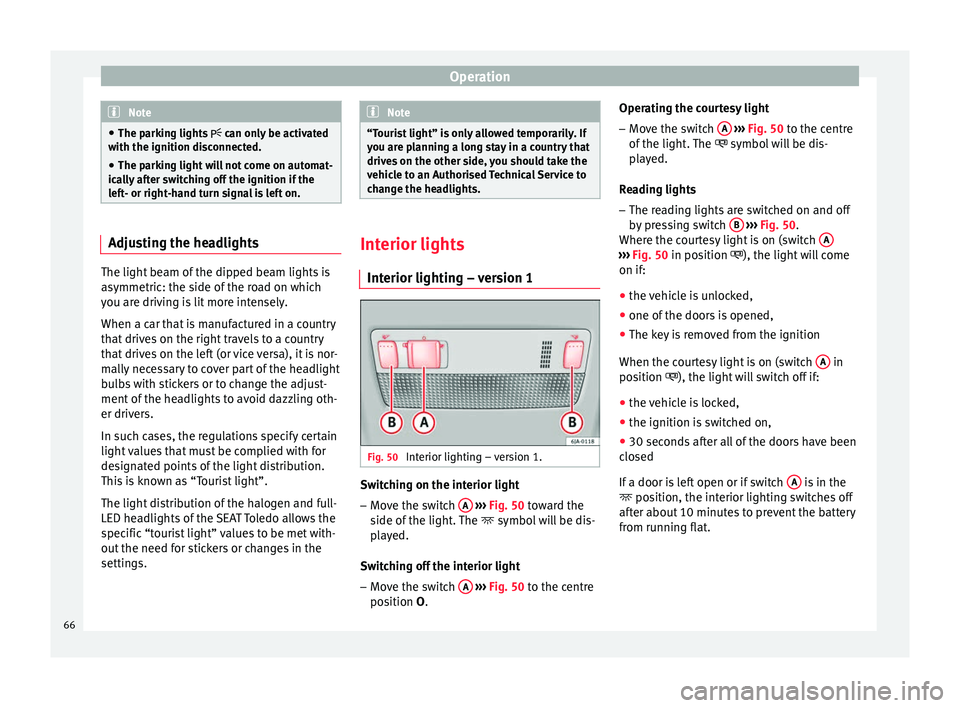
Interior lighting – version 1 Fig. 50
Interior lighting – version 1. Switching on the interior light
– Move the switch A
›››
Fig. 50 toward the
s ide of
the light. The symbol will be dis-
played.
Switching off the interior light – Move the switch A
›››
Fig. 50 to the centre
po s
ition O. Operating the courtesy light
–
Move the switch A
››› Fig. 50 to the centre
of the light
. The symbol will be dis-
played.
Reading lights
– The reading lights are switched on and off
by pressing switch B
››› Fig. 50 .
Wher e the c
ourtesy light is on (switch A ›››
Fig. 50 in position
), the light will come
on if:
● the
vehicle is unlocked,
● one of the doors is opened,
● The key is removed from the ignition
When the courtesy light is on (switch A in
position ), the light will switch off if:
● the vehicle is locked,
● the ignition is switched on,
● 30 seconds after all of the doors have been
closed
If a door is left open or if switch A is in the
position, the interior lighting switches off
after about 10 minutes to prevent the battery
from running flat.
66
Page 80 of 200
Operation
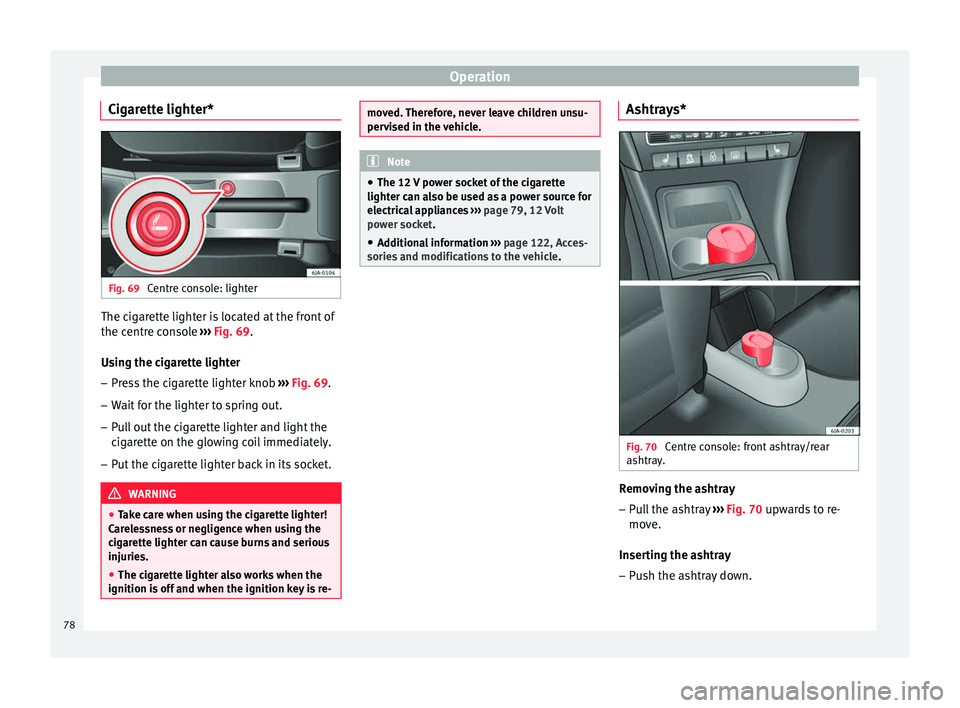
Cigarette lighter* Fig. 69
Centre console: lighter The cigarette lighter is located at the front of
the centre console
››› Fig. 69 .
U s
ing the cigarette lighter
– Press the cigarette lighter knob ››› Fig. 69.
– Wait
for the lighter to spring out.
– Pull out the cigarette lighter and light the
cigarette on the glowing coil immediately.
– Put the cigarette lighter back in its socket. WARNING
● Take care when using the cigarette lighter!
Carelessness or negligence when using the
cigarette lighter can cause burns and serious
injuries.
● The cigarette lighter also works when the
ignition is off and when the ignition key is re- moved. Therefore, never leave children unsu-
pervised in the vehicle.
Note
● The 12 V power socket of the cigarette
lighter can also be used as a power source for
electrical appliances ››› page 79, 12 Volt
power socket .
● Ad dition
al information ››› page 122, Acces-
sories and modifications to the vehicle . Ashtrays*
Fig. 70
Centre console: front ashtray/rear
ashtray. Removing the ashtray
– Pull the ashtray ››› Fig. 70 upwards to re-
mo v
e.
Inserting the ashtray
– Push the ashtray down.
78
Page 81 of 200

Transport and practical equipment
WARNING
Never put flammable materials in the ashtray.
Risk of fire! CAUTION
Never hold onto the ashtray by the lid when
removing it. Risk of breaking the lid. 12 Volt power socket
Fig. 71
Centre console: 12 V power socket. The 12 V power socket is located at the front
of the centre console
›››
Fig. 71 .
U s
ing the power socket
– Open the cover or remove the cigarette
lighter concealing the socket.
– Insert the plug of the electrical appliance
into the socket. Additional information
››› page 122, Acces-
sories and modifications to the vehicle . WARNING
● Improper use of the sockets or electrical
appliances can cause a fire and lead to burns
and other serious injuries.
● Never leave children unsupervised in the
vehicle. The 12 V power socket is also func-
tional when the ignition is switched off and
the key is removed.
● Should the connected appliance overheat,
immediately switch it off and disconnect it
from the socket. CAUTION
● The 12 V power socket can only be used to
power appliances with a power rating of up to
120 watts.
● Never exceed the maximum permitted pow-
er, as this could cause damage to the vehicle
electrical installation.
● With the engine switched off, however, the
vehicle battery will drain. Risk of discharging
the battery!
● Only use suitable plugs so as not to dam-
age the power socket.
● Only use appliances that have been tested
for electromagnetic compatibility in compli-
ance with current regulations.
● Before switching the ignition on or off, un-
plug the appliances from the power socket to protect them from any damage caused by
fluctuations in voltage.
● Follow the instructions for use of connected
appliances! Multimedia compartment
Fig. 72
Front centre console: multimedia
compartment. The multimedia compartment is in the stor-
age compartment of the front centre console
››› Fig. 72 .
The c omp
artment can be used to hold mobile
phones, mp3 players or similar devices. WARNING
Never use the multimedia compartment as an
ashtray or to store flammable materials. Risk
of fire! 79
Technical specifications
Advice
Operation
Safety
Page 98 of 200

Operation
Driving Starting and stopping the
engine Introduction WARNING
● Never adjust the steering wheel while the
vehicle is moving!
● For safety reasons, the steering wheel ad-
justment lever must always be pushed se-
curely against the steering column to prevent
the steering wheel from accidentally chang-
ing position while driving. Risk of accident!
● If the steering wheel is adjusted closer to
your face, the protective effect of the driver
airbag will be decreased in the event of an ac-
cident. Check that the steering wheel is
pointing towards the upper part of your body.
● When driving, always hold the steering
wheel with both hands on the outside part at
the 9 o'clock and 3 o'clock positions. Never
hold the steering wheel at the 12 o'clock po-
sition, or in any other manner (e.g. in the cen-
tre of the steering wheel). In such cases, if
the airbag is triggered, you may sustain inju-
ries to the arms, hands and head.
● When moving with the engine switched off,
the ignition key must always remain in posi-
tion 2
››› Fig. 89 ››› page 97 (ignition on).
The contr
ol lamps will light up in this posi- tion. Otherwise, the steering lock could en-
gage suddenly. Risk of accident!
●
Do not remove the key from the ignition un-
til the vehicle has come to a standstill and is
secure (e.g. the handbrake is engaged). Oth-
erwise, the steering lock could suddenly en-
gage. Risk of accident!
● Always take the ignition key with you when
you leave the vehicle. This is particularly im-
portant if you leave children in the vehicle.
Children could, for example, start the engine
with the subsequent risk of accident.
● Never leave the engine running in unventi-
lated or closed rooms. The exhaust gases
contain carbon monoxide, an odourless and
colourless poisonous gas. Risk of fatal acci-
dents! Carbon monoxide can cause people to
lose consciousness and can cause death.
● Never leave the vehicle unattended if the
engine is running.
● Never switch the engine off until the vehi-
cle has come to a complete stop. Risk of acci-
dent! CAUTION
● Turning the steering wheel fully in either
direction when the vehicle is stationary and
the engine is in gear puts the power steering
under great stress. This could lead to noise.
Never leave the steering wheel turned fully in
either direction for more than 15 seconds.
Risk of damage to the power steering system! ●
The starter motor may only be used (key
position 3
››› Fig. 89 ››› p
age 97 in the igni-
tion) if the engine is off. Using the starter mo-
tor when the engine is running could damage
it.
● Immediately release the ignition key when
the engine starts, otherwise damage could be
caused to the starter motor.
● When the engine is cold, you should avoid
high engine speeds, driving at full throttle
and over-loading the engine before it reaches
operating temperature. Risk of engine dam-
age!
● Do not tow-start the engine. Risk of engine
damage! In vehicles with a catalytic convert-
er, fuel that has not been burned could reach
the catalytic converter and catch fire in it.
This would lead to a fault in the catalytic con-
verter. You may use the battery from another
vehicle to help you start your engine
››› page 157, Jump-starting.
● After prolonged and demanding operation
of the engine, when the journey has ended,
do not stop the engine immediately. Let the
engine run at idle for about one more minute.
This will stop the engine from overheating. For the sake of the environment
Do not warm up the engine when the vehicle
is stationary. If possible, move off immediate-
ly after starting the engine. This will help the
engine reach operating temperature more
quickly, reducing the quantity of emissions. 96