oil Seat Toledo 2014 User Guide
[x] Cancel search | Manufacturer: SEAT, Model Year: 2014, Model line: Toledo, Model: Seat Toledo 2014Pages: 200, PDF Size: 4.37 MB
Page 110 of 200
Operation
CAUTION
● In the event of driving through water, parts
of the vehicle can be seriously damaged,
such as the engine, gearbox, catalytic con-
verter, suspension or the electrical system.
● Oncoming vehicles that drive through wa-
ter can cause waves that exceed your vehi-
cle's permitted level for driving through wa-
ter.
● There may be pot-holes mud or rocks under
the water that can hinder or prevent driving
through water.
● Do not drive through salt water. The salt
can cause rust. All components that are ex-
posed to salt water must be rinsed immedi-
ately with fresh water. Note
After driving through water we recommend
that you contact a specialised service for an
inspection. Preventing damage to the vehicle
In order to prevent damage to the vehicle,
take special care:
● on roads that are in poor condition,
● when mounting kerbs,
● when approaching very steep ramps, etc., ●
with the parts of the vehicle situated on the
lower part of the vehicle, i.e. the spoiler, the
exhaust pipe.
This applies especially to vehicles with a very
low suspension (sport) and when the vehicle
is fully loaded. Driver assistance systems
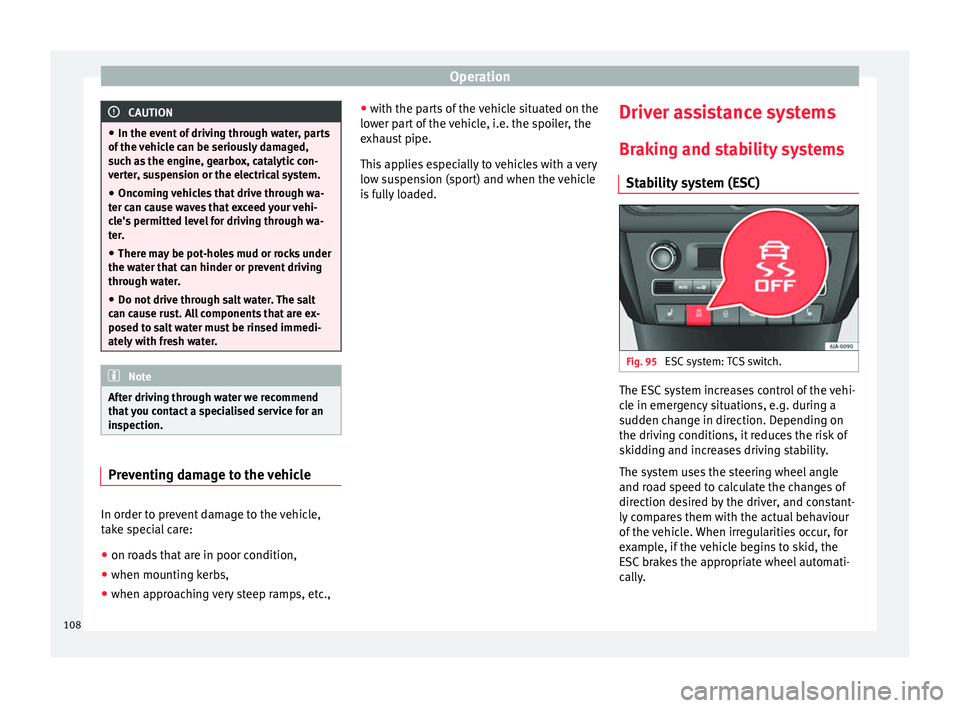
Braking and stability systems Stability system (ESC) Fig. 95
ESC system: TCS switch. The ESC system increases control of the vehi-
cle in emergency situations, e.g. during a
sudden change in direction. Depending on
the driving conditions, it reduces the risk of
skidding and increases driving stability.
The system uses the steering wheel angle
and road speed to calculate the changes of
direction desired by the driver, and constant-
ly compares them with the actual behaviour
of the vehicle. When irregularities occur, for
example, if the vehicle begins to skid, the
ESC brakes the appropriate wheel automati-
cally.
108
Page 126 of 200
Advice
Note
● Remove stains from fresh ball-pen and oth-
er inks, lipstick, shoe cream and similar
stains on the fabric (leather), upholstery and
fabric trim as soon as possible.
● We recommend that you visit an authorised
SEAT dealer to clean and care for the interior
of your vehicle, due to the problems that may
arise when cleaning and caring for the interi-
or of your vehicle and to the utensils and
knowledge required. Washing the vehicle
The best protection of the vehicle from the
harmful influences of the environment in-
volves
frequent washing and waxing. The fre-
quency w
ith which the vehicle is washed de-
pends on many different factors, such as:
● Frequency of use
● Type of parking (garage, underneath trees,
etc.)
● Time of year
● Weather conditions
● Environmental conditions
The longer substances such as insects, bird
droppings, resinous tree sap, road dirt, in-
dustrial deposits, tar, soot or road salt and
other aggressive materials remain on the
paintwork, the more damage they do. High temperatures (for instance in strong sunlight)
further intensify the corrosive effect.
After the winter season, it is important to
have the underside of the vehicle
wa
shed
thoroughly.
Automatic car washes Your vehicle can be washed in an automatic
car wash.
Before going through an automatic car wash,
be sure to take the usual precautions such as
closing the windows, etc.
If the vehicle has special accessories such as
spoilers or a roof rack or two-way radio aerial,
etc., it is advisable to consult the car wash
operator beforehand.
The windscreen wiper rubbers must be de-
greased after going after the car wash and
waxing.
Washing by hand When washing the car by hand, use plenty of
water to soften the dirt first and rinse off as
well as possible.
Then clean the vehicle with a
sponge, glove
or brush
. Start on the roof and work down.
U
se only slight pressure when cleaning the
painted surfaces of the vehicle. A car sham-poo should only be used for very persistent
dirt.
Rinse the sponge or glove thoroughly and of-
ten.
Wheels, sills and underside should be
cleaned last. Use a second sponge for this.
After washing, rinse the vehicle thoroughly
and then dry with a chamois.
Washing with high-pressure cleaners When cleaning the vehicle with a high-pres-
sure cleaner, always follow the operating in-
structions for the equipment. This particular-
ly applies to the
operating pressure and the
distance of the spray from the surface of the
v ehic
le. Do not hold the spray nozzle too
close to the parking aid system sensors and
soft materials, such as rubber hoses or insu-
lating material. WARNING
Do no use a nozzle that sprays the water out
in a direct stream or one that has a “rotating
jet”! CAUTION
Do not use water hotter than +60 °C (140 °F).
Risk of damage to the vehicle! 124
Page 127 of 200

Care and maintenance
Waxing and polishing of the vehicle
paintwork Care
To a great extent, good waxing protects the
vehicle surface from the harmful effects of
the environment.
The vehicle must be treated with a high qual-
ity, hard wax when water no longer forms
droplets on clean paintwork.
A new coat of high quality, hard wax can be
applied to the clean, painted surface only
when it has fully dried. Even if a wax solution
is used regularly in the car wash, it is advisa-
ble to protect the paint with a coat of wax at
least twice a year.
Polishing
Polishing is only necessary if the paint has
lost its shine, and the gloss cannot be
brought back by applying wax.
The vehicle must be waxed after polishing if
the polish used does not contain wax com-
pounds to seal the paint.
CAUTION
● Never wax the windows.
● Do not use polishes and hard wax on pain-
ted parts with a matt finish or on plastic
parts. ●
Do not polish your vehicle in a sandy or
dusty environment. Cleaning chrome
Clean the chrome first with a clean cloth and
then buff up with a soft, dry cloth. If this does
not clean the chrome properly, use a special
chrome cleaner.
CAUTION
Do not polish the chrome in a dusty environ-
ment or it could be scratched. Paint damage
Minor damage to the paint, such as scratches
or stone chips, should be touched up without
delay using paint.
Suitable
touch-up brushes or sprays for the
c o
lour of your vehicle can be purchased from
authorised SEAT dealers. Note
We recommend you leave paint damage re-
pairs to a SEAT Authorised Service. Plastic parts
Exterior plastic parts will come clean using a
damp cloth. If this is not sufficient, plastic
parts can also be treated with special sol-
vent-free plastic cleaning detergents
.
Do not u
se paint cleaners, polishes or wax on
plastic parts.
Windows and exterior mirrors Remove snow and ice from windows and rear
vision mirrors with a plastic scraper only. To
avoid damaging the surface of the glass, the
scraper should only be pushed in one direc-
tion and not moved to and fro.
The windows should also be cleaned on the
inside at regular intervals.
Use a separate cloth or chamois to dry the
windows and rear vision mirrors.
Do not use the chamois used to polish the
bodywork to dry the windows. Waxing and
polishing residues could cause smears on
the glass and hinder visibility.
CAUTION
● Never use hot or boiling water to remove
snow and ice from the windows. Risk of crack-
ing glass! » 125
Technical specifications
Advice
Operation
Safety
Page 130 of 200
Advice
Removing stains
Remove fresh water-based
stains such as cof-
f
ee, tea, juices, blood, etc. with an absorbent
cloth or kitchen roll. Use the special deter-
gent to clean dried-on stains.
Remove fresh
fat-based stains such as but-
ter
, mayonnaise, chocolate, etc. with an ab-
sorbent cloth or paper towel or use the spe-
cial detergent if the stain has not yet soaked
through the surface.
Use a grease-dissolving product to treat
dried-in, fat-based stains.
Treat less common stains such as ball-pen
and other inks, felt-tip pens, nail polish,
emulsion paint, shoe cream etc. with a spe-
cial leather stain remover.
Leather care
The leather should be treated regularly
(about twice a year) with a leather-care prod-
uct.
Apply the protective product very sparingly.
Dry the leather with a soft, dry cloth. CAUTION
● Avoid exposing leather to direct sunlight
for long periods so that it does not lose its
colour. If the car is left for a prolonged period
outdoors, cover the leather so that it does
not lose its colour. ●
Sharp-edged objects on clothing, such as
zips, rivets or belts can leave permanent
scratches and rough marks on the surface of
the leather.
● Use of a mechanical steering wheel lock
can damage the leather surface of the steer-
ing wheel. Note
● Use a suitable impregnating cream with ul-
tra-violet protection at regular intervals and
after cleaning. The cream will nourish and
moisturise the leather, keep it supple and
able to breathe. In addition, it will also help
to protect the surface of the leather.
● Clean the leather every 2 to 3 months and
remove fresh dirt as necessary.
● Preserve the colour of the leather. A special
coloured cream for leather will renew the col-
our of more heavily worn areas as required.
● Leather is a natural material with specific
properties. During vehicle use, the appear-
ance of parts of the leather covers may
change; folds or wrinkles may appear as a re-
sult of their use. Seat belts
Keep the seat belts clean!
Wash soiled seat belts with mild, soapy wa-
ter, removing any heavier dirt with a soft
brush.Check the condition of all seat belts at regu-
lar intervals.
Very soiled belts may not retract properly.
WARNING
● The seat belts should never be removed
from the vehicle for cleaning.
● Never clean using chemical products, as
chemical detergents destroy the fabric. En-
sure that the seat belts do not come into con-
tact with corrosive fluids such as acids, etc.
● If you find any damage to the belt webbing,
belt fittings, the belt retractor or the buckle,
the belt in question must be replaced by an
Official Service.
● Make sure that the inertia reel seat belts
are completely dry before allowing them to
retract. 128
Page 136 of 200

Advice
away from the glass. Otherwise the paint-
work may be damaged.
– Pull the release catch in the direction of the
arrow 2
››› Fig. 108 and the bonnet will be
r el
eased.
– Hold and lift the bonnet.
– Remove the support strut 3
››› Fig. 109
from its fastening in the direction of the ar- row and secure the raised bonnet so that
the end of the strut hooks onto the opening
in the bonnet
4 .
Closing the bonnet – Lift the bonnet slightly and unhook the
support strut keeping the bonnet open and
insert it into its fastening 3 .
–
Let the bonnet drop from a height of
around 20 cm into the catch Do not press
down afterwards!
– Check that the bonnet is correctly closed.
Checking fluid levels Fig. 110
Diagram for the location of the various elements. From time to time, the levels of the different
fluids in the vehicle must be checked. Never
fill with incorrect fluids, otherwise serious
damage to the engine may be caused.
Coolant expansion tank . . . . . . . . . . .138
Window washer water tank . . . . . . . .139
Engine oil filler cap . . . . . . . . . . . . . . .137
1 2
3 Engine oil level dipstick
. . . . . . . . . . .136
Brake fluid reservoir . . . . . . . . . . . . . .139
Battery . . . . . . . . . . . . . . . . . . . . . . . . . . . 140
The checking and replenishment of the serv-
ice fluids are carried out on the components
mentioned above. These operations are de-
scribed in the ››› page 132 .
4 5
6 Overview
You will find further explanations, instruc-
tions and restrictions on the technical speci-
fications as of
››› page 174 . Note
The layout of the engine compartment is very
similar to all petrol and diesel engines. 134
Page 137 of 200

Checking and refilling levels
Radiator fan The radiator is driven by an electric motor
and controlled according to the temperature
of the coolant.
After the engine has been stopped and the
ignition switched off, the radiator fan may
continue running for around 10 minutes.
Engine oil
General notes The engine comes with a special, multi-grade
oil that can be used all year round.
Because the use of high-quality oil is essen-
tial for the correct operation of the engine
and its long useful life, when topping up or
changing oil, use only those oils that comply
with VW standards.
The specifications (VW standards) set out in
the following page should appear on the con-
tainer of the service oil; when the container
displays the specific standards for petrol and
diesel engines together, it means that the oil
can be used for both types of engines.
We recommend that the oil change indicated
in the Maintenance Programme, be per-
formed by a technical service or specialised
workshop. The correct oil specifications for your engine
are listed in the
››› page 136, Oil properties .
Service intervals
Service intervals can be flexible (LongLife
service) or fixed (dependent on time/dis-
tance travelled).
If the PR code that appears on the back of the
Maintenance Programme booklet is QG1, this
means that your vehicle has the LongLife
service programmed. If it has the codes QG0
or QG2, the service interval is dependent on
time/distance travelled.
Flexible service intervals (LongLife service
intervals*)
Special oils and processes have been devel-
oped which, depending on the characteris-
tics and individual driving profiles, enable
the extension of the oil change service (Long-
Life service intervals).
Because this oil is essential for extending the
service intervals, it must only be used ob-
serving the following indications:
● Avoid mixing it with oil for fixed service in-
tervals.
● Only in exceptional circumstances, if the
engine oil level is too low ›››
page 136 and
LongLife oil is not available, it is permitted to
top up (once) with oil for fixed service inter-vals
››› page 136 (up to a maximum of 0.5 li-
tr e
s).
Fixed service intervals*
If your vehicle does not have the “LongLife
service interval” or it has been disabled (by
request), you may use oils for fixed service
intervals
, which also appear in ››› page 136,
Oil properties . In this case, your vehicle must
be serviced after a fixed interval of 1
year/15,000 km (10,000 miles)(whatever
comes first) ››› Booklet Maintenance Pro-
gramme.
● In ex
ceptional circumstances, if the engine
oil level is too low ››› page 136 and you can-
not o
btain the oil specified for your vehicle,
you can add a small quantity of oil conform-
ing to the specification ACEA A2 or ACEA A3
(petrol engines) or ACEA B3 or ACEA B4 (die-
sel engines) (up to 0.5 l).
Vehicles with diesel particulate filter*
The Maintenance Programme states whether
your vehicle is fitted with a diesel particulate
filter.
Only VW 507 00 engine oil, with reduced ash
formation, may be used in diesel engines
equipped with particulate filter. Using other
types of oil will cause a higher soot concen-
tration and reduce the life of the DPF. There-
fore: »
135
Technical specifications
Advice
Operation
Safety
Page 138 of 200

Advice
● Avoid mixing this oil with other engine oils.
● Only in exceptional circumstances, if the
engine oil level is too low ››› page 136 and
you cannot obtain the oil specified for your
vehicle, you can use a small quantity of oil
(once) conforming to the VW 506 00,
VW 506 01, VW 505 00, VW 505 01 or
ACEA B3/ACEA B4 specification. (up to 0.5 l).
Oil propertiesEngine typeSpecification
Petrol without flexible
service intervalVW 502 00/VW 504 00
Petrol with flexible serv-
ice interval (LongLife)VW 504 00
Diesel. Engines without
Particulate filter (DPF)VW 505 01/VW 506 01/VW
507 00
Diesel. Particulate Filter
Engines (DPF).
With or without flexible
service interval (with
and without LongLife) a)VW 507 00
a)
Only use recommended oils, otherwise you may damage the
engine.
Engine oil additives
No type of additive should be mixed with the
engine oil. The deterioration caused by these
additives is not covered by the warranty. Note
Before a long trip, we recommend finding an
engine oil that conforms to the correspond-
ing VW specifications and recommend keep-
ing it in the vehicle. This way, the correct en-
gine oil will always be available for a top-up if
needed. Checking the engine oil level
Fig. 111
Engine oil dipsticks. The dipstick shows the engine oil level.
››› Fig. 111 .
Chec k
ing oil level
– Park the vehicle on a level surface and en-
sure the engine is at operating tempera-
ture.
– Switch the ignition off.
– Open the bonnet. –
Wait a few minutes for the engine oil to
flow back to the sump and remove the dip-
stick.
– Wipe the dipstick with a clean cloth and in-
sert it again as far as it will go.
– Then pull the dipstick out again and check
the oil level.
Oil level in area A –
Do not
t
op up oil.
Oi
l level in area B –
Oil can be topped up. After topping up the
oi l
level could be in area A .
Oil level in area C –
Oil must be topped up. After topping up,
the oil level should be in area B .
It is normal for the engine to consume a cer-
tain amount of oil. Depending on how you
drive and the conditions in which the vehicle
is used, oil consumption can be up to 0.5 li-
tres per 1,000 km. Oil consumption can also
be higher for the first 5,000 km (3000 miles).
You should therefore check the oil level at
regular intervals, ideally every time you fill
the tank or before setting off on a long trip.
When the engine is working hard, for in-
stance during sustained motorway cruising in
summer, when towing a trailer or caravan or
136
Page 139 of 200

Checking and refilling levels
climbing on mountain passes, the oil level
should preferably be kept within area A ,
but
no higher .
A w
arning lamp will appear on the instrument
panel ››› page 34, Engine oil if the oil lev-
el is too low. In this case, check the oil level
as soon as possible. Top up with the required
amount of oil. CAUTION
● The oil level must never exceed area A›››
Fig. 111. Risk of damage to the exhaust
sy s
tem!
● If the engine oil cannot be topped up under
the given conditions, do not drive on! Stop the engine and seek
the professional assis-
tance of an Official Service, as this could
cause serious damage to the engine. Topping up engine oil
–
Check the engine oil level ›››
page 136,
Checking the engine oil level .
– Unscrew the cap from the filler opening.
– Put in the specified grade of oil 0.5 litres at
a time ›››
page 135 .
– Chec k
the oil level ›››
page 136.
– Replace the oil filler cap carefully and push
the dipstick all the way in. Changing engine oil Engine oil must be changed with the frequen-
cy indicated in the Maintenance Programme
or according to the service interval indicator
››› page 45. CAUTION
Do not mix engine oil with additives. Risk of
damage to the engine! Damage caused by
these products is not covered by the warran-
ty. Note
Wash your skin thoroughly if it comes into
contact with engine oil. Coolant
General notes The cooling system is factory-filled with an
anti-freeze product.
Coolant consists of a mixture of water and
40% anti-freeze additive. This mixture gives
the required anti-freeze protection at temper-
atures down to -25 °C (-13 °F) and protects
the cooling and heating system against cor-
rosion. It also prevents scaling and raises the
boiling point of the coolant considerably.The coolant concentration must not be re-
duced by adding water, even in warmer sea-
sons or in warm countries.
The concentration
of the anti-freeze additive in the coolant
must be at least 40 %.
If greater anti-freeze protection is required in
very cold climates, the proportion of the anti-
freeze additive can be increased, but only up
to 60% (anti-freeze protection down to ap-
proximately -40 °C (-40 °F)). Exceeding this
proportion reduces anti-freeze protection and
the cooling effect.
Coolant fluid with protection down to -35 °C
(-31 °F) is added at the factory in vehicles
destined for countries with a cold climate. In
these countries, the concentration of coolant
should always be kept above 50%.
The type of anti-freeze to be used for topping
up is indicated on the coolant tank cover
››› Fig. 112 . CAUTION
● Anti-freeze that does not correspond to the
correct specification may particularly affect
corrosion protection considerably.
● Faults caused by corrosion may lead to
coolant leaks. Risk of serious engine faults! 137
Technical specifications
Advice
Operation
Safety
Page 141 of 200

Checking and refilling levels
Brake fluid Checking brake fluid level Fig. 113
Engine compartment: brake fluid
reservoir. The brake fluid reservoir is located in the en-
gine compartment of the vehicle.
– Switch the ignition off.
– Open the bonnet ››› page 132.
– Check the brake fluid level in the reservoir
››› Fig. 113 . It should be between the “MIN”
and “MAX” m ark
s.
The fluid level drops slightly after a period of
time due to automatic compensation for
brake pad wear. This is quite normal.
However, if the level goes down noticeably in
a short time, or drops below the “MIN” mark,
there may be a leak in the brake system. If
the brake fluid level in the reservoir is too low, this will be indicated by the warning
lamp illuminating on the instrument panel
››› page 33, Brake system . WARNING
If the fluid level has dropped below the MIN
mark, do not continue driving. Risk of acci-
dent! Go t
o a technical service. Changing the brake fluid
Brake fluid absorbs moisture. Therefore, it
gradually absorbs moisture from the atmos-
phere. If the water content in the brake fluid
is too high, the brake system could corrode.
The water content also reduces the boiling
point of the brake fluid.
The brake fluid must comply with one of the
following standards or specifications:
● VW 50114
● FMVSS 116 DOT4 WARNING
Heavy use of the brakes may cause a vapour
lock if the brake fluid is left in the brake sys-
tem for too long. This would seriously affect
the efficiency of the brakes and the safety of
the vehicle. CAUTION
Brake fluid damages the vehicle paintwork. Windscreen washer
Fig. 114
Engine compartment: windscreen
washer reservoir. The container for the windscreen washer con-
tains the cleaning fluid for the windscreen or
rear window and the headlight washer sys-
tem. The container is located in the engine
compartment.
»
139Technical specifications
Advice
Operation
Safety
Page 146 of 200

Advice
Wheels and tyres
Wheels Introduction WARNING
● During the first 500 km, new tyres do not
give maximum grip, therefore you should
drive carefully. Risk of accident!
● Never drive with damaged tyres. Risk of ac-
cident!
● Only use wheels and tyres that been au-
thorised by SEAT or your vehicle model. Fail-
ure to do so could impair road safety. Risk of
accident!
● Never exceed the maximum speed permit-
ted for your tyres. Risk of accident due to tyre
damage and loss of vehicle control!
● Under-inflated tyres are submitted to great-
er rolling resistance. This means that they
can overheat at high speeds. This can cause
tread separation and even tyre blow-out.
● For driving safety, tyres should be replaced
at least in pairs according to the axle and not
individually. The tyres with the deepest tread
should always be used on the front wheels.
● Never fit used tyres of an unknown age or
prior use.
● Tyres must be immediately changed at the
very latest when they have worn down to the
tread wear indicators. ●
Worn tyres reduce the necessary grip at
high speeds on damp surfaces. This could
lead to “aquaplaning” (uncontrolled vehicle
movement – “skidding” on damp surfaces).
● Damaged wheels and tyres must be re-
placed immediately.
● Do not use summer or winter tyres that are
more than 6 or 4 years old respectively.
● Wheel bolts should be clean and screw
easily. However, they must never be treated
with grease or oil.
● If the tightening torque of the wheel bolts
is too low, they could loosen while the vehi-
cle is moving. Risk of accident! If the tighten-
ing torque of the wheel bolts is too high, the
bolts and threads could be damaged, leading
to the permanent deforming of the rim sup-
port surfaces.
● Incorrectly handled wheel bolts could lead
to a wheel coming loose while the vehicle is
moving. Risk of accident!
● Observe the national legal requirements re-
garding the use of snow tyres and chains. CAUTION
● Where a spare wheel that is not compatible
with the wheels fitted is used, follow the in-
structions ››› page 146.
● The pr e
scribed tightening torque for wheel
bolts on steel and alloy wheels is 120 Nm.
● Protect your tyres from coming into contact
with oil, grease and fuel.
● Replace any lost valve caps immediately. For the sake of the environment
Under-inflated tyres increases fuel consump-
tion. Note
● We recommend having all work on tyres
and wheels carried out by an authorised SEAT
dealer.
● We recommend using wheels, tyres, hub
caps and snow chains from the SEAT Original
Accessories programme. Life cycle of tyres
Fig. 117
Side view of tyres with tread wear in-
dicators. Tread wear indicator
The base of the side of the original tyres on
your vehicle show 1.6 mm high tread wear in-
dicators
››› Fig. 117 . The position of these
144