ECU Seat Toledo 2014 Owner's Guide
[x] Cancel search | Manufacturer: SEAT, Model Year: 2014, Model line: Toledo, Model: Seat Toledo 2014Pages: 200, PDF Size: 4.37 MB
Page 98 of 200

Operation
Driving Starting and stopping the
engine Introduction WARNING
● Never adjust the steering wheel while the
vehicle is moving!
● For safety reasons, the steering wheel ad-
justment lever must always be pushed se-
curely against the steering column to prevent
the steering wheel from accidentally chang-
ing position while driving. Risk of accident!
● If the steering wheel is adjusted closer to
your face, the protective effect of the driver
airbag will be decreased in the event of an ac-
cident. Check that the steering wheel is
pointing towards the upper part of your body.
● When driving, always hold the steering
wheel with both hands on the outside part at
the 9 o'clock and 3 o'clock positions. Never
hold the steering wheel at the 12 o'clock po-
sition, or in any other manner (e.g. in the cen-
tre of the steering wheel). In such cases, if
the airbag is triggered, you may sustain inju-
ries to the arms, hands and head.
● When moving with the engine switched off,
the ignition key must always remain in posi-
tion 2
››› Fig. 89 ››› page 97 (ignition on).
The contr
ol lamps will light up in this posi- tion. Otherwise, the steering lock could en-
gage suddenly. Risk of accident!
●
Do not remove the key from the ignition un-
til the vehicle has come to a standstill and is
secure (e.g. the handbrake is engaged). Oth-
erwise, the steering lock could suddenly en-
gage. Risk of accident!
● Always take the ignition key with you when
you leave the vehicle. This is particularly im-
portant if you leave children in the vehicle.
Children could, for example, start the engine
with the subsequent risk of accident.
● Never leave the engine running in unventi-
lated or closed rooms. The exhaust gases
contain carbon monoxide, an odourless and
colourless poisonous gas. Risk of fatal acci-
dents! Carbon monoxide can cause people to
lose consciousness and can cause death.
● Never leave the vehicle unattended if the
engine is running.
● Never switch the engine off until the vehi-
cle has come to a complete stop. Risk of acci-
dent! CAUTION
● Turning the steering wheel fully in either
direction when the vehicle is stationary and
the engine is in gear puts the power steering
under great stress. This could lead to noise.
Never leave the steering wheel turned fully in
either direction for more than 15 seconds.
Risk of damage to the power steering system! ●
The starter motor may only be used (key
position 3
››› Fig. 89 ››› p
age 97 in the igni-
tion) if the engine is off. Using the starter mo-
tor when the engine is running could damage
it.
● Immediately release the ignition key when
the engine starts, otherwise damage could be
caused to the starter motor.
● When the engine is cold, you should avoid
high engine speeds, driving at full throttle
and over-loading the engine before it reaches
operating temperature. Risk of engine dam-
age!
● Do not tow-start the engine. Risk of engine
damage! In vehicles with a catalytic convert-
er, fuel that has not been burned could reach
the catalytic converter and catch fire in it.
This would lead to a fault in the catalytic con-
verter. You may use the battery from another
vehicle to help you start your engine
››› page 157, Jump-starting.
● After prolonged and demanding operation
of the engine, when the journey has ended,
do not stop the engine immediately. Let the
engine run at idle for about one more minute.
This will stop the engine from overheating. For the sake of the environment
Do not warm up the engine when the vehicle
is stationary. If possible, move off immediate-
ly after starting the engine. This will help the
engine reach operating temperature more
quickly, reducing the quantity of emissions. 96
Page 99 of 200

Driving
Note
● The engine can only be started with the
original SEAT key.
● Loud running noises may be heard briefly
after cold-starting the engine. This is normal
and is no cause for concern.
● After the engine has been stopped and the
ignition switched off, the radiator fan may
continue running for around 10 minutes.
● If the engine still does not start after a sec-
ond attempt, the fuel pump fuse might have
blown. Check it and replace if necessary
››› page 163 or contact your Specialised
Ser v
ice.
● You should always engage the steering lock
when you exit the vehicle. This will hinder
any attempts at theft. Power steering
The power steering allows you to turn the
steering wheel more easily.
If the power steering fails or the engine is off
(towing), it is still possible to turn the vehi-
cle's steering wheel fully. However, you need
more strength to steer the vehicle. Start-up lock security system
(immobiliser) There is an electronic chip in the key. The
electronic immobiliser is deactivated when
the key is inserted into the ignition. The elec-
tronic immobiliser is automatically activated
when the key is removed from the ignition.
The engine will not start if an unauthorised
key is used.
The informative display indicates:
Immobiliser active!
Ignition lock Fig. 89
Ignition key positions. Petrol engines
1 – Ignition switched off, engine stopped,
steering can be locked
2 – Ignition switched on3 – Starting
Diesel engines 1 – Fuel supply stopped, ignition switched
off, engine stopped, steering can be locked
2 – Engine pre-heating, ignition switched
on
3 – Starting
To engage the Steering lock without the key
in the ignition, t urn the s
teering wheel slight-
ly until you hear it engage.
If the steering lock is engaged and it is diffi-
cult or impossible to turn the key to position 2 , release the lock by turning the steering
wheel slightly in both directions.
Starting the engine Vehicles with a
diesel engine are equipped
with a glow plug system. When you switch on
the ignition, the glow plug warning lamp
will light up. The engine can be started
straight away when the lamp switches off.
Do not connect electrical appliances during
preheating so as not the drain the vehicle
battery unnecessarily. »
97
Technical specifications
Advice
Operation
Safety
Page 122 of 200
Operation
WARNING
Only use the towing bracket device when the
ball-headed bar is properly fitted! Disassembly of the ball-headed bar
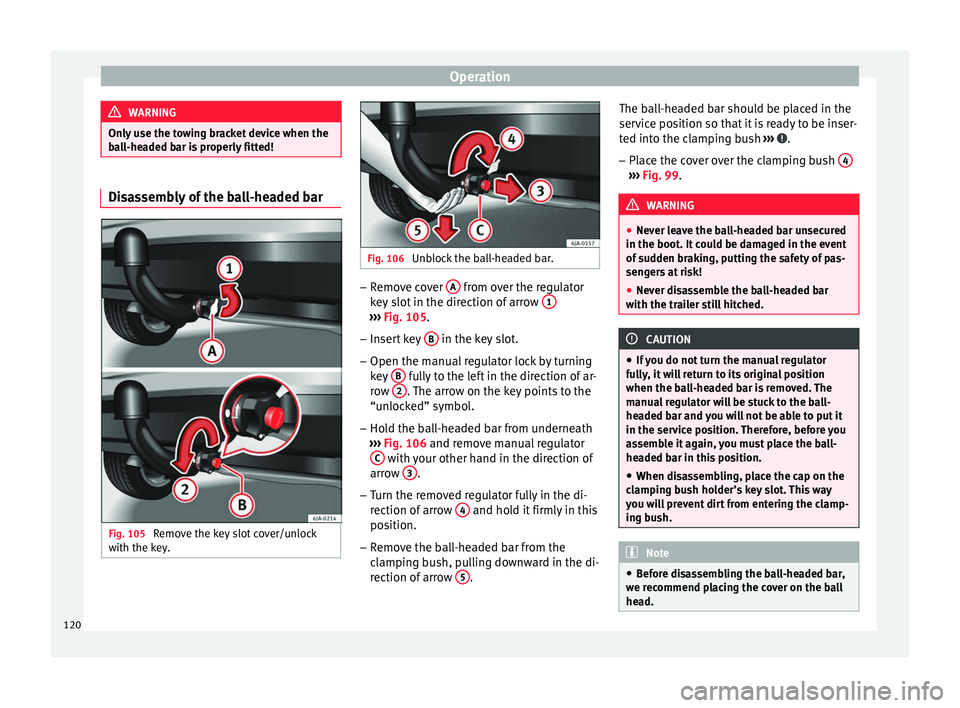
Fig. 105
Remove the key slot cover/unlock
with the key. Fig. 106
Unblock the ball-headed bar. –
Remove cover A from over the regulator
key slot in the direction of arrow 1 ›››
Fig. 105 .
– Inser
t key B in the key slot.
– Open the manual regulator lock by turning
key B fully to the left in the direction of ar-
row 2 . The arrow on the key points to the
“unlocked” symbol.
– Hold the ball-headed bar from underneath
››› Fig. 106 and remove manual regulator
C with your other hand in the direction of
arrow 3 .
– Turn the removed regulator fully in the di-
rection of arrow 4 and hold it firmly in this
position.
– Remove the ball-headed bar from the
clamping bush, pulling downward in the di-
rection of arrow 5 .The ball-headed bar should be placed in the
service position so that it is ready to be inser-
ted into the clamping bush
››› .
– Place the cover over the clamping bush 4 ›››
Fig. 99 . WARNING
● Never leave the ball-headed bar unsecured
in the boot. It could be damaged in the event
of sudden braking, putting the safety of pas-
sengers at risk!
● Never disassemble the ball-headed bar
with the trailer still hitched. CAUTION
● If you do not turn the manual regulator
fully, it will return to its original position
when the ball-headed bar is removed. The
manual regulator will be stuck to the ball-
headed bar and you will not be able to put it
in the service position. Therefore, before you
assemble it again, you must place the ball-
headed bar in this position.
● When disassembling, place the cap on the
clamping bush holder’s key slot. This way
you will prevent dirt from entering the clamp-
ing bush. Note
● Before disassembling the ball-headed bar,
we recommend placing the cover on the ball
head. 120
Page 134 of 200

Advice
serious damage to the engine! Contact an au-
thorised SEAT dealer to clean the engine fuel
system.
● Water allowed to collect in the fuel filter
can cause engine faults.
● Your vehicle is not prepared for use of bio-
fuel (RME) and, therefore, this fuel must not
be used for refuelling or driving. The use of
biofuel (RME) could cause serious damage to
the engine or the fuel system. Engine compartment
Introduction Always be aware of the danger of injury and
scalding as well as the risk of accident or fire
when working in the engine compartment,
e.g. when checking and refilling fluids.
Therefore, always observe the warnings and
follow all general safety precautions. The en-
gine compartment is a dangerous area
.WARNING
● Never open the bonnet if you see steam,
smoke or coolant escaping from the engine
compartment. Risk of scalding! Wait until no
steam or coolant can be seen before opening
the bonnet.
● Switch off the engine and remove the key
from the ignition. ●
Engage neutral in vehicles with manual
gearbox and move the selector lever to posi-
tion P in vehicles with automatic gearbox.
● Apply the handbrake firmly.
● Wait for the engine to cool down.
● For safety reasons, the bonnet must always
be closed when the vehicle is moving. There-
fore, after closing the bonnet always check
that it is properly secured.
● Should you notice that the bonnet is not
safely secured when the vehicle is moving,
stop the vehicle immediately and close the
bonnet properly. Risk of accident!
● Keep children away from the engine com-
partment.
● Do not touch hot engine parts. Risk of
burns!
● Never spill fluids on hot engine compart-
ments. These fluids can cause a fire (e.g. anti-
freeze in coolant)!
● Take care not to cause short circuits in the
electrical system, especially when working
on the battery.
● Never touch the radiator fan when the en-
gine is hot. The fan may start running sud-
denly!
● Never cover the engine with additional in-
sulating materials such as a blanket. Risk of
fire!
● Do not unscrew the cap on the coolant ex-
pansion tank when the engine is hot. The
cooling system is under pressure! ●
Protect face, hands and arms from any hot
steam or hot coolant released by covering the
cap with a large, thick rag when opening the
expansion tank.
● Do not leave any objects, such as cloths or
tools, in the engine compartment.
● When working underneath the vehicle, se-
cure it so that it cannot roll away and support
it safely on suitable supports. The hydraulic
jack is not sufficient for this purpose. Risk of
injuries!
● If any tests have to be performed with the
engine running, there is an extra safety risk
from rotating parts, such as the drive belt, al-
ternator and radiator fan, etc., and from the
high-voltage ignition system. You should also
note the following:
– Never touch the electrical wiring of the
ignition system.
– Keep away from moving engine parts
when wearing jewellery, loose clothing or
long hair. Risk of fatal injuries! All jewel- lery must be removed, hair tied back and
close-fitting clothing worn.
● Observe the following additional warnings
if work on the fuel system or the electrical
system is necessary.
–Always disconnect the battery from the
on-board network.
– Do not smoke.
– Never work near naked flames.
– Always keep an approved fire extinguish-
er immediately available. 132
Page 136 of 200

Advice
away from the glass. Otherwise the paint-
work may be damaged.
– Pull the release catch in the direction of the
arrow 2
››› Fig. 108 and the bonnet will be
r el
eased.
– Hold and lift the bonnet.
– Remove the support strut 3
››› Fig. 109
from its fastening in the direction of the ar- row and secure the raised bonnet so that
the end of the strut hooks onto the opening
in the bonnet
4 .
Closing the bonnet – Lift the bonnet slightly and unhook the
support strut keeping the bonnet open and
insert it into its fastening 3 .
–
Let the bonnet drop from a height of
around 20 cm into the catch Do not press
down afterwards!
– Check that the bonnet is correctly closed.
Checking fluid levels Fig. 110
Diagram for the location of the various elements. From time to time, the levels of the different
fluids in the vehicle must be checked. Never
fill with incorrect fluids, otherwise serious
damage to the engine may be caused.
Coolant expansion tank . . . . . . . . . . .138
Window washer water tank . . . . . . . .139
Engine oil filler cap . . . . . . . . . . . . . . .137
1 2
3 Engine oil level dipstick
. . . . . . . . . . .136
Brake fluid reservoir . . . . . . . . . . . . . .139
Battery . . . . . . . . . . . . . . . . . . . . . . . . . . . 140
The checking and replenishment of the serv-
ice fluids are carried out on the components
mentioned above. These operations are de-
scribed in the ››› page 132 .
4 5
6 Overview
You will find further explanations, instruc-
tions and restrictions on the technical speci-
fications as of
››› page 174 . Note
The layout of the engine compartment is very
similar to all petrol and diesel engines. 134
Page 148 of 200

Advice
Replacing tyres and wheels All four wheels must be fitted only with tyres
of the same type, size and the same tread
pattern.
The correct tyre/wheel combinations speci-
fied for your vehicle are listed in its docu-
mentation.
Note for Italy: A SEAT Service Centre should
be c
on
sulted whether different sized wheels
or tyres to those originally fitted by SEAT may
be fitted, as well as the combinations al-
lowed between the front axle (axle 1) and
back axle (axle 2).
Understanding the tyre designations makes
it easier to choose the correct tyres. The tyre
designation is marked on the sidewall. For
example.
195/55 R 15 85 H
This contains the following information:
195Tyre width in mm
55Height/width ratio in %
Ridentifying tyre construction letter –
Radial
15Rim diameter in inches
85Load rating code
HSpeed rating code letter The tyres are subject to the following
maxi-
mum speed limits :
Speed rating code
letterMaximum speed limit
Q160 km/h (99 mph)
R170 km/h (106 mph)
S180 km/h (112 mph)
T190 km/h (118 mph)
U200 km/h (124 mph)
H210 km/h (130 mph)
V240 km/h (149 mph)
W270 km/h (168 mph) The
manufacturing date
is also indicated on
the ty
re sidewall (possibly only on the inner
side of the wheel).
DOT … 27 12…
means, for example, that the tyre was pro-
duced in the 27th week of 2012.
Follow the instructions ››› page 146 if you
only have a temporary spare wheel.
Tyres with directional tread pattern The direction of rotation is indicated by the
arrows on the tyre sidewall
. The direction ofrotation indicated must be respected. This
guarantees optimum grip and helps avoid ex-
cessive noise, wear and aquaplaning.
In the event of a flat tyre, a spare wheel with
an undetermined tread pattern or an oppo-
site tread pattern must be used and you must
drive carefully, as in these cases the tyres no
longer offer maximum performance.
Spare wheel Spare wheel location* Fig. 119
Luggage compartment: spare wheel. The spare wheel is housed in a well under
the floor panel in the luggage compartment
and is secured by a special bolt
››› Fig. 119 .
T ak
e out the tool box before removing the
spare wheel.
146
Page 151 of 200

Emergencies
Snow chains Snow chains must only be used on the front
wheels.
In winter road conditions, snow chains not
only help to improve grip but also improve
the braking capacity.
For technical reasons snow chains may only
be used on tyres with the following wheel
rim/tyre combinations.Rim sizeRim offsetTyre size
5J x 14
a)35 mm175/70
6J x 15b)38 mm185/60
6J x 15b)38 mm195/55
a)
Only use snow chains with fine-pitch links and lock no greater
than 9 mm.
b) Only use snow chains with fine-pitch links and lock no greater
than 13 mm.
Remove the wheel trims before fitting snow
chains. CAUTION
Chains must be removed when roads are free
of snow. Otherwise they will impair handling,
damage the tyres and wear out very quickly. Emergencies
Emergency equipment First-aid kit and warning triangle* Fig. 121
Location of the warning triangle. The warning triangle, measuring max.
436 x 45 x 32 mm, can be secured to the lin-
ing on the rear of the luggage compartment
with rubber straps
››› Fig. 121. WARNING
The first-aid kit and fire extinguisher must be
properly secured so that they are not catapul-
ted through the vehicle during driving and
braking manoeuvres or in the event of an ac-
cident. Risk of injury. Note
● Observe the expiry date of the contents of
the first aid kit.
● We recommend you use the first-aid kit and
the warning triangle from the SEAT Original
Accessories programme available in author-
ised SEAT dealers. Fire extinguisher*
Read the instructions given on the fire extin-
guisher carefully.
The fire extinguisher must be checked once a
year by an authorised person (take the appli-
cable legal regulations into account).
WARNING
The fire extinguisher must be properly se-
cured so that it is not catapulted through the
vehicle, causing injuries, during driving and
braking manoeuvres or in the event of an ac-
cident. Note
● The fire extinguisher must comply with lo-
cal legal requirements.
● Observe the expiry date of the fire extin-
guisher. The fire extinguisher may not work
properly if used after the expiry date. 149
Technical specifications
Advice
Operation
Safety
Page 152 of 200
Advice
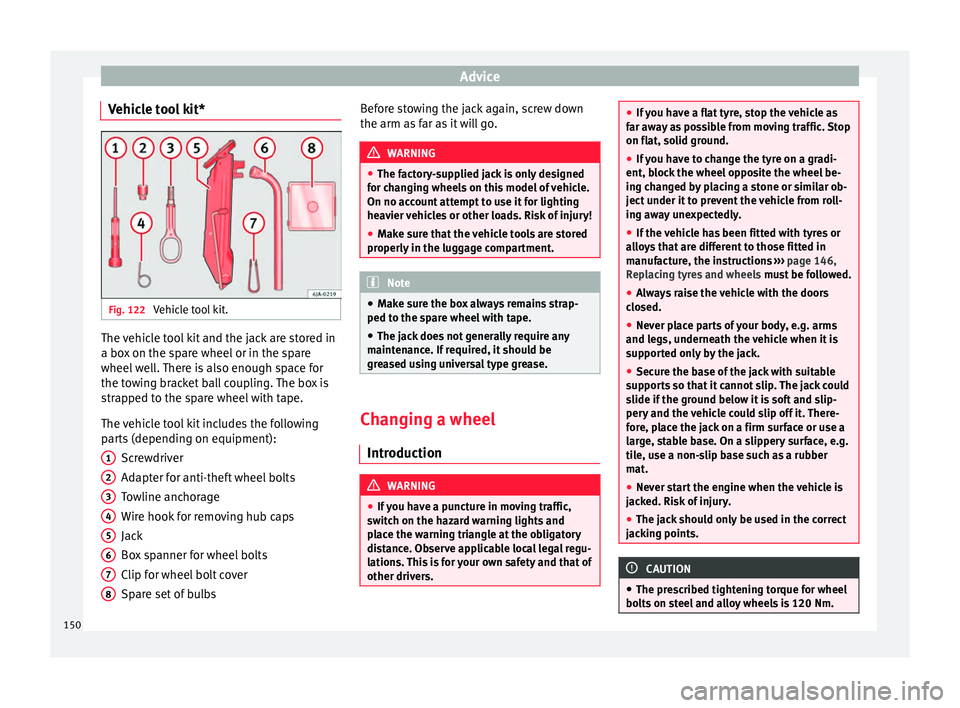
Vehicle tool kit* Fig. 122
Vehicle tool kit. The vehicle tool kit and the jack are stored in
a box on the spare wheel or in the spare
wheel well. There is also enough space for
the towing bracket ball coupling. The box is
strapped to the spare wheel with tape.
The vehicle tool kit includes the following
parts (depending on equipment):
Screwdriver
Adapter for anti-theft wheel bolts
Towline anchorage
Wire hook for removing hub caps
Jack
Box spanner for wheel bolts
Clip for wheel bolt cover
Spare set of bulbs
1 2
3
4
5
6
7
8 Before stowing the jack again, screw down
the arm as far as it will go.
WARNING
● The factory-supplied jack is only designed
for changing wheels on this model of vehicle.
On no account attempt to use it for lighting
heavier vehicles or other loads. Risk of injury!
● Make sure that the vehicle tools are stored
properly in the luggage compartment. Note
● Make sure the box always remains strap-
ped to the spare wheel with tape.
● The jack does not generally require any
maintenance. If required, it should be
greased using universal type grease. Changing a wheel
Introduction WARNING
● If you have a puncture in moving traffic,
switch on the hazard warning lights and
place the warning triangle at the obligatory
distance. Observe applicable local legal regu-
lations. This is for your own safety and that of
other drivers. ●
If you have a flat tyre, stop the vehicle as
far away as possible from moving traffic. Stop
on flat, solid ground.
● If you have to change the tyre on a gradi-
ent, block the wheel opposite the wheel be-
ing changed by placing a stone or similar ob-
ject under it to prevent the vehicle from roll-
ing away unexpectedly.
● If the vehicle has been fitted with tyres or
alloys that are different to those fitted in
manufacture, the instructions ››› page 146,
Replacing tyres and wheels must be followed.
● Always raise the vehicle with the doors
closed.
● Never place parts of your body, e.g. arms
and legs, underneath the vehicle when it is
supported only by the jack.
● Secure the base of the jack with suitable
supports so that it cannot slip. The jack could
slide if the ground below it is soft and slip-
pery and the vehicle could slip off it. There-
fore, place the jack on a firm surface or use a
large, stable base. On a slippery surface, e.g.
tile, use a non-slip base such as a rubber
mat.
● Never start the engine when the vehicle is
jacked. Risk of injury.
● The jack should only be used in the correct
jacking points. CAUTION
● The prescribed tightening torque for wheel
bolts on steel and alloy wheels is 120 Nm. 150
Page 154 of 200
Advice
Wheel bolts The wheel bolts
are m atched to the rims.
When installing different wheels, e.g. to fit
light alloy wheels or wheels with winter tyres,
it is important to use the correct wheel bolts
with the right length and correctly shaped
bolt heads. This is essential for a secure fit of
the wheels and for proper operation of the
brake system.
Changing a wheel If possible, change the wheel on a level sur-
face.
– Pull off the hub cap ›››
page 151 or the
wheel bolt covers ›››
page 151.
– First loosen the anti-theft wheel bolts and
then the other wheel bolts ›››
page 152.
– Raise the vehicle until the wheel to be
changed is no longer touching the ground
››› page 153 .
– Remo
ve the wheel bolts and place them on
a clean surface (cloth, paper, etc.).
– Take off the wheel.
– Lift the spare wheel into position and tight-
en the wheel bolts lightly.
– Lower the vehicle. –
Tighten the wheel bolts firmly in diagonal
sequence with the box spanner and then
the anti-theft wheel bolt ››› page 152.
– Replace the hub cap and/or the bolt cov-
ers. Note
● All bolts must be clean and turn easily.
● Never grease or oil the wheel bolts!
● Note the direction of rotation when putting
on a tyre with a directional tread pattern
››› page 144. After changing a wheel
Tasks that must be carried out after changing
a wheel:
– Place the wheel with the defective tyre in
the spare wheel well and secure it using a
special bolt ›››
page 146 .
– Put
the vehicle tools back in their storage
location.
– Check the tyre pressure of the newly fitted
s
pare wheel as soon as possible.
– Have the tightening torque of the wheel
bo
lts checked as soon as possible with a
torque wrench.
– Have the flat tyre replaced or ask an Official
Service about the possibility of repair. Note
● If you notice that the wheel bolts are rusty
and difficult to turn when changing a wheel,
they must be replaced before having the
tightening torque checked.
● Drive carefully and at moderate speeds un-
til the tightening torque of the wheel bolts
has been checked. Loosening and tightening wheel bolts
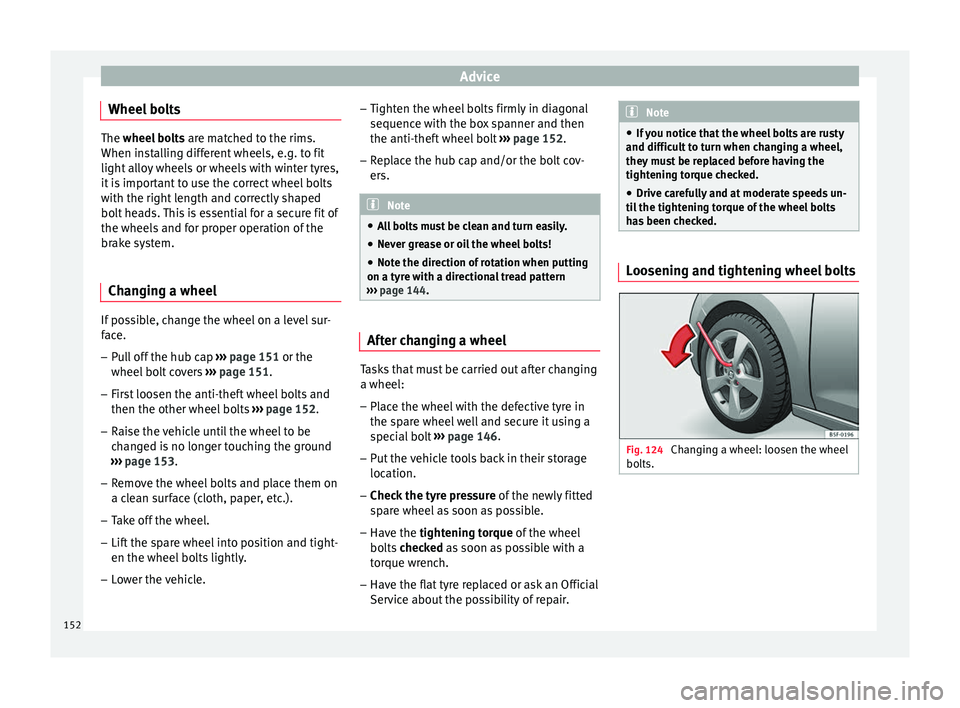
Fig. 124
Changing a wheel: loosen the wheel
bolts. 152
Page 162 of 200
Advice
●
If, due to a fault, there is no oil in the gear-
box, the car may only be towed with the
driven wheels lifted clear of the road and
transported on a special vehicle transporter
or trailer.
● If normal towing is not possible or if the ve-
hicle is to be towed for further than 50 km,
the vehicle must be transported on a special
vehicle transporter or trailer.
● The towrope should be slightly elastic to
reduce the load on both vehicles during tow-
ing. It is advisable to use a towrope made of
synthetic fibre or similar material only.
● Do not pull too hard with the towing vehicle
and always take care to avoid jerking the tow-
rope. When towing on a loose surface there is
always a risk of overloading and damaging
the anchorage points.
● Attach the towrope or towbar only to the
towline anchorages or to the removable tow-
ing bracket ››› page 114, or ››› page 161. Note
● We recommend you use the towrope or tow-
bar available in the SEAT Original Accessories
programme from authorised SEAT dealers.
● Towing a vehicle requires a certain degree
of practical skill. Both drivers should be fa-
miliar with the technique required for towing.
Inexperienced drivers should not attempt to
tow away another vehicle or to have their ve-
hicle towed. ●
Note the legal regulations concerning tow-
ing, particularly those regarding the signal-
ling of the towed and towing vehicle.
● The towrope must not be twisted, as under
certain circumstances this could unscrew the
front towline anchorage. Towline anchorage
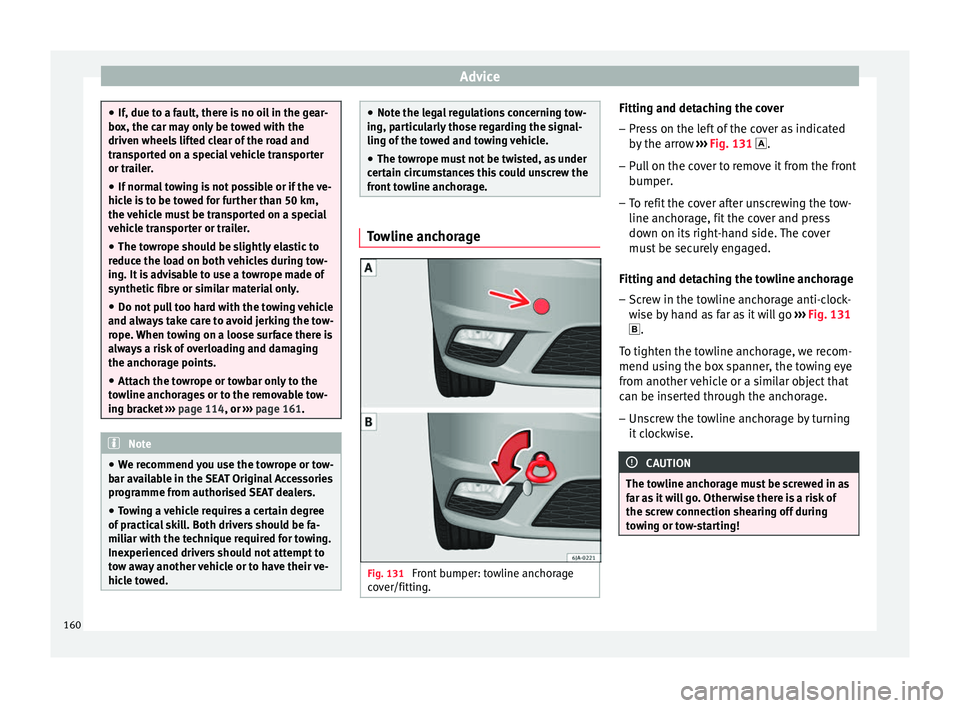
Fig. 131
Front bumper: towline anchorage
cover/fitting. Fitting and detaching the cover
– Press on the left of the cover as indicated
by the arrow ››› Fig. 131 .
– Pull on the cover to remove it from the front
bumper.
– To refit the cover after unscrewing the tow-
line anchorage, fit the cover and press
down on its right-hand side. The cover
must be securely engaged.
Fitting and detaching the towline anchorage
– Screw in the towline anchorage anti-clock-
wise by hand as far as it will go ››› Fig. 131
.
To tighten the towline anchorage, we recom-
mend using the box spanner, the towing eye
from another vehicle or a similar object that
can be inserted through the anchorage.
– Unscrew the towline anchorage by turning
it clockwise. CAUTION
The towline anchorage must be screwed in as
far as it will go. Otherwise there is a risk of
the screw connection shearing off during
towing or tow-starting! 160