battery Seat Toledo 2014 Owner's Guide
[x] Cancel search | Manufacturer: SEAT, Model Year: 2014, Model line: Toledo, Model: Seat Toledo 2014Pages: 200, PDF Size: 4.37 MB
Page 136 of 200

Advice
away from the glass. Otherwise the paint-
work may be damaged.
– Pull the release catch in the direction of the
arrow 2
››› Fig. 108 and the bonnet will be
r el
eased.
– Hold and lift the bonnet.
– Remove the support strut 3
››› Fig. 109
from its fastening in the direction of the ar- row and secure the raised bonnet so that
the end of the strut hooks onto the opening
in the bonnet
4 .
Closing the bonnet – Lift the bonnet slightly and unhook the
support strut keeping the bonnet open and
insert it into its fastening 3 .
–
Let the bonnet drop from a height of
around 20 cm into the catch Do not press
down afterwards!
– Check that the bonnet is correctly closed.
Checking fluid levels Fig. 110
Diagram for the location of the various elements. From time to time, the levels of the different
fluids in the vehicle must be checked. Never
fill with incorrect fluids, otherwise serious
damage to the engine may be caused.
Coolant expansion tank . . . . . . . . . . .138
Window washer water tank . . . . . . . .139
Engine oil filler cap . . . . . . . . . . . . . . .137
1 2
3 Engine oil level dipstick
. . . . . . . . . . .136
Brake fluid reservoir . . . . . . . . . . . . . .139
Battery . . . . . . . . . . . . . . . . . . . . . . . . . . . 140
The checking and replenishment of the serv-
ice fluids are carried out on the components
mentioned above. These operations are de-
scribed in the ››› page 132 .
4 5
6 Overview
You will find further explanations, instruc-
tions and restrictions on the technical speci-
fications as of
››› page 174 . Note
The layout of the engine compartment is very
similar to all petrol and diesel engines. 134
Page 142 of 200
Advice
The capacity
of the reservoir is approximately
3.5 litr
es; in vehicles with a headlight washer
system, it is approximately 5.4 litres 1)
.
Plain water on its own is not enough to clean
the glass and the headlights properly. We
therefore recommend using clean water with
a glass cleaning product to eliminate any
stubborn dirt (with an anti-freeze additive in
winter).
Although
your vehicle has heated windscreen
washer jets, anti-freeze should always be
added to the water in winter.
Ethanol can be used where glass cleaner with
anti-freeze is unavailable. The concentration
of ethanol must be no greater than 15 %.
However, remember that anti-freeze in this
proportion only protects down to -5 °C
(+23 °F). CAUTION
● Never mix the windscreen washing water
with anti-freeze used for the cooling system
or other additives.
● If the vehicle is equipped with a headlight
washer system, only mix a detergent that
does not damage polycarbonates with the
water. Note
When topping up the fluid, do not move the
filter from the container opening, as this
could contaminate the fluid hoses and lead to
a windscreen washer malfunction. Battery
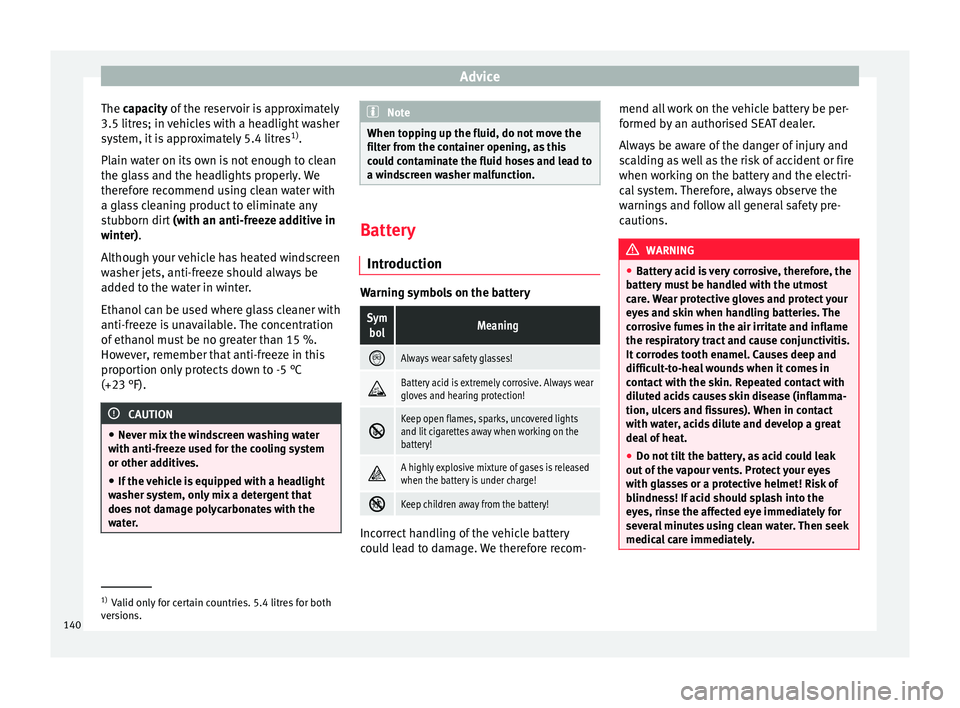
Introduction Warning symbols on the battery
Sym
bolMeaning
Always wear safety glasses!
Battery acid is extremely corrosive. Always wear
gloves and hearing protection!
Keep open flames, sparks, uncovered lights
and lit cigarettes away when working on the
battery!
A highly explosive mixture of gases is released
when the battery is under charge!
Keep children away from the battery!
Incorrect handling of the vehicle battery
could lead to damage. We therefore recom-mend all work on the vehicle battery be per-
formed by an authorised SEAT dealer.
Always be aware of the danger of injury and
scalding as well as the risk of accident or fire
when working on the battery and the electri-
cal system. Therefore, always observe the
warnings and follow all general safety pre-
cautions.
WARNING
● Battery acid is very corrosive, therefore, the
battery must be handled with the utmost
care. Wear protective gloves and protect your
eyes and skin when handling batteries. The
corrosive fumes in the air irritate and inflame
the respiratory tract and cause conjunctivitis.
It corrodes tooth enamel. Causes deep and
difficult-to-heal wounds when it comes in
contact with the skin. Repeated contact with
diluted acids causes skin disease (inflamma-
tion, ulcers and fissures). When in contact
with water, acids dilute and develop a great
deal of heat.
● Do not tilt the battery, as acid could leak
out of the vapour vents. Protect your eyes
with glasses or a protective helmet! Risk of
blindness! If acid should splash into the
eyes, rinse the affected eye immediately for
several minutes using clean water. Then seek
medical care immediately. 1)
Valid only for certain countries. 5.4 litres for both
versions.
140
Page 143 of 200

Checking and refilling levels
●
Neutralize any acid splashes on the skin or
clothing with soap solution as quickly as pos-
sible and rinse off with plenty of water. If acid
is swallowed by mistake, consult a doctor im-
mediately.
● Keep children away from the battery.
● Hydrogen is released and a highly explo-
sive mixture of gases is generated when the
battery is under charge. Sparks when discon-
necting or releasing cable terminals with the
ignition switched on could also cause an ex-
plosion.
● A short circuit is produced if the battery ter-
minals are bridged, e.g. using metal objects,
cables, etc. Possible consequences of a short
circuit: melting of lead plates, battery explo-
sion and fire, splashing acid.
● The following is forbidden while working on
the battery: fire and open flames, smoking
and activities that could produce sparks.
Avoid causing sparks when handling cables
or electrical apparatus. Risk of injury in the
event of large sparks.
● Before working on the electrical system,
you must switch off the engine, the ignition
and all electrical components and disconnect
the cable from the negative terminal (-) of the
battery. To change a bulb, simply switch off
the corresponding light.
● Never charge a frozen or thawed out bat-
tery. Risk of explosion and acid burns! Re-
place a frozen battery.
● Never use the jump leads on batteries in
which the electrolyte level is too low. Risk of
explosion and acid burns! ●
Never use a damaged battery. Risk of ex-
plosion! Replace a damaged battery immedi-
ately. CAUTION
● Never disconnect the battery when the igni-
tion is switched on, as the electrical system
(electronic components) of the vehicle could
be damaged. When disconnecting the battery
from the vehicle electrical system, disconnect
its negative terminal (-) first. Only then may
the positive terminal (+) be disconnected.
● When connecting the battery, first connect
the positive terminal (+) and then the nega-
tive terminal (-). The battery cables must nev-
er be connected to the wrong battery termi-
nals. Risk of burning the electrical installa-
tion!
● Make sure the battery acid does not come
into contact with the bodywork. Risk of paint-
work damage.
● Do not expose the battery to direct sunlight
to protect it from ultraviolet radiation.
● If the vehicle is not used for 3 or 4 weeks,
the battery could run flat. This is because
some components use electricity even in
standby mode (e.g. control units). Prevent the
battery from running flat by disconnecting its
negative terminal or leave it charging at a low
current.
● If you frequently use the vehicle for short
trips, the battery may not fully charge and
could run flat. For the sake of the environment
A flat battery is particularly harmful waste for
the environment. It must therefore be dis-
posed of according to current local law. Note
Replace a battery once it is older than 5
years. Open the battery cover.
Fig. 115
Battery: Opening the cover. The battery is located beneath a plastic cover
in the engine compartment.
–
Open the battery cover in the direction indi-
cated by the arrow ›››
Fig. 115 .
– The po s
itive terminal (+) of the battery is
connected in reverse order.
141
Technical specifications
Advice
Operation
Safety
Page 144 of 200

Advice
Checking battery acid level Fig. 116
Battery: Electrolyte level indicator. We recommend you have the acid level regu-
larly checked at an official technical service,
particularly in the following cases.
● At high outside temperatures.
● On long daily trips.
● Whenever the vehicle is loaded
››› page 142, Charging the battery .
In v
ehicles equipped with a battery with col-
our indicator, the so-called magic eye
››› Fig. 116
changes colour to indicate the
acid level.
Air bubbles can influence the colour of the in-
dicator. Therefore, carefully knock the indica-
tor before checking the acid level.
● Black – the acid level is correct.
● Colourless or light yellow – acid level too
low, battery must be changed. Note
● The battery acid level is also regularly
checked during servicing at authorised SEAT
dealers.
● The electrolyte level on “AGM” batteries
cannot be checked for technical reasons.
● Vehicles equipped with the “Start-Stop”
system include a battery control unit to con-
trol the battery level for repeated engine
starting. Winter service
At low temperatures the battery provides only
a fraction of the starting power it has at nor-
mal temperatures.
A flat battery can also freeze at temperatures
slightly below to 0 °C (32 °F).
We therefore recommend you have the bat-
tery checked and, if necessary, charged at an
official SEAT technical service before the start
of winter.
Charging the battery A fully-charged battery is essential for relia-
ble starting.
– Switch off the ignition and all electrical
equipment. –
For “fast-charging” only: disconnect both
battery connection cables (first the “nega-
tive” terminal and then the “positive”).
– Connect the charger cables to the battery
terminals (red = “positive”, black = “nega-
tive”).
– Plug in the battery charger and switch on.
– After charging the battery: Switch off the
battery charger and disconnect the cable.
– Remove the charger cables.
– If necessary, reconnect both battery cables
to the battery (first the “positive” cable,
then the “negative” cable).
When charging with a low current (e.g. with a
small battery charger ), the battery does not
normally have to be disconnected. The in-
structions of the battery charger manufactur-
er must be followed.
Use a current equivalent to or lower than
10% of the battery capacity to fully charge
the battery.
Before “ fast-charging
” the battery however,
both b
attery cables must be disconnected.
“Fast-charging” a battery is dangerous and
requires a battery charger and special knowl-
edge. Fast charges should be performed by
an official technical service.
The battery caps should not be opened while
the battery is being charged.
142
Page 145 of 200

Checking and refilling levels
CAUTION
In vehicles fitted with the “Start-Stop” sys-
tem, the charger cable cannot be directly con-
nected to the negative terminal of the vehicle
battery but must be attached to the engine
ground point ››› page 158. Disconnecting and connecting the
battery
The following functions will either be inoper-
ative or will not work properly after discon-
necting and reconnecting the battery:FunctionInstallation
Setting the clock›››
page 32
The multifunction display data
is deleted››› page 39 Note
We recommend having the vehicle checked by
an authorised SEAT dealer to guarantee the
correct working order of all electrical sys-
tems. Changing the battery
A replacement battery must have the same
capacity, voltage, current rating and size as
the original. The appropriate types of battery can be acquired from authorised SEAT deal-
ers.
We recommend having the battery changed
by an authorised SEAT dealer, where the new
battery will be correctly installed and the
original disposed of in line with regulations.
Automatic disconnection of electrical
equipment When heavily-charging a battery, the pro-
gramme selected by the electrical system
control unit prevents the battery from auto-
matically discharging. This may result in the
following:
● Increase in idling speed so that the alterna-
tor can supply more current to the electrical
system.
● The performance of certain electrical com-
ponents could be limited or some may switch
off temporarily, e.g. the heated seats, the
heated rear window, the 12 V power socket. Note
Despite any measures taken by the control
unit, the battery could drain. e.g. with the en-
gine is switched off, the key is turned in the
ignition for a long period or the side lights or
parking lights are switched on. The switching
off of certain electrical components does not
impair driving comfort and often the driver
will not even notice. 143
Technical specifications
Advice
Operation
Safety
Page 159 of 200

Emergencies
Check after 10 minutes of driving Check the tyre pressure after 10 minutes of
driving!
If the tyre pressure is less than 1.3 bar
(18.8 psi/130 kPa):
– Do not drive on! The tyr e cannot be suffi-
ciently filled using the tyre repair kit.
– See professional assistance.
If the tyre pressure is greater than 1.3 bar
(18.8 psi/130 kPa): – Correct the tyre pressure again to the cor-
rect value (see inside of the fuel tank flap).
– Carefully drive to the nearest specialised
workshop at a maximum speed of 80 km/h
(50 mph).
Jump-starting Introduction If the engine fails to start because of a dis-
charged battery, the battery can be connec-
ted to the battery of another vehicle to start
the engine. Suitable jump leads are required.
Both batteries need to have nominal voltage
of 12 V. The
capacity (Ah) of the back-up bat- t
er
y should not be notably less than the
drained battery.
Jump leads
The jump leads must be heavy enough to car-
ry the starter current and must be fitted with
insulated battery clamps. Refer to the instruc-
tions given by the manufacturer.
Positive cable – usually red
Neg
ative cable
– usually black WARNING
● A flat battery can also freeze at tempera-
tures slightly below to 0 °C (32 °F). Do not at-
tempt to start the vehicle with a frozen bat-
tery. Risk of explosion!
● Please note the safety warnings referring to
working in the engine compartment
››› page 132.
● The non-in s
ulated parts of the battery
clamps must not be allowed to touch. Addi-
tionally, the jump lead attached to the posi-
tive battery terminal must not touch metal
parts of the vehicle. Risk of short circuit!
● Do not connect the negative lead to the
negative terminal of the discharged battery.
In the event of sparks when starting the en-
gine, the explosive gas given off by the bat-
tery could catch fire.
● Position the jump leads in such a way that
they cannot come into contact with any mov-
ing parts in the engine compartment. ●
Do not bend over the battery. Risk of acid
burns!
● The screw plugs on the battery cells must
be screwed in firmly.
● Keep sources of fire (flames, lit cigarettes,
etc.) away from the battery. - Risk of explo-
sion!
● Never use the jump leads on batteries in
which the electrolyte level is too low. Risk of
explosion and acid burns. Note
● The vehicles must not touch each other, as
electricity could flow as soon as the positive
terminals are connected.
● The discharged battery must be properly
connected to the vehicle electrical system.
● The jump leads should be checked in a spe-
cialist vehicle battery shop. 157
Technical specifications
Advice
Operation
Safety
Page 160 of 200

Advice
How to jump start: description Fig. 129
Diagram of connections for vehicles
without Start Stop system Fig. 130
Diagram of connections for vehicles
with Start Stop system Jump lead terminal connections
1. Switch off the ignition of both vehicles
››› . 2. Connect one end of the
red jump lead to
the po s
itive + terminal of the vehicle
with the flat battery A
››› Fig. 129 .
3. C
onnect the other end of the red
jump
lead to the positive terminal + in the ve-
hicle providing assistance B .
4. For vehicles without Start-Stop system:
connect one end of the black jump lead to
the negative terminal – of the vehicle
providing the current B
››› Fig. 129 .
– For
vehicles with Start-Stop system: con-
nect one end of the black jump lead X to a
suitable ground terminal, to a solid piece of
metal in the engine block, or to the engine
block itself ››› Fig. 130 .
5. C
onnect the other end of the black jump
lead X to a solid metal component bolted
to the engine block or to the engine block
itself of the vehicle with the flat battery.
Do not connect it to a point near the bat-
tery A .
6. Position the leads in such a way that they cannot come into contact with any moving
parts in the engine compartment.
Starting
7. Start the engine of the vehicle with the boosting battery and let it run at idling
speed. 8. Start the engine of the vehicle with the flat
battery and wait 2 or 3 minutes until the
engine is “running”.
Removing the jump leads
9. Before you remove the jump leads, switch off the dipped beam headlights (if they
are switched on).
10.Turn on the heater blower and heated rear window in the vehicle with the flat battery.
This helps minimise voltage peaks which
are generated when the leads are discon-
nected.
11. When the engine is running, disconnect
the l e
ads in reverse order to the details
given above.
Connect the battery clamps so they have
good metal-to-metal contact with the battery
terminals.
If the engine fails to start, switch off the start-
er after about 10 seconds and try again after
about 1 minute. WARNING
● Please note the safety warnings referring to
working in the engine compartment
››› page 132.
● The b att
ery providing assistance must have
the same voltage as the flat battery (12V) and
approximately the same capacity (see imprint 158
Page 161 of 200

Emergencies
on battery). Failure to comply could result in
an explosion.
●
Never use jump leads when one of the bat-
teries is frozen. Danger of explosion! Even af-
ter the battery has thawed, battery acid could
leak and cause chemical burns. If a battery
freezes, it should be replaced.
● Keep sparks, flames and lighted cigarettes
away from batteries, danger of explosion.
Failure to comply could result in an explo-
sion.
● Observe the instructions provided by the
manufacturer of the jump leads.
● Do not connect the negative cable from the
other vehicle directly to the negative terminal
of the flat battery. The gas emitted from the
battery could be ignited by sparks. Danger of
explosion.
● Do not attach the negative cable from the
other vehicle to parts of the fuel system or to
the brake line.
● The non-insulated parts of the battery
clamps must not be allowed to touch. The
jump lead attached to the positive battery
terminal must not touch metal parts of the ve-
hicle, this can cause a short circuit.
● Position the leads in such a way that they
cannot come into contact with any moving
parts in the engine compartment.
● Do not lean on the batteries. This could re-
sult in chemical burns. Note
The vehicles must not touch each other, oth-
erwise electricity could flow as soon as the
positive terminals are connected. Towing the vehicle
Introduction Vehicles with manual gearbox can be towed
using a towbar or towrope. They can also be
towed with either the front or rear wheels lif-
ted off the road.
Vehicles with automatic gearbox can be tow-
ed using a towbar or towrope. They can also
be towed with the front wheels lifted off the
road. If the vehicle is towed with the rear
wheels lifted off the road the automatic gear-
box will be damaged!
It is safer to tow a vehicle with a
towbar. A
towrope should only be used if you do not
h av
e a towbar.
Follow the instructions below when towing a
vehicle:
Notes for the driver of the towing vehicle
– Engage the clutch very gently when starting
to move or on vehicles with automatic gear-
box press the accelerator carefully. –
On vehicles with a manual gearbox, the
towrope must be taut before driving off.
Maximum towing speed is 50 km/h (31
mph).
Note
s for the driver of the towed vehicle
– The ignition should be switched on so that
the steering wheel lock is not engaged and
the turn signals, horn and windscreen wip-
ers and washers can be used.
– Put the gear lever in neutral or move the se-
lector lever to position N (automatic gear-
bo
x).
The brake servo and power steering only
work when the engine is running. Considera-
bly more effort is required on the brake pedal
and steering wheel when the engine is
switched off.
Ensure the towrope remains taut at all times
when towing. CAUTION
● Do not tow-start the engine. Risk of engine
damage! In vehicles with a catalytic convert-
er, fuel that has not been burned could reach
the catalytic converter and catch fire in it.
This could damage and destroy the catalytic
converter. You may use the battery from an-
other vehicle to help you start your engine
››› page 158.
» 159
Technical specifications
Advice
Operation
Safety
Page 167 of 200

Fuses and bulbs
Changing fuses in the engine
compartment Fig. 140
Battery: fuse cover (version 1). Fig. 141
Battery: fuse cover (version 2). ●
Press the flexible tabs on the fuse box cov-
er in the direction indicated by the arrows 1 ›››
Fig. 140 .
● Remo
ve the cover by sliding it in the direc-
tion indicated by arrow 2 .
● Use a flat-headed screwdriver to unlock the
holes 3 .
● Open the cover in the direction indicated
by the arrow 4 .Replacing a blown fuse
Fig. 142
Image of a blown fuse Preparation
● Switch off the ignition, lights and all elec-
trical equipment.
● Open the corresponding fuse box
››› page 164 .
Identif y
ing a blown fuse
A fuse is blown if its metal strip is ruptured
››› Fig. 142.
Point a lamp at the fuse. This will make it
easier to see if the fuse is blown.
To replace a fuse ● Remove the fuse.
● Replace the blown fuse by one with an
identical amperage rating (same colour and
mark
ings) and identical size ››› .
»
165
Technical specifications
Advice
Operation
Safety
Page 189 of 200

Index
Index
A
ABS . . . . . . . . . . . . . . . . . . . . . . . . . . . . . . . . . . . . 109 control lamp . . . . . . . . . . . . . . . . . . . . . . . . . . . . 36
Accessories . . . . . . . . . . . . . . . . . . . . . . . . . . . . . . 122
Adjusting the seat belt height . . . . . . . . . . . . . . . . 15
Adjustment seats . . . . . . . . . . . . . . . . . . . . . . . . . . . . . . . . . . 72
steering wheel . . . . . . . . . . . . . . . . . . . . . . . . . . . 7
Aerial . . . . . . . . . . . . . . . . . . . . . . . . . . . . . . . . . . . 124 see radio reception . . . . . . . . . . . . . . . . . . . . . . 126
Airbag . . . . . . . . . . . . . . . . . . . . . . . . . . . . . . . . . . . 16
Airbag covers . . . . . . . . . . . . . . . . . . . . . . . . . . . . . 19
Airbags description . . . . . . . . . . . . . . . . . . . . . . . . . . . . . 17
Airbag system . . . . . . . . . . . . . . . . . . . . . . . . . . . . . 16 activation . . . . . . . . . . . . . . . . . . . . . . . . . . . . . . 18
control lamp . . . . . . . . . . . . . . . . . . . . . . . . . . . . 18
front airbags . . . . . . . . . . . . . . . . . . . . . . . . . . . . 19
functioning . . . . . . . . . . . . . . . . . . . . . . . . . . . . . 18
Head-protection airbags . . . . . . . . . . . . . . . . . . 21
side airbags . . . . . . . . . . . . . . . . . . . . . . . . . . . . 20
air conditioning air conditioning . . . . . . . . . . . . . . . . . . . . . . . . . 88
Air conditioning air conditioning . . . . . . . . . . . . . . . . . . . . . . 90, 92
Climatronic . . . . . . . . . . . . . . . . . . . . . . . . . . . . . 93
Air recirculation manual air conditioning . . . . . . . . . . . . . . . . . . . 92
Alarm . . . . . . . . . . . . . . . . . . . . . . . . . . . . . . . . . . . . 57
Anti-lock system . . . . . . . . . . . . . . . . . . . . . . . . . . 109
Anti-theft alarm system . . . . . . . . . . . . . . . . . . . . . 57
Armrest . . . . . . . . . . . . . . . . . . . . . . . . . . . . . . . . . . 74 rear . . . . . . . . . . . . . . . . . . . . . . . . . . . . . . . . . . . 74
Ashtrays . . . . . . . . . . . . . . . . . . . . . . . . . . . . . . . . . 78 Aspects to take into account before starting the
vehicle . . . . . . . . . . . . . . . . . . . . . . . . . . . . . . . . . . 5
ASR . . . . . . . . . . . . . . . . . . . . . . . . . . . . . . . . . . . . 109 Assistance systems . . . . . . . . . . . . . . . . . . . . . . 35
control lamp . . . . . . . . . . . . . . . . . . . . . . . . . . . . 35
Assistance system ABS . . . . . . . . . . . . . . . . . . . . . . . . . . . . . . . . . . 109
ASR . . . . . . . . . . . . . . . . . . . . . . . . . . . . . . . . . . 109
Start-Stop . . . . . . . . . . . . . . . . . . . . . . . . . . . . . 112
Assistance systems ABS . . . . . . . . . . . . . . . . . . . . . . . . . . . . . . . . . . . 36
cruise control . . . . . . . . . . . . . . . . . . . . . . . . . . 111
EDL . . . . . . . . . . . . . . . . . . . . . . . . . . . . . . . . . . 110
ESC . . . . . . . . . . . . . . . . . . . . . . . . . . . . . . 35, 108
parking aid . . . . . . . . . . . . . . . . . . . . . . . . . . . . 110
Audible signal . . . . . . . . . . . . . . . . . . . . . . . . . . . . 11
Auto-check system . . . . . . . . . . . . . . . . . . . . . . . . . 44
Automatic disconnection of electrical equip- ment . . . . . . . . . . . . . . . . . . . . . . . . . . . . . . . . . 143
Automatic gearbox . . . . . . . . . . . . . . . . . . . . . . . . 100 back-up programme . . . . . . . . . . . . . . . . . . . . . 104
Driving programmes . . . . . . . . . . . . . . . . . . . . . 103
instructions for use . . . . . . . . . . . . . . . . . . . . . 100
kick-down . . . . . . . . . . . . . . . . . . . . . . . . . . . . . 101
manual release of the selector lever . . . . . . . . 162
parking . . . . . . . . . . . . . . . . . . . . . . . . . . . . . . . 101
Selector lever lock . . . . . . . . . . . . . . . . . . . . . . 103
selector lever positions . . . . . . . . . . . . . . . . . . 101
starting . . . . . . . . . . . . . . . . . . . . . . . . . . . . . . . 101
stopping . . . . . . . . . . . . . . . . . . . . . . . . . . . . . . 101
Tiptronic . . . . . . . . . . . . . . . . . . . . . . . . . . . . . . 102
Automatic headlight control . . . . . . . . . . . . . . . . . 63
AUX-IN . . . . . . . . . . . . . . . . . . . . . . . . . . . . . . . . . . . 51
B Back-up automatic gearbox . . . . . . . . . . . . . . . . . . . . . . 104 Battery
automatic disconnection of electrical equip-ment . . . . . . . . . . . . . . . . . . . . . . . . . . . . . . . 143
changing . . . . . . . . . . . . . . . . . . . . . . . . . . . . . . 143
charging . . . . . . . . . . . . . . . . . . . . . . . . . . . . . . 142
checking acid level . . . . . . . . . . . . . . . . . . . . . . 142
replacing the battery . . . . . . . . . . . . . . . . . . . . . 53
safety instructions . . . . . . . . . . . . . . . . . . . . . . 140
winter service . . . . . . . . . . . . . . . . . . . . . . . . . . 142
Before starting the vehicle . . . . . . . . . . . . . . . . . . . 5
Belt tightening . . . . . . . . . . . . . . . . . . . . . . . . . . . . 15
Bonnet closing . . . . . . . . . . . . . . . . . . . . . . . . . . . . . . . . 133
opening . . . . . . . . . . . . . . . . . . . . . . . . . . . . . . . 133
Boot hook . . . . . . . . . . . . . . . . . . . . . . . . . . . . . . . . . . 84
retaining elements . . . . . . . . . . . . . . . . . . . . . . . 83
retaining nets . . . . . . . . . . . . . . . . . . . . . . . . . . . 84
see boot hatch . . . . . . . . . . . . . . . . . . . . . . . . . . 59
Boot hatch . . . . . . . . . . . . . . . . . . . . . . . . . . . . . . . 59 automatic lock . . . . . . . . . . . . . . . . . . . . . . . . . . 58
Boot lid . . . . . . . . . . . . . . . . . . . . . . . . . . . . . . . . . . 59 automatic lock . . . . . . . . . . . . . . . . . . . . . . . . . . 58
Brake assist . . . . . . . . . . . . . . . . . . . . . . . . . . . . . 108
Brake fluid checking . . . . . . . . . . . . . . . . . . . . . . . . . . . . . . 139
Brakes brake fluid . . . . . . . . . . . . . . . . . . . . . . . . . . . . . 139
handbrake . . . . . . . . . . . . . . . . . . . . . . . . . . . . . . 99
running in . . . . . . . . . . . . . . . . . . . . . . . . . . . . . 104
warning lamps . . . . . . . . . . . . . . . . . . . . . . . . . . 33
Brake servo . . . . . . . . . . . . . . . . . . . . . . . . . . . . . . . 99
Button on driver's door electric window opening and closing . . . . . . . . 60
187