wheel Seat Toledo 2014 Service Manual
[x] Cancel search | Manufacturer: SEAT, Model Year: 2014, Model line: Toledo, Model: Seat Toledo 2014Pages: 200, PDF Size: 4.37 MB
Page 128 of 200

Advice
●
Make sure you do not damage the paint-
work on the vehicle on removing snow and
ice from the windows and rear vision mirrors.
● Do not remove the snow or ice dirty with
thick particles, e.g. gravel, sand or road salt,
from windows and mirrors. Risk of damage to
the glass and mirror surfaces. Radio reception and aerial
In vehicles factory-fitted with an audio or
navigation system, the aerial may be instal-
led in different places:
● inside the rear window next to the heating
elements,
● on the roof of the vehicle.
Headlights Use soap and clean, hot water to clean the
front headlights.
CAUTION
● Never rub the headlights to dry them and
do not use sharp objects to clean the plastic
glass material. These could damage the pro-
tective paint and cause the headlights to
crack. ●
Do not use aggressive cleaning products or
chemical solvents to clean the glass. This
could damage the headlights. Care of rubber seals
The weatherstrips on doors and windows will
remain pliable and last longer if they are oc-
casionally treated with a suitable rubber care
product. This will prevent premature ageing
and leaks. If they are properly cared for, the
seals will be less likely to freeze up in the
winter.
Door lock cylinder Special products must be used to defrost
lock cylinders.
Note
● Make sure, when washing the vehicle, that
the least amount of water possible enters the
lock cylinders.
● We recommend the use of products from
the selection of SEAT Original Accessories to
care for the door lock cylinder. Wheels
Wheel trims
If you wash the vehicle regularly, you should
also thoroughly wash the wheel trim. Regu-
larly remove any brake dust and road salt
from the wheels, otherwise the wheel materi-
al could be damaged. Repair any damage to
the wheel paintwork immediately.
Alloy wheels
After thorough washing, treat the wheels
with a protective product for alloy wheels. Do
not use abrasive products to care for the
wheels.
WARNING
Moisture, ice and road salt may affect braking
efficiency. Risk of accident! CAUTION
Heavy dirt on the wheels could lead to their
misalignment. This could result in vibrations
being transmitted to the steering wheel that
under certain conditions may cause prema-
ture steering wear. This dirt must be re-
moved. Note
We recommend you leave paint damage re-
pairs to a SEAT Authorised Service. 126
Page 130 of 200
Advice
Removing stains
Remove fresh water-based
stains such as cof-
f
ee, tea, juices, blood, etc. with an absorbent
cloth or kitchen roll. Use the special deter-
gent to clean dried-on stains.
Remove fresh
fat-based stains such as but-
ter
, mayonnaise, chocolate, etc. with an ab-
sorbent cloth or paper towel or use the spe-
cial detergent if the stain has not yet soaked
through the surface.
Use a grease-dissolving product to treat
dried-in, fat-based stains.
Treat less common stains such as ball-pen
and other inks, felt-tip pens, nail polish,
emulsion paint, shoe cream etc. with a spe-
cial leather stain remover.
Leather care
The leather should be treated regularly
(about twice a year) with a leather-care prod-
uct.
Apply the protective product very sparingly.
Dry the leather with a soft, dry cloth. CAUTION
● Avoid exposing leather to direct sunlight
for long periods so that it does not lose its
colour. If the car is left for a prolonged period
outdoors, cover the leather so that it does
not lose its colour. ●
Sharp-edged objects on clothing, such as
zips, rivets or belts can leave permanent
scratches and rough marks on the surface of
the leather.
● Use of a mechanical steering wheel lock
can damage the leather surface of the steer-
ing wheel. Note
● Use a suitable impregnating cream with ul-
tra-violet protection at regular intervals and
after cleaning. The cream will nourish and
moisturise the leather, keep it supple and
able to breathe. In addition, it will also help
to protect the surface of the leather.
● Clean the leather every 2 to 3 months and
remove fresh dirt as necessary.
● Preserve the colour of the leather. A special
coloured cream for leather will renew the col-
our of more heavily worn areas as required.
● Leather is a natural material with specific
properties. During vehicle use, the appear-
ance of parts of the leather covers may
change; folds or wrinkles may appear as a re-
sult of their use. Seat belts
Keep the seat belts clean!
Wash soiled seat belts with mild, soapy wa-
ter, removing any heavier dirt with a soft
brush.Check the condition of all seat belts at regu-
lar intervals.
Very soiled belts may not retract properly.
WARNING
● The seat belts should never be removed
from the vehicle for cleaning.
● Never clean using chemical products, as
chemical detergents destroy the fabric. En-
sure that the seat belts do not come into con-
tact with corrosive fluids such as acids, etc.
● If you find any damage to the belt webbing,
belt fittings, the belt retractor or the buckle,
the belt in question must be replaced by an
Official Service.
● Make sure that the inertia reel seat belts
are completely dry before allowing them to
retract. 128
Page 146 of 200

Advice
Wheels and tyres
Wheels Introduction WARNING
● During the first 500 km, new tyres do not
give maximum grip, therefore you should
drive carefully. Risk of accident!
● Never drive with damaged tyres. Risk of ac-
cident!
● Only use wheels and tyres that been au-
thorised by SEAT or your vehicle model. Fail-
ure to do so could impair road safety. Risk of
accident!
● Never exceed the maximum speed permit-
ted for your tyres. Risk of accident due to tyre
damage and loss of vehicle control!
● Under-inflated tyres are submitted to great-
er rolling resistance. This means that they
can overheat at high speeds. This can cause
tread separation and even tyre blow-out.
● For driving safety, tyres should be replaced
at least in pairs according to the axle and not
individually. The tyres with the deepest tread
should always be used on the front wheels.
● Never fit used tyres of an unknown age or
prior use.
● Tyres must be immediately changed at the
very latest when they have worn down to the
tread wear indicators. ●
Worn tyres reduce the necessary grip at
high speeds on damp surfaces. This could
lead to “aquaplaning” (uncontrolled vehicle
movement – “skidding” on damp surfaces).
● Damaged wheels and tyres must be re-
placed immediately.
● Do not use summer or winter tyres that are
more than 6 or 4 years old respectively.
● Wheel bolts should be clean and screw
easily. However, they must never be treated
with grease or oil.
● If the tightening torque of the wheel bolts
is too low, they could loosen while the vehi-
cle is moving. Risk of accident! If the tighten-
ing torque of the wheel bolts is too high, the
bolts and threads could be damaged, leading
to the permanent deforming of the rim sup-
port surfaces.
● Incorrectly handled wheel bolts could lead
to a wheel coming loose while the vehicle is
moving. Risk of accident!
● Observe the national legal requirements re-
garding the use of snow tyres and chains. CAUTION
● Where a spare wheel that is not compatible
with the wheels fitted is used, follow the in-
structions ››› page 146.
● The pr e
scribed tightening torque for wheel
bolts on steel and alloy wheels is 120 Nm.
● Protect your tyres from coming into contact
with oil, grease and fuel.
● Replace any lost valve caps immediately. For the sake of the environment
Under-inflated tyres increases fuel consump-
tion. Note
● We recommend having all work on tyres
and wheels carried out by an authorised SEAT
dealer.
● We recommend using wheels, tyres, hub
caps and snow chains from the SEAT Original
Accessories programme. Life cycle of tyres
Fig. 117
Side view of tyres with tread wear in-
dicators. Tread wear indicator
The base of the side of the original tyres on
your vehicle show 1.6 mm high tread wear in-
dicators
››› Fig. 117 . The position of these
144
Page 147 of 200

Wheels and tyres
indicators is given on the tyre sidewalls by
the letters “TWI”, triangular symbols or other
symbols.
The useful life of the tyres depends primarily
on the following factors:
Tyre pressure values
Under-inflation or over-inflation will consider-
ably reduce the useful life of the tyres and
impair the vehicle's handling. Therefore,
check the tyre pressure, including the spare
wheel, at least once a month and before any
long journey.
Inflation pressures for summer tyres are lis-
ted on a sticker inside the fuel tank flap. The
pressures for winter tyres are 0.2 bar (2.9
psi/20 kPa) above the summer values.
Always check the pressure when the tyre is
cold. Do not reduce over-pressure in warm
tyres. The tyre pressures must be altered to
suit notable changes in the load being car-
ried.
Driving style
Fast cornering, heavy acceleration and hard
braking all increase tyre wear.
Wheel balancing
The wheels on new vehicles are balanced.
Various factors encountered when driving
can cause them to become unbalanced, which results in vibration of the steering
wheel.
The wheel must be rebalanced if a new tyre is
fitted or if a tyre is repaired.
Incorrect wheel alignment
Incorrect front or rear wheel alignment cau-
ses excessive tyre wear, frequently on one
side, and also impairs vehicle safety. If tyre
wear is very irregular, contact an Official
Service.
Tyre damage
To avoid damage to tyres and wheels, only
drive over kerbs or similar obstacles slowly
and at a right angle if possible.
Check tyres and wheels regularly for damage
(punctures, cracks, blisters, deformities,
etc.). Remove any foreign objects embedded
in outside of the treads.
Unusual vibration or the car pulling to one
side may indicate that one of the tyres is
damaged.
Reduce speed immediately and
s t
op if you suspect that damage may have
occurred! Check the tyres for damage (blis-
ter
s, cracks, etc.). If no external damage is
visible, drive slowly and carefully to the near-
est Official Service and have the vehicle in-
spected. Interchanging tyres
Fig. 118
Interchanging tyres. Changing wheels around
If the wear is visibly greater on the front tyres,
they should be exchanged for the rear tyres
as shown in the diagram
››› Fig. 118 . All the
ty r
es will then last for about the same time.
To ensure that the wear is equal on all tyres
and maintain their optimum useful life, they
should be changed around every 10 000 km.
Storing tyres
When you remove the tyres, mark them in or-
der to maintain the same direction of rotation
when they are installed again.
When removed, the wheels and/or tyres
should be stored in a cool, dry and preferably
dark location. Store tyres in a vertical posi-
tion, if they are not fitted on wheel rims.
145
Technical specifications
Advice
Operation
Safety
Page 148 of 200

Advice
Replacing tyres and wheels All four wheels must be fitted only with tyres
of the same type, size and the same tread
pattern.
The correct tyre/wheel combinations speci-
fied for your vehicle are listed in its docu-
mentation.
Note for Italy: A SEAT Service Centre should
be c
on
sulted whether different sized wheels
or tyres to those originally fitted by SEAT may
be fitted, as well as the combinations al-
lowed between the front axle (axle 1) and
back axle (axle 2).
Understanding the tyre designations makes
it easier to choose the correct tyres. The tyre
designation is marked on the sidewall. For
example.
195/55 R 15 85 H
This contains the following information:
195Tyre width in mm
55Height/width ratio in %
Ridentifying tyre construction letter –
Radial
15Rim diameter in inches
85Load rating code
HSpeed rating code letter The tyres are subject to the following
maxi-
mum speed limits :
Speed rating code
letterMaximum speed limit
Q160 km/h (99 mph)
R170 km/h (106 mph)
S180 km/h (112 mph)
T190 km/h (118 mph)
U200 km/h (124 mph)
H210 km/h (130 mph)
V240 km/h (149 mph)
W270 km/h (168 mph) The
manufacturing date
is also indicated on
the ty
re sidewall (possibly only on the inner
side of the wheel).
DOT … 27 12…
means, for example, that the tyre was pro-
duced in the 27th week of 2012.
Follow the instructions ››› page 146 if you
only have a temporary spare wheel.
Tyres with directional tread pattern The direction of rotation is indicated by the
arrows on the tyre sidewall
. The direction ofrotation indicated must be respected. This
guarantees optimum grip and helps avoid ex-
cessive noise, wear and aquaplaning.
In the event of a flat tyre, a spare wheel with
an undetermined tread pattern or an oppo-
site tread pattern must be used and you must
drive carefully, as in these cases the tyres no
longer offer maximum performance.
Spare wheel Spare wheel location* Fig. 119
Luggage compartment: spare wheel. The spare wheel is housed in a well under
the floor panel in the luggage compartment
and is secured by a special bolt
››› Fig. 119 .
T ak
e out the tool box before removing the
spare wheel.
146
Page 149 of 200

Wheels and tyres
The tyre pressure of the spare wheel must be
checked (preferably whenever the tyre pres-
sure is checked – see sticker on fuel tank flap
››› page 144 ) to ensure the spare wheel re-
m ain
s ready for use.
If the spare wheel is not the same size or de-
sign as the tyres that are mounted on the car
(for example if the car has winter tyres or
tyres with direction tread), only use the spare
tyre for a short period of time in the event of
breakdown and drive with the corresponding
care ››› .
It must be replaced as soon as possible for a
wheel with a normal size and finish.
Temporary spare wheel
If the vehicle is equipped with a temporary
spare wheel, there will be a warning sign on
the rim of the wheel.
Follow the instructions below when driving
with this wheel fitted.
● After fitting the wheel, the warning sign
must not be covered.
● Do not drive faster than 80 km/h (50 mph)
with the spare wheel and take great care
while driving. Avoid heavy acceleration, hard
braking and fast cornering.
● The tyre pressure is the same as that of the
standard tyres. ●
Only use this spare wheel to reach the
nearest Official Service, as it is not designed
for permanent use. WARNING
● Under no circumstances must damaged
spare wheels be used.
● If the spare wheel is different in size or de-
sign to the tyres currently fitted, never drive
faster than 80 km/h (50 mph). Avoid heavy
acceleration, hard braking and fast cornering. CAUTION
Follow the instructions given on the tempora-
ry spare wheel label. Note
The tyre pressure of the spare wheel must al-
ways correspond to the highest pressure pre-
scribed for the model of vehicle in question. Tyre control systems
Tyre pressure* Fig. 120
Tyre pressure adjustment switch. The tyre pressure monitoring system uses
ABS sensors to compare the revolutions and
the circumference of each wheel. Should the
circumference of any wheel change, the
warning lamp on the general dash panel
››› page 38 will light up and an audible warn-
in g w
ill be heard.
Tyre circumference may change if:
● Tyre pressure is too low
● Tyre structure is damaged
● Vehicle load not evenly distributed
● wheels on one axle are subjected to greater
load, (e.g. driving with trailer, uphill, down-
hill);
● Snow chains are fitted »
147
Technical specifications
Advice
Operation
Safety
Page 150 of 200
Advice
● The temporary spare wheel is fitted
● One wheel on the axle has been changed
Basic system settings
Should the tyre pressure change or if one or
more wheels are changed or the position of
the wheel on the vehicle is changed, e.g.
changing round the front and rear wheels, or
where a warning lamp lights up when driv-
ing, the system must be adjusted as follows:
● Inflate all tyres to the prescribed pressures
››› page 144 .
● Sw it
ch the ignition on.
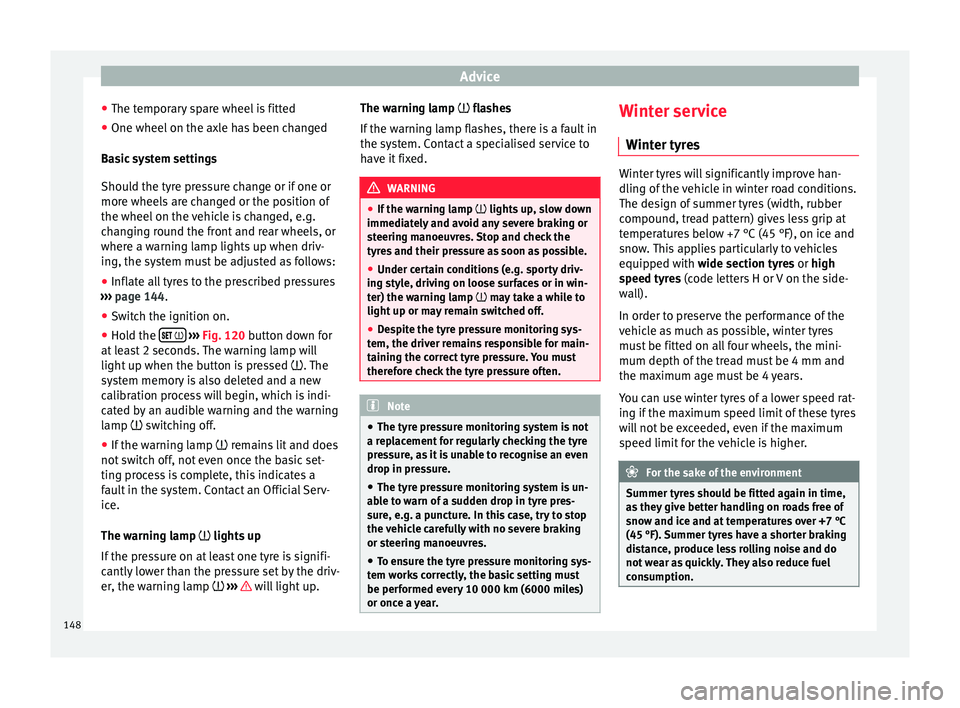
● Hold the
››› Fig. 120 button down for
at least 2 seconds. The warning lamp will
light up when the button is pressed . The
system memory is also deleted and a new
calibration process will begin, which is indi-
cated by an audible warning and the warning
lamp switching off.
● If the warning lamp remains lit and does
not switch off, not even once the basic set-
ting process is complete, this indicates a
fault in the system. Contact an Official Serv-
ice.
The warning lamp lights up
If the pressure on at least one tyre is signifi-
cantly lower than the pressure set by the driv-
er, the warning lamp ››› will light up.The warning lamp flashes
If the warning lamp flashes, there is a fault in
the system. Contact a specialised service to
have it fixed.
WARNING
● If the warning lamp lights up, slow down
immediately and avoid any severe braking or
steering manoeuvres. Stop and check the
tyres and their pressure as soon as possible.
● Under certain conditions (e.g. sporty driv-
ing style, driving on loose surfaces or in win-
ter) the warning lamp may take a while to
light up or m
ay remain switched off.
● Despite the tyre pressure monitoring sys-
tem, the driver remains responsible for main-
taining the correct tyre pressure. You must
therefore check the tyre pressure often. Note
● The tyre pressure monitoring system is not
a replacement for regularly checking the tyre
pressure, as it is unable to recognise an even
drop in pressure.
● The tyre pressure monitoring system is un-
able to warn of a sudden drop in tyre pres-
sure, e.g. a puncture. In this case, try to stop
the vehicle carefully with no severe braking
or steering manoeuvres.
● To ensure the tyre pressure monitoring sys-
tem works correctly, the basic setting must
be performed every 10 000 km (6000 miles)
or once a year. Winter service
Winter tyres Winter tyres will significantly improve han-
dling of the vehicle in winter road conditions.
The design of summer tyres (width, rubber
compound, tread pattern) gives less grip at
temperatures below +7 °C (45 °F), on ice and
snow. This applies particularly to vehicles
equipped with wide section tyres or high
s
peed ty
res (code letters H or V on the side-
wall).
In order to preserve the performance of the
vehicle as much as possible, winter tyres
must be fitted on all four wheels, the mini-
mum depth of the tread must be 4 mm and
the maximum age must be 4 years.
You can use winter tyres of a lower speed rat-
ing if the maximum speed limit of these tyres
will not be exceeded, even if the maximum
speed limit for the vehicle is higher. For the sake of the environment
Summer tyres should be fitted again in time,
as they give better handling on roads free of
snow and ice and at temperatures over +7 °C
(45 °F). Summer tyres have a shorter braking
distance, produce less rolling noise and do
not wear as quickly. They also reduce fuel
consumption. 148
Page 151 of 200

Emergencies
Snow chains Snow chains must only be used on the front
wheels.
In winter road conditions, snow chains not
only help to improve grip but also improve
the braking capacity.
For technical reasons snow chains may only
be used on tyres with the following wheel
rim/tyre combinations.Rim sizeRim offsetTyre size
5J x 14
a)35 mm175/70
6J x 15b)38 mm185/60
6J x 15b)38 mm195/55
a)
Only use snow chains with fine-pitch links and lock no greater
than 9 mm.
b) Only use snow chains with fine-pitch links and lock no greater
than 13 mm.
Remove the wheel trims before fitting snow
chains. CAUTION
Chains must be removed when roads are free
of snow. Otherwise they will impair handling,
damage the tyres and wear out very quickly. Emergencies
Emergency equipment First-aid kit and warning triangle* Fig. 121
Location of the warning triangle. The warning triangle, measuring max.
436 x 45 x 32 mm, can be secured to the lin-
ing on the rear of the luggage compartment
with rubber straps
››› Fig. 121. WARNING
The first-aid kit and fire extinguisher must be
properly secured so that they are not catapul-
ted through the vehicle during driving and
braking manoeuvres or in the event of an ac-
cident. Risk of injury. Note
● Observe the expiry date of the contents of
the first aid kit.
● We recommend you use the first-aid kit and
the warning triangle from the SEAT Original
Accessories programme available in author-
ised SEAT dealers. Fire extinguisher*
Read the instructions given on the fire extin-
guisher carefully.
The fire extinguisher must be checked once a
year by an authorised person (take the appli-
cable legal regulations into account).
WARNING
The fire extinguisher must be properly se-
cured so that it is not catapulted through the
vehicle, causing injuries, during driving and
braking manoeuvres or in the event of an ac-
cident. Note
● The fire extinguisher must comply with lo-
cal legal requirements.
● Observe the expiry date of the fire extin-
guisher. The fire extinguisher may not work
properly if used after the expiry date. 149
Technical specifications
Advice
Operation
Safety
Page 152 of 200
Advice
Vehicle tool kit* Fig. 122
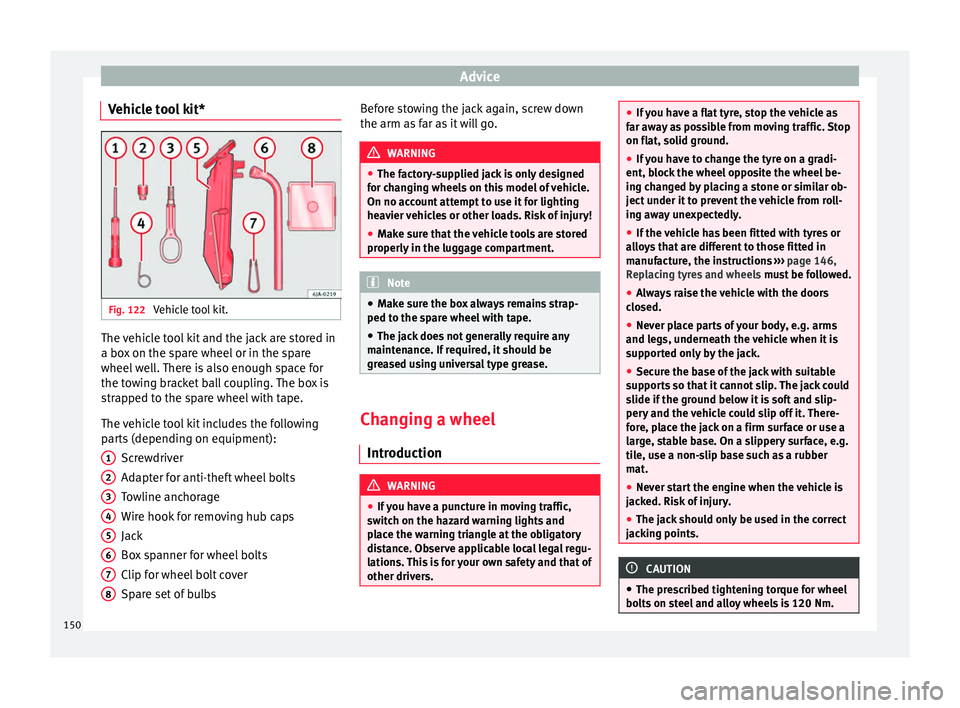
Vehicle tool kit. The vehicle tool kit and the jack are stored in
a box on the spare wheel or in the spare
wheel well. There is also enough space for
the towing bracket ball coupling. The box is
strapped to the spare wheel with tape.
The vehicle tool kit includes the following
parts (depending on equipment):
Screwdriver
Adapter for anti-theft wheel bolts
Towline anchorage
Wire hook for removing hub caps
Jack
Box spanner for wheel bolts
Clip for wheel bolt cover
Spare set of bulbs
1 2
3
4
5
6
7
8 Before stowing the jack again, screw down
the arm as far as it will go.
WARNING
● The factory-supplied jack is only designed
for changing wheels on this model of vehicle.
On no account attempt to use it for lighting
heavier vehicles or other loads. Risk of injury!
● Make sure that the vehicle tools are stored
properly in the luggage compartment. Note
● Make sure the box always remains strap-
ped to the spare wheel with tape.
● The jack does not generally require any
maintenance. If required, it should be
greased using universal type grease. Changing a wheel
Introduction WARNING
● If you have a puncture in moving traffic,
switch on the hazard warning lights and
place the warning triangle at the obligatory
distance. Observe applicable local legal regu-
lations. This is for your own safety and that of
other drivers. ●
If you have a flat tyre, stop the vehicle as
far away as possible from moving traffic. Stop
on flat, solid ground.
● If you have to change the tyre on a gradi-
ent, block the wheel opposite the wheel be-
ing changed by placing a stone or similar ob-
ject under it to prevent the vehicle from roll-
ing away unexpectedly.
● If the vehicle has been fitted with tyres or
alloys that are different to those fitted in
manufacture, the instructions ››› page 146,
Replacing tyres and wheels must be followed.
● Always raise the vehicle with the doors
closed.
● Never place parts of your body, e.g. arms
and legs, underneath the vehicle when it is
supported only by the jack.
● Secure the base of the jack with suitable
supports so that it cannot slip. The jack could
slide if the ground below it is soft and slip-
pery and the vehicle could slip off it. There-
fore, place the jack on a firm surface or use a
large, stable base. On a slippery surface, e.g.
tile, use a non-slip base such as a rubber
mat.
● Never start the engine when the vehicle is
jacked. Risk of injury.
● The jack should only be used in the correct
jacking points. CAUTION
● The prescribed tightening torque for wheel
bolts on steel and alloy wheels is 120 Nm. 150
Page 153 of 200

Emergencies
●
If the anti-theft wheel bolt is overly tight-
ened, this could damage the bolt and the
adapter. Note
● The set of anti-theft wheel bolts or the
adapter are available from authorised SEAT
dealers.
● Please observe the relevant local legal reg-
ulations when changing the wheel. Preparation work
Some preparation is required before chang-
ing a wheel:
– If you have a flat tyre, stop the vehicle as
far away as possible from moving traffic.
The surface must be horizontal.
– All vehicle occupants should leave the ve-
hicle . Vehicle occupants should wait in a
s af
e place, e.g. behind the roadside crash
barrier) while the wheel is being changed.
– Switch off the ignition and engage neutral
or move the selector lever on the automatic
g
earbox to position P.
– Apply the handbrake firmly.
– If t
owing a trailer, unhitch it. –
Take the vehicle tool kit ››
› page 150 and
the spare wheel ››› page 150 out of the lug-
gage compartment.
Wheel trim Removing
– Place the hook from the vehicle tool kit on
the reinforced edge of the wheel trim.
– Insert the box spanner through the hook,
supporting it on the tyre and remove the
wheel trim.
Fitting – First press the wheel trim onto the wheel at
the cut out designed for the valve. Then
press the wheel trim on both sides in the
direction of the valve so that it fits correctly
in place around all the perimeter. CAUTION
● Press down by hand, do not hit the wheel
trim! Knocking it sharply, particularly at
points where the wheel trim has not yet been
inserted, could result in damage to the wheel
trim guiding and centring elements.
● Before fitting the trim on a steel wheel at-
tached with an anti-theft wheel bolt, make
sure the bolt is in the hole in the valve area
››› page 154, Anti-theft wheel bolts*. ●
Where trim is fitted at a later date, ensure
enough air inflow is guaranteed in order to
cool the brake system. Wheel bolt caps
Fig. 123
Pull off the wheel bolt cap. Removing
– Insert the plastic clip into the cap until the
inner retaining notches on the clips touch
the collar of the cap and then remove it
››› Fig. 123 .
Fittin g
– In
sert the caps as far as they will go over
the wheel bolts.
The wheel bolt caps are stored in a box on
the spare wheel or in the spare wheel well.
151
Technical specifications
Advice
Operation
Safety