height Seat Toledo 2015 User Guide
[x] Cancel search | Manufacturer: SEAT, Model Year: 2015, Model line: Toledo, Model: Seat Toledo 2015Pages: 248, PDF Size: 5.06 MB
Page 135 of 248
Seats and head restraints
Seat functions He at
ed fr
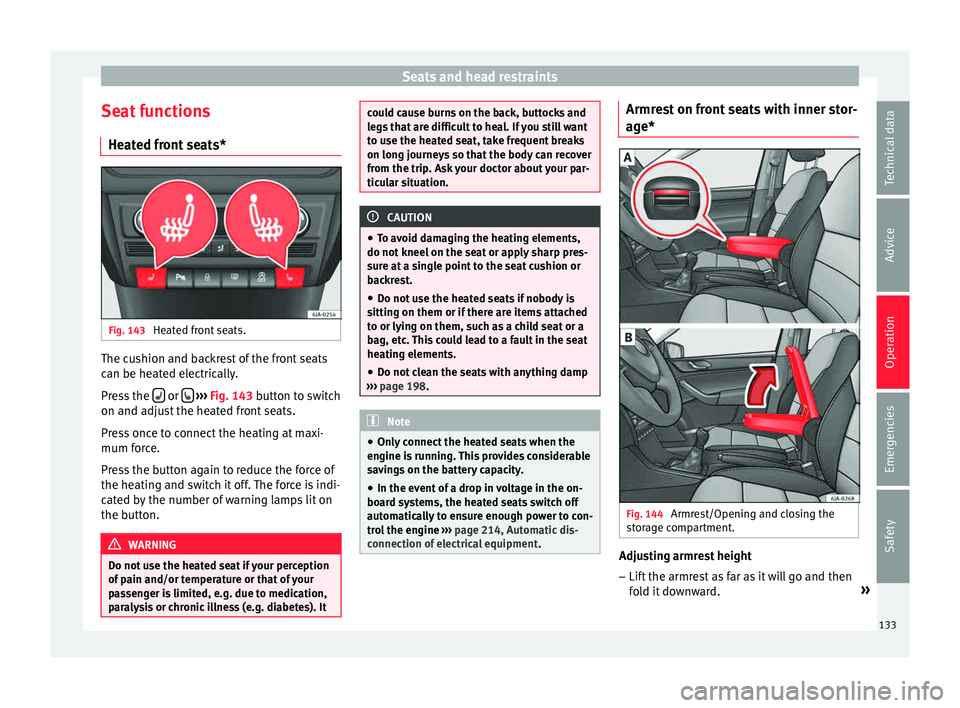
ont seats*Fig. 143
Heated front seats. The cushion and backrest of the front seats
c
an be he
at
ed electrically.
Press the or
› ›
› Fig. 143
button to switch
on and adjust the heated front seats.
Press once to connect the heating at maxi-
mum force.
Press the button again to reduce the force of
the heating and switch it off. The force is indi-
cated by the number of warning lamps lit on
the button. WARNING
Do not use the heated seat if your perception
of p ain and/or t
emperature or that of your
passenger is limited, e.g. due to medication,
paralysis or chronic illness (e.g. diabetes). It could cause burns on the back, buttocks and
le
g
s that are difficult to heal. If you still want
to use the heated seat, take frequent breaks
on long journeys so that the body can recover
from the trip. Ask your doctor about your par-
ticular situation. CAUTION
● To av oid d
amaging the heating elements,
do not kneel on the seat or apply sharp pres-
sure at a single point to the seat cushion or
backrest.
● Do not use the heated seats if nobody is
sitting on them or if
there are items attached
to or lying on them, such as a child seat or a
bag, etc. This could lead to a fault in the seat
heating elements.
● Do not clean the seats with anything damp
›››
page 198. Note
● Only c
onnect the heated seats when the
engine is running. This provides considerable
savings on the battery capacity.
● In the event of a drop in voltage in the on-
board sy
stems, the heated seats switch off
automatically to ensure enough power to con-
trol the engine ››› page 214, Automatic dis-
connection of electrical equipment . Armrest on front seats with inner stor-
ag
e* Fig. 144
Armrest/Opening and closing the
s t
or
age compartment. Adjusting armrest height
– Lift the armrest as far as it will go and then
fo l
d it downward. »
133
Technical data
Advice
Operation
Emergencies
Safety
Page 146 of 248
Operation
WARNING
Do not exceed the maximum load that the
nets c
an support. Heavy objects cannot be
safely secured. Risk of injury! CAUTION
● The ret ainin
g nets support a maximum load
of 1.5 kg.
● Do not place any item with sharp edges in
the net. Risk
of damaging the net! Rear shelf
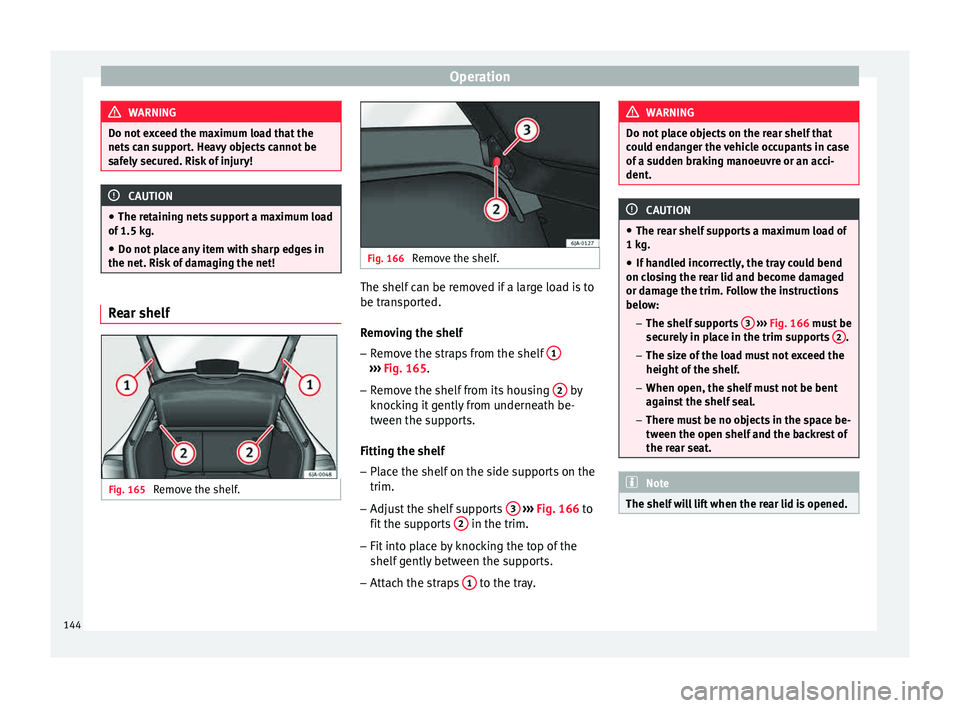
Fig. 165
Remove the shelf. Fig. 166
Remove the shelf. The shelf can be removed if a large load is to
be tr
an
s
ported.
Removing the shelf
– Remove the straps from the shelf 1 ›››
Fig. 165.
– Remove the shelf from its housing 2 by
knoc k
in
g it gently from underneath be-
tween the supports.
Fitting the shelf – Place the shelf on the side supports on the
trim.
– Adjust the shelf supports 3
› ›
› Fig. 166
to
fit the supports 2 in the trim.
– Fit into place by knocking the top of the
shelf g
ently
between the supports.
– Attach the straps 1 to the tray. WARNING
Do not place objects on the rear shelf that
cou l
d endanger the vehicle occupants in case
of a sudden braking manoeuvre or an acci-
dent. CAUTION
● The re ar shelf
supports a maximum load of
1 kg.
● If handled incorrectly, the tray could bend
on clos
ing the rear lid and become damaged
or damage the trim. Follow the instructions
below:
– The shelf supports 3
››› Fig. 166 mu
st be
securely in place in the trim supports 2 .
– The siz e of
the load must not exceed the
height of the shelf.
– When open, the shelf must not be bent
against the shelf seal.
– There must be no objects in the space be-
tween the open shelf and the backrest of
the rear seat. Note
The shelf will lift when the rear lid is opened. 144
Page 147 of 248
Transport and practical equipment
Roof rack* Intr oduction WARNING
● The loa d on the r
oof carrier must be proper-
ly secured. Risk of accident!
● Always secure the load using retaining
strap
s that are in good condition.
● Distribute the load evenly.
● When transporting heavy or large objects
on the roof, an
y change in normal vehicle be-
haviour due to a change in the centre of gravi-
ty or increased wind resistance must be taken
into account. Risk of accident! For this rea-
son, speed and driving style must be adjus-
ted for the situation.
● Avoid sudden manoeuvres and braking.
● Adjust your driving style to suit visibility,
the weather and r
oad and traffic conditions.
● Never exceed the allowed axle loads or al-
lowed m
aximum weight. Risk of accident! CAUTION
● Only u
se SEAT-authorised roof carriers.
● Where roof carriers from other systems are
used or where they
are not fitted properly,
any damage caused to the vehicle will not be
covered by the warranty. Therefore, carefully
follow the Instruction Manual for installation
of the roof carrier. ●
Remember th at
the rear lid must not hit the
roof load.
● The total height of the vehicle increases ac-
cordin
g to the roof load. Compare the height
of the vehicle with the heights of bridges or
other underpasses, for example, the height
of the garage door.
● Do not forget to remove the roof carrier be-
fore ent
ering an automatic carwash.
● Take into account that the load must not
damag
e the aerial located on the roof. For the sake of the environment
If aerodynamic resistance increases, fuel con-
sumption w i
ll also increase. Attachment points
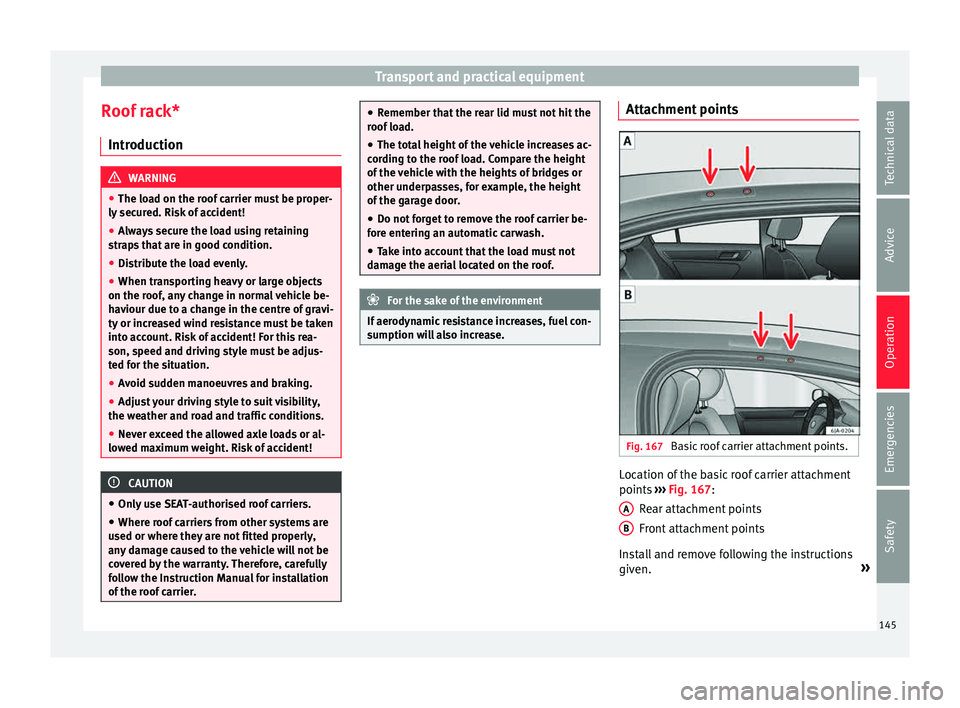
Fig. 167
Basic roof carrier attachment points. Location of the basic roof carrier attachment
points
›
›
› Fig. 167:
Rear attachment points
Front attachment points
Install and remove following the instructions
given. »
A B
145
Technical data
Advice
Operation
Emergencies
Safety
Page 150 of 248
Operation
Closing air vents 3 and 4
– Turn the vertical circular control down-
war
d
s.
Changing the direction of air delivery from
air vents 3 and 4
– The air circulation height can be varied by
chan
ging the position of the sliding adjust-
er upwards or downwards ››› Fig. 168 .
– The air circulation direction can be varied
by c
hanging the position of the sliding ad-
juster to the right or to the left.
The flow of air from the vents is controlled us-
ing control C
› ›
› Fig. 169
. Vents 3 ››› Fig. 168
and 4 can be opened and closed individually.
Depending on the position of the adjusters
and on the weather, open vents can provide
air which is either heated, unheated or
cooled. Heating and fresh air
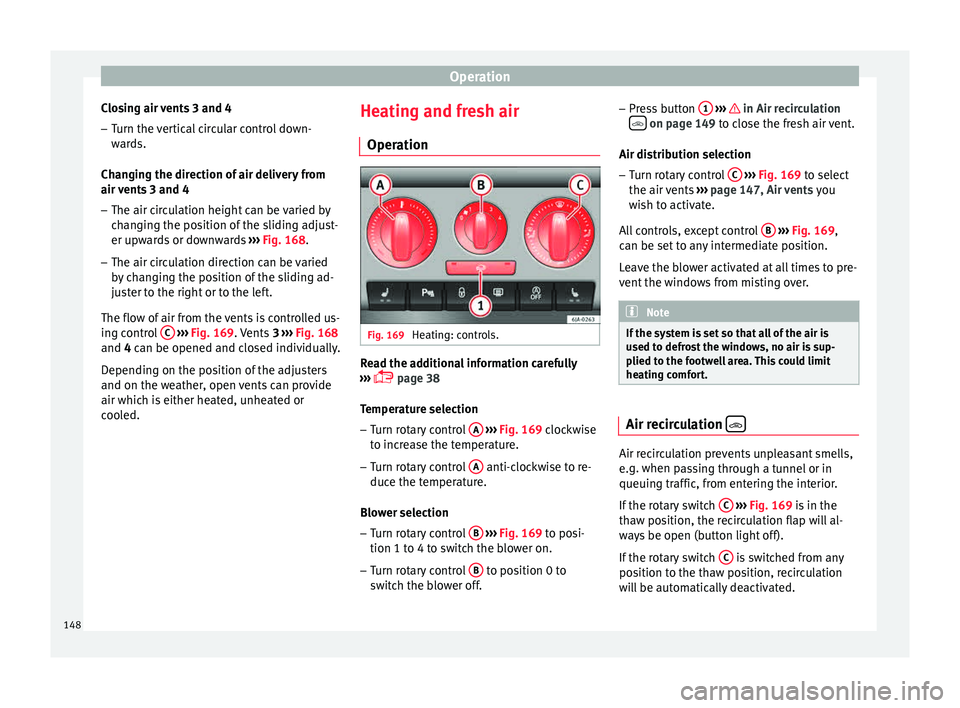
Operation Fig. 169
Heating: controls. Read the additional information carefully
› ›
›
page 38
Temperature selection
– Turn rotary control A
› ›
› Fig. 169
clockwise
to increase the temperature.
– Turn rotary control A anti-clockwise to re-
duc e the t
emper
ature.
Blower selection
– Turn rotary control B
› ›
› Fig. 169
to posi-
tion 1 to 4 to switch the blower on.
– Turn rotary control B to position 0 to
sw it
c
h the blower off. –
Pres
s button 1
› ›› in Air recirculation
on page 149 t
o c
lo se the fresh air vent.
Air distribution selection – Turn rotary control C
› ››
Fig. 169
t
o select
the air vents ››› page 147, Air vents you
wish to activate.
All controls, except control B
› ››
Fig. 169
,
c
an be set to any intermediate position.
Leave the blower activated at all times to pre-
vent the windows from misting over. Note
If the system is set so that all of the air is
used t o defr
ost the windows, no air is sup-
plied to the footwell area. This could limit
heating comfort. Air recirculation
Air recirculation prevents unpleasant smells,
e.
g. when p
a
ssing through a tunnel or in
queuing traffic, from entering the interior.
If the rotary switch C
› ›
›
Fig. 169 is in the
thaw position, the recirculation flap will al-
ways be open (button light off).
If the rotary switch C is switched from any
po sition t
o the thaw position, recirculation
will be automatically deactivated.
148
Page 168 of 248
Operation
Save electricity
The en gine activ
at
es the alternator, which
produces electricity. With the need for elec-
tricity, fuel consumption also increases. Be-
cause of this, always turn off electrical devi-
ces when you do not need them. Examples of
devices that use a lot of electricity are: the
fan at high speeds, the rear window heating
and the seat heaters*. Note
● If y
ou vehicle has Start-Stop, it is not rec-
ommended to switch this function off.
● It is recommended to close
the windows
when driving at more than 60 km/h
● Do not drive with your foot resting on the
clutc
h pedal,, as the pressure can make the
plate spin, more fuel will be used and it can
burn the clutch plate lining, causing a serious
fault.
● Do not hold the vehicle on a hill with the
clutc
h, use the foot brake or hand brake, us-
ing the latter to start. The fuel consumption
will be lower and you will prevent the clutch
plate from being damaged.
● On descents, use the engine brake, chang-
ing to the g
ear that is more suitable for the
slope. Fuel consumption will be “zero” and
the brakes will not suffer. Wading and driving off-road
Driv in
g thr
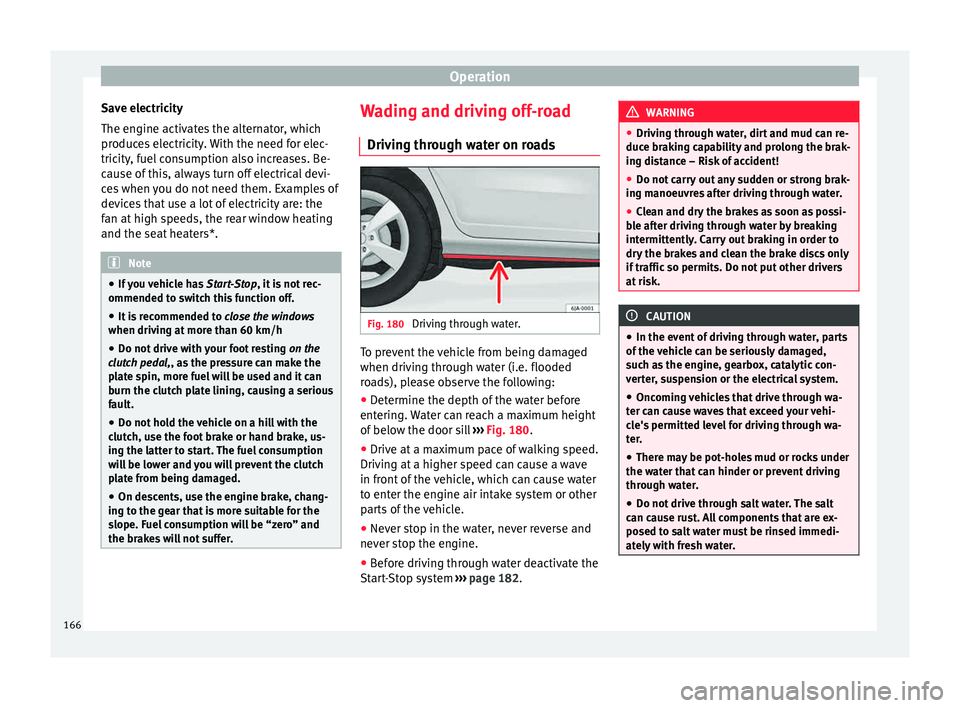
ough water on roads Fig. 180
Driving through water. To prevent the vehicle from being damaged
when driv
in
g thr
ough water (i.e. flooded
roads), please observe the following:
● Determine the depth of the water before
entering.
Water can reach a maximum height
of below the door sill ››› Fig. 180.
● Drive at a maximum pace of walking speed.
Driving at
a higher speed can cause a wave
in front of the vehicle, which can cause water
to enter the engine air intake system or other
parts of the vehicle.
● Never stop in the water, never reverse and
never st
op the engine.
● Before driving through water deactivate the
Start
-Stop system ››› page 182. WARNING
● Drivin g thr
ough water, dirt and mud can re-
duce braking capability and prolong the brak-
ing distance – Risk of accident!
● Do not carry out any sudden or strong brak-
ing manoeu
vres after driving through water.
● Clean and dry the brakes as soon as possi-
ble af
ter driving through water by breaking
intermittently. Carry out braking in order to
dry the brakes and clean the brake discs only
if traffic so permits. Do not put other drivers
at risk. CAUTION
● In the event of
driving through water, parts
of the vehicle can be seriously damaged,
such as the engine, gearbox, catalytic con-
verter, suspension or the electrical system.
● Oncoming vehicles that drive through wa-
ter can c
ause waves that exceed your vehi-
cle's permitted level for driving through wa-
ter.
● There may be pot-holes mud or rocks under
the water th
at can hinder or prevent driving
through water.
● Do not drive through salt water. The salt
can cau
se rust. All components that are ex-
posed to salt water must be rinsed immedi-
ately with fresh water. 166
Page 207 of 248
Checking and refilling levels
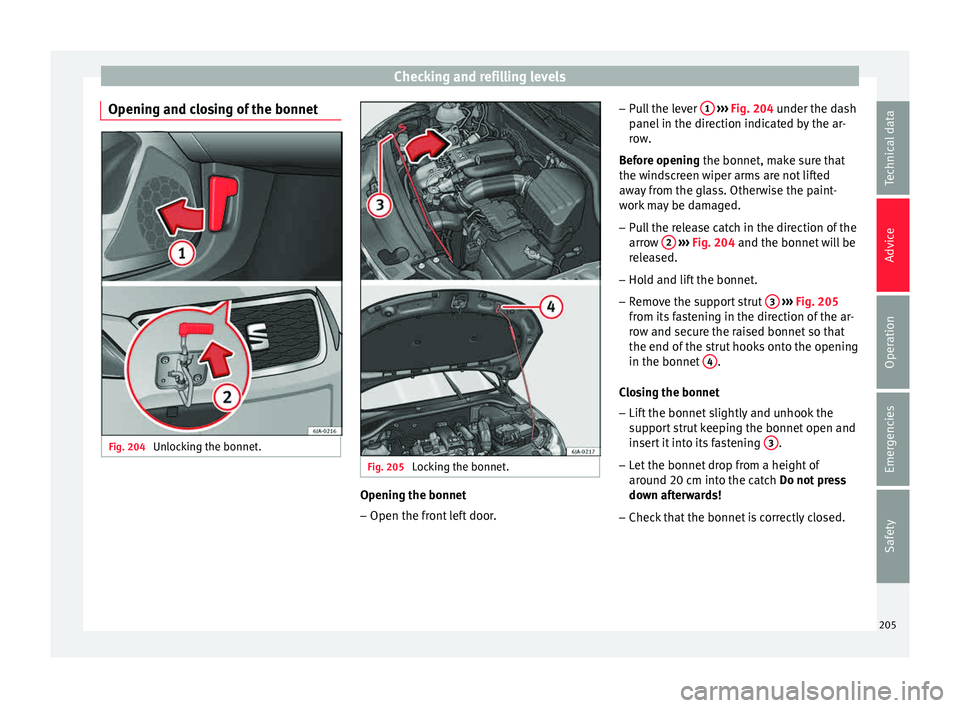
Opening and closing of the bonnet Fig. 204
Unlocking the bonnet. Fig. 205
Locking the bonnet. Opening the bonnet
–
Open the front left door. –
Pu
l
l the lever 1
› ››
Fig. 204
u nder the dash
panel in the direction indicated by the ar-
row.
Before opening the bonnet, make sure that
the windscreen wiper arms are not lifted
away from the glass. Otherwise the paint-
work may be damaged.
– Pull the release catch in the direction of the
arrow 2
› ››
Fig. 204
and the bonnet
will be
released.
– Hold and lift the bonnet.
– Remove the support strut 3
› ›
› Fig. 205
fr
om its fastening in the direction of the ar-
row and secure the raised bonnet so that
the end of the strut hooks onto the opening
in the bonnet 4 .
C lo
s
ing the bonnet
– Lift the bonnet slightly and unhook the
suppor
t strut keeping the bonnet open and
insert it into its fastening 3 .
– Let the bonnet drop from a height of
ar ou
nd 20 c
m into the catch Do not press
down afterwards!
– Check that the bonnet is correctly closed.
205
Technical data
Advice
Operation
Emergencies
Safety
Page 219 of 248
Wheels and tyres
Unusual vibration or the car pulling to one
s ide m
a
y indicate that one of the tyres is
damaged. Reduce speed immediately and
stop if you suspect that a wheel may have
been damaged! Check the tyres for damage
(blisters, cracks, etc.). If no external damage
is visible, drive slowly and carefully to the
nearest Official Service and have the vehicle
inspected.
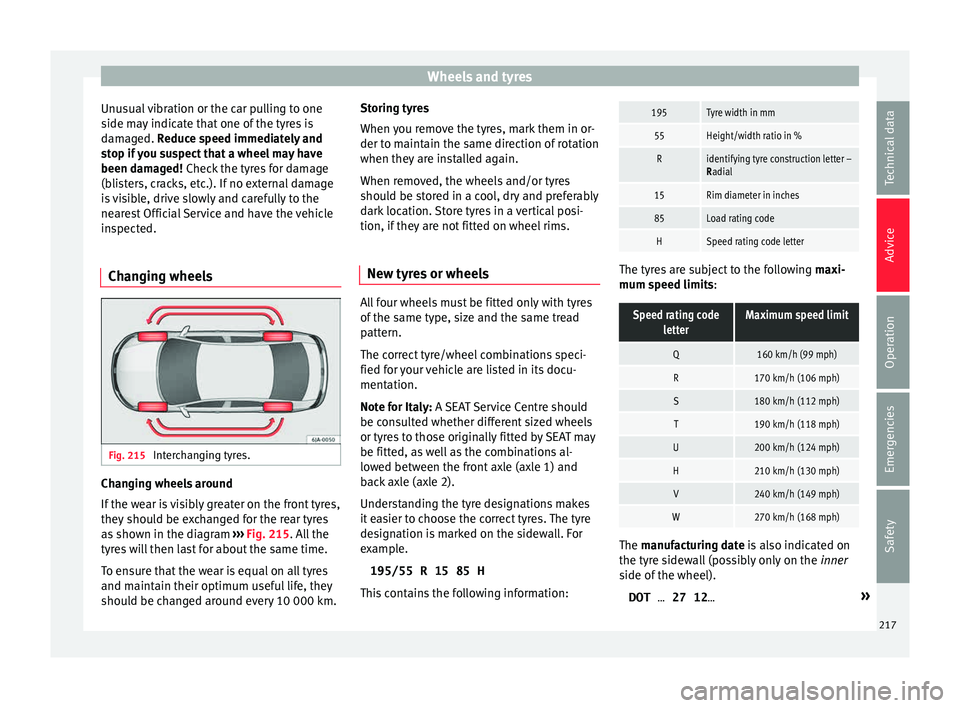
Changing wheels Fig. 215
Interchanging tyres. Changing wheels around
If
the w
e
ar is visibly greater on the front tyres,
they should be exchanged for the rear tyres
as shown in the diagram ››› Fig. 215. All the
tyres will then last for about the same time.
To ensure that the wear is equal on all tyres
and maintain their optimum useful life, they
should be changed around every 10 000 km. Storing tyres
When you r
emove the tyres, mark them in or-
der to maintain the same direction of rotation
when they are installed again.
When removed, the wheels and/or tyres
should be stored in a cool, dry and preferably
dark location. Store tyres in a vertical posi-
tion, if they are not fitted on wheel rims.
New tyres or wheels All four wheels must be fitted only with tyres
of
the s
ame type, s
ize and the same tread
pattern.
The correct tyre/wheel combinations speci-
fied for your vehicle are listed in its docu-
mentation.
Note for Italy: A SEAT Service Centre should
be consulted whether different sized wheels
or tyres to those originally fitted by SEAT may
be fitted, as well as the combinations al-
lowed between the front axle (axle 1) and
back axle (axle 2).
Understanding the tyre designations makes
it easier to choose the correct tyres. The tyre
designation is marked on the sidewall. For
example.
195/55 R 15 85 H
This contains the following information:
195Tyre width in mm
55Height/width ratio in %
Ridentifying tyre construction letter –
Radial
15Rim diameter in inches
85Load rating code
HSpeed rating code letter The tyres are subject to the following
maxi-
mum s
peed limits:
Speed rating codeletterMaximum speed limit
Q160 km/h (99 mph)
R170 km/h (106 mph)
S180 km/h (112 mph)
T190 km/h (118 mph)
U200 km/h (124 mph)
H210 km/h (130 mph)
V240 km/h (149 mph)
W270 km/h (168 mph) The m
anufacturing date is also indicated on
the ty r
e sidewall (possibly only on the inner
side of the wheel).
DOT … 27 12… »
217
Technical data
Advice
Operation
Emergencies
Safety
Page 233 of 248
Technical specifications
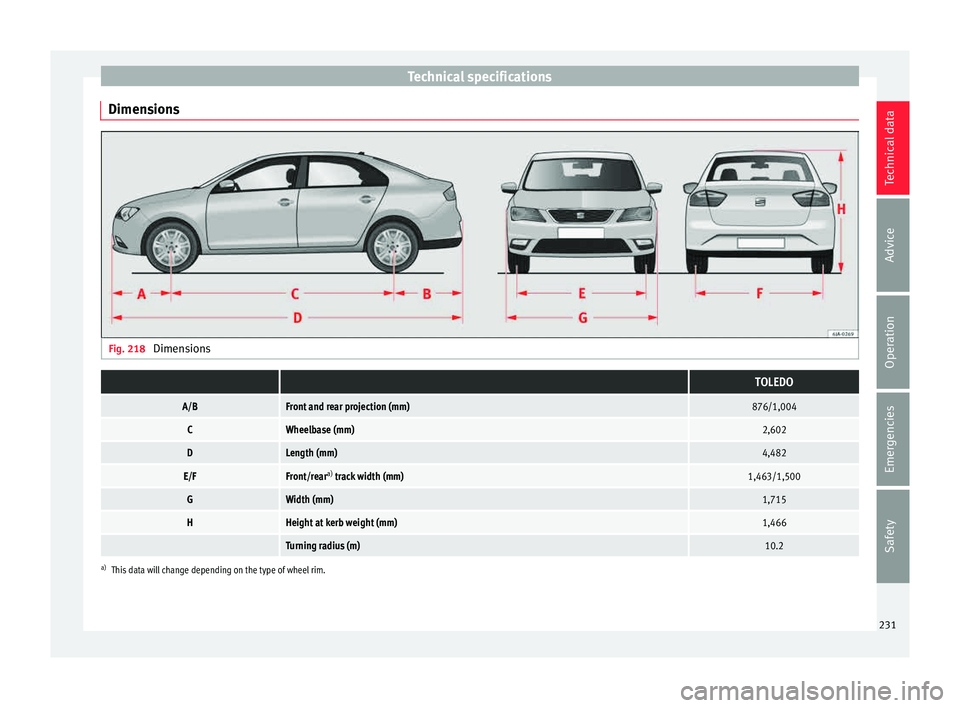
Dimensions Fig. 218
Dimensions TOLEDO
A/BFront and rear projection (mm)876/1,004
CWheelbase (mm)2,602
DLength (mm)4,482
E/FFront/rear a)
track width (mm)1,463/1,500
GWidth (mm)1,715
HHeight at kerb weight (mm)1,466
Turning radius (m)10.2
a) This data will change depending on the type of wheel rim.
231
Technical data
Advice
Operation
Emergencies
Safety
Page 241 of 248
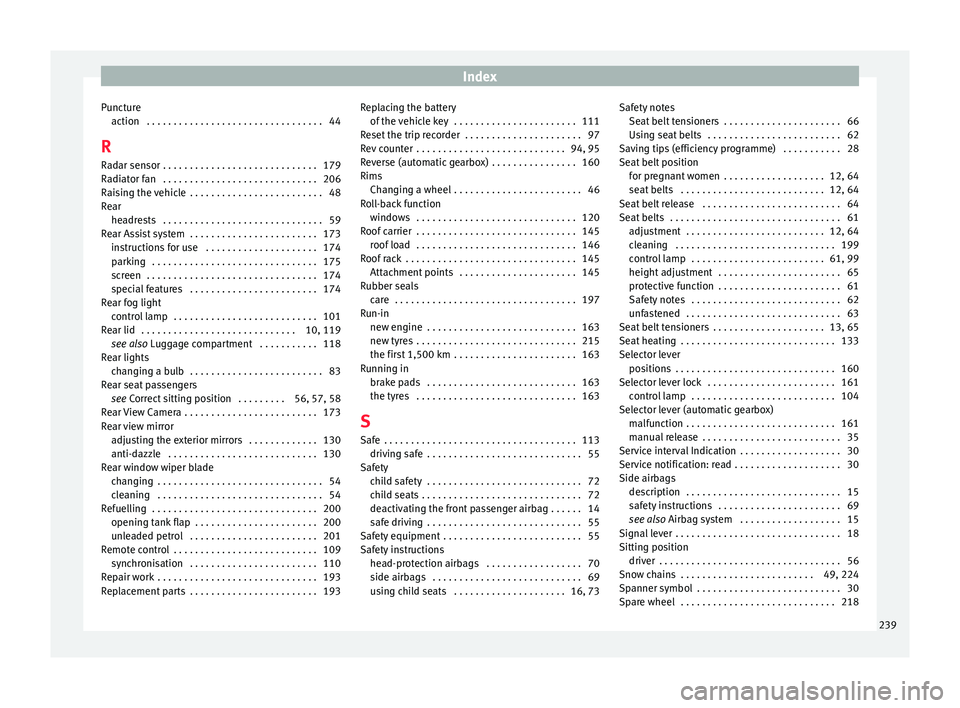
Index
Puncture action . . . . . . . . . . . . . . . . . . . . . . . . . . . . . . . . .
44
R R a
dar sensor . . . . . . . . . . . . . . . . . . . . . . . . . . . . . 179
Radiator fan . . . . . . . . . . . . . . . . . . . . . . . . . . . . . 206
Raising the vehicle . . . . . . . . . . . . . . . . . . . . . . . . . 48
Rear headrests . . . . . . . . . . . . . . . . . . . . . . . . . . . . . . 59
Rear Assist system . . . . . . . . . . . . . . . . . . . . . . . . 173 instructions for use . . . . . . . . . . . . . . . . . . . . . 174
parking . . . . . . . . . . . . . . . . . . . . . . . . . . . . . . . 175
screen . . . . . . . . . . . . . . . . . . . . . . . . . . . . . . . . 174
special features . . . . . . . . . . . . . . . . . . . . . . . . 174
Rear fog light control lamp . . . . . . . . . . . . . . . . . . . . . . . . . . . 101
Rear lid . . . . . . . . . . . . . . . . . . . . . . . . . . . . . 10, 119 see also Luggage compartment . . . . . . . . . . . 118
Rear lights changing a bulb . . . . . . . . . . . . . . . . . . . . . . . . . 83
Rear seat passengers see Correct sitting position . . . . . . . . . 56, 57, 58
Rear View Camera . . . . . . . . . . . . . . . . . . . . . . . . . 173
Rear view mirror adjusting the exterior mirrors . . . . . . . . . . . . . 130
anti-dazzle . . . . . . . . . . . . . . . . . . . . . . . . . . . . 130
Rear window wiper blade changing . . . . . . . . . . . . . . . . . . . . . . . . . . . . . . . 54
cleaning . . . . . . . . . . . . . . . . . . . . . . . . . . . . . . . 54
Refuelling . . . . . . . . . . . . . . . . . . . . . . . . . . . . . . . 200 opening tank flap . . . . . . . . . . . . . . . . . . . . . . . 200
unleaded petrol . . . . . . . . . . . . . . . . . . . . . . . . 201
Remote control . . . . . . . . . . . . . . . . . . . . . . . . . . . 109 synchronisation . . . . . . . . . . . . . . . . . . . . . . . . 110
Repair work . . . . . . . . . . . . . . . . . . . . . . . . . . . . . . 193
Replacement parts . . . . . . . . . . . . . . . . . . . . . . . . 193 Replacing the battery
of the v ehicle key . . . . . . . . . . . . . . . . . . . . . . . 111
Reset the trip recorder . . . . . . . . . . . . . . . . . . . . . . 97
Rev counter . . . . . . . . . . . . . . . . . . . . . . . . . . . . 94, 95
Reverse (automatic gearbox) . . . . . . . . . . . . . . . . 160
Rims Changing a wheel . . . . . . . . . . . . . . . . . . . . . . . . 46
Roll-back function windows . . . . . . . . . . . . . . . . . . . . . . . . . . . . . . 120
Roof carrier . . . . . . . . . . . . . . . . . . . . . . . . . . . . . . 145 roof load . . . . . . . . . . . . . . . . . . . . . . . . . . . . . . 146
Roof rack . . . . . . . . . . . . . . . . . . . . . . . . . . . . . . . . 145 Attachment points . . . . . . . . . . . . . . . . . . . . . . 145
Rubber seals care . . . . . . . . . . . . . . . . . . . . . . . . . . . . . . . . . . 197
Run-in new engine . . . . . . . . . . . . . . . . . . . . . . . . . . . . 163
new tyres . . . . . . . . . . . . . . . . . . . . . . . . . . . . . . 215
the first 1,500 km . . . . . . . . . . . . . . . . . . . . . . . 163
Running in brake pads . . . . . . . . . . . . . . . . . . . . . . . . . . . . 163
the tyres . . . . . . . . . . . . . . . . . . . . . . . . . . . . . . 163
S
Safe . . . . . . . . . . . . . . . . . . . . . . . . . . . . . . . . . . . . 113 driving safe . . . . . . . . . . . . . . . . . . . . . . . . . . . . . 55
Safety child safety . . . . . . . . . . . . . . . . . . . . . . . . . . . . . 72
child seats . . . . . . . . . . . . . . . . . . . . . . . . . . . . . . 72
deactivating the front passenger airbag . . . . . . 14
safe driving . . . . . . . . . . . . . . . . . . . . . . . . . . . . . 55
Safety equipment . . . . . . . . . . . . . . . . . . . . . . . . . . 55
Safety instructions head-protection airbags . . . . . . . . . . . . . . . . . . 70
side airbags . . . . . . . . . . . . . . . . . . . . . . . . . . . . 69
using child seats . . . . . . . . . . . . . . . . . . . . . 16, 73 Safety notes
Seat belt tensioners . . . . . . . . . . . . . . . . . . . . . . 66
Using seat belts . . . . . . . . . . . . . . . . . . . . . . . . . 62
Saving tips (efficiency programme) . . . . . . . . . . . 28
Seat belt position for pregnant women . . . . . . . . . . . . . . . . . . . 12, 64
seat belts . . . . . . . . . . . . . . . . . . . . . . . . . . . 12, 64
Seat belt release . . . . . . . . . . . . . . . . . . . . . . . . . . 64
Seat belts . . . . . . . . . . . . . . . . . . . . . . . . . . . . . . . . 61 adjustment . . . . . . . . . . . . . . . . . . . . . . . . . . 12, 64
cleaning . . . . . . . . . . . . . . . . . . . . . . . . . . . . . . 199
control lamp . . . . . . . . . . . . . . . . . . . . . . . . . 61, 99
height adjustment . . . . . . . . . . . . . . . . . . . . . . . 65
protective function . . . . . . . . . . . . . . . . . . . . . . . 61
Safety notes . . . . . . . . . . . . . . . . . . . . . . . . . . . . 62
unfastened . . . . . . . . . . . . . . . . . . . . . . . . . . . . . 63
Seat belt tensioners . . . . . . . . . . . . . . . . . . . . . 13, 65
Seat heating . . . . . . . . . . . . . . . . . . . . . . . . . . . . . 133
Selector lever positions . . . . . . . . . . . . . . . . . . . . . . . . . . . . . . 160
Selector lever lock . . . . . . . . . . . . . . . . . . . . . . . . 161 control lamp . . . . . . . . . . . . . . . . . . . . . . . . . . . 104
Selector lever (automatic gearbox) malfunction . . . . . . . . . . . . . . . . . . . . . . . . . . . . 161
manual release . . . . . . . . . . . . . . . . . . . . . . . . . . 35
Service interval Indication . . . . . . . . . . . . . . . . . . . 30
Service notification: read . . . . . . . . . . . . . . . . . . . . 30
Side airbags description . . . . . . . . . . . . . . . . . . . . . . . . . . . . . 15
safety instructions . . . . . . . . . . . . . . . . . . . . . . . 69
see also Airbag system . . . . . . . . . . . . . . . . . . . 15
Signal lever . . . . . . . . . . . . . . . . . . . . . . . . . . . . . . . 18
Sitting position driver . . . . . . . . . . . . . . . . . . . . . . . . . . . . . . . . . . 56
Snow chains . . . . . . . . . . . . . . . . . . . . . . . . . 49, 224
Spanner symbol . . . . . . . . . . . . . . . . . . . . . . . . . . . 30
Spare wheel . . . . . . . . . . . . . . . . . . . . . . . . . . . . . 218
239