towing Seat Toledo 2015 Owner's Guide
[x] Cancel search | Manufacturer: SEAT, Model Year: 2015, Model line: Toledo, Model: Seat Toledo 2015Pages: 248, PDF Size: 5.06 MB
Page 187 of 248
Towing bracket device
shown for approximately 5 seconds, and de-
pendin g on the c
a
se, is repeated. The system
stores the last message displayed.
The message on the instrument panel display
can be switched off by pressing the button on the windscreen wiper lever or the
b
utt
on on the multi function steering
wheel
›
›
› page 22.
The message can be recalled to the instru-
ment panel display using the multifunction
display ›››
page 22.
Conditions of operation
Driving behaviour is only calculated on
speeds above about 65 km/h (40 mph) up to
around 200 km/h (125 mph).
Switching on and off
Tiredness detection can be activated or deac-
tivated in the Easy Connect system with the
button and the function button
›››
pag e 104. A mark indicates that the ad-
ju
stment has been activated.
System limitations
The Tiredness detection has certain limita-
tions inherent to the system. The following
conditions can limit the Tiredness detection
or prevent it from functioning. ● At speeds below 65 km/h (40 mph)
● At speeds above 200 km/h (125 mph) ●
When cornerin g
● On r
oads in poor condition
● In unfavourable weather conditions
● When a sporty driving style is employed
● In the event of a serious distraction to the
driver
Tiredne
ss detection will be restored when the
vehicle is stopped for more than 15 minutes,
when the ignition is switched off or when the
driver has unbuckled their seat belt and
opened the door.
In the event of slow driving during a long pe-
riod of time (below 65 km/h (40 mph) the
system automatically re-establishes the tired-
ness calculation. When driving at a faster
speed the driving behaviour will be recalcula-
ted. Towing bracket device
Driv in
g w
ith a trailer
Technical requirements If your vehicle has a factory-fitted towing
brac
k
et or is equipped with a selection of
SEAT Original Accessories, it meets all the rel-
evant technical and legal requirements.
In vehicles with a towing bracket it is possi-
ble to remove the ball joint, situated (togeth-
er with the special assembly instructions) in
the housing for the spare wheel in the vehi-
cle luggage compartment ›››
page 75, Vehicle
tool kit*.
Your vehicle is fitted with a 13-pole power
socket for the electrical connection between
the trailer and the vehicle. If the trailer you
are going to use has a 7-pin connector, the
corresponding adaptor, acquired from the
SEAT Original Accessories Catalogue, can be
used.
If a towing bracket is to be retro-fitted to the
car, it must be done according to the instruc-
tions of the towing bracket manufacturer. Note
Any queries that may arise can be directed to
an authorised S EA
T dealer. 185
Technical data
Advice
Operation
Emergencies
Safety
Page 188 of 248
Operation
Trailer weight Trailer weight
The comb
ined
vehicle and trailer must be
balanced. To do so use the maximum permit-
ted towing bracket load. An insufficient
weight exerted by the trailer drawbar on the
ball joint of the towing bracket will have a
negative impact upon the response of the ve-
hicle-trailer assembly on the road.
Weight distribution
Distribute loads in the trailer so that heavy
objects are as near to the axle as possible.
Ensure that the objects do not move.
If the towing vehicle is empty and the trailer
loaded then the load distribution is incorrect.
However, if these conditions cannot be avoi-
ded, drive very slowly.
Tyre pressure values
Correct the tyre pressure in your vehicle to
“total load” ›››
page 216, Useful life of tyres .
Trailer weight
Never exceed the authorised trailer weight
under any circumstances ›››
page 221, Tech-
nical specifications .
The trailer weights listed are only applicable
for altitudes up to 1000 m above sea level.
Due to lower air density, engine power de-
creases depending on the increase in alti- tude, this also reduces climbing ability,
which r
equir
es a reduction of the weight of
the vehicle with a trailer by 10% for every
1000 m increase in altitude. The weight of
the assembly is calculated by adding the ve-
hicle weight (loaded) to the trailer weight
(loaded). Always drive with special care when
towing a trailer.
The towed load and support load information
that is displayed on the towing bracket man-
ufacturers label are only values for the verifi-
cation of the device. The correct figures for
your specific vehicle, which are usually lower
than these figures, are given in the documen-
tation of your vehicle. WARNING
● Exc eedin
g the maximum established load
per axle and the maximum towing bracket
load in addition to the maximum permitted
load or the load of the vehicle + trailer as-
sembly can cause accidents and serious inju-
ries.
● A sliding load can considerably affect the
stab
ility and safety of the vehicle + trailer as-
sembly, resulting in accidents and serious in-
juries. Driving with a trailer
Exterior mirrors
Check
whether
you can see enough of the
road behind the trailer with the standard rear
vision mirrors. If this is not the case, you
should have additional exterior mirrors fitted.
Observe the relevant statutory requirements
of the country you are in.
Headlights
Before starting a journey, also check the
headlight beam settings with the trailer
hitched up. Adjust the headlight range set-
tings if necessary ›››
page 122, Main light
range control .
Driving speed
For your own safety do not drive faster than
the maximum permitted speed indicated on
the trailer.
At all times, immediately reduce speed if you
detect the slightest swaying movement of the
trailer. Never try to “return the trailer to a
straight position” by accelerating.
Brakes
Brake in due course! If the trailer has an over-
run brake, apply the brakes gently at first and
then, firmly. This will prevent the jerking that
can be caused by locking of trailer wheels.
Change to a lower gear in good time before
186
Page 189 of 248
Towing bracket device
descending a slope in order to take advant-
ag e of
the en
gine brake.
The trailer is incorporated into the vehicle's
anti-theft alarm system:
● When the vehicle has a factory-fitted anti-
theft al
arm and a towing bracket.
● When the trailer is electrically connected to
the vehic
le via the towing bracket socket.
● When the vehicle electrical device and the
tow
ing bracket are operational.
● When the vehicle is locked and the vehi-
cle's
anti-theft alarm device is activated.
Once the electrical connection is interrupted
with the vehicle trailer locked, the alarm
sounds.
Always switch off the vehicle anti-theft alarm
device before connecting or disconnecting a
trailer. The vehicle anti-theft alarm device
could cause the alarm to sound ››› page 117,
Anti-theft alarm system*.
Engine overheating
In the event that the coolant temperature
gauge needle moves to the right section of
the scale or to the red area, immediately re-
duce speed. If the control lamp flashes on
the general instrument panel, stop the vehi-
cle and switch off the engine. Wait several
minutes and check the coolant level in the
tank ››› page 208. Please observe the following indications
›››
page 100, Coolant level and temperature
.
The coolant temperature can be reduced by
switching on the heating. WARNING
● Adjus t
your speed to suit the road and traf-
fic conditions.
● An electrical installation that is connected
incorrectly
or by non-specialised personnel
can prevent the connection of the current to
the trailer and cause faults in the operation of
the electrical system throughout the entire
vehicle, leading to accidents and serious in-
jury.
● All electrical work must be carried out only
by s
pecialised services.
● Never directly connect the trailer electrical
device t
o the electrical sockets of the reverse
driving lights or other sources of electrical
current. CAUTION
● Av oid c
orners, and sudden and sharp brak-
ing.
● Once the trailing arm has been removed,
plac
e the corresponding cover on the hole of
the fastening point. This prevents dirt from
entering the hole – see the trailer system as-
sembly manual. Note
● In the event of
frequent journeys with a
trailer, we recommend also having the vehi-
cle inspected in between the service inter-
vals.
● When connecting and disconnecting the
trail
er, the handbrake must be applied.
● For technical reasons, trailers with LED re-
verse light
s cannot be incorporated into the
vehicle anti-theft alarm system. Towing bracket device for trail-
er
Intr oduction If the vehicle is equipped with a towing
br
ac
k
et device from the factory or is a genu-
ine SEAT accessory, it meets all national tech-
nical and legal requirements for towing.
Your vehicle is fitted with a 13-pin power
socket for the electrical connection between
the trailer and the vehicle. If the towing
bracket is equipped with a 7-pin connector,
you can use the corresponding available
adaptor that is a genuine SEAT accessory.
The towing device has a maximum vertical
load of 50 kg. »
187
Technical data
Advice
Operation
Emergencies
Safety
Page 190 of 248
Operation
WARNING
● Bef or
e driving with the ball-headed bar fit-
ted, verify its correct assembly and place-
ment in the clamping bush.
● Do not use the ball-headed bar if it is not
correctly
placed and fixed in the clamping
bush.
● Do not use the towing device for towing if it
is d
amaged or has missing parts.
● Do not modify or adapt the towing device
connection.
● Never di
sengage the ball-headed bar with
the trail
er still hitched. CAUTION
Be careful not to damage the paint on the
bumper when h andlin
g the ball-headed bar. Description
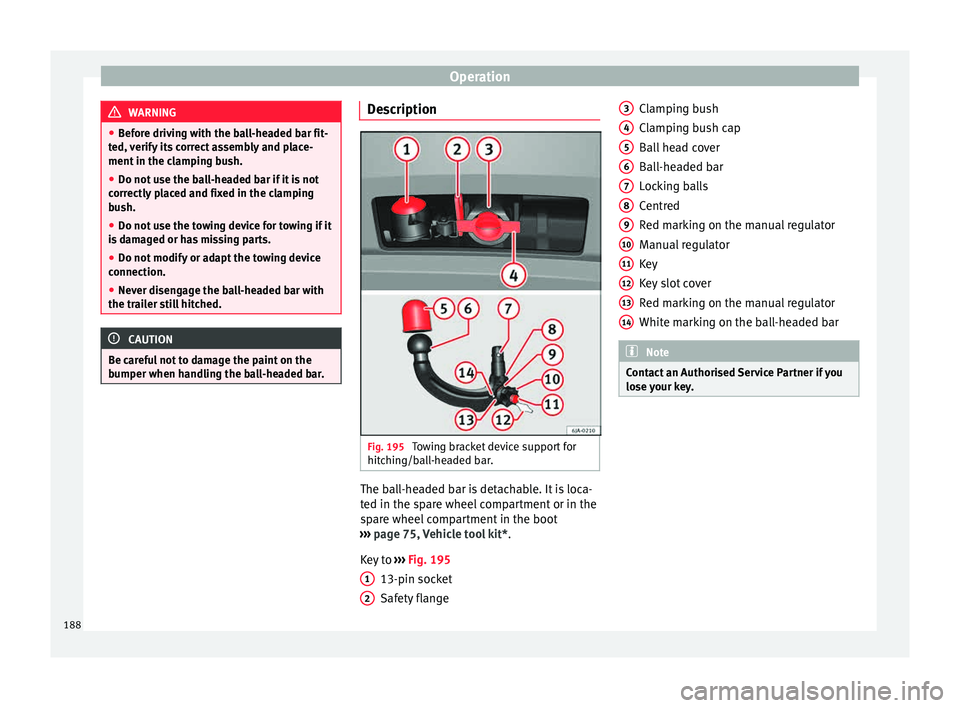
Fig. 195
Towing bracket device support for
hit c
hin
g/ball-headed bar. The ball-headed bar is detachable. It is loca-
t
ed in the s
p
are wheel compartment or in the
spare wheel compartment in the boot
››› page 75, Vehicle tool kit*.
Key to ››› Fig. 195
13-pin socket
Safety flange
1 2 Clamping bush
C
l
ampin
g bush cap
Ball head cover
Ball-headed bar
Locking balls
Centred
Red marking on the manual regulator
Manual regulator
Key
Key slot cover
Red marking on the manual regulator
White marking on the ball-headed bar Note
Contact an Authorised Service Partner if you
lose y
our key. 3
4
5
6
7
8
9
10
11
12
13
14
188
Page 191 of 248
Towing bracket device
Placing in service position Fig. 196
Placing in service position. Fig. 197
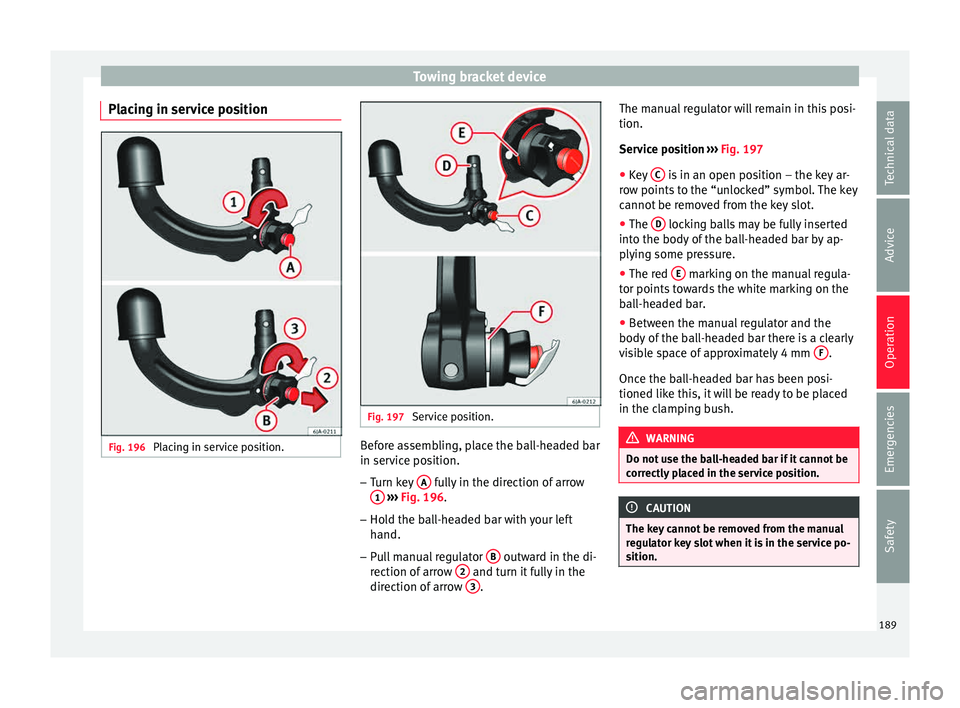
Service position. Before assembling, place the ball-headed bar
in ser
v
ic
e position.
– Turn key A fully in the direction of arrow
1
› ›
› Fig. 196
.
– Hold the ball-headed bar with your left
hand.
– Pu
ll manual regulator B outward in the di-
r ection of
arr
ow 2 and turn it fully in the
dir ection of
arr
ow 3 .The manual regulator will remain in this posi-
tion.
Ser
vic
e position ››› Fig. 197
● Key C is in an open position – the key ar-
r o
w points
to the “unlocked” symbol. The key
cannot be removed from the key slot.
● The D locking balls may be fully inserted
int o the body
of
the ball-headed bar by ap-
plying some pressure.
● The red E marking on the manual regula-
t or points
t
owards the white marking on the
ball-headed bar.
● Between the manual regulator and the
body of the b
all-headed bar there is a clearly
visible space of approximately 4 mm F .
Onc e the b
al
l-headed bar has been posi-
tioned like this, it will be ready to be placed
in the clamping bush. WARNING
Do not use the ball-headed bar if it cannot be
corr ectly
placed in the service position. CAUTION
The key cannot be removed from the manual
re gu
lator key slot when it is in the service po-
sition. 189
Technical data
Advice
Operation
Emergencies
Safety
Page 193 of 248
Towing bracket device
Verification of correct placement Fig. 200
Correct placement of the ball-head-
ed b ar
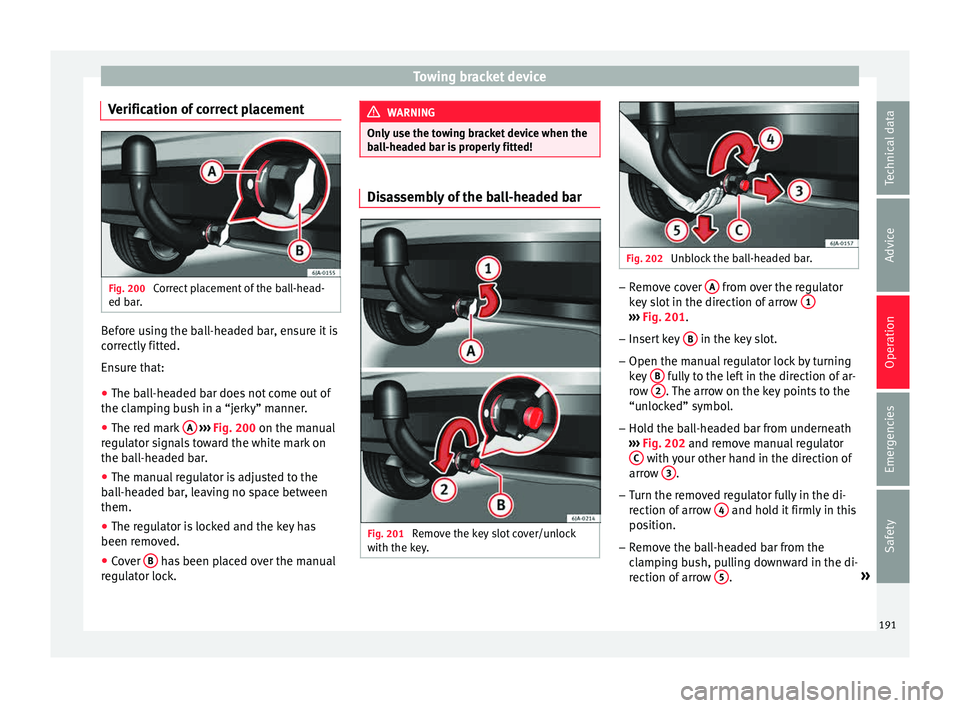
. Before using the ball-headed bar, ensure it is
c
orr
ectly
fitted.
Ensure that:
● The ball-headed bar does not come out of
the clampin
g bush in a “jerky” manner.
● The red mark A
› ›
› Fig. 200
on the manual
regulator signals toward the white mark on
the ball-headed bar.
● The manual regulator is adjusted to the
ball-he
aded bar, leaving no space between
them.
● The regulator is locked and the key has
been remov
ed.
● Cover B has been placed over the manual
r e gu
lator lock. WARNING
Only use the towing bracket device when the
ba l
l-headed bar is properly fitted! Disassembly of the ball-headed bar
Fig. 201
Remove the key slot cover/unlock
w ith the k
ey
. Fig. 202
Unblock the ball-headed bar. –
Remove cover A from over the regulator
k ey
s
lot in the direction of arrow 1 ›››
Fig. 201.
– Insert key B in the key slot.
– Open the manual regulator lock by turning
key
B fully to the left in the direction of ar-
r o
w 2 . The arrow on the key points to the
“u n
loc
ked” symbol.
– Hold the ball-headed bar from underneath
›››
Fig. 202 and remove manual regulator
C with your other hand in the direction of
arr o
w 3 .
– Turn the removed regulator fully in the di-
rection of
arr
ow 4 and hold it firmly in this
po s
ition.
– R
emove the ball-headed bar from the
clampin
g bush, pulling downward in the di-
rection of arrow 5 .
»
191
Technical data
Advice
Operation
Emergencies
Safety
Page 224 of 248
Technical data
Identification data contained on the
d at
a s
ticker Fig. 217
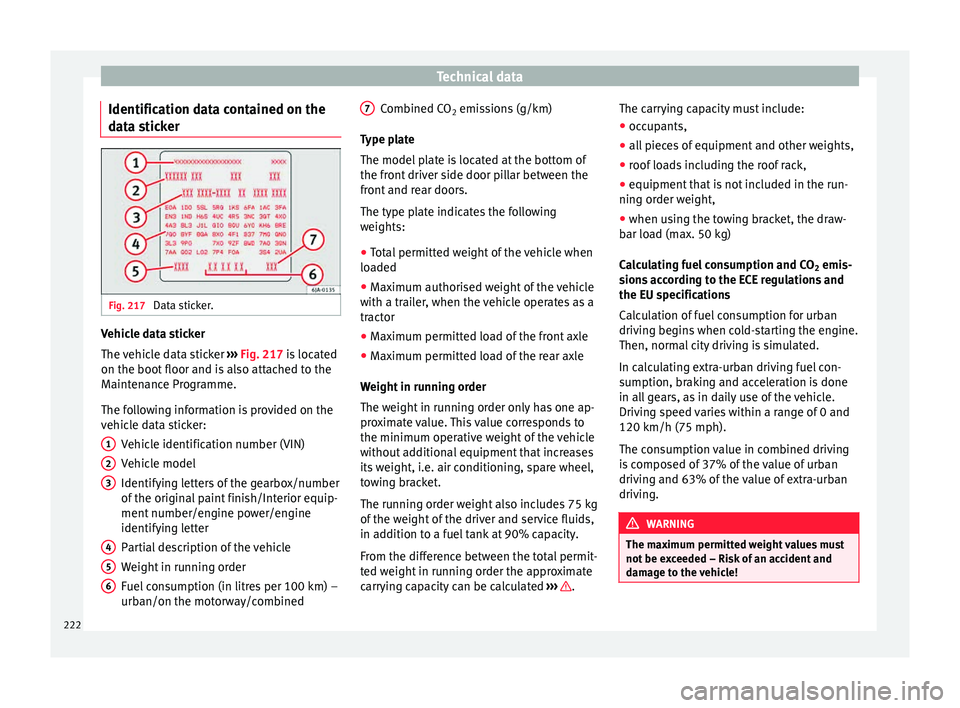
Data sticker. Vehicle data sticker
The
v
ehic
le data sticker ››› Fig. 217 is located
on the boot floor and is also attached to the
Maintenance Programme.
The following information is provided on the
vehicle data sticker:
Vehicle identification number (VIN)
Vehicle model
Identifying letters of the gearbox/number
of the original paint finish/Interior equip-
ment number/engine power/engine
identifying letter
Partial description of the vehicle
Weight in running order
Fuel consumption (in litres per 100 km) –
urban/on the motorway/combined
1 2
3
4
5
6 Combined CO
2 emi
s
s
ions (g/km)
Type plate
The model plate is located at the bottom of
the front driver side door pillar between the
front and rear doors.
The type plate indicates the following
weights:
● Total permitted weight of the vehicle when
loaded
● M
aximum authorised weight of the vehicle
with a trai
ler, when the vehicle operates as a
tractor
● Maximum permitted load of the front axle
● Maximum permitted load of the rear axle
Weight in ru
nning order
The weight in running order only has one ap-
proximate value. This value corresponds to
the minimum operative weight of the vehicle
without additional equipment that increases
its weight, i.e. air conditioning, spare wheel,
towing bracket.
The running order weight also includes 75 kg
of the weight of the driver and service fluids,
in addition to a fuel tank at 90% capacity.
From the difference between the total permit-
ted weight in running order the approximate
carrying capacity can be calculated ››› .
7 The carrying capacity must include:
●
occupants,
● all pieces of equipment and other weights,
● roof loads including the roof rack,
● equipment that is not included in the run-
nin g or
der w
eight,
● when using the towing bracket, the draw-
bar loa
d (max. 50 kg)
Calculating fuel consumption and CO 2 emis-
sions according to the ECE regulations and
the EU specifications
Calculation of fuel consumption for urban
driving begins when cold-starting the engine.
Then, normal city driving is simulated.
In calculating extra-urban driving fuel con-
sumption, braking and acceleration is done
in all gears, as in daily use of the vehicle.
Driving speed varies within a range of 0 and
120 km/h (75 mph).
The consumption value in combined driving
is composed of 37% of the value of urban
driving and 63% of the value of extra-urban
driving. WARNING
The maximum permitted weight values must
not be e x
ceeded – Risk of an accident and
damage to the vehicle! 222
Page 226 of 248
Technical data
Drawbar loads
The maximum permitt ed dr
a
wbar load on the
ball joint of the towing bracket must not ex-
ceed 50 kg.
In the interest of road safety, we recommend
that you always tow approaching the maxi-
mum drawbar load. The response of the trail-
er on the road will be poor, if the drawbar
load is too small.
If the maximum permissible drawbar load
cannot be met (e.g. with small, empty and
light-weight single axle trailers or tandem
axle trailers with a wheelbase of less than 1
metre), a minimum of 4% of the actual trailer
weight is legally required for the drawbar
load. WARNING
● For s af
ety reasons, do not exceed the 80
km/h (50 mph) limit. This is also valid in
countries where higher speeds are permitted.
● Never exceed the maximum trailer weights
or the drawb
ar load. If the permissible axle
load or the permissible total weight is excee-
ded, the driving characteristics of the vehicle
may change, leading to accidents, injuries
and damage to the vehicle. Wheels
Ty
r
e pressure, snow chains, wheel
bolts Tyre pressures
The stic
k
er with the tyre pressure values can
be found on the inside of the fuel tank flap.
The tyre pressure values given there are for
cold tyres. Do not reduce the slightly raised
pressures of warm tyres ››› .
The pre s
sure for winter tyres is 0.2 bar
(2.9 psi / 20 kPa) higher than that of summer
tyres.
Snow chains
Snow chains may be fitted only to the front
wheels.
Consult the section “wheels” of this manual.
Wheel bolts
After the wheels have been changed, the
tightening torque of the wheel bolts should
be checked as soon as possible with a torque
wrench ››› . The tightening torque for steel
and al lo
y
wheels is 120 Nm. WARNING
● Check the ty
re pressure at least once per
month. Checking the tyre pressure is very im-
portant. If the tyre pressure is too high or too low, there is an increased danger of accidents
- par
tic
ularly at high speeds.
● If the tightening torque of the wheel bolts
is t
oo low, they could loosen while the vehi-
cle is in motion. Risk of accident! If the tight-
ening torque is too high, the wheel bolts and
threads can be damaged. Note
We recommend that you ask your Technical
Ser vic
e for information about appropriate
wheel, tyre and snow chain size. 224
Page 237 of 248
Index
Cruise control . . . . . . . . . . . . . . . . . . . . . . . . 31, 176 adju
s
ting the programmed speed . . . . . . . . . . 177
setting the speed . . . . . . . . . . . . . . . . . . . . . . . 176
temporary deactivation . . . . . . . . . . . . . . . . . . 177
turning off the cruise control system . . . . . . . 177
Cruise speed control lamp . . . . . . . . . . . . . . . . . . . . . . . . . . . 104
D Damage to the vehicle . . . . . . . . . . . . . . . . . . . . . 167
Dash panel . . . . . . . . . . . . . . . . . . . . . . . . . . . . . . . 32
Data sticker . . . . . . . . . . . . . . . . . . . . . . . . . . . . . . 221
Deactivating the front passenger front airbag . . . 14
Deactivation of front airbag . . . . . . . . . . . . . . . 68, 71
Defrosting rear window . . . . . . . . . . . . . . . . . . . . 128
Diesel engine oil . . . . . . . . . . . . . . . . . . . . . . . . . . . . . 206
Preheating . . . . . . . . . . . . . . . . . . . . . . . . . . . . . 153
refuelling . . . . . . . . . . . . . . . . . . . . . . . . . . . . . . 202
Digital clock . . . . . . . . . . . . . . . . . . . . . . . . . . . . . . 94
Dimensions . . . . . . . . . . . . . . . . . . . . . . . . . . . . . . 231
Direction of rotation tyres . . . . . . . . . . . . . . . . . . . . . . . . . . . . . . . . . . . 49
Display . . . . . . . . . . . . . . . . . . . . . . . . . . . . . . . 94, 95
Disposal Seat belt tensioners . . . . . . . . . . . . . . . . . . . . . . 66
Door cylinder . . . . . . . . . . . . . . . . . . . . . . . . . . . . . . 9
Door handle . . . . . . . . . . . . . . . . . . . . . . . . . . . . . . . 9
Door lock . . . . . . . . . . . . . . . . . . . . . . . . . . . . . . . . . . 9
Door open warning lamp . . . . . . . . . . . . . . . . . . . . . . . . . . . 99
Doors Child-proof locking . . . . . . . . . . . . . . . . . . . . . . 117
opening and closing . . . . . . . . . . . . . . . . . . . . . . 9
Drink holder centre console . . . . . . . . . . . . . . . . . . . . . . . . . 136
rear seat armrest . . . . . . . . . . . . . . . . . . . . . . . 137 Driver
see Correct sitting position . . . . . . . . . 56, 57, 58
Driver information system CD/radio indication . . . . . . . . . . . . . . . . . . . . . . 22
engine oil temperature display . . . . . . . . . . . . . 27
operation with the windscreen wiper lever . . . . 22
Driving abroad headlights . . . . . . . . . . . . . . . . . . . . . . . . . . . . . 126
Driving through water . . . . . . . . . . . . . . . . . . . . . 166
Driving with a trailer . . . . . . . . . . . . . . . . . . 185, 223
Dynamic headlight range control . . . . . . . . . . . . 122
E
E10 see Ethanol (fuel) . . . . . . . . . . . . . . . . . . . . . . . 201
Easy Connect . . . . . . . . . . . . . . . . . . . . . . . . 20, 104
Economical driving . . . . . . . . . . . . . . . . . . . . . . . . . . . . . . . . 164
EDL see Electronic differential lock . . . . 100, 167, 168
Efficiency programme additional electrical appliances . . . . . . . . . . . . 28
saving tips . . . . . . . . . . . . . . . . . . . . . . . . . . . . . . 28
Electric windows . . . . . . . . . . . . . . . . . . . . . . 11, 120
Electronic differential lock . . . . . . . . . . . . . 100, 168
Electronic immobiliser . . . . . . . . . . . . . . . . . . . 9, 154
Electronic Stability Control (ESC) . . . . . . . . . . . . 100
Emergencies . . . . . . . . . . . . . . . . . . . . . . . . . . . . . . 75 automatic gearbox backup programme . . . . . 162
bulbs . . . . . . . . . . . . . . . . . . . . . . . . . . . . . . . . . . 44
changing a wheel . . . . . . . . . . . . . . . . . . . . . 46, 75
emergency towing of the vehicle . . . . . . . . . . . . 50
Front passenger door . . . . . . . . . . . . . . . . . . . . . 10
fuses . . . . . . . . . . . . . . . . . . . . . . . . . . . . . . . . . . 43
hazard warning lights . . . . . . . . . . . . . . . . . . . 126
Jump leads . . . . . . . . . . . . . . . . . . . . . . . . . . . . . 51
puncture . . . . . . . . . . . . . . . . . . . . . . . . . . . . . . . 44 replacing a blown fuse . . . . . . . . . . . . . . . . . . . . 43
selector l
ever . . . . . . . . . . . . . . . . . . . . . . . . . . . 35
Emission control system control lamp . . . . . . . . . . . . . . . . . . . . . . . . . . . 101
Emissions data . . . . . . . . . . . . . . . . . . . . . . . . . . . 222
Engine assisted starting . . . . . . . . . . . . . . . . . . . . . . . . . 51
preheating . . . . . . . . . . . . . . . . . . . . . . . . . . . . 153
run-in . . . . . . . . . . . . . . . . . . . . . . . . . . . . . . . . . 163
Start-Stop system . . . . . . . . . . . . . . . . . . . . . . . 182
starting . . . . . . . . . . . . . . . . . . . . . . . . . . 153, 156
switching off the engine . . . . . . . . . . . . . . . . . 156
Engine and ignition starting the engine with Keyless Access . . . . . 155
Engine compartment . . . . . . . . . . . . . . 11, 203, 206 battery . . . . . . . . . . . . . . . . . . . . . . . . . . . . . . . . 211
brake fluid . . . . . . . . . . . . . . . . . . . . . . . . . . . . . 209
coolant . . . . . . . . . . . . . . . . . . . . . . . . . . . . . . . 208
engine oil . . . . . . . . . . . . . . . . . . . . . . . . . . . . . 208
opening the bonnet . . . . . . . . . . . . . . . . . . . . . 205
windscreen washer fluid . . . . . . . . . . . . . . . . . 210
Engine coolant . . . . . . . . . . . . . . . . . . . . . . . . . . . . 40 checking level . . . . . . . . . . . . . . . . . . . . . . . . . . 208
control lamp . . . . . . . . . . . . . . . . . . . . . . . . . . . 100
G12 plus-plus . . . . . . . . . . . . . . . . . . . . . . . . . . . 40
G13 . . . . . . . . . . . . . . . . . . . . . . . . . . . . . . . . . . . 40
specifications . . . . . . . . . . . . . . . . . . . . . . . . . . . 40
topping up . . . . . . . . . . . . . . . . . . . . . . . . . . . . 209
Engine data . . . . . . . . . . . . . . . . . . . . . . . . . . . . . . 225
Engine management control lamp . . . . . . . . . . . . . . . . . . . . . . . . . . . 102
Engine oil . . . . . . . . . . . . . . . . . . . . . . . . . . . 40, 206 changing . . . . . . . . . . . . . . . . . . . . . . . . . 206, 208
Checking oil level . . . . . . . . . . . . . . . . . . . . . . . 207
consumption . . . . . . . . . . . . . . . . . . . . . . . . . . . 207
dipstick . . . . . . . . . . . . . . . . . . . . . . . . . . . . . . . 207
inspection service . . . . . . . . . . . . . . . . . . . . . . 206
235
Page 240 of 248
Index
luggage compartment . . . . . . . . . . . . . . . . . . . 127
M ain be
am he
adlights . . . . . . . . . . . . . . . . . . . 123
main beams . . . . . . . . . . . . . . . . . . . . . . . . . . . . 18
parking lights . . . . . . . . . . . . . . . . . . . . . . . . . . 126
parking lights on both sides . . . . . . . . . . . . . . 126
rear fog light . . . . . . . . . . . . . . . . . . . . . . . . . . . 125
rear interior light . . . . . . . . . . . . . . . . . . . . . . . . 127
side lights . . . . . . . . . . . . . . . . . . . . . . . . . . . . . 122
switch . . . . . . . . . . . . . . . . . . . . . . . . . . . . . . . . . 18
turn signals . . . . . . . . . . . . . . . . . . . . . . . . . . . . 123
Loading the vehicle . . . . . . . . . . . . . . . . . . . . . . . 141 luggage compartment . . . . . . . . . . . . . . . . . . . . 10
Locking and unlocking central locking . . . . . . . . . . . . . . . . . . . . . . . . . 113
in the door cylinder . . . . . . . . . . . . . . . . . . . . . . . 9
remote control . . . . . . . . . . . . . . . . . . . . . . . . . 109
with Keyless Access . . . . . . . . . . . . . . . . . . . . . 115
with the central locking switch . . . . . . . . . . . . 114
Locking the front passenger door manually . . . . . 10
Luggage compartment . . . . . . . . . . . . . . . . . . . . . . 10 automatic lock . . . . . . . . . . . . . . . . . . . . . . . . . 118
Category N1 vehicles . . . . . . . . . . . . . . . . . . . . 143
light . . . . . . . . . . . . . . . . . . . . . . . . . . . . . . . . . . 127
net pocket . . . . . . . . . . . . . . . . . . . . . . . . . . . . . 140
rear shelf . . . . . . . . . . . . . . . . . . . . . . . . . . . . . . 144
Unlocking manually . . . . . . . . . . . . . . . . . . . . . . 10
M Main beam headlights control lamp . . . . . . . . . . . . . . . . . . . . . . . . . . . 104
Maintenance intervals . . . . . . . . . . . . . . . . . . . . . 206
Malfunction front assist . . . . . . . . . . . . . . . . . . . . . . . . . . . . 178
gearbox . . . . . . . . . . . . . . . . . . . . . . . . . . . . . . . 162
Manual air conditioning . . . . . . . . . . . . . . . . . . . 149 air recirculation . . . . . . . . . . . . . . . . . . . . . . . . . 150 Manual gearbox
gear l ever . . . . . . . . . . . . . . . . . . . . . . . . . . . . . 158
Mirror vanity . . . . . . . . . . . . . . . . . . . . . . . . . . . . . . . . . 128
Mobile telephones . . . . . . . . . . . . . . . . . . . . . . . . 194
Multimedia . . . . . . . . . . . . . . . . . . . . . . . . . . . . . . 109
Multimedia compartment . . . . . . . . . . . . . . . . . . 139
N
Net pocket luggage compartment . . . . . . . . . . . . . . . . . . . 140
Number of seats . . . . . . . . . . . . . . . . . . . . . . . . . . . 61
O Octane rating (petrol) . . . . . . . . . . . . . . . . . . . . . . 201
Odometer . . . . . . . . . . . . . . . . . . . . . . . . . . . . . 94, 97 Reset button . . . . . . . . . . . . . . . . . . . . . . . . . . . . 97
Oil properties . . . . . . . . . . . . . . . . . . . . . . . . . . . . . 40
Open and close . . . . . . . . . . . . . . . . . . . . . . . . . . 109
Opening and closing . . . . . . . . . . . . . . . . . . . . 9, 109 bonnet . . . . . . . . . . . . . . . . . . . . . . . . . . . . . . . . 205
central locking . . . . . . . . . . . . . . . . . . . . . . . . . 113
in the door cylinder . . . . . . . . . . . . . . . . . . . . . . . 9
rear lid of the luggage compartment . . . . . . . . 10
tank flap . . . . . . . . . . . . . . . . . . . . . . . . . . . . . . 200
vehicle, with Keyless Access . . . . . . . . . . . . . . 115
windows . . . . . . . . . . . . . . . . . . . . . . . . . . . . . . 120
with the central locking switch . . . . . . . . . . . . 114
Opening manually rear lid . . . . . . . . . . . . . . . . . . . . . . . . . . . . . . . . . 10
Outside temperature . . . . . . . . . . . . . . . . . . . . . . . 24
P
Paint care . . . . . . . . . . . . . . . . . . . . . . . . . . . . . . . . . . 196
Code . . . . . . . . . . . . . . . . . . . . . . . . . . . . . . . . . 222
damage . . . . . . . . . . . . . . . . . . . . . . . . . . . . . . . 196 Parking aid . . . . . . . . . . . . . . . . . . . . . . . . . . . . . . 168
adjus ting the display and audible warnings . 172
automatic activation . . . . . . . . . . . . . . . . . . . . 171
fault . . . . . . . . . . . . . . . . . . . . . . . . . . . . . . . . . . 173
operation . . . . . . . . . . . . . . . . . . . . . . . . . . . . . . 170
parking system plus . . . . . . . . . . . . . . . . . . . . . 170
rear parking aid . . . . . . . . . . . . . . . . . . . . . . . . 169
sensors and camera: cleaning . . . . . . . . . . . . . 196
surroundings warning . . . . . . . . . . . . . . . . . . . 170
towing bracket . . . . . . . . . . . . . . . . . . . . . . . . . 173
visual indication . . . . . . . . . . . . . . . . . . . . . . . . 172
Parking aid system see Parking aid . . . . . . . . . . . . . . . . . . . . 168, 170
Parking distance warning system see Parking aid . . . . . . . . . . . . . . . . . . . . 168, 170
ParkPilot see Parking aid . . . . . . . . . . . . . . . . . . . . 168, 170
Particulate filter control lamp . . . . . . . . . . . . . . . . . . . . . . . . . . . 102
Parts . . . . . . . . . . . . . . . . . . . . . . . . . . . . . . . . . . . 193
Passenger see Correct sitting position . . . . . . . . . 56, 57, 58
Pedals . . . . . . . . . . . . . . . . . . . . . . . . . . . . . . . . . . . 60
Petrol preheating . . . . . . . . . . . . . . . . . . . . . . . . . . . . 153
see also Fuel . . . . . . . . . . . . . . . . . . . . . . . . . . . 201
Physical principles of a frontal collision . . . . . . . . 63
Plastic parts: cleaning . . . . . . . . . . . . . . . . . . . . . 197
Polishing . . . . . . . . . . . . . . . . . . . . . . . . . . . . . . . . 196
Positioning seat belts during pregnancy . . . . . . . . . . . . . . . . . . . . . . . . 64
seat belts . . . . . . . . . . . . . . . . . . . . . . . . . . . . . . 64
Power socket . . . . . . . . . . . . . . . . . . . . . . . . . . . . 138
Power steering . . . . . . . . . . . . . . . . . . . . . . . . . . . 154 control lamp . . . . . . . . . . . . . . . . . . . . . . . . . . . 100
Preheating . . . . . . . . . . . . . . . . . . . . . . . . . . . . . . 153 control lamp . . . . . . . . . . . . . . . . . . . . . . . . . . . 102
238