brake light Seat Toledo 2015 Owner's Guide
[x] Cancel search | Manufacturer: SEAT, Model Year: 2015, Model line: Toledo, Model: Seat Toledo 2015Pages: 248, PDF Size: 5.06 MB
Page 189 of 248
Towing bracket device
descending a slope in order to take advant-
ag e of
the en
gine brake.
The trailer is incorporated into the vehicle's
anti-theft alarm system:
● When the vehicle has a factory-fitted anti-
theft al
arm and a towing bracket.
● When the trailer is electrically connected to
the vehic
le via the towing bracket socket.
● When the vehicle electrical device and the
tow
ing bracket are operational.
● When the vehicle is locked and the vehi-
cle's
anti-theft alarm device is activated.
Once the electrical connection is interrupted
with the vehicle trailer locked, the alarm
sounds.
Always switch off the vehicle anti-theft alarm
device before connecting or disconnecting a
trailer. The vehicle anti-theft alarm device
could cause the alarm to sound ››› page 117,
Anti-theft alarm system*.
Engine overheating
In the event that the coolant temperature
gauge needle moves to the right section of
the scale or to the red area, immediately re-
duce speed. If the control lamp flashes on
the general instrument panel, stop the vehi-
cle and switch off the engine. Wait several
minutes and check the coolant level in the
tank ››› page 208. Please observe the following indications
›››
page 100, Coolant level and temperature
.
The coolant temperature can be reduced by
switching on the heating. WARNING
● Adjus t
your speed to suit the road and traf-
fic conditions.
● An electrical installation that is connected
incorrectly
or by non-specialised personnel
can prevent the connection of the current to
the trailer and cause faults in the operation of
the electrical system throughout the entire
vehicle, leading to accidents and serious in-
jury.
● All electrical work must be carried out only
by s
pecialised services.
● Never directly connect the trailer electrical
device t
o the electrical sockets of the reverse
driving lights or other sources of electrical
current. CAUTION
● Av oid c
orners, and sudden and sharp brak-
ing.
● Once the trailing arm has been removed,
plac
e the corresponding cover on the hole of
the fastening point. This prevents dirt from
entering the hole – see the trailer system as-
sembly manual. Note
● In the event of
frequent journeys with a
trailer, we recommend also having the vehi-
cle inspected in between the service inter-
vals.
● When connecting and disconnecting the
trail
er, the handbrake must be applied.
● For technical reasons, trailers with LED re-
verse light
s cannot be incorporated into the
vehicle anti-theft alarm system. Towing bracket device for trail-
er
Intr oduction If the vehicle is equipped with a towing
br
ac
k
et device from the factory or is a genu-
ine SEAT accessory, it meets all national tech-
nical and legal requirements for towing.
Your vehicle is fitted with a 13-pin power
socket for the electrical connection between
the trailer and the vehicle. If the towing
bracket is equipped with a 7-pin connector,
you can use the corresponding available
adaptor that is a genuine SEAT accessory.
The towing device has a maximum vertical
load of 50 kg. »
187
Technical data
Advice
Operation
Emergencies
Safety
Page 196 of 248
Advice
●
The modification of the s
uspension of the
vehicle wheels, including the use of non-per-
mitted combinations of tyres and rims can al-
ter the operation of the airbag system and in-
crease the risk of serious or fatal injuries in
an accident.
● During all jobs on the airbag system, in ad-
dition to the remo
val and fitting of parts of
the system in the course of other repair jobs,
parts of the airbag system can be damaged.
Therefore in the event of an accident, this
may cause the airbags to activate incorrectly
or not activate at all. Radio and aerial reception
In vehicles factory-fitted with an audio or
n
av
ig
ation system, the aerial may be instal-
led in different places:
● inside the rear window next to the heating
elements,
● on the roof
of the vehicle.
Care and cleaning Introduction Regular and suitable care helps to
m
aint ain
the u
seful life of your vehicle. This may also
be one of the requirements for upholding any warranty claims in the event of corrosion or
paint def
ects.
We recommend you use cleaning products
from the SEAT Original Accessories pro-
gramme available in SEAT dealers. Please fol-
low the instructions for use on the packag-
ing. WARNING
● Cle
aning products and other materials used
for car care can damage the health if mis-
used.
● Always keep car care materials in a safe
plac
e out of the reach of children. Risk of poi-
soning!
● When washing the car during the winter
season: Moi
sture and ice on the brakes may
affect braking efficiency. Risk of accident!
● The ignition must always be switched off
when the car is
washed. Risk of accident!
● Do not clean the underside of the car or in-
side the wheel ar
ches without protecting your
hands and arms. You may cut yourself on
sharp metal parts!
● Perfumes and air fresheners inside the ve-
hicle m
ay be harmful to health at high tem-
peratures in the interior. CAUTION
● Check the c
olour-fastness of your clothing
to avoid damaging or visibly staining the fab-
ric (leather), upholstery and fabric trim. ●
Cle
aning products containing solvents may
damage the material being cleaned.
● Do not wash the vehicle in direct sunlight.
Risk of
damage to paintwork.
● If washing the vehicle with a hose in win-
ter, do not
direct the jet of water directly at
the locks or at the door seals or bonnet. Risk
of freezing.
● Do not use sponges for removing insects or
abras
ive household sponges, etc. on painted
surfaces. Risk of damage to the painted sur-
face!
● Do not put stickers on the inner side of the
rear w
indow in areas where heating elements
or the aerial are located. This could cause
damage and, in the case of the aerial, radio
and navigation system reception faults.
● Do not clean the inside of the window with
sharp ob
jects or corrosive or acidic cleaning
products. Risk of damaging the heating ele-
ments or the aerial.
● Do not attach any fragrance or air freshener
to the da
sh panel. Risk of damage to the
dash panel!
● To avoid damaging the parking aid system
sensors, s
pray them only briefly at a mini-
mum distance of 10 cm when cleaning the ve-
hicle with a high-pressure or steam cleaner.
● Do not clean the roof panel with a brush.
Risk of
damage to the panel surface!194
Page 199 of 248
Care and maintenance
Plastic parts Exterior plastic parts will come clean using a
damp c
loth. If
this is not sufficient, plastic
parts can also be treated with special sol-
vent-free plastic cleaning detergents .
Do not use paint cleaners, polishes or wax on
plastic parts.
Windows and mirrors Remove snow and ice from windows and rear
v
i
s
ion mirrors with a plastic scraper only. To
avoid damaging the surface of the glass, the
scraper should only be pushed in one direc-
tion and not moved to and fro.
The windows should also be cleaned on the
inside at regular intervals.
Use a separate cloth or chamois to dry the
windows and rear vision mirrors.
Do not use the chamois used to polish the
bodywork to dry the windows. Waxing and
polishing residues could cause smears on
the glass and hinder visibility. CAUTION
● Never u se hot
or boiling water to remove
snow and ice from the windows. Risk of crack-
ing glass! ●
Mak e s
ure you do not damage the paint-
work on the vehicle on removing snow and
ice from the windows and rear vision mirrors.
● Do not remove the snow or ice dirty with
thick p
articles, e.g. gravel, sand or road salt,
from windows and mirrors. Risk of damage to
the glass and mirror surfaces. Headlights
Use soap and clean, hot water to clean the
front
he
adlights. CAUTION
● Never rub the he a
dlights to dry them and
do not use sharp objects to clean the plastic
glass material. These could damage the pro-
tective paint and cause the headlights to
crack.
● Do not use aggressive cleaning products or
chemica
l solvents to clean the glass. This
could damage the headlights. Care of rubber seals
The weatherstrips on doors and windows will
r
em
ain p
liable and last longer if they are oc-
casionally treated with a suitable rubber care
product. This will prevent premature ageing
and leaks. If they are properly cared for, the seals will be less likely to freeze up in the
winter
.
Door lock cylinder Special products must be used to defrost
lock
cylinder
s. Note
● Mak e s
ure, when washing the vehicle, that
the least amount of water possible enters the
lock cylinders.
● We recommend the use of products from
the selection of
SEAT Original Accessories to
care for the door lock cylinder. Wheels
Wheel trims
If
y
ou wash the vehicle regularly, you should
also thoroughly wash the wheel trim. Regu-
larly remove any brake dust and road salt
from the wheels, otherwise the wheel materi-
al could be damaged. Repair any damage to
the wheel paintwork immediately.
Alloy wheels
After thorough washing, treat the wheels
with a protective product for alloy wheels. Do
not use abrasive products to care for the
wheels. »
197
Technical data
Advice
Operation
Emergencies
Safety
Page 211 of 248
Checking and refilling levels
– Sw it
c
h the ignition off.
– Open the bonnet ›››
page 203.
– Read off the coolant level on coolant ex-
pans
ion tank ››› Fig. 208. When the engine
is cold, the coolant should be between
marks B (min.) and
A (max.). When the
en gine i
s
hot, it may be slightly above mark
A (max.).
If the c
oo
lant fluid level in the reservoir is too
low, this will be indicated by the red warn-
ing lamp illuminating on the general dash
panel ››› page 100, Coolant level and temper-
ature . However, we recommend checking
the coolant level directly in the tank.
Coolant fluid loss
Any loss of coolant normally indicates a leak.
It is not sufficient merely to top up the cool-
ant. The cooling system should be inspected
by an Official Service without delay. CAUTION
● In the event of
a fault that causes the en-
gine to overheat, contact an authorised SEAT
dealer immediately, as this could damage the
engine.
● Anti-freeze that does not correspond to the
correct
specification may particularly affect
corrosion protection considerably.
● Faults caused by corrosion may lead to
cool
ant leaks. Risk of serious engine faults! Topping up the coolant level
–
Switch the ignition off.
– Wait for the engine to cool down.
– Cover the cap on the coolant expansion
tank ›
›› Fig. 208 with a cloth and carefully
unscrew the cap.
– Refill the level of coolant.
– Screw the cap on again until it clicks into
plac
e.
Do not use a different type of additive if the
prescribed anti-freeze additive is not availa-
ble, in the event of an emergency. In this
case, use only water and bring the coolant
concentration back up to the correct level as
soon as possible at an Official Service.
Always top up with unused coolant.
Never fill the coolant tank above mark A (max.)
››
›
Fig. 208 Excess coolant is forced
out of the cooling system through the over-
pressure valve in the filler cap of the expan-
sion tank when the engine heats up. WARNING
● The anti-freez e a
dditive and, therefore, the
entire coolant, are a health hazard. Avoid
touching the coolant. Coolant fumes are also
a health hazard. For this reason, always store
the coolant additive in a safe place out of the
reach of children. Risk of poisoning! ●
If s p
lashed into eyes, rinse immediately
with clean water and seek immediate medical
attention.
● Seek immediate medical attention if the
cool
ant is accidentally ingested. CAUTION
If the coolant cannot be topped up under the
giv en c ondition
s, do not drive on. We rec-
ommend contacting an authorised SEAT deal-
er, as this can damage the engine. Brake fluid
Chec kin
g brake fluid level Fig. 209
Engine compartment: brake fluid
r e
ser
voir. Read the additional information carefully
› ›
›
page 41 »
209
Technical data
Advice
Operation
Emergencies
Safety
Page 212 of 248
Advice
The brake fluid reservoir is located in the en-
gine c omp
ar
tment of the vehicle.
– Switch the ignition off.
– Open the bonnet ›››
page 203.
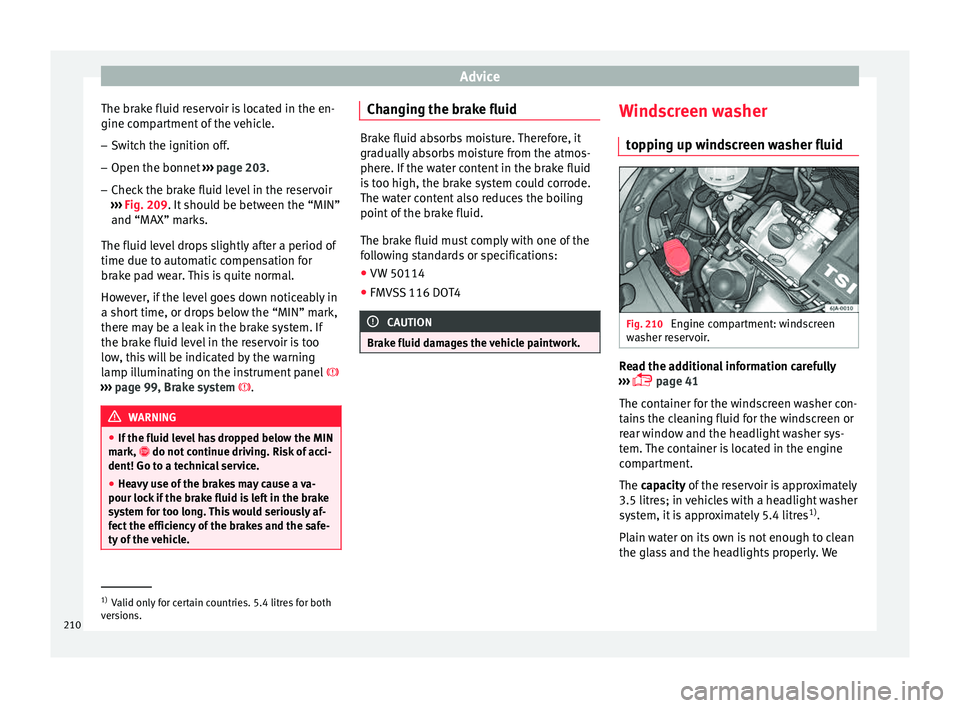
– Check the brake fluid level in the reservoir
›››
Fig. 209. It should be between the “MIN”
and “MAX” marks.
The fluid level drops slightly after a period of
time due to automatic compensation for
brake pad wear. This is quite normal.
However, if the level goes down noticeably in
a short time, or drops below the “MIN” mark,
there may be a leak in the brake system. If
the brake fluid level in the reservoir is too
low, this will be indicated by the warning
lamp illuminating on the instrument panel
››› page 99, Brake system . WARNING
● If the fluid l ev
el has dropped below the MIN
mark, do not continue driving. Risk of acci-
dent! Go to a technical service.
● Heavy use of the brakes may cause a va-
pour lock if
the brake fluid is left in the brake
system for too long. This would seriously af-
fect the efficiency of the brakes and the safe-
ty of the vehicle. Changing the brake fluid
Brake fluid absorbs moisture. Therefore, it
gra
dual
ly absorbs moisture from the atmos-
phere. If the water content in the brake fluid
is too high, the brake system could corrode.
The water content also reduces the boiling
point of the brake fluid.
The brake fluid must comply with one of the
following standards or specifications:
● VW 50114
● FMVSS 116 DOT4 CAUTION
Brake fluid damages the vehicle paintwork. Windscreen washer
top
pin
g up windscreen washer fluid Fig. 210
Engine compartment: windscreen
w a
sher r
eservoir. Read the additional information carefully
› ›
›
page 41
The container for the windscreen washer con-
tains the cleaning fluid for the windscreen or
rear window and the headlight washer sys-
tem. The container is located in the engine
compartment.
The capacity of the reservoir is approximately
3.5 litres; in vehicles with a headlight washer
system, it is approximately 5.4 litres 1)
.
Plain water on its own is not enough to clean
the glass and the headlights properly. We 1)
Valid only for certain countries. 5.4 litres for both
ver s
ions.
210
Page 227 of 248
Technical specifications
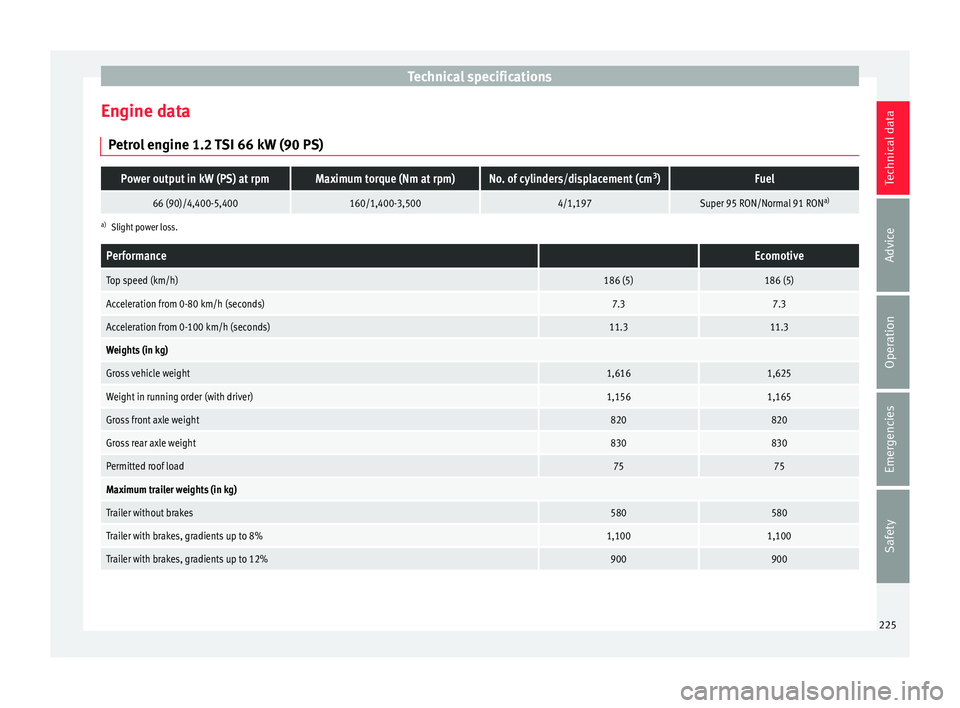
Engine data P etr
o
l engine 1.2 TSI 66 kW (90 PS)
Power output in kW (PS) at rpmMaximum torque (Nm at rpm)No. of cylinders/displacement (cm 3
)Fuel
66 (90)/4,400-5,400160/1,400-3,5004/1,197Super 95 RON/Normal 91 RON a)
a)
Slight power loss.
Performance Ecomotive
Top speed (km/h)186 (5)186 (5)
Acceleration from 0-80 km/h (seconds)7.37.3
Acceleration from 0-100 km/h (seconds)11.311.3
Weights (in kg)
Gross vehicle weight1,6161,625
Weight in running order (with driver)1,1561,165
Gross front axle weight820820
Gross rear axle weight830830
Permitted roof load7575
Maximum trailer weights (in kg)
Trailer without brakes580580
Trailer with brakes, gradients up to 8%1,1001,100
Trailer with brakes, gradients up to 12%900900 225
Technical data
Advice
Operation
Emergencies
Safety
Page 228 of 248
Technical data
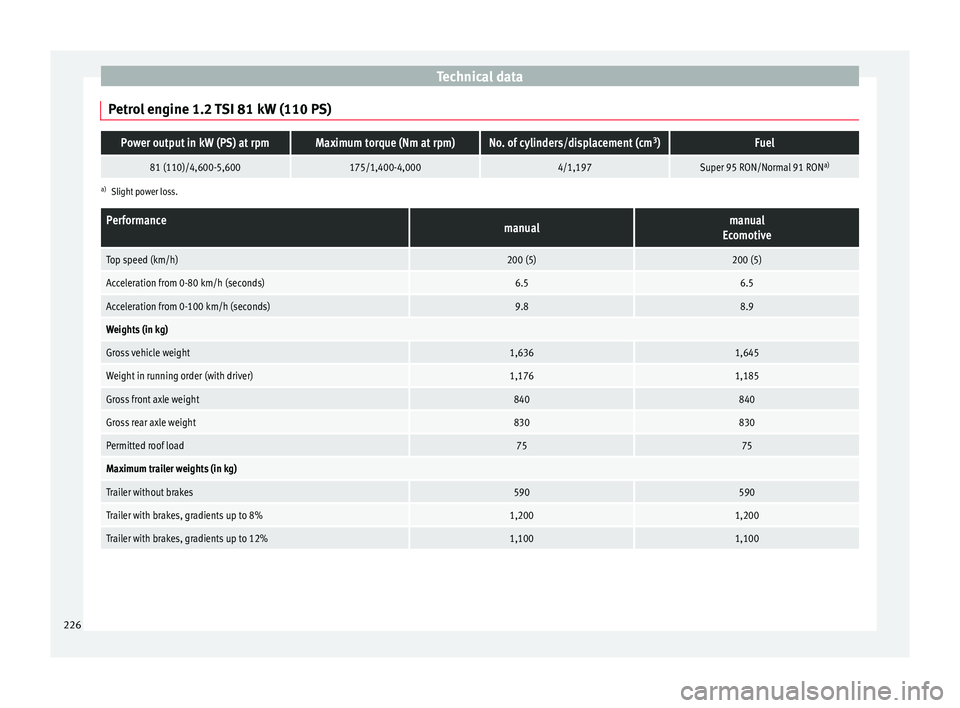
Petrol engine 1.2 TSI 81 kW (110 PS)Power output in kW (PS) at rpmMaximum torque (Nm at rpm)No. of cylinders/displacement (cm 3
)Fuel
81 (110)/4,600-5,600175/1,400-4,0004/1,197Super 95 RON/Normal 91 RON a)
a)
Slight power loss.
Performancemanualmanual
Ecomotive
Top speed (km/h)200 (5)200 (5)
Acceleration from 0-80 km/h (seconds)6.56.5
Acceleration from 0-100 km/h (seconds)9.88.9
Weights (in kg)
Gross vehicle weight1,6361,645
Weight in running order (with driver)1,1761,185
Gross front axle weight840840
Gross rear axle weight830830
Permitted roof load7575
Maximum trailer weights (in kg)
Trailer without brakes590590
Trailer with brakes, gradients up to 8%1,2001,200
Trailer with brakes, gradients up to 12%1,1001,100 226
Page 229 of 248
Technical specifications
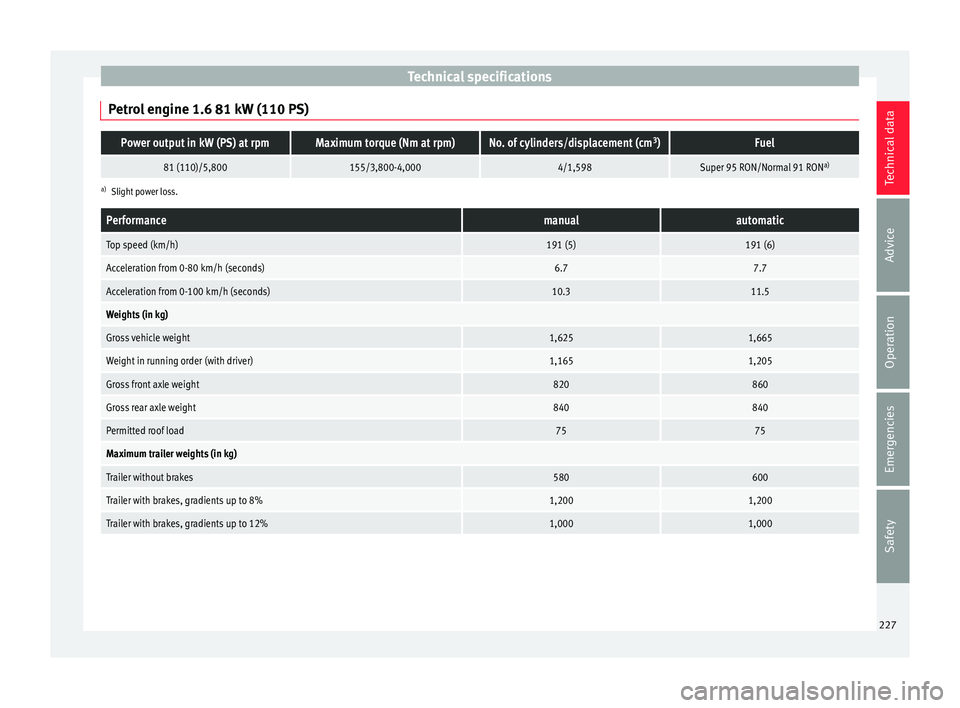
Petrol engine 1.6 81 kW (110 PS)Power output in kW (PS) at rpmMaximum torque (Nm at rpm)No. of cylinders/displacement (cm 3
)Fuel
81 (110)/5,800155/3,800-4,0004/1,598Super 95 RON/Normal 91 RON a)
a)
Slight power loss.
Performancemanualautomatic
Top speed (km/h)191 (5)191 (6)
Acceleration from 0-80 km/h (seconds)6.77.7
Acceleration from 0-100 km/h (seconds)10.311.5
Weights (in kg)
Gross vehicle weight1,6251,665
Weight in running order (with driver)1,1651,205
Gross front axle weight820860
Gross rear axle weight840840
Permitted roof load7575
Maximum trailer weights (in kg)
Trailer without brakes580600
Trailer with brakes, gradients up to 8%1,2001,200
Trailer with brakes, gradients up to 12%1,0001,000 227
Technical data
Advice
Operation
Emergencies
Safety
Page 230 of 248
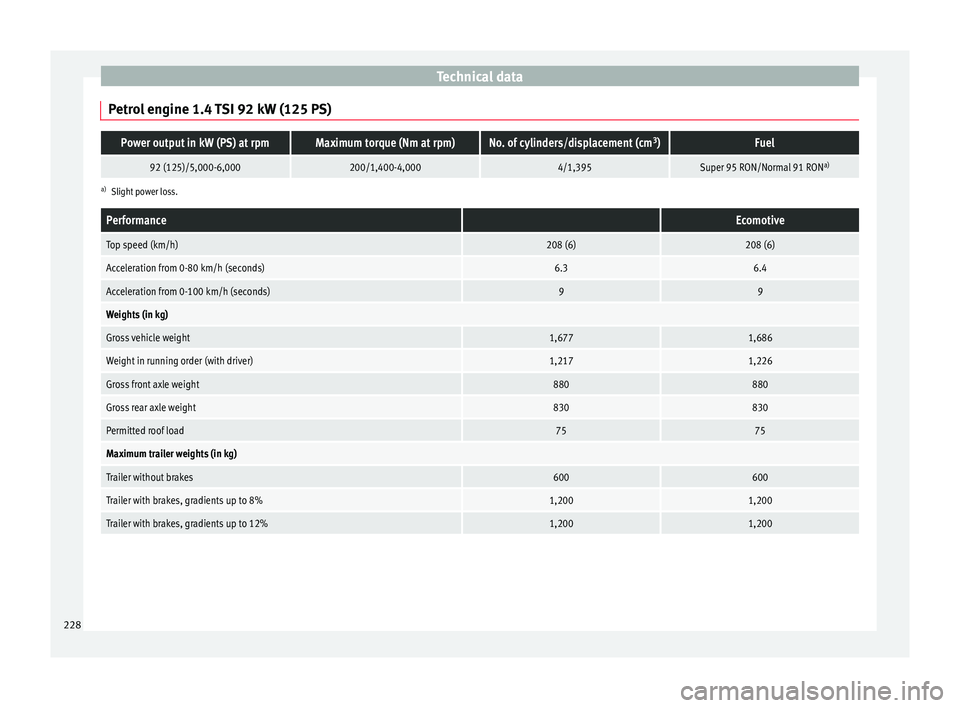
Technical data
Petrol engine 1.4 TSI 92 kW (125 PS)Power output in kW (PS) at rpmMaximum torque (Nm at rpm)No. of cylinders/displacement (cm 3
)Fuel
92 (125)/5,000-6,000200/1,400-4,0004/1,395Super 95 RON/Normal 91 RON a)
a)
Slight power loss.
Performance Ecomotive
Top speed (km/h)208 (6)208 (6)
Acceleration from 0-80 km/h (seconds)6.36.4
Acceleration from 0-100 km/h (seconds)99
Weights (in kg)
Gross vehicle weight1,6771,686
Weight in running order (with driver)1,2171,226
Gross front axle weight880880
Gross rear axle weight830830
Permitted roof load7575
Maximum trailer weights (in kg)
Trailer without brakes600600
Trailer with brakes, gradients up to 8%1,2001,200
Trailer with brakes, gradients up to 12%1,2001,200 228
Page 235 of 248
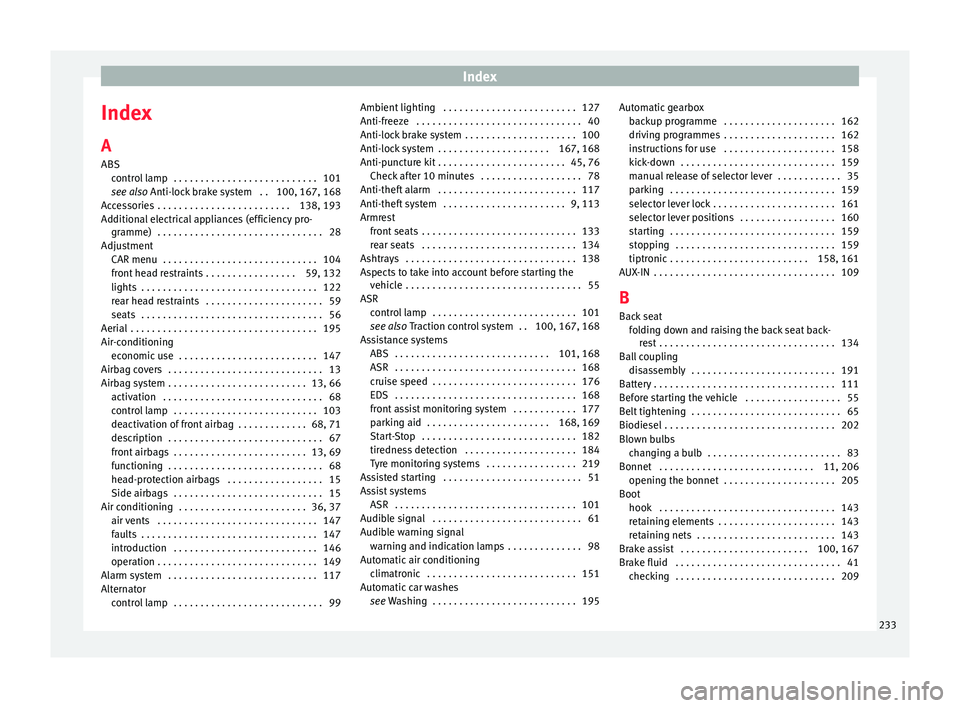
Index
Index
A
ABS contr
o
l lamp . . . . . . . . . . . . . . . . . . . . . . . . . . . 101
see also Anti-lock brake system . . 100, 167, 168
Accessories . . . . . . . . . . . . . . . . . . . . . . . . . 138, 193
Additional electrical appliances (efficiency pro- gramme) . . . . . . . . . . . . . . . . . . . . . . . . . . . . . . . 28
Adjustment CAR menu . . . . . . . . . . . . . . . . . . . . . . . . . . . . . 104
front head restraints . . . . . . . . . . . . . . . . . 59, 132
lights . . . . . . . . . . . . . . . . . . . . . . . . . . . . . . . . . 122
rear head restraints . . . . . . . . . . . . . . . . . . . . . . 59
seats . . . . . . . . . . . . . . . . . . . . . . . . . . . . . . . . . . 56
Aerial . . . . . . . . . . . . . . . . . . . . . . . . . . . . . . . . . . . 195
Air-conditioning economic use . . . . . . . . . . . . . . . . . . . . . . . . . . 147
Airbag covers . . . . . . . . . . . . . . . . . . . . . . . . . . . . . 13
Airbag system . . . . . . . . . . . . . . . . . . . . . . . . . . 13, 66 activation . . . . . . . . . . . . . . . . . . . . . . . . . . . . . . 68
control lamp . . . . . . . . . . . . . . . . . . . . . . . . . . . 103
deactivation of front airbag . . . . . . . . . . . . . 68, 71
description . . . . . . . . . . . . . . . . . . . . . . . . . . . . . 67
front airbags . . . . . . . . . . . . . . . . . . . . . . . . . 13, 69
functioning . . . . . . . . . . . . . . . . . . . . . . . . . . . . . 68
head-protection airbags . . . . . . . . . . . . . . . . . . 15
Side airbags . . . . . . . . . . . . . . . . . . . . . . . . . . . . 15
Air conditioning . . . . . . . . . . . . . . . . . . . . . . . . 36, 37 air vents . . . . . . . . . . . . . . . . . . . . . . . . . . . . . . 147
faults . . . . . . . . . . . . . . . . . . . . . . . . . . . . . . . . . 147
introduction . . . . . . . . . . . . . . . . . . . . . . . . . . . 146
operation . . . . . . . . . . . . . . . . . . . . . . . . . . . . . . 149
Alarm system . . . . . . . . . . . . . . . . . . . . . . . . . . . . 117
Alternator control lamp . . . . . . . . . . . . . . . . . . . . . . . . . . . . 99 Ambient lighting . . . . . . . . . . . . . . . . . . . . . . . . . 127
Anti-freeze
. . . . . . . . . . . . . . . . . . . . . . . . . . . . . . . 40
Anti-lock brake system . . . . . . . . . . . . . . . . . . . . . 100
Anti-lock system . . . . . . . . . . . . . . . . . . . . . 167, 168
Anti-puncture kit . . . . . . . . . . . . . . . . . . . . . . . . 45, 76 Check after 10 minutes . . . . . . . . . . . . . . . . . . . 78
Anti-theft alarm . . . . . . . . . . . . . . . . . . . . . . . . . . 117
Anti-theft system . . . . . . . . . . . . . . . . . . . . . . . 9, 113
Armrest front seats . . . . . . . . . . . . . . . . . . . . . . . . . . . . . 133
rear seats . . . . . . . . . . . . . . . . . . . . . . . . . . . . . 134
Ashtrays . . . . . . . . . . . . . . . . . . . . . . . . . . . . . . . . 138
Aspects to take into account before starting the vehicle . . . . . . . . . . . . . . . . . . . . . . . . . . . . . . . . . 55
ASR control lamp . . . . . . . . . . . . . . . . . . . . . . . . . . . 101
see also Traction control system . . 100, 167, 168
Assistance systems ABS . . . . . . . . . . . . . . . . . . . . . . . . . . . . . 101, 168
ASR . . . . . . . . . . . . . . . . . . . . . . . . . . . . . . . . . . 168
cruise speed . . . . . . . . . . . . . . . . . . . . . . . . . . . 176
EDS . . . . . . . . . . . . . . . . . . . . . . . . . . . . . . . . . . 168
front assist monitoring system . . . . . . . . . . . . 177
parking aid . . . . . . . . . . . . . . . . . . . . . . . 168, 169
Start-Stop . . . . . . . . . . . . . . . . . . . . . . . . . . . . . 182
tiredness detection . . . . . . . . . . . . . . . . . . . . . 184
Tyre monitoring systems . . . . . . . . . . . . . . . . . 219
Assisted starting . . . . . . . . . . . . . . . . . . . . . . . . . . 51
Assist systems ASR . . . . . . . . . . . . . . . . . . . . . . . . . . . . . . . . . . 101
Audible signal . . . . . . . . . . . . . . . . . . . . . . . . . . . . 61
Audible warning signal warning and indication lamps . . . . . . . . . . . . . . 98
Automatic air conditioning climatronic . . . . . . . . . . . . . . . . . . . . . . . . . . . . 151
Automatic car washes see Washing . . . . . . . . . . . . . . . . . . . . . . . . . . . 195 Automatic gearbox
back up programme . . . . . . . . . . . . . . . . . . . . . 162
driving programmes . . . . . . . . . . . . . . . . . . . . . 162
instructions for use . . . . . . . . . . . . . . . . . . . . . 158
kick-down . . . . . . . . . . . . . . . . . . . . . . . . . . . . . 159
manual release of selector lever . . . . . . . . . . . . 35
parking . . . . . . . . . . . . . . . . . . . . . . . . . . . . . . . 159
selector lever lock . . . . . . . . . . . . . . . . . . . . . . . 161
selector lever positions . . . . . . . . . . . . . . . . . . 160
starting . . . . . . . . . . . . . . . . . . . . . . . . . . . . . . . 159
stopping . . . . . . . . . . . . . . . . . . . . . . . . . . . . . . 159
tiptronic . . . . . . . . . . . . . . . . . . . . . . . . . . 158, 161
AUX-IN . . . . . . . . . . . . . . . . . . . . . . . . . . . . . . . . . . 109
B Back seat folding down and raising the back seat back- rest . . . . . . . . . . . . . . . . . . . . . . . . . . . . . . . . . 134
Ball coupling disassembly . . . . . . . . . . . . . . . . . . . . . . . . . . . 191
Battery . . . . . . . . . . . . . . . . . . . . . . . . . . . . . . . . . . 111
Before starting the vehicle . . . . . . . . . . . . . . . . . . 55
Belt tightening . . . . . . . . . . . . . . . . . . . . . . . . . . . . 65
Biodiesel . . . . . . . . . . . . . . . . . . . . . . . . . . . . . . . . 202
Blown bulbs changing a bulb . . . . . . . . . . . . . . . . . . . . . . . . . 83
Bonnet . . . . . . . . . . . . . . . . . . . . . . . . . . . . . 11, 206 opening the bonnet . . . . . . . . . . . . . . . . . . . . . 205
Boot hook . . . . . . . . . . . . . . . . . . . . . . . . . . . . . . . . . 143
retaining elements . . . . . . . . . . . . . . . . . . . . . . 143
retaining nets . . . . . . . . . . . . . . . . . . . . . . . . . . 143
Brake assist . . . . . . . . . . . . . . . . . . . . . . . . 100, 167
Brake fluid . . . . . . . . . . . . . . . . . . . . . . . . . . . . . . . 41 checking . . . . . . . . . . . . . . . . . . . . . . . . . . . . . . 209
233