service Seat Toledo 2016 Repair Manual
[x] Cancel search | Manufacturer: SEAT, Model Year: 2016, Model line: Toledo, Model: Seat Toledo 2016Pages: 248, PDF Size: 5.82 MB
Page 215 of 248

Checking and refilling levels
– Open the b att
er
y cover in the direction indi-
cated by the arrow ››› Fig. 211.
– The positive terminal (+) of the battery is
connected in r
everse order.
Checking the battery electrolyte level Fig. 212
Battery: Electrolyte level indicator. We recommend you have the acid level regu-
l
arly
c
hecked at an official technical service,
particularly in the following cases.
● At high outside temperatures.
● On long daily trips.
● Whenever the vehicle is loaded
›››
page 213, Charging the battery.
In vehicles equipped with a battery with col-
our indicator, the so-called magic eye
››› Fig. 212 changes colour to indicate the
acid level. Air bubbles can influence the colour of the in-
dicator
. Therefore, carefully knock the indica-
tor before checking the acid level.
● Black – the acid level is correct.
● Colourless or light yellow – acid level too
low, b
attery must be changed. Note
● The batt er
y acid level is also regularly
checked during servicing at authorised SEAT
dealers.
● The electrolyte level on “AGM” batteries
cannot be c
hecked for technical reasons.
● Vehicles equipped with the “Start-Stop”
syst
em include a battery control unit to con-
trol the battery level for repeated engine
starting. Winter service
At low temperatures the battery provides only
a fr
action of
the s
tarting power it has at nor-
mal temperatures.
A flat battery can also freeze at temperatures
slightly below to 0°C (32°F).
We therefore recommend you have the bat-
tery checked and, if necessary, charged at an
official SEAT technical service before the start
of winter. Charging the battery A fully-charged battery is essential for relia-
bl
e s
tarting.
– Switch off the ignition and all electrical
equipment.
– For “f
ast-charging” only: disconnect both
batter
y connection cables (first the “nega-
tive” terminal and then the “positive”).
– Connect the charger cables to the battery
terminal
s (red = “positive”, black = “nega-
tive”).
– Plug in the battery charger and switch on.
– After charging the battery: Switch off the
batt er
y charger and disconnect the cable.
– Remove the charger cables.
– If necessary, reconnect both battery cables
to the batt
ery (first the “positive” cable,
then the “negative” cable).
When charging with a low current (e.g. with a
small battery charger ), the battery does not
normally have to be disconnected. The in-
structions of the battery charger manufactur-
er must be followed.
Use a current equivalent to or lower than
10% of the battery capacity to fully charge
the battery.
Before “fast-charging” the battery however,
both battery cables must be disconnected. »
213
Technical data
Advice
Operation
Emergencies
Safety
Page 216 of 248
Advice
“Fast-charging” a battery is dan
g erous and
requires a battery charger and special knowl-
edge. Fast charges should be performed by
an official technical service.
The battery caps should not be opened while
the battery is being charged. CAUTION
In vehicles fitted with the “Start-Stop” sys-
tem, the c h
arger cable cannot be directly con-
nected to the negative terminal of the vehicle
battery but must be attached to the engine
ground point ›››
page 52. Disconnecting and connecting the
b
att
er
y The following functions will either be inoper-
ativ
e or w
i
ll not work properly after discon-
necting and reconnecting the battery:
FunctionInstallation
Setting the clock››› page 95
The multifunction display data
is deleted››› page 97 Note
We recommend having the vehicle checked by
an authorised S EA
T dealer to guarantee the
correct working order of all electrical sys-
tems. Replacing the battery
A replacement battery must have the same
cap
ac
ity, voltage, current rating and size as
the original. The appropriate types of battery
can be acquired from authorised SEAT deal-
ers.
We recommend having the battery changed
by an authorised SEAT dealer, where the new
battery will be correctly installed and the
original disposed of in line with regulations.
Automatic disconnection of electrical
equipment When heavily-charging a battery, the pro-
gr
amme sel
ect
ed by the electrical system
control unit prevents the battery from auto-
matically discharging. This may result in the
following:
● Increase in idling speed so that the alterna-
tor can s
upply more current to the electrical
system.
● The performance of certain electrical com-
ponents cou
ld be limited or some may switch
off temporarily, e.g. the heated seats, the
heated rear window, the 12 V power socket. Note
Despite any measures taken by the control
unit, the b att
ery could drain. e.g. with the en- gine is switched off, the key is turned in the
ignition for a lon
g period or the s
ide lights or
parking lights are switched on. The switching
off of certain electrical components does not
impair driving comfort and often the driver
will not even notice. 214
Page 218 of 248

Advice
Useful life of tyres Fig. 213
Side view of tyres with tread wear in-
dic at
or
s. Fig. 214
Location of the tyre pressure sticker. Tread wear indicator
The b
ase of
the side of the original tyres on
your vehicle show 1.6 mm high tread wear in-
dicators ››› Fig. 213. The position of these in-
dicators is given on the tyre sidewalls by the
letters “TWI”, triangular symbols or other
symbols.
The useful life of the tyres depends primarily
on the following factors:
Tyre pressure values
Under-inflation or over-inflation will consider-
ably reduce the useful life of the tyres and
impair the vehicle's handling. Therefore,
check the tyre pressure, including the spare
wheel, at least once a month and before any
long journey.
Inflation pressures for summer tyres are lis-
ted on a sticker inside the fuel tank flap
››› Fig. 214. The pressures for winter tyres are
0.2 bar (2.9 psi/20 kPa) above the summer
values.
Always check the pressure when the tyre is
cold. Do not reduce over-pressure in warm
tyres. The tyre pressures must be altered to
suit notable changes in the load being car-
ried.
Depending on the vehicle, tyre pressure can
be adjusted to medium load to improve driv-
ing comfort (“comfort” tyre pressure). When driving with comfort tyre pressure fuel con-
sumption ma
y increase slightly.
Driving style
Fast cornering, heavy acceleration and hard
braking all increase tyre wear.
Wheel balancing
The wheels on new vehicles are balanced.
Various factors encountered when driving
can cause them to become unbalanced,
which results in vibration of the steering
wheel.
The wheel must be rebalanced if a new tyre is
fitted or if a tyre is repaired.
Incorrect wheel alignment
Incorrect front or rear wheel alignment cau-
ses excessive tyre wear, frequently on one
side, and also impairs vehicle safety. If tyre
wear is very irregular, contact an Official
Service.
Tyre damage
To avoid damage to tyres and wheels, only
drive over kerbs or similar obstacles slowly
and at a right angle if possible.
Check tyres and wheels regularly for damage
(punctures, cracks, blisters, deformities,
etc.). Remove any foreign objects embedded
in outside of the treads.
216
Page 219 of 248
Wheels and tyres
Unusual vibration or the car pulling to one
s ide m
a
y indicate that one of the tyres is
damaged. Reduce speed immediately and
stop if you suspect that a wheel may have
been damaged! Check the tyres for damage
(blisters, cracks, etc.). If no external damage
is visible, drive slowly and carefully to the
nearest Official Service and have the vehicle
inspected.
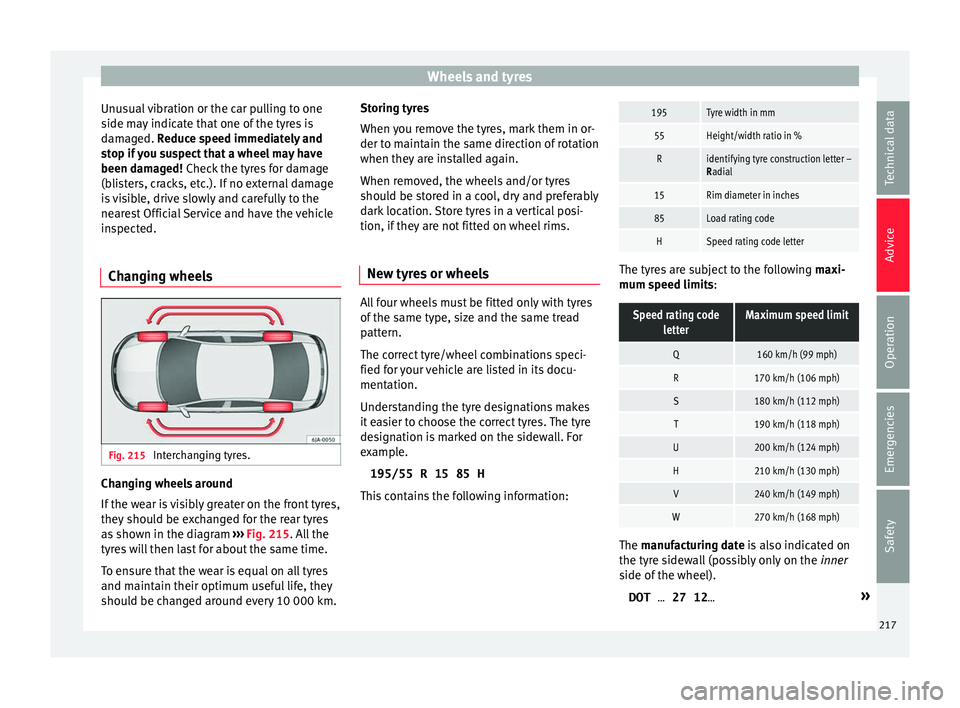
Changing wheels Fig. 215
Interchanging tyres. Changing wheels around
If
the w
e
ar is visibly greater on the front tyres,
they should be exchanged for the rear tyres
as shown in the diagram ››› Fig. 215. All the
tyres will then last for about the same time.
To ensure that the wear is equal on all tyres
and maintain their optimum useful life, they
should be changed around every 10 000 km. Storing tyres
When you r
emove the tyres, mark them in or-
der to maintain the same direction of rotation
when they are installed again.
When removed, the wheels and/or tyres
should be stored in a cool, dry and preferably
dark location. Store tyres in a vertical posi-
tion, if they are not fitted on wheel rims.
New tyres or wheels All four wheels must be fitted only with tyres
of
the s
ame type, s
ize and the same tread
pattern.
The correct tyre/wheel combinations speci-
fied for your vehicle are listed in its docu-
mentation.
Understanding the tyre designations makes
it easier to choose the correct tyres. The tyre
designation is marked on the sidewall. For
example.
195/55 R 15 85 H
This contains the following information:
195Tyre width in mm
55Height/width ratio in %
Ridentifying tyre construction letter –
Radial
15Rim diameter in inches
85Load rating code
HSpeed rating code letter The tyres are subject to the following
maxi-
mum s
peed limits:
Speed rating codeletterMaximum speed limit
Q160 km/h (99 mph)
R170 km/h (106 mph)
S180 km/h (112 mph)
T190 km/h (118 mph)
U200 km/h (124 mph)
H210 km/h (130 mph)
V240 km/h (149 mph)
W270 km/h (168 mph) The m
anufacturing date is also indicated on
the ty r
e sidewall (possibly only on the inner
side of the wheel).
DOT … 27 12… »
217
Technical data
Advice
Operation
Emergencies
Safety
Page 220 of 248
Advice
means, for example, that the tyre was pro-
duc ed in the 27th w
eek
of 2012.
Follow the instructions ››› page 218 if you
only have a temporary spare wheel. Note
A SEAT Service Centre should be consulted to
find out whether wheel s
or tyres of different
sizes to those originally fitted by SEAT can be
fitted, and to find out about the combinations
allowed between the front axle (axle 1) and
the rear axle (axle 2). Tyres with directional tread pattern
The direction of rotation is indicated by the
arr
o
w
s on the tyre sidewall . The direction of
rotation indicated must be respected. This
guarantees optimum grip and helps avoid ex-
cessive noise, wear and aquaplaning.
In the event of a flat tyre, a spare wheel with
an undetermined tread pattern or an oppo-
site tread pattern must be used and you must
drive carefully, as in these cases the tyres no
longer offer maximum performance. Spare wheel
Spar
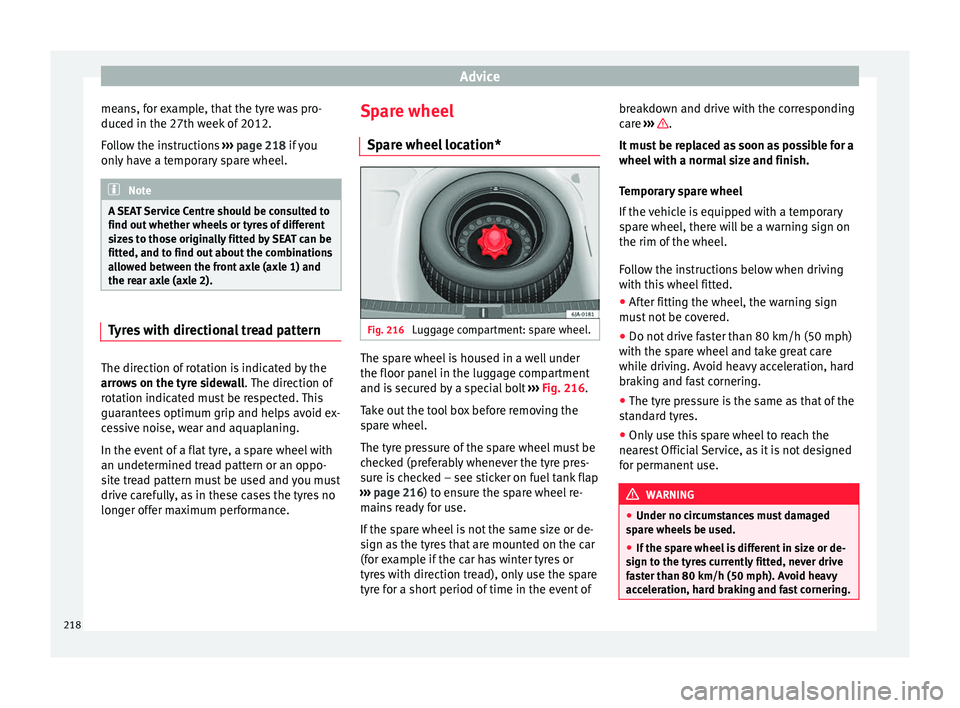
e wheel location* Fig. 216
Luggage compartment: spare wheel. The spare wheel is housed in a well under
the floor p
anel
in the lug
gage compartment
and is secured by a special bolt ››› Fig. 216.
Take out the tool box before removing the
spare wheel.
The tyre pressure of the spare wheel must be
checked (preferably whenever the tyre pres-
sure is checked – see sticker on fuel tank flap
››› page 216) to ensure the spare wheel re-
mains ready for use.
If the spare wheel is not the same size or de-
sign as the tyres that are mounted on the car
(for example if the car has winter tyres or
tyres with direction tread), only use the spare
tyre for a short period of time in the event of breakdown and drive with the corresponding
care
›
›› .
It mu
s
t be replaced as soon as possible for a
wheel with a normal size and finish.
Temporary spare wheel
If the vehicle is equipped with a temporary
spare wheel, there will be a warning sign on
the rim of the wheel.
Follow the instructions below when driving
with this wheel fitted.
● After fitting the wheel, the warning sign
must
not be covered.
● Do not drive faster than 80 km/h (50 mph)
with the sp
are wheel and take great care
while driving. Avoid heavy acceleration, hard
braking and fast cornering.
● The tyre pressure is the same as that of the
stand
ard tyres.
● Only use this spare wheel to reach the
neare
st Official Service, as it is not designed
for permanent use. WARNING
● Under no cir c
umstances must damaged
spare wheels be used.
● If the spare wheel is different in size or de-
sign to the ty
res currently fitted, never drive
faster than 80 km/h (50 mph). Avoid heavy
acceleration, hard braking and fast cornering. 218
Page 221 of 248
Wheels and tyres
CAUTION
Follow the instructions given on the tempora-
ry s
pare wheel label. Note
The tyre pressure of the spare wheel must al-
wa y
s correspond to the highest pressure pre-
scribed for the model of vehicle in question. Tyre monitoring systems
Ty r
e pressure* The tyre pressure monitoring system uses
ABS
sen
sor
s to compare the revolutions and
the circumference of each wheel. Should the
circumference of any wheel change, the
warning lamp on the general instrument
panel will light up and an audible warning
will be heard.
Tyre circumference may change if:
● Tyre pressure is too low
● Tyre structure is damaged
● Vehicle load not evenly distributed
● wheels on one axle are subjected to greater
load, (e.
g. driving with trailer, uphill, down-
hill);
● Snow chains are fitted
● The temporary spare wheel is fitted ●
One wheel on the axl
e has been changed
Basic system settings
Should the tyre pressure change or if one or
more wheels are changed or the position of
the wheel on the vehicle is changed, e.g.
changing round the front and rear wheels, or
where a warning lamp lights up when driv-
ing, the system must be adjusted as follows: ● Inflate all tyres to the prescribed pressures
›››
page 216.
● Switch the ignition on.
● Store the new tyre pressure in the Easy
Connect sy
stem with the button and the
f u
nction b
utton Setup
› ›
›
page 21.
The warning lamp lights up
If the pressure on at least one tyre is signifi-
cantly lower than the pressure set by the driv-
er, the warning lamp will light up ››› .
The w arnin
g l
amp flashes
If the warning lamp flashes, there is a fault in
the system. Contact a specialised service to
have it fixed. WARNING
● If the w arnin
g lamp lights up, slow down
immediately and avoid any severe braking or
steering manoeuvres. Stop and check the
tyres and their pressure as soon as possible. ●
Under cer t
ain conditions (e.g. sporty driv-
ing style, driving on loose surfaces or in win-
ter) the warning lamp may take a while to
light up or may remain switched off.
● Despite the tyre pressure monitoring sys-
tem, the driver r
emains responsible for main-
taining the correct tyre pressure. You must
therefore check the tyre pressure often. Note
● The ty re pr
essure monitoring system is not
a replacement for regularly checking the tyre
pressure, as it is unable to recognise an even
drop in pressure.
● The tyre pressure monitoring system is un-
able t
o warn of a sudden drop in tyre pres-
sure, e.g. a puncture. In this case, try to stop
the vehicle carefully with no severe braking
or steering manoeuvres.
● To ensure the tyre pressure monitoring sys-
tem work
s correctly, the basic setting must
be performed every 10 000 km (6000 miles)
or once a year.
● If the battery is disconnected the warning
lamp lights
up when the ignition is switch-
ed on. This warning lamp must switch off af-
ter covering a short distance. 219
Technical data
Advice
Operation
Emergencies
Safety
Page 222 of 248
Advice
Winter service W int
er ty
resWinter tyres will significantly improve han-
dling of
the
vehicle in winter road conditions.
The design of summer tyres (width, rubber
compound, tread pattern) gives less grip at
temperatures below +7°C (45°F), on ice and
snow. This applies particularly to vehicles
equipped with wide section tyres or high
speed tyres (code letters H or V on the side-
wall).
In order to preserve the performance of the
vehicle as much as possible, winter tyres
must be fitted on all four wheels, the mini-
mum depth of the tread must be 4 mm and
the maximum age must be 4 years.
You can use winter tyres of a lower speed rat-
ing if the maximum speed limit of these tyres
will not be exceeded, even if the maximum
speed limit for the vehicle is higher. For the sake of the environment
Summer tyres should be fitted again in time,
as they
give better handling on roads free of
snow and ice and at temperatures over +7°C
(45°F). Summer tyres have a shorter braking
distance, produce less rolling noise and do
not wear as quickly. They also reduce fuel
consumption. 220
Page 224 of 248
Technical data
Partial description of the vehicle
Di amet
er of
authorised tyre in inches 1)
Type plate
The model plate is located at the bottom of
the B pillar, between the front and rear doors,
on the right-hand side.
The type plate indicates the following
weights:
● Total permitted weight of the vehicle when
loaded
● M
aximum authorised weight of the vehicle
with a trai
ler, when the vehicle operates as a
tractor
● Maximum permitted load of the front axle
● Maximum permitted load of the rear axle
Weight in ru
nning order
The weight in running order only has one ap-
proximate value. This value corresponds to
the minimum operative weight of the vehicle
without additional equipment that increases
its weight, i.e. air conditioning, spare wheel,
towing bracket.
The running order weight also includes 75 kg
of the weight of the driver and service fluids,
in addition to a fuel tank at 90% capacity. 4 5 From the difference between the total permit-
t
ed w
eight
in running order the approximate
carrying capacity can be calculated ››› .
The c arr
y
ing capacity must include:
● occupants,
● all pieces of equipment and other weights,
● roof loads including the roof rack,
● equipment that is not included in the run-
ning order w
eight,
● when using the towing bracket, the draw-
bar loa
d (max. 50 kg)
Calculating fuel consumption and CO 2 emis-
sions according to the ECE regulations and
the EU specifications
Calculation of fuel consumption for urban
driving begins when cold-starting the engine.
Then, normal city driving is simulated.
In calculating extra-urban driving fuel con-
sumption, braking and acceleration is done
in all gears, as in daily use of the vehicle.
Driving speed varies within a range of 0 and
120 km/h (75 mph).
The consumption value in combined driving
is composed of 37% of the value of urban
driving and 63% of the value of extra-urban
driving. WARNING
The maximum permitted weight values must
not be e x
ceeded – Risk of an accident and
damage to the vehicle! Note
● If y
ou wish to calculate the exact weight of
your vehicle please contact a SEAT dealer.
● Depending on the volume of equipment,
driving s
tyle, road conditions, weather condi-
tions and the condition of the vehicle, con-
sumption values can differ from the theoreti-
cal values stated here. Information on fuel consump-
tion
Fuel
c
onsumption Approved consumption values are derived
fr
om me
a
surements performed or supervised
by certified EU laboratories, according to the
legislation in force at the time (for more infor-
mation, see the Publications Office of the Eu-
ropean Union on the EUR-Lex website: © Eu-
ropean Union, http://eur-lex.europa.eu/) and
apply to the specified vehicle characteristics. 1)
Valid only for certain countries.
222
Page 238 of 248
Index
starting . . . . . . . . . . . . . . . . . . . . . . . . . . . . . . . 149
s t
ar
ting the engine . . . . . . . . . . . . . . . . . . . . . . 152
switching off the engine . . . . . . . . . . . . . . . . . 152
Engine and ignition starting the engine with Keyless Access . . . . . 151
Engine compartment . . . . . . . . . . . . . . 11, 202, 205 battery . . . . . . . . . . . . . . . . . . . . . . . . . . . . . . . . 211
brake fluid . . . . . . . . . . . . . . . . . . . . . . . . . . . . . 209
coolant . . . . . . . . . . . . . . . . . . . . . . . . . . . . . . . 208
engine oil . . . . . . . . . . . . . . . . . . . . . . . . . . . . . 207
opening the bonnet . . . . . . . . . . . . . . . . . . . . . 203
windscreen washer fluid . . . . . . . . . . . . . . . . . 210
Engine coolant . . . . . . . . . . . . . . . . . . . . . . . . . . . . 40 checking level . . . . . . . . . . . . . . . . . . . . . . . . . . 208
control lamp . . . . . . . . . . . . . . . . . . . . . . . . . . . 208
G12 plus-plus . . . . . . . . . . . . . . . . . . . . . . . . . . . 40
G13 . . . . . . . . . . . . . . . . . . . . . . . . . . . . . . . . . . . 40
specifications . . . . . . . . . . . . . . . . . . . . . . . . . . . 40
topping up . . . . . . . . . . . . . . . . . . . . . . . . . . . . 209
Engine data . . . . . . . . . . . . . . . . . . . . . . . . . . . . . . 225
Engine fault control lamp . . . . . . . . . . . . . . . . . . . . . . . . . . . 165
Engine management . . . . . . . . . . . . . . . . . . . . . . 164 control lamp . . . . . . . . . . . . . . . . . . . . . . . . . . . 165
Engine oil . . . . . . . . . . . . . . . . . . . . . . . . . . . 40, 205 changing . . . . . . . . . . . . . . . . . . . . . . . . . 205, 208
checking oil level . . . . . . . . . . . . . . . . . . . . . . . 207
consumption . . . . . . . . . . . . . . . . . . . . . . . . . . . 207
control lamp . . . . . . . . . . . . . . . . . . . . . . . . . . . 206
dipstick . . . . . . . . . . . . . . . . . . . . . . . . . . . . . . . 207
inspection service . . . . . . . . . . . . . . . . . . . . . . 205
maintenance intervals . . . . . . . . . . . . . . . . . . . 205
Oil properties . . . . . . . . . . . . . . . . . . . . . . . . . . . 40
specifications . . . . . . . . . . . . . . . . . . . . . . . . . . 205
temperature display . . . . . . . . . . . . . . . . . . . . . . 28
topping up . . . . . . . . . . . . . . . . . . . . . . . . . . . . 207 Environment
ecologic al driving . . . . . . . . . . . . . . . . . . . . . . . 162
environmental compatibility . . . . . . . . . . . . . . 162
Environmental tip refuelling . . . . . . . . . . . . . . . . . . . . . . . . . . . . . . 199
Equipment . . . . . . . . . . . . . . . . . . . . . . . . . 134, 192
ESC electronic stability control . . . . . . . . . . . . . . . . 154
Ethanol (fuel) . . . . . . . . . . . . . . . . . . . . . . . . . . . . 200
Exhaust gas purification system catalytic converter . . . . . . . . . . . . . . . . . . . . . . 164
diesel particulate filter . . . . . . . . . . . . . . . . . . . 164
Extending the luggage compartment . . . . . . . . . . . . . . . . 130
Exterior lighting change a bulb . . . . . . . . . . . . . . . . . . . . . . . . . . . 83
Exterior mirrors adjusting . . . . . . . . . . . . . . . . . . . . . . . . . . . . . . . 13
exterior . . . . . . . . . . . . . . . . . . . . . . . . . . . . . . . 126
heated . . . . . . . . . . . . . . . . . . . . . . . . . . . . . . . . 126
Exterior view . . . . . . . . . . . . . . . . . . . . . . . . . . . . . 5, 6
External aerial . . . . . . . . . . . . . . . . . . . . . . . . . . . . 193
F Fastening rings . . . . . . . . . . . . . . . . . . . . . . . . . . . 137
Filling up the tank . . . . . . . . . . . . . . . . . . . . . . . . 199
Fire extinguisher . . . . . . . . . . . . . . . . . . . . . . . . . . . 75
First-aid kit . . . . . . . . . . . . . . . . . . . . . . . . . . . . . . . 75
Floor mats . . . . . . . . . . . . . . . . . . . . . . . . . . . . . . . . 60
Fluid Level control . . . . . . . . . . . . . . . . . . . . . . . . . 39
Fog light bulb . . . . . . . . . . . . . . . . . . . . . . . . . . . . . 86 removing the bulb holder . . . . . . . . . . . . . . . . . 87
Front Airbag . . . . . . . . . . . . . . . . . . . . . . . . . . . . . . 14
Front airbags . . . . . . . . . . . . . . . . . . . . . . . . . . . . . 69
Front Assist city Emergency braking function . . . . . . . . . . . 180
malfunction . . . . . . . . . . . . . . . . . . . . . . . . . . . . 177 on-screen messages . . . . . . . . . . . . . . . . . . . . 177
operating
. . . . . . . . . . . . . . . . . . . . . . . . . . . . . . 178
radar sensor . . . . . . . . . . . . . . . . . . . . . . . . . . . 177
switching off temporarily . . . . . . . . . . . . . . . . . 179
system limitations . . . . . . . . . . . . . . . . . . . . . . 179
see also Front Assist Monitoring system . . . . . 176
Front Assist monitoring system malfunction . . . . . . . . . . . . . . . . . . . . . . . . . . . . 177
on-screen messages . . . . . . . . . . . . . . . . . . . . 177
operating . . . . . . . . . . . . . . . . . . . . . . . . . . . . . . 178
Front Assist Monitoring system . . . . . . . . . . . . . . 176 city Emergency braking function . . . . . . . . . . . 180
radar sensor . . . . . . . . . . . . . . . . . . . . . . . . . . . 177
Front Assist Monitoring System switching off temporarily . . . . . . . . . . . . . . . . . 179
system limitations . . . . . . . . . . . . . . . . . . . . . . 179
Front passenger front airbag control lamp . . . . . . . . . . . . . . . . . . . . . . . . . . . . 71
deactivating . . . . . . . . . . . . . . . . . . . . . . . . . . . . 14
deactivation . . . . . . . . . . . . . . . . . . . . . . . . . . . . 71
Front seat heating . . . . . . . . . . . . . . . . . . . . . . . . . . . . . . . 128
manual adjustment . . . . . . . . . . . . . . . . . . . . . . 11
Front seats . . . . . . . . . . . . . . . . . . . . . . . . . . . . . . 127
Fuel . . . . . . . . . . . . . . . . . . . . . . . . . . . . . . . . . . . . . 39 diesel . . . . . . . . . . . . . . . . . . . . . . . . . . . . . . . . . 201
fuel level gauge . . . . . . . . . . . . . . . . . . . . . . . . . 98
refuelling . . . . . . . . . . . . . . . . . . . . . . . . . 199, 200
saving . . . . . . . . . . . . . . . . . . . . . . . . . . . . . . . . 162
Fuel consumption switching off using inertia . . . . . . . . . . . . . . . . 162
why does fuel consumption increase? . . . . . . 164
Fuel tank flap opening and closing . . . . . . . . . . . . . . . . . . . . . 39
Full-LED Headlights . . . . . . . . . . . . . . . . . . . . . . . . 83
236
Page 239 of 248
Index
Fuses . . . . . . . . . . . . . . . . . . . . . . . . . . . . . . . . . . . . 80 identif y
in
g blown fuses . . . . . . . . . . . . . . . . . . . 43
identifying by colours . . . . . . . . . . . . . . . . . . . . . 43
in the dash panel . . . . . . . . . . . . . . . . . . . . . . . . 81
in the engine compartment . . . . . . . . . . . . . . . . 82
in the instrument panel . . . . . . . . . . . . . . . . . . . 43
preparation before replacing . . . . . . . . . . . . . . . 43
replacing . . . . . . . . . . . . . . . . . . . . . . . . . . . . . . . 43
G Gauge fuel level . . . . . . . . . . . . . . . . . . . . . . . . . . . . . . . 98
Gear-change indicator . . . . . . . . . . . . . . . . . . . . . . 25
Gearbox lever . . . . . . . . . . . . . . . . . . . . . . . . . . . . . 34
Gear change . . . . . . . . . . . . . . . . . . . . . . . . . . . . . . 34 automatic . . . . . . . . . . . . . . . . . . . . . . . . . . . . . . 35
engaging the gears (manual gearbox) . . . . . . 156
manual . . . . . . . . . . . . . . . . . . . . . . . . . . . . . . . . 34
manual gearbox . . . . . . . . . . . . . . . . . . . . . . . . 156
Gear engaged . . . . . . . . . . . . . . . . . . . . . . . . . . . . . 34
Gear recommendation . . . . . . . . . . . . . . . . . . . . . . 25
Gearshift paddles (automatic gearbox) . . . . . . . 159
General instrument panel control lamps . . . . . . . . . . . . . . . . . . . . . . . . . . . 32
controls and displays . . . . . . . . . . . . . . . . . . . . . 93
warning lamps . . . . . . . . . . . . . . . . . . . . . . . . . . 32
GRA . . . . . . . . . . . . . . . . . . . . . . . . . . . . . . . . . . . . 174 see also Cruise control . . . . . . . . . . . . . . . . . . . 174
H
Handbrake . . . . . . . . . . . . . . . . . . . . . . . . . 152, 154
Hand brake control lamp . . . . . . . . . . . . . . . . . . . . . . . . . . . 154
Hazard warning lights . . . . . . . . . . . . . . . . . 19, 121
HBA . . . . . . . . . . . . . . . . . . . . . . . . . . . . . . . . . . . . 154 Head-protection airbags
desc ription . . . . . . . . . . . . . . . . . . . . . . . . . . . . . 16
safety instructions . . . . . . . . . . . . . . . . . . . . . . . 70
Headlight range control . . . . . . . . . . . . . . . . . . . . 117
Headlights change a bulb . . . . . . . . . . . . . . . . . . . . . . . . . . . 83
driving abroad . . . . . . . . . . . . . . . . . . . . . . . . . 122
headlight washers . . . . . . . . . . . . . . . . . . . . . . 126
Head restraints . . . . . . . . . . . . . . . . . . . . . . . . . . . . 12 adjustment . . . . . . . . . . . . . . . . . . . . . . . . . . . . 128
front head restraints . . . . . . . . . . . . . . . . . . . . . . 59
rear head restraints . . . . . . . . . . . . . . . . . . . . . . 59
Headrests . . . . . . . . . . . . . . . . . . . . . . . . . . . . . . . . 12 adjustment . . . . . . . . . . . . . . . . . . . . . . . . . . . . 128
front . . . . . . . . . . . . . . . . . . . . . . . . . . . . . . . . . . . 59
rear . . . . . . . . . . . . . . . . . . . . . . . . . . . . . . . . . . . 59
Heated rear window . . . . . . . . . . . . . . . . . . . . . . . 123
Heating . . . . . . . . . . . . . . . . . . . . . . . . . . . . . . . . . 144 air recirculation . . . . . . . . . . . . . . . . . . . . . . . . . 144
introduction . . . . . . . . . . . . . . . . . . . . . . . . . . . 142
rear window . . . . . . . . . . . . . . . . . . . . . . . . . . . 123
Heating and fresh air . . . . . . . . . . . . . . . . . . . . . . . 38
HHC . . . . . . . . . . . . . . . . . . . . . . . . . . . . . . . . . . . . 154
Hill hold control . . . . . . . . . . . . . . . . . . . . . . . . . . 154
Horn . . . . . . . . . . . . . . . . . . . . . . . . . . . . . . . . . . . . 93
How to jump start . . . . . . . . . . . . . . . . . . . . . . . . . . 51 description . . . . . . . . . . . . . . . . . . . . . . . . . . . . . 52
I
Identifying letters on engine . . . . . . . . . . . . . . . . 221
Ignition . . . . . . . . . . . . . . . . . . . . . . . . . 18, 149, 151
Ignition lock . . . . . . . . . . . . . . . . . . . . . 18, 149, 151
Incorrect sitting position . . . . . . . . . . . . . . . . . . . . 58
Indications on the display . . . . . . . . . . . . . . . . . . . 95 assist systems submenu . . . . . . . . . . . . . . . . . . 26
compass . . . . . . . . . . . . . . . . . . . . . . . . . . . . . . . 96
distance travelled . . . . . . . . . . . . . . . . . . . . . . . . 95 doors, bonnet and rear lid open . . . . . . . . . . . . 25
driver inform
ation system . . . . . . . . . . . . . . . . . 23
driving data . . . . . . . . . . . . . . . . . . . . . . . . . . . . . 26
ECO . . . . . . . . . . . . . . . . . . . . . . . . . . . . . . . . . . . 96
MKB . . . . . . . . . . . . . . . . . . . . . . . . . . . . . . . . . . . 96
outside temperature . . . . . . . . . . . . . . . . . . . . . . 24
recommended gear . . . . . . . . . . . . . . . . . . . . . . 96
second speed display . . . . . . . . . . . . . . . . . . . . 96
selector lever position . . . . . . . . . . . . . . . 96, 158
service intervals . . . . . . . . . . . . . . . . . . . . . . . . . 30
speed warning . . . . . . . . . . . . . . . . . . . . . . . . . . 96
Start-Stop . . . . . . . . . . . . . . . . . . . . . . . . . . . . . . 96
time . . . . . . . . . . . . . . . . . . . . . . . . . . . . . . . . . . . 96
warning and information messages . . . . . . . . . 26
Infotainment system . . . . . . . . . . . . . . . . . . . . . . . 21
Inspection . . . . . . . . . . . . . . . . . . . . . . . . . . . . . . . 205
Inspection service . . . . . . . . . . . . . . . . . . . . . . . . 205
Instrument panel . . . . . . . . . . . . . . . . . . . . . . . . . . 94 display . . . . . . . . . . . . . . . . . . . . . . . . . . . . . . 94, 95
instruments . . . . . . . . . . . . . . . . . . . . . . . . . . . . . 94
odometer . . . . . . . . . . . . . . . . . . . . . . . . . . . . . . . 97
service interval indication . . . . . . . . . . . . . . . . . 30
warning and control lamps . . . . . . . . . . . . . . . . 98
warning and indication lamps . . . . . . . . . . . . . . 98
Instruments . . . . . . . . . . . . . . . . . . . . . . . . . . . . . . 94
Interior lighting . . . . . . . . . . . . . . . . . . . . . . . . . . . . . . . 122
Interior lights . . . . . . . . . . . . . . . . . . . . . . . . . . . . . 20
Interior view left guide . . . . . . . . . . . . . . . . . . . . . . . . . . . . . . . . 7
right-hand drive . . . . . . . . . . . . . . . . . . . . . . . . . . 8
ISOFIX . . . . . . . . . . . . . . . . . . . . . . . . . . . . . . . . . . . 17
ISOFIX system . . . . . . . . . . . . . . . . . . . . . . . . . . . . . 17
J Jack . . . . . . . . . . . . . . . . . . . . . . . . . . . . . . . . . . 46, 75 mounting points . . . . . . . . . . . . . . . . . . . . . . . . . 48
237