ignition Seat Toledo 2017 Workshop Manual
[x] Cancel search | Manufacturer: SEAT, Model Year: 2017, Model line: Toledo, Model: Seat Toledo 2017Pages: 248, PDF Size: 5.86 MB
Page 129 of 248
Lights and visibility
Where the courtesy light is on (switch A›››
Fig. 136 in po s
ition ), the light will come
on if:
● the vehicle is unlocked,
● one of the doors is opened,
● The key is removed from the ignition
When the court
esy light is on (switch A in
po s
ition
), the light will switch off if:
● the vehicle is locked,
● the ignition is switched on,
● 30 seconds after all of the doors have been
closed
If
a door is left open or if switch A is in the
po s
ition, the int
erior lighting switches off
after about 10 minutes to prevent the battery
from running flat.
Rear interior light Fig. 138
Rear interior light. Press the button
››
›
Fig. 138 to switch the
lighting on or off.
Interior lights / ambient light* The lighting of the central console area, the
door handl
e
s, the storage pockets in the
front doors and the footwell area will switch
on fully when the doors are opened and will
decrease in intensity while driving with the
dipped beam headlights on.
Depending on the version, a logo is back-lit
on the front passenger's side of the dash
panel. This light comes on when the dipped
beam is activated.
The intensity of the ambient light* can be ad-
justed using the menu Easy Connect > Lighting settings > Vehicle inte-
rior lighting ›››
page 21.
Glove box light The light will come on automatically when
the glo
v
e c
ompartment is opened. The light
will go out when the glove compartment is
closed. Luggage compartment light The light switches on automatically when the
boot i
s
open and switches off automatically
10 minutes after the boot lid has been
opened.
Visibility Heated r
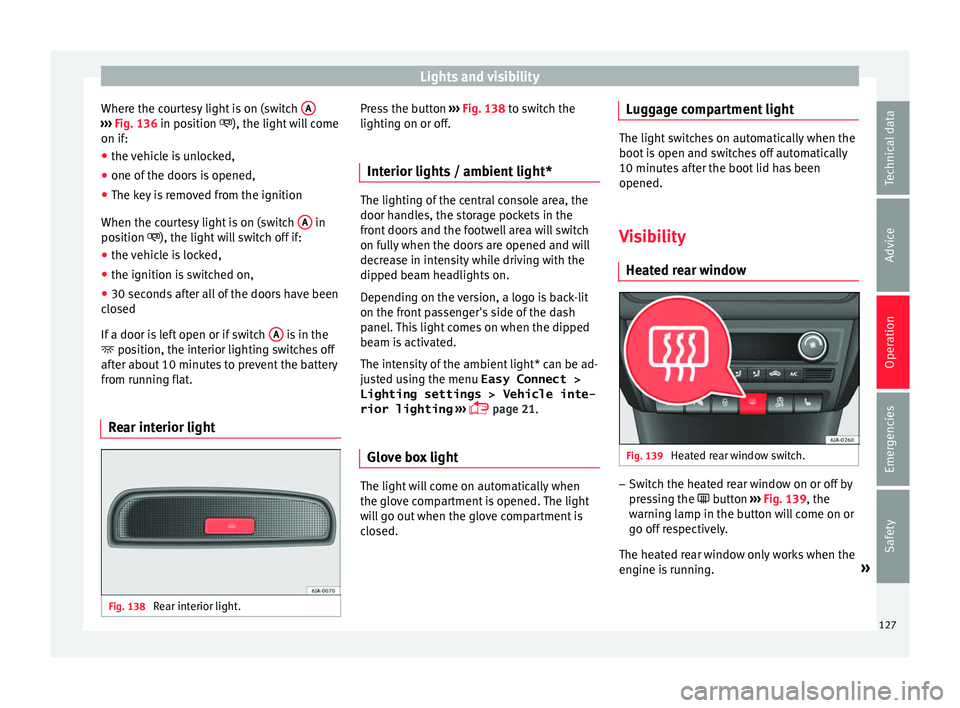
ear window Fig. 139
Heated rear window switch. –
Switch the heated rear window on or off by
pr e
s
sing the button ›››
Fig. 139, the
warning lamp in the button will come on or
go off respectively.
The heated rear window only works when the
engine is running. »
127
Technical data
Advice
Operation
Emergencies
Safety
Page 130 of 248
Operation
After approximately 7 minutes, the heating
dev ic
e of
the rear window switches off auto-
matically. For the sake of the environment
The heated rear window should be switched
off a s
soon as the glass is demisted. By sav-
ing electrical power you can also save fuel
››› page 166. Note
In the event of a drop in voltage in the on-
boar d sy
stems, the heated rear window
switches off automatically to ensure enough
power to control the engine ››› page 216, Au-
tomatic disconnection of electrical equip-
ment. Sun visors
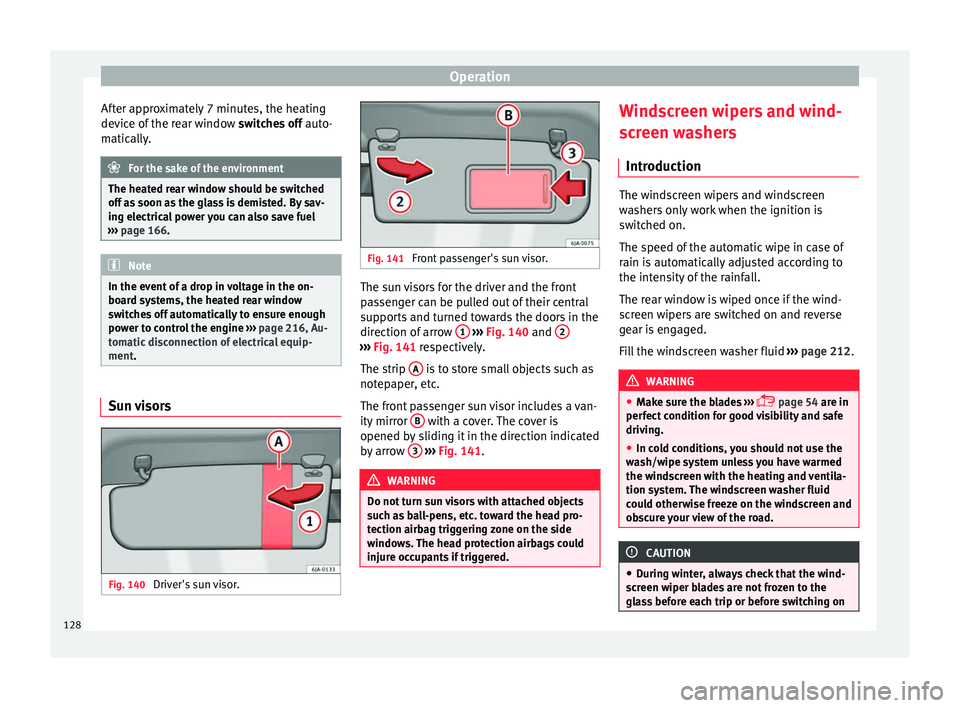
Fig. 140
Driver's sun visor. Fig. 141
Front passenger's sun visor. The sun visors for the driver and the front
p
a
s
senger can be pulled out of their central
supports and turned towards the doors in the
direction of arrow 1
› ›
› Fig. 140
and 2 ›››
Fig. 141 re s pectively.
The strip A is to store small objects such as
not ep
aper
, etc.
The front passenger sun visor includes a van-
ity mirror B with a cover. The cover is
opened b y
s
liding it in the direction indicated
by arrow 3
› ›
› Fig. 141
. WARNING
Do not turn sun visors with attached objects
suc h a
s ball-pens, etc. toward the head pro-
tection airbag triggering zone on the side
windows. The head protection airbags could
injure occupants if triggered. Windscreen wipers and wind-
s
c
r
een washers
Introduction The windscreen wipers and windscreen
wa
sher
s only work when the ignition is
switched on.
The speed of the automatic wipe in case of
rain is automatically adjusted according to
the intensity of the rainfall.
The rear window is wiped once if the wind-
screen wipers are switched on and reverse
gear is engaged.
Fill the windscreen washer fluid ›››
page 212. WARNING
● Mak e s
ure the blades ›››
page 54 are in
perfect condition for good visibility and safe
driving.
● In cold conditions, you should not use the
wash/w
ipe system unless you have warmed
the windscreen with the heating and ventila-
tion system. The windscreen washer fluid
could otherwise freeze on the windscreen and
obscure your view of the road. CAUTION
● Durin g w
inter, always check that the wind-
screen wiper blades are not frozen to the
glass before each trip or before switching on 128
Page 131 of 248
Lights and visibility
the ignition. If you switch on the windscreen
wiper
s
when the wiper blades are frozen to
the glass, this could damage both the wiper
blades and the wiper motor.
● If the ignition is switched off when the
winds
creen wipers are on, they will start op-
erating in the same mode when the ignition
is switched back on. The wiper blades may be
frozen to the glass at low temperatures when
the ignition is switched off.
● Carefully separate the frozen wipers from
the winds
creen or rear window.
● Remove snow and ice from the wipers be-
fore s
tarting your journey.
● Careless handling could lead to the wiper
arms dam
aging the windscreen.
● For safety reasons, the wiper blades should
be chan
ged once or twice a year. They can be
purchased at a SEAT Authorised Service.
● The ignition cannot be switched on while
the winds
creen wiper arms are in a raised po-
sition. Otherwise, the windscreen wipers
would return to their original position and
could damage the paintwork on the bonnet. Note
Keep the wipers clean. The wipers can be
soil ed w
ith remains of wax solutions from car
washes ››› page 196.
● On vehicles equipped with windscreen
washer j
ets, these are heated once the en-
gine is running. Operating windscreen wipers and
w
a
sher
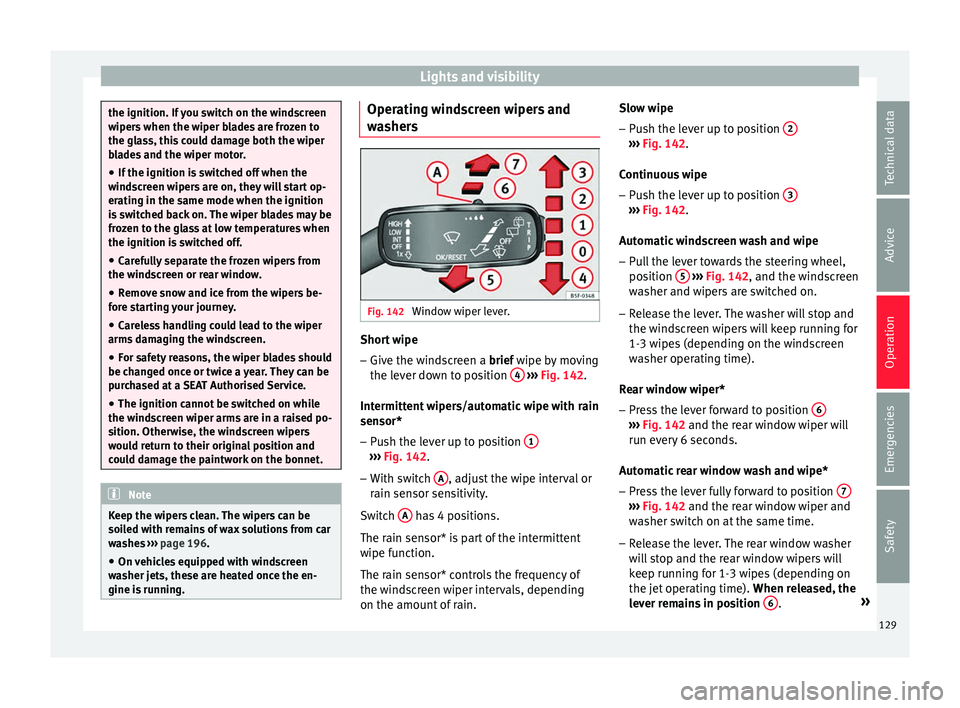
s Fig. 142
Window wiper lever. Short wipe
– Give the windscreen a brief w ipe b
y
moving
the lever down to position 4
› ›
› Fig. 142 .
Intermittent wipers/automatic wipe with rain
sensor* – Push the lever up to position 1 ›››
Fig. 142.
– With switch A , adjust the wipe interval or
r ain sen
sor sen
sitivity.
Switch A has 4 positions.
The r ain sen
sor* i
s part of the intermittent
wipe function.
The rain sensor* controls the frequency of
the windscreen wiper intervals, depending
on the amount of rain. Slow wipe
–
Push the lever up to position 2 ›››
Fig. 142.
C ontinuou
s
wipe
– Push the lever up to position 3 ›››
Fig. 142.
Aut om
atic
windscreen wash and wipe
– Pull the lever towards the steering wheel,
position 5
› ››
Fig. 142
, and the w
indscreen
washer and wipers are switched on.
– Release the lever. The washer will stop and
the winds
creen wipers will keep running for
1-3 wipes (depending on the windscreen
washer operating time).
Rear window wiper*
– Press the lever forward to position 6 ›››
Fig. 142 and the re ar w
indow wiper will
run every 6 seconds.
Automatic rear window wash and wipe* – Press the lever fully forward to position 7 ›››
Fig. 142 and the re ar w
indow wiper and
washer switch on at the same time.
– Release the lever. The rear window washer
wi l
l stop and the rear window wipers will
keep running for 1-3 wipes (depending on
the jet operating time). When released, the
lever remains in position 6 .
»
129
Technical data
Advice
Operation
Emergencies
Safety
Page 139 of 248
Transport and practical equipment
●
Do not u se c
ups or glasses made of fragile
materials (e.g. glass or china). These could
cause injury in the event of an accident. CAUTION
Avoid putting open drinks containers in the
drink hol
der while the vehicle is moving.
They could spill (e.g. on braking) and cause
damage to the electrical equipment or the
seat covers. Drink holder in rear seat armrest
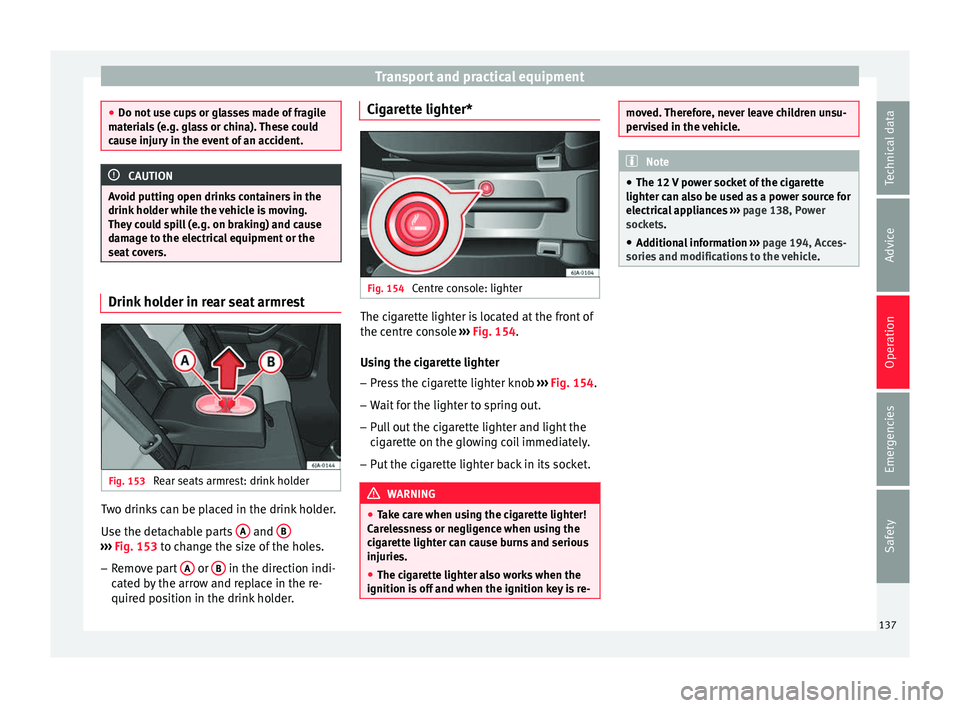
Fig. 153
Rear seats armrest: drink holder Two drinks can be placed in the drink holder.
U
se the det
ac
hable parts A and
B ›››
Fig. 153 to c h
ange the size of the holes.
– Remove part A or
B in the direction indi-
c at ed b
y the arrow and replace in the re-
quired position in the drink holder. Cigarette lighter*
Fig. 154
Centre console: lighter The cigarette lighter is located at the front of
the c
entr
e c
onsole ››› Fig. 154.
Using the cigarette lighter – Press the cigarette lighter knob ›››
Fig. 154.
– Wait for the lighter to spring out.
– Pull out the cigarette lighter and light the
cigar
ette on the glowing coil immediately.
– Put the cigarette lighter back in its socket. WARNING
● Tak e c
are when using the cigarette lighter!
Carelessness or negligence when using the
cigarette lighter can cause burns and serious
injuries.
● The cigarette lighter also works when the
ignition is off
and when the ignition key is re- moved. Therefore, never leave children unsu-
perv
i
sed in the vehicle. Note
● The 12 V po
wer socket of the cigarette
lighter can also be used as a power source for
electrical appliances ››› page 138, Power
sockets.
● Additional information ›››
page 194, Acces-
sories and modifications to the vehicle . 137
Technical data
Advice
Operation
Emergencies
Safety
Page 140 of 248
Operation
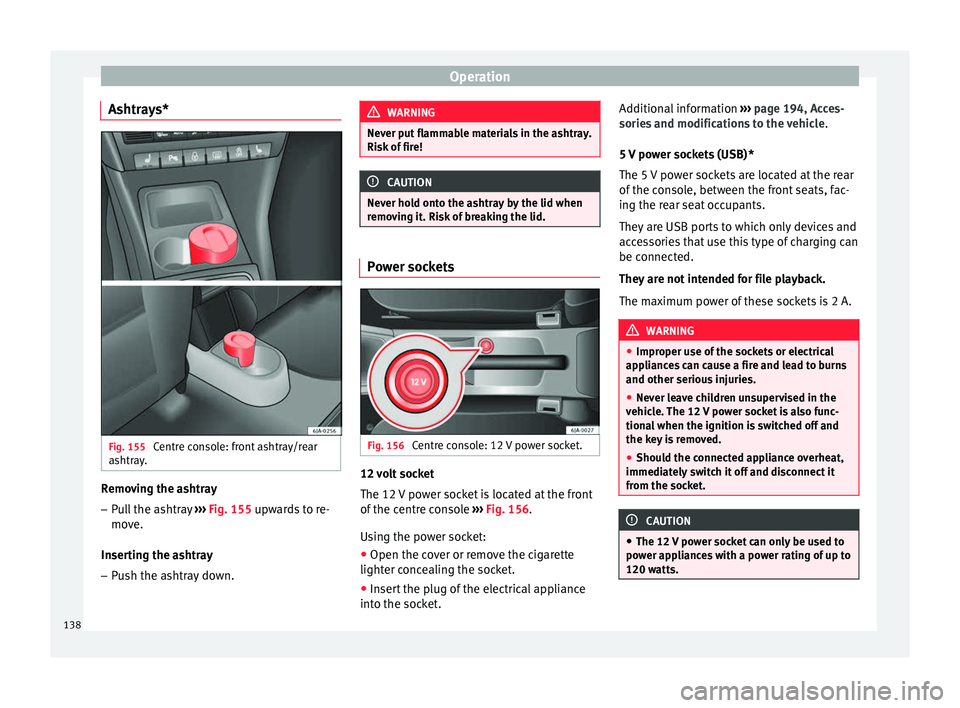
Ashtrays* Fig. 155
Centre console: front ashtray/rear
a shtr
a
y. Removing the ashtray
– Pull the ashtray ››
›
Fig. 155 upwards to re-
move.
Inserting the ashtray
– Push the ashtray down. WARNING
Never put flammable materials in the ashtray.
Risk of
fire! CAUTION
Never hold onto the ashtray by the lid when
remo v
ing it. Risk of breaking the lid. Power sockets
Fig. 156
Centre console: 12 V power socket. 12 volt socket
The 12
V
po
wer socket is located at the front
of the centre console ›››
Fig. 156.
Using the power socket:
● Open the cover or remove the cigarette
lighter conc
ealing the socket.
● Insert the plug of the electrical appliance
into the sock
et. Additional information
›››
page 194, Acces-
sories and modifications to the vehicle .
5 V power sockets (USB)*
The 5 V power sockets are located at the rear
of the console, between the front seats, fac-
ing the rear seat occupants.
They are USB ports to which only devices and
accessories that use this type of charging can
be connected.
They are not intended for file playback.
The maximum power of these sockets is 2 A. WARNING
● Improper u se of
the sockets or electrical
appliances can cause a fire and lead to burns
and other serious injuries.
● Never leave children unsupervised in the
vehicl
e. The 12 V power socket is also func-
tional when the ignition is switched off and
the key is removed.
● Should the connected appliance overheat,
immediately
switch it off and disconnect it
from the socket. CAUTION
● The 12 V po
wer socket can only be used to
power appliances with a power rating of up to
120 watts. 138
Page 141 of 248
Transport and practical equipment
●
Never e x
ceed the maximum permitted pow-
er, as this could cause damage to the vehicle
electrical installation.
● With the engine switched off, however, the
vehicl
e battery will drain. Risk of discharging
the battery!
● Only use suitable plugs so as not to dam-
age the pow
er socket.
● Only use appliances that have been tested
for electr
omagnetic compatibility in compli-
ance with current regulations.
● Before switching the ignition on or off, un-
plug the app
liances from the power socket to
protect them from any damage caused by
fluctuations in voltage.
● Follow the instructions for use of connected
appli
ances! Multimedia compartment
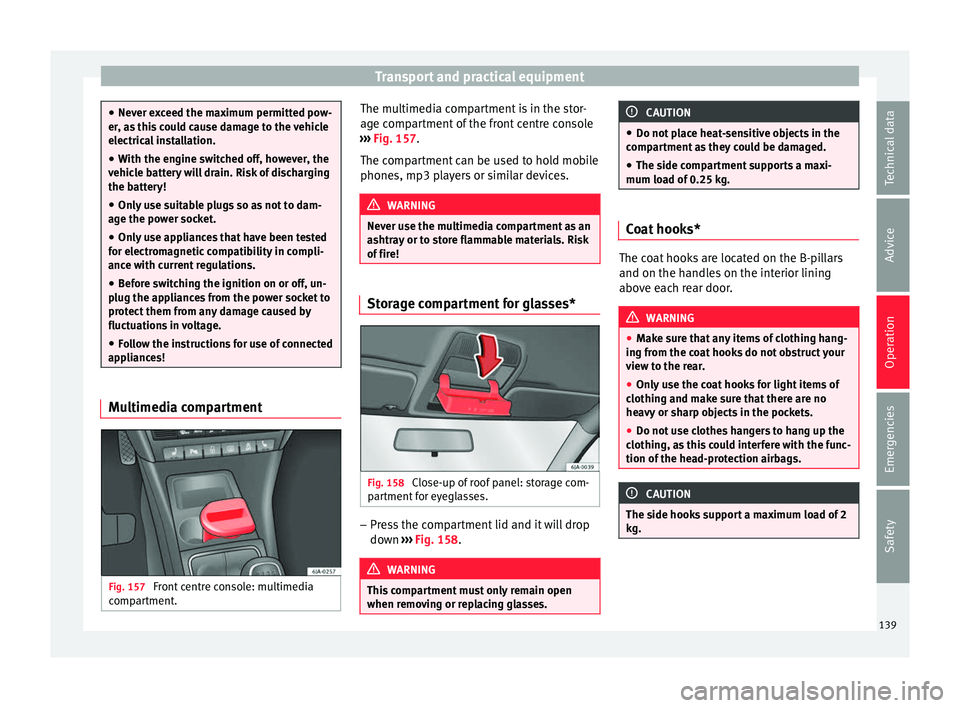
Fig. 157
Front centre console: multimedia
c omp
ar
tment. The multimedia compartment is in the stor-
ag
e c
omp
artment of the front centre console
››› Fig. 157.
The compartment can be used to hold mobile
phones, mp3 players or similar devices. WARNING
Never use the multimedia compartment as an
ashtr a
y or to store flammable materials. Risk
of fire! Storage compartment for glasses*
Fig. 158
Close-up of roof panel: storage com-
p ar
tment
for eyeglasses. –
Press the compartment lid and it will drop
do wn ›
›
› Fig. 158. WARNING
This compartment must only remain open
when remo v
ing or replacing glasses. CAUTION
● Do not p l
ace heat-sensitive objects in the
compartment as they could be damaged.
● The side compartment supports a maxi-
mum load of
0.25 kg. Coat hooks*
The coat hooks are located on the B-pillars
and on the handl
e
s on the interior lining
above each rear door. WARNING
● Mak e s
ure that any items of clothing hang-
ing from the coat hooks do not obstruct your
view to the rear.
● Only use the coat hooks for light items of
clothing and m
ake sure that there are no
heavy or sharp objects in the pockets.
● Do not use clothes hangers to hang up the
clothing, a
s this could interfere with the func-
tion of the head-protection airbags. CAUTION
The side hooks support a maximum load of 2
kg. 139
Technical data
Advice
Operation
Emergencies
Safety
Page 153 of 248
Air conditioning
The system also allows for the effect of sun-
light, so ther e i
s
no need for manual adjust-
ment. It also has a humidity sensor that
helps to automatically demist the wind-
screen.
Automatic operations ››› page 151 guaran-
tee maximum comfort any time of year.
Climatronic description
Cooling only works if the following conditions
are met:
● The engine is running
● the outside temperature is above +2°C
(+36°F);
● ››› Fig. 172 18 turned on.
St ar
tin
g the Climatronic
The corresponding function will be switched
on when a button is pressed, turning on the
air conditioning if it was switched off, with
the exception of button 17 (recirculation).
Sw it
c
hing off the Climatronic
● Turn control 10 to the left until the seg-
ments of
c
olumn 9
› ›
› Fig. 172 switch off.
● After 1 second has elapsed, turn the control
again t
o switch off the display.
In order to ensure engines subject to heavy
loads are cooled, the air conditioning com-
pressor is switched off in the event of high
coolant temperatures. Recommended setting for all seasons of the
year
● Set
the required temperature. We recom-
mend +22°C (+72°F).
● Pre
ss the button 13
› ››
Fig. 172
.
● Adju
st vents 3 and 4 ›››
page 147 so that
the air flow is directed slightly upwards.
Change between degrees Centigrade and de-
grees Fahrenheit
Keep the and buttons ››› Fig. 172
held down for 2 seconds at the same time.
The data is displayed on the screen in the
units required. Note
● A v i
sit to the specialised service once a
year is recommended to clean the Climatronic
system.
● The interior temperature sensor 11 ›››
Fig. 172 is at
the bottom. Do not cover it
with stickers or the like, as this could have a
negative effect on Climatronic operations. Automatic mode
Automatic mode is used to maintain a con-
s
t
ant
temperature and demist the windows
inside the vehicle. Switching on automatic mode
● Set a interior temperature between +16°C
(+64°F) and +29°C (+84°F).
● Adjus
t vents 3 ›››
page 147 and 4 so that
the air flow is directed slightly upwards.
● Press the button 13
› ››
Fig. 172
, and
AUTO i
s displayed on the screen.
Automatic mode is switched off by pressing
the air distribution buttons or increasing or
decreasing the blower speed. However, the
temperature remains regulated.
Adjusting the temperature ●
When you switch on the ignition, control 1 ›››
Fig. 172 can be u sed t
o set the required in-
terior temperature.
It is possible to select interior temperatures
from +16°C (+64°F) to +29°C (+84°F). In this
range the temperature is regulated automati-
cally. If a temperature below +16°C (+64°F) is
selected, “LO” is displayed on the screen. If a
temperature above +29°C (+84°F) is selected,
“HI” is displayed on the screen. At both ex-
tremes, Climatronic works at maximum cool-
ing or heating power, respectively. The tem-
perature is not regulated. »
151
Technical data
Advice
Operation
Emergencies
Safety
Page 154 of 248
Operation
In the event of prolonged, irregular distribu-
tion of the air flo
w fr
om the outlets (particu-
larly the footwells) and significant differen-
ces in temperature, e.g. on leaving the vehi-
cle, sensitive people may catch cold.
Air recirculation Air recirculation prevents unpleasant smells,
e.g. when p
a
ssing through a tunnel or in
queuing traffic, from entering the interior.
Switching on air recirculation mode
● Press the button 17
› ›
› Fig. 172
and the
symbol is displayed on the screen.
Switching off air recirculation mode
● Press the button 17
› ›
› Fig. 172
and the
symbol disappears from the screen. WARNING
Read and observe the safety warnings ›››
in
Genera l
notes on page 146. Note
If air recirculation mode remains on for 15 mi-
nute s, the
symbol will start to flash on
the screen to indicate prolonged air recircula-
tion. If air recirculation is not switched off,
the symbol will continue to flash for about 5
minutes. Blower selection
Climatronic automatically regulates blower
speed ac
c
ording to the interior temperature.
It is possible, however, to set the blower
speed to suit requirements.
● Turn control 10
››› Fig. 172 c
ounter-clock-
wise (to lower the speed) or clockwise (to in-
crease the speed).
Climatronic will switch off when the blower
switches off. WARNING
Read and observe the safety warnings ›››
in
Genera l
notes on page 146. Windscreen defrost
Switching on windscreen defrosting
●
Press the button
12
› ›
›
Fig. 172.
Switching off windscreen defrosting
● Press the button 12
› ›
›
Fig. 172 sev-
eral times or press the button.
The temperature is regulated automatically.
The air output is increased from vents 1
››› page 147 and 2. Driving
St ar
tin
g and stopping the en-
gine
Introduction Read the additional information carefully
›› ›
page 18 WARNING
● When mov in
g with the engine switched off,
the ignition key must always remain in posi-
tion 2
››› Fig. 173 ›
›› page 154 (ignition on).
The control lamps will light up in this posi-
tion. Otherwise, the steering lock could en-
gage suddenly. Risk of accident!
● Do not remove the key from the ignition un-
til the
vehicle has come to a standstill and is
secure (e.g. the handbrake is engaged). Oth-
erwise, the steering lock could suddenly en-
gage. Risk of accident!
● Always take the ignition key with you when
you le
ave the vehicle. This is particularly im-
portant if you leave children in the vehicle.
Children could, for example, start the engine
with the subsequent risk of accident.
● Never leave the engine running in unventi-
lated or c
losed rooms. The exhaust gases
contain carbon monoxide, an odourless and
colourless poisonous gas. Risk of fatal acci-
dents! Carbon monoxide can cause people to
lose consciousness and can cause death. 152
Page 155 of 248
Driving
●
Never l e
ave the vehicle unattended if the
engine is running.
● Never switch the engine off until the vehi-
cle h
as come to a complete stop. Risk of acci-
dent! CAUTION
● Turnin g the s
teering wheel fully in either
direction when the vehicle is stationary and
the engine is in gear puts the power steering
under great stress. This could lead to noise.
Never leave the steering wheel turned fully in
either direction for more than 15 seconds.
Risk of damage to the power steering system!
● The starter motor may only be used (key
position 3
››› Fig. 173 ›
›› page 154 in the ig-
nition) if the engine is off. Using the starter
motor when the engine is running could dam-
age it.
● Immediately release the ignition key when
the engine st
arts, otherwise damage could be
caused to the starter motor.
● When the engine is cold, you should avoid
high engine speed
s, driving at full throttle
and over-loading the engine before it reaches
operating temperature. Risk of engine dam-
age!
● Do not tow-start the engine. Risk of engine
damag
e! In vehicles with a catalytic convert-
er, fuel that has not been burned could reach
the catalytic converter and catch fire in it.
This would lead to a fault in the catalytic con-
verter. You may use the battery from another vehicle to help you start your engine
›› ›
page 52.
● After prolonged and demanding operation
of the engine, when the j
ourney has ended,
do not stop the engine immediately. Let the
engine run at idle for about one more minute.
This will stop the engine from overheating. For the sake of the environment
Do not warm up the engine when the vehicle
i s s
tationary. If possible, move off immediate-
ly after starting the engine. This will help the
engine reach operating temperature more
quickly, reducing the quantity of emissions. Note
● The engine c an on
ly be started with the
original SEAT key.
● Loud running noises may be heard briefly
after c
old-starting the engine. This is normal
and is no cause for concern.
● After the engine has been stopped and the
ignition switc
hed off, the radiator fan may
continue running for around 10 minutes.
● If the engine still does not start after a sec-
ond attempt, the fuel
pump fuse might have
blown. Check it and replace if necessary
››› page 81 or contact your Specialised Serv-
ice.
● You should always engage the steering lock
when you e
xit the vehicle. This will hinder
any attempts at theft. Power steering
The power steering allows you to turn the
st
eerin
g wheel more easily.
If the power steering fails or the engine is off
(towing), it is still possible to turn the vehi-
cle's steering wheel fully. However, you need
more strength to steer the vehicle.
Driver control lamps and warnings (in red) Faulty steering! To
park the vehicle
If the warning lamp remains on and the driver
indication appears, the power steering could
be faulty.
Do not continue driving. Seek specialist as-
sistance. (in yellow) Steering: System
fault! You may continue driving.
If the warning lamp comes on, the steering
could react with more difficultly or more sen-
sitivity than normal. In addition, when driving
in a straight line the steering wheel may be
off-centre.
Drive slowly to a specialised workshop and
have the fault repaired. (in yellow) Steering lock:
fault! Go to an Official Service
The electronic steering lock is malfunction-
ing. »
153
Technical data
Advice
Operation
Emergencies
Safety
Page 156 of 248
Operation
Go to a specialised workshop as soon as
po s
s
ible and have the fault repaired. WARNING
Take it immediately to a specialised work-
shop and hav e the f
ault repaired: risk of acci-
dent! Note
If the lamp (in red) or (in
yellow) lights
up briefly, you may continue driving. Start-up lock security system (immo-
b
i
li
ser) There is an electronic chip in the key. The
el
ectr
onic
immobiliser is deactivated when
the key is inserted into the ignition. The elec-
tronic immobiliser is automatically activated
when the key is removed from the ignition.
The engine will not start if an unauthorised
key is used.
The informative display indicates:
Immobiliser active! Ignition lock
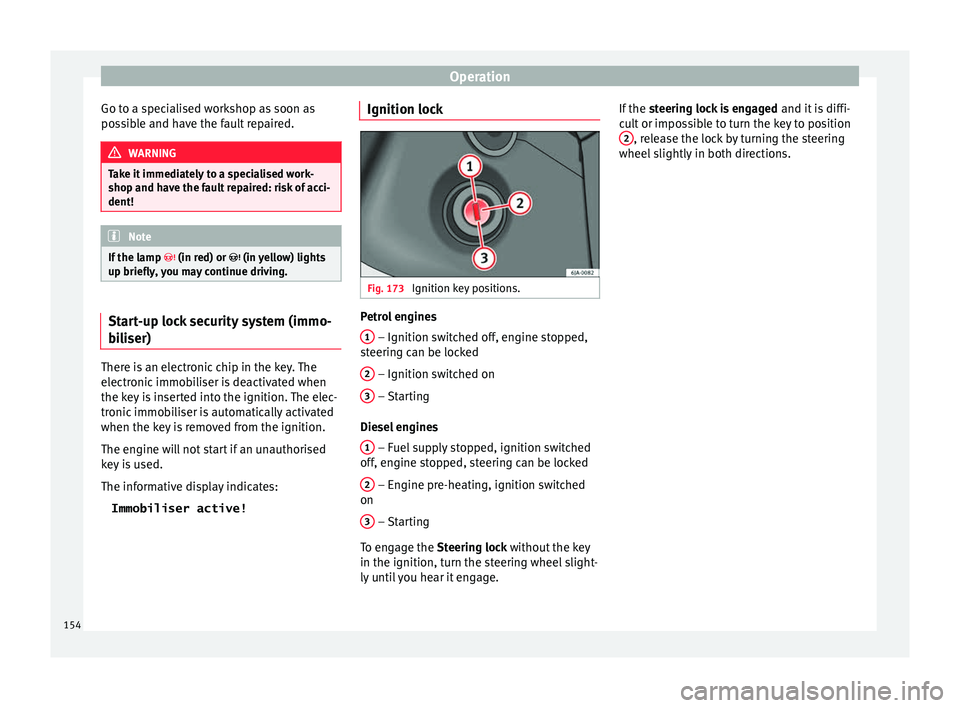
Fig. 173
Ignition key positions. Petrol engines
1 – Ignition switched off, engine stopped,
s t
eerin
g can be locked
2 – Ignition switched on
3 – Starting
Die sel
en
gines
1 – Fuel supply stopped, ignition switched
off , en
gine s
topped, steering can be locked
2 – Engine pre-heating, ignition switched
on
3 – Starting
T o en
g
age the Steering lock without the key
in the ignition, turn the steering wheel slight-
ly until you hear it engage. If the
steering lock is engaged and it i
s diffi-
cult or impossible to turn the key to position 2 , release the lock by turning the steering
wheel s
lightly
in both directions.
154