lights Seat Toledo 2017 Repair Manual
[x] Cancel search | Manufacturer: SEAT, Model Year: 2017, Model line: Toledo, Model: Seat Toledo 2017Pages: 248, PDF Size: 5.86 MB
Page 190 of 248
Operation
descending a slope in order to take advant-
ag e of
the en
gine brake.
The trailer is incorporated into the vehicle's
anti-theft alarm system:
● When the vehicle has a factory-fitted anti-
theft al
arm and a towing bracket.
● When the trailer is electrically connected to
the vehic
le via the towing bracket socket.
● When the vehicle electrical device and the
tow
ing bracket are operational.
● When the vehicle is locked and the vehi-
cle's
anti-theft alarm device is activated.
Once the electrical connection is interrupted
with the vehicle trailer locked, the alarm
sounds.
Always switch off the vehicle anti-theft alarm
device before connecting or disconnecting a
trailer. The vehicle anti-theft alarm device
could cause the alarm to sound ››› page 116,
Anti-theft alarm*.
Engine overheating
In the event that the coolant temperature
gauge needle moves to the right section of
the scale or to the red area, immediately re-
duce speed. If the control lamp flashes on
the general instrument panel, stop the vehi-
cle and switch off the engine. Wait several
minutes and check the coolant level in the
tank ››› page 210. Please observe the following indications
›››
page 210, Control lamp .
The coolant temperature can be reduced by
switching on the heating. WARNING
● Adjus t
your speed to suit the road and traf-
fic conditions.
● An electrical installation that is connected
incorrectly
or by non-specialised personnel
can prevent the connection of the current to
the trailer and cause faults in the operation of
the electrical system throughout the entire
vehicle, leading to accidents and serious in-
jury.
● All electrical work must be carried out only
by s
pecialised services.
● Never directly connect the trailer electrical
device t
o the electrical sockets of the reverse
driving lights or other sources of electrical
current. CAUTION
● Av oid c
orners, and sudden and sharp brak-
ing.
● Once the trailing arm has been removed,
plac
e the corresponding cover on the hole of
the fastening point. This prevents dirt from
entering the hole – see the trailer system as-
sembly manual. Note
● In the event of
frequent journeys with a
trailer, we recommend also having the vehi-
cle inspected in between the service inter-
vals.
● When connecting and disconnecting the
trail
er, the handbrake must be applied.
● For technical reasons, trailers with LED re-
verse light
s cannot be incorporated into the
vehicle anti-theft alarm system. Towing bracket device
Intr oduction If the vehicle is equipped with a towing
br
ac
k
et device from the factory or is a genu-
ine SEAT accessory, it meets all national tech-
nical and legal requirements for towing.
Your vehicle is fitted with a 13-pin power
socket for the electrical connection between
the trailer and the vehicle. If the trailer is
equipped with a 7-pin connector, you can
use the corresponding adaptor, which is
available as a genuine SEAT accessory.
The towing device has a maximum vertical
load of 50 kg.
188
Page 200 of 248
Advice
Paint damage Minor damage to the paint, such as scratches
or st
one c
hips, should be touched up without
delay using paint.
Suitable touch-up brushes or sprays for the
colour of your vehicle can be purchased from
authorised SEAT dealers. Note
We recommend you leave paint damage re-
pair s
to a SEAT Authorised Service. Plastic parts
Exterior plastic parts will come clean using a
d
amp c
loth. If
this is not sufficient, plastic
parts can also be treated with special sol-
vent-free plastic cleaning detergents .
Do not use paint cleaners, polishes or wax on
plastic parts.
Windows and mirrors Remove snow and ice from windows and rear
v
i
s
ion mirrors with a plastic scraper only. To
avoid damaging the surface of the glass, the
scraper should only be pushed in one direc-
tion and not moved to and fro. The windows should also be cleaned on the
inside at
regular intervals.
Use a separate cloth or chamois to dry the
windows and rear vision mirrors.
Do not use the chamois used to polish the
bodywork to dry the windows. Waxing and
polishing residues could cause smears on
the glass and hinder visibility. CAUTION
● Never u se hot
or boiling water to remove
snow and ice from the windows. Risk of crack-
ing glass!
● Make sure you do not damage the paint-
work on the
vehicle on removing snow and
ice from the windows and rear vision mirrors.
● Do not remove the snow or ice dirty with
thick p
articles, e.g. gravel, sand or road salt,
from windows and mirrors. Risk of damage to
the glass and mirror surfaces. Headlights
Use soap and clean, hot water to clean the
fr
ont
he
adlights. CAUTION
● Never rub the he a
dlights to dry them and
do not use sharp objects to clean the plastic
glass material. These could damage the pro- tective paint and cause the headlights to
cr
ac
k.
● Do not use aggressive cleaning products or
chemica
l solvents to clean the glass. This
could damage the headlights. Caring for rubber seals
The weatherstrips on doors and windows will
rem
ain p
liable and last longer if they are oc-
casionally treated with a suitable rubber care
product. This will prevent premature ageing
and leaks. If they are properly cared for, the
seals will be less likely to freeze up in the
winter.
Door lock cylinder Special products must be used to defrost
loc
k
cylinder
s. Note
● Mak e s
ure, when washing the vehicle, that
the least amount of water possible enters the
lock cylinders.
● We recommend the use of products from
the selection of
SEAT Original Accessories to
care for the door lock cylinder. 198
Page 211 of 248
Checking and refilling levels
Go to a technical service.
The c ontr
o
l lamp lights up yellow (insuf-
ficient oil level)
The informative display indicates:
Check the oil level!
Stop the vehicle, switch off the engine and
check the engine oil level ››› page 209
If the bonnet remains open for more than 30
seconds, the warning lamp switches off. If
the engine oil is not refilled, the warning
lamp illuminates again after 100 km (62
miles).
The control lamp flashes yellow (oil level
sensor faulty)
The informative display indicates:
Oil sensor. Workshop!
If the engine oil level sensor is faulty, The
warning lamp flashes various times after
the ignition is switched on and an audible
warning is given.
Go to a technical service. Checking engine oil level
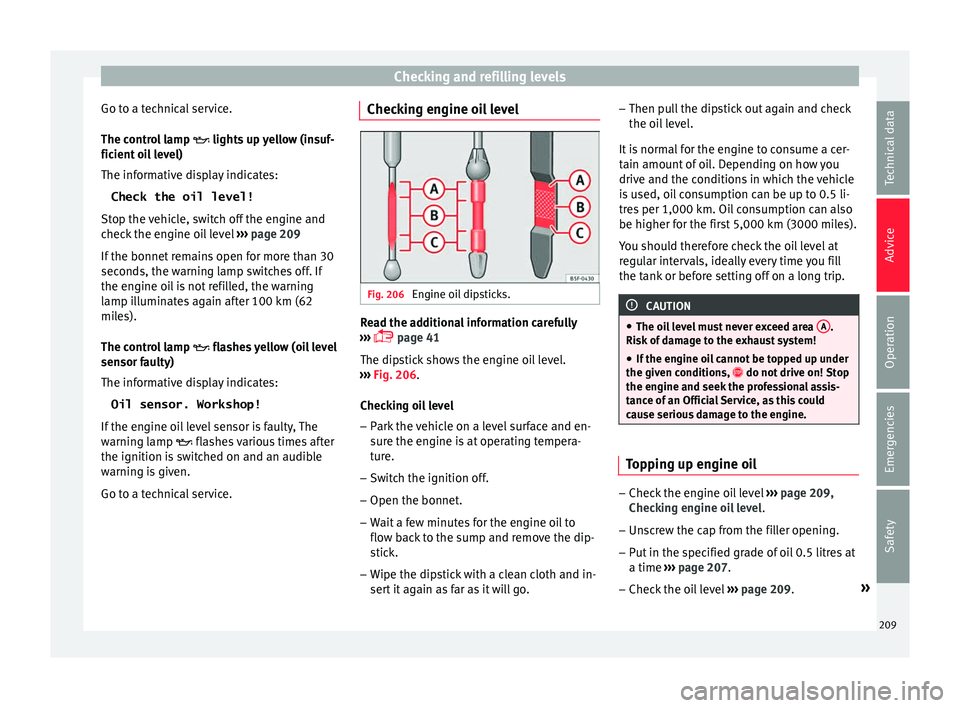
Fig. 206
Engine oil dipsticks. Read the additional information carefully
› ›
›
page 41
The dipstick shows the engine oil level.
››› Fig. 206.
Checking oil level – Park the vehicle on a level surface and en-
sure the en
gine is at operating tempera-
ture.
– Switch the ignition off.
– Open the bonnet.
– Wait a few minutes for the engine oil to
flow bac
k to the sump and remove the dip-
stick.
– Wipe the dipstick with a clean cloth and in-
sert it
again as far as it will go. –
Then pul
l the dipstick out again and check
the oil level.
It is normal for the engine to consume a cer-
tain amount of oil. Depending on how you
drive and the conditions in which the vehicle
is used, oil consumption can be up to 0.5 li-
tres per 1,000 km. Oil consumption can also
be higher for the first 5,000 km (3000 miles).
You should therefore check the oil level at
regular intervals, ideally every time you fill
the tank or before setting off on a long trip. CAUTION
● The oil l
evel must never exceed area A .
Risk of
damage to the exhaust system!
● If the engine oil cannot be topped up under
the given condition
s, do not drive on! Stop
the engine and seek the professional assis-
tance of an Official Service, as this could
cause serious damage to the engine. Topping up engine oil
–
Check the engine oil level ››
›
page 209,
Checking engine oil level .
– Unscrew the cap from the filler opening.
– Put in the specified grade of oil 0.5 litres at
a time ›››
page 207.
– Check the oil level ›››
page 209. »
209
Technical data
Advice
Operation
Emergencies
Safety
Page 214 of 248
Advice
The brake fluid reservoir is located in the en-
gine c omp
ar
tment of the vehicle.
– Switch the ignition off.
– Open the bonnet ›››
page 204.
– Check the brake fluid level in the reservoir
›››
Fig. 208. It should be between the “MIN”
and “MAX” marks.
The fluid level drops slightly after a period of
time due to automatic compensation for
brake pad wear. This is quite normal.
However, if the level goes down noticeably in
a short time, or drops below the “MIN” mark,
there may be a leak in the brake system. If
the brake fluid level in the reservoir is too
low, this will be indicated by the warning
lamp illuminating on the instrument panel
››› page 157, Control lamp .WARNING
● If the fluid l ev
el has dropped below the MIN
mark, do not continue driving. Risk of acci-
dent! Go to a technical service.
● Heavy use of the brakes may cause a va-
pour lock if
the brake fluid is left in the brake
system for too long. This would seriously af-
fect the efficiency of the brakes and the safe-
ty of the vehicle. Changing the brake fluid
Brake fluid absorbs moisture. Therefore, it
gra
dual
ly absorbs moisture from the atmos-
phere. If the water content in the brake fluid
is too high, the brake system could corrode.
The water content also reduces the boiling
point of the brake fluid.
The brake fluid must comply with one of the
following standards or specifications:
● VW 50114
● FMVSS 116 DOT4 CAUTION
Brake fluid damages the vehicle paintwork. Window washer system
Top
pin
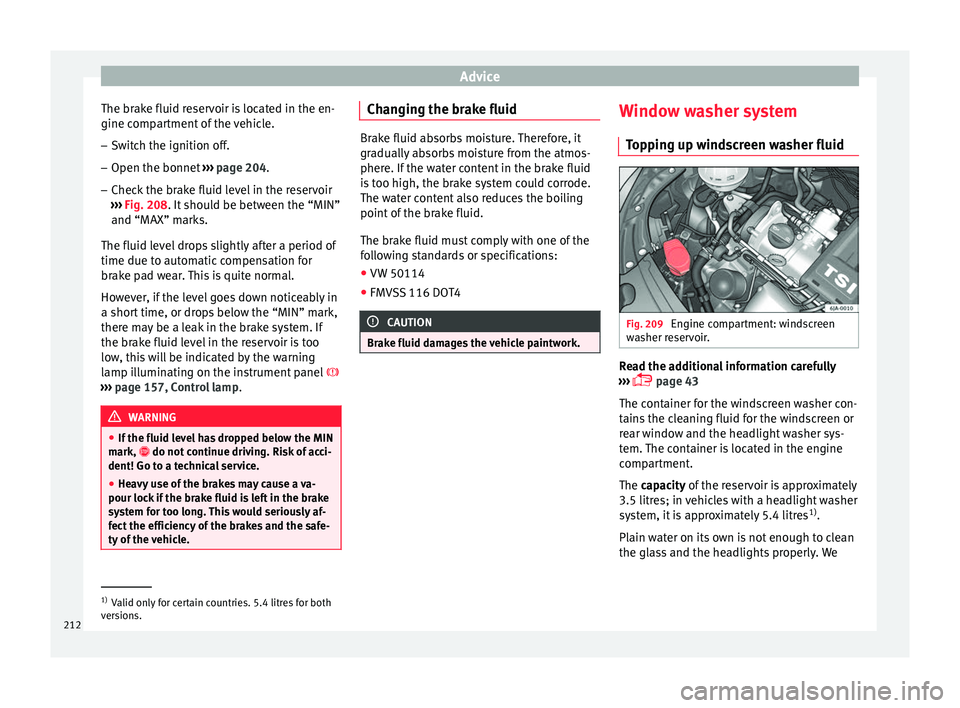
g up windscreen washer fluid Fig. 209
Engine compartment: windscreen
w a
sher r
eservoir. Read the additional information carefully
› ›
›
page 43
The container for the windscreen washer con-
tains the cleaning fluid for the windscreen or
rear window and the headlight washer sys-
tem. The container is located in the engine
compartment.
The capacity of the reservoir is approximately
3.5 litres; in vehicles with a headlight washer
system, it is approximately 5.4 litres 1)
.
Plain water on its own is not enough to clean
the glass and the headlights properly. We 1)
Valid only for certain countries. 5.4 litres for both
ver s
ions.
212
Page 215 of 248
Checking and refilling levels
therefore recommend using clean water with
a gl a
s
s cleaning product to eliminate any
stubborn dirt (with an anti-freeze additive in
winter).
Although your vehicle has heated windscreen
washer jets, anti-freeze should always be
added to the water in winter.
Ethanol can be used where glass cleaner with
anti-freeze is unavailable. The concentration
of ethanol must be no greater than 15 %.
However, remember that anti-freeze in this
proportion only protects down to -5°C
(+23°F). CAUTION
● Never mi x
the windscreen washing water
with anti-freeze used for the cooling system
or other additives.
● If the vehicle is equipped with a headlight
washer sy
stem, only mix in with the water a
detergent that does not damage polycarbon-
ates. Note
When topping up the fluid, do not move the
filt er fr
om the container opening, as this
could contaminate the fluid hoses and lead to
a windscreen washer malfunction. Battery
Intr oduction Read the additional information carefully
›› ›
page 43.
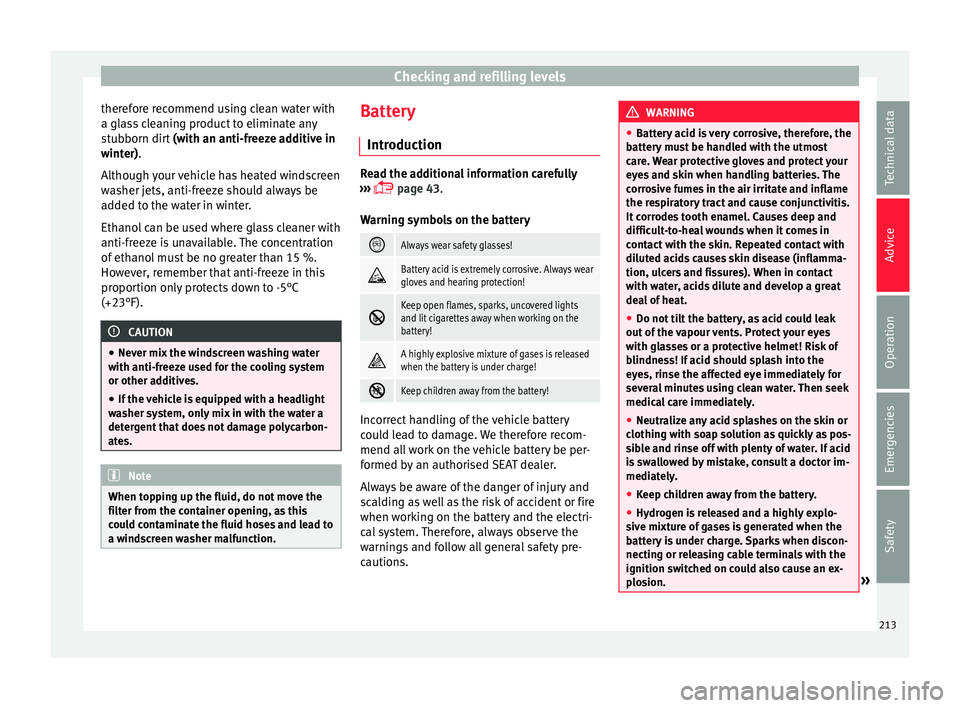
Warning symbols on the battery
Always wear safety glasses!
Battery acid is extremely corrosive. Always wear
gloves and hearing protection!
Keep open flames, sparks, uncovered lights
and lit cigarettes away when working on the
battery!
A highly explosive mixture of gases is released
when the battery is under charge!
Keep children away from the battery!
Incorrect handling of the vehicle battery
c
ou
l
d lead to damage. We therefore recom-
mend all work on the vehicle battery be per-
formed by an authorised SEAT dealer.
Always be aware of the danger of injury and
scalding as well as the risk of accident or fire
when working on the battery and the electri-
cal system. Therefore, always observe the
warnings and follow all general safety pre-
cautions. WARNING
● Batt er
y acid is very corrosive, therefore, the
battery must be handled with the utmost
care. Wear protective gloves and protect your
eyes and skin when handling batteries. The
corrosive fumes in the air irritate and inflame
the respiratory tract and cause conjunctivitis.
It corrodes tooth enamel. Causes deep and
difficult-to-heal wounds when it comes in
contact with the skin. Repeated contact with
diluted acids causes skin disease (inflamma-
tion, ulcers and fissures). When in contact
with water, acids dilute and develop a great
deal of heat.
● Do not tilt the battery, as acid could leak
out of the
vapour vents. Protect your eyes
with glasses or a protective helmet! Risk of
blindness! If acid should splash into the
eyes, rinse the affected eye immediately for
several minutes using clean water. Then seek
medical care immediately.
● Neutralize any acid splashes on the skin or
clothing w
ith soap solution as quickly as pos-
sible and rinse off with plenty of water. If acid
is swallowed by mistake, consult a doctor im-
mediately.
● Keep children away from the battery.
● Hydrogen is released and a highly explo-
sive mi
xture of gases is generated when the
battery is under charge. Sparks when discon-
necting or releasing cable terminals with the
ignition switched on could also cause an ex-
plosion. » 213
Technical data
Advice
Operation
Emergencies
Safety
Page 216 of 248

Advice
●
A short c
ircuit is produced if the battery ter-
minals are bridged, e.g. using metal objects,
cables, etc. Possible consequences of a short
circuit: melting of lead plates, battery explo-
sion and fire, splashing acid.
● The following is forbidden while working on
the batter
y: fire and open flames, smoking
and activities that could produce sparks.
Avoid causing sparks when handling cables
or electrical apparatus. Risk of injury in the
event of large sparks.
● Before working on the electrical system,
you mus
t switch off the engine, the ignition
and all electrical components and disconnect
the cable from the negative terminal (-) of the
battery. To change a bulb, simply switch off
the corresponding light.
● Never charge a frozen or thawed out bat-
tery
. Risk of explosion and acid burns! Re-
place a frozen battery.
● Never use the jump leads on batteries in
which the electr
olyte level is too low. Risk of
explosion and acid burns!
● Never use a damaged battery. Risk of ex-
plos
ion! Replace a damaged battery immedi-
ately. CAUTION
● Never di s
connect the battery when the igni-
tion is switched on, as the electrical system
(electronic components) of the vehicle could
be damaged. When disconnecting the battery
from the vehicle electrical system, disconnect its negative terminal (-) first. Only then may
the pos
itiv
e terminal (+) be disconnected.
● When connecting the battery, first connect
the positiv
e terminal (+) and then the nega-
tive terminal (-). The battery cables must nev-
er be connected to the wrong battery termi-
nals. Risk of burning the electrical installa-
tion!
● Make sure the battery acid does not come
into cont
act with the bodywork. Risk of paint-
work damage.
● Do not expose the battery to direct sunlight
to prot
ect it from ultraviolet radiation.
● If the vehicle is not used for 3 or 4 weeks,
the batter
y could run flat. This is because
some components use electricity even in
standby mode (e.g. control units). Prevent the
battery from running flat by disconnecting its
negative terminal or leave it charging at a low
current.
● If you frequently use the vehicle for short
trips, the batt
ery may not fully charge and
could run flat. For the sake of the environment
A flat battery is particularly harmful waste for
the env ir
onment. It must therefore be dis-
posed of according to current local law. Note
Replace a battery once it is older than 5
ye ar
s. Control lamp
If the
control lamp is illuminated while the
en gine i
s running, the battery is not charg-
ing.
Go to a technical service. Have the car's elec-
trical equipment inspected. CAUTION
Additionally, if the warning lamp lights up
whi
le driving, the warning lamp also lights
up (cooling system fault). Stop the vehicle
and switch off the engine – Risk of engine
damage! Lifting the battery cover
Fig. 210
Battery: Opening the cover. The battery is located beneath a plastic cover
in the en
gine c
omp
artment.
214
Page 218 of 248
Advice
“Fast-charging” a battery is dan
g erous and
requires a battery charger and special knowl-
edge. Fast charges should be performed by
an official technical service.
The battery caps should not be opened while
the battery is being charged. CAUTION
In vehicles fitted with the “Start-Stop” sys-
tem, the c h
arger cable cannot be directly con-
nected to the negative terminal of the vehicle
battery but must be attached to the engine
ground point ›››
page 53. Disconnecting and connecting the
b
att
er
y The following functions will either be inoper-
ativ
e or w
i
ll not work properly after discon-
necting and reconnecting the battery:
FunctionInstallation
Setting the clock››› page 97
The multifunction display data
is deleted››› page 99 Note
We recommend having the vehicle checked by
an authorised S EA
T dealer to guarantee the
correct working order of all electrical sys-
tems. Changing the battery
A replacement battery must have the same
cap
ac
ity, voltage, current rating and size as
the original. The appropriate types of battery
can be acquired from authorised SEAT deal-
ers.
We recommend having the battery changed
by an authorised SEAT dealer, where the new
battery will be correctly installed and the
original disposed of in line with regulations.
Automatic disconnection of electrical
equipment When heavily-charging a battery, the pro-
gr
amme sel
ect
ed by the electrical system
control unit prevents the battery from auto-
matically discharging. This may result in the
following:
● Increase in idling speed so that the alterna-
tor can s
upply more current to the electrical
system.
● The performance of certain electrical com-
ponents cou
ld be limited or some may switch
off temporarily, e.g. the heated seats, the
heated rear window, the 12 V power socket. Note
Despite any measures taken by the control
unit, the b att
ery could drain. e.g. with the en- gine is switched off, the key is turned in the
ignition for a lon
g period or the s
ide lights or
parking lights are switched on. The switching
off of certain electrical components does not
impair driving comfort and often the driver
will not even notice. 216
Page 223 of 248
Wheels and tyres
CAUTION
Follow the instructions given on the tempora-
ry s
pare wheel label. Note
The tyre pressure of the spare wheel must al-
wa y
s correspond to the highest pressure pre-
scribed for the model of vehicle in question. Tyre monitoring systems
Ty r
e pressure* The tyre pressure monitoring system uses
ABS
sen
sor
s to compare the revolutions and
the circumference of each wheel. Should the
circumference of any wheel change, the
warning lamp on the general instrument
panel will light up and an audible warning
will be heard.
Tyre circumference may change if:
● Tyre pressure is too low
● Tyre structure is damaged
● Vehicle load not evenly distributed
● wheels on one axle are subjected to greater
load, (e.
g. driving with trailer, uphill, down-
hill);
● Snow chains are fitted
● The temporary spare wheel is fitted ●
One wheel on the axl
e has been changed
Basic system settings
Should the tyre pressure change or if one or
more wheels are changed or the position of
the wheel on the vehicle is changed, e.g.
changing round the front and rear wheels, or
where a warning lamp lights up when driv-
ing, the system must be adjusted as follows: ● Inflate all tyres to the prescribed pressures
›››
page 218.
● Switch the ignition on.
● Store the new tyre pressure in the Easy
Connect sy
stem with the button and the
S ET
TINGS function button
››
›
page 21.
● In vehicles without radio : pres
s and hold
down the button with the ignition on,
until an acoustic signal is heard.
The warning lamp lights up
If the pressure on at least one tyre is signifi-
cantly lower than the pressure set by the driv-
er, the warning lamp will light up ››› .
The w arnin
g l
amp flashes
If the warning lamp flashes, there is a fault in
the system. Contact a specialised service to
have it fixed. WARNING
● If the w arnin
g lamp lights up, slow down
immediately and avoid any severe braking or
steering manoeuvres. Stop and check the
tyres and their pressure as soon as possible.
● Under certain conditions (e.g. sporty driv-
ing styl
e, driving on loose surfaces or in win-
ter) the warning lamp may take a while to
light up or may remain switched off.
● Despite the tyre pressure monitoring sys-
tem, the driver r
emains responsible for main-
taining the correct tyre pressure. You must
therefore check the tyre pressure often. Note
● The tyr e pr
essure monitoring system is not
a replacement for regularly checking the tyre
pressure, as it is unable to recognise an even
drop in pressure.
● The tyre pressure monitoring system is un-
able t
o warn of a sudden drop in tyre pres-
sure, e.g. a puncture. In this case, try to stop
the vehicle carefully with no severe braking
or steering manoeuvres.
● To ensure the tyre pressure monitoring sys-
tem work
s correctly, the basic setting must
be performed every 10 000 km (6000 miles)
or once a year.
● If the battery is disconnected the warning
lamp lights
up when the ignition is switch-
ed on. This warning lamp must switch off af-
ter covering a short distance. 221
Technical data
Advice
Operation
Emergencies
Safety
Page 237 of 248
Index
Index
A
ABS contr
o
l lamp . . . . . . . . . . . . . . . . . . . . . . . . . . . 159
see also Anti-lock brake system . . . . . . 158, 159
Accessories . . . . . . . . . . . . . . . . . . . . . . . . . 138, 194
Additional consumers (efficiency program) . . . . . 30
Adjusting front head restraints . . . . . . . . . . . . . . . . . . . . . . 60
seats . . . . . . . . . . . . . . . . . . . . . . . . . . . . . . . . . . 57
Adjusting the head restraints front head restraints . . . . . . . . . . . . . . . . . . . . . 132
Adjustment CAR menu . . . . . . . . . . . . . . . . . . . . . . . . . . . . . 101
front head restraints . . . . . . . . . . . . . . . . . . . . . 132
lights . . . . . . . . . . . . . . . . . . . . . . . . . . . . . . . . . 122
rear head restraints . . . . . . . . . . . . . . . . . . . . . . 60
Aerial . . . . . . . . . . . . . . . . . . . . . . . . . . . . . . . . . . . 196
Air-conditioning economic use . . . . . . . . . . . . . . . . . . . . . . . . . . 146
Airbag covers . . . . . . . . . . . . . . . . . . . . . . . . . . . . . 14
Airbags . . . . . . . . . . . . . . . . . . . . . . . . . . . . . . . . . . 67 description . . . . . . . . . . . . . . . . . . . . . . . . . . . . . 68
Airbag system . . . . . . . . . . . . . . . . . . . . . . . . . . 14, 67 activation . . . . . . . . . . . . . . . . . . . . . . . . . . . . . . 69
control lamp . . . . . . . . . . . . . . . . . . . . . . . . . . . . 69
deactivation of front airbag . . . . . . . . . . . . . 69, 72
description . . . . . . . . . . . . . . . . . . . . . . . . . . . . . 68
front airbags . . . . . . . . . . . . . . . . . . . . . . . . . 14, 70
functioning . . . . . . . . . . . . . . . . . . . . . . . . . . . . . 69
head-protection airbags . . . . . . . . . . . . . . . 16, 71
side airbags . . . . . . . . . . . . . . . . . . . . . . . . . 15, 70
Air conditioning . . . . . . . . . . . . . . . . . . . . . . . . 37, 38 air vents . . . . . . . . . . . . . . . . . . . . . . . . . . . . . . 147
faults . . . . . . . . . . . . . . . . . . . . . . . . . . . . . . . . . 146 introduction . . . . . . . . . . . . . . . . . . . . . . . . . . . 146
operation . . . . . . . . . . . . . . . . . . . . . . . . . . . . . .
149
Alarm system . . . . . . . . . . . . . . . . . . . . . . . . . . . . 116
Alternator control lamp . . . . . . . . . . . . . . . . . . . . . . . . . . . 214
Ambient lighting . . . . . . . . . . . . . . . . . . . . . . . . . 127
Anchoring the front tow line. . . . . . . . . . . . . . . . . . . . . . . . . 80
Anti-freeze . . . . . . . . . . . . . . . . . . . . . . . . . . . . . . . 42
Anti-lock brake system . . . . . . . . . . . . . . . . 158, 159
Anti-puncture . . . . . . . . . . . . . . . . . . . . . . . . . . 46, 77
Anti-puncture kit . . . . . . . . . . . . . . . . . . . . . . . . 46, 77 check after 10 minutes . . . . . . . . . . . . . . . . . . . . 79
Anti-slip regulation . . . . . . . . . . . . . . . . . . . . . . . 159
Anti-theft alarm . . . . . . . . . . . . . . . . . . . . . . . . . . 116
Anti-theft security system . . . . . . . . . . . . . . . . . . . . 9
Anti-theft system . . . . . . . . . . . . . . . . . . . . . . . . . 112
Armrests front seats . . . . . . . . . . . . . . . . . . . . . . . . . . . . . 133
rear seats . . . . . . . . . . . . . . . . . . . . . . . . . . . . . 134
Ashtrays . . . . . . . . . . . . . . . . . . . . . . . . . . . . . . . . 138
Aspects to note before setting off . . . . . . . . . . . . . 56
ASR control lamp . . . . . . . . . . . . . . . . . . . . . . . . . . . 159
see also Traction control system . . . . . . 158, 159
Assistance systems ABS . . . . . . . . . . . . . . . . . . . . . . . . . . . . . . . . . . 159
ASR . . . . . . . . . . . . . . . . . . . . . . . . . . . . . . . . . . 159
cruise speed . . . . . . . . . . . . . . . . . . . . . . . . . . . 178
EDL . . . . . . . . . . . . . . . . . . . . . . . . . . . . . . . . . . 160
emergency brake assist (Front Assist) . . . . . . . 179
fatigue detection . . . . . . . . . . . . . . . . . . . . . . . 185
parking aid . . . . . . . . . . . . . . . . . . . . . . . 170, 171
Start-Stop . . . . . . . . . . . . . . . . . . . . . . . . . . . . . 183
tyre monitoring system . . . . . . . . . . . . . . . . . . 221
Assisted starting . . . . . . . . . . . . . . . . . . . . . . . . . . 52 Audible signal . . . . . . . . . . . . . . . . . . . . . . . . . . . . 62
contro l and warning lamps . . . . . . . . . . . . . . . 100
Automatic air conditioning climatronic . . . . . . . . . . . . . . . . . . . . . . . . . . . . 150
Automatic car washes see Washing . . . . . . . . . . . . . . . . . . . . . . . . . . . 196
Automatic gearbox driving programmes . . . . . . . . . . . . . . . . . . . . . 164
emergency program . . . . . . . . . . . . . . . . . . . . . 164
instructions for use . . . . . . . . . . . . . . . . . . . . . 160
kick-down . . . . . . . . . . . . . . . . . . . . . . . . . . . . . 161
manual release of selector lever . . . . . . . . . . . . 36
parking . . . . . . . . . . . . . . . . . . . . . . . . . . . . . . . 161
selector lever lock . . . . . . . . . . . . . . . . . . . . . . . 163
selector lever positions . . . . . . . . . . . . . . . . . . 162
starting . . . . . . . . . . . . . . . . . . . . . . . . . . . . . . . 161
stopping . . . . . . . . . . . . . . . . . . . . . . . . . . . . . . 161
tiptronic . . . . . . . . . . . . . . . . . . . . . . . . . . 160, 163
AUX-IN . . . . . . . . . . . . . . . . . . . . . . . . . . . . . . . . . . 108
B Back seat folding down and raising the back seat back- rest . . . . . . . . . . . . . . . . . . . . . . . . . . . . . . . . . 134
Ball coupling disassembly . . . . . . . . . . . . . . . . . . . . . . . . . . . 192
Battery . . . . . . . . . . . . . . . . . . . . . . . . . . . . . . . . . . 110
Before setting off . . . . . . . . . . . . . . . . . . . . . . . . . . 56
Belt tightening . . . . . . . . . . . . . . . . . . . . . . . . . . . . 66
Biodiesel . . . . . . . . . . . . . . . . . . . . . . . . . . . . . . . . 203
Bonnet . . . . . . . . . . . . . . . . . . . . . . . . . . . . . 11, 207 opening the bonnet . . . . . . . . . . . . . . . . . . . . . 205
Brake assist . . . . . . . . . . . . . . . . . . . . . . . . . . . . . 158
Brake fluid . . . . . . . . . . . . . . . . . . . . . . . . . . . . . . . 43 checking . . . . . . . . . . . . . . . . . . . . . . . . . . . . . . 211
235
Page 238 of 248
Index
Brakes brak
e fluid
. . . . . . . . . . . . . . . . . . . . . . . . . . . . . 211
control lamp . . . . . . . . . . . . . . . . . . . . . . . . . . . 157
handbrake . . . . . . . . . . . . . . . . . . . . . . . . . . . . . 158
running in . . . . . . . . . . . . . . . . . . . . . . . . . . . . . 165
Brake servo . . . . . . . . . . . . . . . . . . . . . . . . . . . . . . 157
Braking brake assist . . . . . . . . . . . . . . . . . . . . . . . . . . . . 158
Bulb failure control lamp . . . . . . . . . . . . . . . . . . . . . . . . . . . 121
C Capacities . . . . . . . . . . . . . . . . . . . . . . . . . . . . . . . . 40
Car-care products . . . . . . . . . . . . . . . . . . . . . . . . . 195
Care of vehicle door lock cylinder . . . . . . . . . . . . . . . . . . . . . . . 198
leatherette . . . . . . . . . . . . . . . . . . . . . . . . . . . . . 199
upholstery . . . . . . . . . . . . . . . . . . . . . . . . . . . . . 199
Carrier system . . . . . . . . . . . . . . . . . . . . . . . . . . . . 144
Catalytic converter . . . . . . . . . . . . . . . . . . . . . . . . 168 malfunction . . . . . . . . . . . . . . . . . . . . . . . . . . . . 168
CCS . . . . . . . . . . . . . . . . . . . . . . . . . . . . . . . . 32, 178 see also Cruise control . . . . . . . . . . . . . . . . . . . 178
Central locking . . . . . . . . . . . . . . . . . . . . . . . . . . . 108 anti-theft alarm . . . . . . . . . . . . . . . . . . . . . . . . . 116
central locking button . . . . . . . . . . . . . . . . . . . 113
closing . . . . . . . . . . . . . . . . . . . . . . . . . . . . . . . . 112
individualised settings . . . . . . . . . . . . . . . . . . 111
keyless Access . . . . . . . . . . . . . . . . . . . . . . . . . 114
locking . . . . . . . . . . . . . . . . . . . . . . . . . . . . . . . . 112
locking manually . . . . . . . . . . . . . . . . . . . . . . . . 10
opening . . . . . . . . . . . . . . . . . . . . . . . . . . . . . . . 112
unlocking . . . . . . . . . . . . . . . . . . . . . . . . . . . . . 112
Central locking system . . . . . . . . . . . . . . . . . . . . . 111
Cetane number (diesel fuel) . . . . . . . . . . . . . . . . 203 Changing a bulb . . . . . . . . . . . . . . . . . . . . . . . . . . . 84
daytime driv ing light . . . . . . . . . . . . . . . . . . . . . 87
dipped beam . . . . . . . . . . . . . . . . . . . . . . . . . . . 86
double headlight bulbs . . . . . . . . . . . . . . . . . . . 85
fog light . . . . . . . . . . . . . . . . . . . . . . . . . . . . . . . . 88
main beam headlight . . . . . . . . . . . . . . . . . . . . . 86
side light . . . . . . . . . . . . . . . . . . . . . . . . . . . . . . . 86
turn signal . . . . . . . . . . . . . . . . . . . . . . . . . . . . . . 87
Changing a wheel . . . . . . . . . . . . . . . . . . . . . . 47, 76 subsequent work . . . . . . . . . . . . . . . . . . . . . . . . 50
Changing bulbs on the number plate . . . . . . . . . . 92 removing the bulb holder . . . . . . . . . . . . . . . . . 92
Changing bulbs on the side panel . . . . . . . . . . . . 89 fitting the rear light . . . . . . . . . . . . . . . . . . . . . . 90
removing the bulb holder . . . . . . . . . . . . . . . . . 89
removing the rear light . . . . . . . . . . . . . . . . . . . . 88
Changing lights on the side panel . . . . . . . . . . . . 88
Changing rear lights on the rear lid changing bulbs . . . . . . . . . . . . . . . . . . . . . . . . . . 91
fitting the bulb-holder . . . . . . . . . . . . . . . . . . . . 91
Changing settings CAR menu . . . . . . . . . . . . . . . . . . . . . . . . . . . . . . 21
Changing the rear lights on the rear lid removing the bulb holder . . . . . . . . . . . . . . . . . 90
Charging the battery . . . . . . . . . . . . . . . . . . . . . . . 52
Checking levels engine compartment . . . . . . . . . . . . . . . . . . . . 207
Child-proof locking . . . . . . . . . . . . . . . . . . . . . . . . 116 electric windows . . . . . . . . . . . . . . . . . . . . . . . . 119
Child seats . . . . . . . . . . . . . . . . . . . . . . . . . . . . 16, 75 categorisation into groups . . . . . . . . . . . . . . . . . 75
ISOFIX system . . . . . . . . . . . . . . . . . . . . . . . . . . . 17
safety instructions . . . . . . . . . . . . . . . . . . . . 16, 74
securing with the seat belt . . . . . . . . . . . . . . . . 16Top Tether system . . . . . . . . . . . . . . . . . . . . . . . . 17
Cigarette lighter . . . . . . . . . . . . . . . . . . . . . . . . . . 137 Cleaning . . . . . . . . . . . . . . . . . . . . . . . . . . . . . . . . 195
chromed p arts . . . . . . . . . . . . . . . . . . . . . . . . . 197
headlights . . . . . . . . . . . . . . . . . . . . . . . . . . . . . 198
leatherette . . . . . . . . . . . . . . . . . . . . . . . . . . . . . 199
natural leather . . . . . . . . . . . . . . . . . . . . . . . . . 200
plastic parts . . . . . . . . . . . . . . . . . . . . . . . . . . . 198
upholstery . . . . . . . . . . . . . . . . . . . . . . . . 199, 200
washing the vehicle . . . . . . . . . . . . . . . . . . . . . 196
wheels . . . . . . . . . . . . . . . . . . . . . . . . . . . . . . . . 199
windows . . . . . . . . . . . . . . . . . . . . . . . . . . . . . . 198
Cleaning and thawing windows . . . . . . . . . . . . . 198
Climatronic . . . . . . . . . . . . . . . . . . . . . . . . . . . . . . . 37 adjusting the temperature . . . . . . . . . . . . . . . . 151
air recirculation . . . . . . . . . . . . . . . . . . . . . . . . . 152automatic mode . . . . . . . . . . . . . . . . . . . . . . . . 151
blower selection . . . . . . . . . . . . . . . . . . . . . . . . 152
windscreen defrost . . . . . . . . . . . . . . . . . . . . . . 152
Close . . . . . . . . . . . . . . . . . . . . . . . . . . . . . . . . . . . 108
Closing central locking . . . . . . . . . . . . . . . . . . . . . . . . . 112
vehicle with Keyless Access . . . . . . . . . . . . . . . 114
windows . . . . . . . . . . . . . . . . . . . . . . . . . . . . . . 119
Coat hooks . . . . . . . . . . . . . . . . . . . . . . . . . . . . . . 139
Coming Home and Leaving Home . . . . . . . . . . . . 125
Coming Home and Leaving Home Function . . . . 125
Compartments . . . . . . . . . . . . . . . . . . . . . . . . . . . 135
Control and warning lamps . . . . . . . . . . . . . 33, 100 ABS . . . . . . . . . . . . . . . . . . . . . . . . . . . . . . . . . . 159
airbags . . . . . . . . . . . . . . . . . . . . . . . . . . . . . . . . 69
alternator . . . . . . . . . . . . . . . . . . . . . . . . . . . . . 214
ASR . . . . . . . . . . . . . . . . . . . . . . . . . . . . . . . . . . 159
audible signal . . . . . . . . . . . . . . . . . . . . . . . . . . 100
brakes . . . . . . . . . . . . . . . . . . . . . . . . . . . . . . . . 157
break recommendation . . . . . . . . . . . . . . . . . . 185
coolant temperature . . . . . . . . . . . . . . . . . 99, 210
deactivating the airbag . . . . . . . . . . . . . . . . . . . 14
236