display SKODA CITIGO 2012 1.G Owner's Guide
[x] Cancel search | Manufacturer: SKODA, Model Year: 2012, Model line: CITIGO, Model: SKODA CITIGO 2012 1.GPages: 157, PDF Size: 3.9 MB
Page 114 of 157
Changing engine oil
First read and observe the introductory information and safety warn-
ings on page 108.
The engine oil must be changed at the intervals stated in the Service schedule or
according to the service interval indicator
» page 10, Service Interval Display.CAUTION
Additives must not be added to the engine oil – risk of causing considerable dam-
age to parts of the engine! Damage, which results from such product, are exclu-
ded from the warranty. Note
If your skin has come into contact with oil, it must be washed thoroughly. ÐCoolant
First read and observe the introductory information and safety warn-
ings on page 108.
The cooling system is filled with a coolant in the factory.
The coolant consists of water with a concentration of coolant additive of 40 %.
This mixture provides antifreeze protection down to -25
°C and also protects the
cooling and heating system from corrosion. It also prevents the formation of scale
and significantly increases the boiling point of the coolant.
The concentration of coolant must therefore not be reduced by adding water dur-
ing the summer months or in countries with a warm climate. The concentration of
coolant additive in the coolant must be at least 40 %.
If a higher concentration of antifreeze is required for climatic reasons, the amount
of coolant additive can only be increased up to 60 % (antifreeze protection down
to approx. -40 °C). The antifreeze protection tails off above that concentration.
Vehicles exported to countries with a cold climate are already factory-filled with a
coolant which offers antifreeze protection down to about -35 °C. In these coun-
tries the concentration of coolant additive should be at least 50 %.
When refilling, we only recommend you use the same antifreeze written on the
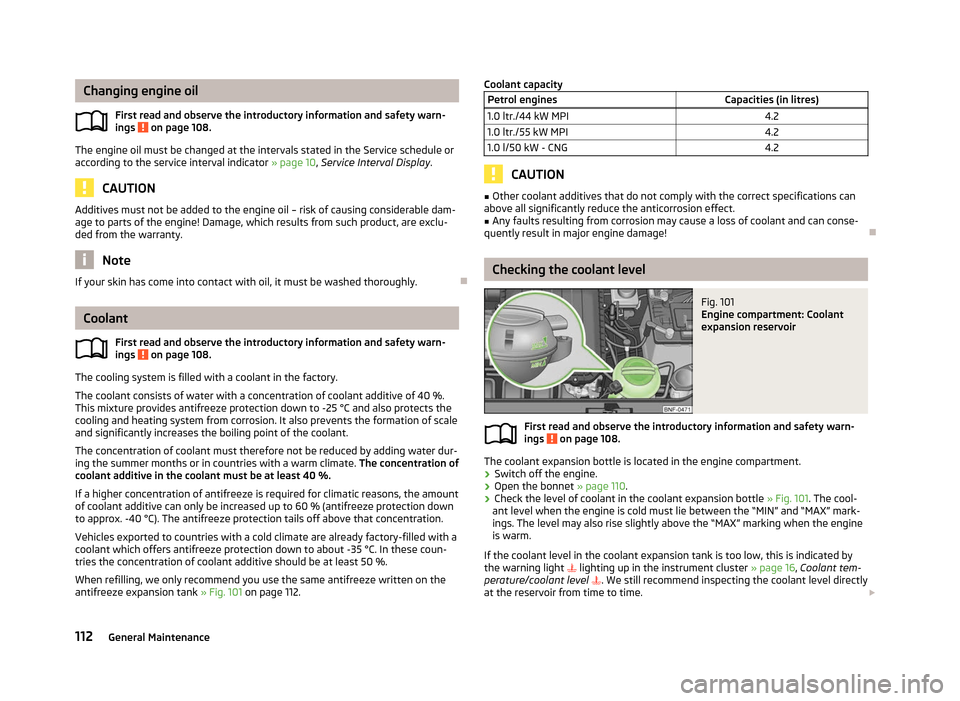
antifreeze expansion tank » Fig. 101 on page 112.
ä
ä
Coolant capacity
Petrol engines Capacities (in litres)
1.0 ltr./44 kW MPI 4.2
1.0 ltr./55 kW MPI 4.2
1.0 l/50 kW - CNG 4.2 CAUTION
■ Other coolant additives that do not comply with the correct specifications can
above all significantly reduce the anticorrosion effect.
■ Any faults resulting from corrosion may cause a loss of coolant and can conse-
quently result in major engine damage! Ð Checking the coolant level
Fig. 101
Engine compartment: Coolant
expansion reservoir
First read and observe the introductory information and safety warn-
ings on page 108.
The coolant expansion bottle is located in the engine compartment.
›
Switch off the engine.
› Open the bonnet
» page 110.
› Check the level of coolant in the coolant expansion bottle
» Fig. 101. The cool-
ant level when the engine is cold must lie between the
“MIN” and “MAX” mark-
ings. The level may also rise slightly above the “MAX” marking when the engine
is warm.
If the coolant level in the coolant expansion tank is too low, this is indicated by
the warning light lighting up in the instrument cluster » page 16, Coolant tem-
perature/coolant level . We still recommend inspecting the coolant level directly
at the reservoir from time to time. £
ä
112 General Maintenance
Page 119 of 157
Operation in winter
First read and observe the introductory information and safety warn-
ings on page 115.
At low temperatures, the vehicle battery only has part of the initial power output
that it has at normal temperatures.
A discharged vehicle battery may already freeze at temperatures just below 0
°C.
We therefore recommend that you have the battery checked and, if necessary, re-
charged by a ŠKODA Service Partner before the start of the winter.
ÐCharging a vehicle battery
First read and observe the introductory information and safety warn-
ings on page 115.
A properly charged vehicle battery is essential for reliably starting the engine.
›
Switch off the ignition and all of the electrical components.
› Only for “quick-charging”: Disconnect both battery cables (first of all “negative”,
then “positive”).
› Attach the terminal clamps of the charger to the battery terminals (red =
“posi-
tive
”, black = “negative”).
› Only now plug the mains cable of the charger into the power socket and switch
on the device.
› When charging is completed: Switch off the charger and remove the mains ca-
ble from the power socket.
› Only then disconnect the charger's terminal clamps.
› Reconnect the cables to the battery, if necessary (first of all
“positive”, then
“negative
”).
It is not normally necessary to disconnect the cables of the battery if you re-
charge the vehicle battery using low amperages (as for example from a mini-
charger). Refer to the instructions of the charger manufacturer.
A charging current of 0.1 multiple of the total vehicle battery capacity (or lower)
must be used until full charging is achieved.
It is, however, necessary to disconnect both cables before charging the battery
with high amperages, so-called “ quick-charging”.
ä
ä “Quick-charging” the vehicle battery is
dangerous
and requires a special charger
and specialist knowledge. We therefore recommend having the quick charging of
vehicle batteries undertaken by a ŠKODA specialist garage.
The vent plugs of the vehicle battery should not be opened for charging. CAUTION
On vehicles with the START/STOP system, the pole terminal of the charger must
not be connected directly to the negative terminal of the vehicle battery, but only
to the engine earth » page 136, Jump-starting in vehicles with the
START-STOP
system . Ð Disconnecting and reconnecting the vehicle battery
First read and observe the introductory information and safety warn-
ings on page 115.
On disconnecting and reconnecting the vehicle battery the following functions
are initially deactivated or are no longer able to operate fault-free:
Operation Operating measure
Enter radio code number » Radio manual
Setting the clock » page 12
Data in the multifunction display are deleted. » page 11 Note
We recommend having the vehicle checked by a ŠKODA Service Partner to ensure
the full functionality of all electrical systems. Ð Replacing the vehicle battery
First read and observe the introductory information and safety warn-
ings on page 115.
When replacing a battery, the new vehicle battery must have the same capacity,
voltage, amperage and be the same size. Suitable types of vehicle batteries can
be purchased from a
ŠKODA Service Partner. £
ä
ä
117
Inspecting and replenishing
Page 124 of 157
If, in the event of a puncture, it is necessary to fit a spare wheel with a tyre with-
out a dedicated running direction or the opposite running direction, drive carefully
as the optimum characteristics of the tyre are no longer applicable in this situa-
tion. ÐSpare wheel
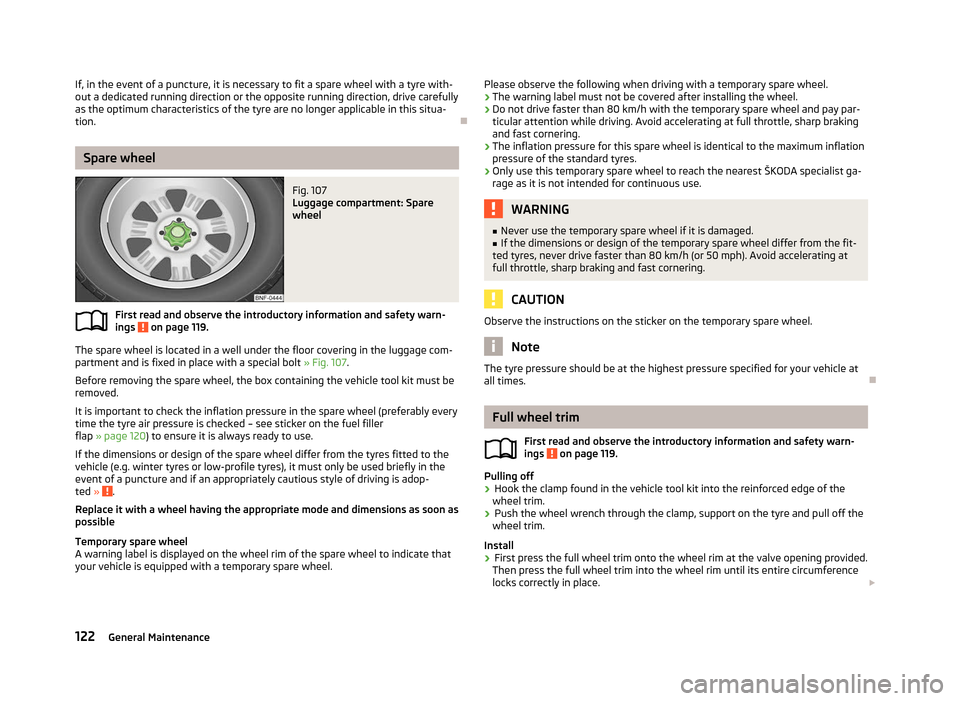
Fig. 107
Luggage compartment: Spare
wheel
First read and observe the introductory information and safety warn-
ings on page 119.
The spare wheel is located in a well under the floor covering in the luggage com-
partment and is fixed in place with a special bolt
» Fig. 107.
Before removing the spare wheel, the box containing the vehicle tool kit must be
removed.
It is important to check the inflation pressure in the spare wheel (preferably every
time the tyre air pressure is checked – see sticker on the fuel filler
flap » page 120) to ensure it is always ready to use.
If the dimensions or design of the spare wheel differ from the tyres fitted to the
vehicle (e.g. winter tyres or low-profile tyres), it must only be used briefly in the
event of a puncture and if an appropriately cautious style of driving is adop-
ted » .
Replace it with a wheel having the appropriate mode and dimensions as soon as
possible
Temporary spare wheel
A warning label is displayed on the wheel rim of the spare wheel to indicate that
your vehicle is equipped with a temporary spare wheel. ä Please observe the following when driving with a temporary spare wheel.
› The warning label must not be covered after installing the wheel.
› Do not drive faster than 80
km/h with the temporary spare wheel and pay par-
ticular attention while driving. Avoid accelerating at full throttle, sharp braking
and fast cornering.
› The inflation pressure for this spare wheel is identical to the maximum inflation
pressure of the standard tyres.
› Only use this temporary spare wheel to reach the nearest ŠKODA specialist ga-
rage as it is not intended for continuous use. WARNING
■ Never use the temporary spare wheel if it is damaged.
■ If the dimensions or design of the temporary spare wheel differ from the fit-
ted tyres, never drive faster than 80
km/h (or 50 mph). Avoid accelerating at
full throttle, sharp braking and fast cornering. CAUTION
Observe the instructions on the sticker on the temporary spare wheel. Note
The tyre pressure should be at the highest pressure specified for your vehicle at
all times. Ð Full wheel trim
First read and observe the introductory information and safety warn-
ings on page 119.
Pulling off
›
Hook the clamp found in the vehicle tool kit into the reinforced edge of the
wheel trim.
› Push the wheel wrench through the clamp, support on the tyre and pull off the
wheel trim.
Install
› First press the full wheel trim onto the wheel rim at the valve opening provided.
Then press the full wheel trim into the wheel rim until its entire circumference
locks correctly in place. £
ä
122 General Maintenance
Page 150 of 157
Index
A
ABS 61
Warning light 17
Accessories 125
Adjusting Exterior mirror 36
Interior mirror 35
Adjusting seats 75
Adjustment Seat 38
Aerial 98
Airbag Deployment 82
Front airbag 83
Side airbag Head-Thorax 84
Switching off 85
System description 82
Air conditioning system 53
Recirculated air mode 55
Antilock brake system 61
Ash tray 45
Assistance systems ESC 60
Assist systems ABS 17, 61
City Safe Drive 66
Cruise control systems (CCS) 63
EDL 61
ESC 17
Parking aid 62
START/STOP 65
TCS 61
Traction Control System (TCS) 17
Visual parking system 63Automatic gearbox 69
Dynamic shift programme 71
Information for driving 69
Kickdown 71
Operational faults 71
Parking 69
Selector lever positions 70
Starting off 69
Stopping 69
Tiptronic 70
Automatic load deactivation 118
Avoiding damage to your vehicle 95
B
Before setting off 74
Belts 78
Belt tensioners 80
Bonnet Closing 110
Opening 110
Brake assist 60
Brake booster 60
Brake fluid Checking 113
Brakes Handbrake 60
Running in 91
Warning light 15
Braking Brake fluid 113
Breakdown kit 132
Bulbs Replacing 141
Button in the driver's door Electrical power windows 26
C
Car computer see Multifunction display 11Car jack 127
Carrier 44
Catalytic converter 91
Central locking button 23
Central locking system 21
lock 22
unlock 22
Changes 125
Changing Engine oil 112
Wheel 128
Charging a vehicle battery 117
Checking Battery electrolyte level 116
Brake fluid 113
Coolant level 112
Engine oil 111
Oil level 111
Windscreen washer fluid 114
Children and safety 87
Child safety Side airbag 88
Child safety lock 21
Child seat Classification 88
ISOFIX 89
on the front passenger seat 87
Suitability 89
TOP TETHER 90
Chrome parts refer to Taking care of your vehicle 99
Cigarette lighter 46
City Safe Drive 66
Warning light 19
Cleaning 97
Artificial leather 101
Headlight lenses 100
Material coverings 102
Materials 101
Natural leather 102
148 Index
Page 151 of 157
Plastic parts 99
Wheels 101
Clock 12
Clothes hooks 50
CNG 106
Fuel gauge 9
Refuelling 106
Cockpit 12-volt power socket 46
Ash tray 45
Cigarette lighter 46
Cup holder 45
General view 7
Light 32
Storage compartments 47
Compartments 47
Compressed natural gas see CNG 106
Computer see Multifunction display 11
Coolant Checking 112
Replenishing 113
Correct seated position 75
Counter for distance driven 10
Cruise control system (CCS) 63
Cup holder 45
D
Dash panel insert 8
Daytime running light 30
Defrsoting rear window 33
Digital clock 12
Dipstick 111
Display Fuel level 9
Service interval 10
Distance driven 10Door
Child safety lock 21
Door opening lever locking of 22
Door opening leverl unlocking of 22
Doors Emergency locking 25
Driving Abroad 95
Driving through water on the street 96
Emissions 145
Fuel consumption 145
Towing a trailer 126
E
Economical and environmentally friendly driving 92
EDL 61
Electrical power windows Button in the driver's door 26
Electronic differential lock 61
Electronic immobiliser 57
Emergency Changing a wheel 128
Hazard warning light system 31
Jump-starting 134
locking of the doors 25
Towing the vehicle 136
Tyre repair 132
Unlocking the luggage compartment lid 26
Emissions 145
Engine Running in 91
Starting and stopping the engine 56
Engine compartment Brake fluid 113
Coolant 112
Overview 110
Vehicle battery 115Engine oil
Capacity 146
Changing 112
Checking 111
Replenishing 111
Specification 146
Engine revolutions counter 9
Environment 92
Environmental compatibility 94
Environmentally friendly driving 92
ESC Function 60
Warning light 17
F
Fire extinguisher 127
First-aid kit 127
Floor mats 62
Front airbag 83
Front seats 38
Fuel 104
Fuel gauge 9
refer to Fuel 104
Refuelling 104
Unleaded petrol 105
Fuel consumption 92
Fuses Assignment 138
Replacing 138
G
Gear Recommended gear 10
General view Cockpit 7
H
Handbrake 60
149
Index
Page 152 of 157
Head-Thorax 84
Headlights Driving abroad 95
Head restraint 40
Heating 52
Exterior mirror 36
Rear window 33
recommended settings 53
Seats 39
Heating rear window 33
Horn 7
I
Ignition 58
Ignition lock 58
Immobiliser 57
Instrument cluster 8
ISOFIX 89
J
Jacking points Raise vehicle 131
Jump-starting 134
L
Lever Main beam 31
Turn signal 31
Light Cockpit 32
Daytime running light 30
Fog lights 30
Hazard warning light system 31
Headlight beam adjustment 30
Headlight flasher 32
Low beam 29
Main beam 31
Parking light 29, 30Rear fog light 30
Replacing bulbs 141
Turn signal 31
Lights Switching lights on and off 29
Loads 145
Lock Central locking system 22
Locking Door opening lever 22
Emergency locking 25
Remote control 24
Locking and unlocking from the inside 23
luggage compartment see luggage compartment lid 25
Luggage compartment Bag hooks 42
cover 43
Emergency unlocking 26
Fixing nets 43
Lashing eyes 42
Unlocking the luggage compartment lid 26
Luggage compartment lid 25
M
Mirror Additional interior mirror 36
Exterior 36
Vanity 33
Mobile phone 72
Multifunction display Functions 11
Memory 11
Operation 12
O
Oil refer to Engine oil 111Onboard computer
see Multifunction display 11
Operation in winter De-icing windows 100
Vehicle battery 117
Outside temperature 12
Overview Engine compartment 110
Warning lights 14
P
Paint see Paint damage 99
Paint damage 99
Parking Parking aid 62
Visual parking system 63
Parking ticket holder 50
Passive Safety 74
Periodic wiping 34
Petrol refer to Fuel 105
Polishing the paintwork refer to Taking care of your vehicle 99
Power steering 57
Power windows Button in the driver's door 27
Preservation refer to Taking care of your vehicle 99
R
Radiator fan 113
Radio reception Operating problem 100
Raise vehicle 131
Rear mirror Exterior 36
Interior 35
150 Index
Page 153 of 157
Rear windows
closing 27
opening 27
Recirculated air mode 55
Recommended gear 10
Refuelling 104
Fuel 104
Regulation Headlight beam 30
Remote control 23
Synchronisation process 24
Remote control key Replacing the battery 20
Replacement of parts 125
Replacing bulbs 141
Fuses 138
Vehicle battery 117
Windscreen wiper blade 35
Replenishing Coolant 113
Engine oil 111
Windscreen washer fluid 114
Rof rack system Attachment points 44
Roof rack system Roof load 45
Running in Brake pads 91
Engine 91
The first 1 500 km 91
Tyres 91
S
Safe securing system 22
Safety 74
Airbags 82
Child safety 87
Child safety seats 87
Head restraints 40ISOFIX 89
TOP TETHER 90
Save electrical energy 92
Seat Adjusting 38
Seat belt Warning light 19
Seat belts 78
Belt tensioners 80
Cleaning 103
fastening and unfastening 80
Warning light 15
Seats Folding forwards 40
Head restraints 40
Heating 39
Selector lever see selector lever positions 70
Selector lever positions 70
Service display 10
Setting Air conditioning system 55
Heating 53
Steering wheel 57
Setting the clock Clock 12
Shifting Diving economically 92
Gearshift lever 61
Side airbag 84
Sliding/tilting roof Closing 27
Opening and tilting 27
Operating 27
Snow chains 123
Spare wheel 122
Speedometer 9
START/STOP Function 65
Starting and stopping the engine 56Starting engine
Jump-starting 134
START STOP Jump-starting 136
Warning light 19
Steering force assistance 57
Steering wheel 57
Storage 47
Storage compartments 47
Sun visors 33
Switching lights on and off 29
Switching off the front seat passenger 85
T
Taking care of the vehicle Artificial leather 101
Material coverings 102
Materials 101
Natural leather 102
Seat belts 103
Taking care of your vehicle 97
Automatic car wash system 98
Chrome parts 99
Cleaning the wheels 101
Door lock cylinders 100
Headlight lenses 100
High-pressure cleaner 98
Plastic parts 99
Polishing the paintwork 99
Preservation 99
Rubber seals 100
Washing 98
Washing by hand 98
Wash system 98
TCS 61
Technical data 145
Tiptronic 69
see automatic gearbox 70
Tool 127
TOP TETHER 90
151
Index