ignition SKODA CITIGO 2012 1.G Service Manual
[x] Cancel search | Manufacturer: SKODA, Model Year: 2012, Model line: CITIGO, Model: SKODA CITIGO 2012 1.GPages: 157, PDF Size: 3.9 MB
Page 118 of 157
CAUTION
■ The vehicle battery must only be disconnected if the ignition is switched off,
otherwise the vehicle's electrical system (electronic components) can be dam-
aged. When disconnecting the battery from the electrical system, first of all dis-
connect the negative terminal
(-) of the battery. Then disconnect the positive ter-
minal (+).
■ When connecting the battery to the electrical system, first connect the positive
terminal (+) of the battery. Then connect the negative terminal
(-). Under no cir-
cumstances must the battery cables be connected incorrectly – risk of a cable fire.
■ Ensure that battery acid does not come into contact with the bodywork – risk of
damage to the paintwork.
■ Do not place the battery in direct daylight in order to protect the vehicle battery
housing from the effects of ultra-violet light.
■ If the vehicle has not been driven for more than 3 to 4 weeks, the battery will
discharge. This is because certain electrical components consume electricity (e.
g.
control units) also in idle state. Prevent the battery from discharging by discon-
necting the battery's negative terminal or continuously charging the battery with
a very low charging current.
■ If the vehicle is frequently used for making short trips, the vehicle battery will
not have time to charge up sufficiently and may discharge. For the sake of the environment
A vehicle battery that has been removed is a special type of hazardous waste.
These must be disposed of in accordance with national legal regulations. Note
You should replace batteries older than 5 years. Ð Checking the battery electrolyte level
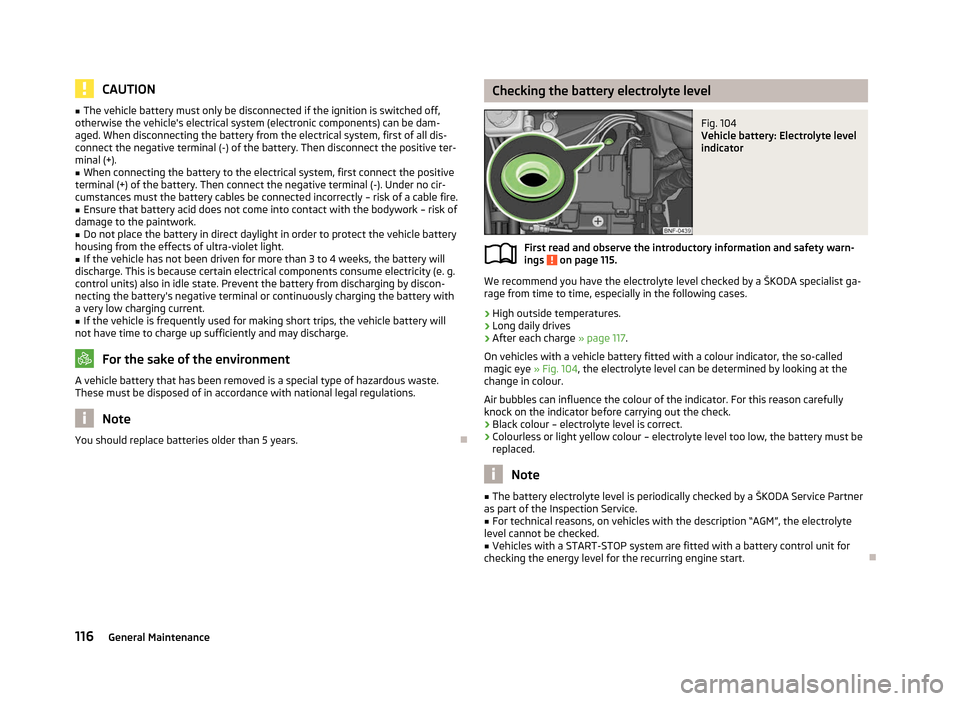
Fig. 104
Vehicle battery: Electrolyte level
indicator
First read and observe the introductory information and safety warn-
ings on page 115.
We recommend you have the electrolyte level checked by a ŠKODA specialist ga-
rage from time to time, especially in the following cases.
› High outside temperatures.
› Long daily drives
› After each charge
» page 117.
On vehicles with a vehicle battery fitted with a colour indicator, the so-called
magic eye » Fig. 104 , the electrolyte level can be determined by looking at the
change in colour.
Air bubbles can influence the colour of the indicator. For this reason carefully
knock on the indicator before carrying out the check.
› Black colour – electrolyte level is correct.
› Colourless or light yellow colour – electrolyte level too low, the battery must be
replaced. Note
■ The battery electrolyte level is periodically checked by a
ŠKODA Service Partner
as part of the Inspection Service. ■ For technical reasons, on vehicles with the description “AGM”, the electrolyte
level cannot be checked. ■ Vehicles with a START-STOP system are fitted with a battery control unit for
checking the energy level for the recurring engine start. Ð
ä
116 General Maintenance
Page 119 of 157
Operation in winter
First read and observe the introductory information and safety warn-
ings on page 115.
At low temperatures, the vehicle battery only has part of the initial power output
that it has at normal temperatures.
A discharged vehicle battery may already freeze at temperatures just below 0
°C.
We therefore recommend that you have the battery checked and, if necessary, re-
charged by a ŠKODA Service Partner before the start of the winter.
ÐCharging a vehicle battery
First read and observe the introductory information and safety warn-
ings on page 115.
A properly charged vehicle battery is essential for reliably starting the engine.
›
Switch off the ignition and all of the electrical components.
› Only for “quick-charging”: Disconnect both battery cables (first of all “negative”,
then “positive”).
› Attach the terminal clamps of the charger to the battery terminals (red =
“posi-
tive
”, black = “negative”).
› Only now plug the mains cable of the charger into the power socket and switch
on the device.
› When charging is completed: Switch off the charger and remove the mains ca-
ble from the power socket.
› Only then disconnect the charger's terminal clamps.
› Reconnect the cables to the battery, if necessary (first of all
“positive”, then
“negative
”).
It is not normally necessary to disconnect the cables of the battery if you re-
charge the vehicle battery using low amperages (as for example from a mini-
charger). Refer to the instructions of the charger manufacturer.
A charging current of 0.1 multiple of the total vehicle battery capacity (or lower)
must be used until full charging is achieved.
It is, however, necessary to disconnect both cables before charging the battery
with high amperages, so-called “ quick-charging”.
ä
ä “Quick-charging” the vehicle battery is
dangerous
and requires a special charger
and specialist knowledge. We therefore recommend having the quick charging of
vehicle batteries undertaken by a ŠKODA specialist garage.
The vent plugs of the vehicle battery should not be opened for charging. CAUTION
On vehicles with the START/STOP system, the pole terminal of the charger must
not be connected directly to the negative terminal of the vehicle battery, but only
to the engine earth » page 136, Jump-starting in vehicles with the
START-STOP
system . Ð Disconnecting and reconnecting the vehicle battery
First read and observe the introductory information and safety warn-
ings on page 115.
On disconnecting and reconnecting the vehicle battery the following functions
are initially deactivated or are no longer able to operate fault-free:
Operation Operating measure
Enter radio code number » Radio manual
Setting the clock » page 12
Data in the multifunction display are deleted. » page 11 Note
We recommend having the vehicle checked by a ŠKODA Service Partner to ensure
the full functionality of all electrical systems. Ð Replacing the vehicle battery
First read and observe the introductory information and safety warn-
ings on page 115.
When replacing a battery, the new vehicle battery must have the same capacity,
voltage, amperage and be the same size. Suitable types of vehicle batteries can
be purchased from a
ŠKODA Service Partner. £
ä
ä
117
Inspecting and replenishing
Page 120 of 157
We recommend that the battery is replaced by a ŠKODA Service Partner, where
the new vehicle battery will be installed properly and the original battery will be
disposed of in accordance with national regulations.
ÐAutomatic load deactivation
First read and observe the introductory information and safety warn-
ings on page 115.
An intelligent vehicle power management system automatically takes various
measures at high loads on the vehicle battery to prevent discharging of the bat-
tery: This manifests itself by the following:
› The idling speed is raised to allow the generator to deliver more electricity to
the electrical system.
› Where appropriate large consumers of power, e.g. seat heaters, rear window
heaters, voltage supply to the 12V power socket, have their power limited or in
case of emergency shut off completely. Note
Despite such intervention by the vehicle electric system management, the vehicle
battery may be drained. For example, when the ignition is switched on a long time
with the engine turned off or the side or parking lights are turned on during lon-
ger parking. Driving comfort is not put at risk by any shutting off of consumers.
Often the driver is not aware of it having taken place. Ðä
118 General Maintenance
Page 137 of 157
WARNING
■ A discharged vehicle battery may already freeze at temperatures just below
0 °C. In case of frozen battery carry out no jump-starting – risk of explosion!
■ Pay attention to the warning instructions relating to working in the engine
compartment » page 108, Engine compartment .
■ The non-insulated parts of the terminal clamps must never make contact
with each other. In addition, the jump-start cable connected to the positive
terminal of the battery must not come into contact with electrically conduct-
ing parts of the vehicle – risk of short circuit! ■ Do not clamp the jump-start cable to the negative terminal of the dis-
charged battery. There is the risk of detonating gas seeping out the battery
being ignited by the strong spark which results from the engine being started. ■ Route the jump-start cables so that they cannot be caught by any rotating
parts in the engine compartment. ■ Do not bend over the battery – risk of caustic burns!
■ The vent screws of the battery cells must be tightened firmly.
■ Keep any sources of ignition (naked flame, smouldering cigarettes, etc.)
away from the battery – risk of an explosion!
■ Never jump-start vehicle batteries with an electrolyte level that is too low –
risk of explosion and caustic burns. Note
■ There must not be any contact between the two vehicles otherwise current
may flow as soon as the negative terminals are connected. ■ The discharged battery must be properly connected to the system of the vehi-
cle. ■ We recommend you buy jump-start cables from a car battery specialist. Ð Jump-starting
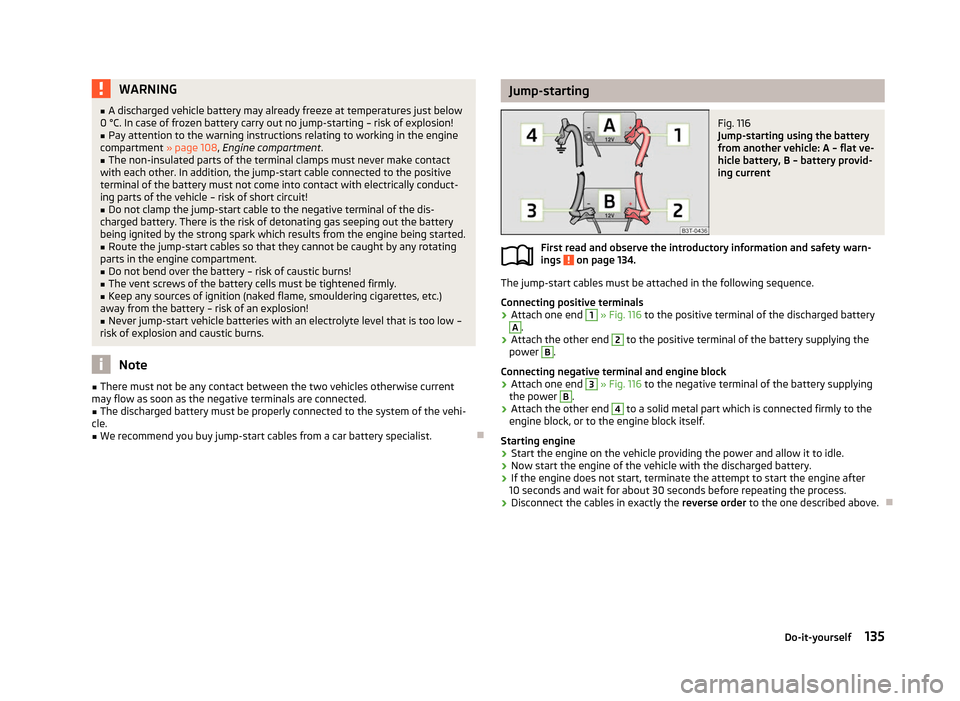
Fig. 116
Jump-starting using the battery
from another vehicle: A – flat ve-
hicle battery, B – battery provid-
ing current
First read and observe the introductory information and safety warn-
ings on page 134.
The jump-start cables must be attached in the following sequence.
Connecting positive terminals
› Attach one end 1
» Fig. 116
to the positive terminal of the discharged battery A
.
› Attach the other end 2
to the positive terminal of the battery supplying the
power B
.
Connecting negative terminal and engine block
› Attach one end 3
»
Fig. 116
to the negative terminal of the battery supplying
the power B
.
› Attach the other end 4
to a solid metal part which is connected firmly to the
engine block, or to the engine block itself.
Starting engine
› Start the engine on the vehicle providing the power and allow it to idle.
› Now start the engine of the vehicle with the discharged battery.
› If the engine does not start, terminate the attempt to start the engine after
10 seconds and wait for about 30 seconds before repeating the process.
› Disconnect the cables in exactly the
reverse order to the one described above. Ð
ä
135
Do-it-yourself
Page 138 of 157
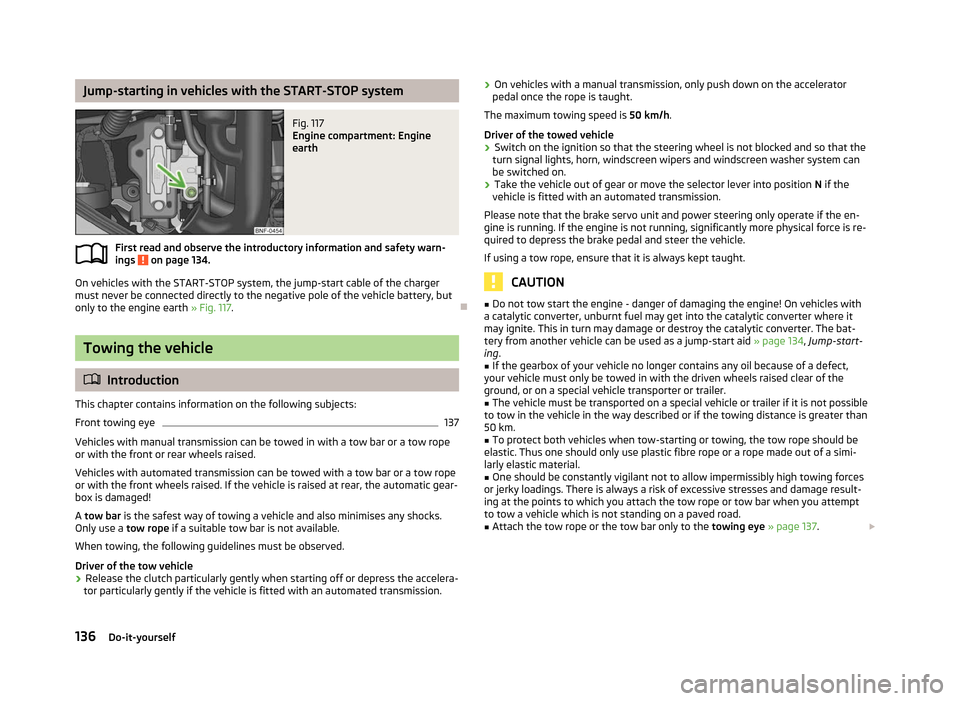
Jump-starting in vehicles with the START-STOP system
Fig. 117
Engine compartment: Engine
earth
First read and observe the introductory information and safety warn-
ings on page 134.
On vehicles with the START-STOP system, the jump-start cable of the charger
must never be connected directly to the negative pole of the vehicle battery, but
only to the engine earth
» Fig. 117. ÐTowing the vehicle
ä
Introduction
This chapter contains information on the following subjects:
Front towing eye 137
Vehicles with manual transmission can be towed in with a tow bar or a tow rope
or with the front or rear wheels raised.
Vehicles with automated transmission can be towed with a tow bar or a tow rope
or with the front wheels raised. If the vehicle is raised at rear, the automatic gear-
box is damaged!
A tow bar is the safest way of towing a vehicle and also minimises any shocks.
Only use a tow rope if a suitable tow bar is not available.
When towing, the following guidelines must be observed.
Driver of the tow vehicle
› Release the clutch particularly gently when starting off or depress the accelera-
tor particularly gently if the vehicle is fitted with an automated transmission.
ä
›
On vehicles with a manual transmission, only push down on the accelerator
pedal once the rope is taught.
The maximum towing speed is 50 km/h.
Driver of the towed vehicle
› Switch on the ignition so that the steering wheel is not blocked and so that the
turn signal lights, horn, windscreen wipers and windscreen washer system can
be switched on.
› Take the vehicle out of gear or move the selector lever into position
N if the
vehicle is fitted with an automated transmission.
Please note that the brake servo unit and power steering only operate if the en-
gine is running. If the engine is not running, significantly more physical force is re-
quired to depress the brake pedal and steer the vehicle.
If using a tow rope, ensure that it is always kept taught. CAUTION
■ Do not tow start the engine - danger of damaging the engine! On vehicles with
a catalytic converter, unburnt fuel may get into the catalytic converter where it
may ignite. This in turn may damage or destroy the catalytic converter. The bat-
tery from another vehicle can be used as a jump-start aid » page 134, Jump-start-
ing .
■ If the gearbox of your vehicle no longer contains any oil because of a defect,
your vehicle must only be towed in with the driven wheels raised clear of the
ground, or on a special vehicle transporter or trailer.
■ The vehicle must be transported on a special vehicle or trailer if it is not possible
to tow in the vehicle in the way described or if the towing distance is greater than
50 km. ■ To protect both vehicles when tow-starting or towing, the tow rope should be
elastic. Thus one should only use plastic fibre rope or a rope made out of a simi-
larly elastic material.
■ One should be constantly vigilant not to allow impermissibly high towing forces
or jerky loadings. There is always a risk of excessive stresses and damage result-
ing at the points to which you attach the tow rope or tow bar when you attempt
to tow a vehicle which is not standing on a paved road.
■ Attach the tow rope or the tow bar only to the towing eye » page 137. £
136 Do-it-yourself
Page 140 of 157
Fuses and light bulbs
Fuses
ä
Introduction
This chapter contains information on the following subjects:
Fuses on the underside of the dash panel 138
Fuses in the engine compartment 140
Fuses in the dash panel 140
Individual electrical circuits are protected by fuses.
› Before replacing a fuse, switch off the ignition and the appropriate consumer
› Find out which fuse belongs to the component that is not operat-
ing » page 138, Fuses on the underside of the dash panel , » page 140, Fuses
in the engine compartment , or »
page 140, Fuses in the dash panel .
› Take the plastic clip out of its fixture in the cover of the fuse box, place it on the
relevant fuse and pull it out.
› A blown fuses is recognisable by the molten metal strip. Replace the faulty fuse
with a new one of the
same amperage.
Colour coding of fuses Colour Maximum amperage
purple 3
light brown 5
brown 7.5
red 10
blue 15
yellow 20
white 25
green 30
orange 40 WARNING
Always read and observe the warnings before completing any work in the en-
gine compartment » page 108, Engine compartment . CAUTION
■ Never “repair” fuses and also do not replace them with a fuse of a higher am-
perage - risk of fire! This may also cause damage at another part of the electrical
system.
■ Have the electrical system checked as quickly as possible by a ŠKODA specialist
garage if a newly inserted fuse blows again after a short time. Note
■ We recommend always carrying replacement fuses in the vehicle. A box of re-
placement fuses can be purchased from
ŠKODA Original Accessories.
■ Multiple fuses may exist for a single power consuming device.
■ Multiple power consuming devices can share a single fuse. Ð Fuses on the underside of the dash panel
Fig. 119
Underside of the dash panel: Fuse box/schematic diagram of the
fuse box
First read and observe the introductory information and safety warn-
ings on page 138.
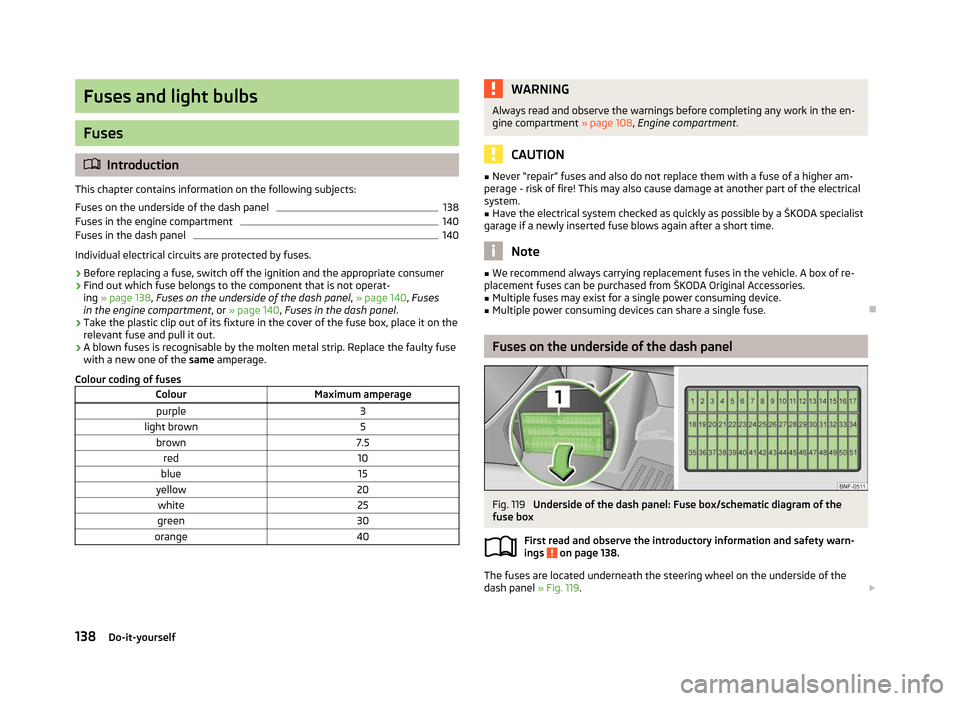
The fuses are located underneath the steering wheel on the underside of the
dash panel » Fig. 119. £
ä
138 Do-it-yourself
Page 141 of 157
›
Press the locking mechanism 1
and carefully open the cover in the direction of
the arrow.
› After the fuse has been replaced, fold the cover upwards in the opposite direc-
tion of the arrow so that it audibly latches.
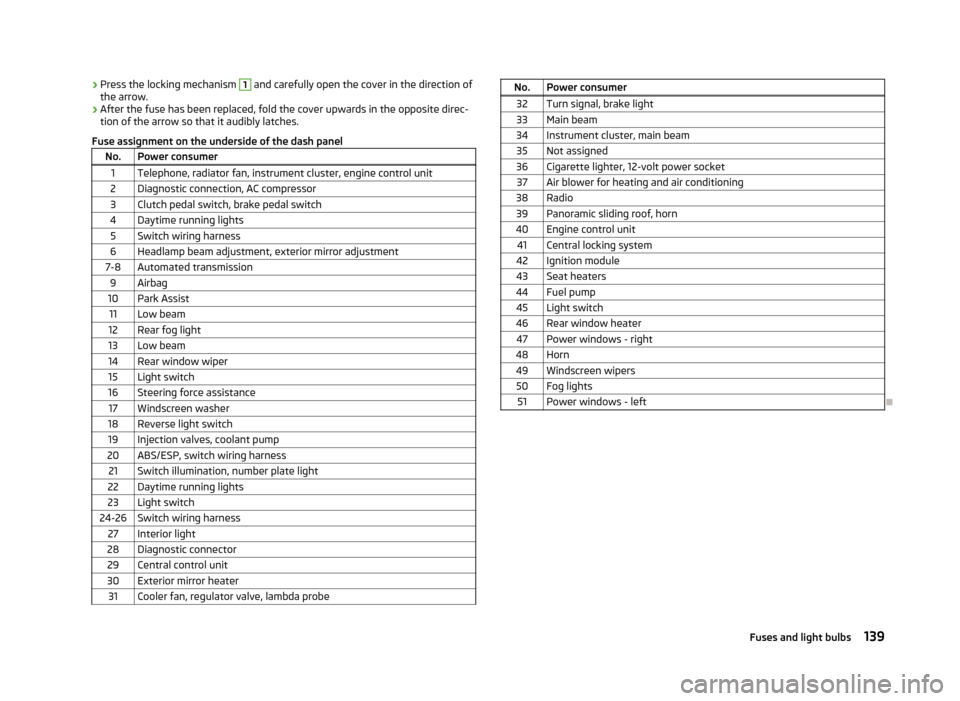
Fuse assignment on the underside of the dash panel No. Power consumer
1 Telephone, radiator fan, instrument cluster, engine control unit
2 Diagnostic connection, AC compressor
3 Clutch pedal switch, brake pedal switch
4 Daytime running lights 5 Switch wiring harness
6 Headlamp beam adjustment, exterior mirror adjustment
7-8 Automated transmission 9 Airbag
10 Park Assist 11 Low beam
12 Rear fog light
13 Low beam
14 Rear window wiper 15 Light switch
16 Steering force assistance 17 Windscreen washer
18 Reverse light switch 19 Injection valves, coolant pump
20 ABS/ESP, switch wiring harness 21 Switch illumination, number plate light
22 Daytime running lights
23 Light switch
24-26 Switch wiring harness 27 Interior light
28 Diagnostic connector 29 Central control unit
30 Exterior mirror heater 31 Cooler fan, regulator valve, lambda probe No. Power consumer
32 Turn signal, brake light
33 Main beam
34 Instrument cluster, main beam 35 Not assigned
36 Cigarette lighter, 12-volt power socket 37 Air blower for heating and air conditioning
38 Radio 39 Panoramic sliding roof, horn
40 Engine control unit 41 Central locking system
42 Ignition module
43 Seat heaters
44 Fuel pump 45 Light switch
46 Rear window heater 47 Power windows - right
48 Horn 49 Windscreen wipers50 Fog lights 51 Power windows - left Ð
139
Fuses and light bulbs
Page 142 of 157
Fuses in the engine compartment
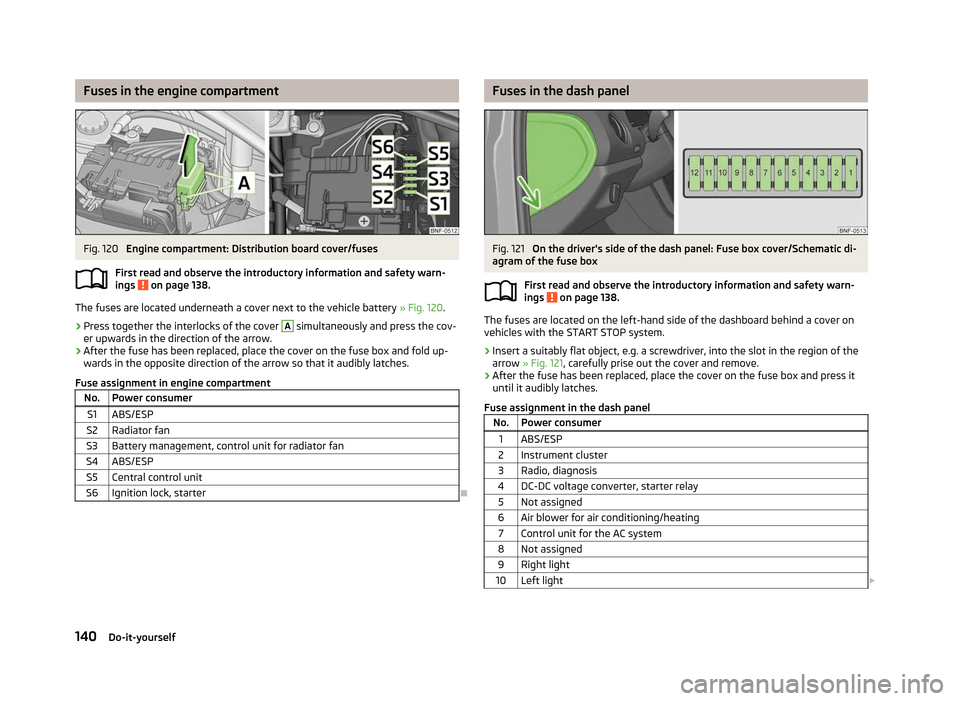
Fig. 120
Engine compartment: Distribution board cover/fuses
First read and observe the introductory information and safety warn-
ings on page 138.
The fuses are located underneath a cover next to the vehicle battery
» Fig. 120.
› Press together the interlocks of the cover A
simultaneously and press the cov-
er upwards in the direction of the arrow.
› After the fuse has been replaced, place the cover on the fuse box and fold up-
wards in the opposite direction of the arrow so that it audibly latches.
Fuse assignment in engine compartment No. Power consumer
S1 ABS/ESP
S2 Radiator fan
S3 Battery management, control unit for radiator fan
S4 ABS/ESP S5 Central control unit
S6 Ignition lock, starter Ð
ä Fuses in the dash panel
Fig. 121
On the driver's side of the dash panel: Fuse box cover/Schematic di-
agram of the fuse box
First read and observe the introductory information and safety warn-
ings on page 138.
The fuses are located on the left-hand side of the dashboard behind a cover on
vehicles with the
START STOP system.
› Insert a suitably flat object, e.g. a screwdriver, into the slot in the region of the
arrow » Fig. 121, carefully prise out the cover and remove.
› After the fuse has been replaced, place the cover on the fuse box and press it
until it audibly latches.
Fuse assignment in the dash panel No. Power consumer
1 ABS/ESP
2 Instrument cluster
3 Radio, diagnosis
4 DC-DC voltage converter, starter relay 5 Not assigned
6 Air blower for air conditioning/heating 7 Control unit for the AC system
8 Not assigned 9 Right light
10 Left light £ ä
140 Do-it-yourself
Page 143 of 157
No. Power consumer
11 Starter
12 DC-DC voltage converter Ð
Bulbs
ä
Introduction
This chapter contains information on the following subjects:
Headlights 141
Changing the light bulb for side repeater turn signal lights 142
Changing light bulbs for fog lights 142
Changing the bulb for the licence plate light 143
Tail lamp assembly 143
Some manual skills are required to change a bulb. For this reason, if uncertain, we
recommend that bulbs are replaced by a ŠKODA specialist garage or other expert
help is sought.
› Switch off the ignition and all of the lights before replacing a bulb.
› Faulty bulbs must only be replaced with the same type of bulbs. The designa-
tion is located on the light socket or the glass bulb.
› A stowage compartment for replacement bulbs is located in a plastic box in the
spare wheel or underneath the floor covering in the luggage compartment. WARNING
■ Accidents can be caused if the road in front of the vehicle is not sufficiently
illuminated and the vehicle cannot or can only be seen with difficulty by other
road users.
■ Always read and observe the warnings before completing any work in the
engine compartment » page 108, Engine compartment .
■ The H4 bulb is under pressure and may explode during a lamp replacement -
risk of injury! We therefore recommended wearing gloves and safety glasses
when changing a bulb. CAUTION
■ Do not take hold of the glass bulb with naked fingers (even the smallest
amount of dirt reduces the working life of the light bulb). Use a clean cloth, nap-
kin, or similar. ■ When removing and installing the number plate light and tail light make sure
that the paintwork of the vehicle and the tail light are not damaged. Note
■ This Owner's Manual only describes the replacement of bulbs where it is possi-
ble to replace the bulbs on your own without any complications arising. Other
light bulbs should be changed by a
ŠKODA specialist garage.
■ We recommend that a box of replacement bulbs be always carried in the vehi-
cle. Replacement bulbs can be purchased from
ŠKODAOriginal Accessories.
■ We recommend that the headlight settings are checked by a ŠKODA specialist
garage after replacing a bulb in the main or low beam.
■ LED diodes should be changed by a specialist ŠKODA garage. Ð Headlights
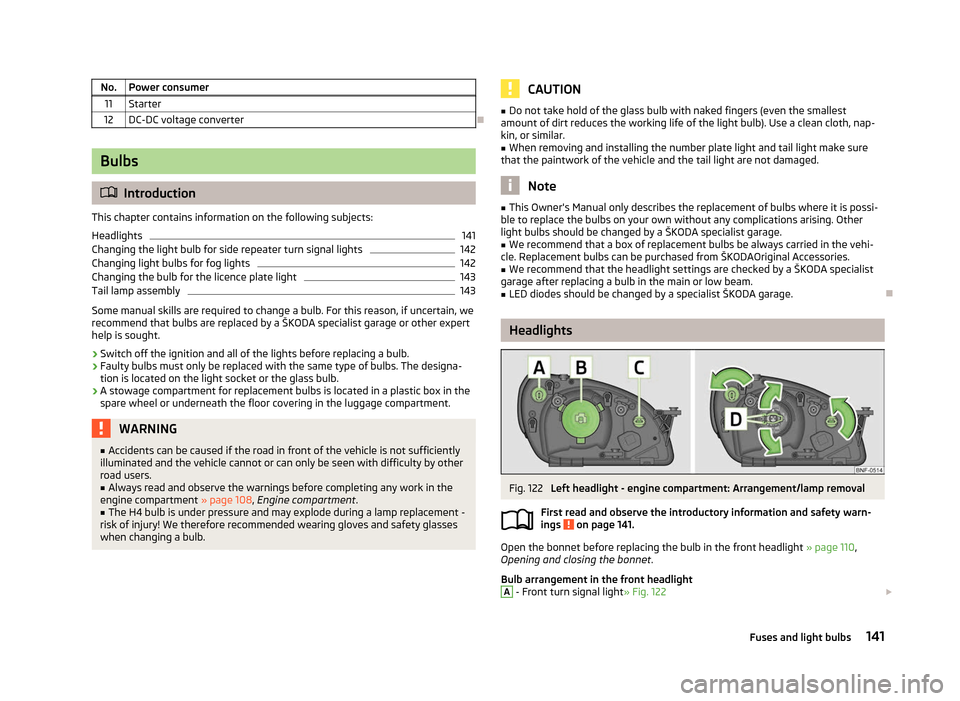
Fig. 122
Left headlight - engine compartment: Arrangement/lamp removal
First read and observe the introductory information and safety warn-
ings on page 141.
Open the bonnet before replacing the bulb in the front headlight
» page 110,
Opening and closing the bonnet .
Bulb arrangement in the front headlight A
- Front turn signal light
» Fig. 122 £
ä
141
Fuses and light bulbs
Page 152 of 157
Head-Thorax 84
Headlights Driving abroad 95
Head restraint 40
Heating 52
Exterior mirror 36
Rear window 33
recommended settings 53
Seats 39
Heating rear window 33
Horn 7
I
Ignition 58
Ignition lock 58
Immobiliser 57
Instrument cluster 8
ISOFIX 89
J
Jacking points Raise vehicle 131
Jump-starting 134
L
Lever Main beam 31
Turn signal 31
Light Cockpit 32
Daytime running light 30
Fog lights 30
Hazard warning light system 31
Headlight beam adjustment 30
Headlight flasher 32
Low beam 29
Main beam 31
Parking light 29, 30Rear fog light 30
Replacing bulbs 141
Turn signal 31
Lights Switching lights on and off 29
Loads 145
Lock Central locking system 22
Locking Door opening lever 22
Emergency locking 25
Remote control 24
Locking and unlocking from the inside 23
luggage compartment see luggage compartment lid 25
Luggage compartment Bag hooks 42
cover 43
Emergency unlocking 26
Fixing nets 43
Lashing eyes 42
Unlocking the luggage compartment lid 26
Luggage compartment lid 25
M
Mirror Additional interior mirror 36
Exterior 36
Vanity 33
Mobile phone 72
Multifunction display Functions 11
Memory 11
Operation 12
O
Oil refer to Engine oil 111Onboard computer
see Multifunction display 11
Operation in winter De-icing windows 100
Vehicle battery 117
Outside temperature 12
Overview Engine compartment 110
Warning lights 14
P
Paint see Paint damage 99
Paint damage 99
Parking Parking aid 62
Visual parking system 63
Parking ticket holder 50
Passive Safety 74
Periodic wiping 34
Petrol refer to Fuel 105
Polishing the paintwork refer to Taking care of your vehicle 99
Power steering 57
Power windows Button in the driver's door 27
Preservation refer to Taking care of your vehicle 99
R
Radiator fan 113
Radio reception Operating problem 100
Raise vehicle 131
Rear mirror Exterior 36
Interior 35
150 Index