engine SKODA CITIGO 2013 1.G User Guide
[x] Cancel search | Manufacturer: SKODA, Model Year: 2013, Model line: CITIGO, Model: SKODA CITIGO 2013 1.GPages: 176, PDF Size: 10.54 MB
Page 24 of 176
Cruise control systemFirst read and observe the introductory information and safety warn-
ings
on page 16.
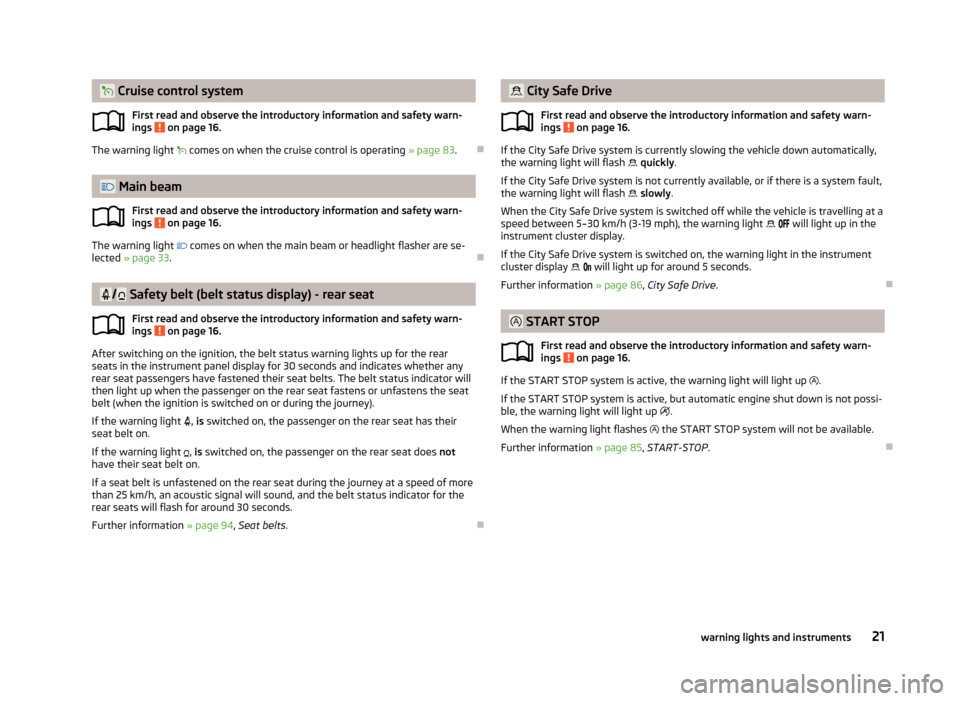
The warning light comes on when the cruise control is operating » page 83.
Main beam
First read and observe the introductory information and safety warn-ings
on page 16.
The warning light
comes on when the main beam or headlight flasher are se-
lected » page 33 .
/ Safety belt (belt status display) - rear seat
First read and observe the introductory information and safety warn-ings
on page 16.
After switching on the ignition, the belt status warning lights up for the rear
seats in the instrument panel display for 30 seconds and indicates whether any
rear seat passengers have fastened their seat belts. The belt status indicator will
then light up when the passenger on the rear seat fastens or unfastens the seat
belt (when the ignition is switched on or during the journey).
If the warning light
, is switched on, the passenger on the rear seat has their
seat belt on.
If the warning light ,
is switched on, the passenger on the rear seat does not
have their seat belt on.
If a seat belt is unfastened on the rear seat during the journey at a speed of more than 25 km/h, an acoustic signal will sound, and the belt status indicator for the
rear seats will flash for around 30 seconds.
Further information » page 94, Seat belts .
City Safe Drive
First read and observe the introductory information and safety warn-
ings
on page 16.
If the City Safe Drive system is currently slowing the vehicle down automatically,
the warning light will flash quickly .
If the City Safe Drive system is not currently available, or if there is a system fault, the warning light will flash slowly .
When the City Safe Drive system is switched off while the vehicle is travelling at a
speed between 5–30 km/h (3-19 mph), the warning light will light up in the
instrument cluster display.
If the City Safe Drive system is switched on, the warning light in the instrument
cluster display
will light up for around 5 seconds.
Further information » page 86, City Safe Drive .
START STOP
First read and observe the introductory information and safety warn-
ings
on page 16.
If the START STOP system is active, the warning light will light up
.
If the START STOP system is active, but automatic engine shut down is not possi-
ble, the warning light will light up
.
When the warning light flashes
the START STOP system will not be available.
Further information » page 85, START-STOP .
21warning lights and instruments
Page 25 of 176
Unlocking and locking
Unlocking and locking
Introduction
This chapter contains information on the following subjects:
Vehicle key
22
Replacing the battery in the remote control key
23
Child safety lock
23
Opening/closing a door
24
Door opening lever
24
Emergency locking of the doors
25
Vehicle key
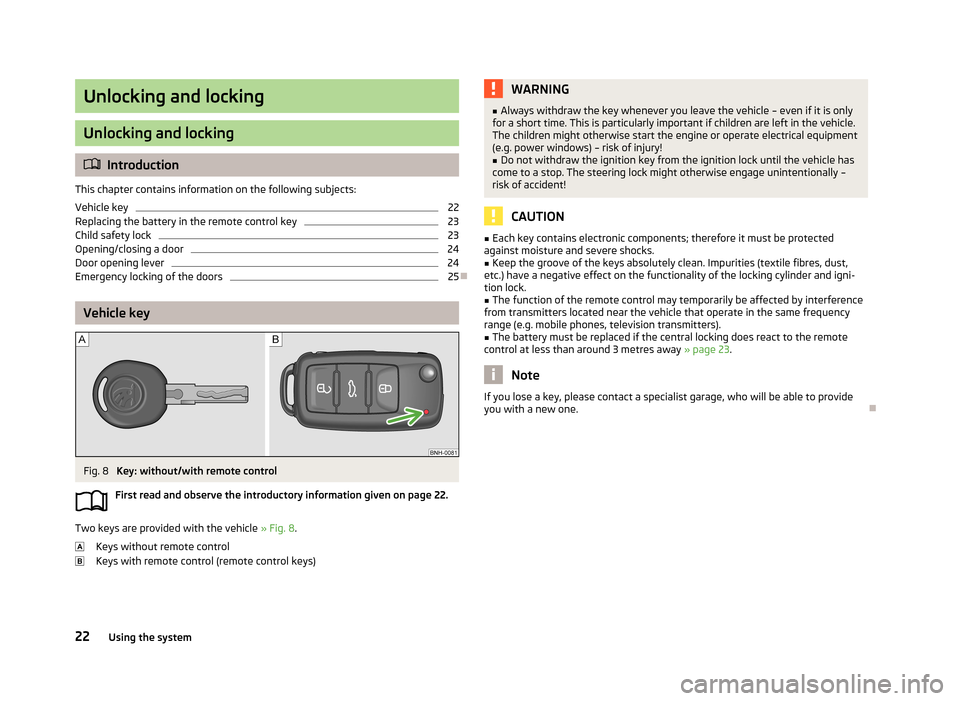
Fig. 8
Key: without/with remote control
First read and observe the introductory information given on page 22.
Two keys are provided with the vehicle » Fig. 8.
Keys without remote control
Keys with remote control (remote control keys)
WARNING■ Always withdraw the key whenever you leave the vehicle – even if it is only
for a short time. This is particularly important if children are left in the vehicle.
The children might otherwise start the engine or operate electrical equipment
(e.g. power windows) – risk of injury!■
Do not withdraw the ignition key from the ignition lock until the vehicle has
come to a stop. The steering lock might otherwise engage unintentionally –
risk of accident!
CAUTION
■ Each key contains electronic components; therefore it must be protected
against moisture and severe shocks.■
Keep the groove of the keys absolutely clean. Impurities (textile fibres, dust,
etc.) have a negative effect on the functionality of the locking cylinder and igni-
tion lock.
■
The function of the remote control may temporarily be affected by interference
from transmitters located near the vehicle that operate in the same frequency
range (e.g. mobile phones, television transmitters).
■
The battery must be replaced if the central locking does react to the remote
control at less than around 3 metres away » page 23.
Note
If you lose a key, please contact a specialist garage, who will be able to provide
you with a new one.
22Using the system
Page 30 of 176
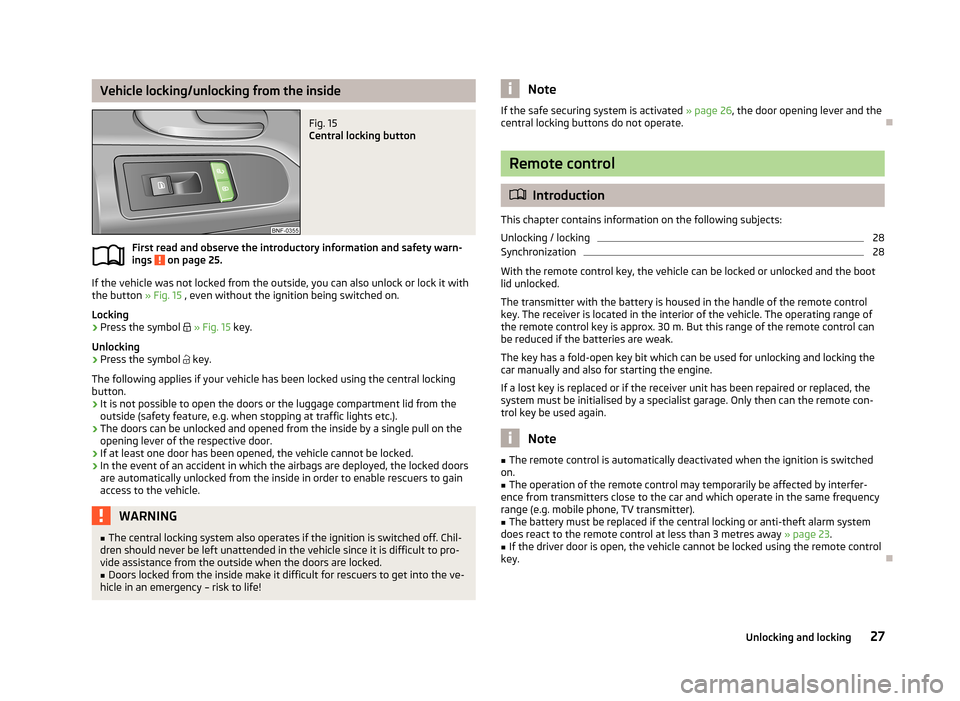
Vehicle locking/unlocking from the insideFig. 15
Central locking button
First read and observe the introductory information and safety warn-ings on page 25.
If the vehicle was not locked from the outside, you can also unlock or lock it with
the button » Fig. 15 , even without the ignition being switched on.
Locking
›
Press the symbol
» Fig. 15 key.
Unlocking
›
Press the symbol
key.
The following applies if your vehicle has been locked using the central locking button.
› It is not possible to open the doors or the luggage compartment lid from the
outside (safety feature, e.g. when stopping at traffic lights etc.).
› The doors can be unlocked and opened from the inside by a single pull on the
opening lever of the respective door.
› If at least one door has been opened, the vehicle cannot be locked.
› In the event of an accident in which the airbags are deployed, the locked doors
are automatically unlocked from the inside in order to enable rescuers to gain
access to the vehicle.
WARNING■ The central locking system also operates if the ignition is switched off. Chil-
dren should never be left unattended in the vehicle since it is difficult to pro-
vide assistance from the outside when the doors are locked.■
Doors locked from the inside make it difficult for rescuers to get into the ve-
hicle in an emergency – risk to life!
NoteIf the safe securing system is activated » page 26, the door opening lever and the
central locking buttons do not operate.
Remote control
Introduction
This chapter contains information on the following subjects:
Unlocking / locking
28
Synchronization
28
With the remote control key, the vehicle can be locked or unlocked and the boot
lid unlocked.
The transmitter with the battery is housed in the handle of the remote control
key. The receiver is located in the interior of the vehicle. The operating range of
the remote control key is approx. 30 m. But this range of the remote control can
be reduced if the batteries are weak.
The key has a fold-open key bit which can be used for unlocking and locking the
car manually and also for starting the engine.
If a lost key is replaced or if the receiver unit has been repaired or replaced, thesystem must be initialised by a specialist garage. Only then can the remote con-
trol key be used again.
Note
■ The remote control is automatically deactivated when the ignition is switched
on.■
The operation of the remote control may temporarily be affected by interfer-
ence from transmitters close to the car and which operate in the same frequency
range (e.g. mobile phone, TV transmitter).
■
The battery must be replaced if the central locking or anti-theft alarm system
does react to the remote control at less than 3 metres away » page 23.
■
If the driver door is open, the vehicle cannot be locked using the remote control
key.
27Unlocking and locking
Page 40 of 176
NoteIf the interior light remains switched on when the ignition is switched off or if one
of the doors is open, the light will automatically go out after around 10 minutes.
Interior light - Version 2
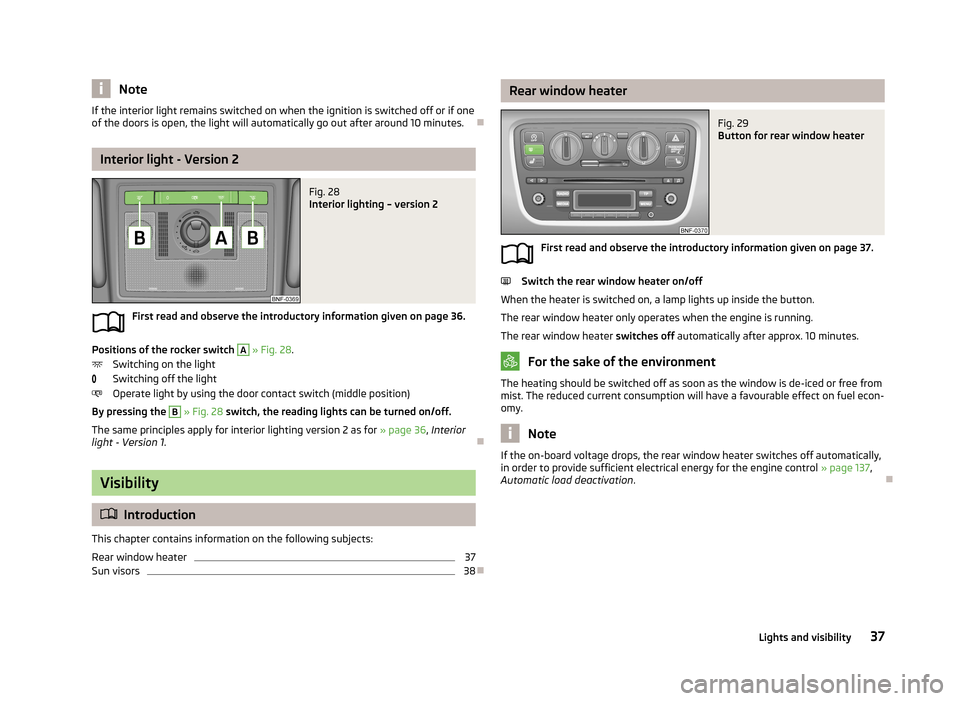
Fig. 28
Interior lighting – version 2
First read and observe the introductory information given on page 36.
Positions of the rocker switch
A
» Fig. 28 .
Switching on the light
Switching off the light
Operate light by using the door contact switch (middle position)
By pressing the
B
» Fig. 28 switch, the reading lights can be turned on/off.
The same principles apply for interior lighting version 2 as for » page 36, Interior
light - Version 1 .
Visibility
Introduction
This chapter contains information on the following subjects:
Rear window heater
37
Sun visors
38
Rear window heaterFig. 29
Button for rear window heater
First read and observe the introductory information given on page 37.
Switch the rear window heater on/off
When the heater is switched on, a lamp lights up inside the button. The rear window heater only operates when the engine is running.
The rear window heater switches off automatically after approx. 10 minutes.
For the sake of the environment
The heating should be switched off as soon as the window is de-iced or free from
mist. The reduced current consumption will have a favourable effect on fuel econ-
omy.
Note
If the on-board voltage drops, the rear window heater switches off automatically,
in order to provide sufficient electrical energy for the engine control » page 137,
Automatic load deactivation .
37Lights and visibility
Page 43 of 176
›Turn on the ignition and press the windscreen wiper lever into position4
» Fig. 31 on page 39 ; the windscreen wiper arms move to the home position.
Replacing the rear windscreen wiper blade
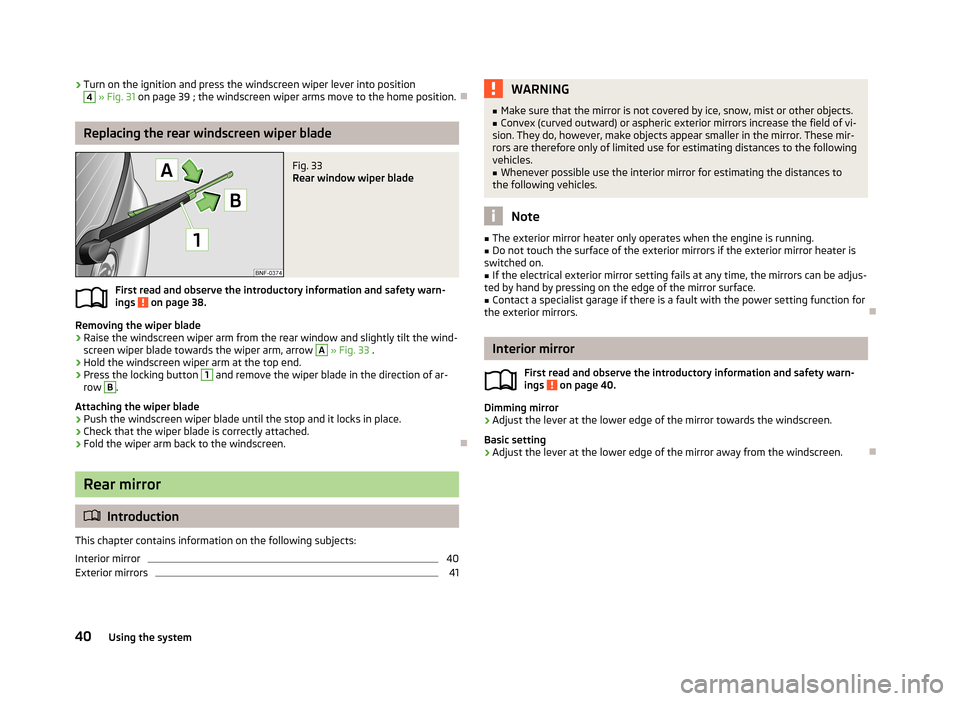
Fig. 33
Rear window wiper blade
First read and observe the introductory information and safety warn-
ings on page 38.
Removing the wiper blade
›
Raise the windscreen wiper arm from the rear window and slightly tilt the wind-
screen wiper blade towards the wiper arm, arrow
A
» Fig. 33 .
›
Hold the windscreen wiper arm at the top end.
›
Press the locking button
1
and remove the wiper blade in the direction of ar-
row
B
.
Attaching the wiper blade
›
Push the windscreen wiper blade until the stop and it locks in place.
›
Check that the wiper blade is correctly attached.
›
Fold the wiper arm back to the windscreen.
Rear mirror
Introduction
This chapter contains information on the following subjects:
Interior mirror
40
Exterior mirrors
41WARNING■ Make sure that the mirror is not covered by ice, snow, mist or other objects.■Convex (curved outward) or aspheric exterior mirrors increase the field of vi-
sion. They do, however, make objects appear smaller in the mirror. These mir-
rors are therefore only of limited use for estimating distances to the following
vehicles.■
Whenever possible use the interior mirror for estimating the distances to
the following vehicles.
Note
■ The exterior mirror heater only operates when the engine is running.■Do not touch the surface of the exterior mirrors if the exterior mirror heater is
switched on.■
If the electrical exterior mirror setting fails at any time, the mirrors can be adjus-
ted by hand by pressing on the edge of the mirror surface.
■
Contact a specialist garage if there is a fault with the power setting function for
the exterior mirrors.
Interior mirror
First read and observe the introductory information and safety warn-
ings
on page 40.
Dimming mirror
›
Adjust the lever at the lower edge of the mirror towards the windscreen.
Basic setting
›
Adjust the lever at the lower edge of the mirror away from the windscreen.
40Using the system
Page 47 of 176
WARNING■The front passenger airbag should be switched off when transporting ob-
jects on the seat backrest that has been folded forwards » page 102.■
Only adjust the seat backrest when the vehicle is stationary.
■
When moving the seat backrest, make sure that the seat backrest has been
properly secured – check by pulling on the seat backrest.
■
If the seat backrest is folded, passengers may only be transported on the
outer seat behind the driver.
■
When moving the seat backrest, keep limbs out of the area between the
seat and seat backrest – risk of injury!
■
The seat backrest that has been folded forwards must never be used to
transport objects that: ■could restrict the driver's view;
■ can make it impossible for the driver to operate the vehicle, e.g. if they
could fall under the pedals or protrude into the driver's area; ■ could injure passengers when the driver accelerates sharply, changes di-
rection or brakes.
Front seat heating
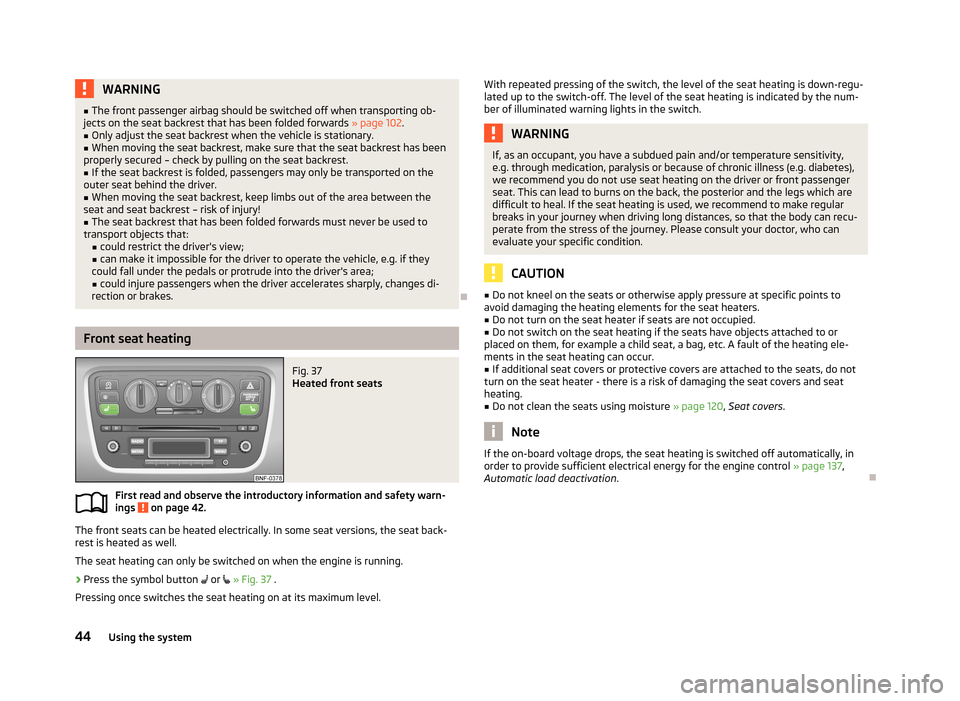
Fig. 37
Heated front seats
First read and observe the introductory information and safety warn- ings on page 42.
The front seats can be heated electrically. In some seat versions, the seat back-
rest is heated as well.
The seat heating can only be switched on when the engine is running.
›
Press the symbol button
or
» Fig. 37 .
Pressing once switches the seat heating on at its maximum level.
With repeated pressing of the switch, the level of the seat heating is down-regu-
lated up to the switch-off. The level of the seat heating is indicated by the num-
ber of illuminated warning lights in the switch.WARNINGIf, as an occupant, you have a subdued pain and/or temperature sensitivity,
e.g. through medication, paralysis or because of chronic illness (e.g. diabetes),
we recommend you do not use seat heating on the driver or front passenger
seat. This can lead to burns on the back, the posterior and the legs which are difficult to heal. If the seat heating is used, we recommend to make regular
breaks in your journey when driving long distances, so that the body can recu-
perate from the stress of the journey. Please consult your doctor, who can evaluate your specific condition.
CAUTION
■ Do not kneel on the seats or otherwise apply pressure at specific points to
avoid damaging the heating elements for the seat heaters.■
Do not turn on the seat heater if seats are not occupied.
■
Do not switch on the seat heating if the seats have objects attached to or
placed on them, for example a child seat, a bag, etc. A fault of the heating ele- ments in the seat heating can occur.
■
If additional seat covers or protective covers are attached to the seats, do not
turn on the seat heater - there is a risk of damaging the seat covers and seat
heating.
■
Do not clean the seats using moisture » page 120, Seat covers .
Note
If the on-board voltage drops, the seat heating is switched off automatically, in
order to provide sufficient electrical energy for the engine control » page 137,
Automatic load deactivation .
44Using the system
Page 55 of 176
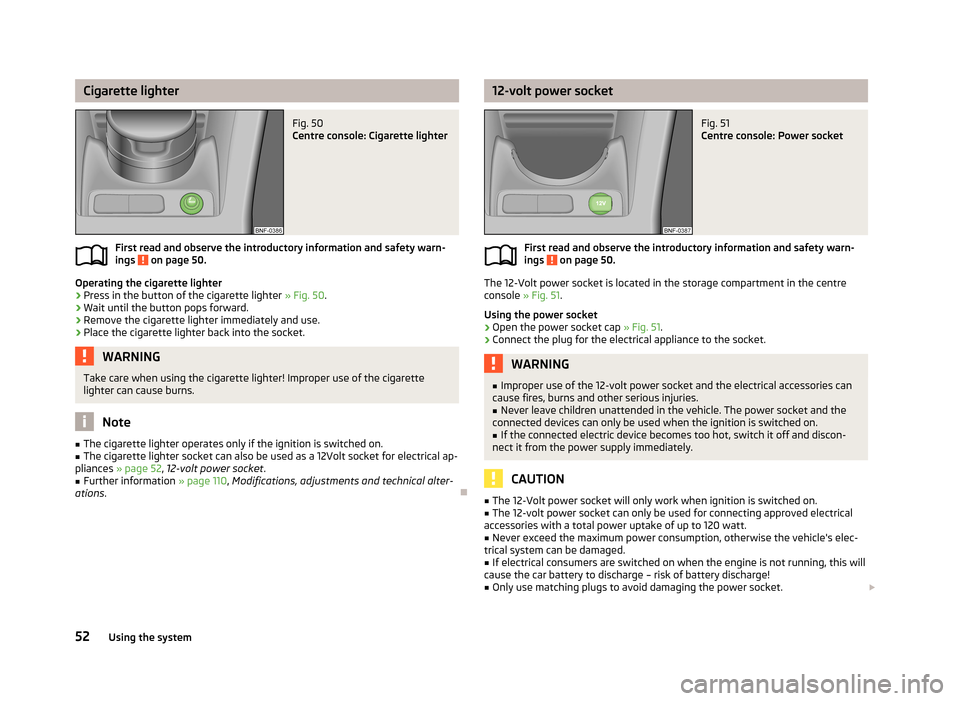
Cigarette lighterFig. 50
Centre console: Cigarette lighter
First read and observe the introductory information and safety warn-
ings on page 50.
Operating the cigarette lighter
›
Press in the button of the cigarette lighter » Fig. 50.
›
Wait until the button pops forward.
›
Remove the cigarette lighter immediately and use.
›
Place the cigarette lighter back into the socket.
WARNINGTake care when using the cigarette lighter! Improper use of the cigarette
lighter can cause burns.
Note
■ The cigarette lighter operates only if the ignition is switched on.■The cigarette lighter socket can also be used as a 12Volt socket for electrical ap-
pliances » page 52 , 12-volt power socket .■
Further information » page 110, Modifications, adjustments and technical alter-
ations .
12-volt power socketFig. 51
Centre console: Power socket
First read and observe the introductory information and safety warn-
ings on page 50.
The 12-Volt power socket is located in the storage compartment in the centre
console » Fig. 51.
Using the power socket
›
Open the power socket cap » Fig. 51.
›
Connect the plug for the electrical appliance to the socket.
WARNING■
Improper use of the 12-volt power socket and the electrical accessories can
cause fires, burns and other serious injuries.■
Never leave children unattended in the vehicle. The power socket and the
connected devices can only be used when the ignition is switched on.
■
If the connected electric device becomes too hot, switch it off and discon-
nect it from the power supply immediately.
CAUTION
■ The 12-Volt power socket will only work when ignition is switched on.■The 12-volt power socket can only be used for connecting approved electrical
accessories with a total power uptake of up to 120 watt.■
Never exceed the maximum power consumption, otherwise the vehicle's elec-
trical system can be damaged.
■
If electrical consumers are switched on when the engine is not running, this will
cause the car battery to discharge – risk of battery discharge!
■
Only use matching plugs to avoid damaging the power socket.
52Using the system
Page 60 of 176
Heating and air-conditioning
Heating, ventilation and cooling
Introduction
This chapter contains information on the following subjects:
Air outlet vents
57
The heating effect is dependent upon the coolant temperature, thus full heat output only occurs when the engine has reached its operating temperature.
If the cooling system is switched on, the temperature and air humidity drops in
the vehicle. The cooling system prevents the windows from misting up during
winter months.
It is possible to briefly activate recirculated air mode to enhance the cooling ef-
fect.
Please refer to the information regarding the recalculated air mode for air-condi-
tioning » page 61 .
WARNINGFor your own safety and that of other road users, ensure that all the windows
are free of ice, snow and misting. Please familiarize yourself about how to cor- rectly operate the heating and ventilation systems, how to demist and defrost
the windows, as well as with the cooling mode.
CAUTION
■ The air inlet in front of the windscreen must be free from ice, snow or leaves,
for example, to ensure that the heating and cooling system works properly.■
After switching on the cooling Condensation from the evaporator of the air con-
ditioning may drip down and form a puddle below the vehicle. This is not a leak!
Note■ The used air streams out through the vents in the luggage compartment.■We recommend that you do not smoke in the vehicle when the recirculating air
mode is operating since the smoke which is drawn at the evaporator from the in-
terior of the vehicle forms deposits in the evaporator of the air conditioning sys- tem. This produces a permanent odour when the air conditioning system is oper-ating which can only be eliminated through considerable effort and expense (re-
placement of compressor).
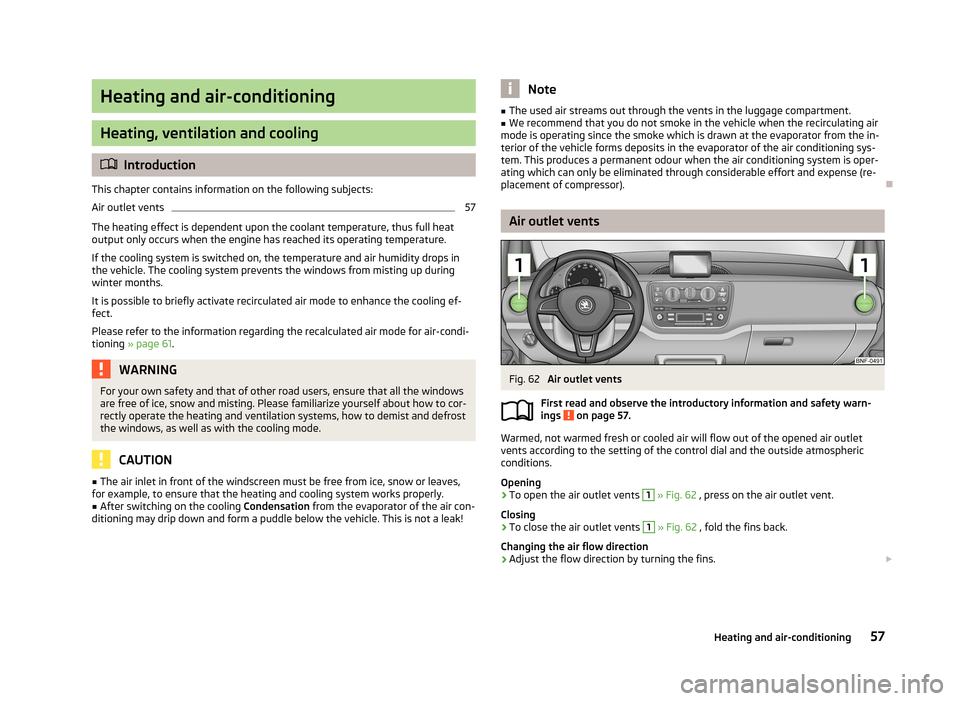
Air outlet vents
Fig. 62
Air outlet vents
First read and observe the introductory information and safety warn-
ings
on page 57.
Warmed, not warmed fresh or cooled air will flow out of the opened air outlet
vents according to the setting of the control dial and the outside atmospheric
conditions.
Opening
›
To open the air outlet vents
1
» Fig. 62 , press on the air outlet vent.
Closing
›
To close the air outlet vents
1
» Fig. 62 , fold the fins back.
Changing the air flow direction
›
Adjust the flow direction by turning the fins.
57Heating and air-conditioning
Page 62 of 176
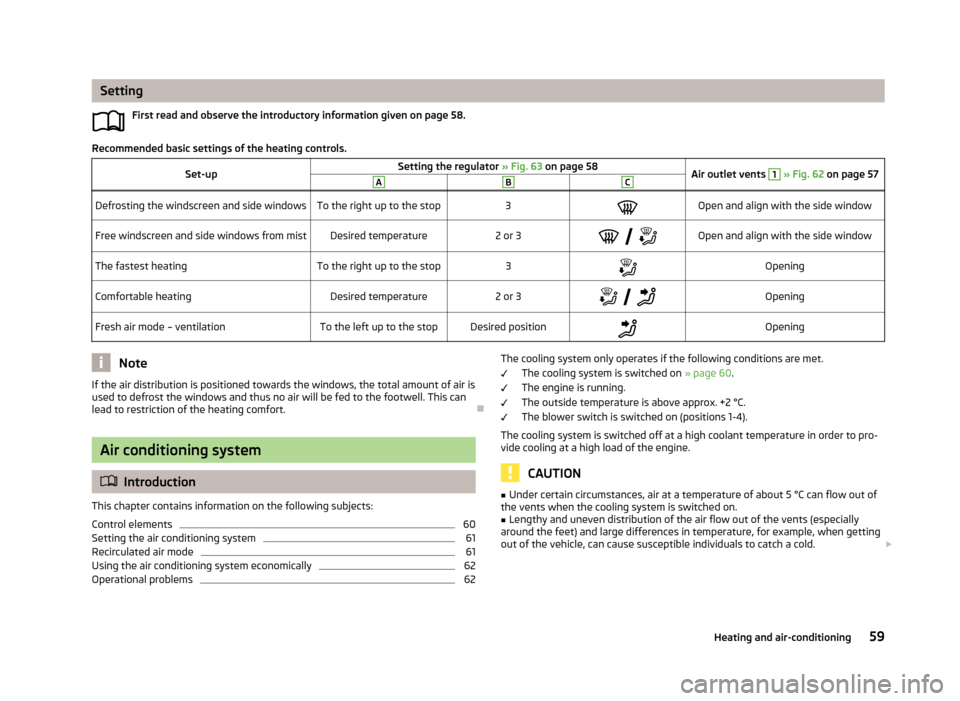
SettingFirst read and observe the introductory information given on page 58.
Recommended basic settings of the heating controls.
Set-upSetting the regulator » Fig. 63 on page 58Air outlet vents 1 » Fig. 62 on page 57ABCDefrosting the windscreen and side windowsTo the right up to the stop3Open and align with the side windowFree windscreen and side windows from mistDesired temperature2 or 3
Open and align with the side windowThe fastest heatingTo the right up to the stop3OpeningComfortable heatingDesired temperature2 or 3
OpeningFresh air mode – ventilationTo the left up to the stopDesired positionOpeningNoteIf the air distribution is positioned towards the windows, the total amount of air is
used to defrost the windows and thus no air will be fed to the footwell. This can
lead to restriction of the heating comfort.
Air conditioning system
Introduction
This chapter contains information on the following subjects:
Control elements
60
Setting the air conditioning system
61
Recirculated air mode
61
Using the air conditioning system economically
62
Operational problems
62The cooling system only operates if the following conditions are met. The cooling system is switched on » page 60.
The engine is running.
The outside temperature is above approx. +2 °C.
The blower switch is switched on (positions 1-4).
The cooling system is switched off at a high coolant temperature in order to pro-
vide cooling at a high load of the engine.
CAUTION
■ Under certain circumstances, air at a temperature of about 5 °C can flow out of
the vents when the cooling system is switched on.■
Lengthy and uneven distribution of the air flow out of the vents (especially
around the feet) and large differences in temperature, for example, when getting
out of the vehicle, can cause susceptible individuals to catch a cold.
59Heating and air-conditioning
Page 65 of 176
Using the air conditioning system economicallyFirst read and observe the introductory information and safety warn-ings
on page 59.
The compressor on the air conditioning system uses power from the engine whenin cooling mode which will effect the fuel consumption.
It recommended to open the windows or the doors of a vehicle for which the inte- rior has been strongly heated through the effect of direct sunlight in order to al-low the heated air to escape.
The cooling system should not be on if the windows are open.
For the sake of the environment
Pollutant emissions are also reduced when fuel is saved » page 74.
Operational problems
First read and observe the introductory information and safety warn-
ings
on page 59.
If the cooling system does not operate at outside temperatures higher than +5 °C,
there is a problem in the system. The reasons for this may be.
› One of the fuses has blown. Check the fuse and replace if necessa-
ry » page 154 .
› The cooling system has switched off automatically for a short time because the
coolant temperature of the engine is too hot » page 15.
If you are not able to resolve the operational problem yourself, or if the cooler
output has reduced, switch off the cooling system and seek assistance from a
specialist garage.
62Using the system