engine SKODA CITIGO 2013 1.G Service Manual
[x] Cancel search | Manufacturer: SKODA, Model Year: 2013, Model line: CITIGO, Model: SKODA CITIGO 2013 1.GPages: 176, PDF Size: 10.54 MB
Page 112 of 176
In order to be able to operate a vehicle with a variable service interval, it must
only be filled and topped up with the specified engine oil.
If this engine oil is not available, the oil change is subject to a fixed service inter-val. In this case, the vehicle must be changed to the fixed service interval.
Note
■
The corresponding motor oil specifications » page 130.■A changeover from the variable service interval to the fixed service interval, or
from the fixed service interval to the variable service interval, can be carried out
by a specialist garage.
Fixed service intervals QI1 - QI4
First read and observe the introductory information given on page 108.
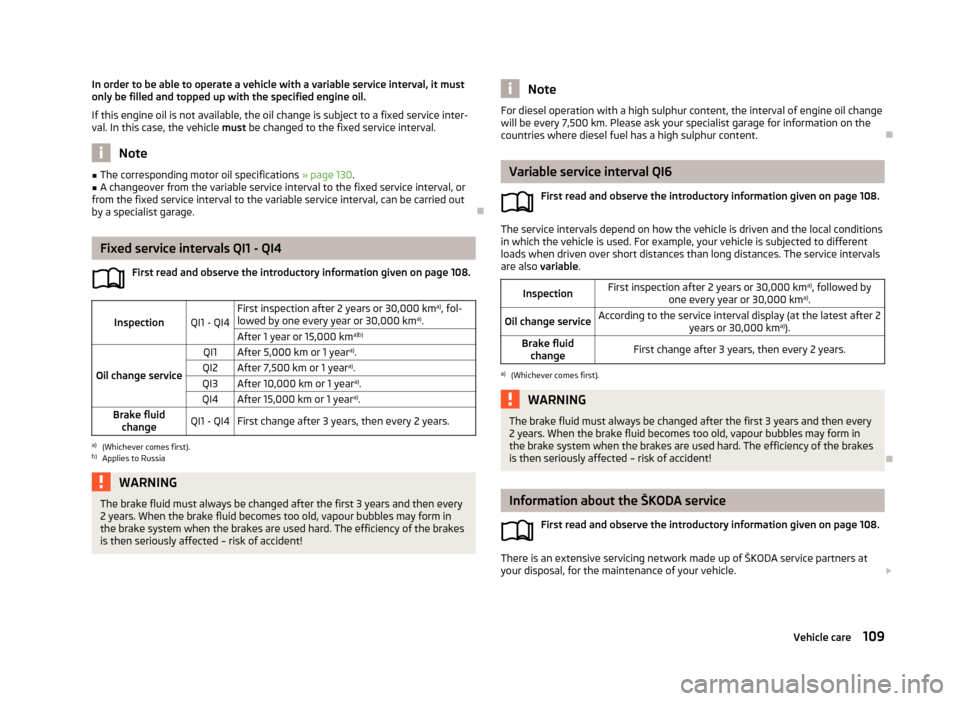
InspectionQI1 - QI4First inspection after 2 years or 30,000 km a)
, fol-
lowed by one every year or 30,000 km a)
.After 1 year or 15,000 km a)b)
Oil change service
QI1After 5,000 km or 1 yeara)
.QI2After 7,500 km or 1 year a)
.QI3After 10,000 km or 1 year a)
.QI4After 15,000 km or 1 year a)
.Brake fluid
changeQI1 - QI4First change after 3 years, then every 2 years.a)
(Whichever comes first).
b)
Applies to Russia
WARNINGThe brake fluid must always be changed after the first 3 years and then every
2 years. When the brake fluid becomes too old, vapour bubbles may form in
the brake system when the brakes are used hard. The efficiency of the brakes is then seriously affected – risk of accident!NoteFor diesel operation with a high sulphur content, the interval of engine oil change
will be every 7,500 km. Please ask your specialist garage for information on the
countries where diesel fuel has a high sulphur content.
Variable service interval QI6
First read and observe the introductory information given on page 108.
The service intervals depend on how the vehicle is driven and the local conditions
in which the vehicle is used. For example, your vehicle is subjected to different
loads when driven over short distances than long distances. The service intervals
are also variable.
InspectionFirst inspection after 2 years or 30,000 km a)
, followed by
one every year or 30,000 km a)
.Oil change serviceAccording to the service interval display (at the latest after 2
years or 30,000 km a)
).Brake fluid
changeFirst change after 3 years, then every 2 years.a)
(Whichever comes first).
WARNINGThe brake fluid must always be changed after the first 3 years and then every
2 years. When the brake fluid becomes too old, vapour bubbles may form in
the brake system when the brakes are used hard. The efficiency of the brakes is then seriously affected – risk of accident!
Information about the ŠKODA service
First read and observe the introductory information given on page 108.
There is an extensive servicing network made up of ŠKODA service partners at
your disposal, for the maintenance of your vehicle.
109Vehicle care
Page 121 of 176
This wax protection does not need to be inspected or re-applied.If any small amount of wax flow out of the cavities at high temperatures, thesemust be removed with a plastic scraper and the stains cleaned using a petroleum cleaner.WARNINGSafety regulations should be observed when using petroleum cleaner to re-
move wax – risk of fire!
Wheels
First read and observe the introductory information and safety warn-
ings
on page 115.
Wheel rims
Also thoroughly wash the wheel rims when washing the vehicle on a regular ba- sis.
Regularly remove salt and brake abrasion, otherwise the rim material will be cor-
roded.
Damage to the paint layer on the wheel rims must be touched up immediately.
Light alloy wheels
After washing thoroughly and treat the wheel rims with a protective product for
light alloy wheels. Products which cause abrasion must not be used to treat the
wheel rims.
CAUTION
Severe layers of dirt on the wheels can also result in wheel imbalance. This may
show itself in the form of a wheel vibration which is transmitted to the steering
wheel which, in certain circumstances, can cause premature wear of the steering.
This means it is necessary to remove the dirt.
Underbody protection
First read and observe the introductory information and safety warn-ings
on page 115.
The underside of your vehicle is protected for life against chemical and mechani-
cal influences.
When driving, it cannot be guaranteed that no damage to the protective layer will
occur.
We recommend having the protective layer underneath the vehicle and the chas-
sis checked — preferably before the beginning of winter and at the end of winter.
WARNINGNever use additional underbody protection or anti-corrosion agents for ex-
haust pipes, catalytic converters or heat shields. When the engine reaches its
operating temperature, these substances may ignite - risk of fire!
Taking care of the interior
Introduction
This chapter contains information on the following subjects:
Natural leather
119
Artificial leather, cloths and Alcantara ®
120
Seat covers
120
Seat belts
121
Regular and proper care helps to ensure efficiency and maintain the
value of your
vehicle.
We recommend using vehicle care products from ŠKODA Original Accessories. These are available from ŠKODA Partners. The usage instructions on the packagemust be observed.
118General Maintenance
Page 126 of 176
Unleaded petrolFirst read and observe the introductory information and safety warn-
ings
on page 122.
Your vehicle can only be operated with unleaded petrol in compliance with the
EN 228 1)
standard.
All petrol engines can be operated using petrol that contains at most 10% bioe-
thanol (E10).
Prescribed fuel – unleaded petrol min. 95 RON Use unleaded fuel with the octane rating 95 RON or higher.
In case of necessity, you can refuel with petrol with the octane ratings 91, 92 or
93 RON, if petrol with the octane rating 95 RON is not available »
.
Fuel additives
Unleaded petrol in accordance with the EN 228 standard 1)
meets all the condi-
tions for a smooth-running engine. We therefore recommend that no fuel addi-
tives are used. This can result in considerable damage to parts of the engine or
the exhaust system.
CAUTION
■ Even filling the tank with leaded petrol that does not meet the standards once
can lead to serious damage to parts of the exhaust system!■
If a fuel other than unleaded fuel which complies to the above mentioned
standards (e.g. leaded petrol) is used by mistake, do not start the engine or
switch on the ignition! Extensive damage to engine parts can occur! We recom-
mend that you have the fuel system cleaned by a specialist garage.CAUTION■ If, in an emergency, the vehicle has to be refuelled with petrol of a lower octane
number than the one prescribed, the journey must only be continued at medium
engine speeds and a low engine load. Driving at high engine revs or a high engine
load can severely damage the engine! Refuel using petrol of the prescribed oc-
tane number as soon as possible.■
Engine parts can be damaged if petrol with a lower octane number than the one
prescribed is used.
■
Even in the event of an emergency, petrol of a lower octane number than 91
RON must not be used, otherwise the engine can be severely damaged!
CAUTION
■ In no case may fuel additives with metal components be used, especially not
with manganese and iron content. LRP(lead replacement petrol) fuels with metal-
lic components may not be used. There is a risk of causing considerable damage
to parts of the engine or exhaust system!■
Fuels with metallic content may not be used. There is a risk of causing consider-
able damage to parts of the engine or exhaust system!
Note
■ Unleaded petrol that has a higher octane number than that required by the en-
gine can be used without limitations.■
On vehicles using prescribed unleaded petrol of min. 95 RON, the use of petrol
with a higher octane number than 95 RON can increase the power and reduce
fuel consumption.
Vehicles with CNG (compressed natural gas) mode
Introduction
This chapter contains information on the following subjects:
Refuelling
124
Automatic switching from CNG to petrol mode
125
Natural gas as fuel
125
1)
In Germany, DIN 51626-1 or E10 for unleaded gasoline with octane number 95 and 91.
123Inspecting and replenishing
Page 128 of 176
In the following situation, it is possible that the tank cannot be fully filled with
natural gas.
› At very high ambient temperatures. The natural gas refuelling systems have
overheating protection. When the ambient temperature reaches a predefined value, the refuelling system automatically switches off.
› If the refuelling system has been in operation for a longer period, the filling
pressure of the natural gas refuelling system slightly drops.WARNING■ Stop the engine before refuelling.■Always switch off your mobile phone, do not smoke and do not use open
flames when refuelling with natural gas – risk of explosion!■
When refuelling, never get into the vehicle. If you have to get into your vehi-
cle in exceptional cases, close the door and touch a metal surface before you
touch the filling coupling again. This will avoid electrostatic discharges, which
may generate sparks. Sparks can cause a fire during refuelling.
■
Natural gas is highly explosive and flammable. Incorrect refuelling or improp-
er handling of natural gas can cause a fire, an explosion and injuries.
Note
■ The natural gas system of your vehicle is suitable both for fuelling from small
compressors (slow fuelling) and for fuelling from natural gas stations with large
compressors (quick fuelling).■
Noises that occur during refuelling represent no risk.
■
If the vehicle is parked for a longer period of time immediately after refuelling,
the situation may arise in which the pointer of the fuel tank gauge does not indi- cate exactly the same level as was the case immediately after refuelling when theengine is restarted. This is not due to any system leakages but a drop in pressurein the natural gas fuel tank due to technical reasons after a cooling phase directly
after refuelling.
■
For frequent short-haul traffic, especially at low outside temperatures, the vehi-
cle is driven more frequently in petrol mode than in natural gas mode. This is why the petrol tank runs empty faster than the natural gas tank.
■
The capacity of the natural gas tank is about 11 kg, of which about 1.5 kg are a
reserve.
■
The capacity of the petrol tank is about 10 l, of which about 5 l are a reserve.
Automatic switching from CNG to petrol mode
First read and observe the introductory information and safety warn-
ings
on page 123.
The vehicle automatically switches over from CNG mode to petrol mode when the following conditions are met:
› when starting the engine, if the coolant temperature is below 15 °C,
› when the natural gas tank is empty,
› after refuelling with natural gas.
Natural gas as fuel
First read and observe the introductory information and safety warn-ings
on page 123.
Natural gas is an alternative fuel for motor vehicles. Its main component is meth-
ane (CH 4). The rest is carbon dioxide and lower hydrocarbons.
The strict legal requirements for exhaust emissions of motor vehicles are decisive for the current significance of natural gas. In direct comparison to all other fossil
fuels, natural gas is one of the fuels which cause the lowest emissions.
Natural gas is odourless and lighter than air. For safety reasons, it is saturated
with odorous substances, so that is perceived even in very small amounts.
Regular gas system checks
First read and observe the introductory information and safety warn-ings
on page 123.
Every two years, the following inspections must be carried out:
› Check the condition of the fuel filler cap, filler neck and sealing ring, and clean
sealing ring if necessary.
› Check gas system for leaks.
The following checks must be carried out every four years: › Check gas tank mounting for secure attachment and possible damage.
The gas tank must be filled prior to the regular gas system check.
125Inspecting and replenishing
Page 129 of 176
Safe natural gasFirst read and observe the introductory information and safety warn-ings
on page 123.
The safety concept of the natural gas system ensures safe operation. It is equip-
ped with the following security features.
› At each natural gas tank, there is a solenoid valve that closes automatically af-
ter turning off the ignition or when running in petrol mode.
› A thermal fuse prevents uncontrolled rise in pressure in the natural gas tank in
case of fire.
› A flow limiter prevents sudden emptying of the natural gas tank in case the
pressure system is damaged.
› All the attachment points and materials are designed for maximum safety.
Natural gas quality and consumption
First read and observe the introductory information and safety warn-ings
on page 123.
Natural gas is divided into quality groups H-gas and L-gas. The two types of gas
are subdivided according to their calorific value and nitrogen and carbon dioxide
contents. H-gas has a higher calorific value and lower nitrogen or carbon dioxide
content than L-gas.
The higher the calorific value of natural gas, the lower is the consumption. How-
ever, the calorific value and the nitrogen and carbon dioxide contents can vary
within a quality group. Therefore, the consumption of the vehicle may even vary
when driving with only one natural gas quality (either only H-gas or L-gas).
The engine control of your vehicle automatically adjusts to the different natural
gas qualities. Therefore both natural gas qualities can be mixed in the fuel tank. It is therefore not necessary to run the natural gas tank completely empty to fill up
another quality.
CNG labelsFig. 101
CNG label
Fig. 102
Position of the CNG label
First read and observe the introductory information and safety warn-
ings on page 123.
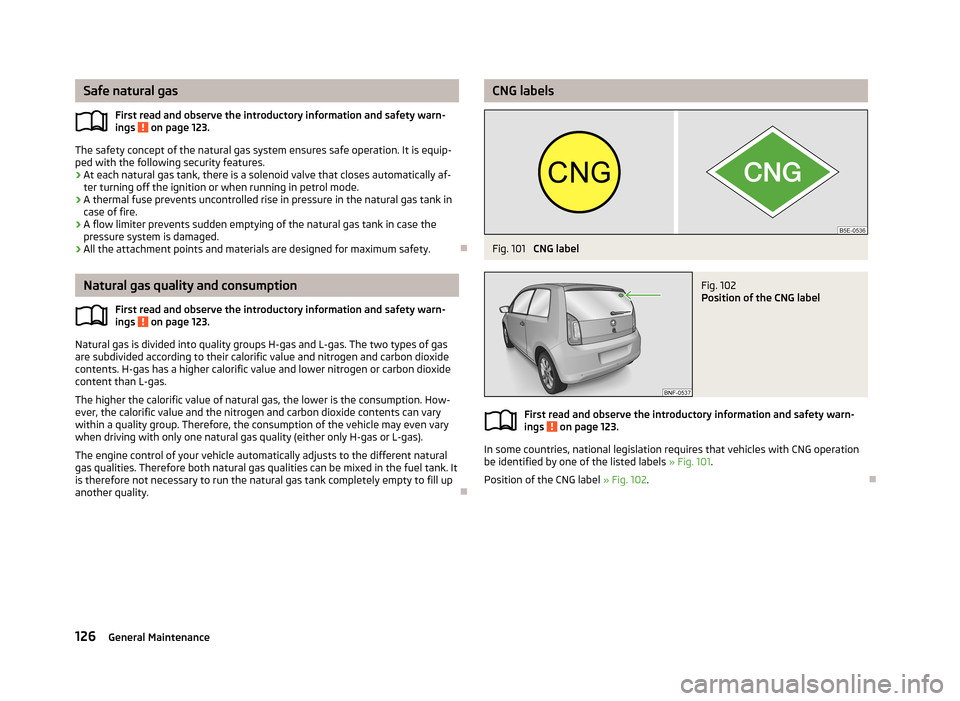
In some countries, national legislation requires that vehicles with CNG operation
be identified by one of the listed labels » Fig. 101.
Position of the CNG label » Fig. 102.
126General Maintenance
Page 130 of 176
Engine compartment
Introduction
This chapter contains information on the following subjects:
Opening and closing the bonnet
128
Engine compartment overview
129
Radiator fan
129
Windscreen washer system
129WARNINGInjuries or scolding or risks of accident or fire may occur when working in the
engine compartment. For this reason, it is essential to comply with the warn- ing instructions outlined below and with the general applicable safety rules.
The engine compartment of your car is a hazardous area!WARNINGThe following instructions must be followed before starting work in the en-
gine compartment:■
Turn off the engine and withdraw the ignition key.
■
Firmly apply the handbrake.
■
If the vehicle is fitted with a manual gearbox, move the gearshift lever into
Neutral, or if the vehicle is fitted with an automatic gearbox, move the selec-
tor lever into position N.
■
Allow the engine to cool.
■
Never open the bonnet if you can see steam or coolant escaping from the
engine compartment – risk of scalding! Wait until no more steam or coolant is
escaping.
WARNINGThe following instructions must be followed when working in the engine com-
partment.■
Keep children clear of the engine compartment.
■
Never touch the radiator fan while the engine is still warm. The fan might
suddenly start running!
WARNING (Continued)■ Do not touch any hot engine parts – risk of burns!■The coolant additive and thus all of the coolant is harmful to your health.■
Avoid contact with the coolant.
■
Coolant vapours are harmful to health.
■
Never open the end cover of the coolant expansion reservoir while the en-
gine is still warm. The cooling system is pressurized!
■
When opening the end cover of the coolant expansion reservoir, cover it
with a cloth to protect your face, hands and arms from hot steam or hot cool-
ant.
■
If any coolant splashes into your eyes, immediately rinse out your eyes with
clear water and contact a doctor as soon as possible.
■
Always store the coolant additive securely in its original container, and in
particular out of the reach of children – risk of poisoning!
■
If coolant is swallowed, consult a doctor immediately.
■
Do not leave any items (e.g. cloths or tools) in the engine compartment.
■
Never spill fluids on the hot engine. Such fluids (e.g. the antifreeze con-
tained in the coolant) may ignite!
WARNINGThe following warning instructions must be observed at all times when work-
ing in the engine compartment while the engine is running.■
Pay particular attention to rotating engine parts (e.g. V-ribbed belt, genera-
tor, radiator fan) and the high-voltage ignition system – risk to life!
■
Never touch the electric wiring on the ignition system.
■
Avoid short circuits in the electrical system – particularly on the vehicle's
battery.
■
Always make sure that no jewellery, loose clothing or long hair can get
caught in rotating engine parts – risk to life! Always remove any jewellery, tie
back long hair and wear tight fitting clothing before completing any work.
WARNINGThe following warning instructions must be observed if work has to be carried
out on the fuel or electrical systems.■
Always disconnect the vehicle battery from the electrical system.
■
Do not smoke.
■
Never work near open flames.
■
Always have a functioning fire extinguisher nearby.
127Inspecting and replenishing
Page 131 of 176
WARNING■Read and observe the information and warning instructions on the fluid con-
tainers.■
Keep fluids in their original containers and keep securely out of the reach of
children!
■
If you intend to work underneath the vehicle, you must secure the vehicle
from rolling away and support it with suitable supporting blocks; the car jack
is not sufficient – risk of injury!
■
Never cover the engine with additional insulation material (e.g. with a cover)
– risk of fire!
■
The bonnet must always be properly closed when driving. Therefore, the
lock must always be checked after closing the bonnet in order to ensure that
it has engaged properly.
■
If you notice that the lock is not properly engaged while driving, stop the ve-
hicle immediately and close the bonnet – risk of accident!
CAUTION
■ Always top up using the correct specification of fluids. This may result in major
operating problems and also vehicle damage!■
Never open the bonnet using the locking lever.
For the sake of the environment
In view of the requirements for the environmentally friendly disposal of fluids and the special tools and knowledge required for such work, we recommend that flu-
ids be changed by a specialist garage.
Note
■ Please consult a specialist garage for any questions relating to fluids.■Fluids with the correct specifications can be purchased from ŠKODA Original Ac-
cessories.
Opening and closing the bonnetFig. 103
Bonnet release lever
Fig. 104
Securing the bonnet
First read and observe the introductory information and safety warn-
ings
on page 127.
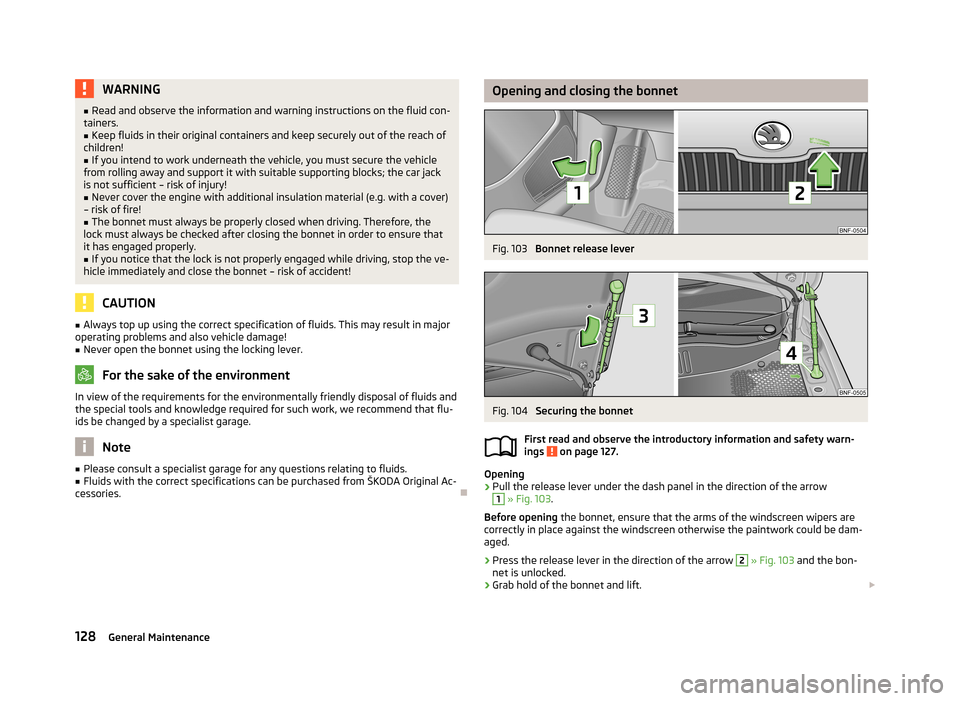
Opening
›
Pull the release lever under the dash panel in the direction of the arrow
1
» Fig. 103 .
Before opening the bonnet, ensure that the arms of the windscreen wipers are
correctly in place against the windscreen otherwise the paintwork could be dam- aged.
›
Press the release lever in the direction of the arrow
2
» Fig. 103 and the bon-
net is unlocked.
›
Grab hold of the bonnet and lift.
128General Maintenance
Page 132 of 176
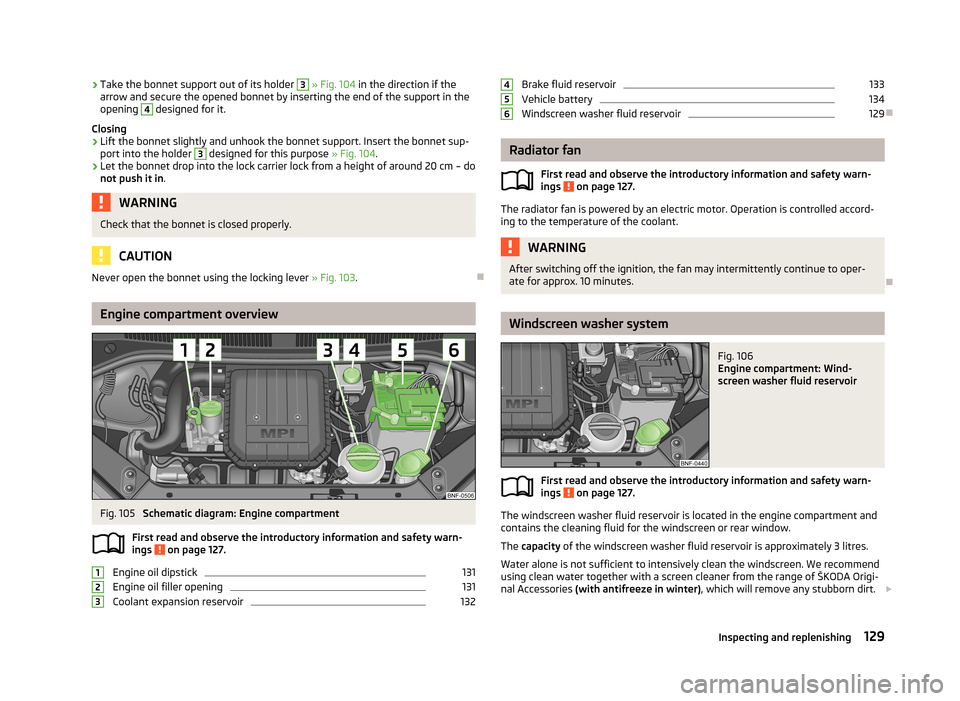
›Take the bonnet support out of its holder 3
» Fig. 104 in the direction if the
arrow and secure the opened bonnet by inserting the end of the support in the
opening 4
designed for it.
Closing
›
Lift the bonnet slightly and unhook the bonnet support. Insert the bonnet sup-
port into the holder
3
designed for this purpose » Fig. 104.
›
Let the bonnet drop into the lock carrier lock from a height of around 20 cm – do
not push it in .
WARNINGCheck that the bonnet is closed properly.
CAUTION
Never open the bonnet using the locking lever » Fig. 103.
Engine compartment overview
Fig. 105
Schematic diagram: Engine compartment
First read and observe the introductory information and safety warn- ings
on page 127.
Engine oil dipstick
131
Engine oil filler opening
131
Coolant expansion reservoir
132123Brake fluid reservoir133Vehicle battery134
Windscreen washer fluid reservoir
129
Radiator fan
First read and observe the introductory information and safety warn-
ings
on page 127.
The radiator fan is powered by an electric motor. Operation is controlled accord-
ing to the temperature of the coolant.
WARNINGAfter switching off the ignition, the fan may intermittently continue to oper-
ate for approx. 10 minutes.
Windscreen washer system
Fig. 106
Engine compartment: Wind-
screen washer fluid reservoir
First read and observe the introductory information and safety warn- ings on page 127.
The windscreen washer fluid reservoir is located in the engine compartment and
contains the cleaning fluid for the windscreen or rear window.
The capacity of the windscreen washer fluid reservoir is approximately 3 litres.
Water alone is not sufficient to intensively clean the windscreen. We recommend using clean water together with a screen cleaner from the range of ŠKODA Origi-
nal Accessories (with antifreeze in winter) , which will remove any stubborn dirt.
456129Inspecting and replenishing
Page 133 of 176
Under exceptional circumstances, methylated spirits can also be used if no screen
cleaner with antifreeze is available. The concentration of methylated spirits must
not be more than 15 %. The freeze protection at this concentration is sufficient
only to -5 °C.
CAUTION
■ Under no circumstances must radiator antifreeze or other additives be added to
the windscreen washer fluid.■
Do not remove the filter from the windscreen washer fluid reservoir when refill-
ing, as this may cause contamination of the liquid transportation system, leading
in turn to a windscreen washer system malfunction.
Engine oil
Introduction
This chapter contains information on the following subjects:
Specifications and capacity
130
Checking the oil level
131
Replenishing
131
Changing
131
The engine has been factory-filled with a high-grade oil that can be use through-
out the year - except in extreme climate zones.
The engine oils are undergoing continuous further development. Thus the infor-
mation stated in this Owner's Manual is only correct at the time of publication.
ŠKODA Service Partners are informed about the latest changes by the manufac-
turer. We therefore recommend that the oil change be completed by a ŠKODA
Service Partner.
The specifications (VW standards) stated in the following can be indicated sepa-
rately or together with other specifications on the bottle.
The oil capacities include oil filter change. Check the oil level when filling; do not
over fill. The oil level must be between the markings » page 131.
WARNING■
The engine compartment of your car is a hazardous area. The following
warning instructions must be followed at all times when working in the en-
gine compartment » page 127.■
Do not continue your journey if for some reason it is not possible to top
up the engine oil under the prevailing conditions! Switch off the engine and
seek assistance from a specialist garage.
■
If the oil level is above level
A
» Fig. 107 on page 131, do not continue to
drive! Switch off the engine and seek assistance from a specialist garage.
CAUTION
Do not pour any additives into the engine oil – risk of serious damage to the en-
gine parts!
Note
■ Before a long drive we recommend that you purchase and carry with you engine
oil which complies with the specification for your vehicle.■
We recommend that you use oils from ŠKODA Original Accessories.
■
If your skin has come into contact with oil, it must be washed thoroughly.
Specifications and capacity
First read and observe the introductory information and safety warn-
ings
on page 130.
Specifications and capacity (in l)
EngineSpecificationFilling level1.0 l/44 kWVW 502 00, VW 504 00 a)3.41.0 l/55 kWVW 502 00, VW 504 00a)3.41.0 l/50 kW - CNGVW 502 003.4a)
Optional engine oil specifications.
Note
■
Before a long drive we recommend that you purchase and carry with you engine
oil which complies with the specification for your vehicle.■
We recommend that you use oils from ŠKODA Original Accessories.
130General Maintenance
Page 134 of 176
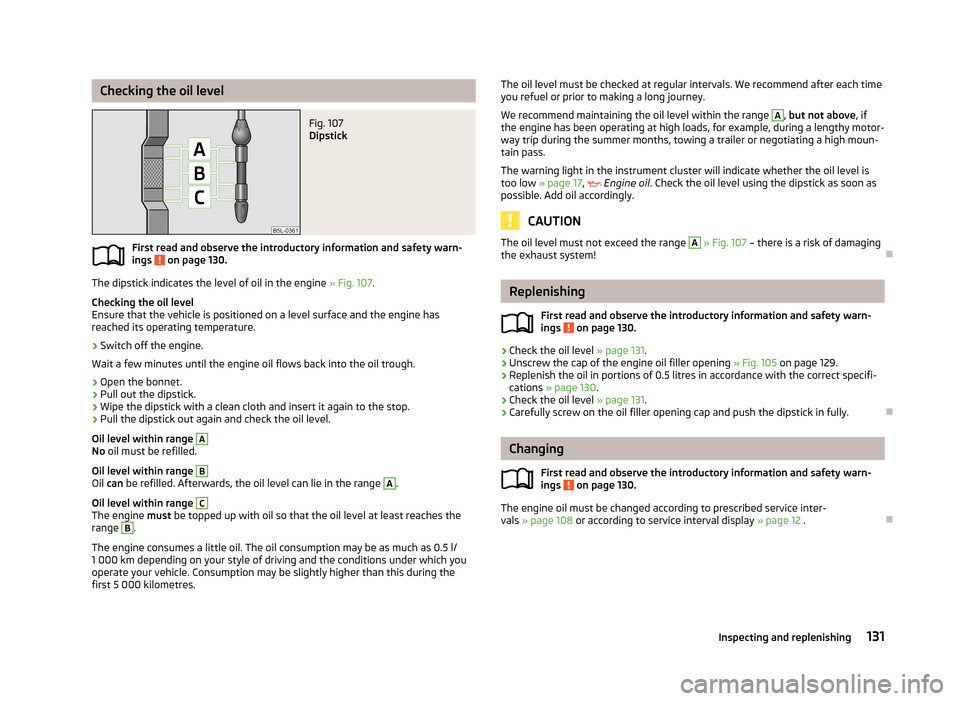
Checking the oil levelFig. 107
Dipstick
First read and observe the introductory information and safety warn-
ings on page 130.
The dipstick indicates the level of oil in the engine » Fig. 107.
Checking the oil level
Ensure that the vehicle is positioned on a level surface and the engine has reached its operating temperature.
›
Switch off the engine.
Wait a few minutes until the engine oil flows back into the oil trough.
›
Open the bonnet.
›
Pull out the dipstick.
›
Wipe the dipstick with a clean cloth and insert it again to the stop.
›
Pull the dipstick out again and check the oil level.
Oil level within range
A
No oil must be refilled.
Oil level within range
B
Oil can be refilled. Afterwards, the oil level can lie in the range
A
.
Oil level within range
C
The engine must be topped up with oil so that the oil level at least reaches the
range
B
.
The engine consumes a little oil. The oil consumption may be as much as 0.5 l/
1 000 km depending on your style of driving and the conditions under which you
operate your vehicle. Consumption may be slightly higher than this during the
first 5 000 kilometres.
The oil level must be checked at regular intervals. We recommend after each time
you refuel or prior to making a long journey.
We recommend maintaining the oil level within the range A
, but not above , if
the engine has been operating at high loads, for example, during a lengthy motor-
way trip during the summer months, towing a trailer or negotiating a high moun- tain pass.
The warning light in the instrument cluster will indicate whether the oil level is too low » page 17 , Engine oil . Check the oil level using the dipstick as soon as
possible. Add oil accordingly.
CAUTION
The oil level must not exceed the range A » Fig. 107 – there is a risk of damaging
the exhaust system!
Replenishing
First read and observe the introductory information and safety warn-
ings
on page 130.
›
Check the oil level » page 131.
›
Unscrew the cap of the engine oil filler opening » Fig. 105 on page 129.
›
Replenish the oil in portions of 0.5 litres in accordance with the correct specifi-
cations » page 130 .
›
Check the oil level » page 131.
›
Carefully screw on the oil filler opening cap and push the dipstick in fully.
Changing
First read and observe the introductory information and safety warn-ings
on page 130.
The engine oil must be changed according to prescribed service inter-
vals » page 108 or according to service interval display » page 12 .
131Inspecting and replenishing