tow SKODA CITIGO 2013 1.G Owner's Manual
[x] Cancel search | Manufacturer: SKODA, Model Year: 2013, Model line: CITIGO, Model: SKODA CITIGO 2013 1.GPages: 176, PDF Size: 10.54 MB
Page 6 of 176
Table of Contents
Materials defect liability and ŠKODA warranty for
new cars5
Mobility warranty and ŠKODA extended
warranty.
6
Abbreviations
Using the system
Cockpit
9
Overview
8
warning lights and instruments
10
Instrument cluster
10
Multifunction display (MFA)
13
Warning lights
16
Unlocking and locking
22
Unlocking and locking
22
Central locking system
25
Remote control
27
Luggage compartment lid
28
Electrical power windows
30
Power sliding/tilting roof
31
Lights and visibility
33
Lights
33
Indoor Lighting
36
Visibility
37
Windscreen wipers and washers
38
Rear mirror
40
Seats and stowing
42
Front seats
42
Rear seats
45
Luggage compartment
46
Roof rack system
49Useful equipment50Storage compartments53
Heating and air-conditioning
57
Heating, ventilation and cooling
57
Heating
58
Air conditioning system
59
Communication and multimedia
63
Telephone and Move & Fun
63
Driving
Starting-off and Driving
66
Steering
66
Starting and stopping the engine
67
Brakes
68
Manual gear changing and pedals
70
Automated transmission
71
Running in
73
Economical driving and environmental
sustainability
74
Avoiding damage to your vehicle
78
Driving abroad
79
Assist systems
80
Brake assist systems
80
Parking aid
81
Cruise Control System
83
START-STOP
85
City Safe Drive
86
Safety
Passive Safety
90
General information
90
Correct seated position
91
Seat belts
94
Using seat belts
94
Inertia reels and belt tensioners
96Airbag system98Description of the airbag system98
Airbag overview
99
Deactivating airbags
101
Transporting children safely
103
Child seat
103
Fastening systems
105
General Maintenance
Vehicle care
108
Service intervals
108
Modifications, adjustments and technical
alterations
110
Washing your car
113
Taking care of your vehicle exterior
115
Taking care of the interior
118
Inspecting and replenishing
122
Fuel
122
Vehicles with CNG (compressed natural gas)
mode
123
Engine compartment
127
Engine oil
130
Coolant
132
Brake fluid
133
Vehicle battery
134
Wheels
138
Tyres and wheel rims
138
Winter operation
143
Do-it-yourself
Emergency equipment and self-help
144
Emergency equipment
144
Changing a wheel
145
Tyre repair
1483Table of Contents
Page 7 of 176
Jump-starting150Towing the vehicle152
Fuses and light bulbs
154
Fuses
154
Bulbs
157
Technical data
Technical data
161
Vehicle data
161
Index
4Table of Contents
Page 9 of 176
Mobility warranty and ŠKODA extendedwarranty.
Mobility warranty
Mobility warranty provides a sense of security when travelling in your vehicle.
Should your car break down when you're on the move one day as a result of an
unexpected fault, you will be eligible for services to ensure your continued mobili-
ty as part of the mobility warranty, which includes the following: Breakdown serv- ice at the breakdown location and towing off to the ŠKODA service partner, tech-
nical assistance by phone or on-site operation.
If your vehicle is not repaired on the same day, the ŠKODA service partner may
provide further services as required, such as replacement transportation (bus,
train, etc.), a courtesy vehicle, etc.
You can obtain more information regarding terms and conditions for the provision
of mobility warranty for your vehicle from your ŠKODA partner. Here you will also
be given detailed terms and conditions for the mobility warranty with respect to
your vehicle. In the event that there is no mobility warranty coverage available for
your vehicle, you should check with any ŠKODA service partner about the possibil-
ity of a subsequent agreement.
Note
The mobility guarantee is only available for some countries.
Optional ŠKODA extended warranty
If you received an extended ŠKODA warranty when purchasing your new car, the
two-year ŠKODA warranty for damages to your ŠKODA vehicle will be extended
by the time you chose or until the chosen mileage limit has been reached, which-
ever occurs first.
The previously mentioned paint warranty and the warranty against rust perfora-
tion stay unaffected by the extended warranty.
Detailed conditions for the extended warranty are included in the extended war- ranty terms and conditions, which your ŠKODA partner will have given to you
upon purchasing your new vehicle.
NoteThe mobility guarantee and optional ŠKODA extended warranty are only available
for some countries.
6Mobility warranty and ŠKODA extended warranty.
Page 35 of 176
›In order to tilt, press the switch in the region of the lug E towards the roof.
Closing›
Turn the switch to position
A
» Fig. 21 .
›
To close, press the switch on the recess
E
down and then push it forwards.
Force limiter
The sliding/tilting roof is fitted with a force limiter. The sliding/tilting roof stops and moves back several centimetres when it cannot be closed because there is
something in the way (e.g. ice). The sliding/tilting roof can be fully closed without
a force limiter by pressing the switch on the recess down and then pushing it for- ward until the sliding/tilting roof is fully closed »
.
WARNINGWhen closing the sliding/tilting roof proceed with caution to avoid causing
crushing injuries – risk of injury!
CAUTION
During the winter it may be necessary to remove any ice and snow in the vicinity
of the sliding/tilting roof before opening it to prevent any damage to the opening
mechanism.
32Using the system
Page 41 of 176
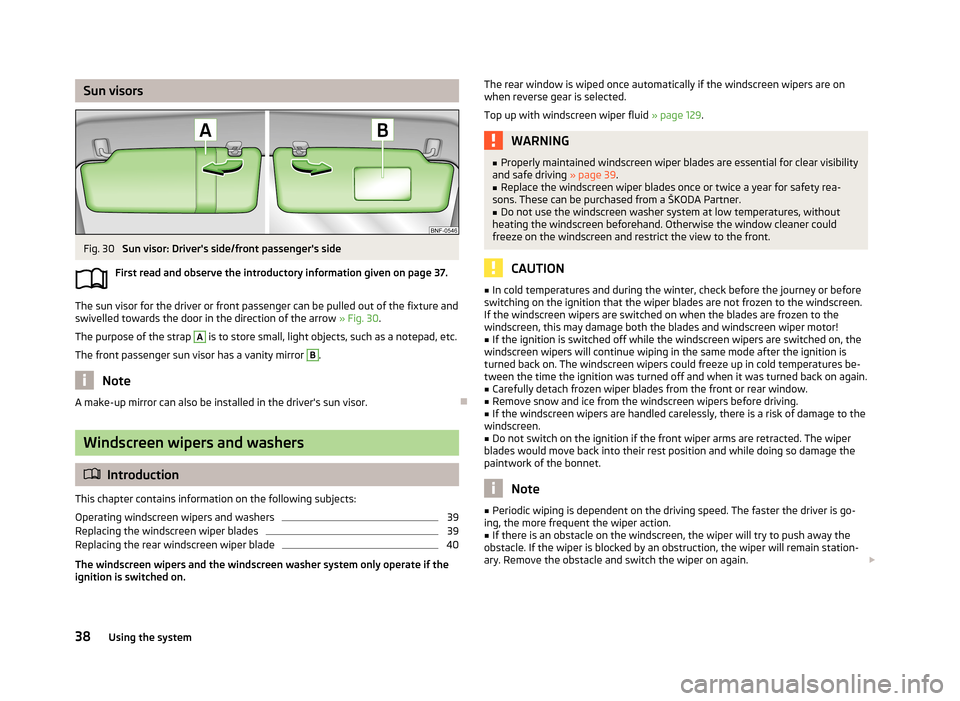
Sun visorsFig. 30
Sun visor: Driver's side/front passenger's side
First read and observe the introductory information given on page 37.
The sun visor for the driver or front passenger can be pulled out of the fixture and
swivelled towards the door in the direction of the arrow » Fig. 30.
The purpose of the strap
A
is to store small, light objects, such as a notepad, etc.
The front passenger sun visor has a vanity mirror
B
.
Note
A make-up mirror can also be installed in the driver's sun visor.
Windscreen wipers and washers
Introduction
This chapter contains information on the following subjects:
Operating windscreen wipers and washers
39
Replacing the windscreen wiper blades
39
Replacing the rear windscreen wiper blade
40
The windscreen wipers and the windscreen washer system only operate if the ignition is switched on.
The rear window is wiped once automatically if the windscreen wipers are on
when reverse gear is selected.
Top up with windscreen wiper fluid » page 129.WARNING■
Properly maintained windscreen wiper blades are essential for clear visibility
and safe driving » page 39.■
Replace the windscreen wiper blades once or twice a year for safety rea-
sons. These can be purchased from a ŠKODA Partner.
■
Do not use the windscreen washer system at low temperatures, without
heating the windscreen beforehand. Otherwise the window cleaner could
freeze on the windscreen and restrict the view to the front.
CAUTION
■ In cold temperatures and during the winter, check before the journey or before
switching on the ignition that the wiper blades are not frozen to the windscreen. If the windscreen wipers are switched on when the blades are frozen to the
windscreen, this may damage both the blades and windscreen wiper motor!■
If the ignition is switched off while the windscreen wipers are switched on, the
windscreen wipers will continue wiping in the same mode after the ignition is
turned back on. The windscreen wipers could freeze up in cold temperatures be- tween the time the ignition was turned off and when it was turned back on again.
■
Carefully detach frozen wiper blades from the front or rear window.
■
Remove snow and ice from the windscreen wipers before driving.
■
If the windscreen wipers are handled carelessly, there is a risk of damage to the
windscreen.
■
Do not switch on the ignition if the front wiper arms are retracted. The wiper
blades would move back into their rest position and while doing so damage the
paintwork of the bonnet.
Note
■ Periodic wiping is dependent on the driving speed. The faster the driver is go-
ing, the more frequent the wiper action.■
If there is an obstacle on the windscreen, the wiper will try to push away the
obstacle. If the wiper is blocked by an obstruction, the wiper will remain station-
ary. Remove the obstacle and switch the wiper on again.
38Using the system
Page 42 of 176
■The capacity of the windscreen washer fluid reservoir is approximately 3 litres.■The wiper blades should be cleaned on a regular basis with a windscreen clean-
er to avoid any smears. The wiper blades should be cleaned with a sponge or
cloth if they are heavily soiled by insect residues, for example.
Operating windscreen wipers and washers
Fig. 31
Operating lever: Windscreen wipers and washer settings
First read and observe the introductory information and safety warn-
ings
on page 38.
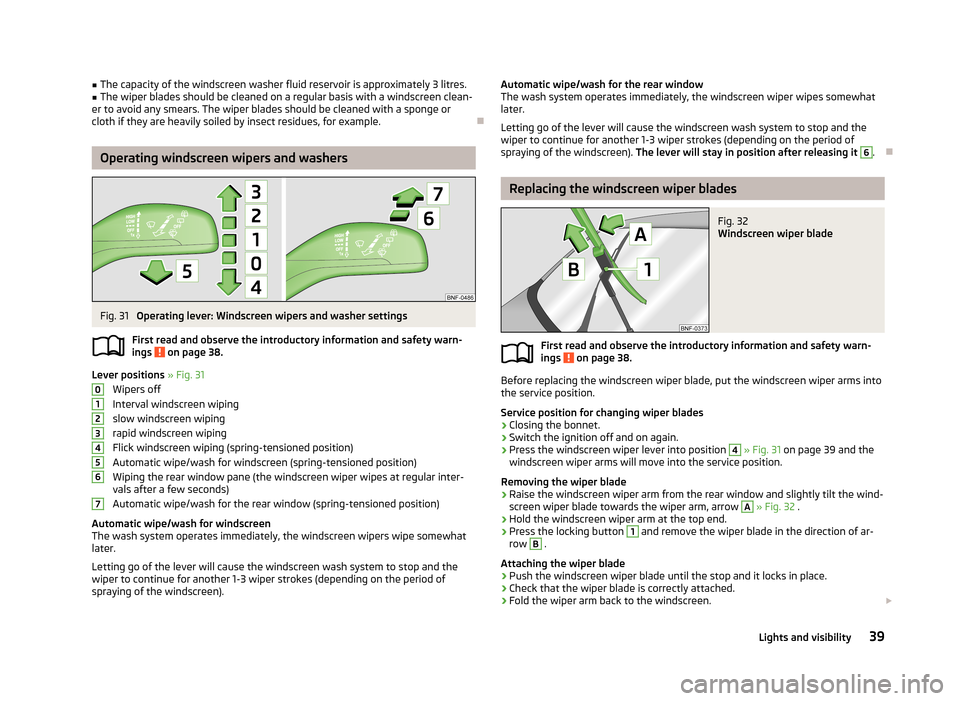
Lever positions » Fig. 31
Wipers off
Interval windscreen wiping
slow windscreen wiping
rapid windscreen wiping
Flick windscreen wiping (spring-tensioned position)
Automatic wipe/wash for windscreen (spring-tensioned position) Wiping the rear window pane (the windscreen wiper wipes at regular inter- vals after a few seconds)
Automatic wipe/wash for the rear window (spring-tensioned position)
Automatic wipe/wash for windscreen
The wash system operates immediately, the windscreen wipers wipe somewhat
later.
Letting go of the lever will cause the windscreen wash system to stop and the
wiper to continue for another 1-3 wiper strokes (depending on the period of
spraying of the windscreen).
01234567Automatic wipe/wash for the rear window The wash system operates immediately, the windscreen wiper wipes somewhatlater.
Letting go of the lever will cause the windscreen wash system to stop and the wiper to continue for another 1-3 wiper strokes (depending on the period ofspraying of the windscreen). The lever will stay in position after releasing it 6
.
Replacing the windscreen wiper blades
Fig. 32
Windscreen wiper blade
First read and observe the introductory information and safety warn-
ings on page 38.
Before replacing the windscreen wiper blade, put the windscreen wiper arms into
the service position.
Service position for changing wiper blades
›
Closing the bonnet.
›
Switch the ignition off and on again.
›
Press the windscreen wiper lever into position
4
» Fig. 31 on page 39 and the
windscreen wiper arms will move into the service position.
Removing the wiper blade
›
Raise the windscreen wiper arm from the rear window and slightly tilt the wind-
screen wiper blade towards the wiper arm, arrow
A
» Fig. 32 .
›
Hold the windscreen wiper arm at the top end.
›
Press the locking button
1
and remove the wiper blade in the direction of ar-
row
B
.
Attaching the wiper blade
›
Push the windscreen wiper blade until the stop and it locks in place.
›
Check that the wiper blade is correctly attached.
›
Fold the wiper arm back to the windscreen.
39Lights and visibility
Page 43 of 176
›Turn on the ignition and press the windscreen wiper lever into position4
» Fig. 31 on page 39 ; the windscreen wiper arms move to the home position.
Replacing the rear windscreen wiper blade
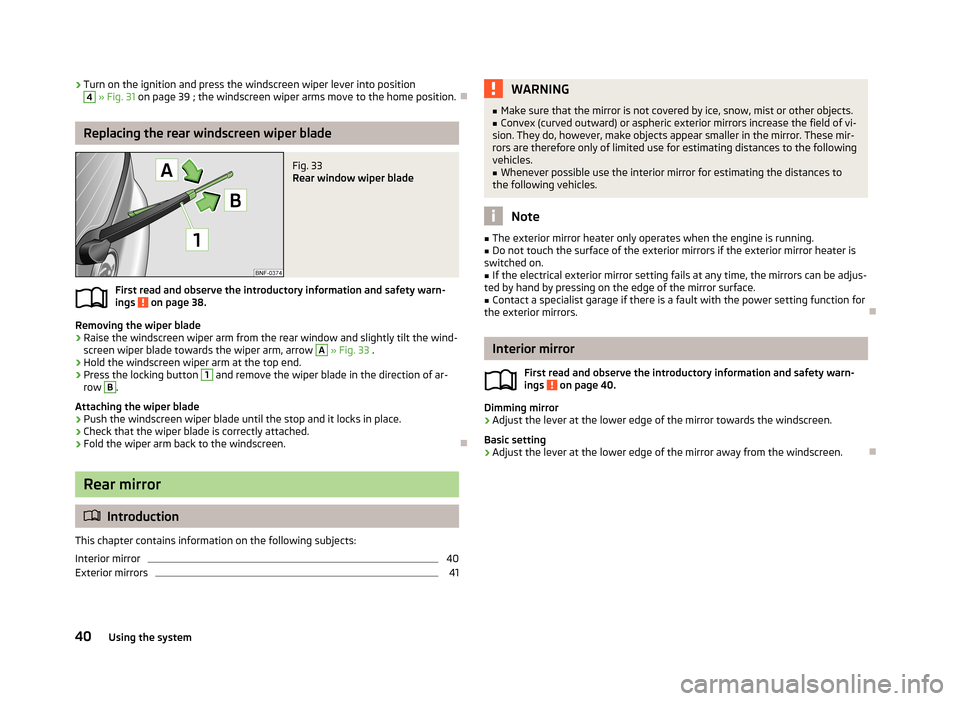
Fig. 33
Rear window wiper blade
First read and observe the introductory information and safety warn-
ings on page 38.
Removing the wiper blade
›
Raise the windscreen wiper arm from the rear window and slightly tilt the wind-
screen wiper blade towards the wiper arm, arrow
A
» Fig. 33 .
›
Hold the windscreen wiper arm at the top end.
›
Press the locking button
1
and remove the wiper blade in the direction of ar-
row
B
.
Attaching the wiper blade
›
Push the windscreen wiper blade until the stop and it locks in place.
›
Check that the wiper blade is correctly attached.
›
Fold the wiper arm back to the windscreen.
Rear mirror
Introduction
This chapter contains information on the following subjects:
Interior mirror
40
Exterior mirrors
41WARNING■ Make sure that the mirror is not covered by ice, snow, mist or other objects.■Convex (curved outward) or aspheric exterior mirrors increase the field of vi-
sion. They do, however, make objects appear smaller in the mirror. These mir-
rors are therefore only of limited use for estimating distances to the following
vehicles.■
Whenever possible use the interior mirror for estimating the distances to
the following vehicles.
Note
■ The exterior mirror heater only operates when the engine is running.■Do not touch the surface of the exterior mirrors if the exterior mirror heater is
switched on.■
If the electrical exterior mirror setting fails at any time, the mirrors can be adjus-
ted by hand by pressing on the edge of the mirror surface.
■
Contact a specialist garage if there is a fault with the power setting function for
the exterior mirrors.
Interior mirror
First read and observe the introductory information and safety warn-
ings
on page 40.
Dimming mirror
›
Adjust the lever at the lower edge of the mirror towards the windscreen.
Basic setting
›
Adjust the lever at the lower edge of the mirror away from the windscreen.
40Using the system
Page 44 of 176
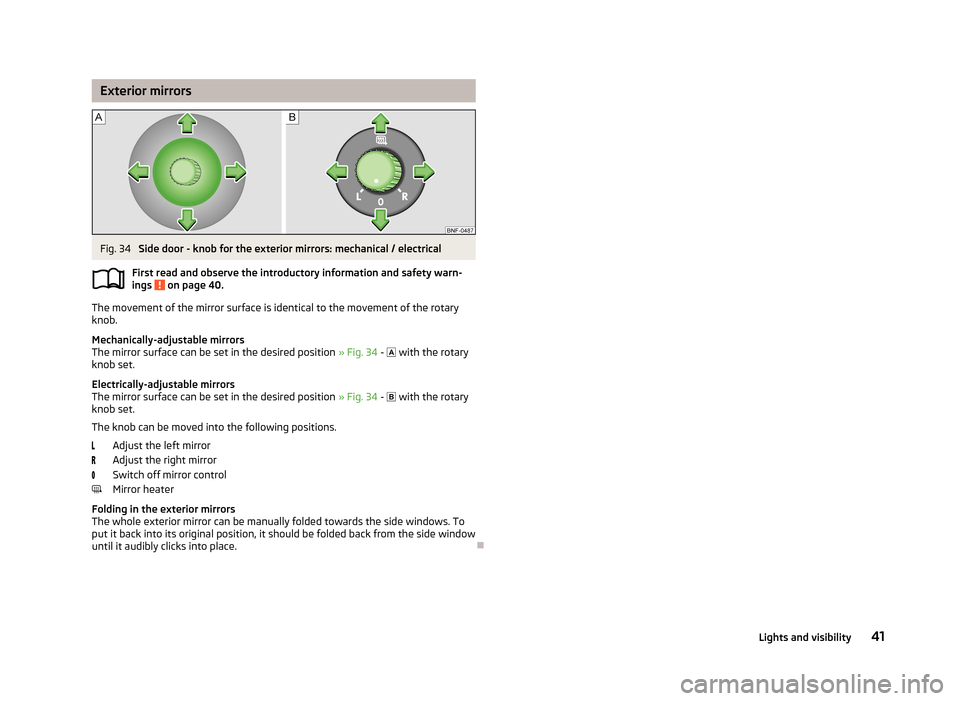
Exterior mirrorsFig. 34
Side door - knob for the exterior mirrors: mechanical / electrical
First read and observe the introductory information and safety warn-
ings
on page 40.
The movement of the mirror surface is identical to the movement of the rotary
knob.
Mechanically-adjustable mirrors
The mirror surface can be set in the desired position » Fig. 34 -
with the rotary
knob set.
Electrically-adjustable mirrors
The mirror surface can be set in the desired position » Fig. 34 -
with the rotary
knob set.
The knob can be moved into the following positions. Adjust the left mirror
Adjust the right mirror
Switch off mirror control
Mirror heater
Folding in the exterior mirrors
The whole exterior mirror can be manually folded towards the side windows. To
put it back into its original position, it should be folded back from the side window
until it audibly clicks into place.
41Lights and visibility
Page 45 of 176
Seats and stowing
Front seats
Introduction
This chapter contains information on the following subjects:
Adjusting the front seats
43
Foldable front passenger seat
43
Front seat heating
44
The driver's seat should be adjusted in such a way that the pedals can be fully
pressed to the floor with slightly bent legs.
The seat backrest on the driver's seat should be adjusted in such a way that the
upper point of the steering wheel can be easily reached with slightly bent arms.
Correct adjustment of the seats is particularly important:
› for safely and quickly reaching the controls;
› for a relaxed body position that reduces fatigue;
› for achieving maximum protection from the seat belts and the airbag system.
WARNINGGeneral information■Caution when adjusting the seat! You may suffer injuries or bruises as a re-
sult of adjusting the seat without paying proper attention.■
The seat backrests must not be tilted too far back when driving, as this will
impair the function of the seat belts and of the airbag system – risk of injury!
■
Never carry more people than the number of seats in the vehicle.
■
Each occupant must correctly fasten the seat belt belonging to the seat.
Children must be fastened » page 103, Transporting children safely with a
suitable restraint system.
■
The front seats and the head restraints must always be adjusted according
to height, so that the occupants can be protected as effectively as possible.
■
Do not carry any objects on the front passenger seat except objects de-
signed for this purpose (e.g. child seat) – risk of accident!
WARNINGInformation for the driver■Only adjust the driver's seat when the vehicle is stationary – risk of accident!■
Maintain a distance of at least 25 cm to the steering wheel. Not maintaining
this minimum distance will mean that the airbag system will not be able to
properly protect you – risk to life!
■
Ensure that there are no objects in the driver's footwell, as these may get
caught in the pedal apparatus when driving or braking. You would then no
longer be able to operate the clutch, brake or acceleration pedals.
WARNINGInformation for the front seat passenger■Maintain a distance of at least 25 cm to the dash panel. Not maintaining this
minimum distance will mean that the airbag system will not be able to proper-
ly protect you – hazard!■
Always keep your feet in the footwell when the car is being driven – never
place your feet on the instrument panel, out of the window or on the surfaces
of the seats. You will be exposed to increased risk of injury if it becomes nec-
essary to apply the brake or in the event of an accident. If an airbag is de-
ployed, you may suffer fatal injuries when adopting an incorrect seated posi-
tion!
Note
After a certain time, play can develop within the adjustment mechanism of the
backrest angle.
42Using the system
Page 46 of 176
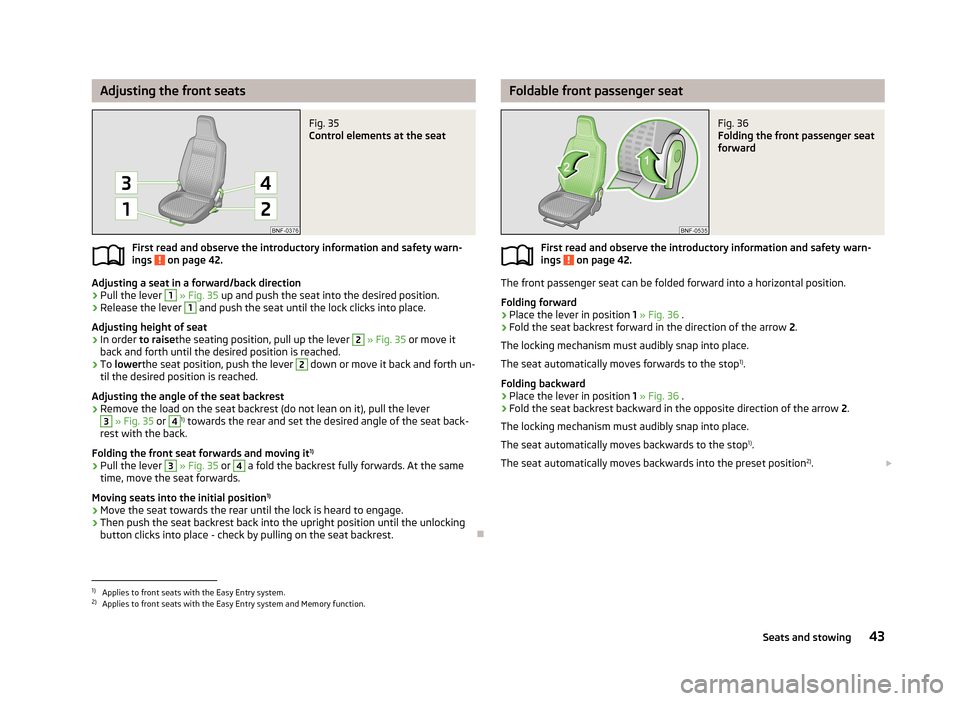
Adjusting the front seatsFig. 35
Control elements at the seat
First read and observe the introductory information and safety warn-
ings on page 42.
Adjusting a seat in a forward/back direction
›
Pull the lever
1
» Fig. 35 up and push the seat into the desired position.
›
Release the lever
1
and push the seat until the lock clicks into place.
Adjusting height of seat
›
In order to raisethe seating position, pull up the lever
2
» Fig. 35 or move it
back and forth until the desired position is reached.
›
To lower the seat position, push the lever
2
down or move it back and forth un-
til the desired position is reached.
Adjusting the angle of the seat backrest
›
Remove the load on the seat backrest (do not lean on it), pull the lever
3
» Fig. 35 or
4
1)
towards the rear and set the desired angle of the seat back-
rest with the back.
Folding the front seat forwards and moving it 1)
›
Pull the lever
3
» Fig. 35 or
4
a fold the backrest fully forwards. At the same
time, move the seat forwards.
Moving seats into the initial position 1)
›
Move the seat towards the rear until the lock is heard to engage.
›
Then push the seat backrest back into the upright position until the unlocking
button clicks into place - check by pulling on the seat backrest.
Foldable front passenger seatFig. 36
Folding the front passenger seat
forward
First read and observe the introductory information and safety warn-
ings on page 42.
The front passenger seat can be folded forward into a horizontal position.
Folding forward
›
Place the lever in position 1 » Fig. 36 .
›
Fold the seat backrest forward in the direction of the arrow 2.
The locking mechanism must audibly snap into place.
The seat automatically moves forwards to the stop 1)
.
Folding backward
›
Place the lever in position 1 » Fig. 36 .
›
Fold the seat backrest backward in the opposite direction of the arrow 2.
The locking mechanism must audibly snap into place.
The seat automatically moves backwards to the stop 1)
.
The seat automatically moves backwards into the preset position 2)
.
1)
Applies to front seats with the Easy Entry system.
2)
Applies to front seats with the Easy Entry system and Memory function.
43Seats and stowing