check engine SKODA CITIGO 2014 1.G Owner's Guide
[x] Cancel search | Manufacturer: SKODA, Model Year: 2014, Model line: CITIGO, Model: SKODA CITIGO 2014 1.GPages: 164, PDF Size: 12.08 MB
Page 115 of 164
CAUTION■ Do not continue if for some reason it is not possible to fill with coolant un-
der the current circumstances! Switch off the engine and seek assistance from
a specialist garage.■
If the expansion tank is empty, do not top up with coolant. The system could
fill with air - risk of engine damage,
stop driving! Switch off the engine and
seek assistance from a specialist garage.
■
The concentration of coolant additive in the coolant must never be under
40%.
■
Over 60% of coolant additive in the coolant reduces the antifreeze protec-
tion and cooling effect.
■
A coolant additive that does not comply with the correct specification can
significantly reduce the corrosion protection of the cooling system.
■
Any faults resulting from corrosion may cause a loss of coolant and can con-
sequently result in major engine damage!
■
Do not fill the coolant above the mark
» Fig. 101 on page 112 .
■
If an error occurs, leading to the engine overheating, the help of a professio-
nal garage is to be sought - there is a risk of serious engine damage occurring.
■
Additional headlights and other attached components in front of the air inlet
impair the cooling efficiency of the coolant.
■
Never cover the radiator - there is a risk of the engine overheating.
Checking the coolant level
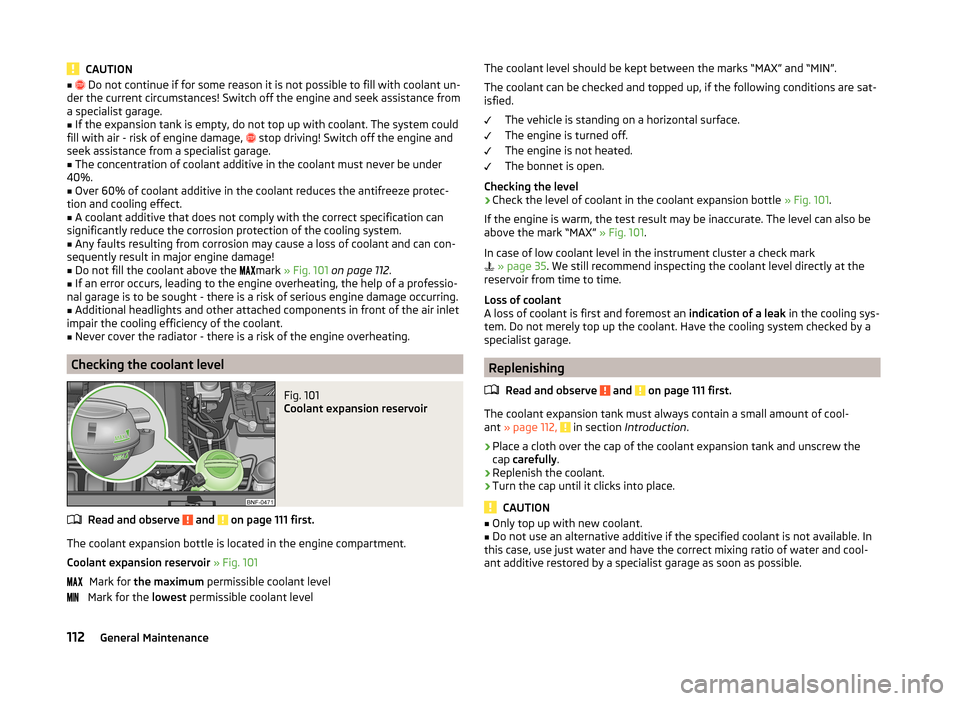
Fig. 101
Coolant expansion reservoir
Read and observe and on page 111 first.
The coolant expansion bottle is located in the engine compartment.
Coolant expansion reservoir » Fig. 101
Mark for the maximum permissible coolant level
Mark for the lowest permissible coolant level
The coolant level should be kept between the marks “MAX” and “MIN”.
The coolant can be checked and topped up, if the following conditions are sat-isfied.
The vehicle is standing on a horizontal surface.
The engine is turned off.
The engine is not heated.
The bonnet is open.
Checking the level›
Check the level of coolant in the coolant expansion bottle » Fig. 101.
If the engine is warm, the test result may be inaccurate. The level can also be
above the mark “MAX” » Fig. 101.
In case of low coolant level in the instrument cluster a check mark
» page 35 . We still recommend inspecting the coolant level directly at the
reservoir from time to time.
Loss of coolant
A loss of coolant is first and foremost an indication of a leak in the cooling sys-
tem. Do not merely top up the coolant. Have the cooling system checked by a
specialist garage.
Replenishing
Read and observe
and on page 111 first.
The coolant expansion tank must always contain a small amount of cool-
ant » page 112, in section Introduction .
›
Place a cloth over the cap of the coolant expansion tank and unscrew the
cap carefully .
›
Replenish the coolant.
›
Turn the cap until it clicks into place.
CAUTION
■
Only top up with new coolant.■Do not use an alternative additive if the specified coolant is not available. In
this case, use just water and have the correct mixing ratio of water and cool-
ant additive restored by a specialist garage as soon as possible.112General Maintenance
Page 116 of 164
Brake fluid
Introduction
This chapter contains information on the following subjects:
Checking the brake fluid level
113
Specification
113
The brake fluid reservoir is located in the engine compartment » Fig. 102 on
page 113 .
WARNING■
The engine compartment of your car is a hazardous area. The following
warning instructions must be followed at all times when working in the en-
gine compartment » page 107.■
Do not use used brake fluid - the function of the brake system may be im-
paired – risk of accident!
CAUTION
■ Do not continue your journey if the fluid level has dropped below the “MIN”
marking » Fig. 102 on page 113 , do not continue driving - there is a risk of an
accident! Seek help from a specialist garage.■
Brake fluid damages the paintwork of the vehicle.
Note
■ The brake fluid is changed as part of a compulsory inspection service.■We recommend using brake fluids from the ŠKODA Original Accessories
range.
Checking the brake fluid level
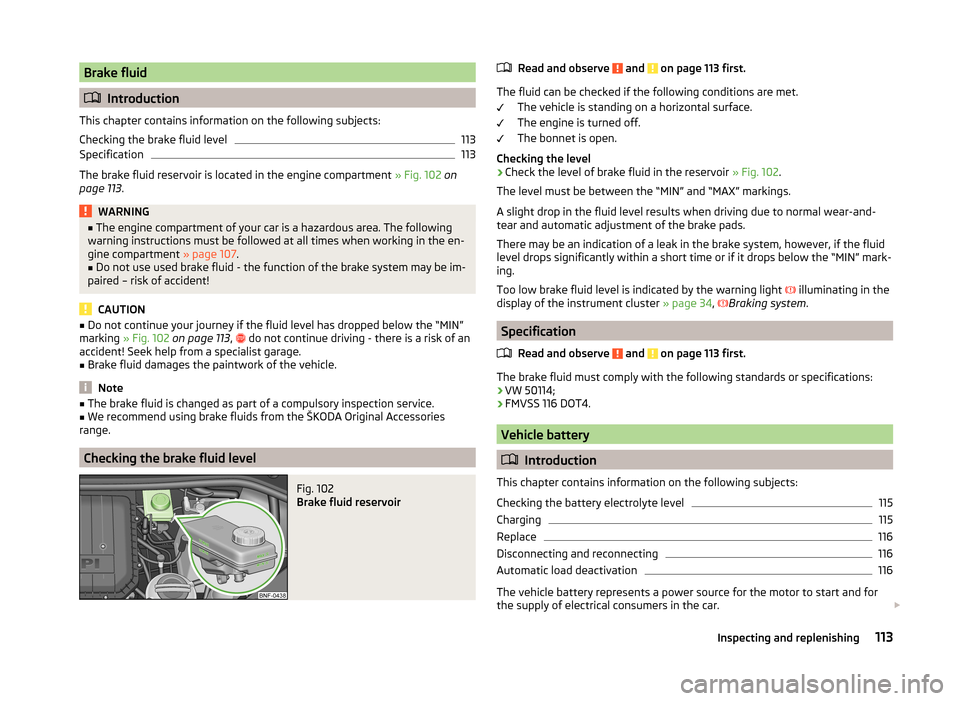
Fig. 102
Brake fluid reservoir
Read and observe and on page 113 first.
The fluid can be checked if the following conditions are met.
The vehicle is standing on a horizontal surface.
The engine is turned off.
The bonnet is open.
Checking the level
›
Check the level of brake fluid in the reservoir » Fig. 102.
The level must be between the “MIN” and “MAX” markings.
A slight drop in the fluid level results when driving due to normal wear-and-
tear and automatic adjustment of the brake pads.
There may be an indication of a leak in the brake system, however, if the fluid
level drops significantly within a short time or if it drops below the “MIN” mark-
ing.
Too low brake fluid level is indicated by the warning light illuminating in the
display of the instrument cluster » page 34,
Braking system
.
Specification
Read and observe
and on page 113 first.
The brake fluid must comply with the following standards or specifications:› VW 50114;
› FMVSS 116 DOT4.
Vehicle battery
Introduction
This chapter contains information on the following subjects:
Checking the battery electrolyte level
115
Charging
115
Replace
116
Disconnecting and reconnecting
116
Automatic load deactivation
116
The vehicle battery represents a power source for the motor to start and for
the supply of electrical consumers in the car.
113Inspecting and replenishing
Page 118 of 164
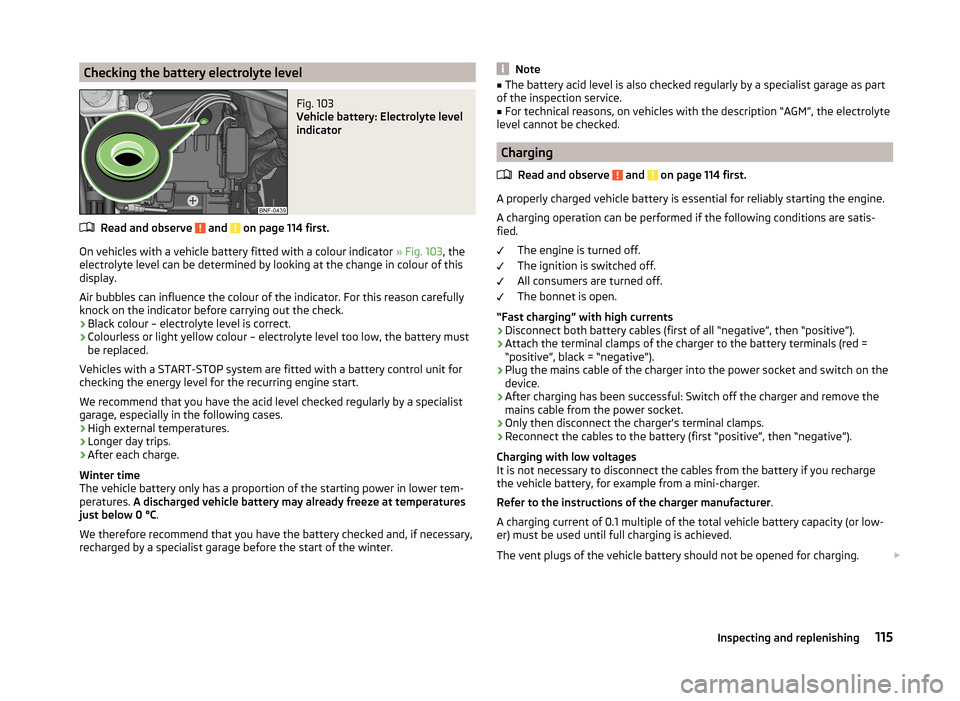
Checking the battery electrolyte levelFig. 103
Vehicle battery: Electrolyte level
indicator
Read and observe and on page 114 first.
On vehicles with a vehicle battery fitted with a colour indicator » Fig. 103, the
electrolyte level can be determined by looking at the change in colour of this
display.
Air bubbles can influence the colour of the indicator. For this reason carefully
knock on the indicator before carrying out the check.
› Black colour – electrolyte level is correct.
› Colourless or light yellow colour – electrolyte level too low, the battery must
be replaced.
Vehicles with a START-STOP system are fitted with a battery control unit for
checking the energy level for the recurring engine start.
We recommend that you have the acid level checked regularly by a specialist
garage, especially in the following cases.
› High external temperatures.
› Longer day trips.
› After each charge.
Winter time
The vehicle battery only has a proportion of the starting power in lower tem-
peratures. A discharged vehicle battery may already freeze at temperatures
just below 0 °C .
We therefore recommend that you have the battery checked and, if necessary,
recharged by a specialist garage before the start of the winter.
Note■ The battery acid level is also checked regularly by a specialist garage as part
of the inspection service.■
For technical reasons, on vehicles with the description “AGM”, the electrolyte
level cannot be checked.
Charging
Read and observe
and on page 114 first.
A properly charged vehicle battery is essential for reliably starting the engine.A charging operation can be performed if the following conditions are satis-
fied.
The engine is turned off.
The ignition is switched off.
All consumers are turned off.
The bonnet is open.
“Fast charging” with high currents
›
Disconnect both battery cables (first of all “negative”, then “positive”).
›
Attach the terminal clamps of the charger to the battery terminals (red =
“positive”, black = “negative”).
›
Plug the mains cable of the charger into the power socket and switch on the
device.
›
After charging has been successful: Switch off the charger and remove the
mains cable from the power socket.
›
Only then disconnect the charger's terminal clamps.
›
Reconnect the cables to the battery (first “positive”, then “negative”).
Charging with low voltages
It is not necessary to disconnect the cables from the battery if you recharge
the vehicle battery, for example from a mini-charger.
Refer to the instructions of the charger manufacturer .
A charging current of 0.1 multiple of the total vehicle battery capacity (or low-
er) must be used until full charging is achieved.
The vent plugs of the vehicle battery should not be opened for charging.
115Inspecting and replenishing
Page 119 of 164
WARNING■When you charge a battery, hydrogen is released, and a highly explosive
gas mixture is also produced. An explosion can be caused through sparkling
over during unclamping or loosening of the cable plug while the ignition is
on.■
Creating a bridge between the poles on the battery (e.g. with metal ob-
jects - cables) creates a short circuit - risk of damage to the battery, explo-
sion and burning of the battery, jets of acid spurting out.
■
Avoid creating sparks when working with cables and electrical devices.
Strong sparking represents a risk of injury.
■
Before carrying out any work on the electrical system, switch off the en-
gine, the ignition and all electrical consumers and disconnect the negative
terminal
.
■
“Quick-charging” the vehicle battery is dangerous and requires a special
charger and specialist knowledge.
■
We therefore recommend that vehicle batteries be “rapidly charged” by a
specialist garage.
CAUTION
On vehicles with the START-STOP system, the pole terminal of the charger
must not be connected directly to the negative terminal of the vehicle battery,
but only to the engine earth » page 130.
Replace
Read and observe
and on page 114 first.
The new vehicle battery must have the same capacity, voltage, current and
size as the original battery. Suitable vehicle battery types can be purchased
from a specialist garage.
We recommend having the battery replaced by a specialist garage, where the
new vehicle battery will be installed properly and the original battery will be
disposed of in accordance with national regulations.
Disconnecting and reconnecting
Read and observe
and on page 114 first.
Disconnecting
›
Switch off the ignition.
›Disconnect the negative terminal
first and then the positive terminal of
the battery.
Connecting›
Connect the positive terminal
first, then the negative
battery terminal.
After disconnecting and re-connecting the vehicle battery, the following func-
tions or devices are partially or completely inoperative.
Function / deviceOperating measureRadioEnter code » operating instruc-
tions for the radioTime settings» page 33
CAUTION
■ Disconnect the vehicle battery only with the ignition turned off - there is a
risk of damaging the electrical system of the vehicle.■
Under no circumstances must the battery cables be connected incorrectly –
risk of a cable fire.
Note
■ After disconnecting and re-connecting the vehicle battery, we recommend
having the vehicle checked by a specialist to ensure that the full functionality
of all electrical systems is guaranteed.■
The data of the multi-function display will be reset.
Automatic load deactivation
Read and observe
and on page 114 first.
The vehicle voltage control unit automatically prevents the battery from dis-
charging when the battery is put under high levels of strain. This manifests it-
self by the following.
› The idling speed is raised to allow the generator to deliver more electricity to
the electrical system.
› Where necessary, large convenience consumers such as seat heaters and
rear window heaters have their power limited or are shut off completely in
the event of an emergency.
116General Maintenance
Page 132 of 164
Preparations for using the breakdown kitRead and observe
on page 127 first.
The following preparatory work must be carried out before using the puncture
repair kit.
›
Switch off the engine.
›
Select first gear or place the selector lever for automatic gearbox in the D or
R position .
›
Firmly apply the handbrake.
›
Check that you can carry out the repairs with the breakdown kit » page 127.
›
Remove the breakdown kit from the luggage compartment.
›
Stick the sticker
2
» Fig. 114 on page 128 on the dashboard in the driver's
field of view.
›
Unscrew the valve cap.
›
Use the valve remover
1
to unscrew the valve core and place it on a clean
surface (rag, paper, etc.).
Sealing and inflating the tyre
Read and observe
on page 127 first.
Sealing
›
Forcefully shake the tyre inflator bottle
10
» Fig. 114 on page 128 several
times.
›
Firmly screw the inflation hose
3
onto the tyre inflator bottle
10
clockwise.
The film on the cap is pierced automatically.
›
Remove the plug from the inflation hose
3
and plug the open end fully onto
the tyre valve.
›
Hold the bottle
10
with the bottom facing upwards and fill all of the sealing
agent from the tyre inflator bottle into the tyre.
›
Remove the empty tyre inflator bottle from the valve.
›
Screw the valve core back into the tyre valve using the valve remover
1
.
Inflating
›
Screw the tyre inflation hose
5
» Fig. 114 on page 128 of the air compressor
firmly onto the tyre valve.
›
Check that the air release valve
7
is closed.
›
Start the engine and run it in idle.
›
Plug the connector
9
into 12 Volt socket » page 62, 12-Volt power outlet .
›
Switch on the air compressor with the ON and OFF switch
8
.
›Allow the air compressor to run until a pressure of 2.0 - 2.5 bar is achieved.
Maximum run time of 8 minutes » .›
Switch off the air compressor.
›
If you cannot reach an air pressure of 2.0 – 2.5 bar, unscrew the tyre inflation
hose
5
from the tyre valve.
›
Drive the vehicle 10 metres forwards or backwards to allow the sealing agent
to “distribute” in the tyre.
›
Firmly screw the tyre inflation hose
5
back onto the tyre valve and repeat
the inflation process.
›
If you cannot reach the required tyre inflation pressure here either, this
means the tyre has sustained too much damage. You cannot seal with tyre with the breakdown kit »
.
›
Switch off the air compressor.
›
Remove the tyre inflation hose
5
from the tyre valve.
Once a tyre inflation pressure of 2.0 – 2.5 bar is achieved, continue the journey
at a maximum speed of 80 km/h (50 mph).
WARNING■ If you cannot inflate the tyre to at least 2.0 bar, this means the damage
sustained was too serious. The sealing agent cannot be used to seal the
tyre.
Do not drive the vehicle! Seek help from a specialist garage.■
The tyre inflation hose and air compressor may get hot as the tyre is be-
ing inflated – risk of burning.
CAUTION
Switch off the air compressor after running 8 minutes at the latest – there is a
risk of overheating. Allow the air compressor to cool a few minutes before
switching it on again.
Notes for driving with repaired tyres
Read and observe
on page 127 first.
The inflation pressure of the repaired tyre must be checked after driving for 10
minutes.
If the tyre pressure is 1.3 bar or less
›
Do not drive the vehicle! You cannot properly seal with tyre with the
breakdown kit.
If the tyre pressure is 1.3 bar or more
›
Set the tyre pressure to the correct value.
129Emergency equipment and self-help
Page 138 of 164
Replacing the rear window wiper bladeFig. 123
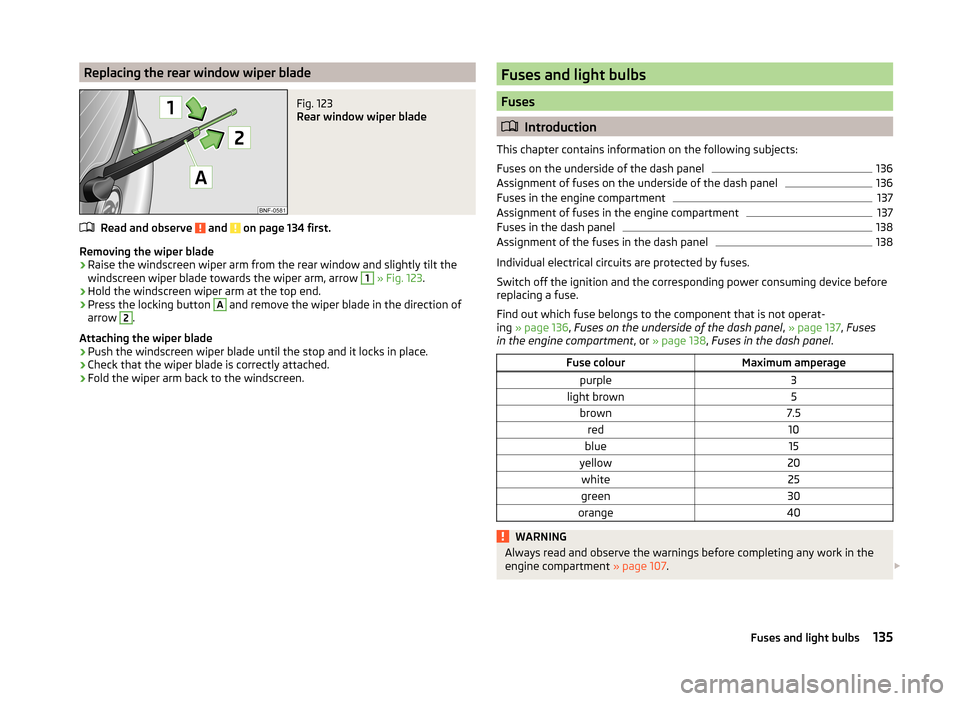
Rear window wiper blade
Read and observe and on page 134 first.
Removing the wiper blade
›
Raise the windscreen wiper arm from the rear window and slightly tilt the
windscreen wiper blade towards the wiper arm, arrow
1
» Fig. 123 .
›
Hold the windscreen wiper arm at the top end.
›
Press the locking button
A
and remove the wiper blade in the direction of
arrow
2
.
Attaching the wiper blade
›
Push the windscreen wiper blade until the stop and it locks in place.
›
Check that the wiper blade is correctly attached.
›
Fold the wiper arm back to the windscreen.
Fuses and light bulbs
Fuses
Introduction
This chapter contains information on the following subjects:
Fuses on the underside of the dash panel
136
Assignment of fuses on the underside of the dash panel
136
Fuses in the engine compartment
137
Assignment of fuses in the engine compartment
137
Fuses in the dash panel
138
Assignment of the fuses in the dash panel
138
Individual electrical circuits are protected by fuses.
Switch off the ignition and the corresponding power consuming device before
replacing a fuse.
Find out which fuse belongs to the component that is not operat-
ing » page 136 , Fuses on the underside of the dash panel , » page 137 , Fuses
in the engine compartment , or » page 138 , Fuses in the dash panel .
Fuse colourMaximum amperagepurple3light brown5brown7.5red10blue15yellow20white25green30orange40WARNINGAlways read and observe the warnings before completing any work in the
engine compartment » page 107. 135Fuses and light bulbs
Page 152 of 164
Cavity protection100
Central locking39
Central locking button43
Change engine oil
110
Change engine oil
110
Changing Front turn signal bulb
140
Fuses on the underside of the dash panel136
light bulb in tail light141
Low beam and high beam bulb - halogen head- lights
139
Wheels124
Changing a wheel Follow-up work
125
Preliminary work124
Remove and attaching a wheel125
Charging a vehicle battery115
Checking Battery electrolyte level
115
Brake fluid113
Coolant112
Engine oil110
Oil level110
Windscreen washer fluid109
Checks Statutory checks
93
Children and safety19
Child safety Side airbag
21
Child safety lock43
Child seat Classification
22
ISOFIX22
on the front passenger seat20
TOP TETHER23
Use of child seats22
Use of ISOFIX child seats23
Chrome parts see vehicle care99
Cigarette lighter61
City Safe Drive90
Disable/Enable91
Operation90
warning symbol39
cleaning chrome parts
99
Cleaning Alcantara
102
and maintaining belts103
artificial leather102
headlight glasses99
materials102
natural leather101
plastic parts98
seats covers of the electrically heated seats102
wheels100
Cleaning safety belt
103
Cleaning seat covers
102
Cleaning the interior artificial leather
102
Seat covers102
Cleaning the outside of the vehicle Decorative films
99
Cleaning the vehicle exterior Cavity protection
100
Door locking cylinder100
Headlight glasses99
Under-body protection100
wheels100
Windows and external mirrors99
Cleaning vehicle96
Cleaning vehicle exterior97
Plastic parts98
Rubber seals98
Vehicle paint work98
Wiper blades101
Clean interior Safety belt
103
clean outside of vehicle chrome parts
99
Clothes hook64
CNG106
Fuel reserve display29
refuelling105
Refuelling105
Sticker106
Cockpit 12-Volt power outlet
62
Ashtray62
Cigarette lighter61
General view27
Light51
storage compartments60
useful equipment60
compartments60
Components of the puncture repair kits128
Compressed natural gas see CNG
106
Computer see multi-function display
30
convenience turn signal50
Coolant111
Checking112
Replenishing112
Warning light35
Cooling system cost-effective use
72
malfunctions72
Correct seated position9
Driver9
Front passenger10
Instructions11
Rear seats10
Counter for distance driven30
149Index
Page 153 of 164
cruise controloperation87
operation Description87
Cruise control system Warning light
38
Cruise Control System87
Cup holders61
D
DAY LIGHT see Daylight running lights
49
Daylight running lights49
De-icing windows
99
Deactivating an airbag18
Decorative films99
Defrosting rear window52
Delayed locking of the boot lid see boot lid
44
Departure angle146
Digital Clock Time
33
Dimmed headlights48
Dipstick110
Disconnecting and reconnecting vehicle battery
116
Display Service interval
30
Display of fuel reserve
29
Disposal Acceptance and recycling of used vehicles
96
Distance driven30
Door Child safety lock
43
Closing41
Emergency locking133
Opening41
Door opening lever locking of42
unlocking of42
Driving Driving through water
83
Emissions144
Fuel consumption144
Maximum speed147
off of made-up roads83
Trailer operation96
Driving in Brake linings
82
engine82
Tyres82
Driving off of made-up roads83
Driving through water83
E
Economical driving Tips
82
EDL85
Electric Windows44
Button in driver's door44
Electronic Differential Lock (EDL)85
Electronic immobilizer76
Electronic Stability Control (ESC)84
Emergency Changing a wheel
124
Hazard warning light system50
Jump-starting130
Locking the door without a locking cylinder133
Towing the vehicle131
Tyre repair127
Unlocking the tailgate134
Emergency equipment First aid kit
122
Jack122
Reflective Vest122
Vehicle tool kit122
Warning triangle122
Emissions144
Engine Switch off engine
77
Engine compartment107
Brake fluid113
Overview109
Vehicle battery113
Engine number143
engine oil specification
110
Engine oil110
Checking110
Replenishing111
Warning light35
EPC Warning light
38
ESC Function
84
Warning light36
Exhaust inspection system Warning light
37
F
Films
99
First aid kit122
Fog lights50
Foldable hook64
Footmats80
see footmats80
Force limit Sliding/tilting roof
46
Front airbag16
fuel lead-free petrol
104
Fuel103
CNG106
Fuel reserve display29
refer to Fuel103
150Index
Page 157 of 164
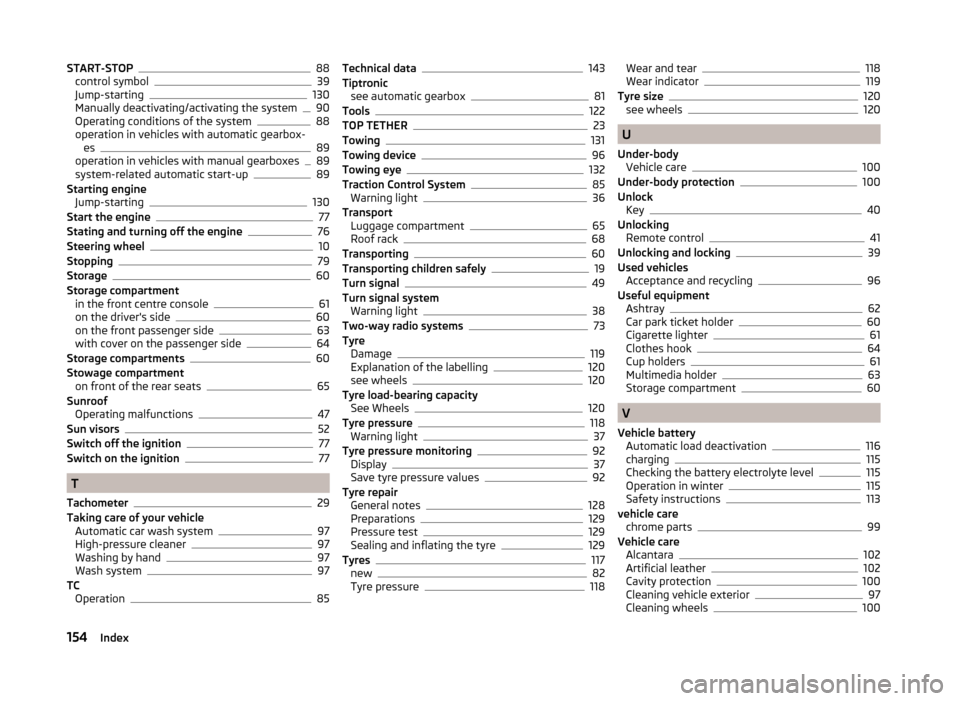
START-STOP88
control symbol39
Jump-starting130
Manually deactivating/activating the system90
Operating conditions of the system88
operation in vehicles with automatic gearbox- es
89
operation in vehicles with manual gearboxes89
system-related automatic start-up89
Starting engine Jump-starting
130
Start the engine77
Stating and turning off the engine76
Steering wheel10
Stopping79
Storage60
Storage compartment in the front centre console
61
on the driver's side60
on the front passenger side63
with cover on the passenger side64
Storage compartments60
Stowage compartment on front of the rear seats
65
Sunroof Operating malfunctions
47
Sun visors52
Switch off the ignition77
Switch on the ignition77
T
Tachometer
29
Taking care of your vehicle Automatic car wash system
97
High-pressure cleaner97
Washing by hand97
Wash system97
TC Operation
85
Technical data143
Tiptronic see automatic gearbox
81
Tools122
TOP TETHER23
Towing131
Towing device96
Towing eye132
Traction Control System85
Warning light36
Transport Luggage compartment
65
Roof rack68
Transporting60
Transporting children safely19
Turn signal49
Turn signal system Warning light
38
Two-way radio systems73
Tyre Damage
119
Explanation of the labelling120
see wheels120
Tyre load-bearing capacity See Wheels
120
Tyre pressure118
Warning light37
Tyre pressure monitoring92
Display37
Save tyre pressure values92
Tyre repair General notes
128
Preparations129
Pressure test129
Sealing and inflating the tyre129
Tyres117
new82
Tyre pressure118
Wear and tear118
Wear indicator119
Tyre size120
see wheels120
U
Under-body Vehicle care
100
Under-body protection100
Unlock Key
40
Unlocking Remote control
41
Unlocking and locking39
Used vehicles Acceptance and recycling
96
Useful equipment Ashtray
62
Car park ticket holder60
Cigarette lighter61
Clothes hook64
Cup holders61
Multimedia holder63
Storage compartment60
V
Vehicle battery Automatic load deactivation
116
charging115
Checking the battery electrolyte level115
Operation in winter115
Safety instructions113
vehicle care chrome parts
99
Vehicle care Alcantara
102
Artificial leather102
Cavity protection100
Cleaning vehicle exterior97
Cleaning wheels100
154Index