oil SKODA CITIGO 2015 1.G User Guide
[x] Cancel search | Manufacturer: SKODA, Model Year: 2015, Model line: CITIGO, Model: SKODA CITIGO 2015 1.GPages: 160, PDF Size: 23.1 MB
Page 110 of 160
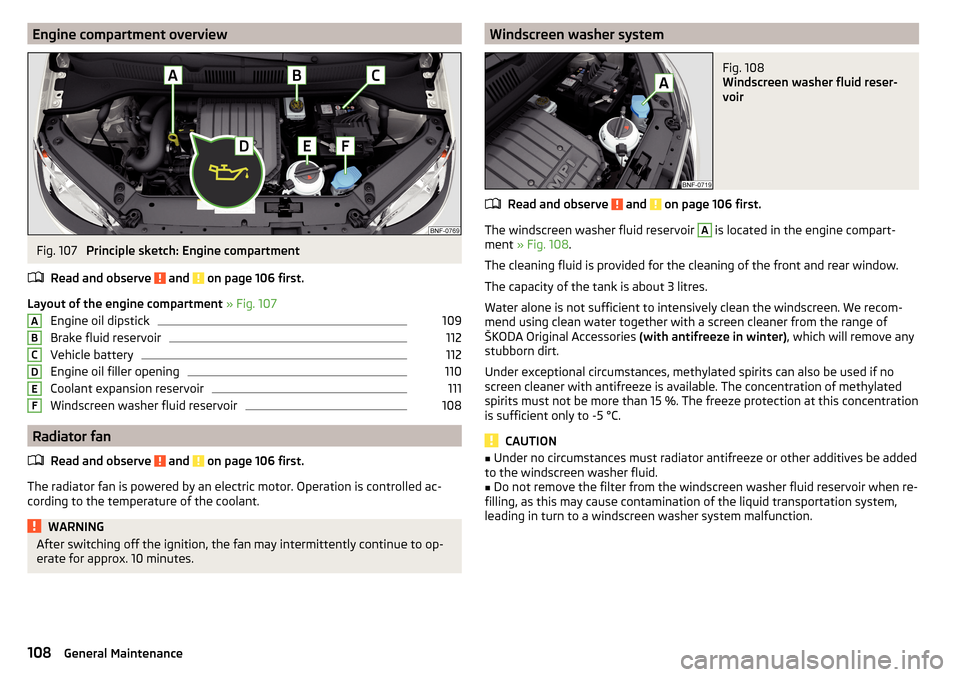
Engine compartment overviewFig. 107
Principle sketch: Engine compartment
Read and observe
and on page 106 first.
Layout of the engine compartment » Fig. 107
Engine oil dipstick
109
Brake fluid reservoir
112
Vehicle battery
112
Engine oil filler opening
110
Coolant expansion reservoir
111
Windscreen washer fluid reservoir
108
Radiator fan
Read and observe
and on page 106 first.
The radiator fan is powered by an electric motor. Operation is controlled ac-
cording to the temperature of the coolant.
WARNINGAfter switching off the ignition, the fan may intermittently continue to op-
erate for approx. 10 minutes.ABCDEFWindscreen washer systemFig. 108
Windscreen washer fluid reser-
voir
Read and observe and on page 106 first.
The windscreen washer fluid reservoir
A
is located in the engine compart-
ment » Fig. 108 .
The cleaning fluid is provided for the cleaning of the front and rear window.
The capacity of the tank is about 3 litres.
Water alone is not sufficient to intensively clean the windscreen. We recom- mend using clean water together with a screen cleaner from the range of
ŠKODA Original Accessories (with antifreeze in winter), which will remove any
stubborn dirt.
Under exceptional circumstances, methylated spirits can also be used if no
screen cleaner with antifreeze is available. The concentration of methylated
spirits must not be more than 15 %. The freeze protection at this concentration
is sufficient only to -5 °C.
CAUTION
■ Under no circumstances must radiator antifreeze or other additives be added
to the windscreen washer fluid.■
Do not remove the filter from the windscreen washer fluid reservoir when re-
filling, as this may cause contamination of the liquid transportation system,
leading in turn to a windscreen washer system malfunction.
108General Maintenance
Page 111 of 160
Engine oil
Introduction
This chapter contains information on the following subjects:
Specification
109
Checking the oil level
109
Replenishing
110
The engine has been factory-filled with a high-grade oil that can be use
throughout the year - except in extreme climate zones.
The engine oils are undergoing continuous further development. Thus the in- formation stated in this Owner's Manual is only correct at the time of publica-
tion.
ŠKODA Service Partners are informed about the latest changes by the manu-
facturer. We therefore recommend that the oil change be completed by a
ŠKODA Service Partner.
The specifications (VW standards) stated in the following can be indicated sep-
arately or together with other specifications on the bottle.
The engine oil should be changed after specified service intervals » page 30.
WARNINGThe engine compartment of your car is a hazardous area. The following
warning instructions must be followed at all times when working in the en-
gine compartment » page 106.
CAUTION
Do not pour any additives into the engine oil – risk of serious damage to the
engine parts.
Note
■ Before a long drive we recommend that you purchase and carry with you en-
gine oil which complies with the specification for your vehicle.■
We recommend that you use oils from ŠKODA Original Accessories.
■
If your skin has come into contact with oil, it must be washed thoroughly.
Specification
Read and observe
and on page 109 first.
Vehicles with variable service intervals
EngineSpecification1.0 ltr./44 kW MPIVW 504 001.0 ltr./55 kW MPI
Vehicles with fixed service intervals
EngineSpecification1.0 ltr./44 kW MPI
VW 502 00
1.0 ltr./55 kW MPI1.0 l/50 kW MPI G-TEC
CAUTION
■In an emergency, another engine oil can be used. To prevent damage to the
engine, a maximum of 0.5 litres only of the following engine oils may be used:
■ for petrol engines: ACEA A3/ACEA B4 or API SN, (API SM).
Checking the oil level
Fig. 109
Principle sketch: Dipstick
Read and observe and on page 109 first.
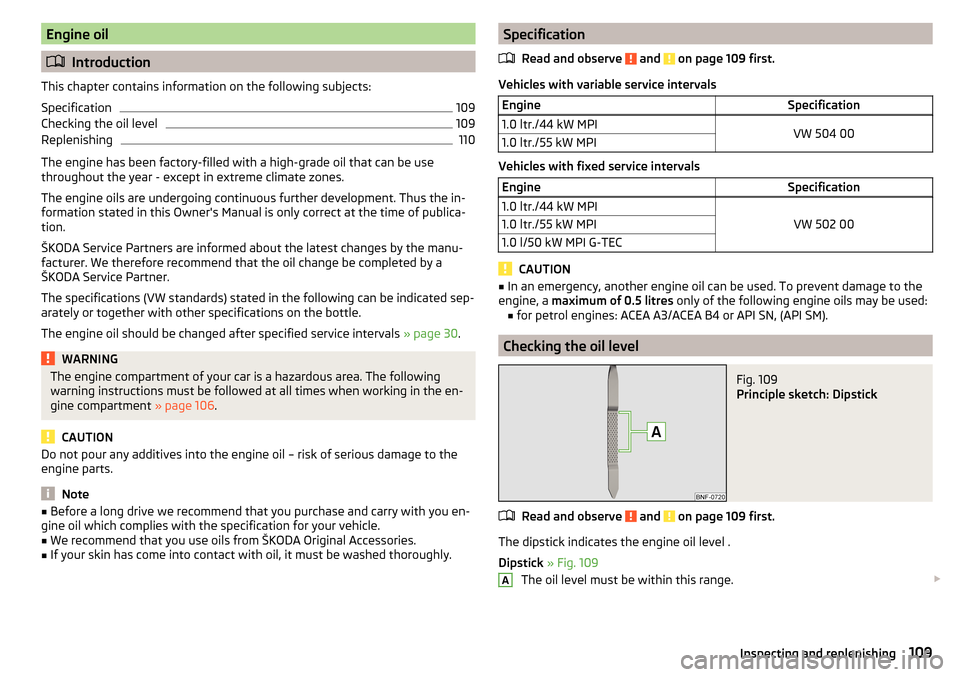
The dipstick indicates the engine oil level .
Dipstick » Fig. 109
The oil level must be within this range.
A109Inspecting and replenishing
Page 112 of 160
The oil can be checked and topped up, if the following conditions are satisfied.The vehicle is standing on a horizontal surface.
The engine operating temperature is reached.
The engine is turned off.
The bonnet is open.
Checking the level›
Wait a few minutes until the engine oil flows back into the oil trough.
›
Pull out the dipstick.
›
Wipe the dipstick with a clean cloth and insert it again to the stop.
›
Pull the dipstick out again and check the oil level.
›
Re-insert the dipstick.
The engine consumes a little oil. The oil consumption may be as much as 0.5
l/1 000 km depending on your style of driving and the conditions under which
you operate your vehicle. Consumption may be slightly higher than this during
the first 5 000 km.
The oil level must be checked at regular intervals.
In the event of the oil level being too low, the warning light appears in the dis-
play of the instrument cluster » page 35. Check the oil level using the dipstick
as soon as possible. Add oil accordingly.
CAUTION
■ The oil level must never be above the range A » Fig. 109 - risk of damage to
the motor as well as the exhaust system.■
If for some reason, it is not possible to top up the engine oil under the cur-
rent circumstances,
do not continue driving! Switch off the engine and seek
assistance from a specialist garage.
■
If the oil level is above the range
A
,
stop driving! Switch off the engine
and seek assistance from a specialist garage.
Replenishing
Read and observe
and on page 109 first.
›
Unscrew the cap of the engine oil filler opening » Fig. 107 on page 108 .
›
Replenish the oil in portions of 0.5 litres in accordance with the correct speci-
fications » page 109 .
›
Check the oil level » page 109.
›
Screw the lid of the engine oil filler closed carefully.
›
Pull the dipstick out as far as the stop.
Coolant
Introduction
This chapter contains information on the following subjects:
Checking the coolant level
111
Replenishing
111
The coolant provides cooling for the motor.
It consists of water and coolant additive with additives that protect the cooling
system against corrosion and prevents furring.
The proportion of coolant additive in the coolant must be at least 40%.
The coolant additive may be increased to a maximum of 60%.
The correct mixing ratio of water and coolant additive is to be checked if nec-
essary by a specialist garage or is to be restored if necessary.
The description of the coolant is shown in the coolant expansion reservoir
» Fig. 110 on page 111 .
WARNINGThe engine compartment of your car is a hazardous area. The following
warning instructions must be followed at all times when working in the en- gine compartment » page 106.■
The coolant is harmful to health.
■
Avoid contact with the coolant.
■
Coolant vapours are harmful to health.
■
Never open the end cover of the coolant expansion reservoir while the
engine is still warm. The cooling system is pressurized!
■
When opening the end cover of the coolant expansion reservoir, cover it
with a cloth to protect your face, hands and arms from hot steam or hot
coolant.
■
If any coolant splashes into your eyes, immediately rinse out your eyes
with clear water and contact a doctor as soon as possible.
■
Always keep the coolant in the original container, safe from people who
are not completely independent, especially children - there is a danger of
poisoning!
■
If coolant is swallowed, consult a doctor immediately.
■
Never spill operating fluids over the hot engine - risk of fire.
110General Maintenance
Page 121 of 160
Tyre damageRead and observe
on page 116 first.
We recommend checking your tyres and wheel rims for damage (punctures,
cuts, splits and bulges, etc.) on a regular basis. Remove foreign bodies (e.g.
small stones) from the tyre tread immediately.
Drive over kerbs and other such obstacles slowly and at right angles wherever
possible in order to avoid damage to tyres and wheel trims.
Immediately replace damaged wheel rims or tyres.
WARNINGNever drive with damaged tyres – risk of accident.
CAUTION
The tyres must be protected from contact with substances such as oil, grease
and fuel, which could damage them. If the tyres come into contact with these
substances, then we recommend you have this checked out in a specialist
workshop.
Unidirectional tyres
Read and observe
on page 116 first.
The direction of rotation of the tyres is marked by arrows on the wall of the
tyre .
The indicated direction of rotation must be adhered to in order to ensure the
optimal characteristics of these tyres.
These characteristics mainly relate to the following: ▶ Increased driving stability.
▶ Reduced risk of aquaplaning.
▶ Reduced tyre noise and tyre wear.
Spare wheel
Read and observe
on page 116 first.
The size of the spare wheel is identical to that of the vehicle factory installedwheels.
After changing the spare wheel, the tyre pressure should be adjusted.
In vehicles with tyre pressure monitoring, the tyre pressure values should be
saved » page 91 .WARNING■
If, you get a puncture and a spare tyre has to be mounted with opposite
direction of rotation, then drive carefully. The best properties of the tyre
are no longer present in this situation.■
If the dimensions or design of the spare wheel differ from the tyres fitted
to the vehicle (e.g. winter tyres or low-profile tyres), it must only be used
briefly in the event of a puncture and if an appropriately cautious style of
driving is adopted.
■
Never use the temporary spare wheel if it is damaged.
Spare wheel
Read and observe
on page 116 first.
A yellow warning label is always displayed on the rim of the temporary spare
wheel.
Please note the following if you intend to use the temporary spare wheel. ▶ The warning label must not be covered after installing the wheel.
▶ Be particularly observant when driving.
▶ The temporary spare wheel is inflated to the maximum inflation pressure for
the vehicle » page 117.
▶ Only use this temporary spare wheel to reach the nearest specialist garage,
since it is not intended for permanent use.
If you need to use a spare wheel, make sure to fit a standard wheel of the ap-
propriate dimensions and design as soon as possible.
In vehicles with tyre pressure monitoring, the tyre pressure values should be
saved » page 91 .
WARNING■
Never drive with more than one temporary spare wheel mounted!■Only use the temporary spare wheel when absolutely necessary.■
Avoid accelerating at full throttle, sharp braking and fast cornering.
■
The snow chains cannot be used on the temporary spare wheel.
■
If the dimensions or design of the temporary spare wheel differ from the
tyres fitted, never drive faster than 80 km/h (or 50 mph).
119Wheels
Page 128 of 160
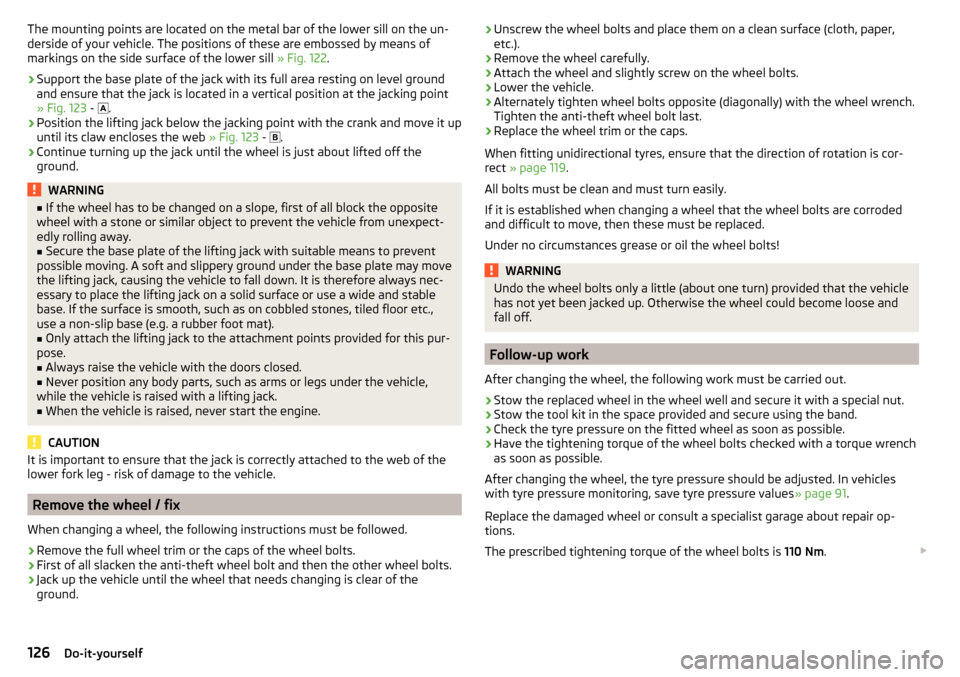
The mounting points are located on the metal bar of the lower sill on the un-
derside of your vehicle. The positions of these are embossed by means of
markings on the side surface of the lower sill » Fig. 122.›
Support the base plate of the jack with its full area resting on level ground
and ensure that the jack is located in a vertical position at the jacking point
» Fig. 123 -
.
›
Position the lifting jack below the jacking point with the crank and move it up
until its claw encloses the web » Fig. 123 -
.
›
Continue turning up the jack until the wheel is just about lifted off the
ground.
WARNING■ If the wheel has to be changed on a slope, first of all block the opposite
wheel with a stone or similar object to prevent the vehicle from unexpect-
edly rolling away.■
Secure the base plate of the lifting jack with suitable means to prevent
possible moving. A soft and slippery ground under the base plate may move
the lifting jack, causing the vehicle to fall down. It is therefore always nec-
essary to place the lifting jack on a solid surface or use a wide and stable
base. If the surface is smooth, such as on cobbled stones, tiled floor etc.,
use a non-slip base (e.g. a rubber foot mat).
■
Only attach the lifting jack to the attachment points provided for this pur-
pose.
■
Always raise the vehicle with the doors closed.
■
Never position any body parts, such as arms or legs under the vehicle,
while the vehicle is raised with a lifting jack.
■
When the vehicle is raised, never start the engine.
CAUTION
It is important to ensure that the jack is correctly attached to the web of the
lower fork leg - risk of damage to the vehicle.
Remove the wheel / fix
When changing a wheel, the following instructions must be followed.
›
Remove the full wheel trim or the caps of the wheel bolts.
›
First of all slacken the anti-theft wheel bolt and then the other wheel bolts.
›
Jack up the vehicle until the wheel that needs changing is clear of the
ground.
› Unscrew the wheel bolts and place them on a clean surface (cloth, paper,
etc.).›
Remove the wheel carefully.
›
Attach the wheel and slightly screw on the wheel bolts.
›
Lower the vehicle.
›
Alternately tighten wheel bolts opposite (diagonally) with the wheel wrench.
Tighten the anti-theft wheel bolt last.
›
Replace the wheel trim or the caps.
When fitting unidirectional tyres, ensure that the direction of rotation is cor-
rect » page 119 .
All bolts must be clean and must turn easily.
If it is established when changing a wheel that the wheel bolts are corroded and difficult to move, then these must be replaced.
Under no circumstances grease or oil the wheel bolts!
WARNINGUndo the wheel bolts only a little (about one turn) provided that the vehicle
has not yet been jacked up. Otherwise the wheel could become loose and
fall off.
Follow-up work
After changing the wheel, the following work must be carried out.
›
Stow the replaced wheel in the wheel well and secure it with a special nut.
›
Stow the tool kit in the space provided and secure using the band.
›
Check the tyre pressure on the fitted wheel as soon as possible.
›
Have the tightening torque of the wheel bolts checked with a torque wrench
as soon as possible.
After changing the wheel, the tyre pressure should be adjusted. In vehicles
with tyre pressure monitoring, save tyre pressure values » page 91.
Replace the damaged wheel or consult a specialist garage about repair op-
tions.
The prescribed tightening torque of the wheel bolts is 110 Nm.
126Do-it-yourself
Page 133 of 160
Please note that the brake servo unit and power steering only operate if the
engine is running. If the engine is not running, significantly more physical force
is required to depress the brake pedal and steer the vehicle.
If using a tow rope, ensure that it is always kept taught.
General information on towing
Both drivers should be familiar with the problems which might occur while a
vehicle is being towed. Unskilled drivers should not attempt to tow in another
vehicle or to be towed in.
The vehicle must be transported on a special breakdown vehicle or trailer if it
is not possible to tow in the vehicle in the way described or if the towing dis-
tance is greater than 50 km.
If the gearbox has no oil, your vehicle must be towed with the front axle raised
clear of the ground or on a breakdown vehicle or trailer.
To protect both vehicles when tow-starting or towing, the tow rope should be elastic. Thus one should only use plastic fibre rope or a rope made out of a
similarly elastic material.
Attach the tow rope or the tow bar only to the towing eye » page 131 .WARNING■
When towing, exercise increased caution.■Do not use spiral rope for towing » Fig. 126- , the towing eye may un-
screw from the vehicle - risk of accident.■
Ensure tow rope is not twisted - risk of accident.
CAUTION
■ Do not start engine by towing - there is a risk of damaging the engine parts.
The battery from another vehicle can be used as a jump-start aid » page 129,
Jump-starting .■
There is always a risk of excessive stresses and damage resulting at the
points to which you attach the tow rope or tow bar when you attempt to tow a
vehicle which is not standing on a paved road.
Note
We recommend using a tow rope from ŠKODA Original Accessories, which is
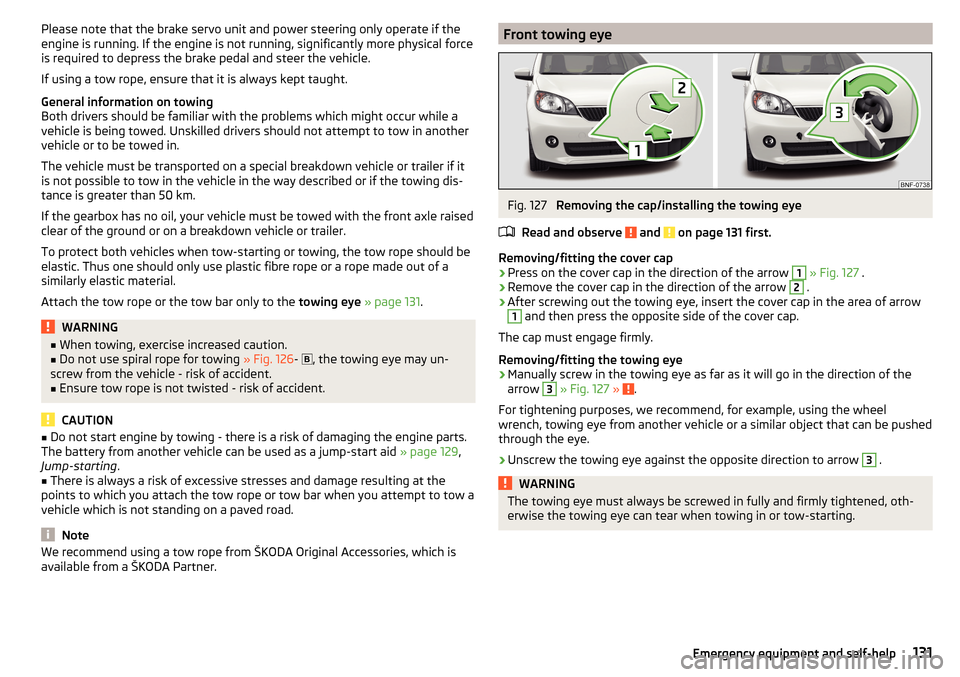
available from a ŠKODA Partner.Front towing eyeFig. 127
Removing the cap/installing the towing eye
Read and observe
and on page 131 first.
Removing/fitting the cover cap
›
Press on the cover cap in the direction of the arrow
1
» Fig. 127 .
›
Remove the cover cap in the direction of the arrow
2
.
›
After screwing out the towing eye, insert the cover cap in the area of arrow
1
and then press the opposite side of the cover cap.
The cap must engage firmly.
Removing/fitting the towing eye
›
Manually screw in the towing eye as far as it will go in the direction of the
arrow
3
» Fig. 127 » .
For tightening purposes, we recommend, for example, using the wheel
wrench, towing eye from another vehicle or a similar object that can be pushed through the eye.
›
Unscrew the towing eye against the opposite direction to arrow
3
.
WARNINGThe towing eye must always be screwed in fully and firmly tightened, oth-
erwise the towing eye can tear when towing in or tow-starting.131Emergency equipment and self-help
Page 150 of 160
Central locking button40
Change engine oil
109
Change engine oil
109
Changing Bulb in the tail light
141
Front turn signal bulb139
light bulb in tail light141
Low beam and high beam bulb - halogen head- lights
139
Wheels123
Changing a wheel Follow-up work
126
Preliminary work123
Changing wheels Wheel removal and fix
126
Charging a vehicle battery114
Checking Battery electrolyte level
114
Brake fluid112
Coolant111
Engine oil109
Oil level109
Windscreen washer fluid108
Checks Statutory checks
92
Children and safety19
Child safety Side airbag
21
Child safety lock42
Child seat Classification
21
ISOFIX22
on the front passenger seat20
TOP TETHER24
Use of child seats22
Use of ISOFIX child seats23
Chrome parts Refer to vehicle maintenance
98
Cigarette lighter60
City Safe Drive89
Disable/Enable90
Operation89
warning symbol38
Clean Anodized parts
98
Chrome parts98
Cleaning Alcantara
101
and maintaining belts102
artificial leather101
headlight glasses98
materials101
natural leather100
plastic parts98
seats covers of the electrically heated seats101
wheels99
Cleaning safety belt
102
Cleaning seat covers
101
Cleaning the interior artificial leather
101
Seat covers101
Cleaning the vehicle exterior Cavity protection
99
Decorative films97
Door locking cylinder99
Headlight glasses98
Protective films97
Under-body protection99
Vehicle paintwork97
wheels99
Windows and external mirrors98
Cleaning vehicle95
Cleaning vehicle exterior96
Anodized parts98
Chrome parts98
Plastic parts98
Rubber seals98
Wiper blades100
Clean interior Safety belt
102
Clothes hook63
CNG105
Fuel reserve display29
refuelling104
Refuelling104
Sticker105
Cockpit 12-Volt power outlet
61
Ashtray61
Cigarette lighter60
General view27
Light50
storage compartments58
useful equipment58
compartments58
Components of the puncture repair kits127
Compressed natural gas see CNG
105
Computer see multi-function display
31
Conserving the vehicle paintwork see vehicle care
97
convenience turn signal48
Coolant110
Checking111
Replenishing111
Warning light35
Correct routing of seat belt
12
Correct seated position8
Front passenger10
Rear seats10
Correct seat position Driver
9
Counter for distance driven30
148Index
Page 151 of 160
cruise controloperation88
operation Description88
Cruise control system Warning light
38
Cruise Control System88
Cup holders59
D
DAY LIGHT see Daylight running lights
48
Daylight running lights48
De-icing windows
98
Deactivating an airbag17
Decorative films97
Defrosting rear window51
Delayed locking of the boot lid see boot lid
43
Departure angle145
Digital Clock Time
33
Dimmed headlights47
Dipstick109
Disconnecting and reconnecting vehicle battery
115
Display Service interval
30
Display of fuel reserve
29
Disposal Acceptance and recycling of used vehicles
95
Distance driven30
Door Child safety lock
42
Closing41
Emergency locking132
Opening41
Door opening lever locking of42
unlocking of42
Drive Driving through water
84
Driving Emissions
143
Fuel consumption143
through water84
Top speed146
Trailer operation95
E
Economical driving Tips
83
EDL86
Electric Windows44
Button in driver's door44
Button in the front passenger door44
Electronic Differential Lock (EDL)86
Electronic immobilizer75
Emergency Changing a wheel
123
Hazard warning light system49
Jump-starting129
Locking the door without a locking cylinder132
Towing the vehicle130
Tyre repair127
Emergency equipment Jack
122
Reflective vest122
Vehicle tool kit122
Warning triangle122
Emissions143
Engine Running-in
83
Switch off engine76
Engine compartment106
Brake fluid112
Overview108
Vehicle battery112
Engine number142
engine oil specification
109
Engine oil109
Checking109
Replenishing110
Warning light35
EPC Warning light
37
ESC Operation
85
Warning light36
Exhaust inspection system Warning light
37
F
Films
97
Fog Lights49
Foldable hook63
Footmats80
see footmats80
Force limit Sliding/tilting roof
45
Force limiter Sliding/tilting roof
46
Front airbag15
fuel lead-free petrol
103
Fuel102
CNG105
Fuel reserve display29
refer to Fuel102
Refuelling103
Refuelling - natural gas104
Fuel consumption143
149Index
Page 153 of 160
Locking the door without a locking cylinderEmergency132
Low tyre pressure warning refer to the tyre pressure monitoring
90
Luggage compartment64
Cover66
Fixing nets65
Lashing eyes65
Lighting64
unlock manually133
Unlock the boot lid133
Variable loading floor67
Luggage compartment cover66
Luggage compartment lid42
Luggage storage Bag hooks
65
M
Main beam
48
Warning light38
Manual gear changing see gear changing
80
Maximum permissible weights
142
Mechanical window lifter open and close
44
Mechanical window lifters43
Media see Radio
4
MFD see multi-function display
31
Mirror Exterior mirrors
53
Interior mirror53
Mirrors Vanity
51
Mobile phone72
Modes of automated transmission81
Modifications92
Modifications and technical alterations Airbags94
Service93
Spoiler94
Trailer operation95
Move & Fun72
install/remove72
operation73
Multi-function display Functions
31
Memory33
Operation31
Multi-function display operation31
Multimedia holder62
N
N1
67
Nameplate142
Natural gas vehicles see CNG
105
Nets65
Notes for driving with repaired tyres129
Notes on using wheels116
O
Oil See Engine oil
109
On-board computer see multi-function display
31
Operate wiper
52
Operating weight143
Operation in winter Vehicle battery
114
Original accessories93
Outside temperature32
Overview Engine compartment
108
Warning lights34
P
Parking
80
Parking aid86
Visual parking system87
Parking aid86
Function87
Parking space80
Parking vehicle80
ParkPilot86
Part replacement92
Passive safety Before setting off
8
Driving safety8
Passive Safety8
Pedals80
Footmats80
Petrol see fuel
103
Photo holder62
Plastic parts98
Pocket holder63
Pockets on the front seat rests64
Polishing the vehicle paintwork see vehicle care
97
Power outlet 12 V
61
Power steering Warning light
36
Power windows43
Practical equipment Net pockets on the front seat rests
64
Photo holder62
Pocket holder63
Reflective vest122
Practical features 12-Volt power outlet
61
Waste container59
Protective films97
151Index
Page 154 of 160
Puncture repair kit127
R
Radiator fan
108
Radio4
Raising the vehicle125
Rear-view mirror Exterior mirrors
53
Rear fog light49
Warning light37
Rear mirror52
Rear view mirror Interior mirror
53
Rear window heating51
Rear windows Closing
45
Opening45
Recirculation70
Refuelling103
Fuel103
Fuel - natural gas104
Regulation Lighting range
47
Remote control Locking
40
Replacing the battery132
Synchronisation process132
Unlocking40
Remote control key Replacing the battery
132
Repairs and technical alterations92
Replace vehicle battery
115
Replace vehicle battery
115
Replacing Bulb for daytime running lights and parkinglights
139
Bulb for the fog light140
Bulb for the licence plate light140
Bulbs138
Fuses134
Fuses in the dash panel135, 136
Fuses in the engine compartment137
Rear window wiper blade134
Windscreen wiper blades133
Replenishing Coolant
111
Engine oil110
Windscreen washer fluid108
Roof Load
68
Roof rack67
mounting points68
Roof load68
Rubber seals98
Running-in Brake linings
83
Engine83
Tyres83
S
SAFE See Safe securing system
41
SAFELOCK See Safe securing system
41
Safe securing system41
Safety8
Child safety19
Child safety seats19
Correct seated position8
Head restraints54
ISOFIX22
TOP TETHER24
Save electrical energy83
Save fuel83
Seals Vehicle care
98
SeatAdjusting54
Seat belt height adjustment
12
Warning icon38
Seat belts11
Belt tensioners13
fastening and unfastening13
Inertia reels13
The physical principle of a frontal collision12
Warning light34
Seat features55
Seats Folding front passenger seat
56
Head restraints54
Heating55
Seat backrests57
Seats and head restraint54
Service93
Service display30
Setting33
Seat belt height12
seats and head restraints54
Settings Interior mirror
53
Setting the33
Shift Gear recommendation
30
Information on the gear changed30
Side airbag17
Sidelights47
Sliding/tilting roof Closing
45
Sliding / tilting roof Malfunction
46
Sliding/tilting roof Opening and tilting
45
Operation45
Sunblind46
Snow chains121
152Index