Instruments SKODA CITIGO 2016 1.G Owner's Manual
[x] Cancel search | Manufacturer: SKODA, Model Year: 2016, Model line: CITIGO, Model: SKODA CITIGO 2016 1.GPages: 172, PDF Size: 24.59 MB
Page 5 of 172
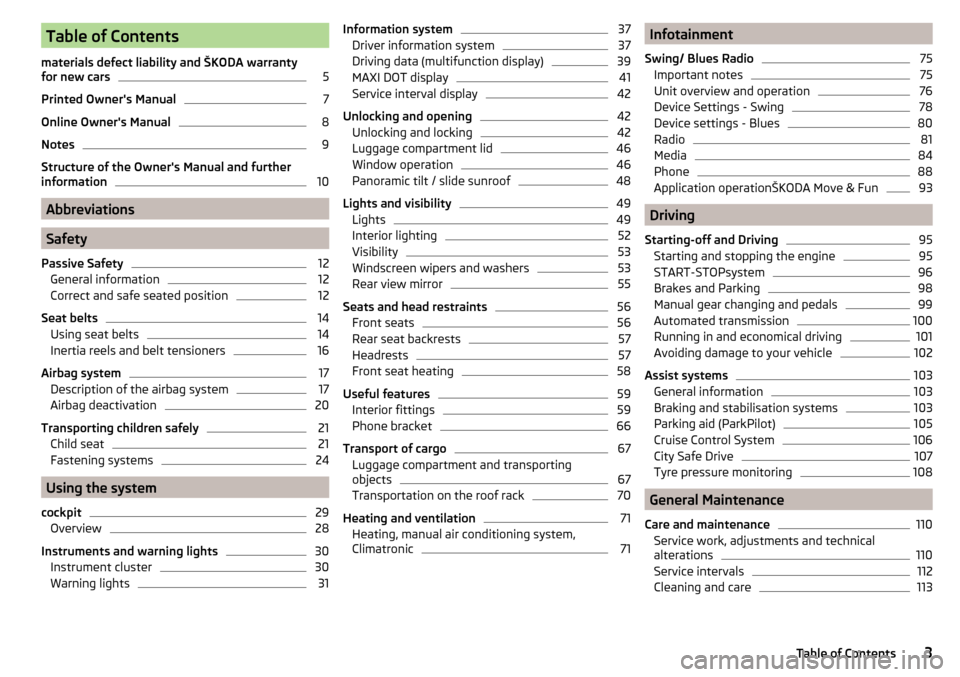
Table of Contents
materials defect liability and ŠKODA warranty
for new cars5
Printed Owner's Manual
7
Online Owner's Manual
8
Notes
9
Structure of the Owner's Manual and further
information
10
Abbreviations
Safety
Passive Safety
12
General information
12
Correct and safe seated position
12
Seat belts
14
Using seat belts
14
Inertia reels and belt tensioners
16
Airbag system
17
Description of the airbag system
17
Airbag deactivation
20
Transporting children safely
21
Child seat
21
Fastening systems
24
Using the system
cockpit
29
Overview
28
Instruments and warning lights
30
Instrument cluster
30
Warning lights
31Information system37Driver information system37
Driving data (multifunction display)
39
MAXI DOT display
41
Service interval display
42
Unlocking and opening
42
Unlocking and locking
42
Luggage compartment lid
46
Window operation
46
Panoramic tilt / slide sunroof
48
Lights and visibility
49
Lights
49
Interior lighting
52
Visibility
53
Windscreen wipers and washers
53
Rear view mirror
55
Seats and head restraints
56
Front seats
56
Rear seat backrests
57
Headrests
57
Front seat heating
58
Useful features
59
Interior fittings
59
Phone bracket
66
Transport of cargo
67
Luggage compartment and transporting
objects
67
Transportation on the roof rack
70
Heating and ventilation
71
Heating, manual air conditioning system,
Climatronic
71Infotainment
Swing/ Blues Radio75
Important notes
75
Unit overview and operation
76
Device Settings - Swing
78
Device settings - Blues
80
Radio
81
Media
84
Phone
88
Application operationŠKODA Move & Fun
93
Driving
Starting-off and Driving
95
Starting and stopping the engine
95
START-STOPsystem
96
Brakes and Parking
98
Manual gear changing and pedals
99
Automated transmission
100
Running in and economical driving
101
Avoiding damage to your vehicle
102
Assist systems
103
General information
103
Braking and stabilisation systems
103
Parking aid (ParkPilot)
105
Cruise Control System
106
City Safe Drive
107
Tyre pressure monitoring
108
General Maintenance
Care and maintenance
110
Service work, adjustments and technical
alterations
110
Service intervals
112
Cleaning and care
1133Table of Contents
Page 32 of 172
Instruments and warning lights
Instrument cluster
Introduction
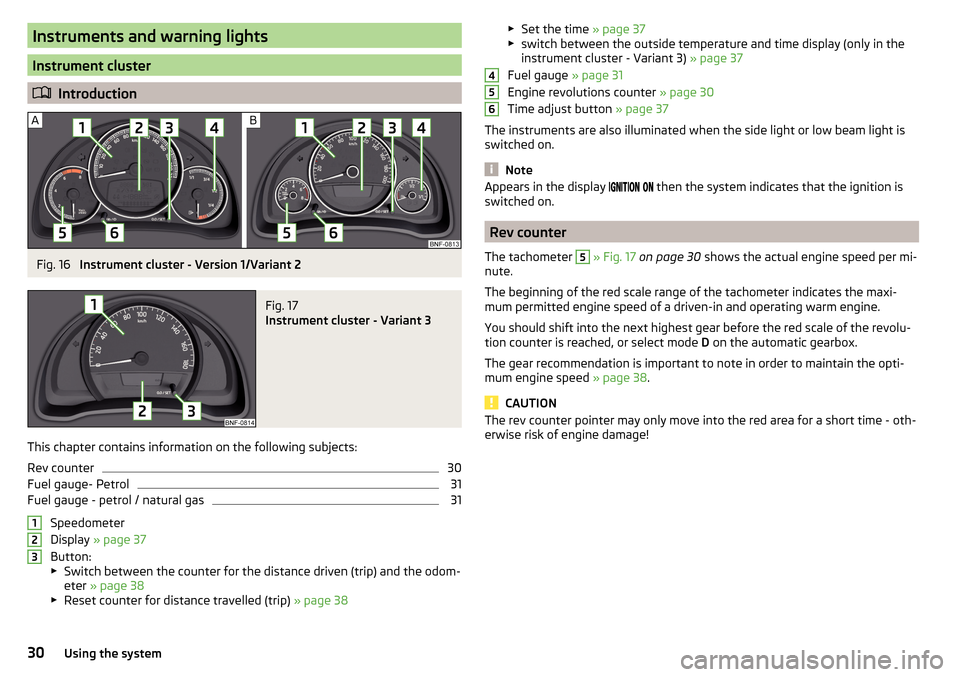
Fig. 16
Instrument cluster - Version 1/Variant 2
Fig. 17
Instrument cluster - Variant 3
This chapter contains information on the following subjects:
Rev counter
30
Fuel gauge- Petrol
31
Fuel gauge - petrol / natural gas
31
Speedometer
Display » page 37
Button:
▶ Switch between the counter for the distance driven (trip) and the odom-
eter » page 38
▶ Reset counter for distance travelled (trip) » page 38
123▶
Set the time » page 37
▶ switch between the outside temperature and time display (only in the
instrument cluster - Variant 3) » page 37
Fuel gauge » page 31
Engine revolutions counter » page 30
Time adjust button » page 37
The instruments are also illuminated when the side light or low beam light is
switched on.
Note
Appears in the display then the system indicates that the ignition is
switched on.
Rev counter
The tachometer
5
» Fig. 17 on page 30 shows the actual engine speed per mi-
nute.
The beginning of the red scale range of the tachometer indicates the maxi-
mum permitted engine speed of a driven-in and operating warm engine.
You should shift into the next highest gear before the red scale of the revolu- tion counter is reached, or select mode D on the automatic gearbox.
The gear recommendation is important to note in order to maintain the opti-
mum engine speed » page 38.
CAUTION
The rev counter pointer may only move into the red area for a short time - oth-
erwise risk of engine damage!45630Using the system
Page 33 of 172
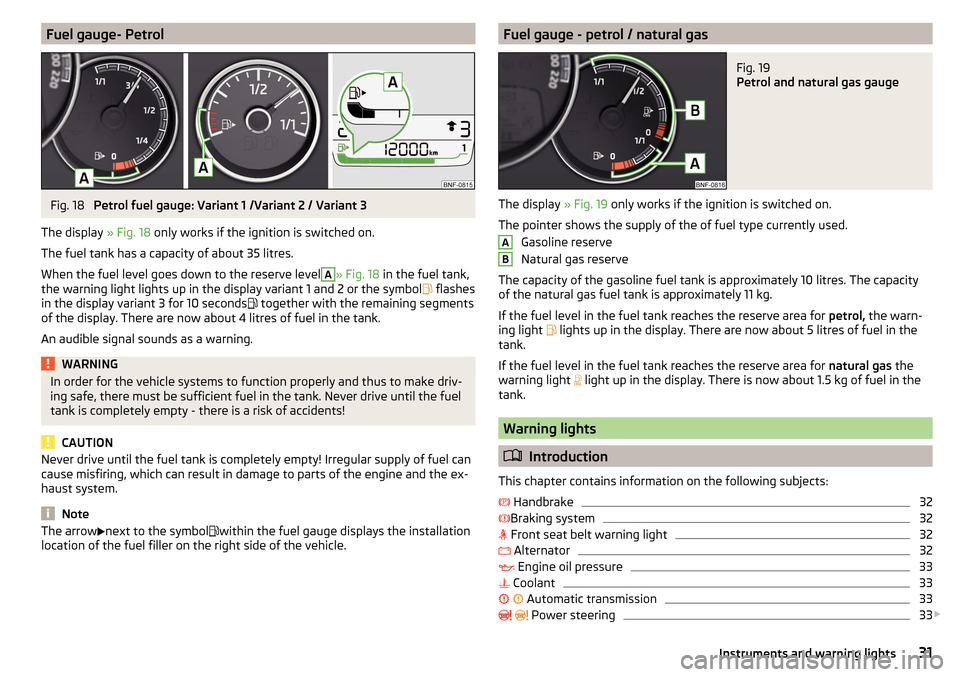
Fuel gauge- PetrolFig. 18
Petrol fuel gauge: Variant 1 /Variant 2 / Variant 3
The display » Fig. 18 only works if the ignition is switched on.
The fuel tank has a capacity of about 35 litres.
When the fuel level goes down to the reserve level
A
» Fig. 18 in the fuel tank,
the warning light lights up in the display variant 1 and 2 or the symbol flashes
in the display variant 3 for 10 seconds together with the remaining segments
of the display. There are now about 4 litres of fuel in the tank.
An audible signal sounds as a warning.
WARNINGIn order for the vehicle systems to function properly and thus to make driv-
ing safe, there must be sufficient fuel in the tank. Never drive until the fuel
tank is completely empty - there is a risk of accidents!
CAUTION
Never drive until the fuel tank is completely empty! Irregular supply of fuel can
cause misfiring, which can result in damage to parts of the engine and the ex-
haust system.
Note
The arrow next to the symbol within the fuel gauge displays the installation
location of the fuel filler on the right side of the vehicle.Fuel gauge - petrol / natural gasFig. 19
Petrol and natural gas gauge
The display » Fig. 19 only works if the ignition is switched on.
The pointer shows the supply of the of fuel type currently used. Gasoline reserve
Natural gas reserve
The capacity of the gasoline fuel tank is approximately 10 litres. The capacity
of the natural gas fuel tank is approximately 11 kg.
If the fuel level in the fuel tank reaches the reserve area for petrol, the warn-
ing light lights up in the display. There are now about 5 litres of fuel in the
tank.
If the fuel level in the fuel tank reaches the reserve area for natural gas the
warning light light up in the display. There is now about 1.5 kg of fuel in the
tank.
Warning lights
Introduction
This chapter contains information on the following subjects:
Handbrake
32
Braking system
32
Front seat belt warning light
32
Alternator
32
Engine oil pressure
33
Coolant
33
Automatic transmission
33
Power steering
33
AB31Instruments and warning lights
Page 35 of 172
▶Seek help from a specialist garage.
CAUTION
If, while driving, the warning light lights up in addition to the warning
light » page 33 , do not drive any further - risk of damage to the engine!
Switch off the engine and seek assistance from a specialist garage.
Engine oil pressure
Read and observe
on page 32 first.
lights up or flashes - the engine oil pressure is too low.
An audible signal sounds as a warning. ▶ Stop the vehicle, switch off the engine, and check the engine oil level
» page 124 , Check and refill .
▶ If the warning light lights up or flashes, do not drive any further, even if
the oil level is correct! Switch off the engine and seek assistance from a spe-
cialist garage.
CAUTION
■ The oil pressure light is not an oil level indicator! One should therefore
check the oil level at regular intervals, preferably after every refuelling stop.■
If for some reason it is not possible to top up the engine oil under the current
circumstances,
do not continue driving! Switch off the engine and seek as-
sistance from a specialist garage.
Coolant
Read and observe
on page 32 first.
lights up or flashes – the coolant temperature is too high or the coolant lev-
el is too low.
An audible signal sounds as a warning tone. ▶ Stop the vehicle, switch off the engine, and allow the engine to cool down.
▶ Check the coolant level, if necessary top up the coolant.
If the coolant level is within the specified range and the warning light
lights
up or flashes again, then there may be a malfunction of the cooling fan.
▶ Switch off the ignition.
▶ Check the fuse for the cooling fan, replace if necessary.
If the coolant level and fan fuse are both OK but the warning light is still
illuminated , do not drive any further!
▶ Seek help from a specialist garage.
Automatic transmission
Read and observe
on page 32 first.
fault
lights up - there is a fault in the automatic transmission.
An audible signal sounds as a warning tone. ▶
Do not drive the vehicle! Switch off the engine and seek assistance from a
specialist garage.
Functional impairment
lights up and gear change is not possible - for technical reasons there may
be an impairment of the automatic transmission.
▶ Stop the car, turn the ignition off and on again.
If the warning light lights up after you again switch on the ignition, seek as-
sistance from a specialist garage.
Gearbox overheating
May also light up - the automatic transmission is overheating.
An audible signal sounds as a warning tone. ▶ Stop and allow the transmission to cool down or drive more quickly than
20 km/h (12 mph).
If the warning light lights up again, switch off the vehicle, shut off the en-
gine and allow the gearbox to cool down.
Further information » page 100, Automated transmission .
Power steering
Read and observe
on page 32 first.
Fault in the power steering
lights up – this indicates a complete failure of the power steering and the
steering assist is no longer working (significantly higher steering forces).
lights up – this indicates a partial failure of the power steering and the
steering forces can be greater.
33Instruments and warning lights
Page 37 of 172
▶Seek help from a specialist garage.
Disconnecting the vehicle battery
If the vehicle's battery has been disconnected and reconnected, the warning
light comes on after switching on the
ignition.
The warning light should go out after driving a short distance.
If, after a short drive, the indicator light does not go out, there is a system er-
ror.
▶ Seek help from a specialist garage.
Other incidents
The following reasons can explain the warning light being illuminated.
▶ The vehicle is loaded on one side. Distribute the load evenly.
▶ The wheels of one axle are loaded more heavily (e.g. when driving uphill or
downhill).
▶ Snow chains are mounted.
▶ A wheel has been changed.
CAUTION
Under certain circumstances (e.g. sporty style of driving, wintry or unpaved
roads) the warning light in the instrument cluster can be delayed or does
not light up at all.
Low fuel - petrol
Read and observe
on page 32 first.
illuminates – the petrol level in the fuel tank is at the reserve level (approxi-
mately 4-5 litres).
An audible signal sounds as a warning. ▶ Please refuel » page 118.
Low fuel - natural gas
Read and observe
on page 32 first.
illuminates – the natural level in the fuel tank is at the reserve level (approxi-
mately 1.5 kg litres).
An audible signal sounds as a warning. ▶ Please refuel » page 119.
Rear fog light
Read and observe
on page 32 first.
lights up – the rear fog light is switched on.
Emission control system
Read and observe
on page 32 first.
lights up – there is a fault in the emission control system. The system
makes it possible to drive on in emergency mode - there may be a noticeable
reduction in engine performance.
▶ Seek help from a specialist garage.
Engine electronics check
Read and observe
on page 32 first.
lights up – there is a fault in the engine management system. The system
makes it possible to drive on in emergency mode - there may be a noticeable
reduction in engine performance.
▶ Seek help from a specialist garage.
Airbag system
Read and observe
on page 32 first.
System fault
lights up - there is a fault in the airbag system.
This also applies if the warning light does not come on when the ignition is
switched on.
The functionality of the airbag system is monitored automatically even if one
of the airbags is switched off.
One of the airbags or a belt tensioner has been disabled by the diagnostic
tool
lights up for approximately 4 seconds after the ignition is switched on and
then flashes for approximately 12 seconds.
The front passenger airbag has been disabled with the key switch
lights up for a few seconds when the ignition is switched on.
35Instruments and warning lights