warning light SKODA CITIGO 2017 Owner's Manual
[x] Cancel search | Manufacturer: SKODA, Model Year: 2017, Model line: CITIGO, Model: SKODA CITIGO 2017Pages: 172, PDF Size: 24.54 MB
Page 51 of 172
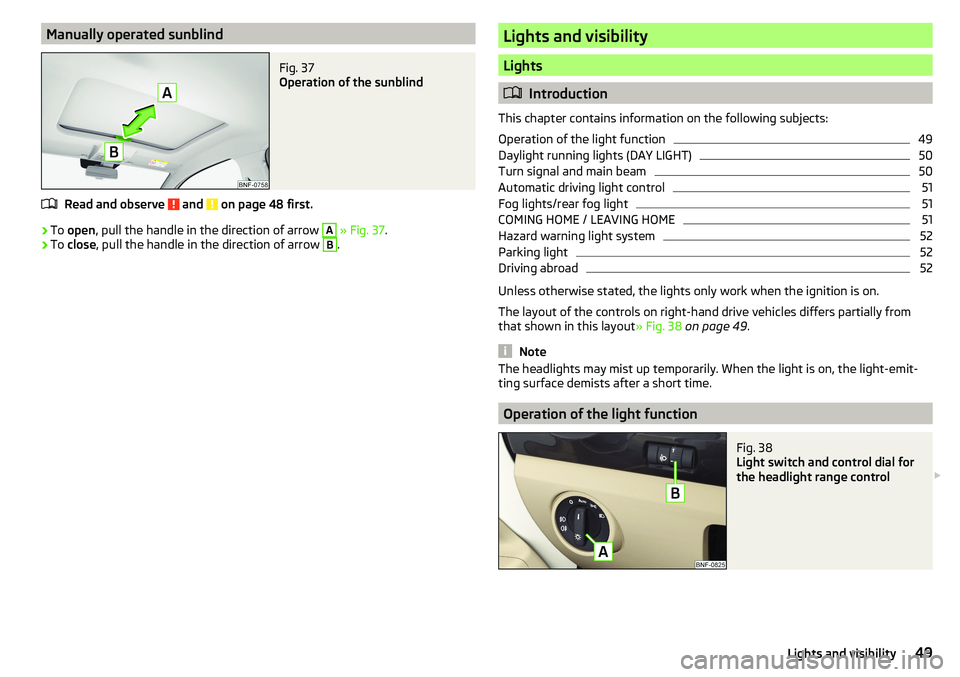
Manually operated sunblindFig. 37
Operation of the sunblind
Read and observe and on page 48 first.
›
To open , pull the handle in the direction of arrow
A
» Fig. 37 .
›
To
close , pull the handle in the direction of arrow
B
.
Lights and visibility
Lights
Introduction
This chapter contains information on the following subjects:
Operation of the light function
49
Daylight running lights (DAY LIGHT)
50
Turn signal and main beam
50
Automatic driving light control
51
Fog lights/rear fog light
51
COMING HOME / LEAVING HOME
51
Hazard warning light system
52
Parking light
52
Driving abroad
52
Unless otherwise stated, the lights only work when the ignition is on.
The layout of the controls on right-hand drive vehicles differs partially from
that shown in this layout » Fig. 38 on page 49 .
Note
The headlights may mist up temporarily. When the light is on, the light-emit-
ting surface demists after a short time.
Operation of the light function
Fig. 38
Light switch and control dial for
the headlight range control
49Lights and visibility
Page 52 of 172
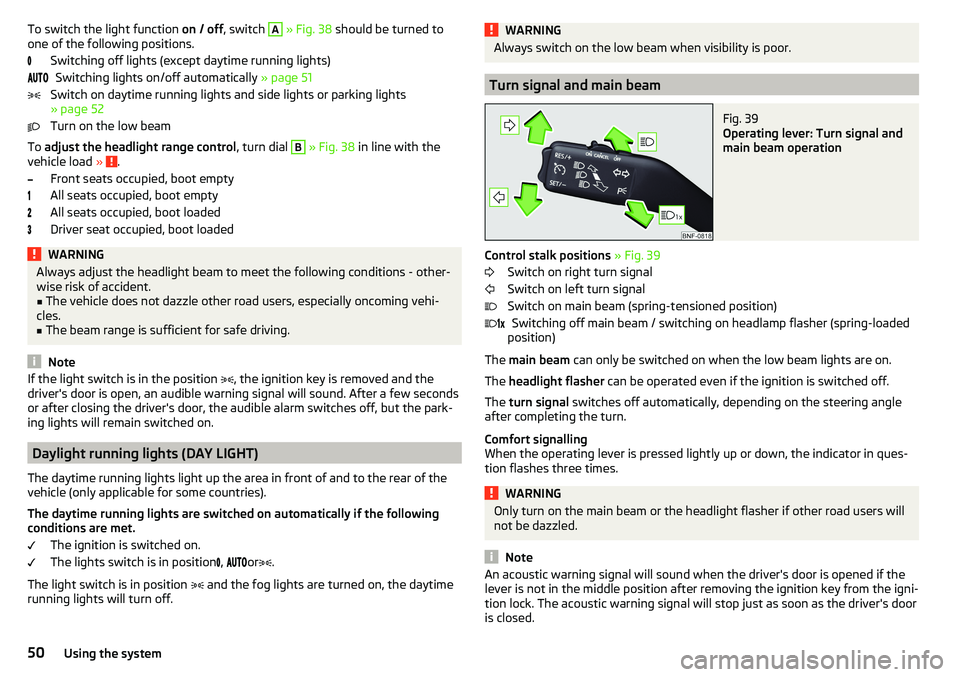
To switch the light function on / off, switch A » Fig. 38 should be turned to
one of the following positions.
Switching off lights (except daytime running lights)Switching lights on/off automatically » page 51
Switch on daytime running lights and side lights or parking lights
» page 52
Turn on the low beam
To adjust the headlight range control , turn dial B
» Fig. 38 in line with the
vehicle load » .
Front seats occupied, boot empty
All seats occupied, boot empty
All seats occupied, boot loaded
Driver seat occupied, boot loaded
WARNINGAlways adjust the headlight beam to meet the following conditions - other-
wise risk of accident.■
The vehicle does not dazzle other road users, especially oncoming vehi-
cles.
■
The beam range is sufficient for safe driving.
Note
If the light switch is in the position , the ignition key is removed and the
driver's door is open, an audible warning signal will sound. After a few seconds
or after closing the driver's door, the audible alarm switches off, but the park-
ing lights will remain switched on.
Daylight running lights (DAY LIGHT)
The daytime running lights light up the area in front of and to the rear of the
vehicle (only applicable for some countries).
The daytime running lights are switched on automatically if the following
conditions are met.
The ignition is switched on.
The lights switch is in position
,
or
.
The light switch is in position
and the fog lights are turned on, the daytime
running lights will turn off.
WARNINGAlways switch on the low beam when visibility is poor.
Turn signal and main beam
Fig. 39
Operating lever: Turn signal and
main beam operation
Control stalk positions » Fig. 39
Switch on right turn signal
Switch on left turn signal
Switch on main beam (spring-tensioned position) Switching off main beam / switching on headlamp flasher (spring-loaded
position)
The main beam can only be switched on when the low beam lights are on.
The headlight flasher can be operated even if the ignition is switched off.
The turn signal switches off automatically, depending on the steering angle
after completing the turn.
Comfort signalling
When the operating lever is pressed lightly up or down, the indicator in ques-
tion flashes three times.
WARNINGOnly turn on the main beam or the headlight flasher if other road users will
not be dazzled.
Note
An acoustic warning signal will sound when the driver's door is opened if the
lever is not in the middle position after removing the ignition key from the igni-
tion lock. The acoustic warning signal will stop just as soon as the driver's door
is closed. 50Using the system
Page 54 of 172
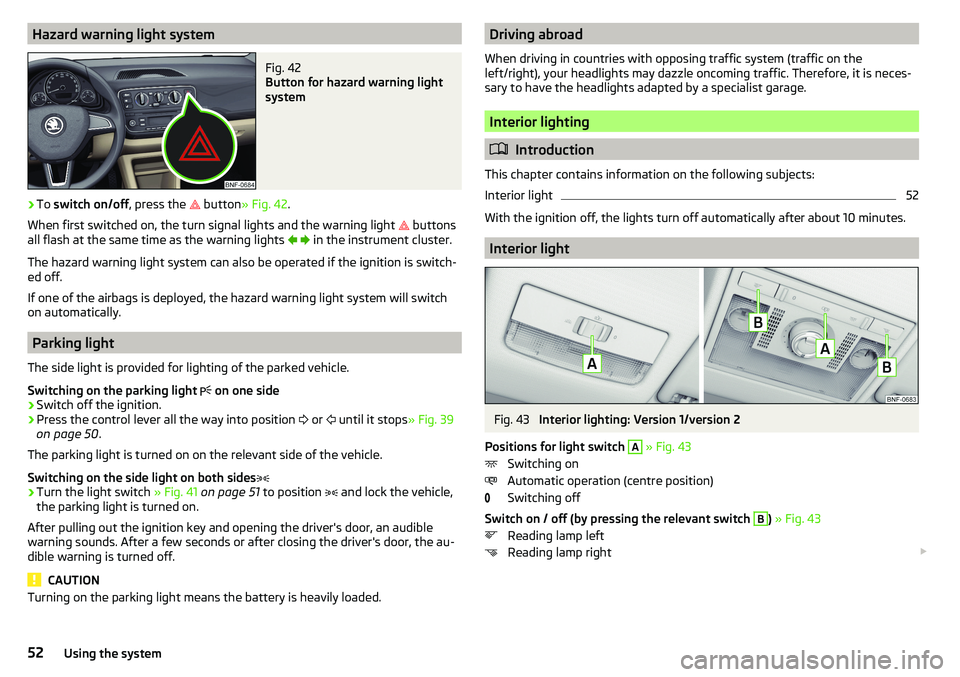
Hazard warning light systemFig. 42
Button for hazard warning light
system
›
To switch on/off , press the
button
» Fig. 42 .
When first switched on, the turn signal lights and the warning light buttons
all flash at the same time as the warning lights
in the instrument cluster.
The hazard warning light system can also be operated if the ignition is switch-
ed off.
If one of the airbags is deployed, the hazard warning light system will switch
on automatically.
Parking light
The side light is provided for lighting of the parked vehicle.
Switching on the parking light on one side
›
Switch off the ignition.
›
Press the control lever all the way into position
or
until it stops
» Fig. 39
on page 50 .
The parking light is turned on on the relevant side of the vehicle.
Switching on the side light on both sides
›
Turn the light switch » Fig. 41 on page 51 to position
and lock the vehicle,
the parking light is turned on.
After pulling out the ignition key and opening the driver's door, an audible
warning sounds. After a few seconds or after closing the driver's door, the au-
dible warning is turned off.
CAUTION
Turning on the parking light means the battery is heavily loaded.Driving abroad
When driving in countries with opposing traffic system (traffic on the
left/right), your headlights may dazzle oncoming traffic. Therefore, it is neces-
sary to have the headlights adapted by a specialist garage.
Interior lighting
Introduction
This chapter contains information on the following subjects:
Interior light
52
With the ignition off, the lights turn off automatically after about 10 minutes.
Interior light
Fig. 43
Interior lighting: Version 1/version 2
Positions for light switch
A
» Fig. 43
Switching on
Automatic operation (centre position)
Switching off
Switch on / off (by pressing the relevant switch
B
) » Fig. 43
Reading lamp left
Reading lamp right
52Using the system
Page 55 of 172
Automatic operation - position
The system is turned on when any of the following is present.
▶ The vehicle is unlocked.
▶ One of the doors is opened.
▶ The ignition key is removed.
The system is turned off when any of the following is present.
▶ The vehicle is locked.
▶ The ignition is switched on.
▶ About 30 seconds after all the doors have been closed.
Visibility
Introduction
This chapter contains information on the following subjects:
Rear window heater
53
Front sun visors
53WARNINGNo objects should be attached to the sun visor that could restrict the view
or endanger the vehicle occupants during sudden braking or in a collision.
Rear window heater
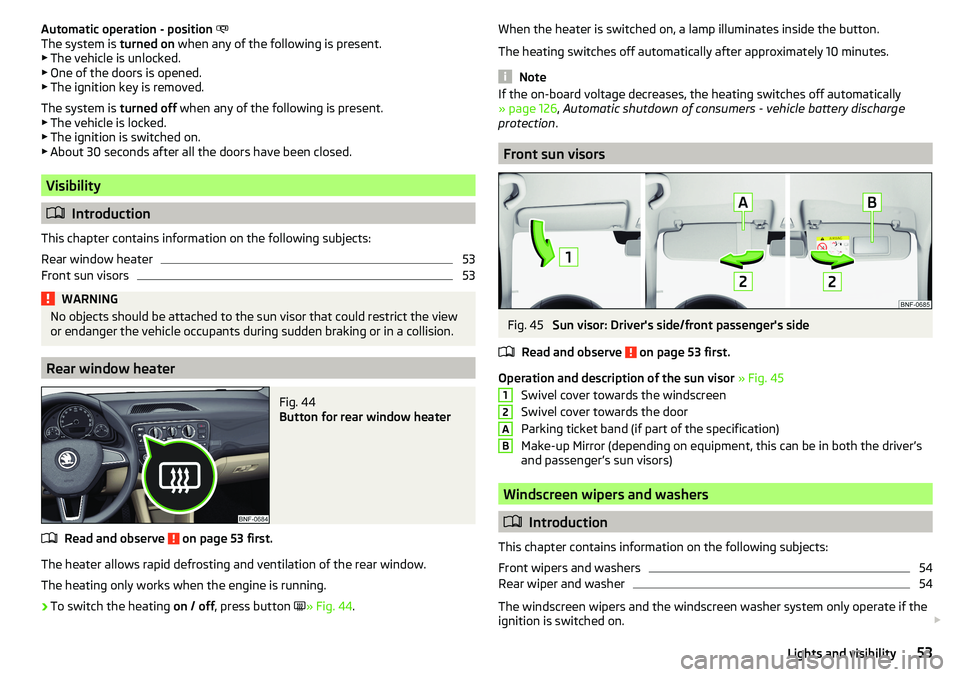
Fig. 44
Button for rear window heater
Read and observe on page 53 first.
The heater allows rapid defrosting and ventilation of the rear window.
The heating only works when the engine is running.
›
To switch the heating on / off, press button
» Fig. 44 .
When the heater is switched on, a lamp illuminates inside the button.
The heating switches off automatically after approximately 10 minutes.
Note
If the on-board voltage decreases, the heating switches off automatically
» page 126 , Automatic shutdown of consumers - vehicle battery discharge
protection .
Front sun visors
Fig. 45
Sun visor: Driver's side/front passenger's side
Read and observe
on page 53 first.
Operation and description of the sun visor » Fig. 45
Swivel cover towards the windscreen
Swivel cover towards the door
Parking ticket band (if part of the specification)
Make-up Mirror (depending on equipment, this can be in both the driver’s
and passenger’s sun visors)
Windscreen wipers and washers
Introduction
This chapter contains information on the following subjects:
Front wipers and washers
54
Rear wiper and washer
54
The windscreen wipers and the windscreen washer system only operate if the
ignition is switched on.
12AB53Lights and visibility
Page 57 of 172
Rear view mirror
Introduction
This chapter contains information on the following subjects:
Interior mirror dimming
55
Mirrors
55WARNINGExterior mirrors increase the field of view, however, they make objects ap-
pear smaller and further away. Therefore use the interior mirror whenever
possible, for assessing the distances to the vehicles following behind.
Interior mirror dimming
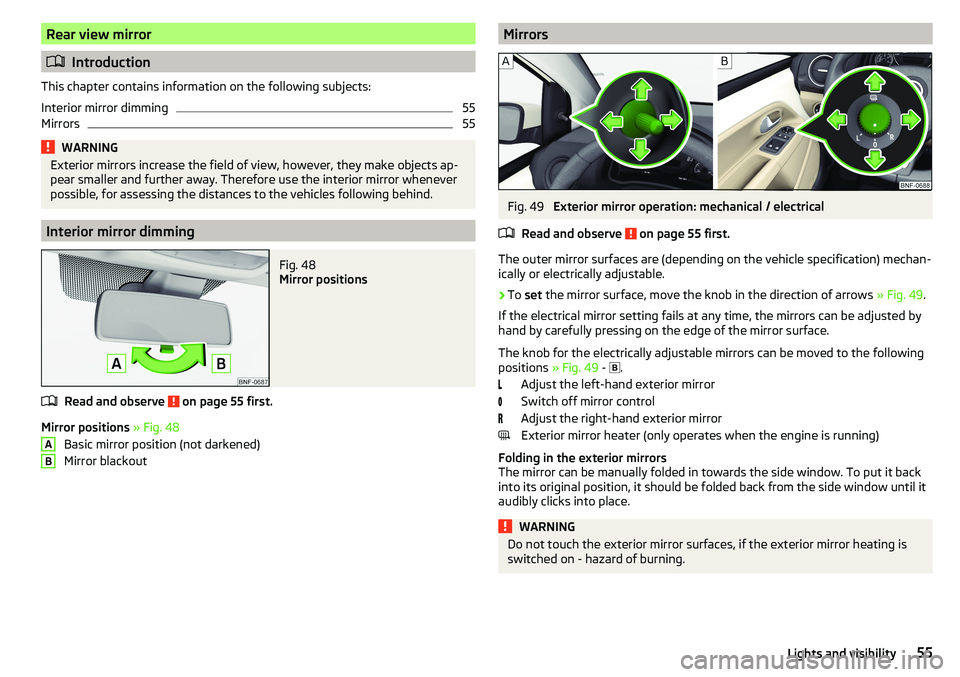
Fig. 48
Mirror positions
Read and observe on page 55 first.
Mirror positions » Fig. 48
Basic mirror position (not darkened)
Mirror blackout
ABMirrorsFig. 49
Exterior mirror operation: mechanical / electrical
Read and observe
on page 55 first.
The outer mirror surfaces are (depending on the vehicle specification) mechan-
ically or electrically adjustable.
›
To set the mirror surface, move the knob in the direction of arrows » Fig. 49.
If the electrical mirror setting fails at any time, the mirrors can be adjusted by
hand by carefully pressing on the edge of the mirror surface.
The knob for the electrically adjustable mirrors can be moved to the following
positions » Fig. 49 -
.
Adjust the left-hand exterior mirror
Switch off mirror control
Adjust the right-hand exterior mirror
Exterior mirror heater (only operates when the engine is running)
Folding in the exterior mirrors
The mirror can be manually folded in towards the side window. To put it back
into its original position, it should be folded back from the side window until it
audibly clicks into place.
WARNINGDo not touch the exterior mirror surfaces, if the exterior mirror heating is
switched on - hazard of burning.55Lights and visibility
Page 59 of 172
WARNING■If the seat backrest is folded, passengers may only be transported on the
outer seat behind the driver.■
The front passenger airbag should be switched off when transporting ob-
jects on the seat backrest that has been folded forwards » page 20.
■
Do not adjust the seat back while driving - danger of injury and accidents!
■
When moving the seat backrest, keep limbs out of the area between the
seat and seat backrest – risk of injury!
■
Never transport the following items on the seat backrest when folded
forwards. ■Objects that could restrict the driver's view.
■ Objects which make it impossible for the driver to control the vehicle
(e.g. if they roll under the pedals, or protrude into the driver's zone).
■ Objects which could lead to injury to passengers (e.g. if accelerating
sharply, braking or changing direction).
Rear seat backrests
Fig. 52
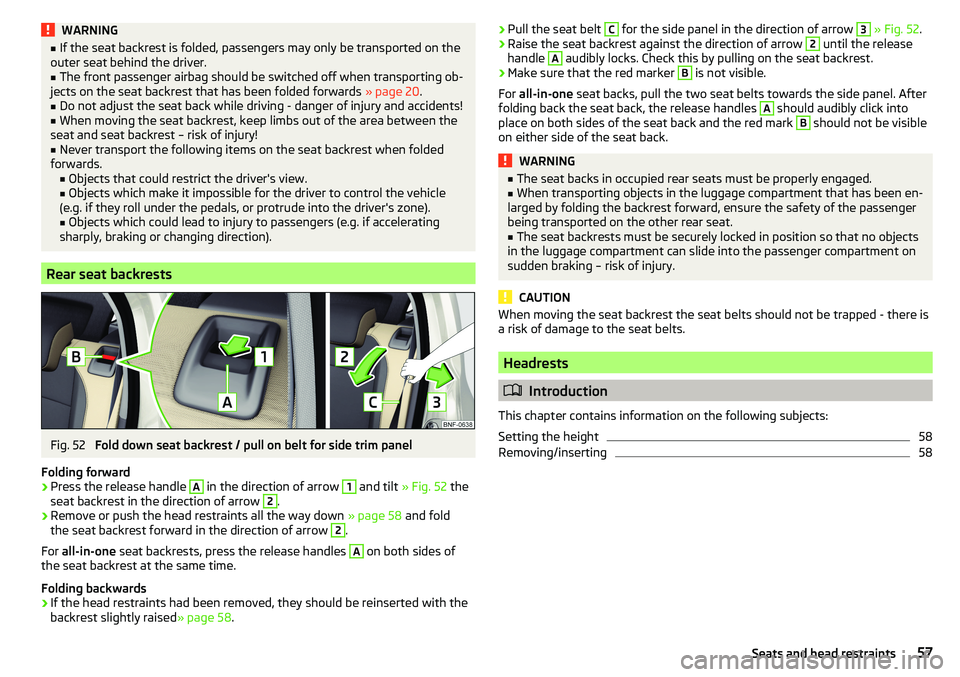
Fold down seat backrest / pull on belt for side trim panel
Folding forward
›
Press the release handle
A
in the direction of arrow
1
and tilt » Fig. 52 the
seat backrest in the direction of arrow
2
.
›
Remove or push the head restraints all the way down » page 58 and fold
the seat backrest forward in the direction of arrow
2
.
For all-in-one seat backrests, press the release handles
A
on both sides of
the seat backrest at the same time.
Folding backwards
›
If the head restraints had been removed, they should be reinserted with the
backrest slightly raised » page 58.
›Pull the seat belt C for the side panel in the direction of arrow 3
» Fig. 52 .›Raise the seat backrest against the direction of arrow 2 until the release
handle A
audibly locks. Check this by pulling on the seat backrest.
›
Make sure that the red marker
B
is not visible.
For all-in-one seat backs, pull the two seat belts towards the side panel. After
folding back the seat back, the release handles
A
should audibly click into
place on both sides of the seat back and the red mark
B
should not be visible
on either side of the seat back.
WARNING■ The seat backs in occupied rear seats must be properly engaged.■When transporting objects in the luggage compartment that has been en-
larged by folding the backrest forward, ensure the safety of the passenger
being transported on the other rear seat.■
The seat backrests must be securely locked in position so that no objects
in the luggage compartment can slide into the passenger compartment on
sudden braking – risk of injury.
CAUTION
When moving the seat backrest the seat belts should not be trapped - there is
a risk of damage to the seat belts.
Headrests
Introduction
This chapter contains information on the following subjects:
Setting the height
58
Removing/inserting
5857Seats and head restraints
Page 60 of 172
Setting the heightFig. 53
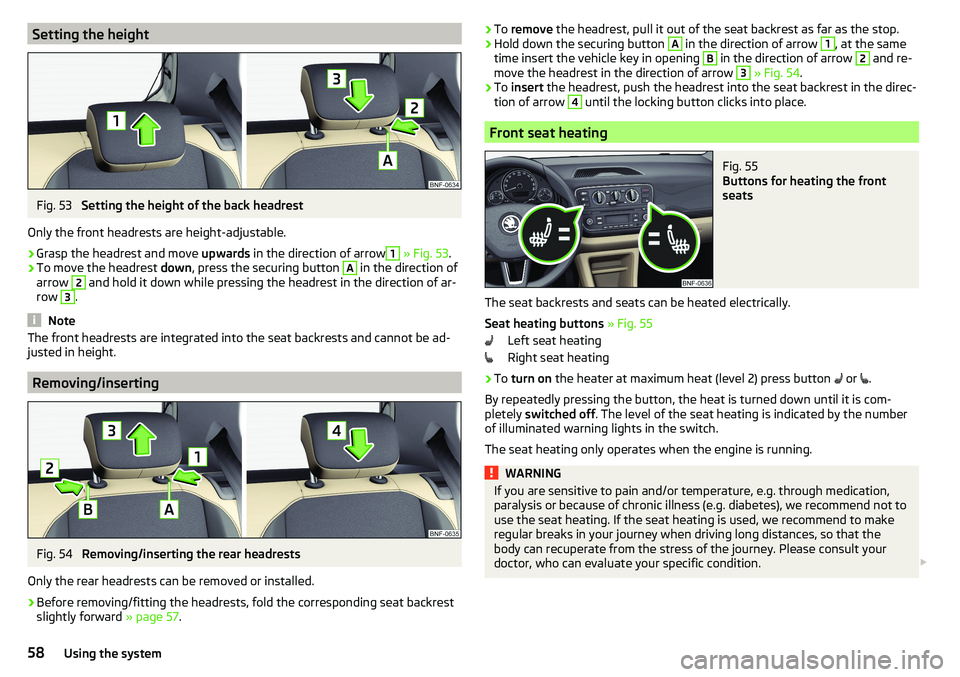
Setting the height of the back headrest
Only the front headrests are height-adjustable.
›
Grasp the headrest and move upwards in the direction of arrow
1
» Fig. 53 .
›
To move the headrest down, press the securing button
A
in the direction of
arrow
2
and hold it down while pressing the headrest in the direction of ar-
row
3
.
Note
The front headrests are integrated into the seat backrests and cannot be ad-
justed in height.
Removing/inserting
Fig. 54
Removing/inserting the rear headrests
Only the rear headrests can be removed or installed.
›
Before removing/fitting the headrests, fold the corresponding seat backrest slightly forward » page 57.
›To
remove the headrest, pull it out of the seat backrest as far as the stop.›Hold down the securing button A in the direction of arrow 1, at the same
time insert the vehicle key in opening B
in the direction of arrow
2
and re-
move the headrest in the direction of arrow
3
» Fig. 54 .
›
To insert the headrest, push the headrest into the seat backrest in the direc-
tion of arrow
4
until the locking button clicks into place.
Front seat heating
Fig. 55
Buttons for heating the front
seats
The seat backrests and seats can be heated electrically.
Seat heating buttons » Fig. 55
Left seat heating
Right seat heating
›
To turn on the heater at maximum heat (level 2) press button
or
.
By repeatedly pressing the button, the heat is turned down until it is com-
pletely switched off . The level of the seat heating is indicated by the number
of illuminated warning lights in the switch.
The seat heating only operates when the engine is running.
WARNINGIf you are sensitive to pain and/or temperature, e.g. through medication,
paralysis or because of chronic illness (e.g. diabetes), we recommend not to
use the seat heating. If the seat heating is used, we recommend to make
regular breaks in your journey when driving long distances, so that the
body can recuperate from the stress of the journey. Please consult your
doctor, who can evaluate your specific condition. 58Using the system
Page 61 of 172
CAUTIONThe following instructions should be observed to avoid damage to the seats.■Do not kneel on the seats or otherwise apply concentrated pressure to them.■
Do not switch on the heating for unoccupied seats.
■
Do not switch on the heating for seats which have objects on them (e.g. a
child seat, bag or similar).
■
Do not switch on the heating for seats which have seat covers or protective
covers on them.
Note
If the on-board voltage decreases, the seat heating switches off automatically
» page 126 , Automatic shutdown of consumers - vehicle battery discharge
protection .Useful features
Interior fittings
Introduction
This chapter contains information on the following subjects:
Ticket holder
60
Storage compartment on the driver's side
60
Stowage compartments in the doors
60
Storage compartments in the front centre console
61
Cup holders
61
Waste container
61
Cigarette lighter
62
Ashtray
62
12-volt socket
63
Multimedia holder
63
Storage compartment on the front passenger side - version 1
64
Storage compartment on the passenger side - version 2
64
Storage compartment for umbrella
64
Foldable hook
65
Clothes hook
65
Storage pockets on the inner sides of the front seats
65
Stowage compartments in front of the rear seats
66WARNING■ Do not place anything on the dash panel. These objects might slide or fall
down when driving and may distract you from concentrating on the traffic –
risk of accident!■
Make sure that while driving no objects can enter the driver's footwell -
they could cause an accident!
■
Do not carry any objects on the front passenger seat except objects de-
signed for this purpose (e.g. child seat) – risk of accident!
■
No objects should be placed in the storage compartments nor in the
drinks holders; the vehicle occupants could be endangered if there is sud-
den braking or the vehicle collides with something.
59Useful features
Page 64 of 172
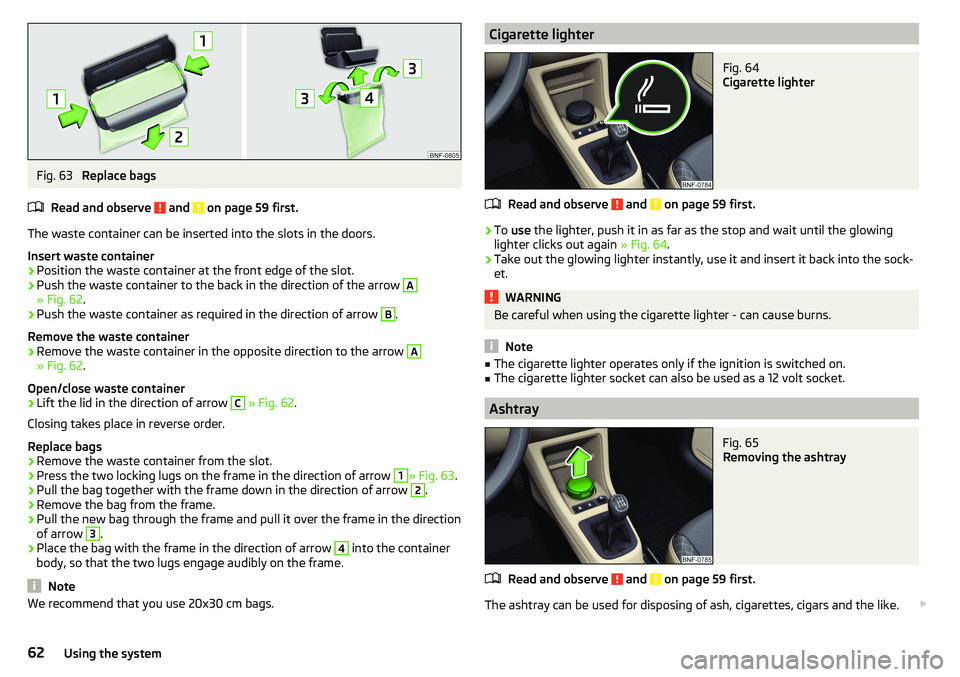
Fig. 63
Replace bags
Read and observe
and on page 59 first.
The waste container can be inserted into the slots in the doors.
Insert waste container
›
Position the waste container at the front edge of the slot.
›
Push the waste container to the back in the direction of the arrow
A
» Fig. 62 .
›
Push the waste container as required in the direction of arrow
B
.
Remove the waste container
›
Remove the waste container in the opposite direction to the arrow
A
» Fig. 62 .
Open/close waste container
›
Lift the lid in the direction of arrow
C
» Fig. 62 .
Closing takes place in reverse order.
Replace bags
›
Remove the waste container from the slot.
›
Press the two locking lugs on the frame in the direction of arrow
1
» Fig. 63 .
›
Pull the bag together with the frame down in the direction of arrow
2
.
›
Remove the bag from the frame.
›
Pull the new bag through the frame and pull it over the frame in the direction
of arrow
3
.
›
Place the bag with the frame in the direction of arrow
4
into the container
body, so that the two lugs engage audibly on the frame.
Note
We recommend that you use 20x30 cm bags.Cigarette lighterFig. 64
Cigarette lighter
Read and observe and on page 59 first.
›
To use the lighter, push it in as far as the stop and wait until the glowing
lighter clicks out again » Fig. 64.
›
Take out the glowing lighter instantly, use it and insert it back into the sock-
et.
WARNINGBe careful when using the cigarette lighter - can cause burns.
Note
■ The cigarette lighter operates only if the ignition is switched on.■The cigarette lighter socket can also be used as a 12 volt socket.
Ashtray
Fig. 65
Removing the ashtray
Read and observe and on page 59 first.
The ashtray can be used for disposing of ash, cigarettes, cigars and the like.
62Using the system
Page 67 of 172
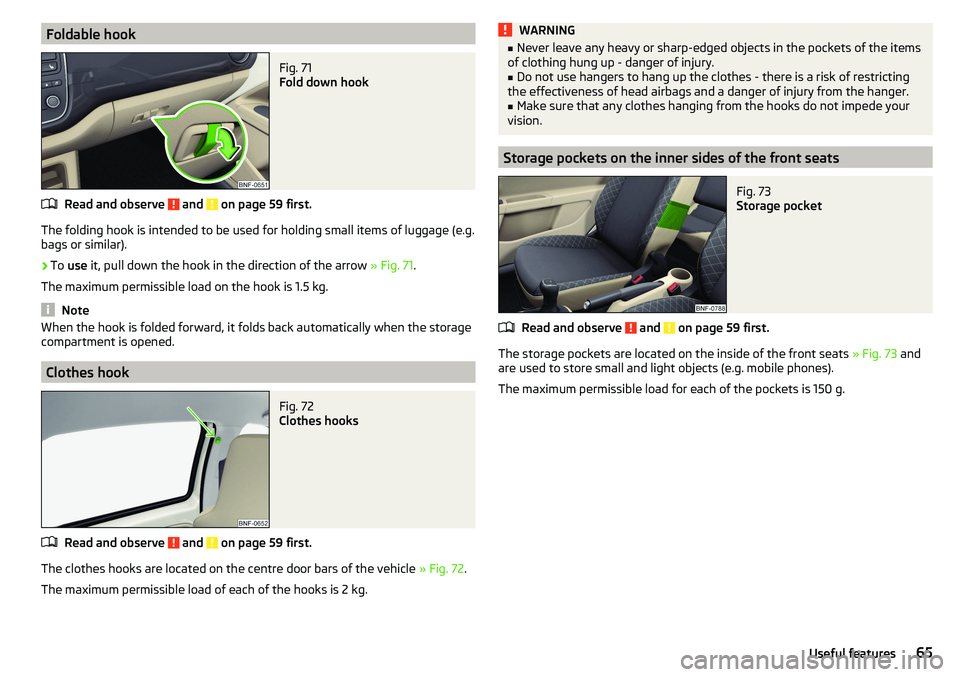
Foldable hookFig. 71
Fold down hook
Read and observe and on page 59 first.
The folding hook is intended to be used for holding small items of luggage (e.g.
bags or similar).
›
To use it, pull down the hook in the direction of the arrow » Fig. 71.
The maximum permissible load on the hook is 1.5 kg.
Note
When the hook is folded forward, it folds back automatically when the storage
compartment is opened.
Clothes hook
Fig. 72
Clothes hooks
Read and observe and on page 59 first.
The clothes hooks are located on the centre door bars of the vehicle » Fig. 72.
The maximum permissible load of each of the hooks is 2 kg.
WARNING■ Never leave any heavy or sharp-edged objects in the pockets of the items
of clothing hung up - danger of injury.■
Do not use hangers to hang up the clothes - there is a risk of restricting
the effectiveness of head airbags and a danger of injury from the hanger.
■
Make sure that any clothes hanging from the hooks do not impede your
vision.
Storage pockets on the inner sides of the front seats
Fig. 73
Storage pocket
Read and observe and on page 59 first.
The storage pockets are located on the inside of the front seats » Fig. 73 and
are used to store small and light objects (e.g. mobile phones).
The maximum permissible load for each of the pockets is 150 g.
65Useful features